CROSS-MATCHING
DR.MD.MIZANUR RAHMAN CHOWDHURY
SPECIALIST
TRANSFUSION MEDICINE
UNITED HOSPITAL LTD
INTRODUCTION
Cross-matching is one of the most important serological
procedure pertaining to blood group serology and is the
fundamental procedure responsible for safe blood
transfusion.
Basically Cross-matching is an antigen-antibody reaction,
a correct interpretation of which is the most essential
preliminary step in the practice of safe transfusion of
blood.
By cross-matching we are able to detect the atypical and
clinically significant antibody mostly IgM and IgG present
in recipient serum or in donor serum, also by autocontrol
we are able to detect auto-antibody in patient himself.
CONTINUE…
Cross match test is carried out to ensure that there are no
antibodies present in patients serum that will react with
donor cells when transfused.
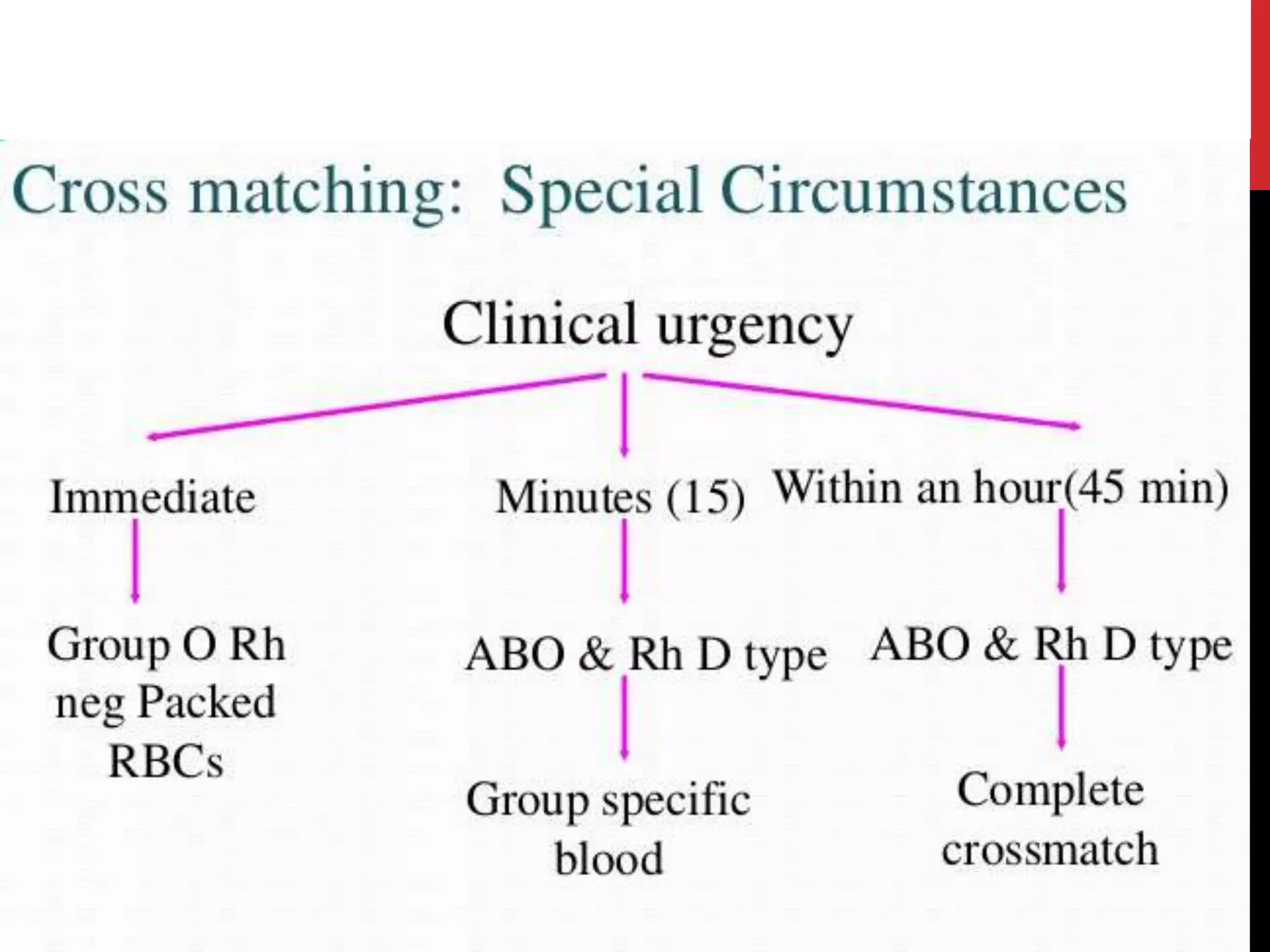
Unless there is an urgent need for blood, a cross-match
must be preformed for red cell transfusion.
FUNCTIONS OF CROSS-MATCH
It is final check of ABO compatibility between the donor
and patient.
It may detect the presence of an antibody in the patient’s
serum which will react with an antigen on donor red cells
To ensure that patient/ recipient is supplied with a
compitable unit of antigen negative blood.
To prevent hemolytic transfusion reaction.
To detect immunologic auto antigen and auto antibody,
and blood to be issued has to be processed accordingly.
All this done with sole aim for safe transfusion
of blood
CROSS MATCH TESTING PROCEDURES
HAD BEEN DIVIDED INTO TWO
PARTS…..
Major cross match
Minor cross
MAJOR CROSS MATCH
DONOR RED CELLS + PATIENT SERUM
MINOR CROSS MATCH
PATIENT CELLS + DONOR SERUM
PRINCIPLE OF CROSS MATCH
Major cross match is done to detect any serological
incompatibility b/w donor’s cells and patients serum.
Minor cross-match is done to detect any serological
incompatibility b/w patient cells and donor serum.
Cross-match is verified with a coombs reaction to detect
even the incomplete antibodies.
CROSS-MATCH TECHNIQUES
Immediate spin method
Saline room temperature technique
Indirect Antiglobulin technique
Albumin addition technique
IMMEDIATE SPIN
TECHNIQUE/SALINE ROOM
TEMPERATURE TECHNIQUE
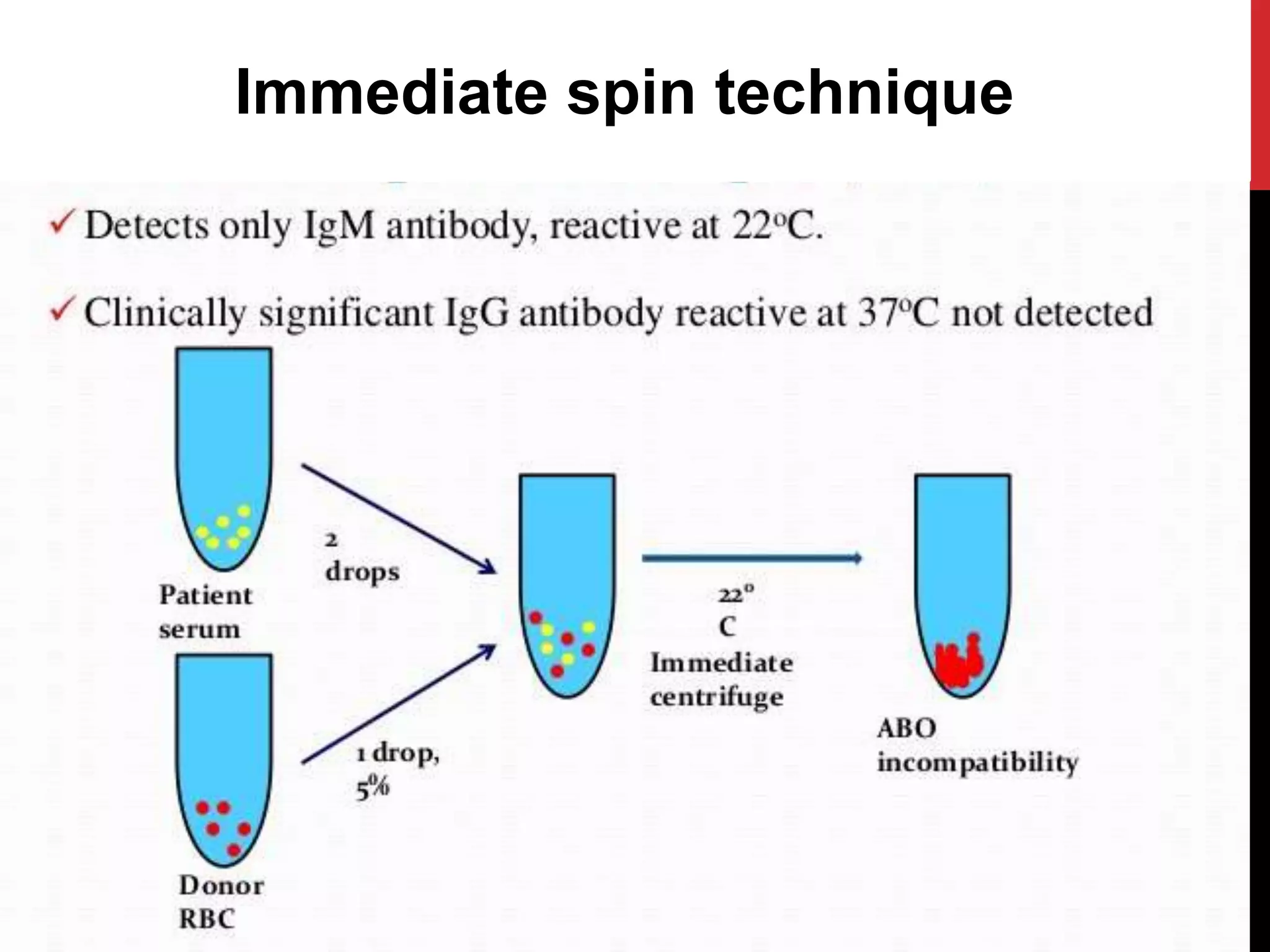
Immediate spin technique or saline room temperature
technique is enough to rule out any ABO grouping error.
But this technique is inadequate for identification of
clinically significant IgG type of antibodies.
Both these techniques are not good, because antibody
screening has not been carried out in our country.
PROCEDURE
label the tube as major/minor cross-match with donor
number & patient ID.
Using a micropipette add 1 volume of 2-5 % red cell
suspension to the labeled tube and 2 volume of serum to
the same tube.
Mix the tube well and centrifuge at 1000RPM for 1 min.
CONTINUE..
Gently shake and observe for agglutination or hemolysis
NO agglutination or hemolysis: Compatible
Agglutination or hemolysis seen : Incompatible
Immediate spin technique
INDIRECT ANTI GLOBULIN
TECHNIQUE (IAT)
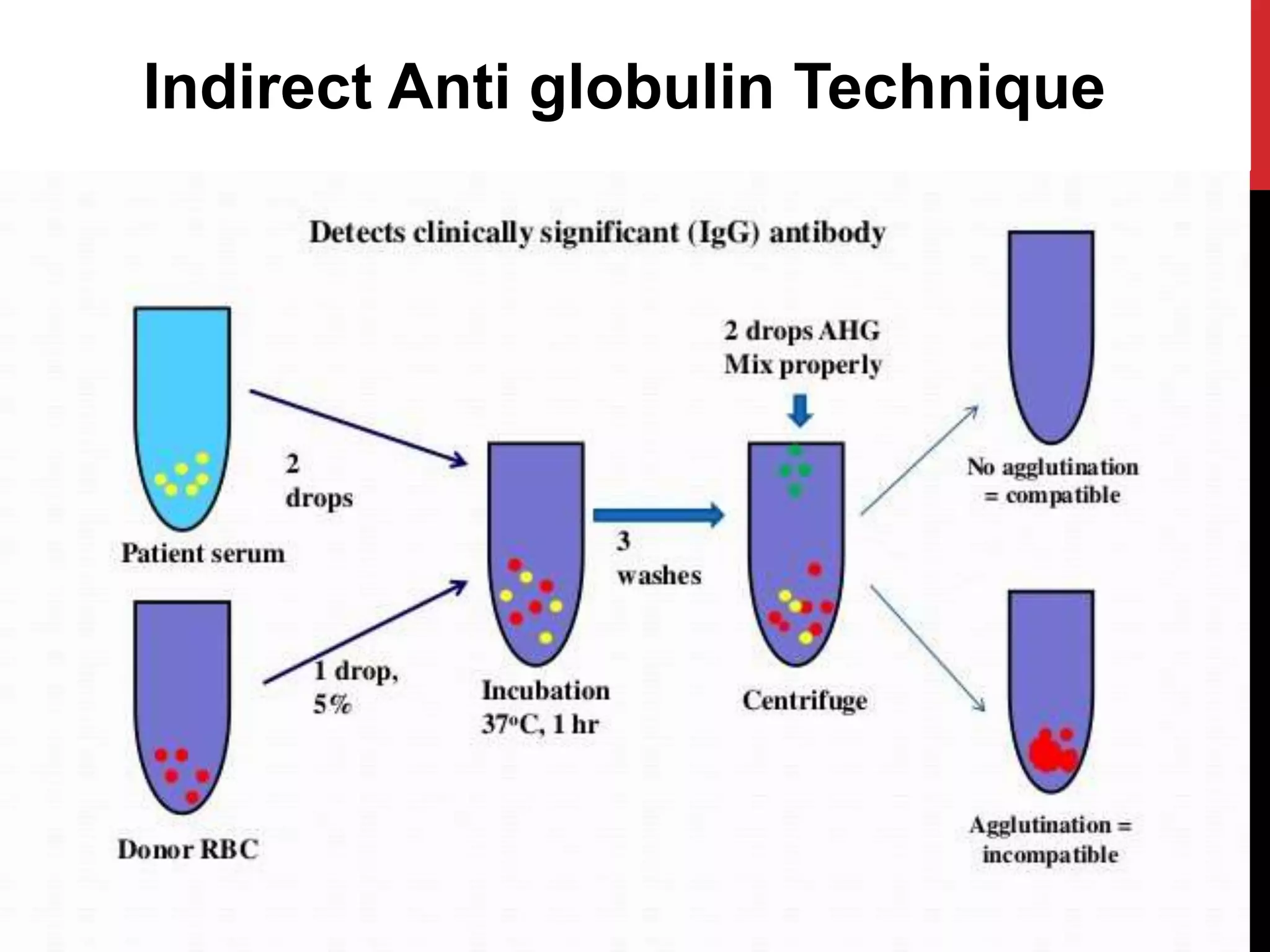
IAT test is widely used in cross matching as it detects
majority of incomplete antibodies.
PROCEDURE
Put 2 drops of serum in prelabelled test tube, & one drop
of 2 – 5% suspension of red cells
Incubate 45 to 60 min at 37°c
Gently shake and observe for agglutination or hemolysis
If test tube show any agglutination or hemolysis that
means incompatible at 37°C
CONTINUE…
If no agglutination or hemolysis present, wash the cells
three to four times with saline and decant the last wash
completely.
Add 2 drops of AHG reagent to the test tube
Gently shake and read the result immediately, if no
reaction, Wait for 5 min
Centrifuge at 1000rpm for 1 min
CONTINUE…
Shake gently and observe for agglutination or hemolysis
with optical aid
NO agglutination or hemolysis: Compatible
Agglutination or hemolysis seen : Incompatible
CONTINUE..
If the test is negative add one drop control IgG coated red
cells. Centrifuge again at 1000 rpm for 1 min
look for hemolysis or agglutination
if no agglutination or hemolysis, the test is invalid repeat
the procedure
INTERPRETATION
Haemolysis or agglutination at any stage of the test
procedure except after adding control IgG coated red cells
indicates incompatible
Indirect Anti globulin Technique
FACTORS AFFECTING IAT
Temperature ( 37°C)
Serum : Cell ratio
Incubation time
Suspending Medium
( sensitivity of IAT increased with addition of 22 % bovine
albumin , enzyme or LISS)
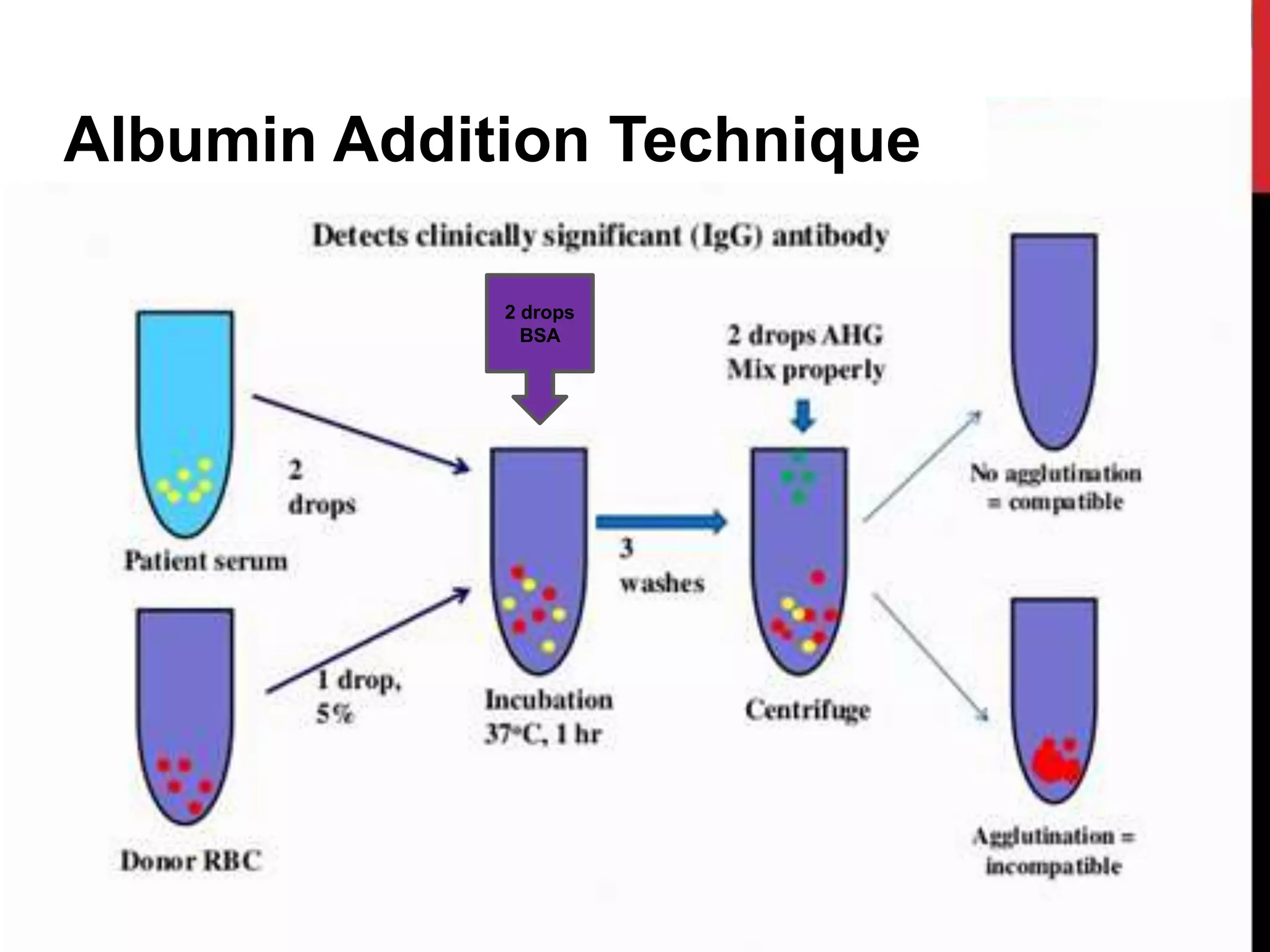
ALBUMIN ADDITION TECHNIQUE
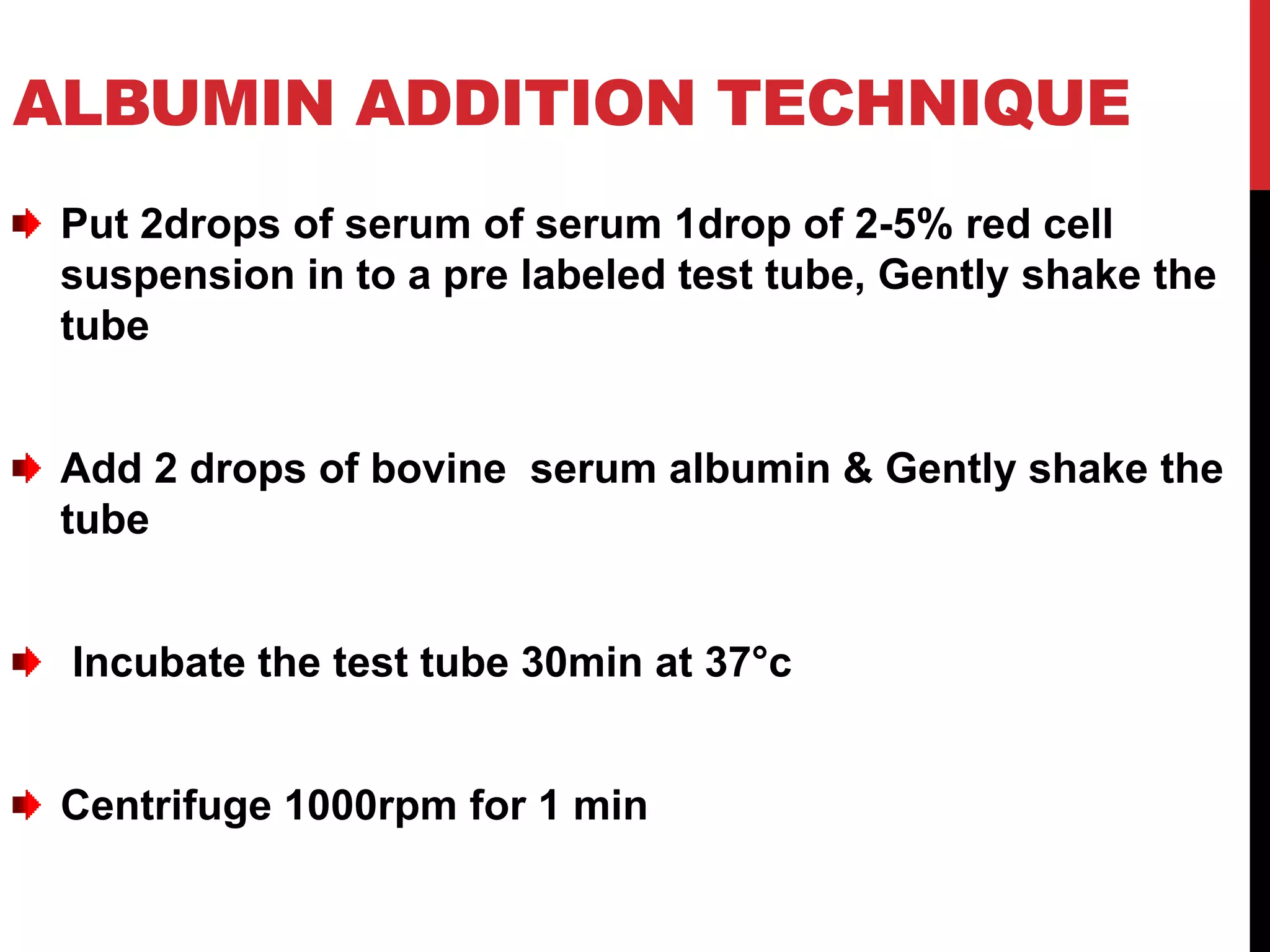
Put 2drops of serum of serum 1drop of 2-5% red cell
suspension in to a pre labeled test tube, Gently shake the
tube
Add 2 drops of bovine serum albumin & Gently shake the
tube
Incubate the test tube 30min at 37°c
Centrifuge 1000rpm for 1 min
CONTINUE…
Wash 3 times(minute amount of human protein can
neutralize AHG )ensure that the saline is completely
decanted after each wash
Add AHG 2 drops to the dry cell button
Gently shake and read the result immediately, if no
reaction, Wait for 5 min
Centrifuge at 1000rpm for 1 min
CONTINUE…
Shake gently and observe for agglutination or hemolysis
with optical aid
NO agglutination or hemolysis: Compatible
Agglutination or hemolysis seen : Incompatible
CONTINUE..
If the test is negative add one drop control IgG coated red
cells. Centrifuge again at 1000 rpm for 1 min
look for hemolysis or agglutination
if no agglutination or hemolysis, the test is invalid repeat
the procedure
2 drops
BSA
Albumin Addition Technique
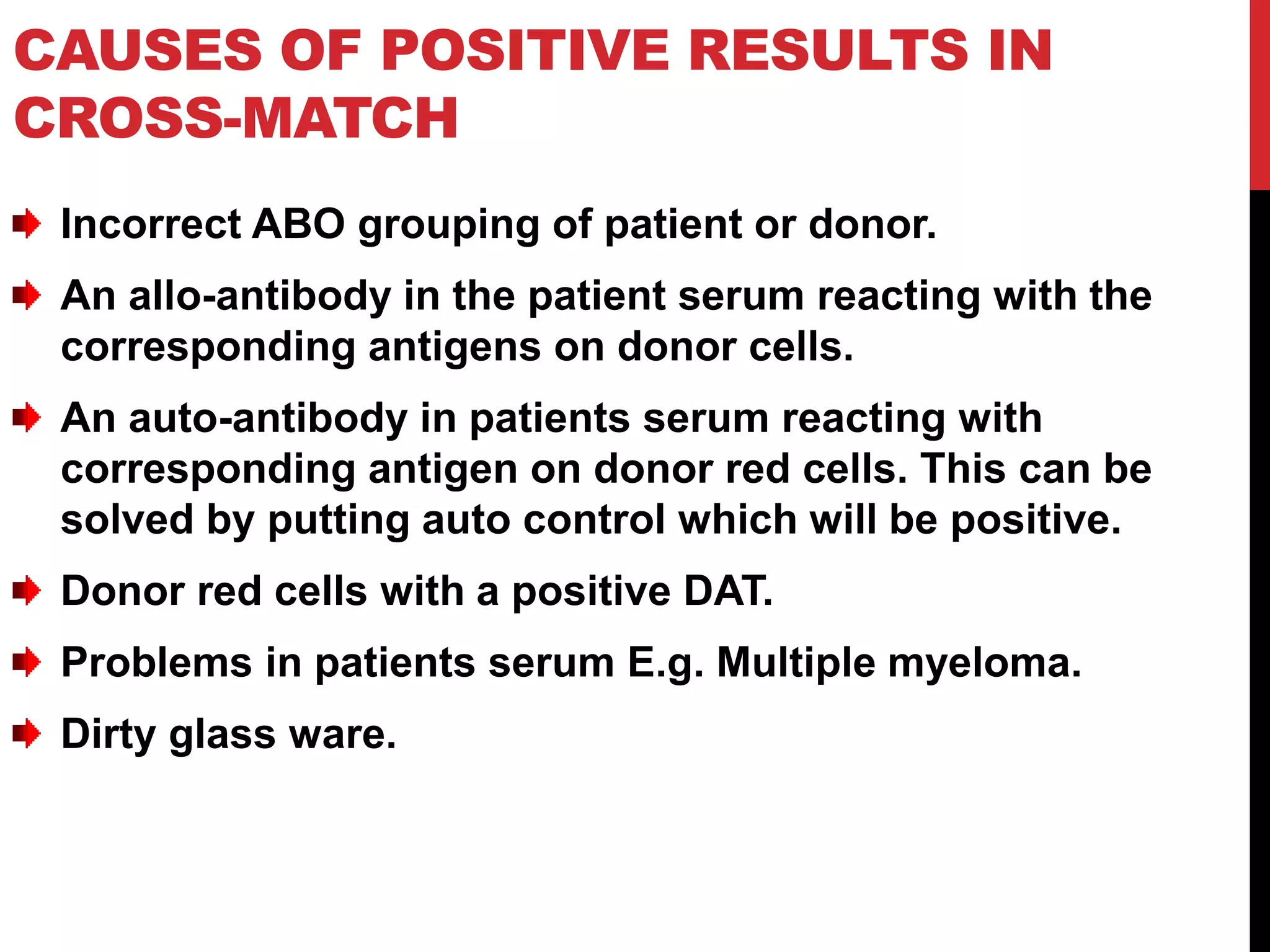
CAUSES OF POSITIVE RESULTS IN
CROSS-MATCH
Incorrect ABO grouping of patient or donor.
An allo-antibody in the patient serum reacting with the
corresponding antigens on donor cells.
An auto-antibody in patients serum reacting with
corresponding antigen on donor red cells. This can be
solved by putting auto control which will be positive.
Donor red cells with a positive DAT.
Problems in patients serum E.g. Multiple myeloma.
Dirty glass ware.
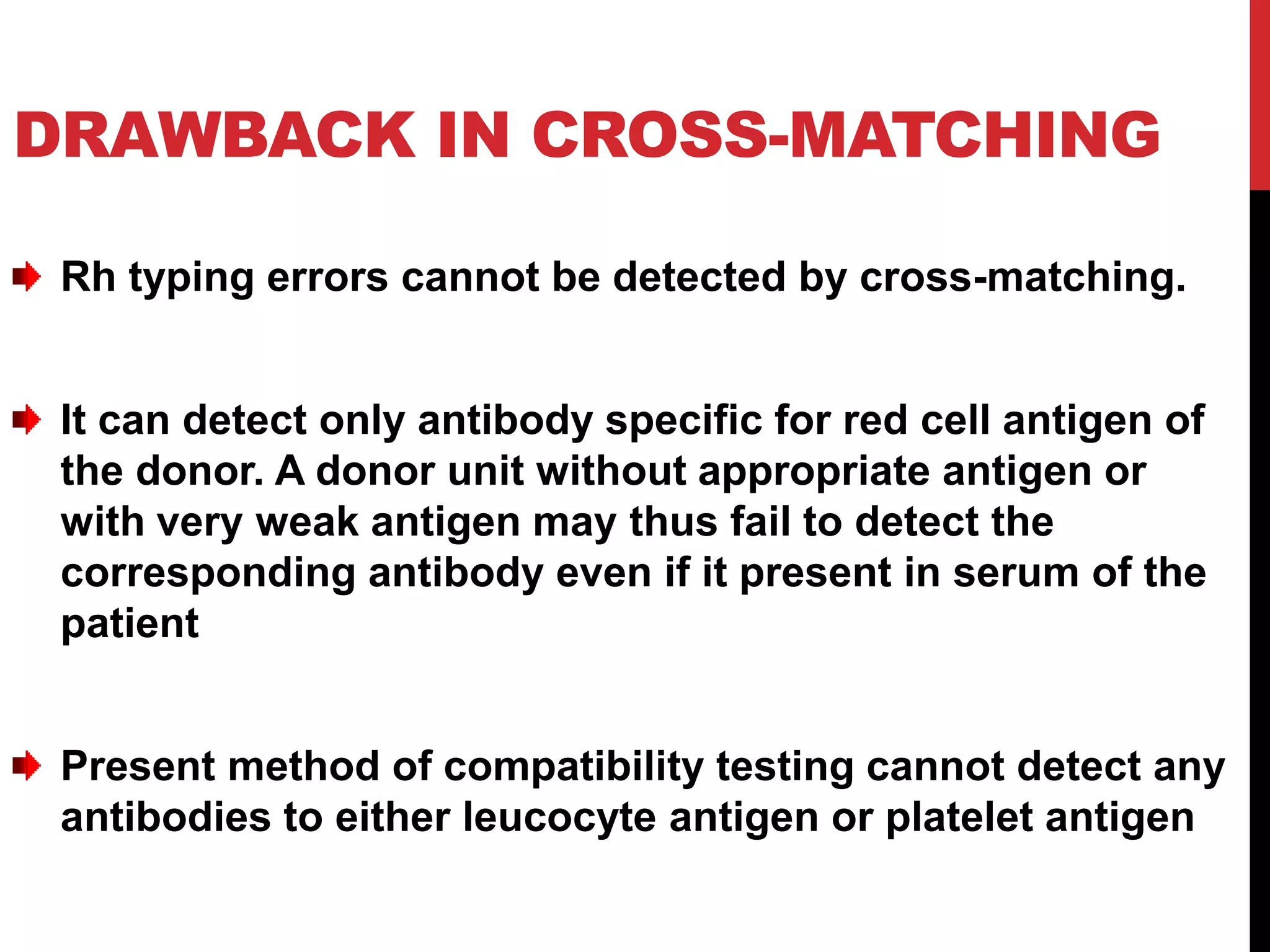
DRAWBACK IN CROSS-MATCHING
Rh typing errors cannot be detected by cross-matching.
It can detect only antibody specific for red cell antigen of
the donor. A donor unit without appropriate antigen or
with very weak antigen may thus fail to detect the
corresponding antibody even if it present in serum of the
patient
Present method of compatibility testing cannot detect any
antibodies to either leucocyte antigen or platelet antigen
Thank you

Crossmatching

  • 1.
  • 2.
    INTRODUCTION Cross-matching is oneof the most important serological procedure pertaining to blood group serology and is the fundamental procedure responsible for safe blood transfusion. Basically Cross-matching is an antigen-antibody reaction, a correct interpretation of which is the most essential preliminary step in the practice of safe transfusion of blood. By cross-matching we are able to detect the atypical and clinically significant antibody mostly IgM and IgG present in recipient serum or in donor serum, also by autocontrol we are able to detect auto-antibody in patient himself.
  • 3.
    CONTINUE… Cross match testis carried out to ensure that there are no antibodies present in patients serum that will react with donor cells when transfused. Unless there is an urgent need for blood, a cross-match must be preformed for red cell transfusion.
  • 4.
    FUNCTIONS OF CROSS-MATCH Itis final check of ABO compatibility between the donor and patient. It may detect the presence of an antibody in the patient’s serum which will react with an antigen on donor red cells To ensure that patient/ recipient is supplied with a compitable unit of antigen negative blood. To prevent hemolytic transfusion reaction. To detect immunologic auto antigen and auto antibody, and blood to be issued has to be processed accordingly. All this done with sole aim for safe transfusion of blood
  • 5.
    CROSS MATCH TESTINGPROCEDURES HAD BEEN DIVIDED INTO TWO PARTS….. Major cross match Minor cross
  • 6.
    MAJOR CROSS MATCH DONORRED CELLS + PATIENT SERUM
  • 7.
    MINOR CROSS MATCH PATIENTCELLS + DONOR SERUM
  • 8.
    PRINCIPLE OF CROSSMATCH Major cross match is done to detect any serological incompatibility b/w donor’s cells and patients serum. Minor cross-match is done to detect any serological incompatibility b/w patient cells and donor serum. Cross-match is verified with a coombs reaction to detect even the incomplete antibodies.
  • 9.
    CROSS-MATCH TECHNIQUES Immediate spinmethod Saline room temperature technique Indirect Antiglobulin technique Albumin addition technique
  • 10.
    IMMEDIATE SPIN TECHNIQUE/SALINE ROOM TEMPERATURETECHNIQUE Immediate spin technique or saline room temperature technique is enough to rule out any ABO grouping error. But this technique is inadequate for identification of clinically significant IgG type of antibodies. Both these techniques are not good, because antibody screening has not been carried out in our country.
  • 11.
    PROCEDURE label the tubeas major/minor cross-match with donor number & patient ID. Using a micropipette add 1 volume of 2-5 % red cell suspension to the labeled tube and 2 volume of serum to the same tube. Mix the tube well and centrifuge at 1000RPM for 1 min.
  • 12.
    CONTINUE.. Gently shake andobserve for agglutination or hemolysis NO agglutination or hemolysis: Compatible Agglutination or hemolysis seen : Incompatible
  • 13.
  • 14.
    INDIRECT ANTI GLOBULIN TECHNIQUE(IAT) IAT test is widely used in cross matching as it detects majority of incomplete antibodies.
  • 15.
    PROCEDURE Put 2 dropsof serum in prelabelled test tube, & one drop of 2 – 5% suspension of red cells Incubate 45 to 60 min at 37°c Gently shake and observe for agglutination or hemolysis If test tube show any agglutination or hemolysis that means incompatible at 37°C
  • 16.
    CONTINUE… If no agglutinationor hemolysis present, wash the cells three to four times with saline and decant the last wash completely. Add 2 drops of AHG reagent to the test tube Gently shake and read the result immediately, if no reaction, Wait for 5 min Centrifuge at 1000rpm for 1 min
  • 17.
    CONTINUE… Shake gently andobserve for agglutination or hemolysis with optical aid NO agglutination or hemolysis: Compatible Agglutination or hemolysis seen : Incompatible
  • 18.
    CONTINUE.. If the testis negative add one drop control IgG coated red cells. Centrifuge again at 1000 rpm for 1 min look for hemolysis or agglutination if no agglutination or hemolysis, the test is invalid repeat the procedure
  • 19.
    INTERPRETATION Haemolysis or agglutinationat any stage of the test procedure except after adding control IgG coated red cells indicates incompatible
  • 20.
  • 21.
    FACTORS AFFECTING IAT Temperature( 37°C) Serum : Cell ratio Incubation time Suspending Medium ( sensitivity of IAT increased with addition of 22 % bovine albumin , enzyme or LISS)
  • 22.
    ALBUMIN ADDITION TECHNIQUE Put2drops of serum of serum 1drop of 2-5% red cell suspension in to a pre labeled test tube, Gently shake the tube Add 2 drops of bovine serum albumin & Gently shake the tube Incubate the test tube 30min at 37°c Centrifuge 1000rpm for 1 min
  • 23.
    CONTINUE… Wash 3 times(minuteamount of human protein can neutralize AHG )ensure that the saline is completely decanted after each wash Add AHG 2 drops to the dry cell button Gently shake and read the result immediately, if no reaction, Wait for 5 min Centrifuge at 1000rpm for 1 min
  • 24.
    CONTINUE… Shake gently andobserve for agglutination or hemolysis with optical aid NO agglutination or hemolysis: Compatible Agglutination or hemolysis seen : Incompatible
  • 25.
    CONTINUE.. If the testis negative add one drop control IgG coated red cells. Centrifuge again at 1000 rpm for 1 min look for hemolysis or agglutination if no agglutination or hemolysis, the test is invalid repeat the procedure
  • 26.
  • 28.
    CAUSES OF POSITIVERESULTS IN CROSS-MATCH Incorrect ABO grouping of patient or donor. An allo-antibody in the patient serum reacting with the corresponding antigens on donor cells. An auto-antibody in patients serum reacting with corresponding antigen on donor red cells. This can be solved by putting auto control which will be positive. Donor red cells with a positive DAT. Problems in patients serum E.g. Multiple myeloma. Dirty glass ware.
  • 29.
    DRAWBACK IN CROSS-MATCHING Rhtyping errors cannot be detected by cross-matching. It can detect only antibody specific for red cell antigen of the donor. A donor unit without appropriate antigen or with very weak antigen may thus fail to detect the corresponding antibody even if it present in serum of the patient Present method of compatibility testing cannot detect any antibodies to either leucocyte antigen or platelet antigen
  • 30.