Course Title: Advance Course on Educational Research
Course Code: 3706
By
TAMOOR ZULFIQUAR
11/20/15 1
1. Experimental Research
2.Experimental Research Designs
• True Experimental Designs
▫ Pretest-Posttest Control Group
▫ Posttest Only Control Group
▫ Solomon Four-Group
• Quasi-experimental Designs
▫ Time Series
▫ Nonequivalent Control Group Design
▫ Counterbalanced Design
• Pre-experimental Designs
▫ The One Shot Case Study
▫ One-Group Pretest/Posttest
▫ Static-Group comparison
11/20/15
2
• Experimental is most scientifically sophisticated
research method which is defined as
‘observation under controlled conditions’.
• Experimental research design are concerned
with examination of the effect of independent
variable on the dependent variable, where the
independent variable is manipulated through
treatment or intervention(s), & the effect of
those interventions is observed on the
dependant variable (Patidar, J., 2007).
11/20/15
3
Source: www.drjayeshpatidar.blogspot.com
• True Experimental Designs
• Quasi-experimental Designs
• Pre-experimental Designs
11/20/15
4
• Pretest-Posttest Control Group
• Posttest Only Control Group
• Solomon Four-Group
11/20/15
5
Experimental designs are considered true
experiments when they employ randomization
in the selection of their samples and control for
extraneous influences of variation on the
dependent variable (Cook, T.D. & Campbell, D., 1990).
Source: http://www.rbtaylor.net/rmcj_266_291.pdf
Source: http://www.socialresearchmethods.net/kb/intval.php
11/20/15
6
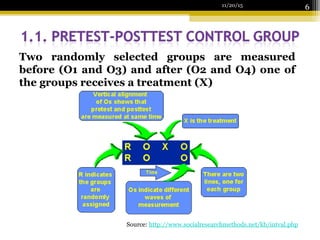
Two randomly selected groups are measured
before (O1 and O3) and after (O2 and O4) one of
the groups receives a treatment (X)
11/20/15
7
Source: http://www.socialresearchmethods.net/kb/intval.php
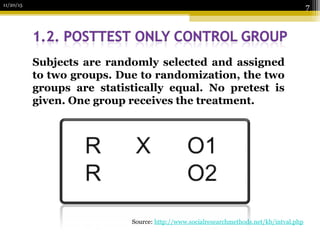
Subjects are randomly selected and assigned
to two groups. Due to randomization, the two
groups are statistically equal. No pretest is
given. One group receives the treatment.
11/20/15
8
Source: http://www.itdl.org/journal/mar_08/article04.htm
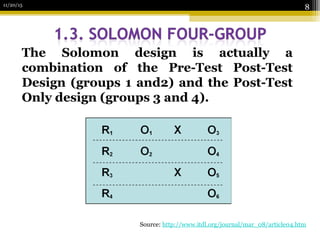
The Solomon design is actually a
combination of the Pre-Test Post-Test
Design (groups 1 and2) and the Post-Test
Only design (groups 3 and 4).
11/20/15
9
Source: http://www.slideshare.net/cadella49/observation-test-marketing
Quasi-experimental designs are used when
true experiments cannot be done. Several
designs have been developed for these
situations that are “almost true
experiments,” or quasi-experimental
designs (Ward, S. 2002). Most common types
are:
• Time Series
• Nonequivalent Control Group Design
• Counterbalanced Design
11/20/15
10
Source: http://www.socialresearchmethods.net/kb/intval.php
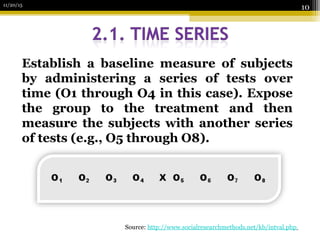
Establish a baseline measure of subjects
by administering a series of tests over
time (O1 through O4 in this case). Expose
the group to the treatment and then
measure the subjects with another series
of tests (e.g., O5 through O8).
11/20/15
11
Source: http://www.itdl.org/journal/mar_08/article04.htm
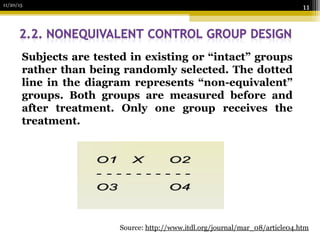
Subjects are tested in existing or “intact” groups
rather than being randomly selected. The dotted
line in the diagram represents “non-equivalent”
groups. Both groups are measured before and
after treatment. Only one group receives the
treatment.
11/20/15
12
Source: http://www.slideshare.net/uroojshafqat/experimental-research-11401013
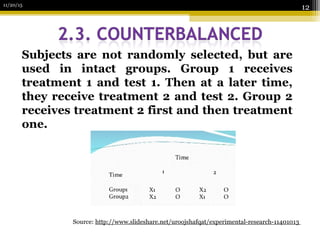
Subjects are not randomly selected, but are
used in intact groups. Group 1 receives
treatment 1 and test 1. Then at a later time,
they receive treatment 2 and test 2. Group 2
receives treatment 2 first and then treatment
one.
11/20/15
13
Source: http://www.itdl.org/journal/mar_08/article04.htm
Pre-experimental designs should not be
considered true experiments, and are not
appropriate for formal research. Data collected
with these designs is highly suspect. We will
consider the One Shot Case Study design, the One
Group Pretest Posttest design, and the Static
Group comparison design (James, E., 2008).
▫ The One Shot Case Study
▫ One-Group Pretest/Posttest
▫ Static-Group comparison
11/20/15
14
Source: http://www.slideshare.net/triggerjps/experimental-research-26640946
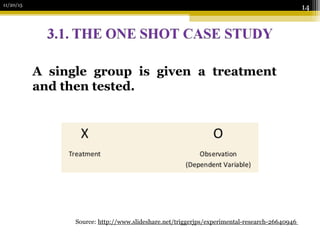
A single group is given a treatment
and then tested.
11/20/15
15
Source: https://www.urbanreproductivehealth.org/toolkits/measuring-success/types-evaluation-designs
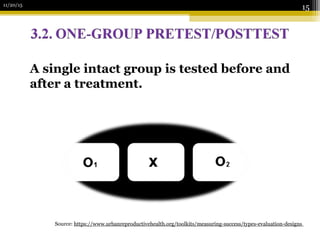
A single intact group is tested before and
after a treatment.
11/20/15
16
Source: http://www.education.com/reference/article/quasiexperimental-research/
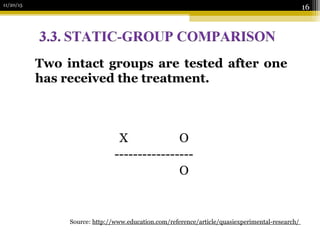
Two intact groups are tested after one
has received the treatment.
X O
-----------------
O
11/20/15
17
• Borg, W. R., & Gall, M. D. (1999). Educational research:
An introduction. New York: Longman.
• Campbell, D., & J. Stanley. (1993). Experimental and
quasi-experimental Designs. Chicago: Rand McNally.
• Gribbons, B., & Herman, J. (1997) True and quasi-
experimental designs. Washington, DC: ERIC
Clearinghouse on Assessment and Evaluation.
• Kidder, L. H. (1981). Research methods in social
sciences. Fort Worth, TX: Holt, Rinehart & Winston.
Experimental research designs

Experimental research designs