This document discusses experimental and quasi-experimental research methods. Experimental research methods aim to test the effect of a treatment in uncontrolled conditions and allow strict control of variables. Quasi-experimental designs involve selecting groups to test a variable without random assignment and cannot fully control external factors. Both methods are useful in social sciences where random assignment is difficult. Experimental research advantages include control over external factors, while disadvantages include potential lack of randomization. Quasi-experiments reduce time/resources compared to experiments but cannot account for pre-existing influences as well.
Introduction to Experimental and Quasi-experimental research by the authors Diah Nesti Kristanti, Nova Isnawati, and Vivin Quaratul ‘Aini.
Experimental research investigates treatment effects in uncontrolled settings. Quasi-experimental design uses groups with no random selection, yet has a control group.
In physics, experimental designs can control variables. An example is studying sea water's impact on metal corrosion.
Experimental research considers null and alternative hypotheses, exemplifying effects on pupil's retention through moving pictures.
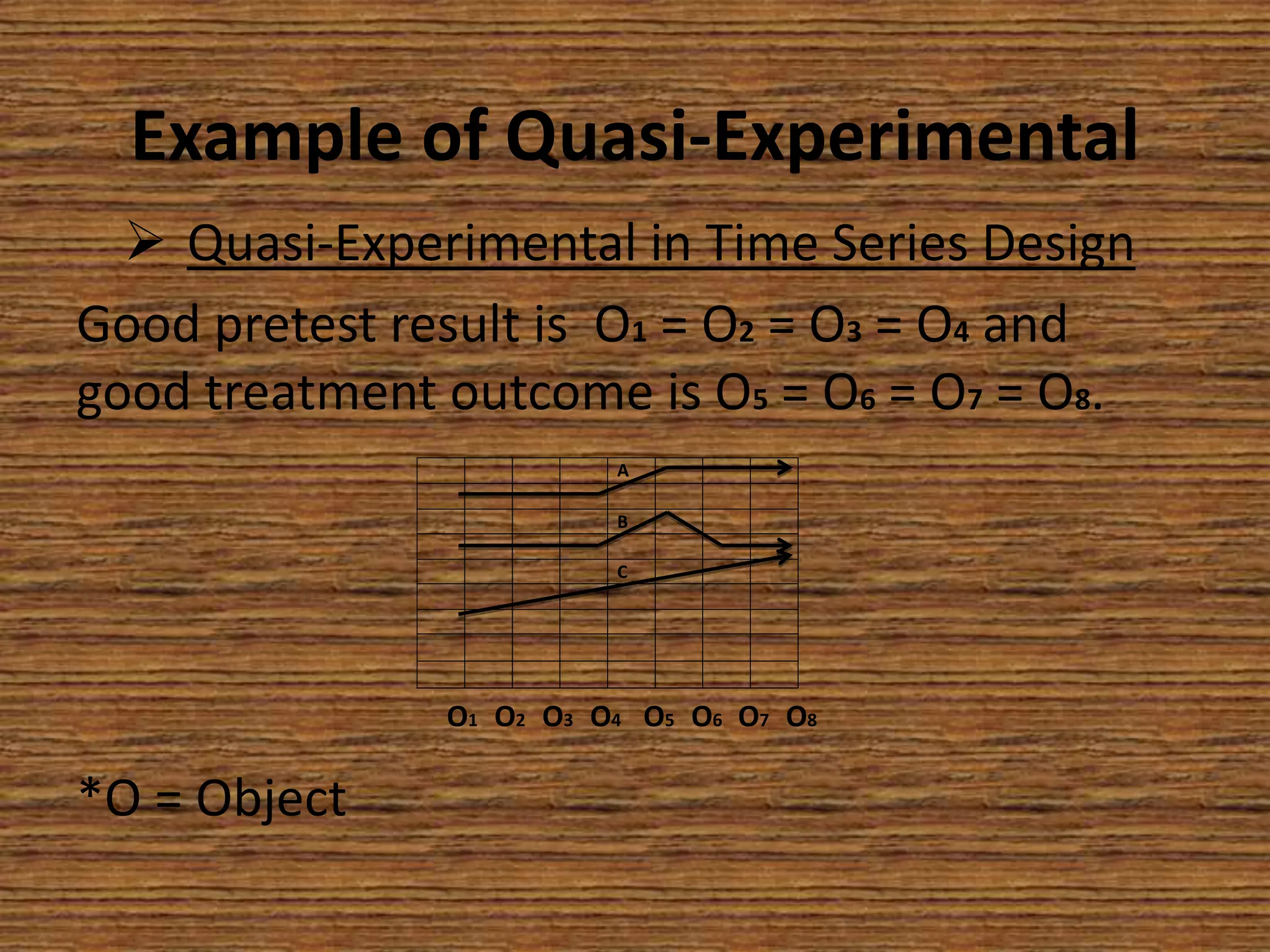
Illustration of a quasi-experimental time series design, showing treatment outcomes with multiple observations.
Charts compare results of quasi-experimental treatments, analyzing stability and effectiveness of interventions.
Experimental research allows control of external factors, enhancing validity, especially vital in social sciences.
Quasi-experimental designs facilitate case studies and require less time and resources than full experimentation.
Challenges in experimental research include meaningless statistical tests due to lack of randomization and unaccounted pre-existing factors.
Despite drawbacks, quasi-experimental designs are powerful tools for studying effects where true experiments are impractical.
Reiteration that experimental methods seek treatment effects in uncontrolled settings, exemplified through physics research.
Conclusion slides thanking the audience for their attention.
Experimental and QuasiexperimentalResearch
Created by :
Diah Nesti Kristanti (09321066)
Nova Isnawati
(09321197)
Vivin Quaratul ‘Aini (09321311)
2.
Definition
1. Experimental researchmethods can be
interpreted as a method of research used to
search for a specific treatment effect on others
in uncontrolled conditions.
2. Quasi-experimental design involves selecting
groups, upon which a variable is tested,
without any random pre-selection processes.
This design has a control group, but it can not
be fully functional to control the external
variables that affect the implementation of the
experiment.
3.
Example of ExperimentalResearch
In the field of physics, these studies can use
experimental design, because these variables
can affect the process of experimentation that
can be strictly controlled.
For example : the influence of sea water on the
corrosion of certain metals. It can also be done
through research with experimental design,
because it can be carefully controlled
conditions.
4.
In experimental research,we traditionally look at
two distinct types of hypotheses. They are the
null hypothesis and the alternative hypothesis.
• Null hypothesis (H0): adding moving pictures will
not improve pupils’ retention of the content.
• Alternative hypothesis (H1): adding moving
pictures will improve pupils’ retention of the
content.
•
5.
Example of Quasi-Experimental
Quasi-Experimental in Time Series Design
Good pretest result is O1 = O2 = O3 = O4 and
good treatment outcome is O5 = O6 = O7 = O8.
A
B
C
O1 O2 O3 O4 O5 O6 O7 O8
*O = Object
6.
The best resultsare shown in chart A. Pretest
results showing the stable and consistent state of
the group (O1 = O2 = O3 = O4) after being given
treatment, the situation improved consistently (O5
= O6 = O7 = O8).
Graph B shows has treatment effect in the
experimental group, but after it returned to its
original position. So the treatment effect only as an
example: at the time of the seminar, the
knowledge and skills increase, but after returning
to class abilities back to normal. Graph C shows
the outside influences contribute more than the
treatment effect, so the graph is rising steadily.
Graph D shows the unstable state of the group.
7.
advantages of experimentalresearch
• The main advantage of experimental research
is the control over external factors mentioned
several times in the previous section.
• Especially in social sciences, where preselection and randomization of groups is often
difficult, they can be very useful in
generating results for general trends.
8.
Advantages of Quasi-experimental
designs
•Quasi-experimental design is often integrated
with individual case studies; the figures and
results generated often reinforce the findings
in a case study, and allow some sort of
statistical analysis to take place.
• In addition, without extensive pre-screening
and randomization needing to be undertaken,
they do reduce the time and resources
needed for experimentation.
9.
Disadvantages of experimental
research
•Without proper randomization, statistical tests
can be meaningless. For example, these
experimental designs do not take into account
any pre-existing factors (as for the mothers:
what made them drink or not drink alcohol),
or recognize that influences outside the
experiment may have affected the results.
10.
Disadvantages of quasi-experiment
•Disadvantages aside, as long as the shortcomings
of the quasi-experimental design are recognized,
these studies can be a very powerful tool,
especially in situations where ‘true’
experiments are not possible.
• A quasi experiment constructed to analyze the
effects of different educational programs on two
groups of children. For example, might generate
results that show that one program is more
effective than the other.
11.
SUMMARY
• Experimental researchmethods can be
interpreted as a method of research used to
search for a specific treatment effect on
others in uncontrolled conditions. In the field
of physics, these studies can use experimental
design, because these variables can affect the
process of experimentation that can be strictly
controlled