TOPIC :
Subcutaneous
Injection
INTRODUCTION
The administration of subcutaneous injection is an important part of
drug administration and a common nursing intervention in clinical
practice. Among the different drug injection methods, subcutaneous
injection is the one which is applied to the fatty layer of
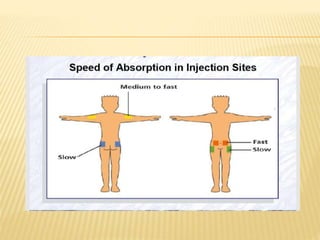
subcutaneous tissue just beneath the skin. As subcutaneous tissue
has few blood vessels, the injected drug is diffused very slowly at a
sustained rate of absorption. Therefore, it is highly effective in
administering vaccines, growth hormones and insulin, which require
continuous delivery at a low dose rate. It is often part of nurse’s role
to administer medicine and educate the patient in injection
technique. A skilled injection technique can make the patients
experience less painful and avoid unnecessary complications.
Giving a subcutaneous injection safely is considered to be a routine
nursing activity. However, it requires knowledge of anatomy and
physiology, psychology, communication skills and practical
expertise.
DEFINITION
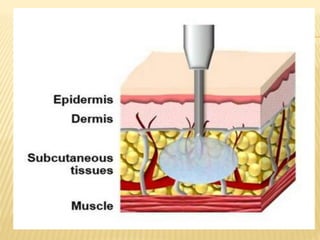
Subcutaneous injection is administered into the
fatty layer of skin directly below the dermis and
epidermis. Subcutaneous injections are highly
effective in administering vaccines such as
measles, mumps, rubella and medications such
as insulin, morphine, di-acetyl morphine and
goserelin.
TYPES OF SYRINGE FOR SUBCUTANEOUS INJECTION
Two types of syringe :
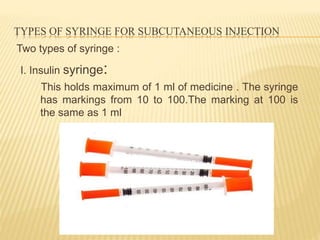
I. Insulin syringe:
This holds maximum of 1 ml of medicine . The syringe
has markings from 10 to 100.The marking at 100 is
the same as 1 ml
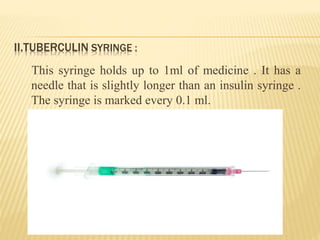
II.TUBERCULIN SYRINGE :
This syringe holds up to 1ml of medicine . It has a
needle that is slightly longer than an insulin syringe .
The syringe is marked every 0.1 ml.
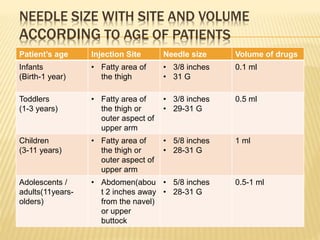
NEEDLE SIZE WITH SITE AND VOLUME
ACCORDING TO AGE OF PATIENTS
Patient’s age Injection Site Needle size Volume of drugs
Infants
(Birth-1 year)
• Fatty area of
the thigh
• 3/8 inches
• 31 G
0.1 ml
Toddlers
(1-3 years)
• Fatty area of
the thigh or
outer aspect of
upper arm
• 3/8 inches
• 29-31 G
0.5 ml
Children
(3-11 years)
• Fatty area of
the thigh or
outer aspect of
upper arm
• 5/8 inches
• 28-31 G
1 ml
Adolescents /
adults(11years-
olders)
• Abdomen(abou
t 2 inches away
from the navel)
or upper
buttock
• 5/8 inches
• 28-31 G
0.5-1 ml
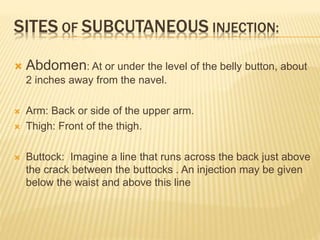
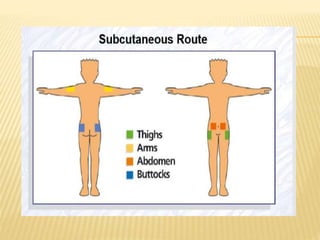
SITES OF SUBCUTANEOUS INJECTION:
 Abdomen: At or under the level of the belly button, about
2 inches away from the navel.
 Arm: Back or side of the upper arm.
 Thigh: Front of the thigh.
 Buttock: Imagine a line that runs across the back just above
the crack between the buttocks . An injection may be given
below the waist and above this line
INDICATIONS OF SUBCUTANEOUS INJECTION
 Severe dysphagia/swallowing difficulties
 Mouth, throat and esophageal lesions
 Intestinal obstruction
 Profound weakness
 Poor absorption of oral drugs
 Unacceptable number of oral medications
 Unconscious patient
ADVANTAGES OF SUBCUTANEOUS INJECTION
1. Safe and easy route.
2. Slow and sustained absorption.
3. Self medication is possible.
4. Prolonged duration of action.
5. Foul smelling & irritating drugs can be given.
DISADVANTAGES OF SUBCUTANEOUS INJECTION
1. Painful
2. Skin pigmentation
3. Hypersensitivity reaction may occur.
4. Large volume of drug can not be given.
5. Discoloration of skin may occur.
6. Irritation , infection , tissue necrosis to the
site of injection may occur.
COMPLICATIONS:
 Severe pain
 Redness
 Swelling or bruising
 Skin irritation
 Thrombus formation
 Pulmonary embolism
 Allergic reaction
 Restlessness
 Tenderness
 May be experience soreness or bleeding
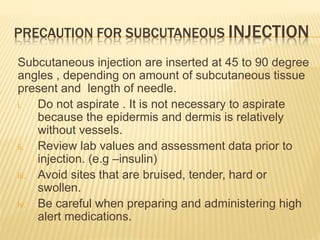
PRECAUTION FOR SUBCUTANEOUS INJECTION
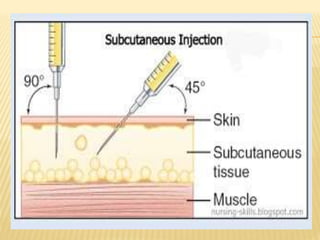
Subcutaneous injection are inserted at 45 to 90 degree
angles , depending on amount of subcutaneous tissue
present and length of needle.
i. Do not aspirate . It is not necessary to aspirate
because the epidermis and dermis is relatively
without vessels.
ii. Review lab values and assessment data prior to
injection. (e.g –insulin)
iii. Avoid sites that are bruised, tender, hard or
swollen.
iv. Be careful when preparing and administering high
alert medications.
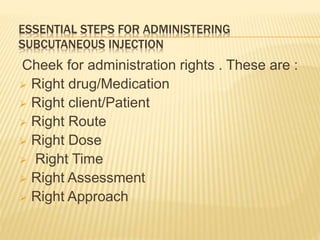
ESSENTIAL STEPS FOR ADMINISTERING
SUBCUTANEOUS INJECTION
Cheek for administration rights . These are :
 Right drug/Medication
 Right client/Patient
 Right Route
 Right Dose
 Right Time
 Right Assessment
 Right Approach
Continue..
 Right Education
 Right Prescription
 Right Nurse Clinician
 Right Principle of Care
 Right Evaluation
 Right Documentation
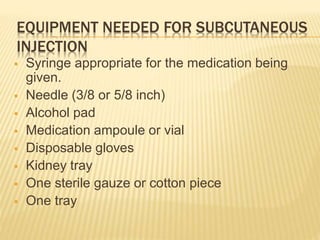
EQUIPMENT NEEDED FOR SUBCUTANEOUS
INJECTION
 Syringe appropriate for the medication being
given.
 Needle (3/8 or 5/8 inch)
 Alcohol pad
 Medication ampoule or vial
 Disposable gloves
 Kidney tray
 One sterile gauze or cotton piece
 One tray
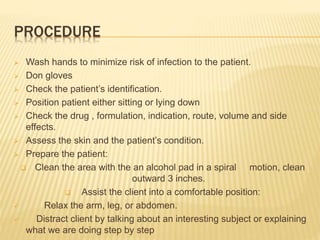
PROCEDURE
 Wash hands to minimize risk of infection to the patient.
 Don gloves
 Check the patient’s identification.
 Position patient either sitting or lying down
 Check the drug , formulation, indication, route, volume and side
effects.
 Assess the skin and the patient’s condition.
 Prepare the patient:
 Clean the area with the an alcohol pad in a spiral motion, clean
outward 3 inches.
 Assist the client into a comfortable position:
 Relax the arm, leg, or abdomen.
 Distract client by talking about an interesting subject or explaining
what we are doing step by step
CONTINUE..
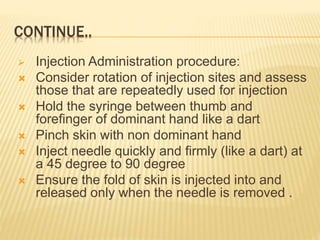
 Injection Administration procedure:
 Consider rotation of injection sites and assess
those that are repeatedly used for injection
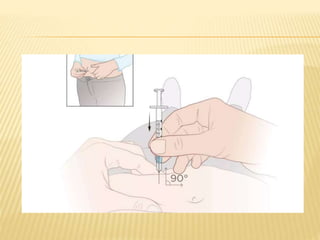
 Hold the syringe between thumb and
forefinger of dominant hand like a dart
 Pinch skin with non dominant hand
 Inject needle quickly and firmly (like a dart) at
a 45 degree to 90 degree
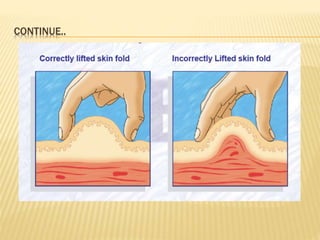
 Ensure the fold of skin is injected into and
released only when the needle is removed .
CONTINUE..
CONTINUE..
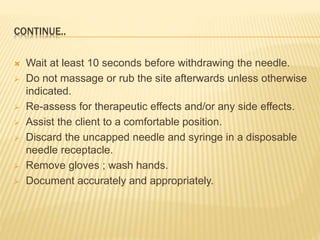
 Wait at least 10 seconds before withdrawing the needle.
 Do not massage or rub the site afterwards unless otherwise
indicated.
 Re-assess for therapeutic effects and/or any side effects.

 Assist the client to a comfortable position.
 Discard the uncapped needle and syringe in a disposable
needle receptacle.
 Remove gloves ; wash hands.
 Document accurately and appropriately.
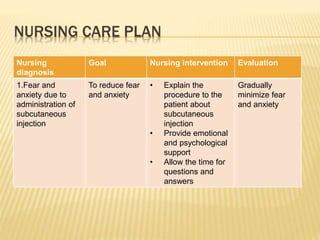
NURSING CARE PLAN
Nursing
diagnosis
Goal Nursing intervention Evaluation
1.Fear and
anxiety due to
administration of
subcutaneous
injection
To reduce fear
and anxiety
• Explain the
procedure to the
patient about
subcutaneous
injection
• Provide emotional
and psychological
support
• Allow the time for
questions and
answers
Gradually
minimize fear
and anxiety
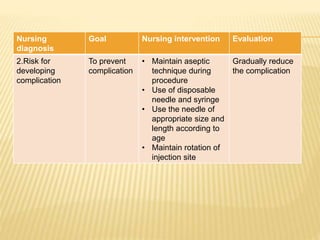
Nursing
diagnosis
Goal Nursing intervention Evaluation
2.Risk for
developing
complication
To prevent
complication
• Maintain aseptic
technique during
procedure
• Use of disposable
needle and syringe
• Use the needle of
appropriate size and
length according to
age
• Maintain rotation of
injection site
Gradually reduce
the complication
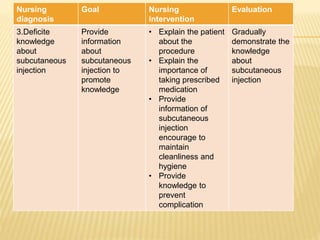
Nursing
diagnosis
Goal Nursing
intervention
Evaluation
3.Deficite
knowledge
about
subcutaneous
injection
Provide
information
about
subcutaneous
injection to
promote
knowledge
• Explain the patient
about the
procedure
• Explain the
importance of
taking prescribed
medication
• Provide
information of
subcutaneous
injection
encourage to
maintain
cleanliness and
hygiene
• Provide
knowledge to
prevent
complication
Gradually
demonstrate the
knowledge
about
subcutaneous
injection
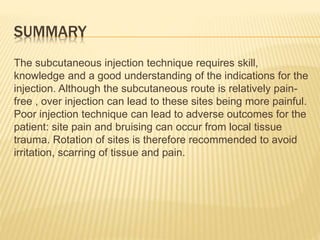
SUMMARY
The subcutaneous injection technique requires skill,
knowledge and a good understanding of the indications for the
injection. Although the subcutaneous route is relatively pain-
free , over injection can lead to these sites being more painful.
Poor injection technique can lead to adverse outcomes for the
patient: site pain and bruising can occur from local tissue
trauma. Rotation of sites is therefore recommended to avoid
irritation, scarring of tissue and pain.
REFERENCE
 Dr. Md. Mokbul Hossain MBBS;M phil (pharmacology), A
handbook of easy pharmacology
 Hunter J (2008) Subcutaneous injection technique.
Nursing Standard.22,21,41-44.
 In Jamieson EM, Whyte LA, McCall JM (Eds) Clinical Nursing
Practices. Fifth Edition. Churchill Livingstone Elsevier, Edinburgh,
5-9.
 Sherri Ogston -Tuck
Senior lecturer, adult nursing, Institute of Health and Society,
University of Worcester, Worcester.
Correspondence to : S.ogston-tuck@worc.ac.uk
 http://en.wikipedia.org/wiki/subcutaneous injection
 www.healthline.com/health/SC injection
THANKS

Subcutaneous injection

  • 1.
  • 2.
    INTRODUCTION The administration ofsubcutaneous injection is an important part of drug administration and a common nursing intervention in clinical practice. Among the different drug injection methods, subcutaneous injection is the one which is applied to the fatty layer of subcutaneous tissue just beneath the skin. As subcutaneous tissue has few blood vessels, the injected drug is diffused very slowly at a sustained rate of absorption. Therefore, it is highly effective in administering vaccines, growth hormones and insulin, which require continuous delivery at a low dose rate. It is often part of nurse’s role to administer medicine and educate the patient in injection technique. A skilled injection technique can make the patients experience less painful and avoid unnecessary complications. Giving a subcutaneous injection safely is considered to be a routine nursing activity. However, it requires knowledge of anatomy and physiology, psychology, communication skills and practical expertise.
  • 4.
    DEFINITION Subcutaneous injection isadministered into the fatty layer of skin directly below the dermis and epidermis. Subcutaneous injections are highly effective in administering vaccines such as measles, mumps, rubella and medications such as insulin, morphine, di-acetyl morphine and goserelin.
  • 6.
    TYPES OF SYRINGEFOR SUBCUTANEOUS INJECTION Two types of syringe : I. Insulin syringe: This holds maximum of 1 ml of medicine . The syringe has markings from 10 to 100.The marking at 100 is the same as 1 ml
  • 7.
    II.TUBERCULIN SYRINGE : Thissyringe holds up to 1ml of medicine . It has a needle that is slightly longer than an insulin syringe . The syringe is marked every 0.1 ml.
  • 8.
    NEEDLE SIZE WITHSITE AND VOLUME ACCORDING TO AGE OF PATIENTS Patient’s age Injection Site Needle size Volume of drugs Infants (Birth-1 year) • Fatty area of the thigh • 3/8 inches • 31 G 0.1 ml Toddlers (1-3 years) • Fatty area of the thigh or outer aspect of upper arm • 3/8 inches • 29-31 G 0.5 ml Children (3-11 years) • Fatty area of the thigh or outer aspect of upper arm • 5/8 inches • 28-31 G 1 ml Adolescents / adults(11years- olders) • Abdomen(abou t 2 inches away from the navel) or upper buttock • 5/8 inches • 28-31 G 0.5-1 ml
  • 9.
    SITES OF SUBCUTANEOUSINJECTION:  Abdomen: At or under the level of the belly button, about 2 inches away from the navel.  Arm: Back or side of the upper arm.  Thigh: Front of the thigh.  Buttock: Imagine a line that runs across the back just above the crack between the buttocks . An injection may be given below the waist and above this line
  • 12.
    INDICATIONS OF SUBCUTANEOUSINJECTION  Severe dysphagia/swallowing difficulties  Mouth, throat and esophageal lesions  Intestinal obstruction  Profound weakness  Poor absorption of oral drugs  Unacceptable number of oral medications  Unconscious patient
  • 13.
    ADVANTAGES OF SUBCUTANEOUSINJECTION 1. Safe and easy route. 2. Slow and sustained absorption. 3. Self medication is possible. 4. Prolonged duration of action. 5. Foul smelling & irritating drugs can be given.
  • 14.
    DISADVANTAGES OF SUBCUTANEOUSINJECTION 1. Painful 2. Skin pigmentation 3. Hypersensitivity reaction may occur. 4. Large volume of drug can not be given. 5. Discoloration of skin may occur. 6. Irritation , infection , tissue necrosis to the site of injection may occur.
  • 15.
    COMPLICATIONS:  Severe pain Redness  Swelling or bruising  Skin irritation  Thrombus formation  Pulmonary embolism  Allergic reaction  Restlessness  Tenderness  May be experience soreness or bleeding
  • 16.
    PRECAUTION FOR SUBCUTANEOUSINJECTION Subcutaneous injection are inserted at 45 to 90 degree angles , depending on amount of subcutaneous tissue present and length of needle. i. Do not aspirate . It is not necessary to aspirate because the epidermis and dermis is relatively without vessels. ii. Review lab values and assessment data prior to injection. (e.g –insulin) iii. Avoid sites that are bruised, tender, hard or swollen. iv. Be careful when preparing and administering high alert medications.
  • 17.
    ESSENTIAL STEPS FORADMINISTERING SUBCUTANEOUS INJECTION Cheek for administration rights . These are :  Right drug/Medication  Right client/Patient  Right Route  Right Dose  Right Time  Right Assessment  Right Approach
  • 18.
    Continue..  Right Education Right Prescription  Right Nurse Clinician  Right Principle of Care  Right Evaluation  Right Documentation
  • 19.
    EQUIPMENT NEEDED FORSUBCUTANEOUS INJECTION  Syringe appropriate for the medication being given.  Needle (3/8 or 5/8 inch)  Alcohol pad  Medication ampoule or vial  Disposable gloves  Kidney tray  One sterile gauze or cotton piece  One tray
  • 20.
    PROCEDURE  Wash handsto minimize risk of infection to the patient.  Don gloves  Check the patient’s identification.  Position patient either sitting or lying down  Check the drug , formulation, indication, route, volume and side effects.  Assess the skin and the patient’s condition.  Prepare the patient:  Clean the area with the an alcohol pad in a spiral motion, clean outward 3 inches.  Assist the client into a comfortable position:  Relax the arm, leg, or abdomen.  Distract client by talking about an interesting subject or explaining what we are doing step by step
  • 21.
    CONTINUE..  Injection Administrationprocedure:  Consider rotation of injection sites and assess those that are repeatedly used for injection  Hold the syringe between thumb and forefinger of dominant hand like a dart  Pinch skin with non dominant hand  Inject needle quickly and firmly (like a dart) at a 45 degree to 90 degree  Ensure the fold of skin is injected into and released only when the needle is removed .
  • 23.
  • 24.
    CONTINUE..  Wait atleast 10 seconds before withdrawing the needle.  Do not massage or rub the site afterwards unless otherwise indicated.  Re-assess for therapeutic effects and/or any side effects.  Assist the client to a comfortable position.  Discard the uncapped needle and syringe in a disposable needle receptacle.  Remove gloves ; wash hands.  Document accurately and appropriately.
  • 25.
    NURSING CARE PLAN Nursing diagnosis GoalNursing intervention Evaluation 1.Fear and anxiety due to administration of subcutaneous injection To reduce fear and anxiety • Explain the procedure to the patient about subcutaneous injection • Provide emotional and psychological support • Allow the time for questions and answers Gradually minimize fear and anxiety
  • 26.
    Nursing diagnosis Goal Nursing interventionEvaluation 2.Risk for developing complication To prevent complication • Maintain aseptic technique during procedure • Use of disposable needle and syringe • Use the needle of appropriate size and length according to age • Maintain rotation of injection site Gradually reduce the complication
  • 27.
    Nursing diagnosis Goal Nursing intervention Evaluation 3.Deficite knowledge about subcutaneous injection Provide information about subcutaneous injection to promote knowledge •Explain the patient about the procedure • Explain the importance of taking prescribed medication • Provide information of subcutaneous injection encourage to maintain cleanliness and hygiene • Provide knowledge to prevent complication Gradually demonstrate the knowledge about subcutaneous injection
  • 28.
    SUMMARY The subcutaneous injectiontechnique requires skill, knowledge and a good understanding of the indications for the injection. Although the subcutaneous route is relatively pain- free , over injection can lead to these sites being more painful. Poor injection technique can lead to adverse outcomes for the patient: site pain and bruising can occur from local tissue trauma. Rotation of sites is therefore recommended to avoid irritation, scarring of tissue and pain.
  • 29.
    REFERENCE  Dr. Md.Mokbul Hossain MBBS;M phil (pharmacology), A handbook of easy pharmacology  Hunter J (2008) Subcutaneous injection technique. Nursing Standard.22,21,41-44.  In Jamieson EM, Whyte LA, McCall JM (Eds) Clinical Nursing Practices. Fifth Edition. Churchill Livingstone Elsevier, Edinburgh, 5-9.  Sherri Ogston -Tuck Senior lecturer, adult nursing, Institute of Health and Society, University of Worcester, Worcester. Correspondence to : S.ogston-tuck@worc.ac.uk  http://en.wikipedia.org/wiki/subcutaneous injection  www.healthline.com/health/SC injection
  • 30.