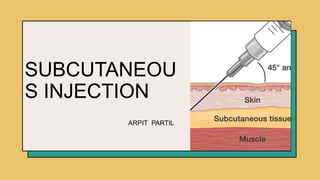
SUBCUTANEOU
S INJECTION
ARPIT PARTIL​
Introduction
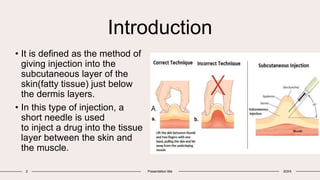
• It is defined as the method of
giving injection into the
subcutaneous layer of the
skin(fatty tissue) just below
the dermis layers.
• In this type of injection, a
short needle is used
to inject a drug into the tissue
layer between the skin and
the muscle.
2 Presentation title 20XX
• As subcutaneous tissue has few blood vessels, the injected drug is
diffused very slowly at a sustained rate of absorption.
• Therefore, it is highly effective in administering vaccines such as
measles, mumps, rubella and heparin and insulin, which require
continuous delivery at a low dose rate.
• A subcutaneous injection is absorbed slower than a substance
injected intravenously or into a muscle, but faster than a medication
administered by mouth.
• They are also the easiest form of parenteral administration of
medication to perform by lay people, and are associated with less
adverse effects such as pain or infection than other forms of
injection.
3 Presentation title 20XX
Indications
• Administration of insulin injection for diabetic patient
• Administration of heparin
• Unconscious patient
• Poor absorption of oral drugs
• Unacceptable number of oral medications
4 Presentation title 20XX
Advantages
• Safe and easy route
• Slow and sustained absorption
• Self medication is possible
• Prolong duration of action
• Foul smelling drugs can be given
5 Presentation title 20XX
Contraindications
• Bony prominences
• Skin lesions and lumps
• Injection site reactions may be minimized if repeated injections are
necessary by moving the injection site at least one inch from
previous injections, or using a different injection location altogether.
6 Presentation title 20XX
Technique
• Subcutaneous injections are performed by cleaning the area to be
injected followed by an injection, usually at a 45-degree angle to
the skin when using a syringe and needle, or at a 90-degree angle
if using an injector pen.
• The appropriate injection angle is based on the length of needle
used, and the depth of the subcutaneous fat in the skin of the
specific person.
• A 90-degree angle is always used for medications such as heparin.
7 Presentation title 20XX
• If administered at an angle, the skin and underlying tissue may be
pinched upwards prior to injection. The injection is administered
slowly, lasting about 10 seconds per milliliter of fluid injected, and
the needle may be left in place for 10 seconds following injection
to ensure the medicine is fully injected.
8 Presentation title 20XX
Sites
• Outer area of the upper arm
• Abdomen except for 2 inches above
the area around the navel
• Thigh about 2 inches above the
knee and 2 inches below the groin
• Upper area of buttocks just behind
the hip bone
9 Presentation title 20XX
Articles
• Medication card
• Tuberculin syringe or insulin syringe
• Hand sanitizer
• Alcohol swab
• Sterile gloves
• Kidney tray and paper bag
• Drug plus ampule cutter
• Injection tray
10 Presentation title 20XX
Procedure
• Check doctor’s order for medication administration
• Confirm patient identity and explain the procedure
• Check the 10 rights of medication administration and expiry date
• Wash the hands and wear gloves
• Prepare the medication from the vial or ampule and load the
medication in the syringe
• Pull the certain or screen
• Assist the patient to sit in comfortable position
11 Presentation title 20XX
• Select the appropriate site for injection
• Clean the site with alcohol swab in a circular motion
• Remove the needle cap and hold the syringe like a pencil
• Pinch the subcutaneous tissue between thumb and fingers with
non-dominant hand
• Insert the needle at 45 degree angle with dominant hand, 90
degree used if 26 gauge needle is used
• When needle is in place release the subcutaneous tissue and hold
the hub of needle
• Do not aspirate after insertion of needle
12 Presentation title 20XX
• With dominant hand inject the medication at 10 sec/ml
• Withdraw the needle at the same angle at which it was inserted
• Do not recap needle
• Do not massage the site
• Place patient in comfortable position
• Remove gloves and wash hands
• Dispose contaminated articles
• Record the procedure in patient medication card
• Evaluate the patient response to medication.
13 Presentation title 20XX
• With dominant hand inject the medication at 10 sec/ml
• Withdraw the needle at the same angle at which it was inserted
• Do not recap needle
• Do not massage the site
• Place patient in comfortable position
• Remove gloves and wash hands
• Dispose contaminated articles
• Record the procedure in patient medication card
• Evaluate the patient response to medication.
14 Presentation title 20XX
Thank you.

SUBCUTANEOUS INJECTION.pptx

  • 1.
  • 2.
    Introduction • It isdefined as the method of giving injection into the subcutaneous layer of the skin(fatty tissue) just below the dermis layers. • In this type of injection, a short needle is used to inject a drug into the tissue layer between the skin and the muscle. 2 Presentation title 20XX
  • 3.
    • As subcutaneoustissue has few blood vessels, the injected drug is diffused very slowly at a sustained rate of absorption. • Therefore, it is highly effective in administering vaccines such as measles, mumps, rubella and heparin and insulin, which require continuous delivery at a low dose rate. • A subcutaneous injection is absorbed slower than a substance injected intravenously or into a muscle, but faster than a medication administered by mouth. • They are also the easiest form of parenteral administration of medication to perform by lay people, and are associated with less adverse effects such as pain or infection than other forms of injection. 3 Presentation title 20XX
  • 4.
    Indications • Administration ofinsulin injection for diabetic patient • Administration of heparin • Unconscious patient • Poor absorption of oral drugs • Unacceptable number of oral medications 4 Presentation title 20XX
  • 5.
    Advantages • Safe andeasy route • Slow and sustained absorption • Self medication is possible • Prolong duration of action • Foul smelling drugs can be given 5 Presentation title 20XX
  • 6.
    Contraindications • Bony prominences •Skin lesions and lumps • Injection site reactions may be minimized if repeated injections are necessary by moving the injection site at least one inch from previous injections, or using a different injection location altogether. 6 Presentation title 20XX
  • 7.
    Technique • Subcutaneous injectionsare performed by cleaning the area to be injected followed by an injection, usually at a 45-degree angle to the skin when using a syringe and needle, or at a 90-degree angle if using an injector pen. • The appropriate injection angle is based on the length of needle used, and the depth of the subcutaneous fat in the skin of the specific person. • A 90-degree angle is always used for medications such as heparin. 7 Presentation title 20XX
  • 8.
    • If administeredat an angle, the skin and underlying tissue may be pinched upwards prior to injection. The injection is administered slowly, lasting about 10 seconds per milliliter of fluid injected, and the needle may be left in place for 10 seconds following injection to ensure the medicine is fully injected. 8 Presentation title 20XX
  • 9.
    Sites • Outer areaof the upper arm • Abdomen except for 2 inches above the area around the navel • Thigh about 2 inches above the knee and 2 inches below the groin • Upper area of buttocks just behind the hip bone 9 Presentation title 20XX
  • 10.
    Articles • Medication card •Tuberculin syringe or insulin syringe • Hand sanitizer • Alcohol swab • Sterile gloves • Kidney tray and paper bag • Drug plus ampule cutter • Injection tray 10 Presentation title 20XX
  • 11.
    Procedure • Check doctor’sorder for medication administration • Confirm patient identity and explain the procedure • Check the 10 rights of medication administration and expiry date • Wash the hands and wear gloves • Prepare the medication from the vial or ampule and load the medication in the syringe • Pull the certain or screen • Assist the patient to sit in comfortable position 11 Presentation title 20XX
  • 12.
    • Select theappropriate site for injection • Clean the site with alcohol swab in a circular motion • Remove the needle cap and hold the syringe like a pencil • Pinch the subcutaneous tissue between thumb and fingers with non-dominant hand • Insert the needle at 45 degree angle with dominant hand, 90 degree used if 26 gauge needle is used • When needle is in place release the subcutaneous tissue and hold the hub of needle • Do not aspirate after insertion of needle 12 Presentation title 20XX
  • 13.
    • With dominanthand inject the medication at 10 sec/ml • Withdraw the needle at the same angle at which it was inserted • Do not recap needle • Do not massage the site • Place patient in comfortable position • Remove gloves and wash hands • Dispose contaminated articles • Record the procedure in patient medication card • Evaluate the patient response to medication. 13 Presentation title 20XX
  • 14.
    • With dominanthand inject the medication at 10 sec/ml • Withdraw the needle at the same angle at which it was inserted • Do not recap needle • Do not massage the site • Place patient in comfortable position • Remove gloves and wash hands • Dispose contaminated articles • Record the procedure in patient medication card • Evaluate the patient response to medication. 14 Presentation title 20XX
  • 15.