
By
Sudarshan Kadariya
JMC
What is
Monopoly??
 A firm is a monopoly if . . .
◦ it is the only seller of its product, and
◦ its product does not have close substitutes.
 The fundamental cause of monopoly is the
existence of barriers to entry.
 Barriers to entry have three sources:
◦ Ownership of a key resource.
◦ The government gives a firm the exclusive right to
produce some good.
◦ Costs of production make one producer more efficient
than a large number of producers (Natural Monopoly)
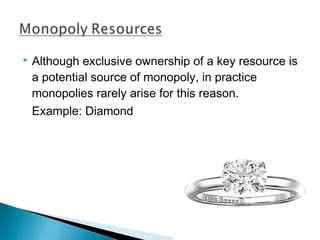
 Although exclusive ownership of a key resource is
a potential source of monopoly, in practice
monopolies rarely arise for this reason.
Example: Diamond
 Governments may restrict entry by giving one firm
the exclusive right to sell a particular goods in
certain markets.
Example: Patent and copyright laws are two important
examples of how governments create monopoly to serve
the public interest.
 An industry is a natural monopoly when one firm
can supply a good or service to an entire market at
a lower cost than could two or more firms.
 In other words, natural monopoly is an industry in
which economies of scale are so important so that
only one firm can survive.
Example: delivery of electricity, phone service, tap water,
etc.
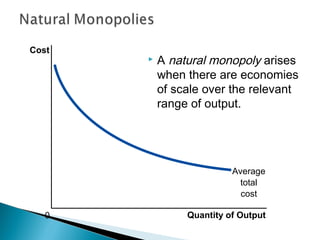
 A natural monopoly arises
when there are economies
of scale over the relevant
range of output.
Quantity of Output
Average
total
cost
0
Cost
Quantity of Output
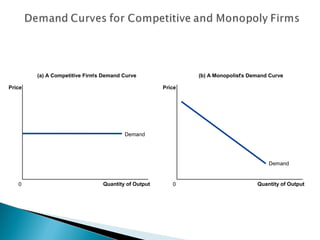
Demand
(a) A Competitive Firm’s Demand Curve (b) A Monopolist’s Demand Curve
0
Price
Quantity of Output0
Price
Demand
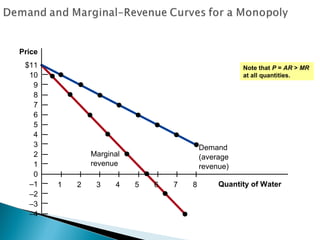
Quantity of Water
Price
$11
10
9
8
7
6
5
4
3
2
1
0
–1
–2
–3
–4
Demand
(average
revenue)
Marginal
revenue
1 2 3 4 5 6 7 8
Note that P = AR > MR
at all quantities.
 Unregulated natural monopoly
 Regulated natural monopoly
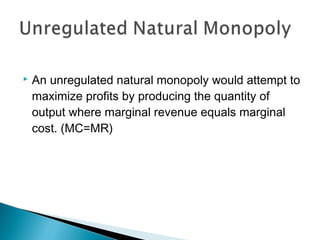
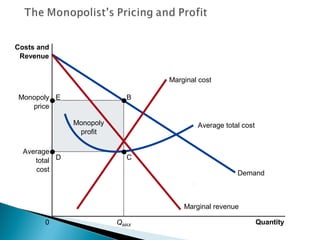
 An unregulated natural monopoly would attempt to
maximize profits by producing the quantity of
output where marginal revenue equals marginal
cost. (MC=MR)
 Exploitation to customers
 Excessive profitability strengthen the monopoly
power
 Inequitable distribution of resources
 Operational inefficiency, etc
If so, How to curve????
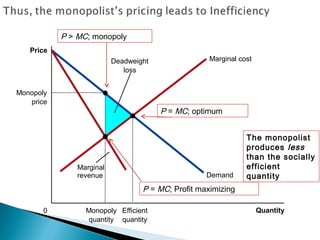
 The optimal quantity of output occurs where price
equals marginal cost. (P=MC)
 Thus, marginal social benefit equals marginal
social cost.
 Producing the profit-maximizing output causes a
deadweight loss.
 The deadweight loss is equal to the area between
the demand curve and the marginal cost curve for
the amount of underproduction.
Deadweight loss: The costs to society created by market inefficiency due to
inefficient allocation of resources. Price ceilings, price floors, and taxation are all
said to create deadweight losses. Deadweight loss occurs when supply and
demand are not in equilibrium.
Monopoly
profit
Average
total
cost
Quantity
Monopoly
price
QMAX0
Costs and
Revenue
Demand
Marginal cost
Marginal revenue
Average total cost
B
C
E
D
Quantity0
Price
Deadweight
loss
Demand
Marginal
revenue
Marginal cost
Efficient
quantity
Monopoly
price
Monopoly
quantity
P > MC; monopoly
P = MC; optimum
The monopolist
produces less
than the socially
efficient
quantity
P = MC; Profit maximizing
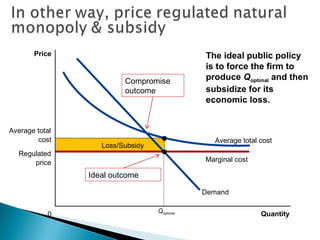
 If a natural monopoly is regulated to produce the
optimal quantity of output, the firm will suffer an
economic loss.
 To keep the monopoly firm to survive would
require a government subsidy to the firm to
eliminate the economic loss.
Economic loss: The difference between the revenue received from the sale of an
output and the opportunity cost of the inputs used.
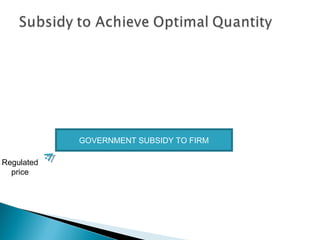
Regulated
price
GOVERNMENT SUBSIDY TO FIRM
Loss/Subsidy
Quantity0
Price
Demand
Average total cost
Regulated
price Marginal cost
Average total
cost
The ideal public policy
is to force the firm to
produce Qoptimal and then
subsidize for its
economic loss.
Qoptimal
Ideal outcome
Compromise
outcome
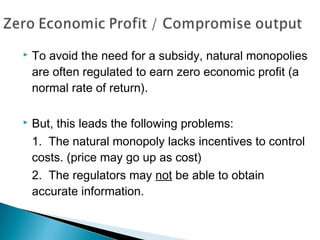
 To avoid the need for a subsidy, natural monopolies
are often regulated to earn zero economic profit (a
normal rate of return).
 But, this leads the following problems:
1. The natural monopoly lacks incentives to control
costs. (price may go up as cost)
2. The regulators may not be able to obtain
accurate information.
Compromis
e price
 To overcome the monopoly power or the inefficiency
of monopoly firm or the inefficient allocation of
resources, government can play a significant role to
balance the social benefits and the costs through
subsidy to the firm or determining the zero economic
profit. (Profit constraints – normal rate of return, price
ceiling, etc.
THANK YOU.

natural monopoly

  • 1.
  • 2.
  • 3.
     A firmis a monopoly if . . . ◦ it is the only seller of its product, and ◦ its product does not have close substitutes.
  • 4.
     The fundamentalcause of monopoly is the existence of barriers to entry.  Barriers to entry have three sources: ◦ Ownership of a key resource. ◦ The government gives a firm the exclusive right to produce some good. ◦ Costs of production make one producer more efficient than a large number of producers (Natural Monopoly)
  • 5.
     Although exclusiveownership of a key resource is a potential source of monopoly, in practice monopolies rarely arise for this reason. Example: Diamond
  • 6.
     Governments mayrestrict entry by giving one firm the exclusive right to sell a particular goods in certain markets. Example: Patent and copyright laws are two important examples of how governments create monopoly to serve the public interest.
  • 7.
     An industryis a natural monopoly when one firm can supply a good or service to an entire market at a lower cost than could two or more firms.  In other words, natural monopoly is an industry in which economies of scale are so important so that only one firm can survive. Example: delivery of electricity, phone service, tap water, etc.
  • 8.
     A naturalmonopoly arises when there are economies of scale over the relevant range of output. Quantity of Output Average total cost 0 Cost
  • 9.
    Quantity of Output Demand (a)A Competitive Firm’s Demand Curve (b) A Monopolist’s Demand Curve 0 Price Quantity of Output0 Price Demand
  • 10.
  • 11.
     Unregulated naturalmonopoly  Regulated natural monopoly
  • 12.
     An unregulatednatural monopoly would attempt to maximize profits by producing the quantity of output where marginal revenue equals marginal cost. (MC=MR)
  • 14.
     Exploitation tocustomers  Excessive profitability strengthen the monopoly power  Inequitable distribution of resources  Operational inefficiency, etc If so, How to curve????
  • 15.
     The optimalquantity of output occurs where price equals marginal cost. (P=MC)  Thus, marginal social benefit equals marginal social cost.
  • 17.
     Producing theprofit-maximizing output causes a deadweight loss.  The deadweight loss is equal to the area between the demand curve and the marginal cost curve for the amount of underproduction. Deadweight loss: The costs to society created by market inefficiency due to inefficient allocation of resources. Price ceilings, price floors, and taxation are all said to create deadweight losses. Deadweight loss occurs when supply and demand are not in equilibrium.
  • 19.
  • 20.
    Quantity0 Price Deadweight loss Demand Marginal revenue Marginal cost Efficient quantity Monopoly price Monopoly quantity P >MC; monopoly P = MC; optimum The monopolist produces less than the socially efficient quantity P = MC; Profit maximizing
  • 21.
     If anatural monopoly is regulated to produce the optimal quantity of output, the firm will suffer an economic loss.  To keep the monopoly firm to survive would require a government subsidy to the firm to eliminate the economic loss. Economic loss: The difference between the revenue received from the sale of an output and the opportunity cost of the inputs used.
  • 22.
  • 23.
    Loss/Subsidy Quantity0 Price Demand Average total cost Regulated priceMarginal cost Average total cost The ideal public policy is to force the firm to produce Qoptimal and then subsidize for its economic loss. Qoptimal Ideal outcome Compromise outcome
  • 25.
     To avoidthe need for a subsidy, natural monopolies are often regulated to earn zero economic profit (a normal rate of return).  But, this leads the following problems: 1. The natural monopoly lacks incentives to control costs. (price may go up as cost) 2. The regulators may not be able to obtain accurate information.
  • 26.
  • 27.
     To overcomethe monopoly power or the inefficiency of monopoly firm or the inefficient allocation of resources, government can play a significant role to balance the social benefits and the costs through subsidy to the firm or determining the zero economic profit. (Profit constraints – normal rate of return, price ceiling, etc.
  • 28.