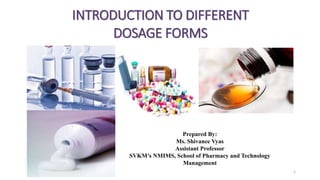

INTRODUCTION TO DIFFERENT
DOSAGE FORMS
Prepared By:
Ms. Shivanee Vyas
Assistant Professor
SVKM’s NMIMS, School of Pharmacy and Technology
Management
1
INTRODUCTION
DOSAGE FORM (MEDICINES) API + Excipients
• The means (or the form) by which drug molecules are delivered to sites of action within the body.
• The drugs are rarely administered in their original pure state. They are administered in different dosage
forms after converting them into a suitable formulation.
• Dosage form is a combination of the drug and different kind of non-drug compound called “additives”.
DRUG (ACTIVE PHARMACEUTICAL INGREDIENTS)
• Chemical compound intended for used in diagnosis, treatment and prevention, of disease. The Active
Pharmaceutical Ingredient (API) is the part of any drug that produces its effects.
EXCIPIENTS
• Do not increase or affect the therapeutic action of the active ingredient
• Inactive ingredients may also be referred to as inert ingredients or excipients, and generally have no
pharmacological effect.
• Examples of inactive ingredients include binding materials, dyes, preservatives, and flavoring agents,
sweetening agents, coloring agents etc.
2
The Need for Dosage Forms
 To provide a safe and convenient delivery of accurate dosage.
 Many dosage forms can be easily identified from their distinct color and shape.
 To protect the drug substance from oxidation, hydrolysis, and reduction. i.e. coated tablets.
 To protect the drug from the destructive effect of gastric juice of the stomach after oral administration.
 To mask the bitter taste and odour of a drug substance. i.e. capsules, flavored syrups etc.
 To provide the insertion of drugs into body cavities (rectal, vaginal suppositories)
 To provide maximum drug action from topical administration sites. i.e. creams, ointments, etc.
 To provide sustained released action through controlled release mechanism, i.e. sustained release tablets.
 To provide liquid dosage forms of the drug suitable in a suitable vehicle. i.e. solution.
 To provide liquid preparation of the drugs which are insoluble and unstable in different vehicles. i.e.
suspension. 3
• “Pharmaceutics is the discipline of pharmacy that deals with the
process of turning a new chemical entity (NCE) or old drugs into a
medication to be used safely and effectively by patients.”
• It is also called the science of dosage form design.
What is Pharmaceutics?
4
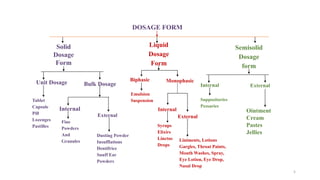
DOSAGE FORM
Solid
Dosage
Form
Unit Dosage
Tablet
Capsule
Pill
Lozenges
Pastilles
Bulk Dosage
Internal
Fine
Powders
And
Granules
External
Dusting Powder
Insufflations
Dentifrice
Snuff Ear
Powders
Liquid
Dosage
Form
Biphasic
Emulsion
Suspension
Monophasic
Internal
Syrups
Elixirs
Linctus
Drops
External
Liniments, Lotions
Gargles, Throat Paints,
Mouth Washes, Spray,
Eye Lotion, Eye Drop,
Nasal Drop
Semisolid
Dosage
form
Internal
Suppositories
Pessaries
External
Ointment
Cream
Pastes
Jellies
5
SOLID DOSAGE FORMS
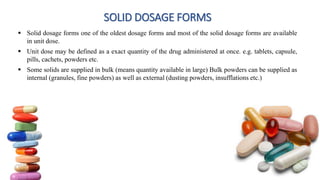
 Solid dosage forms one of the oldest dosage forms and most of the solid dosage forms are available
in unit dose.
 Unit dose may be defined as a exact quantity of the drug administered at once. e.g. tablets, capsule,
pills, cachets, powders etc.
 Some solids are supplied in bulk (means quantity available in large) Bulk powders can be supplied as
internal (granules, fine powders) as well as external (dusting powders, insufflations etc.)
6
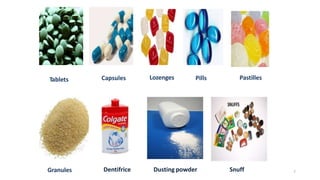
Tablets
Granules
Lozenges Pastilles
Capsules Pills
Dusting powder Snuff
Dentifrice 7
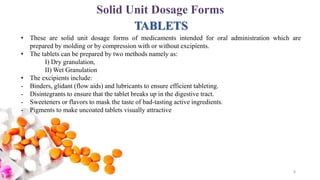
• These are solid unit dosage forms of medicaments intended for oral administration which are
prepared by molding or by compression with or without excipients.
• The tablets can be prepared by two methods namely as:
I) Dry granulation,
II) Wet Granulation
• The excipients include:
- Binders, glidant (flow aids) and lubricants to ensure efficient tableting.
- Disintegrants to ensure that the tablet breaks up in the digestive tract.
- Sweeteners or flavors to mask the taste of bad-tasting active ingredients.
- Pigments to make uncoated tablets visually attractive
TABLETS
Solid Unit Dosage Forms
8
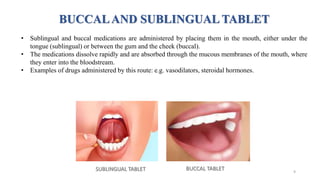
BUCCALAND SUBLINGUAL TABLET
• Sublingual and buccal medications are administered by placing them in the mouth, either under the
tongue (sublingual) or between the gum and the cheek (buccal).
• The medications dissolve rapidly and are absorbed through the mucous membranes of the mouth, where
they enter into the bloodstream.
• Examples of drugs administered by this route: e.g. vasodilators, steroidal hormones.
SUBLINGUAL TABLET BUCCAL TABLET 9
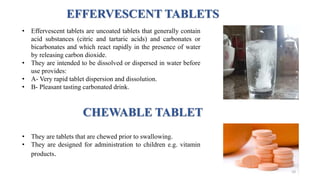
EFFERVESCENT TABLETS
• They are tablets that are chewed prior to swallowing.
• They are designed for administration to children e.g. vitamin
products.
CHEWABLE TABLET
• Effervescent tablets are uncoated tablets that generally contain
acid substances (citric and tartaric acids) and carbonates or
bicarbonates and which react rapidly in the presence of water
by releasing carbon dioxide.
• They are intended to be dissolved or dispersed in water before
use provides:
• A- Very rapid tablet dispersion and dissolution.
• B- Pleasant tasting carbonated drink.
10
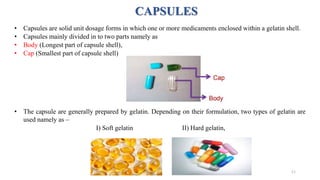
CAPSULES
• Capsules are solid unit dosage forms in which one or more medicaments enclosed within a gelatin shell.
• Capsules mainly divided in to two parts namely as
• Body (Longest part of capsule shell),
• Cap (Smallest part of capsule shell)
• The capsule are generally prepared by gelatin. Depending on their formulation, two types of gelatin are
used namely as –
I) Soft gelatin II) Hard gelatin,
11
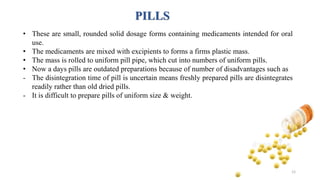
PILLS
• These are small, rounded solid dosage forms containing medicaments intended for oral
use.
• The medicaments are mixed with excipients to forms a firms plastic mass.
• The mass is rolled to uniform pill pipe, which cut into numbers of uniform pills.
• Now a days pills are outdated preparations because of number of disadvantages such as
- The disintegration time of pill is uncertain means freshly prepared pills are disintegrates
readily rather than old dried pills.
- It is difficult to prepare pills of uniform size & weight.
12
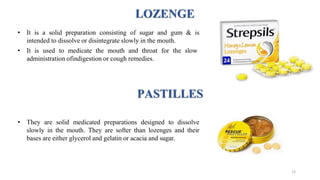
LOZENGE
• It is a solid preparation consisting of sugar and gum & is
intended to dissolve or disintegrate slowly in the mouth.
• It is used to medicate the mouth and throat for the slow
administration ofindigestion or cough remedies.
PASTILLES
• They are solid medicated preparations designed to dissolve
slowly in the mouth. They are softer than lozenges and their
bases are either glycerol and gelatin or acacia and sugar.
13
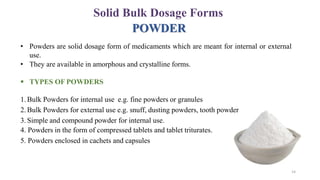
POWDER
• Powders are solid dosage form of medicaments which are meant for internal or external
use.
• They are available in amorphous and crystalline forms.
 TYPES OF POWDERS
1. Bulk Powders for internal use e.g. fine powders or granules
2. Bulk Powders for external use e.g. snuff, dusting powders, tooth powder
3. Simple and compound powder for internal use.
4. Powders in the form of compressed tablets and tablet triturates.
5. Powders enclosed in cachets and capsules
Solid Bulk Dosage Forms
14
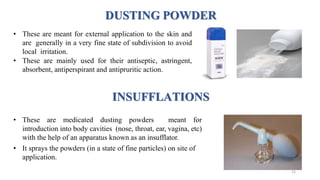
DUSTING POWDER
• These are meant for external application to the skin and
are generally in a very fine state of subdivision to avoid
local irritation.
• These are mainly used for their antiseptic, astringent,
absorbent, antiperspirant and antipruritic action.
INSUFFLATIONS
• These are medicated dusting powders meant for
introduction into body cavities (nose, throat, ear, vagina, etc)
with the help of an apparatus known as an insufflator.
• It sprays the powders (in a state of fine particles) on site of
application.
15
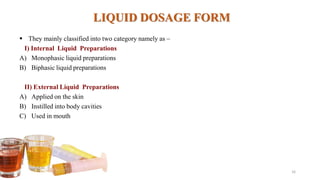
LIQUID DOSAGE FORM
 They mainly classified into two category namely as –
I) Internal Liquid Preparations
A) Monophasic liquid preparations
B) Biphasic liquid preparations
II) External Liquid Preparations
A) Applied on the skin
B) Instilled into body cavities
C) Used in mouth
16
• Advantage
 Immediately available for absorption.
 Administration convenient, particularly for infants, mentally ill patients.
 Easy to color, flavor & sweeten.
 A solution is an homogeneous system and therefore the drug will be uniformly distributed throughout
the preparation.
 Some drugs like aspirin, KCl can irritate gastric mucosa if used orally as a solid dosage forms. But
this effect can be reduce by solution system.
 Liquids are easier to swallow than solid and are therefor particularly acceptable for pediatric patients.
• Disadvantage
 Patients have no accurate measuring device.
 Accident breakage of container results in complete loss.
 Solution often provide suitable media for the growth of microorganisms.
 The taste of a drug, which is often unpleasant, is always more pronounced when in solution than in a
solid form.
 Bulky than tablets or capsule, so difficult to carry transport.
17
MONOPHASIC LIQUID DOSAGE FORMS
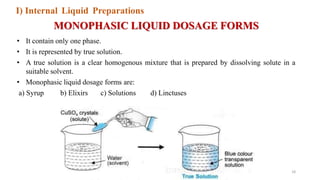
• It contain only one phase.
• It is represented by true solution.
• A true solution is a clear homogenous mixture that is prepared by dissolving solute in a
suitable solvent.
• Monophasic liquid dosage forms are:
a) Syrup b) Elixirs c) Solutions d) Linctuses
18
I) Internal Liquid Preparations
SYRUP
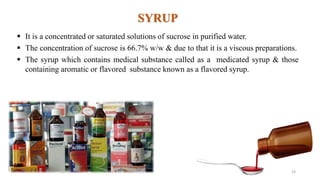
 It is a concentrated or saturated solutions of sucrose in purified water.
 The concentration of sucrose is 66.7% w/w & due to that it is a viscous preparations.
 The syrup which contains medical substance called as a medicated syrup & those
containing aromatic or flavored substance known as a flavored syrup.
19
ELIXIRS
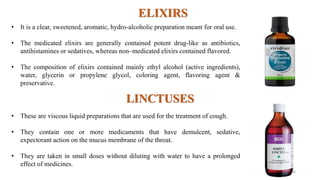
• It is a clear, sweetened, aromatic, hydro-alcoholic preparation meant for oral use.
• The medicated elixirs are generally contained potent drug-like as antibiotics,
antihistamines or sedatives, whereas non–medicated elixirs contained flavored.
• The composition of elixirs contained mainly ethyl alcohol (active ingredients),
water, glycerin or propylene glycol, coloring agent, flavoring agent &
preservative.
LINCTUSES
• These are viscous liquid preparations that are used for the treatment of cough.
• They contain one or more medicaments that have demulcent, sedative,
expectorant action on the mucus membrane of the throat.
• They are taken in small doses without diluting with water to have a prolonged
effect of medicines.
20
 The liquid which consistof two phasesare knownas a biphasic liquid
dosage forms.
 They are sub categorized into two different forms namely as –
I) Emulsion
II) Suspension
 In emulsion both phases are available in liquid where as in suspension,
finely divided solid particles are suspended in liquid medium.
Biphasic liquid dosage forms
21
EMULSION
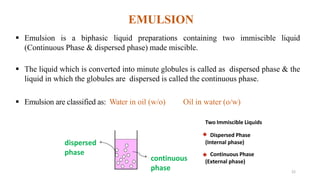
 Emulsion is a biphasic liquid preparations containing two immiscible liquid
(Continuous Phase & dispersed phase) made miscible.
 The liquid which is converted into minute globules is called as dispersed phase & the
liquid in which the globules are dispersed is called the continuous phase.
 Emulsion are classified as: Water in oil (w/o) Oil in water (o/w)
dispersed
phase
continuous
phase
Two Immiscible Liquids
Dispersed Phase
(Internal phase)
Continuous Phase
(External phase)
22
SUSPENSION
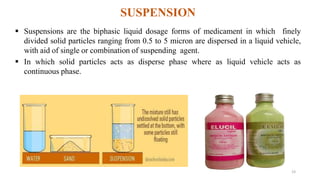
 Suspensions are the biphasic liquid dosage forms of medicament in which finely
divided solid particles ranging from 0.5 to 5 micron are dispersed in a liquid vehicle,
with aid of single or combination of suspending agent.
 In which solid particles acts as disperse phase where as liquid vehicle acts as
continuous phase.
23
2. External liquid preparations
A) Applied on the skin
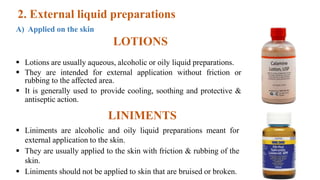
LOTIONS
 Lotions are usually aqueous, alcoholic or oily liquid preparations.
 They are intended for external application without friction or
rubbing to the affected area.
 It is generally used to provide cooling, soothing and protective &
antiseptic action.
LINIMENTS
 Liniments are alcoholic and oily liquid preparations meant for
external application to the skin.
 They are usually applied to the skin with friction & rubbing of the
skin.
 Liniments should not be applied to skin that are bruised or broken. 24
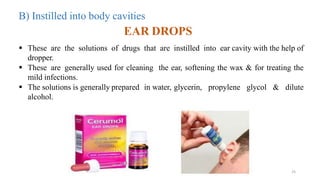
EAR DROPS
 These are the solutions of drugs that are instilled into ear cavity with the help of
dropper.
 These are generally used for cleaning the ear, softening the wax & for treating the
mild infections.
 The solutions is generally prepared in water, glycerin, propylene glycol & dilute
alcohol.
25
B) Instilled into body cavities
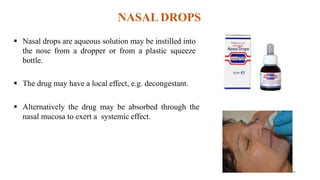
NASAL DROPS
 Nasal drops are aqueous solution may be instilled into
the nose from a dropper or from a plastic squeeze
bottle.
 The drug may have a local effect, e.g. decongestant.
 Alternatively the drug may be absorbed through the
nasal mucosa to exert a systemic effect.
26
C) Used in mouth
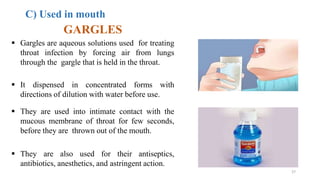
GARGLES
 Gargles are aqueous solutions used for treating
throat infection by forcing air from lungs
through the gargle that is held in the throat.
 It dispensed in concentrated forms with
directions of dilution with water before use.
 They are used into intimate contact with the
mucous membrane of throat for few seconds,
before they are thrown out of the mouth.
 They are also used for their antiseptics,
antibiotics, anesthetics, and astringent action.
27
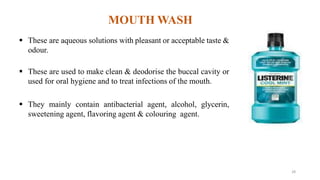
MOUTH WASH
 These are aqueous solutions with pleasant or acceptable taste &
odour.
 These are used to make clean & deodorise the buccal cavity or
used for oral hygiene and to treat infections of the mouth.
 They mainly contain antibacterial agent, alcohol, glycerin,
sweetening agent, flavoring agent & colouring agent.
28
SEMISOLID DOSAGE FORMS
 Semisolid dosage forms meant for external application.
 They contain one or more active ingredients dissolved or uniformly dispersed in a
suitable base and any suitable excipients such as emulsifiers, viscosity-increasing
agents, antimicrobial agents, antioxidants, or stabilizing agents.
 Semisolid dosage forms subcategorized are as-
i. Ointment
ii. Creams
iii. Paste
iv. Jellies
v. Suppositories
29
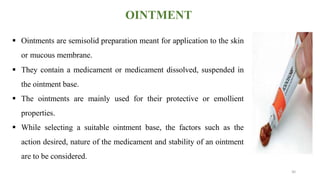
OINTMENT
 Ointments are semisolid preparation meant for application to the skin
or mucous membrane.
 They contain a medicament or medicament dissolved, suspended in
the ointment base.
 The ointments are mainly used for their protective or emollient
properties.
 While selecting a suitable ointment base, the factors such as the
action desired, nature of the medicament and stability of an ointment
are to be considered.
30
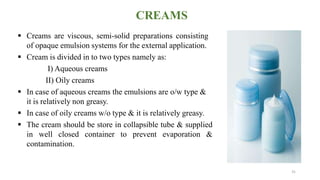
CREAMS
 Creams are viscous, semi-solid preparations consisting
of opaque emulsion systems for the external application.
 Cream is divided in to two types namely as:
I) Aqueous creams
II) Oily creams
 In case of aqueous creams the emulsions are o/w type &
it is relatively non greasy.
 In case of oily creams w/o type & it is relatively greasy.
 The cream should be store in collapsible tube & supplied
in well closed container to prevent evaporation &
contamination.
31
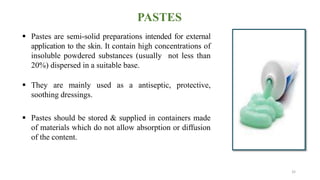
PASTES
 Pastes are semi-solid preparations intended for external
application to the skin. It contain high concentrations of
insoluble powdered substances (usually not less than
20%) dispersed in a suitable base.
 They are mainly used as a antiseptic, protective,
soothing dressings.
 Pastes should be stored & supplied in containers made
of materials which do not allow absorption or diffusion
of the content.
32
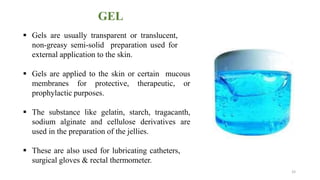
GEL
 Gels are usually transparent or translucent,
non-greasy semi-solid preparation used for
external application to the skin.
 Gels are applied to the skin or certain mucous
membranes for protective, therapeutic, or
prophylactic purposes.
 The substance like gelatin, starch, tragacanth,
sodium alginate and cellulose derivatives are
used in the preparation of the jellies.
 These are also used for lubricating catheters,
surgical gloves & rectal thermometer.
33
NEW DRUG DELIVERY SYSTEM
With the advancement of pharmaceutical sciences, a new concept have
evolved various modern dosage forms & methods of their administration.
Some of the modern dosage forms are:
 Implants
 Films & strips
 Liposome drug carriers
 Controlled drug delivery modules
 Erythrocytes
 Nanoparticles
 Prodrugs
34
IMPLANTS
 These hypodermic tablets are placed under the skin by a minor surgery in order to
release drugs over prolonged periods of time.
 Now the magnetically controlled implants have been developed which can be
opened or closed to release or stop the drug.
 The implants which are in capsule forms, consist of a body and a cap. It can be
opened by placing a magnet on the skin and moving it in the desired direction.
 These implants are useful in hormone therapy. When AlNicor rod magnate is taped
over the skin immediately above the capsule, it will remain open and release the
medicament but the capsule gets closed as soon as the magnet is removed.
35
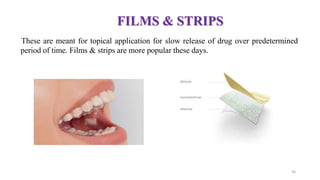
FILMS & STRIPS
These are meant for topical application for slow release of drug over predetermined
period of time. Films & strips are more popular these days.
36
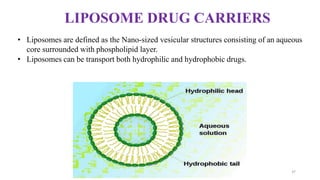
LIPOSOME DRUG CARRIERS
• Liposomes are defined as the Nano-sized vesicular structures consisting of an aqueous
core surrounded with phospholipid layer.
• Liposomes can be transport both hydrophilic and hydrophobic drugs.
37
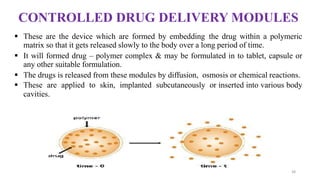
CONTROLLED DRUG DELIVERY MODULES
 These are the device which are formed by embedding the drug within a polymeric
matrix so that it gets released slowly to the body over a long period of time.
 It will formed drug – polymer complex & may be formulated in to tablet, capsule or
any other suitable formulation.
 The drugs is released from these modules by diffusion, osmosis or chemical reactions.
 These are applied to skin, implanted subcutaneously or inserted into various body
cavities.
38
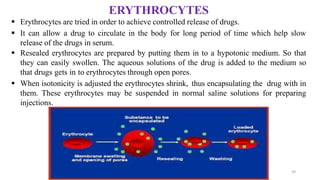
ERYTHROCYTES
 Erythrocytes are tried in order to achieve controlled release of drugs.
 It can allow a drug to circulate in the body for long period of time which help slow
release of the drugs in serum.
 Resealed erythrocytes are prepared by putting them in to a hypotonic medium. So that
they can easily swollen. The aqueous solutions of the drug is added to the medium so
that drugs gets in to erythrocytes through open pores.
 When isotonicity is adjusted the erythrocytes shrink, thus encapsulating the drug with in
them. These erythrocytes may be suspended in normal saline solutions for preparing
injections.
39
40

Introduction to Dosage forms

  • 1.
    INTRODUCTION TO DIFFERENT DOSAGEFORMS Prepared By: Ms. Shivanee Vyas Assistant Professor SVKM’s NMIMS, School of Pharmacy and Technology Management 1
  • 2.
    INTRODUCTION DOSAGE FORM (MEDICINES)API + Excipients • The means (or the form) by which drug molecules are delivered to sites of action within the body. • The drugs are rarely administered in their original pure state. They are administered in different dosage forms after converting them into a suitable formulation. • Dosage form is a combination of the drug and different kind of non-drug compound called “additives”. DRUG (ACTIVE PHARMACEUTICAL INGREDIENTS) • Chemical compound intended for used in diagnosis, treatment and prevention, of disease. The Active Pharmaceutical Ingredient (API) is the part of any drug that produces its effects. EXCIPIENTS • Do not increase or affect the therapeutic action of the active ingredient • Inactive ingredients may also be referred to as inert ingredients or excipients, and generally have no pharmacological effect. • Examples of inactive ingredients include binding materials, dyes, preservatives, and flavoring agents, sweetening agents, coloring agents etc. 2
  • 3.
    The Need forDosage Forms  To provide a safe and convenient delivery of accurate dosage.  Many dosage forms can be easily identified from their distinct color and shape.  To protect the drug substance from oxidation, hydrolysis, and reduction. i.e. coated tablets.  To protect the drug from the destructive effect of gastric juice of the stomach after oral administration.  To mask the bitter taste and odour of a drug substance. i.e. capsules, flavored syrups etc.  To provide the insertion of drugs into body cavities (rectal, vaginal suppositories)  To provide maximum drug action from topical administration sites. i.e. creams, ointments, etc.  To provide sustained released action through controlled release mechanism, i.e. sustained release tablets.  To provide liquid dosage forms of the drug suitable in a suitable vehicle. i.e. solution.  To provide liquid preparation of the drugs which are insoluble and unstable in different vehicles. i.e. suspension. 3
  • 4.
    • “Pharmaceutics isthe discipline of pharmacy that deals with the process of turning a new chemical entity (NCE) or old drugs into a medication to be used safely and effectively by patients.” • It is also called the science of dosage form design. What is Pharmaceutics? 4
  • 5.
    DOSAGE FORM Solid Dosage Form Unit Dosage Tablet Capsule Pill Lozenges Pastilles BulkDosage Internal Fine Powders And Granules External Dusting Powder Insufflations Dentifrice Snuff Ear Powders Liquid Dosage Form Biphasic Emulsion Suspension Monophasic Internal Syrups Elixirs Linctus Drops External Liniments, Lotions Gargles, Throat Paints, Mouth Washes, Spray, Eye Lotion, Eye Drop, Nasal Drop Semisolid Dosage form Internal Suppositories Pessaries External Ointment Cream Pastes Jellies 5
  • 6.
    SOLID DOSAGE FORMS Solid dosage forms one of the oldest dosage forms and most of the solid dosage forms are available in unit dose.  Unit dose may be defined as a exact quantity of the drug administered at once. e.g. tablets, capsule, pills, cachets, powders etc.  Some solids are supplied in bulk (means quantity available in large) Bulk powders can be supplied as internal (granules, fine powders) as well as external (dusting powders, insufflations etc.) 6
  • 7.
  • 8.
    • These aresolid unit dosage forms of medicaments intended for oral administration which are prepared by molding or by compression with or without excipients. • The tablets can be prepared by two methods namely as: I) Dry granulation, II) Wet Granulation • The excipients include: - Binders, glidant (flow aids) and lubricants to ensure efficient tableting. - Disintegrants to ensure that the tablet breaks up in the digestive tract. - Sweeteners or flavors to mask the taste of bad-tasting active ingredients. - Pigments to make uncoated tablets visually attractive TABLETS Solid Unit Dosage Forms 8
  • 9.
    BUCCALAND SUBLINGUAL TABLET •Sublingual and buccal medications are administered by placing them in the mouth, either under the tongue (sublingual) or between the gum and the cheek (buccal). • The medications dissolve rapidly and are absorbed through the mucous membranes of the mouth, where they enter into the bloodstream. • Examples of drugs administered by this route: e.g. vasodilators, steroidal hormones. SUBLINGUAL TABLET BUCCAL TABLET 9
  • 10.
    EFFERVESCENT TABLETS • Theyare tablets that are chewed prior to swallowing. • They are designed for administration to children e.g. vitamin products. CHEWABLE TABLET • Effervescent tablets are uncoated tablets that generally contain acid substances (citric and tartaric acids) and carbonates or bicarbonates and which react rapidly in the presence of water by releasing carbon dioxide. • They are intended to be dissolved or dispersed in water before use provides: • A- Very rapid tablet dispersion and dissolution. • B- Pleasant tasting carbonated drink. 10
  • 11.
    CAPSULES • Capsules aresolid unit dosage forms in which one or more medicaments enclosed within a gelatin shell. • Capsules mainly divided in to two parts namely as • Body (Longest part of capsule shell), • Cap (Smallest part of capsule shell) • The capsule are generally prepared by gelatin. Depending on their formulation, two types of gelatin are used namely as – I) Soft gelatin II) Hard gelatin, 11
  • 12.
    PILLS • These aresmall, rounded solid dosage forms containing medicaments intended for oral use. • The medicaments are mixed with excipients to forms a firms plastic mass. • The mass is rolled to uniform pill pipe, which cut into numbers of uniform pills. • Now a days pills are outdated preparations because of number of disadvantages such as - The disintegration time of pill is uncertain means freshly prepared pills are disintegrates readily rather than old dried pills. - It is difficult to prepare pills of uniform size & weight. 12
  • 13.
    LOZENGE • It isa solid preparation consisting of sugar and gum & is intended to dissolve or disintegrate slowly in the mouth. • It is used to medicate the mouth and throat for the slow administration ofindigestion or cough remedies. PASTILLES • They are solid medicated preparations designed to dissolve slowly in the mouth. They are softer than lozenges and their bases are either glycerol and gelatin or acacia and sugar. 13
  • 14.
    POWDER • Powders aresolid dosage form of medicaments which are meant for internal or external use. • They are available in amorphous and crystalline forms.  TYPES OF POWDERS 1. Bulk Powders for internal use e.g. fine powders or granules 2. Bulk Powders for external use e.g. snuff, dusting powders, tooth powder 3. Simple and compound powder for internal use. 4. Powders in the form of compressed tablets and tablet triturates. 5. Powders enclosed in cachets and capsules Solid Bulk Dosage Forms 14
  • 15.
    DUSTING POWDER • Theseare meant for external application to the skin and are generally in a very fine state of subdivision to avoid local irritation. • These are mainly used for their antiseptic, astringent, absorbent, antiperspirant and antipruritic action. INSUFFLATIONS • These are medicated dusting powders meant for introduction into body cavities (nose, throat, ear, vagina, etc) with the help of an apparatus known as an insufflator. • It sprays the powders (in a state of fine particles) on site of application. 15
  • 16.
    LIQUID DOSAGE FORM They mainly classified into two category namely as – I) Internal Liquid Preparations A) Monophasic liquid preparations B) Biphasic liquid preparations II) External Liquid Preparations A) Applied on the skin B) Instilled into body cavities C) Used in mouth 16
  • 17.
    • Advantage  Immediatelyavailable for absorption.  Administration convenient, particularly for infants, mentally ill patients.  Easy to color, flavor & sweeten.  A solution is an homogeneous system and therefore the drug will be uniformly distributed throughout the preparation.  Some drugs like aspirin, KCl can irritate gastric mucosa if used orally as a solid dosage forms. But this effect can be reduce by solution system.  Liquids are easier to swallow than solid and are therefor particularly acceptable for pediatric patients. • Disadvantage  Patients have no accurate measuring device.  Accident breakage of container results in complete loss.  Solution often provide suitable media for the growth of microorganisms.  The taste of a drug, which is often unpleasant, is always more pronounced when in solution than in a solid form.  Bulky than tablets or capsule, so difficult to carry transport. 17
  • 18.
    MONOPHASIC LIQUID DOSAGEFORMS • It contain only one phase. • It is represented by true solution. • A true solution is a clear homogenous mixture that is prepared by dissolving solute in a suitable solvent. • Monophasic liquid dosage forms are: a) Syrup b) Elixirs c) Solutions d) Linctuses 18 I) Internal Liquid Preparations
  • 19.
    SYRUP  It isa concentrated or saturated solutions of sucrose in purified water.  The concentration of sucrose is 66.7% w/w & due to that it is a viscous preparations.  The syrup which contains medical substance called as a medicated syrup & those containing aromatic or flavored substance known as a flavored syrup. 19
  • 20.
    ELIXIRS • It isa clear, sweetened, aromatic, hydro-alcoholic preparation meant for oral use. • The medicated elixirs are generally contained potent drug-like as antibiotics, antihistamines or sedatives, whereas non–medicated elixirs contained flavored. • The composition of elixirs contained mainly ethyl alcohol (active ingredients), water, glycerin or propylene glycol, coloring agent, flavoring agent & preservative. LINCTUSES • These are viscous liquid preparations that are used for the treatment of cough. • They contain one or more medicaments that have demulcent, sedative, expectorant action on the mucus membrane of the throat. • They are taken in small doses without diluting with water to have a prolonged effect of medicines. 20
  • 21.
     The liquidwhich consistof two phasesare knownas a biphasic liquid dosage forms.  They are sub categorized into two different forms namely as – I) Emulsion II) Suspension  In emulsion both phases are available in liquid where as in suspension, finely divided solid particles are suspended in liquid medium. Biphasic liquid dosage forms 21
  • 22.
    EMULSION  Emulsion isa biphasic liquid preparations containing two immiscible liquid (Continuous Phase & dispersed phase) made miscible.  The liquid which is converted into minute globules is called as dispersed phase & the liquid in which the globules are dispersed is called the continuous phase.  Emulsion are classified as: Water in oil (w/o) Oil in water (o/w) dispersed phase continuous phase Two Immiscible Liquids Dispersed Phase (Internal phase) Continuous Phase (External phase) 22
  • 23.
    SUSPENSION  Suspensions arethe biphasic liquid dosage forms of medicament in which finely divided solid particles ranging from 0.5 to 5 micron are dispersed in a liquid vehicle, with aid of single or combination of suspending agent.  In which solid particles acts as disperse phase where as liquid vehicle acts as continuous phase. 23
  • 24.
    2. External liquidpreparations A) Applied on the skin LOTIONS  Lotions are usually aqueous, alcoholic or oily liquid preparations.  They are intended for external application without friction or rubbing to the affected area.  It is generally used to provide cooling, soothing and protective & antiseptic action. LINIMENTS  Liniments are alcoholic and oily liquid preparations meant for external application to the skin.  They are usually applied to the skin with friction & rubbing of the skin.  Liniments should not be applied to skin that are bruised or broken. 24
  • 25.
    EAR DROPS  Theseare the solutions of drugs that are instilled into ear cavity with the help of dropper.  These are generally used for cleaning the ear, softening the wax & for treating the mild infections.  The solutions is generally prepared in water, glycerin, propylene glycol & dilute alcohol. 25 B) Instilled into body cavities
  • 26.
    NASAL DROPS  Nasaldrops are aqueous solution may be instilled into the nose from a dropper or from a plastic squeeze bottle.  The drug may have a local effect, e.g. decongestant.  Alternatively the drug may be absorbed through the nasal mucosa to exert a systemic effect. 26
  • 27.
    C) Used inmouth GARGLES  Gargles are aqueous solutions used for treating throat infection by forcing air from lungs through the gargle that is held in the throat.  It dispensed in concentrated forms with directions of dilution with water before use.  They are used into intimate contact with the mucous membrane of throat for few seconds, before they are thrown out of the mouth.  They are also used for their antiseptics, antibiotics, anesthetics, and astringent action. 27
  • 28.
    MOUTH WASH  Theseare aqueous solutions with pleasant or acceptable taste & odour.  These are used to make clean & deodorise the buccal cavity or used for oral hygiene and to treat infections of the mouth.  They mainly contain antibacterial agent, alcohol, glycerin, sweetening agent, flavoring agent & colouring agent. 28
  • 29.
    SEMISOLID DOSAGE FORMS Semisolid dosage forms meant for external application.  They contain one or more active ingredients dissolved or uniformly dispersed in a suitable base and any suitable excipients such as emulsifiers, viscosity-increasing agents, antimicrobial agents, antioxidants, or stabilizing agents.  Semisolid dosage forms subcategorized are as- i. Ointment ii. Creams iii. Paste iv. Jellies v. Suppositories 29
  • 30.
    OINTMENT  Ointments aresemisolid preparation meant for application to the skin or mucous membrane.  They contain a medicament or medicament dissolved, suspended in the ointment base.  The ointments are mainly used for their protective or emollient properties.  While selecting a suitable ointment base, the factors such as the action desired, nature of the medicament and stability of an ointment are to be considered. 30
  • 31.
    CREAMS  Creams areviscous, semi-solid preparations consisting of opaque emulsion systems for the external application.  Cream is divided in to two types namely as: I) Aqueous creams II) Oily creams  In case of aqueous creams the emulsions are o/w type & it is relatively non greasy.  In case of oily creams w/o type & it is relatively greasy.  The cream should be store in collapsible tube & supplied in well closed container to prevent evaporation & contamination. 31
  • 32.
    PASTES  Pastes aresemi-solid preparations intended for external application to the skin. It contain high concentrations of insoluble powdered substances (usually not less than 20%) dispersed in a suitable base.  They are mainly used as a antiseptic, protective, soothing dressings.  Pastes should be stored & supplied in containers made of materials which do not allow absorption or diffusion of the content. 32
  • 33.
    GEL  Gels areusually transparent or translucent, non-greasy semi-solid preparation used for external application to the skin.  Gels are applied to the skin or certain mucous membranes for protective, therapeutic, or prophylactic purposes.  The substance like gelatin, starch, tragacanth, sodium alginate and cellulose derivatives are used in the preparation of the jellies.  These are also used for lubricating catheters, surgical gloves & rectal thermometer. 33
  • 34.
    NEW DRUG DELIVERYSYSTEM With the advancement of pharmaceutical sciences, a new concept have evolved various modern dosage forms & methods of their administration. Some of the modern dosage forms are:  Implants  Films & strips  Liposome drug carriers  Controlled drug delivery modules  Erythrocytes  Nanoparticles  Prodrugs 34
  • 35.
    IMPLANTS  These hypodermictablets are placed under the skin by a minor surgery in order to release drugs over prolonged periods of time.  Now the magnetically controlled implants have been developed which can be opened or closed to release or stop the drug.  The implants which are in capsule forms, consist of a body and a cap. It can be opened by placing a magnet on the skin and moving it in the desired direction.  These implants are useful in hormone therapy. When AlNicor rod magnate is taped over the skin immediately above the capsule, it will remain open and release the medicament but the capsule gets closed as soon as the magnet is removed. 35
  • 36.
    FILMS & STRIPS Theseare meant for topical application for slow release of drug over predetermined period of time. Films & strips are more popular these days. 36
  • 37.
    LIPOSOME DRUG CARRIERS •Liposomes are defined as the Nano-sized vesicular structures consisting of an aqueous core surrounded with phospholipid layer. • Liposomes can be transport both hydrophilic and hydrophobic drugs. 37
  • 38.
    CONTROLLED DRUG DELIVERYMODULES  These are the device which are formed by embedding the drug within a polymeric matrix so that it gets released slowly to the body over a long period of time.  It will formed drug – polymer complex & may be formulated in to tablet, capsule or any other suitable formulation.  The drugs is released from these modules by diffusion, osmosis or chemical reactions.  These are applied to skin, implanted subcutaneously or inserted into various body cavities. 38
  • 39.
    ERYTHROCYTES  Erythrocytes aretried in order to achieve controlled release of drugs.  It can allow a drug to circulate in the body for long period of time which help slow release of the drugs in serum.  Resealed erythrocytes are prepared by putting them in to a hypotonic medium. So that they can easily swollen. The aqueous solutions of the drug is added to the medium so that drugs gets in to erythrocytes through open pores.  When isotonicity is adjusted the erythrocytes shrink, thus encapsulating the drug with in them. These erythrocytes may be suspended in normal saline solutions for preparing injections. 39
  • 40.