CHAPTER - 4
FOREST SOCIETY AND
COLONIALISM
Email for more PPTs at a very reasonable price.
Email: parmarshivam105@gmail.com By Shivam Parmar (PPT Designer)
INTRODUCTION
• This Chapter will take you into the forest and tell
you about the variety of ways the forests were
used by communities living within them. You will
see how colonial control was established over
the forests, how forest areas were mapped, trees
were classified, and plantations were developed.
• All these developments affected the lives of
those local communities who used forest
resources. The chapter will give you an idea of
the history of such developments in India and
Indonesia.
FOREST
SOCIETY AND
COLONIALISM
• Forests provide
bamboo, wood for
fuel, grass, charcoal
packaging, fruits,
flowers, animals, birds
and many other
things.
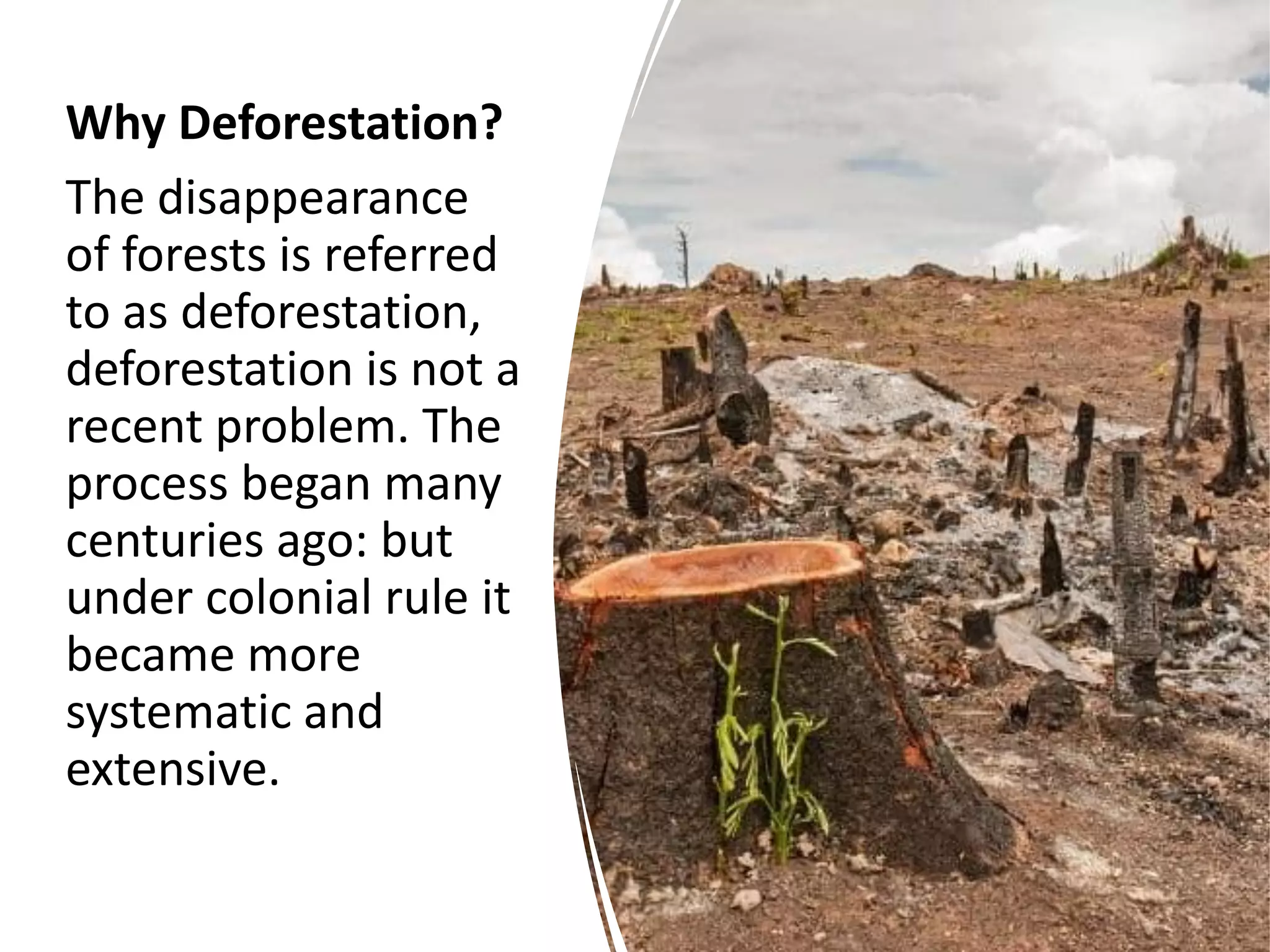
Why Deforestation?
The disappearance
of forests is referred
to as deforestation,
deforestation is not a
recent problem. The
process began many
centuries ago: but
under colonial rule it
became more
systematic and
extensive.
THE RISE OF
COMMERCIAL
FORESTRY
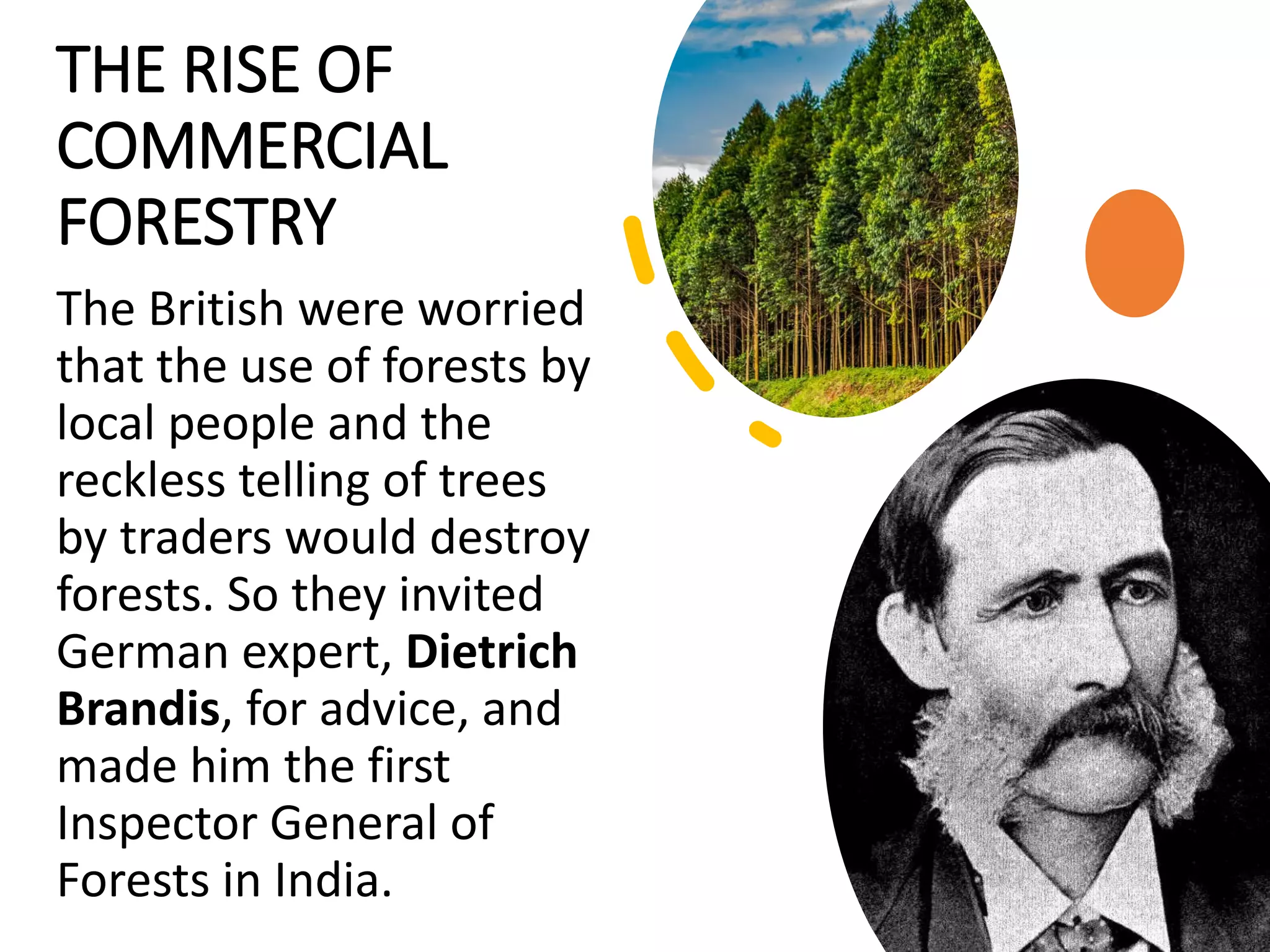
The British were worried
that the use of forests by
local people and the
reckless telling of trees
by traders would destroy
forests. So they invited
German expert, Dietrich
Brandis, for advice, and
made him the first
Inspector General of
Forests in India.
How did Forest Rules Affect
Cultivation?
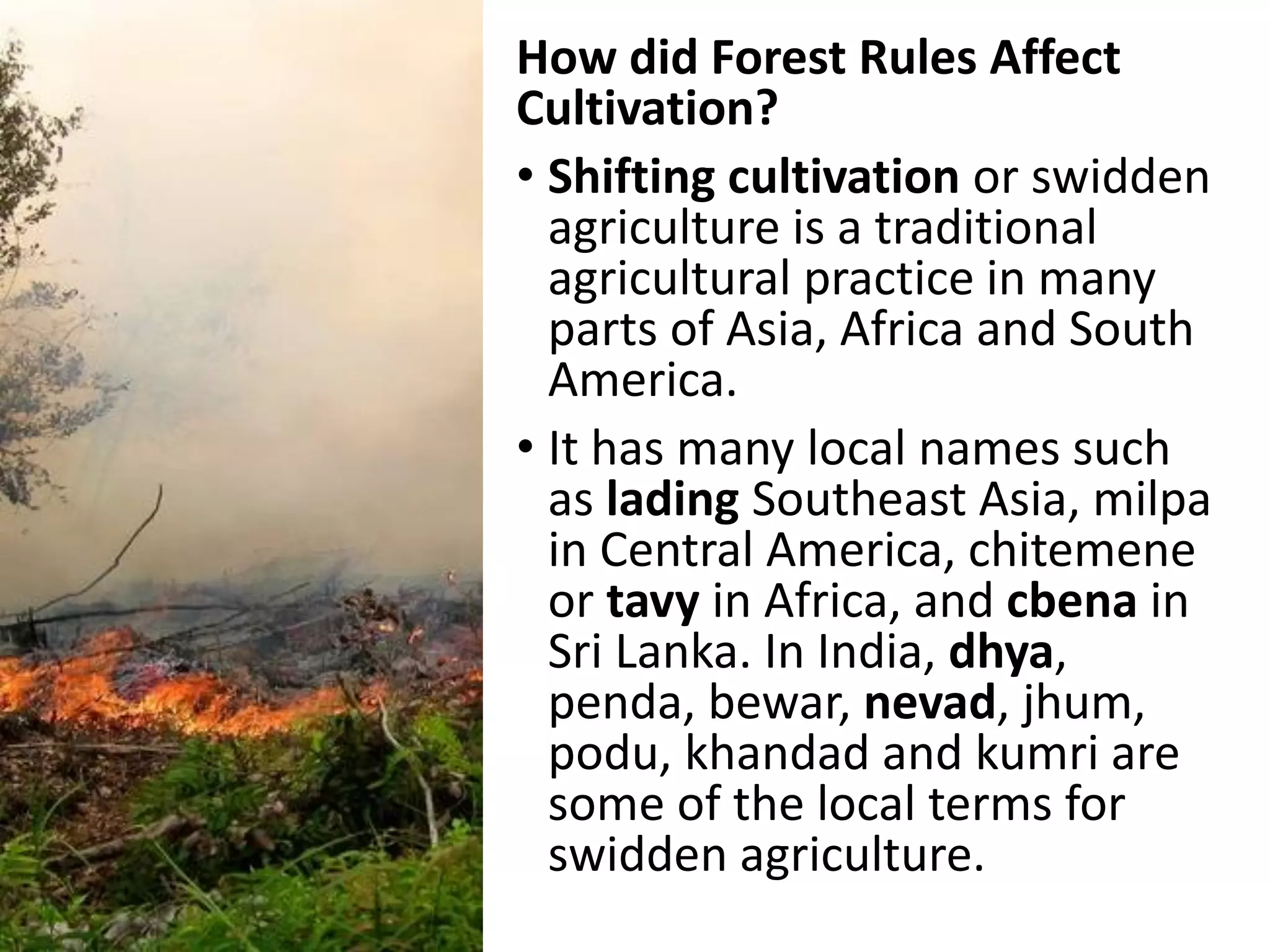
• Shifting cultivation or swidden
agriculture is a traditional
agricultural practice in many
parts of Asia, Africa and South
America.
• It has many local names such
as lading Southeast Asia, milpa
in Central America, chitemene
or tavy in Africa, and cbena in
Sri Lanka. In India, dhya,
penda, bewar, nevad, jhum,
podu, khandad and kumri are
some of the local terms for
swidden agriculture.
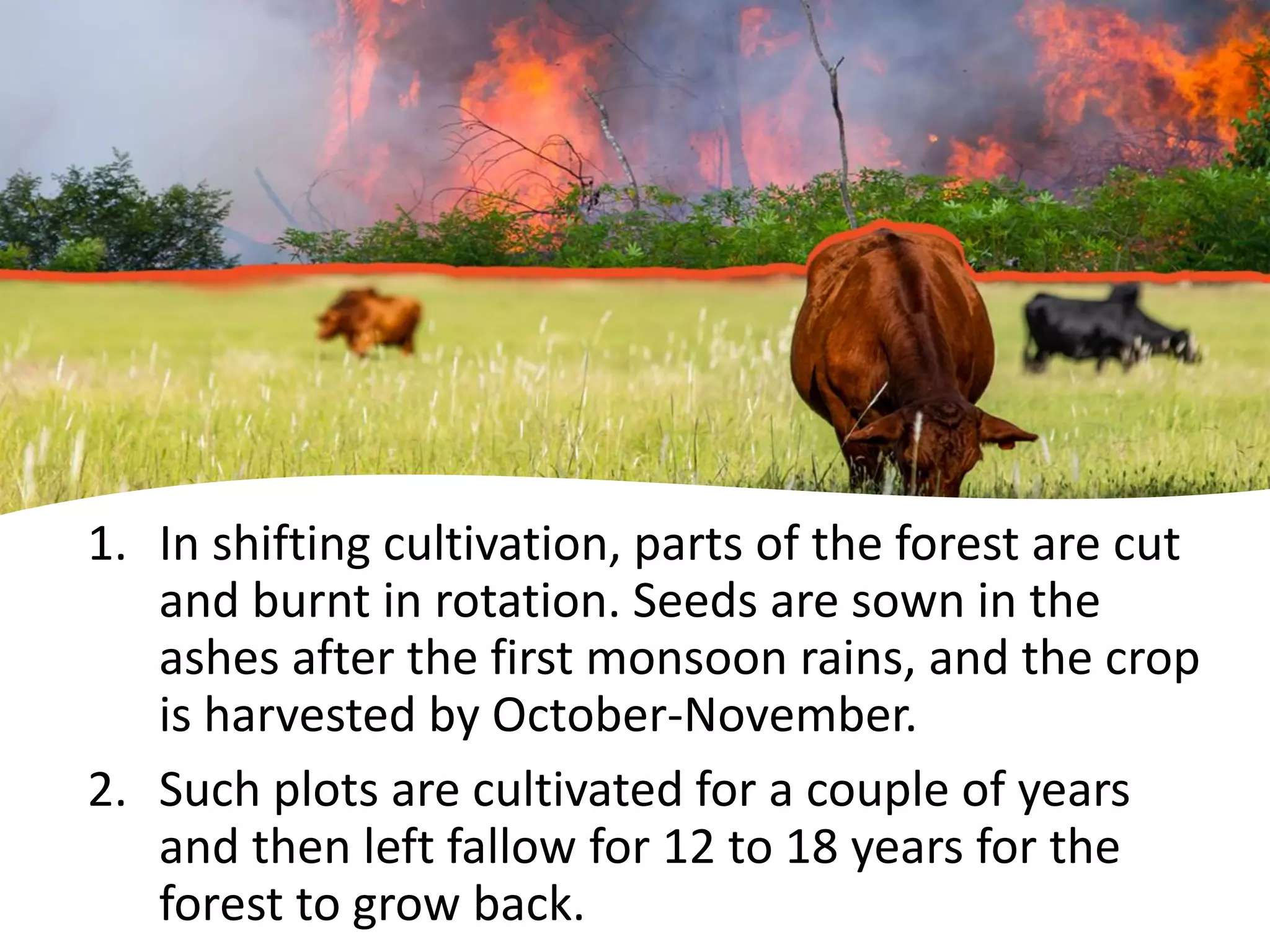
1. In shifting cultivation, parts of the forest are cut
and burnt in rotation. Seeds are sown in the
ashes after the first monsoon rains, and the crop
is harvested by October-November.
2. Such plots are cultivated for a couple of years
and then left fallow for 12 to 18 years for the
forest to grow back.
European foresters regarded this practice
as harmful for the forests.
• They felt that land which was used for
cultivation every few years could not grow
trees for railway timber.
• When a forest was burnt, there was the added
danger of the flames spreading and burning
valuable timber.
• Shifting cultivation also made it harder for the
government to calculate, taxes. Therefore, the
government decided to ban shifting
cultivation.
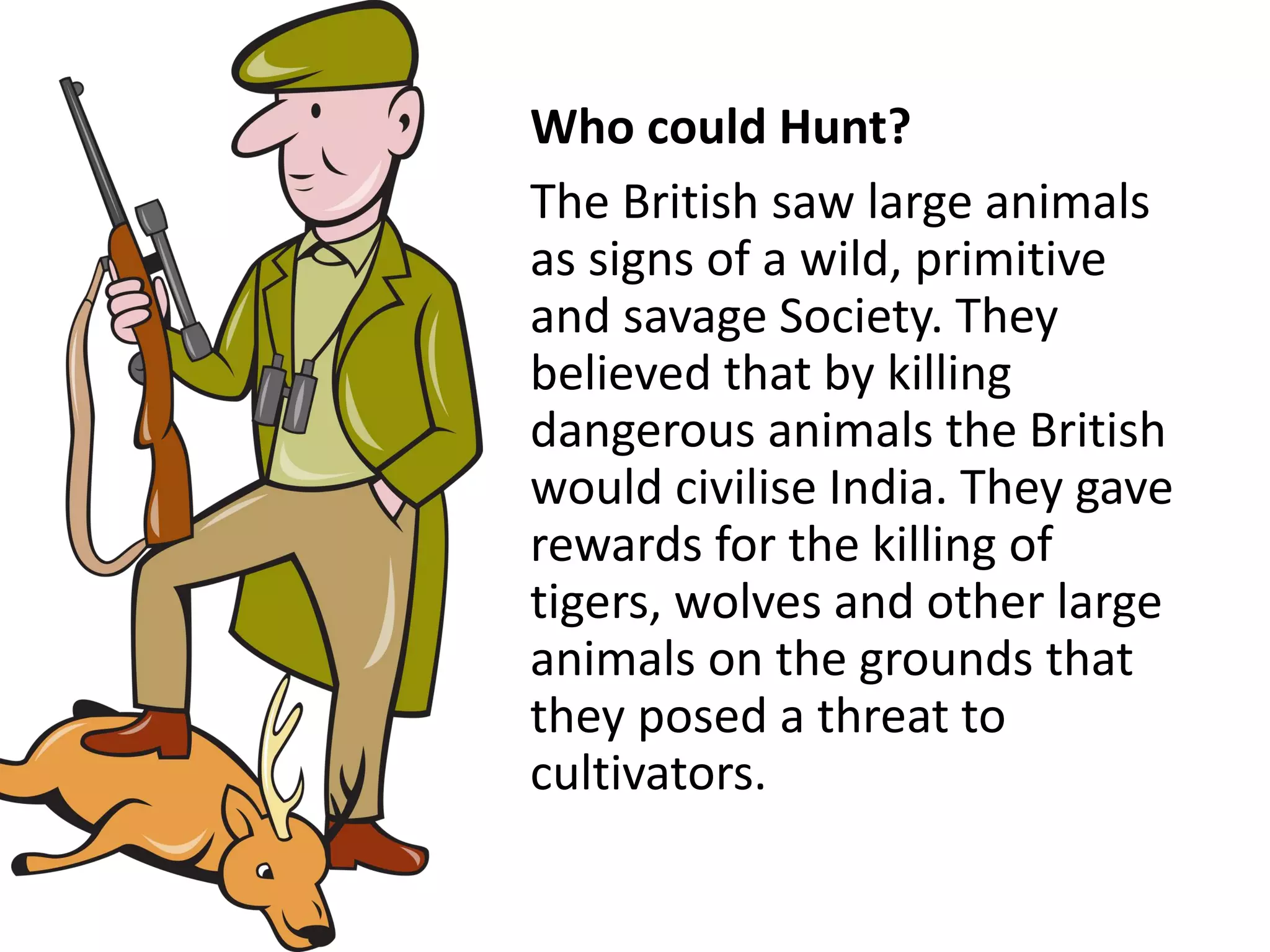
Who could Hunt?
The British saw large animals
as signs of a wild, primitive
and savage Society. They
believed that by killing
dangerous animals the British
would civilise India. They gave
rewards for the killing of
tigers, wolves and other large
animals on the grounds that
they posed a threat to
cultivators.
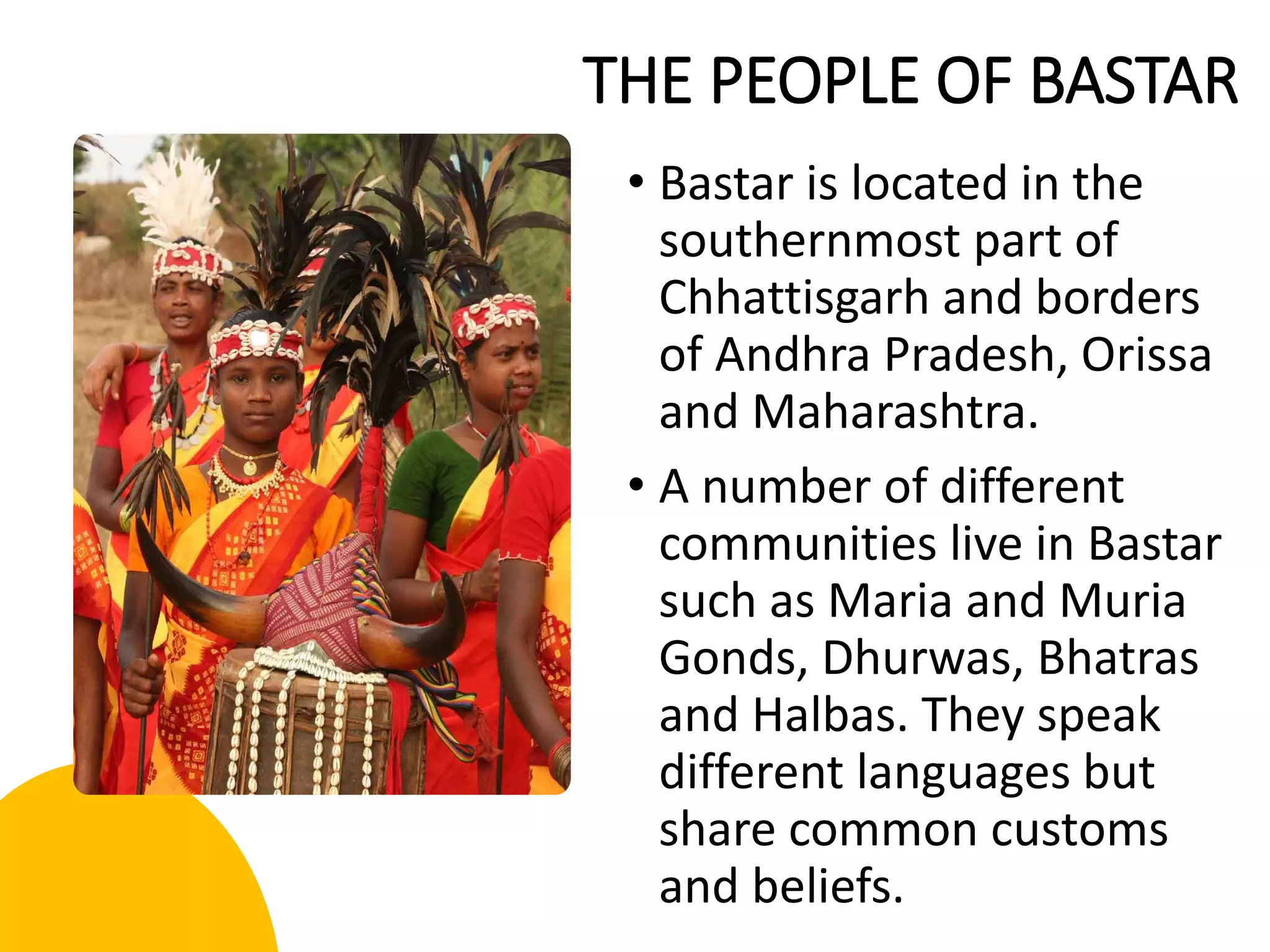
THE PEOPLE OF BASTAR
• Bastar is located in the
southernmost part of
Chhattisgarh and borders
of Andhra Pradesh, Orissa
and Maharashtra.
• A number of different
communities live in Bastar
such as Maria and Muria
Gonds, Dhurwas, Bhatras
and Halbas. They speak
different languages but
share common customs
and beliefs.
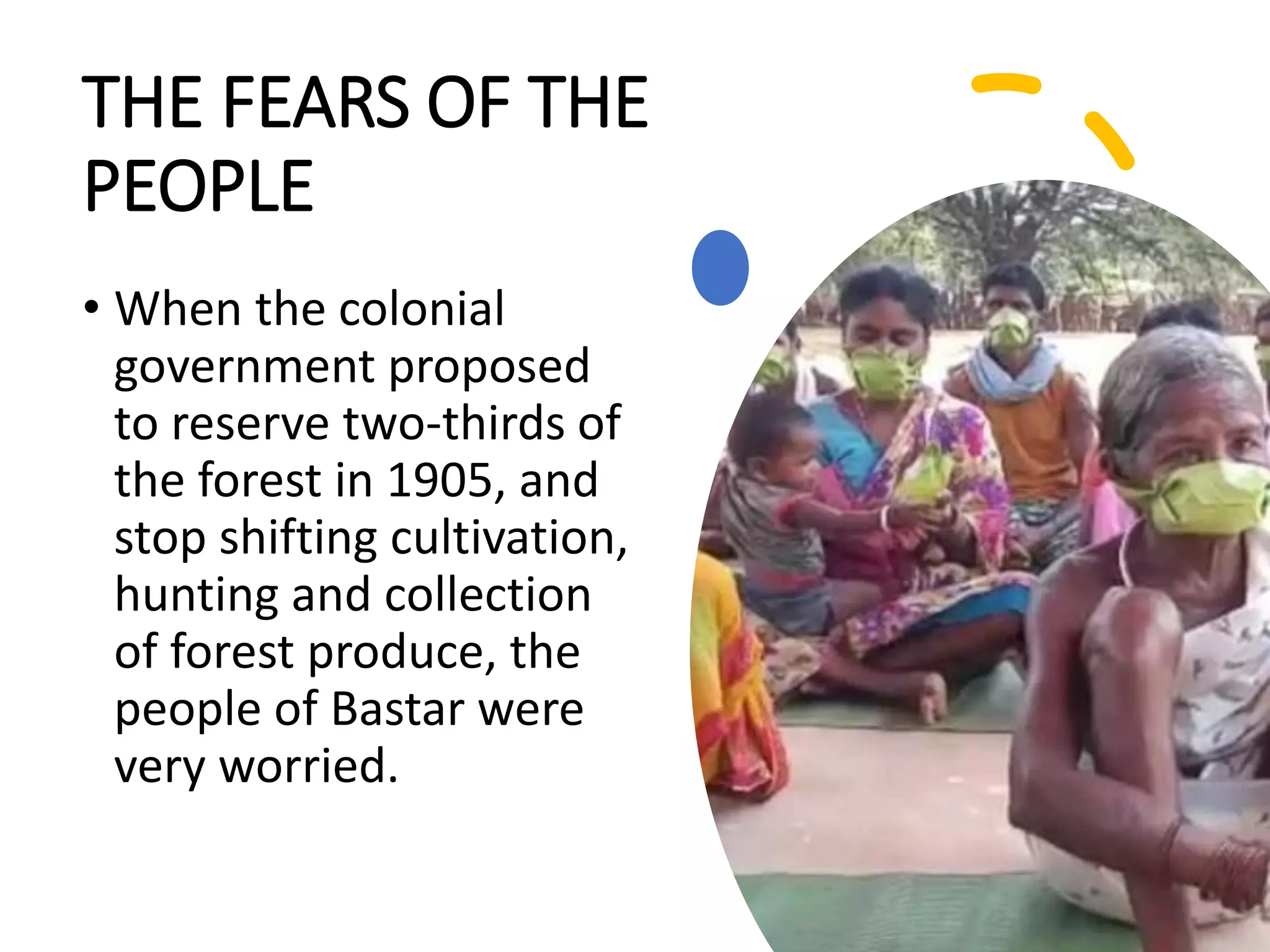
THE FEARS OF THE
PEOPLE
• When the colonial
government proposed
to reserve two-thirds of
the forest in 1905, and
stop shifting cultivation,
hunting and collection
of forest produce, the
people of Bastar were
very worried.
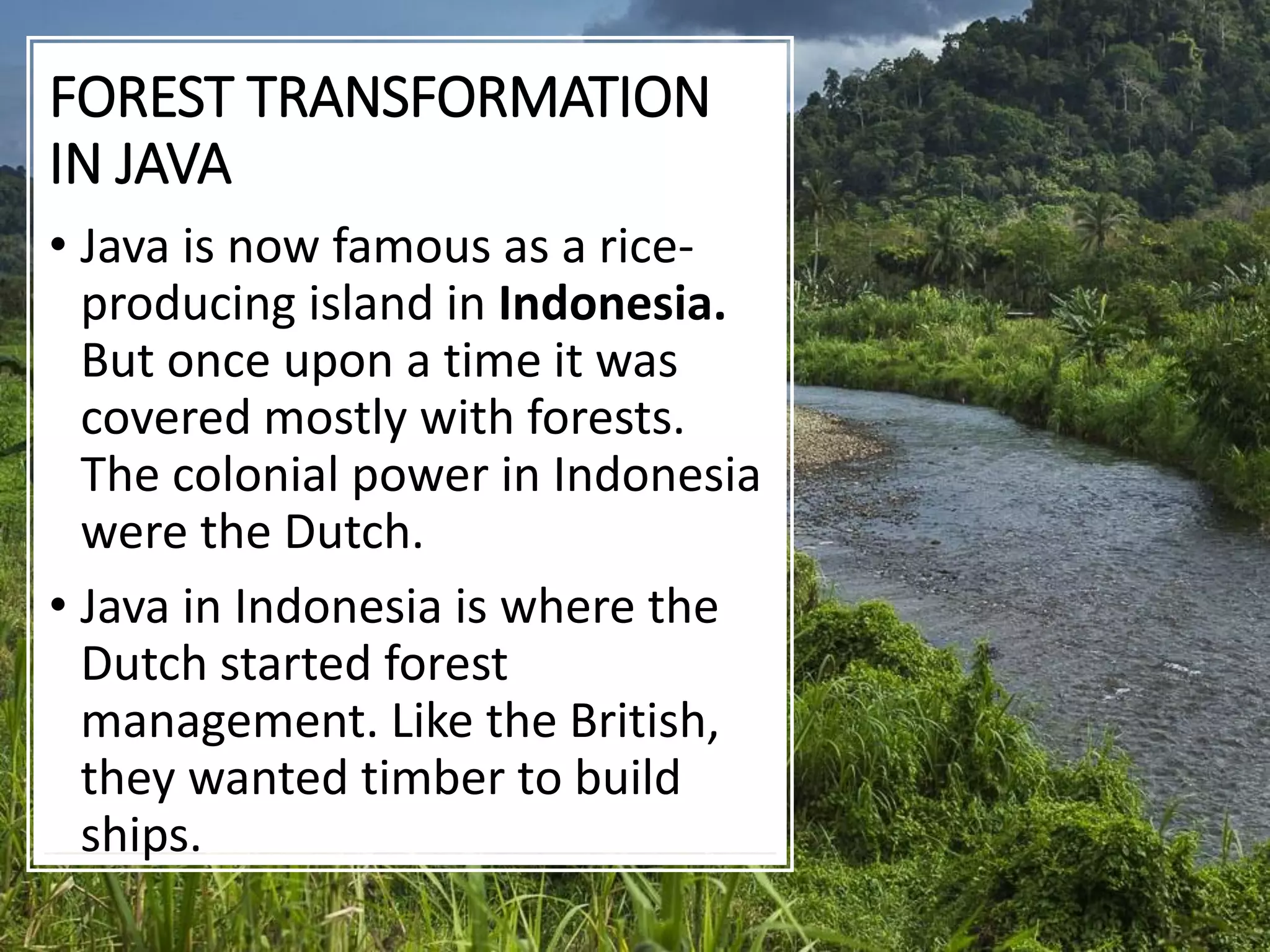
FOREST TRANSFORMATION
IN JAVA
• Java is now famous as a rice-
producing island in Indonesia.
But once upon a time it was
covered mostly with forests.
The colonial power in Indonesia
were the Dutch.
• Java in Indonesia is where the
Dutch started forest
management. Like the British,
they wanted timber to build
ships.
THE WOODCUTTERS OF JAVA
• The Kalangs of Java were a community of skilled
forest cutters and shifting cultivators.
• Without their expertise, it would have been
difficult to harvest teak and for the kings to
build their palaces. When the Dutch began to
gain control over the forests in the eighteenth
century, they tried to make the Kalangs work
under them. In 1770, the Kalangs resisted
attacking a Dutch fort at Joana, but the uprising
was suppressed.
DUTCH SCIENTIFIC FORESTRY
The Dutch enacted forest laws in Java,
restricting villagers access to forests.
• Now wood could only be cut for specified
purposes like making river boats or
constructing houses, and only from specific
forests under those supervisions.
• Villagers were punished for grazing cattle in
young stands, transporting wood without a
permit, or travelling on forest roads with
horse carts or cattle.
SAMIN’S CHALLENGE
• Around 1890, Surontiko Samin of
Randublatung village, a teak forest village,
began questioning state ownership of the
forest. He argued that the state had not
created the wind, water, earth and wood, so
it could not own it.
• Some of the Saminists protested by lying
down on their land when the Dutch came to
survey it, while others refused to pay taxes
or fines or perform labour.
WAR AND DEFORESTATION
1. In India, working plans were
abandoned at this time, and the
forest department cut trees
freely to meet British war
needs.
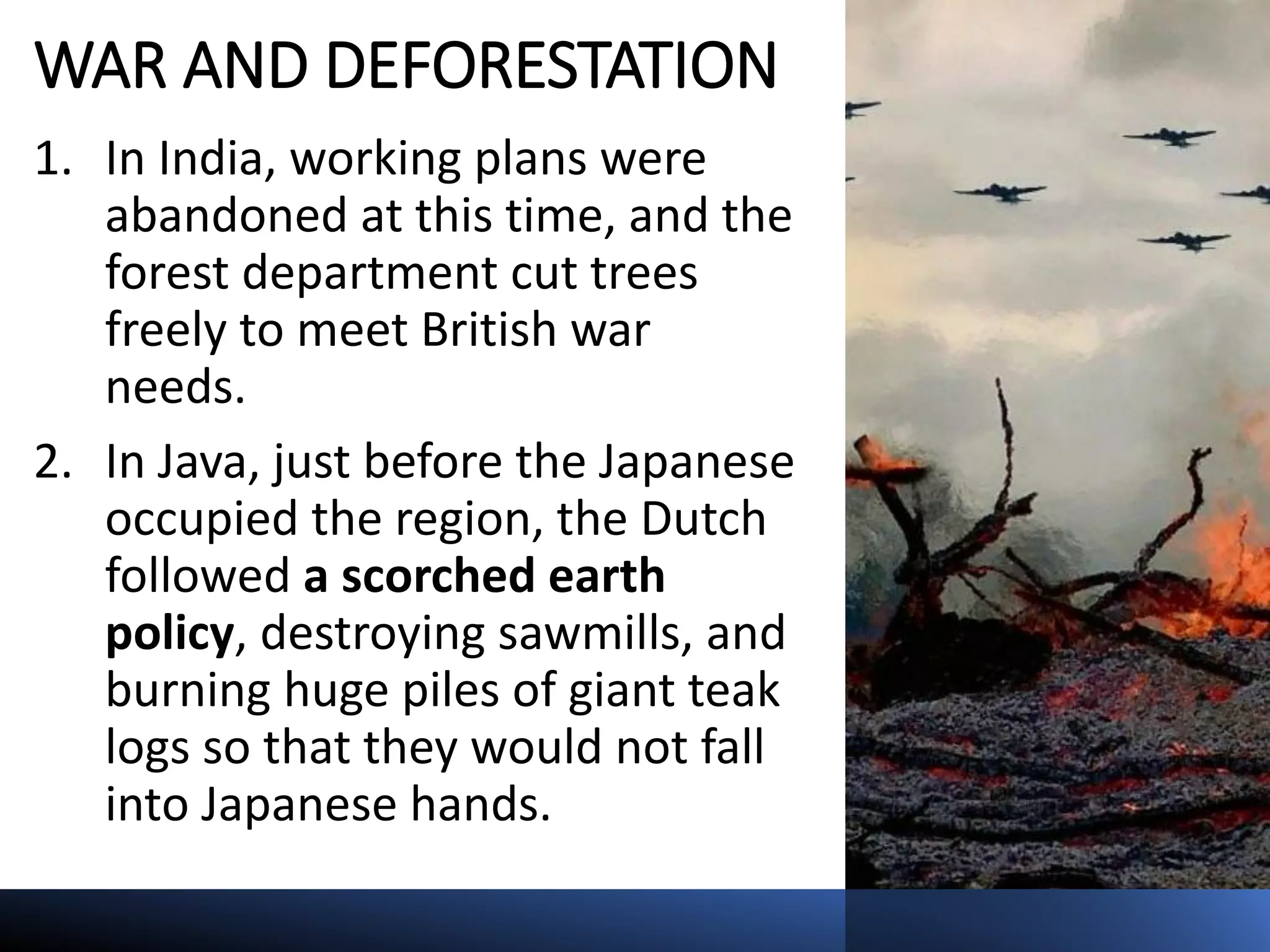
2. In Java, just before the Japanese
occupied the region, the Dutch
followed a scorched earth
policy, destroying sawmills, and
burning huge piles of giant teak
logs so that they would not fall
into Japanese hands.
NEW DEVELOPMENTS
IN FORESTRY
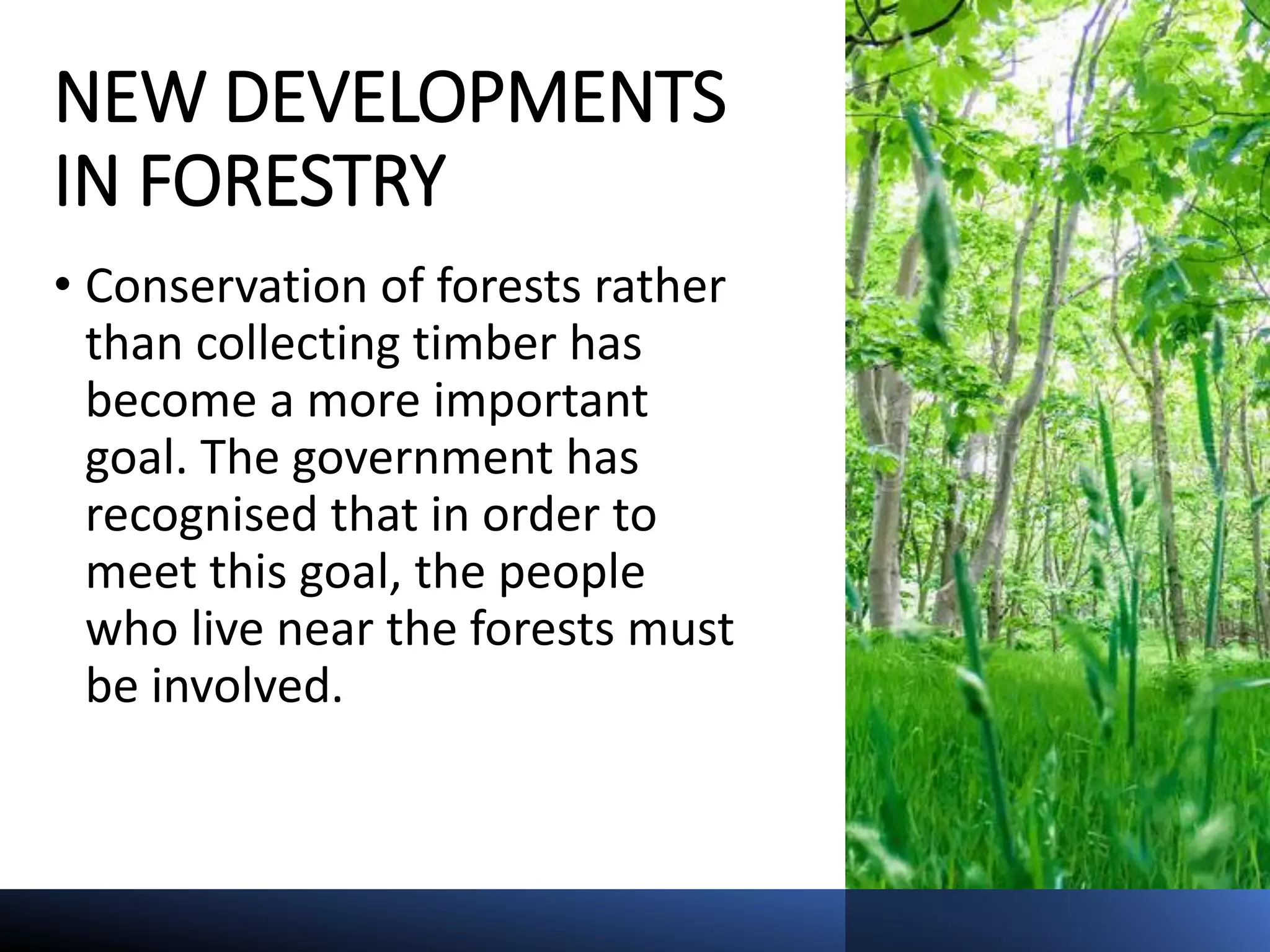
• Conservation of forests rather
than collecting timber has
become a more important
goal. The government has
recognised that in order to
meet this goal, the people
who live near the forests must
be involved.
1. In many cases, across India, from Mizoram to
Kerala, dense forests have survived only
because villages projected them in sacred
groves known as sarnas, devarakudu, kan, mi.
etc.
2. Some villages have been patrolling their own
forests, with each household taking it in turns,
instead of leaving it to the forest guards.
3. Local forest communities and
environmentalists today are thinking of
different forms of forest managements.
I have expertise in making educational
and other PPTs. Email me for more
PPTs at a very reasonable price that
perfectly fits in your budget.
Email: parmarshivam105@gmail.com
THANK YOU
• This PPT is for educational
purposes only. If you find
any infringement of your
copyrighted content, email
me directly and I will
remove it.
• If anyone is found using
this PPT for commercial
purposes, he/she will be
solely responsible for the
consequences.

Chapter - 4, Forest Society and Colonialism, History, Social Science, Class 9

  • 1.
    CHAPTER - 4 FORESTSOCIETY AND COLONIALISM Email for more PPTs at a very reasonable price. Email: parmarshivam105@gmail.com By Shivam Parmar (PPT Designer)
  • 2.
    INTRODUCTION • This Chapterwill take you into the forest and tell you about the variety of ways the forests were used by communities living within them. You will see how colonial control was established over the forests, how forest areas were mapped, trees were classified, and plantations were developed. • All these developments affected the lives of those local communities who used forest resources. The chapter will give you an idea of the history of such developments in India and Indonesia.
  • 3.
    FOREST SOCIETY AND COLONIALISM • Forestsprovide bamboo, wood for fuel, grass, charcoal packaging, fruits, flowers, animals, birds and many other things.
  • 4.
    Why Deforestation? The disappearance offorests is referred to as deforestation, deforestation is not a recent problem. The process began many centuries ago: but under colonial rule it became more systematic and extensive.
  • 5.
    THE RISE OF COMMERCIAL FORESTRY TheBritish were worried that the use of forests by local people and the reckless telling of trees by traders would destroy forests. So they invited German expert, Dietrich Brandis, for advice, and made him the first Inspector General of Forests in India.
  • 6.
    How did ForestRules Affect Cultivation? • Shifting cultivation or swidden agriculture is a traditional agricultural practice in many parts of Asia, Africa and South America. • It has many local names such as lading Southeast Asia, milpa in Central America, chitemene or tavy in Africa, and cbena in Sri Lanka. In India, dhya, penda, bewar, nevad, jhum, podu, khandad and kumri are some of the local terms for swidden agriculture.
  • 7.
    1. In shiftingcultivation, parts of the forest are cut and burnt in rotation. Seeds are sown in the ashes after the first monsoon rains, and the crop is harvested by October-November. 2. Such plots are cultivated for a couple of years and then left fallow for 12 to 18 years for the forest to grow back.
  • 8.
    European foresters regardedthis practice as harmful for the forests. • They felt that land which was used for cultivation every few years could not grow trees for railway timber. • When a forest was burnt, there was the added danger of the flames spreading and burning valuable timber. • Shifting cultivation also made it harder for the government to calculate, taxes. Therefore, the government decided to ban shifting cultivation.
  • 9.
    Who could Hunt? TheBritish saw large animals as signs of a wild, primitive and savage Society. They believed that by killing dangerous animals the British would civilise India. They gave rewards for the killing of tigers, wolves and other large animals on the grounds that they posed a threat to cultivators.
  • 10.
    THE PEOPLE OFBASTAR • Bastar is located in the southernmost part of Chhattisgarh and borders of Andhra Pradesh, Orissa and Maharashtra. • A number of different communities live in Bastar such as Maria and Muria Gonds, Dhurwas, Bhatras and Halbas. They speak different languages but share common customs and beliefs.
  • 11.
    THE FEARS OFTHE PEOPLE • When the colonial government proposed to reserve two-thirds of the forest in 1905, and stop shifting cultivation, hunting and collection of forest produce, the people of Bastar were very worried.
  • 12.
    FOREST TRANSFORMATION IN JAVA •Java is now famous as a rice- producing island in Indonesia. But once upon a time it was covered mostly with forests. The colonial power in Indonesia were the Dutch. • Java in Indonesia is where the Dutch started forest management. Like the British, they wanted timber to build ships.
  • 13.
    THE WOODCUTTERS OFJAVA • The Kalangs of Java were a community of skilled forest cutters and shifting cultivators. • Without their expertise, it would have been difficult to harvest teak and for the kings to build their palaces. When the Dutch began to gain control over the forests in the eighteenth century, they tried to make the Kalangs work under them. In 1770, the Kalangs resisted attacking a Dutch fort at Joana, but the uprising was suppressed.
  • 14.
    DUTCH SCIENTIFIC FORESTRY TheDutch enacted forest laws in Java, restricting villagers access to forests. • Now wood could only be cut for specified purposes like making river boats or constructing houses, and only from specific forests under those supervisions. • Villagers were punished for grazing cattle in young stands, transporting wood without a permit, or travelling on forest roads with horse carts or cattle.
  • 15.
    SAMIN’S CHALLENGE • Around1890, Surontiko Samin of Randublatung village, a teak forest village, began questioning state ownership of the forest. He argued that the state had not created the wind, water, earth and wood, so it could not own it. • Some of the Saminists protested by lying down on their land when the Dutch came to survey it, while others refused to pay taxes or fines or perform labour.
  • 16.
    WAR AND DEFORESTATION 1.In India, working plans were abandoned at this time, and the forest department cut trees freely to meet British war needs. 2. In Java, just before the Japanese occupied the region, the Dutch followed a scorched earth policy, destroying sawmills, and burning huge piles of giant teak logs so that they would not fall into Japanese hands.
  • 17.
    NEW DEVELOPMENTS IN FORESTRY •Conservation of forests rather than collecting timber has become a more important goal. The government has recognised that in order to meet this goal, the people who live near the forests must be involved.
  • 18.
    1. In manycases, across India, from Mizoram to Kerala, dense forests have survived only because villages projected them in sacred groves known as sarnas, devarakudu, kan, mi. etc. 2. Some villages have been patrolling their own forests, with each household taking it in turns, instead of leaving it to the forest guards. 3. Local forest communities and environmentalists today are thinking of different forms of forest managements.
  • 19.
    I have expertisein making educational and other PPTs. Email me for more PPTs at a very reasonable price that perfectly fits in your budget. Email: parmarshivam105@gmail.com THANK YOU
  • 20.
    • This PPTis for educational purposes only. If you find any infringement of your copyrighted content, email me directly and I will remove it. • If anyone is found using this PPT for commercial purposes, he/she will be solely responsible for the consequences.