CLASS- IXth HISTORY
.
WHAT WILL WE LEARN ?
1. Why Deforestation?
2. The Rise of Commercial Forestry .
3. How were the Lives of People Affected?
4. The Forest Act meant severe hardship for villagers across the
country.
5. Who could Hunt?
6.New Trades, New Employments and New Services.
7. Rebellion in the Forest
8. BASTAR AND JAVA( INDONESIA)
9. War and Deforestation.
10. New Developments in Forestry.
• DEFORESTATION: Deforestation is cutting down of trees
indiscriminately in a forest area. Under the colonial rule it became
very systematic and extensive.
Why Deforestation?
• The disappearance of forests is referred to as deforestation.
• Deforestation is not a recent problem. The process began many
• centuries ago; but under colonial rule it became more systematic
and
• 1.the British directly
encouraged the production
of commercial crops like
jute, sugar, wheat and
cotton.
• 2.foodgrains were needed
to feed the growing
POPULATION
• 1.Sleepers – Wooden planks laid
across railway
• tracks; they hold the tracks in
position
• 2.The spread of railways from the
1850s created a new demand.
• 3. By the early nineteenth
century, oak forests in England
were
• disappearing. This created a
problem of timber supply for the
Royal
• Navy
• Large areas of natural
forests were also cleared
to make way for
• tea, coffee and rubber
plantations to meet
Europe’s growing need
• for these commodities.
• Brandis set up the Indian
Forest Service in 1864
and helped formulate the
Indian Forest Act of
1865. The Imperial
Forest Research
Institute was set up at
Dehradun in 1906. The
system they taught here
was called ‘scientific
forestry’.
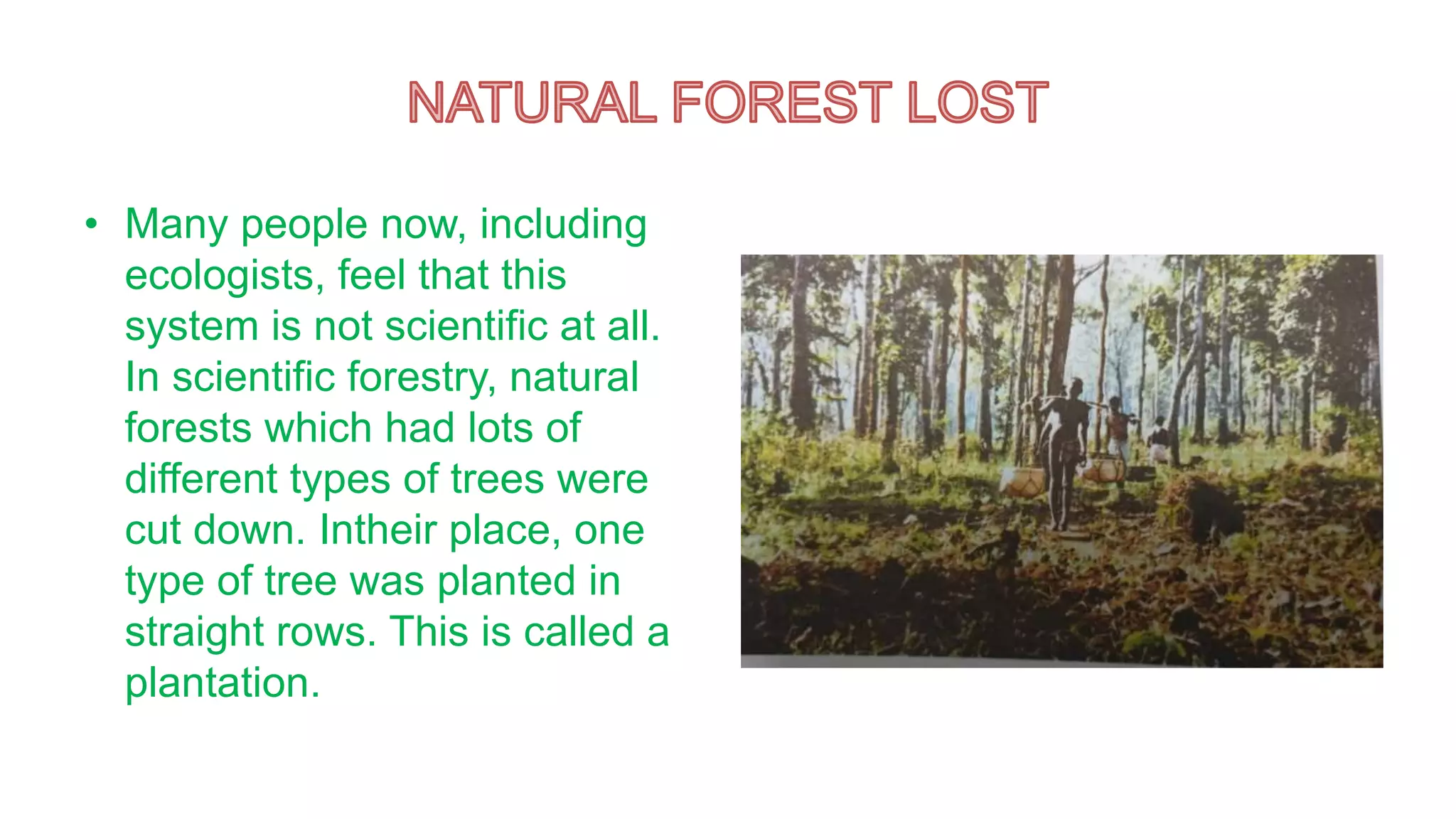
• Many people now, including
ecologists, feel that this
system is not scientific at all.
In scientific forestry, natural
forests which had lots of
different types of trees were
cut down. Intheir place, one
type of tree was planted in
straight rows. This is called a
plantation.
FOREST SURVEY
• Forest officials surveyed the
forests, estimated the area
under different types of trees,
and made working plans for
forest management. They
planned how much of the
plantation area to cut every
year. The area cut was then to
be replanted so that it was
ready to be cut again in some
years
A
• 1.Villagers wanted forests with a mixture of
species
• to satisfy different needs – fuel, fodder,
leaves.
• 2.The forest department on the other hand
wanted trees which were suitable for
building ships or railways.
B.
In forest areas, people use forest products
• 1.Roots, leaves, fruits, and tubers.
• 2.Fruits and tubers are nutritious to eat.
• 3.Herbs are used for medicine
B.
In forest areas, people use forest products
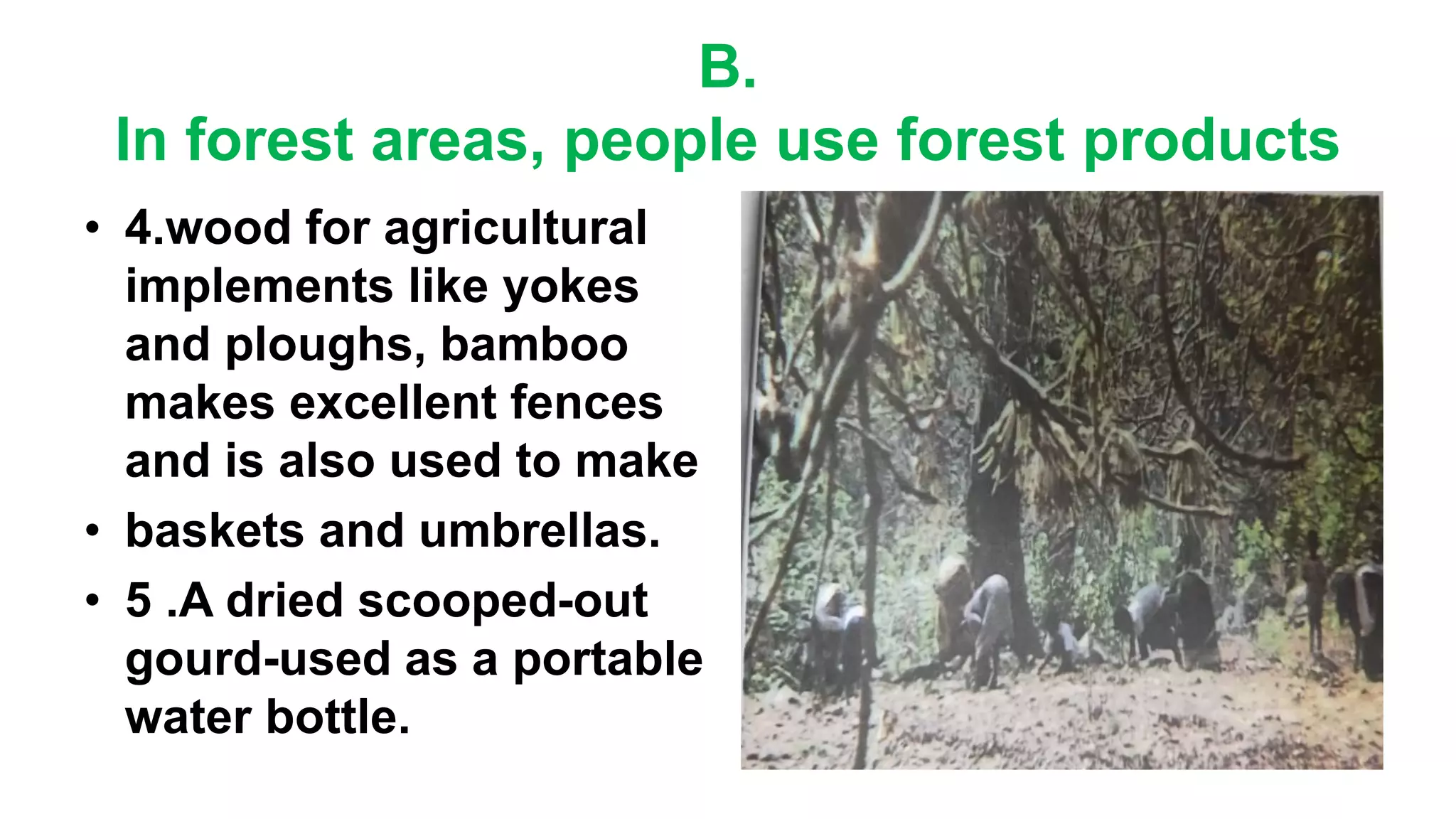
• 4.wood for agricultural
implements like yokes
and ploughs, bamboo
makes excellent fences
and is also used to make
• baskets and umbrellas.
• 5 .A dried scooped-out
gourd-used as a portable
water bottle.
B.
In forest areas, people use forest products
• 6.The forest – leaves :
disposable plates and cups,
• 7.The siadi (Bauhinia vahlii)
creeper :ropes, and the
• thorny bark of the semur
(silk-cotton) tree is used to
grate vegetables
• 8.Oil for cooking and to light
lamps can be pressed from
the fruit of
• the mahua tree.
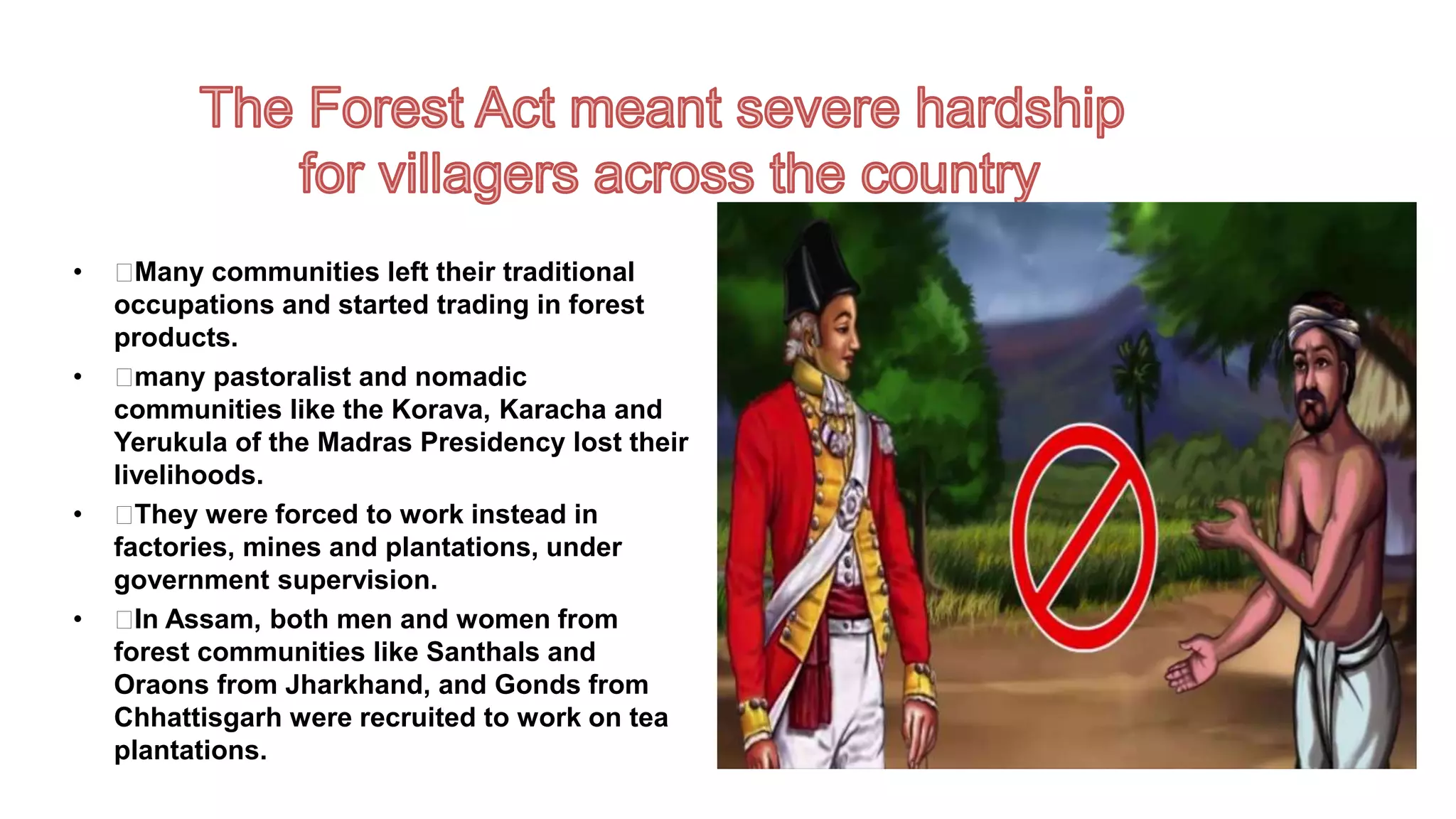
• Many communities left their traditional
occupations and started trading in forest
products.
• many pastoralist and nomadic
communities like the Korava, Karacha and
Yerukula of the Madras Presidency lost their
livelihoods.
• They were forced to work instead in
factories, mines and plantations, under
government supervision.
• In Assam, both men and women from
forest communities like Santhals and
Oraons from Jharkhand, and Gonds from
Chhattisgarh were recruited to work on tea
plantations.
 Siddhu and Kanu in the
Santhal Parganas,
 Birsa Munda of
Chhotanagpur
 Alluri Sitarama Raju of
Andhra Pradesh
 Rebellion which took
place in the kingdom of
Bastar in 1910.
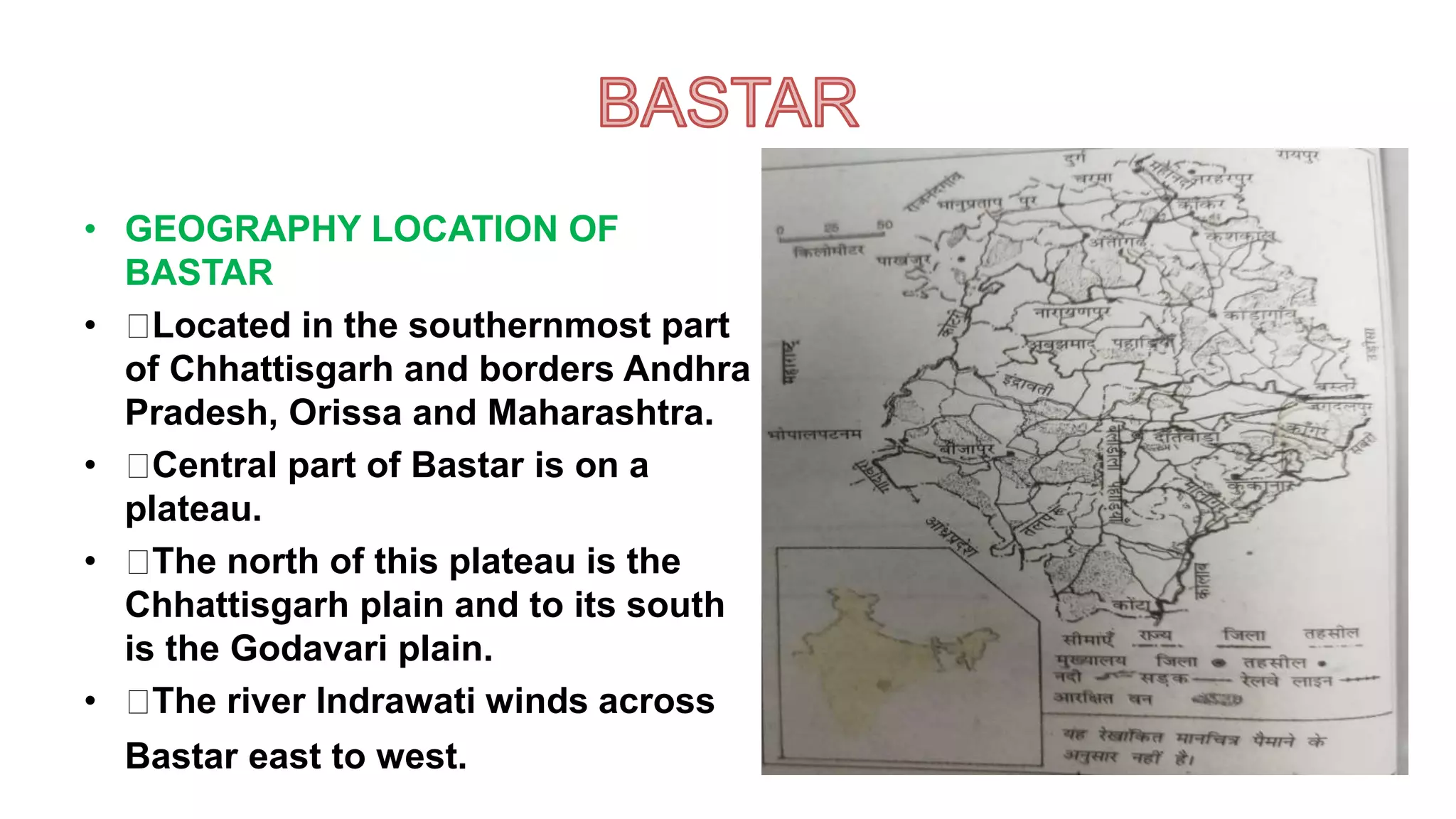
• GEOGRAPHY LOCATION OF
BASTAR
• Located in the southernmost part
of Chhattisgarh and borders Andhra
Pradesh, Orissa and Maharashtra.
• Central part of Bastar is on a
plateau.
• The north of this plateau is the
Chhattisgarh plain and to its south
is the Godavari plain.
• The river Indrawati winds across
Bastar east to west.
• Communities live in Bastar such as
Maria and Muria Gonds, Dhurwas,
Bhatras and Halbas.
• They speak different languages but
share common customs and beliefs.
• The people of Bastar believe that each
village was given its land by the Earth.
• They show respect to the spirits of the
river, the forest and the mountain.
• Every year there is one big hunt
where the headmen of villages in a
pargana (cluster of villages) meet and
discuss issues of concern, including
forests.
• village knows where its boundaries
lie, the local people look after all the
natural resources within that boundary.(
they pay a small fee called devsari,
dand or man in exchange)
• The people of Bastar were very
worried, allowed to stay on in the
reserved forests on the condition
• They worked free for the forest
department .
• Displaced without any notice.
• The terrible famines, in 1899-1900 and
again in 1907-1908. Reservations
proved to be the last straw.
• The initiative was taken by the
Dhurwas of the Kanger forest
• There was no single leader,
many people speak of Gunda
Dhur, from village Nethanar, as
an important figure in the
movement. In 1910,
• Rebel against the British, Most
villages were deserted as people
fled into the jungles.
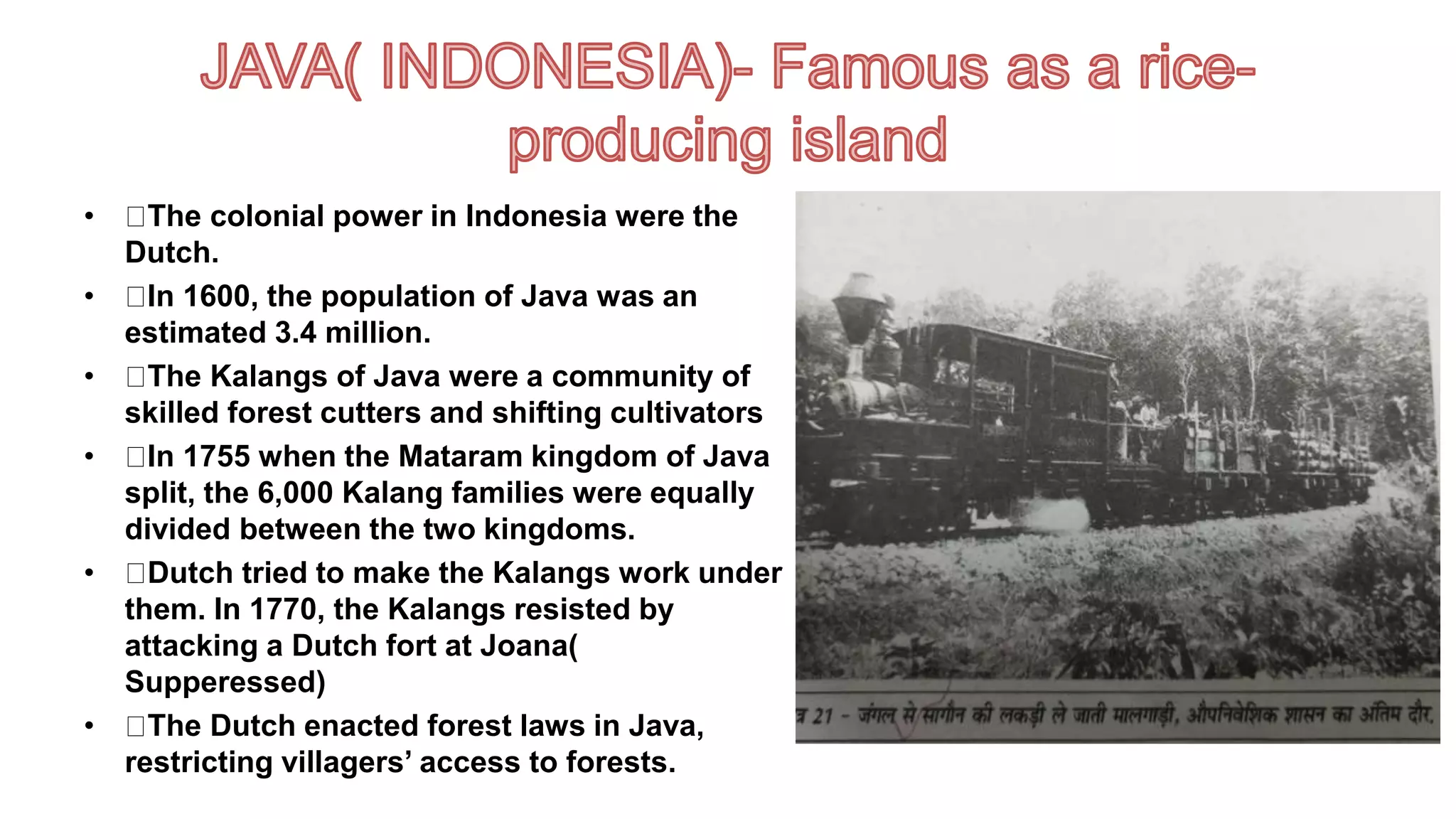
• The colonial power in Indonesia were the
Dutch.
• In 1600, the population of Java was an
estimated 3.4 million.
• The Kalangs of Java were a community of
skilled forest cutters and shifting cultivators
• In 1755 when the Mataram kingdom of Java
split, the 6,000 Kalang families were equally
divided between the two kingdoms.
• Dutch tried to make the Kalangs work under
them. In 1770, the Kalangs resisted by
attacking a Dutch fort at Joana(
Supperessed)
• The Dutch enacted forest laws in Java,
restricting villagers’ access to forests.
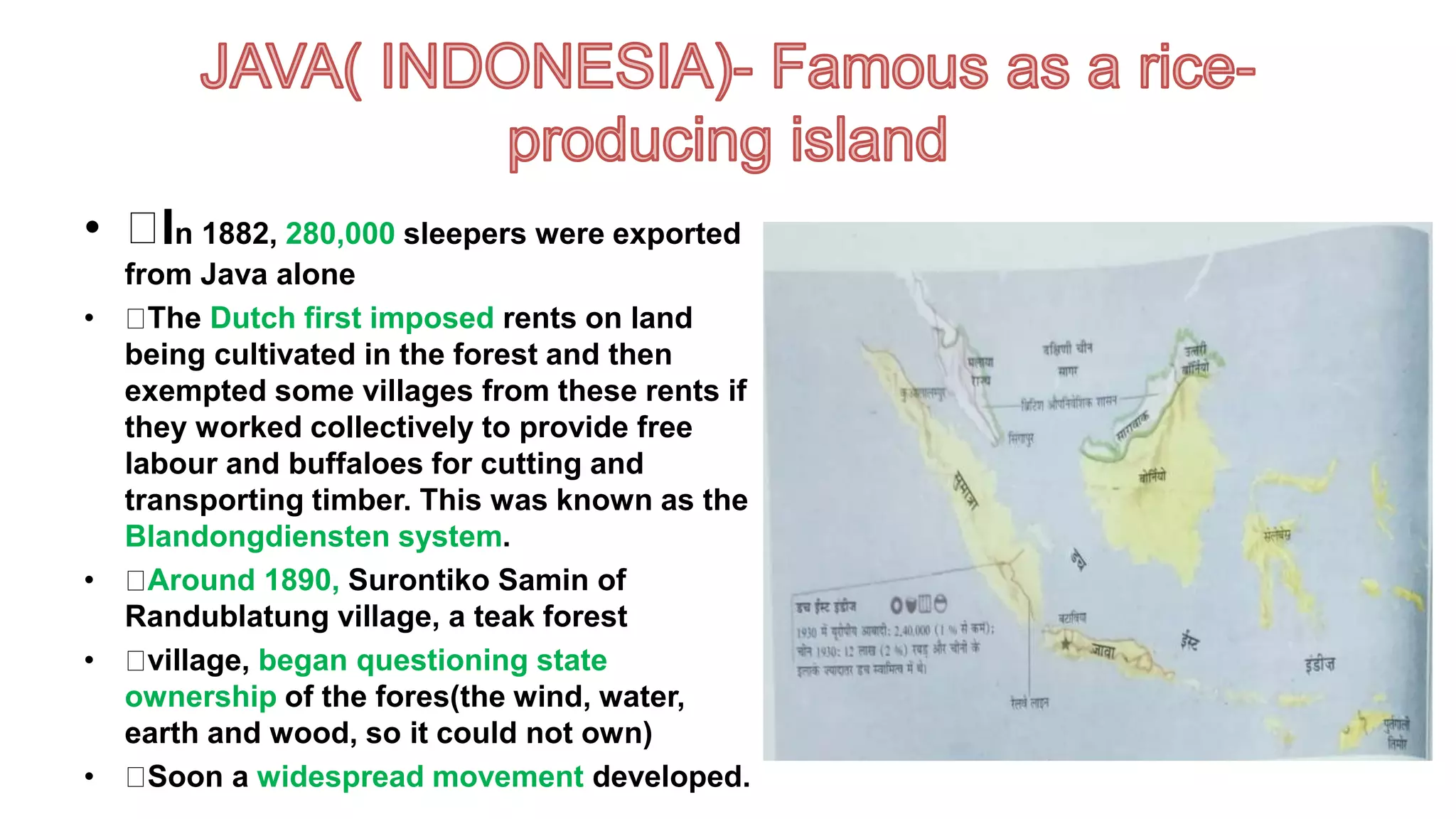
• In 1882, 280,000 sleepers were exported
from Java alone
• The Dutch first imposed rents on land
being cultivated in the forest and then
exempted some villages from these rents if
they worked collectively to provide free
labour and buffaloes for cutting and
transporting timber. This was known as the
Blandongdiensten system.
• Around 1890, Surontiko Samin of
Randublatung village, a teak forest
• village, began questioning state
ownership of the fores(the wind, water,
earth and wood, so it could not own)
• Soon a widespread movement developed.
• In India, working plans were
abandoned at this time, and the
forest department cut trees freely
to meet British
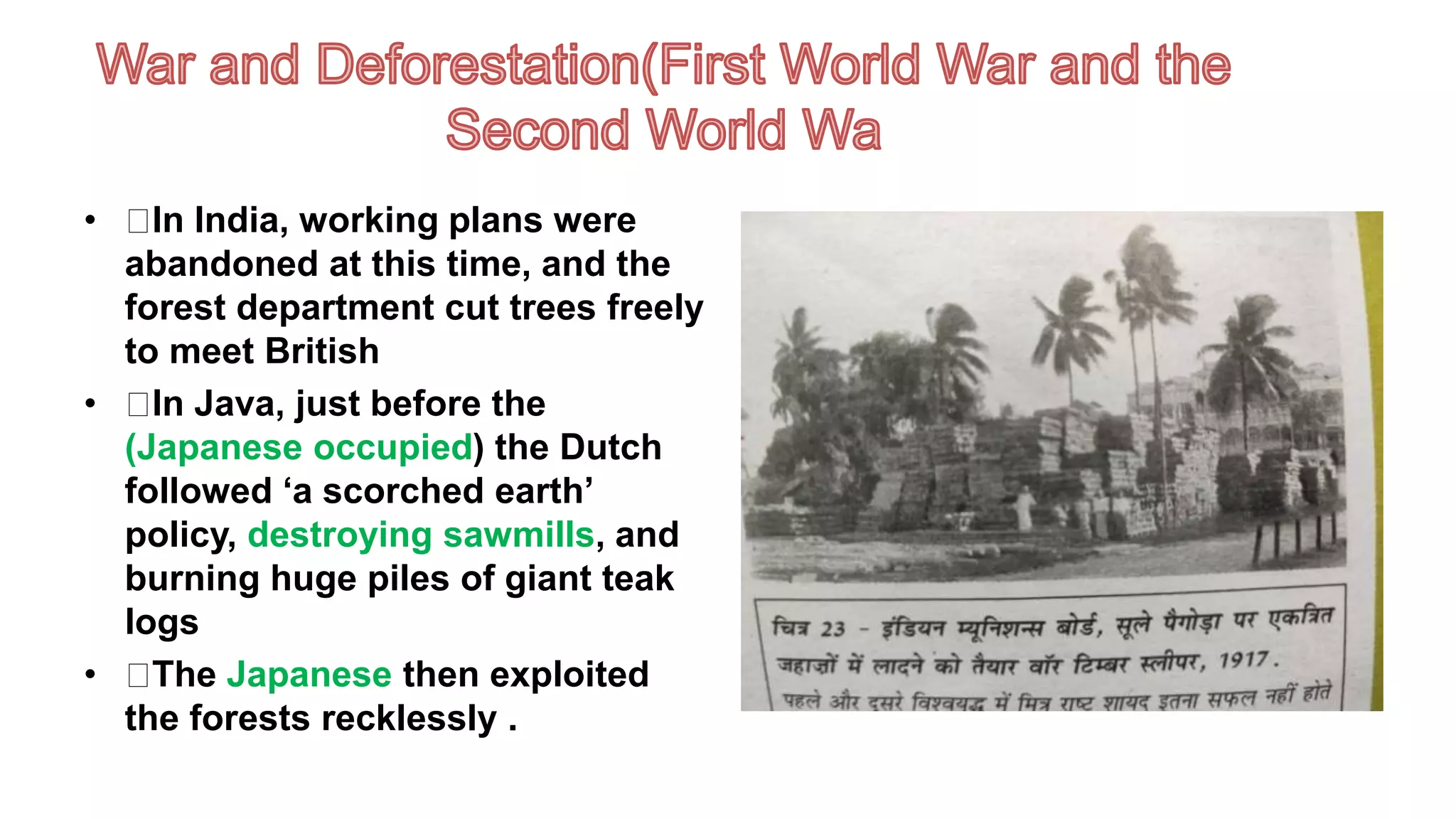
• In Java, just before the
(Japanese occupied) the Dutch
followed ‘a scorched earth’
policy, destroying sawmills, and
burning huge piles of giant teak
logs
• The Japanese then exploited
the forests recklessly .
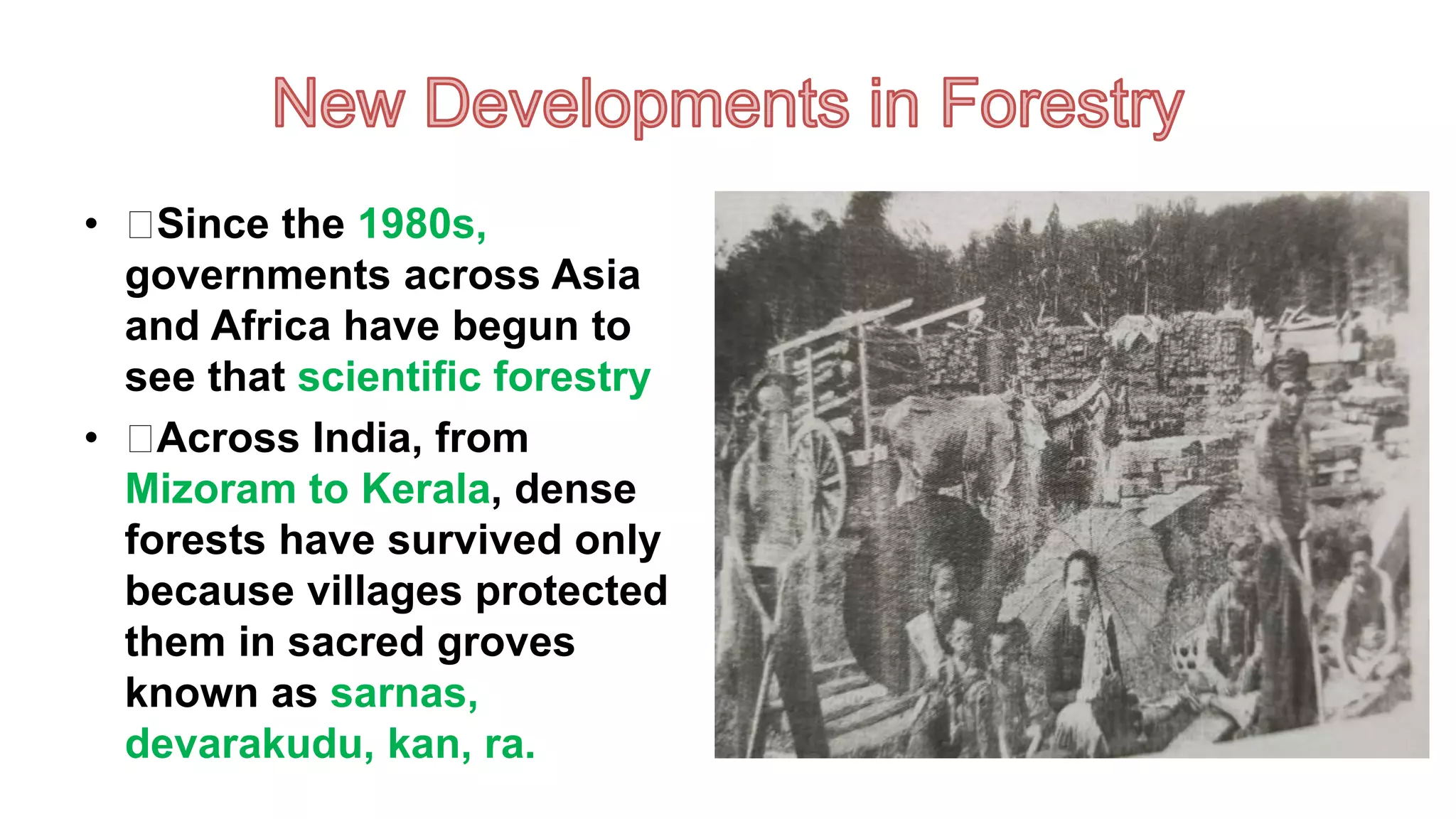
• Since the 1980s,
governments across Asia
and Africa have begun to
see that scientific forestry
• Across India, from
Mizoram to Kerala, dense
forests have survived only
because villages protected
them in sacred groves
known as sarnas,
devarakudu, kan, ra.

9th..Forest, Society and Colonialism .pptx

  • 1.
  • 2.
    WHAT WILL WELEARN ? 1. Why Deforestation? 2. The Rise of Commercial Forestry . 3. How were the Lives of People Affected? 4. The Forest Act meant severe hardship for villagers across the country. 5. Who could Hunt? 6.New Trades, New Employments and New Services. 7. Rebellion in the Forest 8. BASTAR AND JAVA( INDONESIA) 9. War and Deforestation. 10. New Developments in Forestry.
  • 3.
    • DEFORESTATION: Deforestationis cutting down of trees indiscriminately in a forest area. Under the colonial rule it became very systematic and extensive. Why Deforestation? • The disappearance of forests is referred to as deforestation. • Deforestation is not a recent problem. The process began many • centuries ago; but under colonial rule it became more systematic and
  • 4.
    • 1.the Britishdirectly encouraged the production of commercial crops like jute, sugar, wheat and cotton. • 2.foodgrains were needed to feed the growing POPULATION
  • 5.
    • 1.Sleepers –Wooden planks laid across railway • tracks; they hold the tracks in position • 2.The spread of railways from the 1850s created a new demand. • 3. By the early nineteenth century, oak forests in England were • disappearing. This created a problem of timber supply for the Royal • Navy
  • 6.
    • Large areasof natural forests were also cleared to make way for • tea, coffee and rubber plantations to meet Europe’s growing need • for these commodities.
  • 7.
    • Brandis setup the Indian Forest Service in 1864 and helped formulate the Indian Forest Act of 1865. The Imperial Forest Research Institute was set up at Dehradun in 1906. The system they taught here was called ‘scientific forestry’.
  • 8.
    • Many peoplenow, including ecologists, feel that this system is not scientific at all. In scientific forestry, natural forests which had lots of different types of trees were cut down. Intheir place, one type of tree was planted in straight rows. This is called a plantation.
  • 9.
    FOREST SURVEY • Forestofficials surveyed the forests, estimated the area under different types of trees, and made working plans for forest management. They planned how much of the plantation area to cut every year. The area cut was then to be replanted so that it was ready to be cut again in some years
  • 11.
    A • 1.Villagers wantedforests with a mixture of species • to satisfy different needs – fuel, fodder, leaves. • 2.The forest department on the other hand wanted trees which were suitable for building ships or railways. B. In forest areas, people use forest products • 1.Roots, leaves, fruits, and tubers. • 2.Fruits and tubers are nutritious to eat. • 3.Herbs are used for medicine
  • 12.
    B. In forest areas,people use forest products • 4.wood for agricultural implements like yokes and ploughs, bamboo makes excellent fences and is also used to make • baskets and umbrellas. • 5 .A dried scooped-out gourd-used as a portable water bottle.
  • 13.
    B. In forest areas,people use forest products • 6.The forest – leaves : disposable plates and cups, • 7.The siadi (Bauhinia vahlii) creeper :ropes, and the • thorny bark of the semur (silk-cotton) tree is used to grate vegetables • 8.Oil for cooking and to light lamps can be pressed from the fruit of • the mahua tree.
  • 14.
    • Many communitiesleft their traditional occupations and started trading in forest products. • many pastoralist and nomadic communities like the Korava, Karacha and Yerukula of the Madras Presidency lost their livelihoods. • They were forced to work instead in factories, mines and plantations, under government supervision. • In Assam, both men and women from forest communities like Santhals and Oraons from Jharkhand, and Gonds from Chhattisgarh were recruited to work on tea plantations.
  • 15.
     Siddhu andKanu in the Santhal Parganas,  Birsa Munda of Chhotanagpur  Alluri Sitarama Raju of Andhra Pradesh  Rebellion which took place in the kingdom of Bastar in 1910.
  • 16.
    • GEOGRAPHY LOCATIONOF BASTAR • Located in the southernmost part of Chhattisgarh and borders Andhra Pradesh, Orissa and Maharashtra. • Central part of Bastar is on a plateau. • The north of this plateau is the Chhattisgarh plain and to its south is the Godavari plain. • The river Indrawati winds across Bastar east to west.
  • 17.
    • Communities livein Bastar such as Maria and Muria Gonds, Dhurwas, Bhatras and Halbas. • They speak different languages but share common customs and beliefs. • The people of Bastar believe that each village was given its land by the Earth. • They show respect to the spirits of the river, the forest and the mountain. • Every year there is one big hunt where the headmen of villages in a pargana (cluster of villages) meet and discuss issues of concern, including forests.
  • 18.
    • village knowswhere its boundaries lie, the local people look after all the natural resources within that boundary.( they pay a small fee called devsari, dand or man in exchange) • The people of Bastar were very worried, allowed to stay on in the reserved forests on the condition • They worked free for the forest department . • Displaced without any notice. • The terrible famines, in 1899-1900 and again in 1907-1908. Reservations proved to be the last straw.
  • 19.
    • The initiativewas taken by the Dhurwas of the Kanger forest • There was no single leader, many people speak of Gunda Dhur, from village Nethanar, as an important figure in the movement. In 1910, • Rebel against the British, Most villages were deserted as people fled into the jungles.
  • 20.
    • The colonialpower in Indonesia were the Dutch. • In 1600, the population of Java was an estimated 3.4 million. • The Kalangs of Java were a community of skilled forest cutters and shifting cultivators • In 1755 when the Mataram kingdom of Java split, the 6,000 Kalang families were equally divided between the two kingdoms. • Dutch tried to make the Kalangs work under them. In 1770, the Kalangs resisted by attacking a Dutch fort at Joana( Supperessed) • The Dutch enacted forest laws in Java, restricting villagers’ access to forests.
  • 21.
    • In 1882,280,000 sleepers were exported from Java alone • The Dutch first imposed rents on land being cultivated in the forest and then exempted some villages from these rents if they worked collectively to provide free labour and buffaloes for cutting and transporting timber. This was known as the Blandongdiensten system. • Around 1890, Surontiko Samin of Randublatung village, a teak forest • village, began questioning state ownership of the fores(the wind, water, earth and wood, so it could not own) • Soon a widespread movement developed.
  • 22.
    • In India,working plans were abandoned at this time, and the forest department cut trees freely to meet British • In Java, just before the (Japanese occupied) the Dutch followed ‘a scorched earth’ policy, destroying sawmills, and burning huge piles of giant teak logs • The Japanese then exploited the forests recklessly .
  • 23.
    • Since the1980s, governments across Asia and Africa have begun to see that scientific forestry • Across India, from Mizoram to Kerala, dense forests have survived only because villages protected them in sacred groves known as sarnas, devarakudu, kan, ra.