WHAT IS
DEMOCRACY?
WHY DEMOCRACY?
CLASS IX – SOCIAL SCIENCE
POLITICAL SCIENCE: CHAPTER – 1
(MRS. USHA JOY)
DEMOCRACY
• The word democracy comes from a Greek word ‘Demokratia’.
• In Greek ‘demos’ means people and ‘kratia’ means rule.
• So democracy is rule by the people.
DEFINITION
• Definition: Democracy is a form of government in which rulers
are elected by the people.
• Based on this definition let us see the features of democracy, by
analyzing the case studies of different nations.
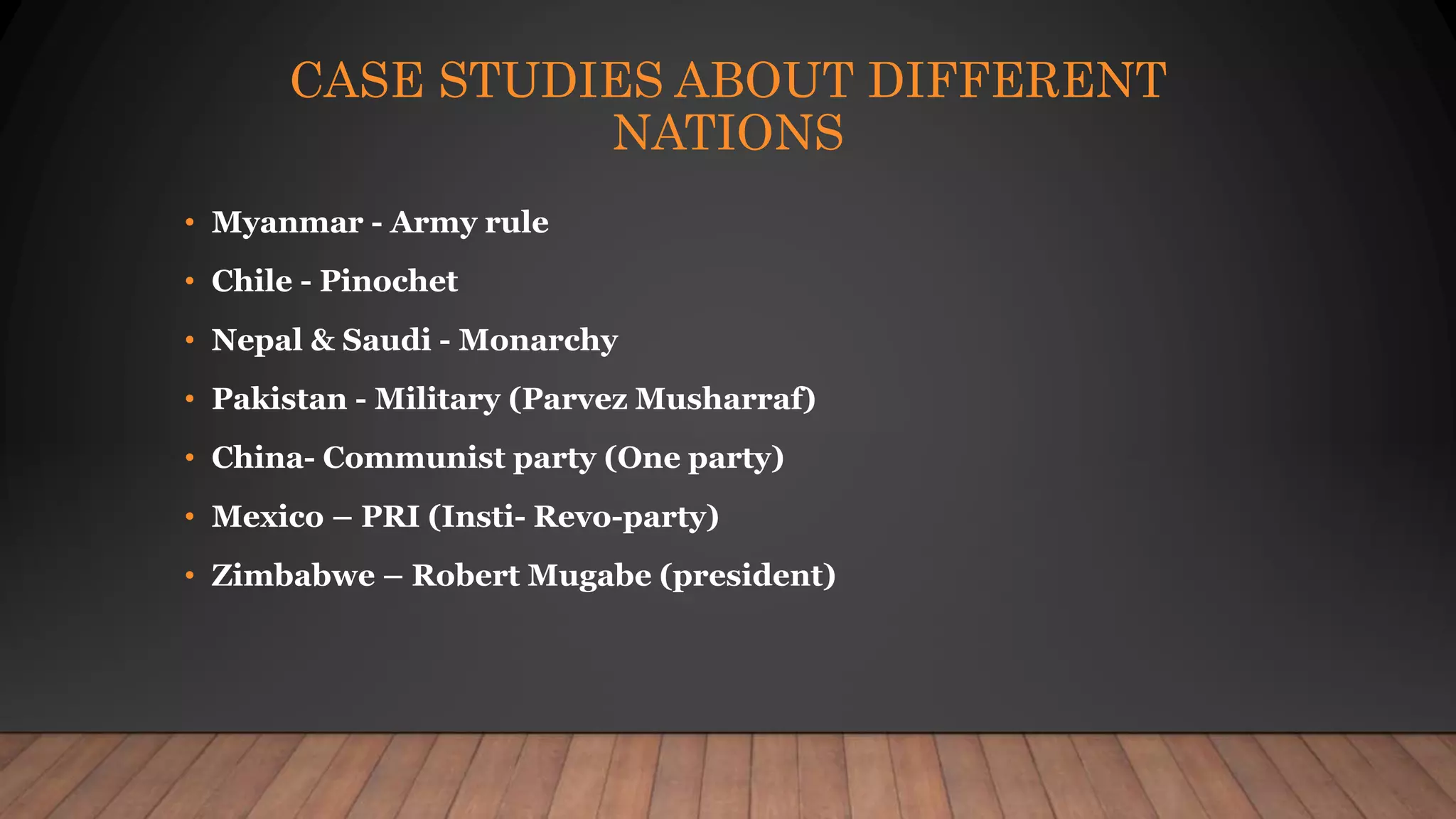
CASE STUDIES ABOUT DIFFERENT
NATIONS
• Myanmar - Army rule
• Chile - Pinochet
• Nepal & Saudi - Monarchy
• Pakistan - Military (Parvez Musharraf)
• China- Communist party (One party)
• Mexico – PRI (Insti- Revo-party)
• Zimbabwe – Robert Mugabe (president)
MAJOR DECISIONS BY ELECTED LEADERS
 In Pakistan, General Perves Musharraf led a military coup in
October 1999.
 He overthrew a democratically elected government and declared
himself the ‘Chief Executive’ of the country.
 In 2002 held a referendum in the country that granted him a five
year extension.
 In August 2002 he issued a ‘Legal Framework Order’ that amended
the Constitution of Pakistan.
MAJOR DECISIONS BY ELECTED LEADERS
 According to this Order, the President can dismiss the national and provincial
assemblies.
 The work of the civilian cabinet is supervised by a National Security Council which
is dominated by military officers.
 Then elections were held to the national and provincial assemblies.
 But the final power rested with military officers and General Musharraf himself.
 This cannot be called a democratic government because the power to take final
decision rested with army officials and with General Musharraf, and none of them
were elected by the people.
MAJOR DECISIONS BY ELECTED LEADERS
• This happens in many dictatorships and monarchies. They formally
have an elected parliament and government but the real power is
with those who are not elected.
• This example gives us the first feature of democracy.
• Feature 1
In a democracy the final decision making power must rest with those
elected by the people.
FREE AND FAIR ELECTORAL
COMPETITION
• China –In China, elections are regularly held after every five years for the
parliament, called Quanguo Renmin Daibiao Dahui (National People’s
Congress).
• Before contesting elections, a candidate needs the approval of the Chinese
Communist Party.
• Only those who are members of the Chinese Communist Party or eight smaller
parties allied to it were allowed to contest elections.
• The government is always formed by the Communist Party
FREE AND FAIR ELECTORAL
COMPETITION
• Mexico: Since 1930 Mexico holds elections after every six years to elect its
President
• But until 2000 every election was won by PRI (Institutional Revolutionary
Party).
• Opposition parties never win as the PRI was known to use many dirty tricks
to win elections.
• Dirty tricks used to win- Govt employees had to attend party meetings,
Teachers used to force parents to vote for the PRI, Media ignore opposition
political parties except to criticise them, polling booth – shifted, The PRI
spent large sum of money
CHINA AND MEXICO
• From the two examples; China – do not offer serious choice to people
and in Mexico there is no way to defeat ruling party.
• From these examples we can derive the second feature of democracy.
Feature 2
A democracy must be based on a free and fair election,
Those who are currently in power have a fair chance of losing
ONE PERSON, ONE VOTE. ONE VALUE
• In many countries equal right to vote is denied.
• E.g. Until 2015, in Saudi Arabia women did not have the right to vote.
• Estonia – Russian minorities find it difficult to get the right to vote.
• Fiji – the vote of an indigenous Fiji has more value than that of an Indian-
Fijian.
Feature 3
Each adult citizen must have one vote, and each vote must have one
value.
RULE OF LAW AND RESPECT FOR RIGHTS
• Zimbabwe – attained independence from White minority rule in 1980.
• Since then the country has been ruled by ZANU-PF and its leader Robert
Mughabe
• Unfair practices in election
• Changed constitution many times to increase the powers of the President.
• Opposition party workers were harassed, meetings disrupted, Public protests
and demonstrations against the government were declared illegal, television
and radio were controlled by the government, harassed journalists, ignored
court judgement…
ZIMBABWE
• The state should respect some basic rights of the citizen. They should be
free to think, to have opinions, to express these in public, to form
associations, to protest and take other political actions. Everyone should
be equal in the eyes of law. These rights must be protected by an
independent judiciary.
• Feature 4
A democratic government rules within limits set by constitutional
law and citizens’ rights.
SUMMARY DEFINITION
• Definition: democracy is a form of government in which the rulers are elected by the
people
• Features
• The final decision making power must rest with those elected by the people.
• A democracy must be based on a free and fair election where those currently in power
have a fair chance of losing.
• In a democracy, each adult citizen must have one vote and each vote must have one value.
• A democratic government rules within limits set by constitutional law and citizens’ rights.
ARGUMENTS AGAINST DEMOCRACY
• Demerits:
• Leaders keep changing in democracy. This leads to instability.
• Democracy is all about political competition and power play. There is no
scope for morality.
• So many people have to be consulted in a democracy that it leads to delays.
ARGUMENTS AGAINST DEMOCRACY
• Elected leaders do not know the best interest of the people. It leads to bad
decisions.
• Democracy leads to corruption for it is based on electoral competition.
• Ordinary people don’t know what is good for them; they should not decide
anything.
ARGUMENTS FOR DEMOCRACY
(1) A democratic government is a better government because it is a more accountable
form of government.
• China’s famine of 1958-1961 was the worst recorded famine in world history.
• Nearly 3 crore people died in China but India did not had a famine like China had.
• This was the result of difference in the policies taken by these countries.
• In India - food security system, multiparty election, opposition party, a press free
to criticize the government.
• This example brings out the fact that democratic rulers have to attend the needs of
people.
ARGUMENTS FOR DEMOCRACY
• (2) Democracy improves the quality of decision making
• Democracy is based on consultation and discussion
• A democratic decision always involves many persons, discussions and
meetings.
• When a number of people put their heads together, they are able to point
out possible mistakes in any decision.
• This takes time but there is a big advantage, it reduces the chances of rash
or irresponsible decisions.
ARGUMENTS FOR DEMOCRACY
• (3) Provides a method to deal with differences and conflicts
• People are bound to have differences of opinion and interest
• In India people belong to different regions, speak different languages,
practise different religions and have different castes.
• The preferences of one group can clash with those of other groups.
• Democracy provides a peaceful solution to this problem, there is no
permanent winner or loser in a democracy.
ARGUMENTS FOR DEMOCRACY
• (4) Democracy enhances the dignity of citizens
• Democracy is based political equality on recognising that the poorest and
the least educated has the same status as the rich and the educated.
• People are not subjects of a ruler, they are the rulers themselves.
• Even when they make mistakes, they are responsible for their conduct.
ARGUMENTS FOR DEMOCRACY
• (5) Better than other form of government because it corrects its own
mistakes.
• There is no guarantee that mistakes cannot be made in democracy.
• Such mistakes cannot be hidden for long.
• There is a space for public discussion on these mistakes and there is a room
for correction.
• Either rulers have to change their decision or rulers can be changed.
• Democracy cannot get us everything and is not the solution to
all problems. But it is clearly better than any other alternative
that we know.
MERITS OF DEMOCRACY
• A democratic government is a better government because it is a more
accountable form of government.
• Democracy improves the quality of decision making.
• Provides a method to deal with differences and conflicts.
• Democracy enhances the dignity of citizens.
• Better than other form of govt. because it corrects its own mistakes.
BROADER MEANING OF DEMOCRACY
• The most common form that democracy takes in our times is that of a
representative democracy
• Modern democracies – it is physically impossible for them to sit together
and take a collective decision.
• Even if they could, - don’t have time, desire, or the skills to take part in all
the decisions.
BROADER MEANING OF DEMOCRACY
• To distinguish between a democracy and a good democracy - we need to turn to
broader meanings of democracy.
• A democratic decision involves consultation with and consent of all those who are
affected by that decision.
• This can apply to a government or a family or any other organisation.
• If we take these ideals seriously, then no country in the world is a democracy.
• It helps us to distinguish between a minimal democracy and a good democracy
REPRESENTATIVE OR MINIMAL
DEMOCRACY
• The most common form of democracy in today’s world is rule through
people’s elected representatives.
• Direct democracy is possible only in a small society like Gram sabha in
village
• No country is a perfect democracy in the modern world.
• Other forms of government like monarchy, dictatorship or one-party rule do
not require all citizens to take part in politics.

What is democracy why democracy

  • 1.
    WHAT IS DEMOCRACY? WHY DEMOCRACY? CLASSIX – SOCIAL SCIENCE POLITICAL SCIENCE: CHAPTER – 1 (MRS. USHA JOY)
  • 2.
    DEMOCRACY • The worddemocracy comes from a Greek word ‘Demokratia’. • In Greek ‘demos’ means people and ‘kratia’ means rule. • So democracy is rule by the people.
  • 3.
    DEFINITION • Definition: Democracyis a form of government in which rulers are elected by the people. • Based on this definition let us see the features of democracy, by analyzing the case studies of different nations.
  • 4.
    CASE STUDIES ABOUTDIFFERENT NATIONS • Myanmar - Army rule • Chile - Pinochet • Nepal & Saudi - Monarchy • Pakistan - Military (Parvez Musharraf) • China- Communist party (One party) • Mexico – PRI (Insti- Revo-party) • Zimbabwe – Robert Mugabe (president)
  • 5.
    MAJOR DECISIONS BYELECTED LEADERS  In Pakistan, General Perves Musharraf led a military coup in October 1999.  He overthrew a democratically elected government and declared himself the ‘Chief Executive’ of the country.  In 2002 held a referendum in the country that granted him a five year extension.  In August 2002 he issued a ‘Legal Framework Order’ that amended the Constitution of Pakistan.
  • 7.
    MAJOR DECISIONS BYELECTED LEADERS  According to this Order, the President can dismiss the national and provincial assemblies.  The work of the civilian cabinet is supervised by a National Security Council which is dominated by military officers.  Then elections were held to the national and provincial assemblies.  But the final power rested with military officers and General Musharraf himself.  This cannot be called a democratic government because the power to take final decision rested with army officials and with General Musharraf, and none of them were elected by the people.
  • 8.
    MAJOR DECISIONS BYELECTED LEADERS • This happens in many dictatorships and monarchies. They formally have an elected parliament and government but the real power is with those who are not elected. • This example gives us the first feature of democracy. • Feature 1 In a democracy the final decision making power must rest with those elected by the people.
  • 9.
    FREE AND FAIRELECTORAL COMPETITION • China –In China, elections are regularly held after every five years for the parliament, called Quanguo Renmin Daibiao Dahui (National People’s Congress). • Before contesting elections, a candidate needs the approval of the Chinese Communist Party. • Only those who are members of the Chinese Communist Party or eight smaller parties allied to it were allowed to contest elections. • The government is always formed by the Communist Party
  • 11.
    FREE AND FAIRELECTORAL COMPETITION • Mexico: Since 1930 Mexico holds elections after every six years to elect its President • But until 2000 every election was won by PRI (Institutional Revolutionary Party). • Opposition parties never win as the PRI was known to use many dirty tricks to win elections. • Dirty tricks used to win- Govt employees had to attend party meetings, Teachers used to force parents to vote for the PRI, Media ignore opposition political parties except to criticise them, polling booth – shifted, The PRI spent large sum of money
  • 13.
    CHINA AND MEXICO •From the two examples; China – do not offer serious choice to people and in Mexico there is no way to defeat ruling party. • From these examples we can derive the second feature of democracy. Feature 2 A democracy must be based on a free and fair election, Those who are currently in power have a fair chance of losing
  • 14.
    ONE PERSON, ONEVOTE. ONE VALUE • In many countries equal right to vote is denied. • E.g. Until 2015, in Saudi Arabia women did not have the right to vote. • Estonia – Russian minorities find it difficult to get the right to vote. • Fiji – the vote of an indigenous Fiji has more value than that of an Indian- Fijian. Feature 3 Each adult citizen must have one vote, and each vote must have one value.
  • 15.
    RULE OF LAWAND RESPECT FOR RIGHTS • Zimbabwe – attained independence from White minority rule in 1980. • Since then the country has been ruled by ZANU-PF and its leader Robert Mughabe • Unfair practices in election • Changed constitution many times to increase the powers of the President. • Opposition party workers were harassed, meetings disrupted, Public protests and demonstrations against the government were declared illegal, television and radio were controlled by the government, harassed journalists, ignored court judgement…
  • 17.
    ZIMBABWE • The stateshould respect some basic rights of the citizen. They should be free to think, to have opinions, to express these in public, to form associations, to protest and take other political actions. Everyone should be equal in the eyes of law. These rights must be protected by an independent judiciary. • Feature 4 A democratic government rules within limits set by constitutional law and citizens’ rights.
  • 18.
    SUMMARY DEFINITION • Definition:democracy is a form of government in which the rulers are elected by the people • Features • The final decision making power must rest with those elected by the people. • A democracy must be based on a free and fair election where those currently in power have a fair chance of losing. • In a democracy, each adult citizen must have one vote and each vote must have one value. • A democratic government rules within limits set by constitutional law and citizens’ rights.
  • 19.
    ARGUMENTS AGAINST DEMOCRACY •Demerits: • Leaders keep changing in democracy. This leads to instability. • Democracy is all about political competition and power play. There is no scope for morality. • So many people have to be consulted in a democracy that it leads to delays.
  • 20.
    ARGUMENTS AGAINST DEMOCRACY •Elected leaders do not know the best interest of the people. It leads to bad decisions. • Democracy leads to corruption for it is based on electoral competition. • Ordinary people don’t know what is good for them; they should not decide anything.
  • 21.
    ARGUMENTS FOR DEMOCRACY (1)A democratic government is a better government because it is a more accountable form of government. • China’s famine of 1958-1961 was the worst recorded famine in world history. • Nearly 3 crore people died in China but India did not had a famine like China had. • This was the result of difference in the policies taken by these countries. • In India - food security system, multiparty election, opposition party, a press free to criticize the government. • This example brings out the fact that democratic rulers have to attend the needs of people.
  • 22.
    ARGUMENTS FOR DEMOCRACY •(2) Democracy improves the quality of decision making • Democracy is based on consultation and discussion • A democratic decision always involves many persons, discussions and meetings. • When a number of people put their heads together, they are able to point out possible mistakes in any decision. • This takes time but there is a big advantage, it reduces the chances of rash or irresponsible decisions.
  • 23.
    ARGUMENTS FOR DEMOCRACY •(3) Provides a method to deal with differences and conflicts • People are bound to have differences of opinion and interest • In India people belong to different regions, speak different languages, practise different religions and have different castes. • The preferences of one group can clash with those of other groups. • Democracy provides a peaceful solution to this problem, there is no permanent winner or loser in a democracy.
  • 24.
    ARGUMENTS FOR DEMOCRACY •(4) Democracy enhances the dignity of citizens • Democracy is based political equality on recognising that the poorest and the least educated has the same status as the rich and the educated. • People are not subjects of a ruler, they are the rulers themselves. • Even when they make mistakes, they are responsible for their conduct.
  • 25.
    ARGUMENTS FOR DEMOCRACY •(5) Better than other form of government because it corrects its own mistakes. • There is no guarantee that mistakes cannot be made in democracy. • Such mistakes cannot be hidden for long. • There is a space for public discussion on these mistakes and there is a room for correction. • Either rulers have to change their decision or rulers can be changed.
  • 26.
    • Democracy cannotget us everything and is not the solution to all problems. But it is clearly better than any other alternative that we know.
  • 27.
    MERITS OF DEMOCRACY •A democratic government is a better government because it is a more accountable form of government. • Democracy improves the quality of decision making. • Provides a method to deal with differences and conflicts. • Democracy enhances the dignity of citizens. • Better than other form of govt. because it corrects its own mistakes.
  • 28.
    BROADER MEANING OFDEMOCRACY • The most common form that democracy takes in our times is that of a representative democracy • Modern democracies – it is physically impossible for them to sit together and take a collective decision. • Even if they could, - don’t have time, desire, or the skills to take part in all the decisions.
  • 29.
    BROADER MEANING OFDEMOCRACY • To distinguish between a democracy and a good democracy - we need to turn to broader meanings of democracy. • A democratic decision involves consultation with and consent of all those who are affected by that decision. • This can apply to a government or a family or any other organisation. • If we take these ideals seriously, then no country in the world is a democracy. • It helps us to distinguish between a minimal democracy and a good democracy
  • 30.
    REPRESENTATIVE OR MINIMAL DEMOCRACY •The most common form of democracy in today’s world is rule through people’s elected representatives. • Direct democracy is possible only in a small society like Gram sabha in village • No country is a perfect democracy in the modern world. • Other forms of government like monarchy, dictatorship or one-party rule do not require all citizens to take part in politics.