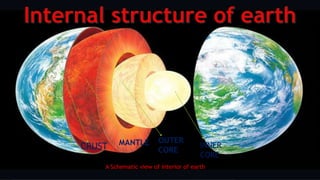
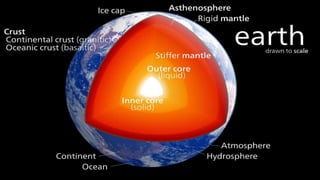
A Schematic view of interior of earth
CRUST MANTLE OUTER
CORE
INNER
CORE
Deep parts of Earth are studied indirectly, however,
largely through the branch of geology called geophysics.
 Geophysics includes the study of seismic waves
and Earth’s magnetic field, gravity, and heat.
 Together, they create a convincing picture of what
makes up Earth’s interior.
Introduction
 There are two important ways of learning about Earth’s
interior.
1.seismic reflection
2.Seismic refraction
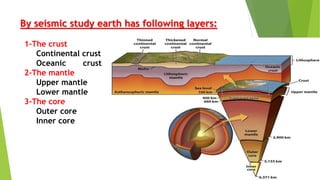
By seismic study earth has following layers:
1-The crust
Continental crust
Oceanic crust
2-The mantle
Upper mantle
Lower mantle
3-The core
Outer core
Inner core
Studies of seismic waves have shown that the
crust is thinner beneath the oceans as compare
to the continents.
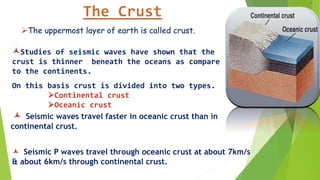
The uppermost layer of earth is called crust.
 Seismic waves travel faster in oceanic crust than in
continental crust.
On this basis crust is divided into two types.
Continental crust
Oceanic crust
 Seismic P waves travel through oceanic crust at about 7km/s
& about 6km/s through continental crust.
 Lithosphere
 The combination of uppermost mantle and crust above the
asthenosphere is called the lithosphere.
 The lithosphere is free to move over the weak asthenosphere.
 The tectonic plates are, in. fact, lithospheric plate
The boundary that separates the crust from the
mantle is called the Mohorovic˘ic´ discontinuity.
Moho Boundary:
Properties of the Crust:
Continental Crust:
►Depth 20 to 70 km, average 30 to 40 km
► Composition: felsic, intermediate, and mafic
igneous, sedimentary, and metamorphic rocks.
► Age: 0 to 4 B.y.
► Summary: thicker, less dense, heterogeneous,
 Oceanic Crust:
► Depth to Moho: ~7 km
► Composition: mafic igneous rock (basalt &
gabbro) with thin layer of sediments on top
► Age: 0 to 200 M.y.
► Summary: thin, more dense, homogeneous,
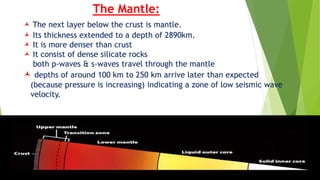
The Mantle:
 The next layer below the crust is mantle.
 Its thickness extended to a depth of 2890km.
 It is more denser than crust
 It consist of dense silicate rocks
both p-waves & s-waves travel through the mantle
 depths of around 100 km to 250 km arrive later than expected
(because pressure is increasing) indicating a zone of low seismic wave
velocity.
Velocity of seismic waves in mantle:
P-waves velocity:
Its velocity is about 8km/s in the upper
mantle and increases up to 13km/s in lower
mantle
 S-waves velocity:
S-waves velocity profile in the mantle is
similar to the p-wave profile. S-waves velocity
time cannot be measured as accurately as p-
waves travel time.
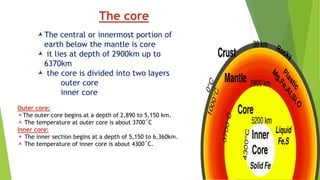
The core
The central or innermost portion of
earth below the mantle is core
 it lies at depth of 2900km up to
6370km
 the core is divided into two layers
outer core
inner core
Outer core:
The outer core begins at a depth of 2,890 to 5,150 km.
 The temperature at outer core is about 3700˚C
Inner core:
 The inner section begins at a depth of 5,150 to 6,360km.
 The temperature of inner core is about 4300˚C.
Seismologists first determined that the
back and-forth motion of S-waves does not
travel through liquid.
 Then, seismologists noticed that S-waves
do not travel through Earth’s center.
 This observation led to the discovery
that Earth’s core must be at least partly
liquid.

Internal Structure of Earth

  • 1.
    A Schematic viewof interior of earth CRUST MANTLE OUTER CORE INNER CORE
  • 2.
    Deep parts ofEarth are studied indirectly, however, largely through the branch of geology called geophysics.  Geophysics includes the study of seismic waves and Earth’s magnetic field, gravity, and heat.  Together, they create a convincing picture of what makes up Earth’s interior. Introduction  There are two important ways of learning about Earth’s interior. 1.seismic reflection 2.Seismic refraction
  • 3.
    By seismic studyearth has following layers: 1-The crust Continental crust Oceanic crust 2-The mantle Upper mantle Lower mantle 3-The core Outer core Inner core
  • 4.
    Studies of seismicwaves have shown that the crust is thinner beneath the oceans as compare to the continents. The uppermost layer of earth is called crust.  Seismic waves travel faster in oceanic crust than in continental crust. On this basis crust is divided into two types. Continental crust Oceanic crust  Seismic P waves travel through oceanic crust at about 7km/s & about 6km/s through continental crust.
  • 5.
     Lithosphere  Thecombination of uppermost mantle and crust above the asthenosphere is called the lithosphere.  The lithosphere is free to move over the weak asthenosphere.  The tectonic plates are, in. fact, lithospheric plate The boundary that separates the crust from the mantle is called the Mohorovic˘ic´ discontinuity. Moho Boundary:
  • 7.
    Properties of theCrust: Continental Crust: ►Depth 20 to 70 km, average 30 to 40 km ► Composition: felsic, intermediate, and mafic igneous, sedimentary, and metamorphic rocks. ► Age: 0 to 4 B.y. ► Summary: thicker, less dense, heterogeneous,  Oceanic Crust: ► Depth to Moho: ~7 km ► Composition: mafic igneous rock (basalt & gabbro) with thin layer of sediments on top ► Age: 0 to 200 M.y. ► Summary: thin, more dense, homogeneous,
  • 8.
    The Mantle:  Thenext layer below the crust is mantle.  Its thickness extended to a depth of 2890km.  It is more denser than crust  It consist of dense silicate rocks both p-waves & s-waves travel through the mantle  depths of around 100 km to 250 km arrive later than expected (because pressure is increasing) indicating a zone of low seismic wave velocity.
  • 9.
    Velocity of seismicwaves in mantle: P-waves velocity: Its velocity is about 8km/s in the upper mantle and increases up to 13km/s in lower mantle  S-waves velocity: S-waves velocity profile in the mantle is similar to the p-wave profile. S-waves velocity time cannot be measured as accurately as p- waves travel time.
  • 10.
    The core The centralor innermost portion of earth below the mantle is core  it lies at depth of 2900km up to 6370km  the core is divided into two layers outer core inner core Outer core: The outer core begins at a depth of 2,890 to 5,150 km.  The temperature at outer core is about 3700˚C Inner core:  The inner section begins at a depth of 5,150 to 6,360km.  The temperature of inner core is about 4300˚C.
  • 11.
    Seismologists first determinedthat the back and-forth motion of S-waves does not travel through liquid.  Then, seismologists noticed that S-waves do not travel through Earth’s center.  This observation led to the discovery that Earth’s core must be at least partly liquid.