Rt-PCR
Course: Fundamental of genetic engineering and biotechnology
Course code: GEB302
Course Instructor: Dr. Mohiuddin Kabir
Presented by: Bitali Islam
Nilmoni Bushra
Mohammad Nabil Hossain
Md. Shabab Mehebub
Introduction of RT-PCR
RT PCR - Reverse transcription polymerase Chain
reaction.
•Reverse transcription polymerase chain reaction (RT-
PCR) is one of many variants of polymerase chain
reaction (PCR).
•It was introduced in 1977 .
• The discovery of reverse transcriptase during the study
of viral replication of genetic material led to the
development of RT-PCR.
•RT-PCR is used to qualitatively detect gene expression
through creation of complementary DNA (cDNA)
transcripts from RNA.
•This technique is commonly used in molecular biology
to detect RNA expression.
V/SRT-PCR PCR
RT-PCR Principles
There are several types of RT PCR Principles.
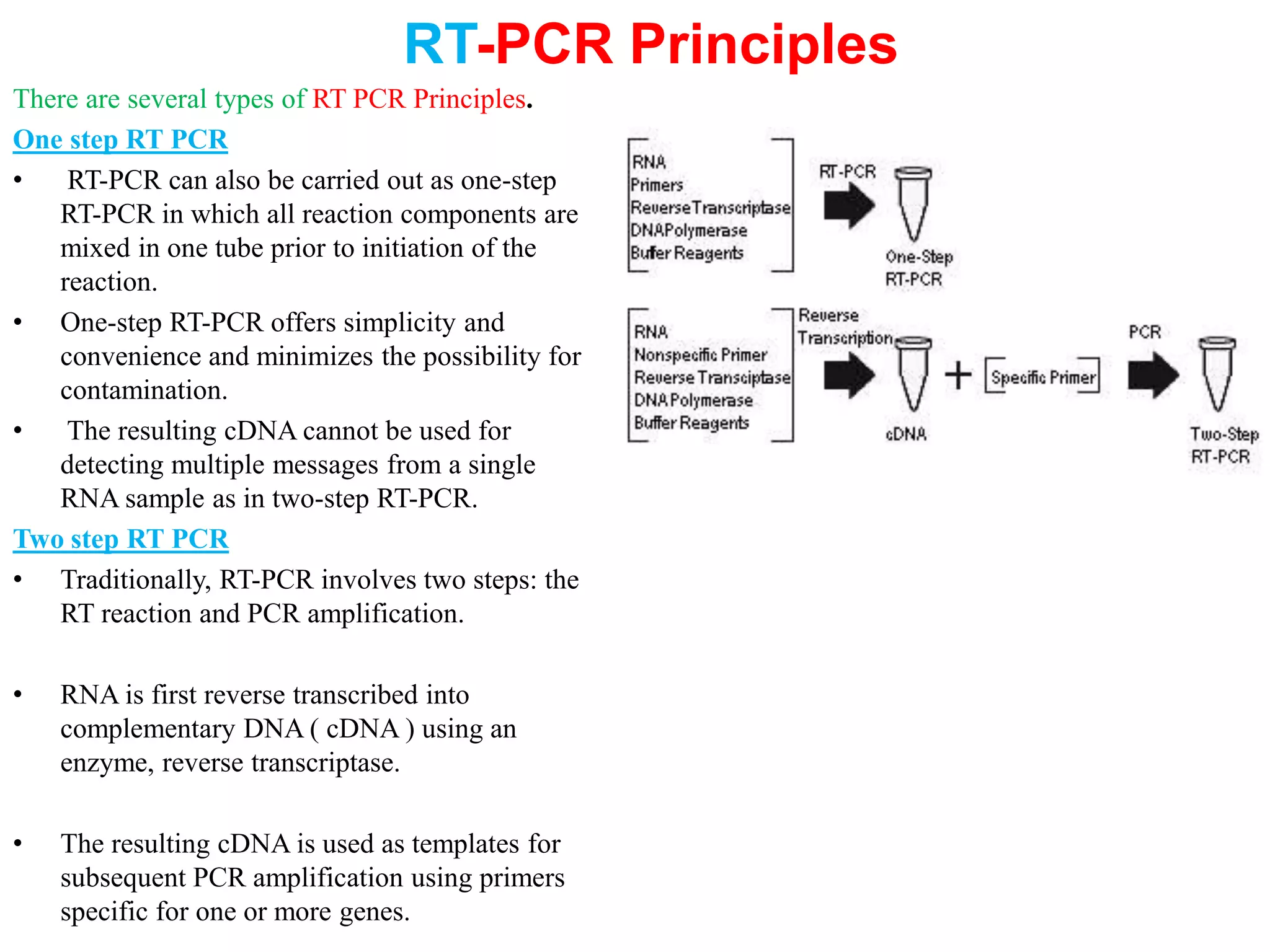
One step RT PCR
• RT-PCR can also be carried out as one-step
RT-PCR in which all reaction components are
mixed in one tube prior to initiation of the
reaction.
• One-step RT-PCR offers simplicity and
convenience and minimizes the possibility for
contamination.
• The resulting cDNA cannot be used for
detecting multiple messages from a single
RNA sample as in two-step RT-PCR.
Two step RT PCR
• Traditionally, RT-PCR involves two steps: the
RT reaction and PCR amplification.
• RNA is first reverse transcribed into
complementary DNA ( cDNA ) using an
enzyme, reverse transcriptase.
• The resulting cDNA is used as templates for
subsequent PCR amplification using primers
specific for one or more genes.
RT-PCR Principles
Quantification of RT-PCR products can largely be divided into two categories: end-
point and real-time.
• End-point RT-PCR : measurement approaches of end-point RT-PCR detect gene
expression levels by the use of fluorescent dyes like ethidium
bromide, Phosphorus-32 labeling of PCR products using phosphorimager. End-
point RT-PCR is commonly achieved using three different methods: relative,
competitive and comparative.
• Real-time RT-PCR: the analysis and detection of PCR products in real-time has
consequently led to the widespread adoption of real-time RT-PCR for the analysis
of gene expression.
• There are four different fluorescent DNA probes for the detection of PCR
products: SYBR Green, TaqMan, Molecular Beacons, and Scorpions. All of these
probes allow the detection of PCR products by generating a fluorescent signal.
Method of RT PCR
Double
strand cDNA
AAAAA
TTTTTRT
AAAAA
TTTTT
RT
RTAAAAA
TTTTT
Oligo dT primer is
bound to mRNA
Reverse
transcriptase (RT)
copies first cDNA
strand
Reverse
transcriptase
digests and
displaces mRNA
and copies second
strand of cDNA
Conversion of mRNA to cDNA by Reverse Transcription
A. Double
strand DNA
B. Denature96º
50º
C. Anneal
primers
50º
D. Polymerase
binds
72º
Taq
Taq
72º
Taq
Taq
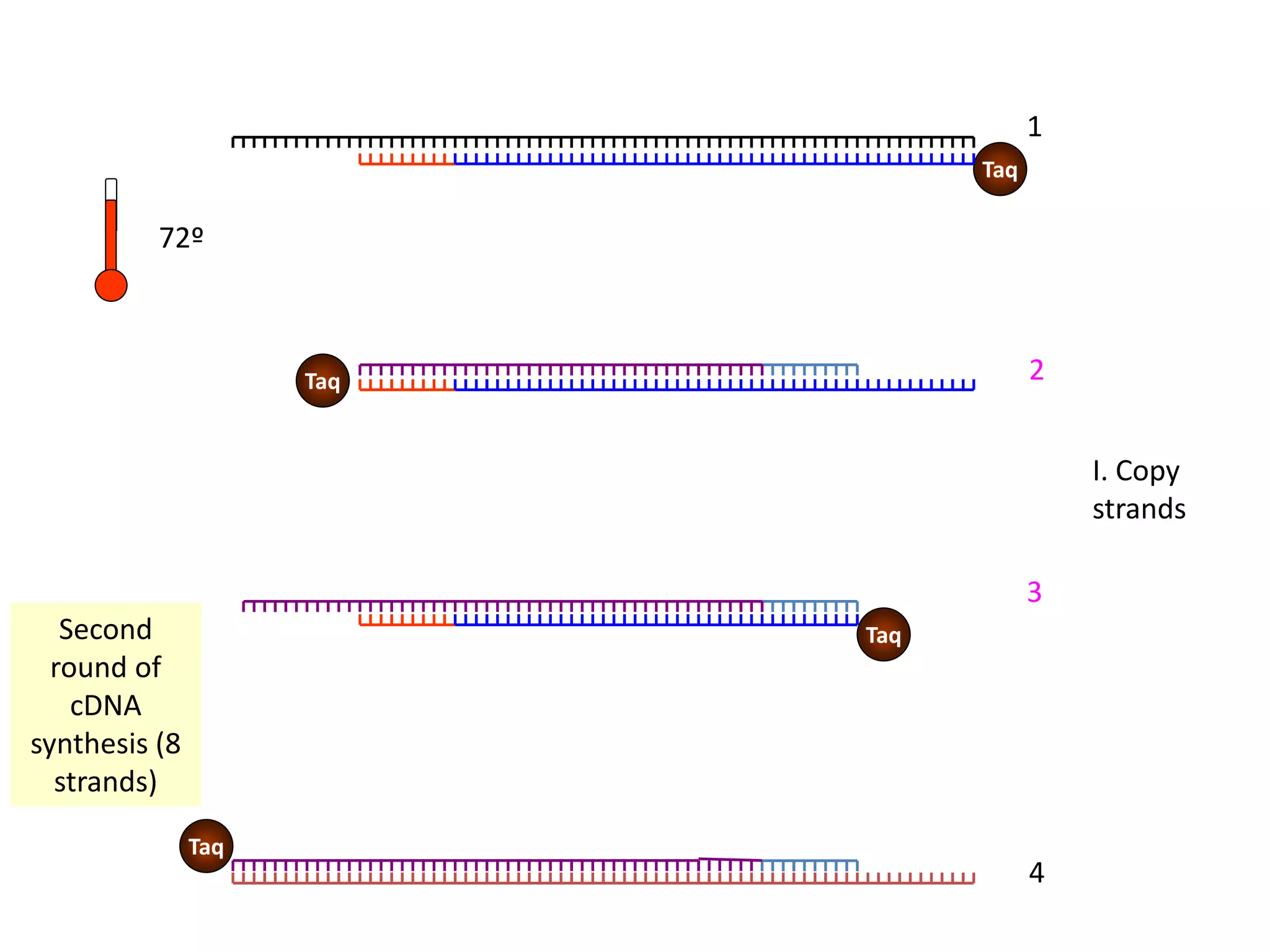
E. Copy
strands
1
2
3
4
F.
Denature
96º
First round
of cDNA
synthesis (4
strands)
Taq
Taq
1
2
3
4
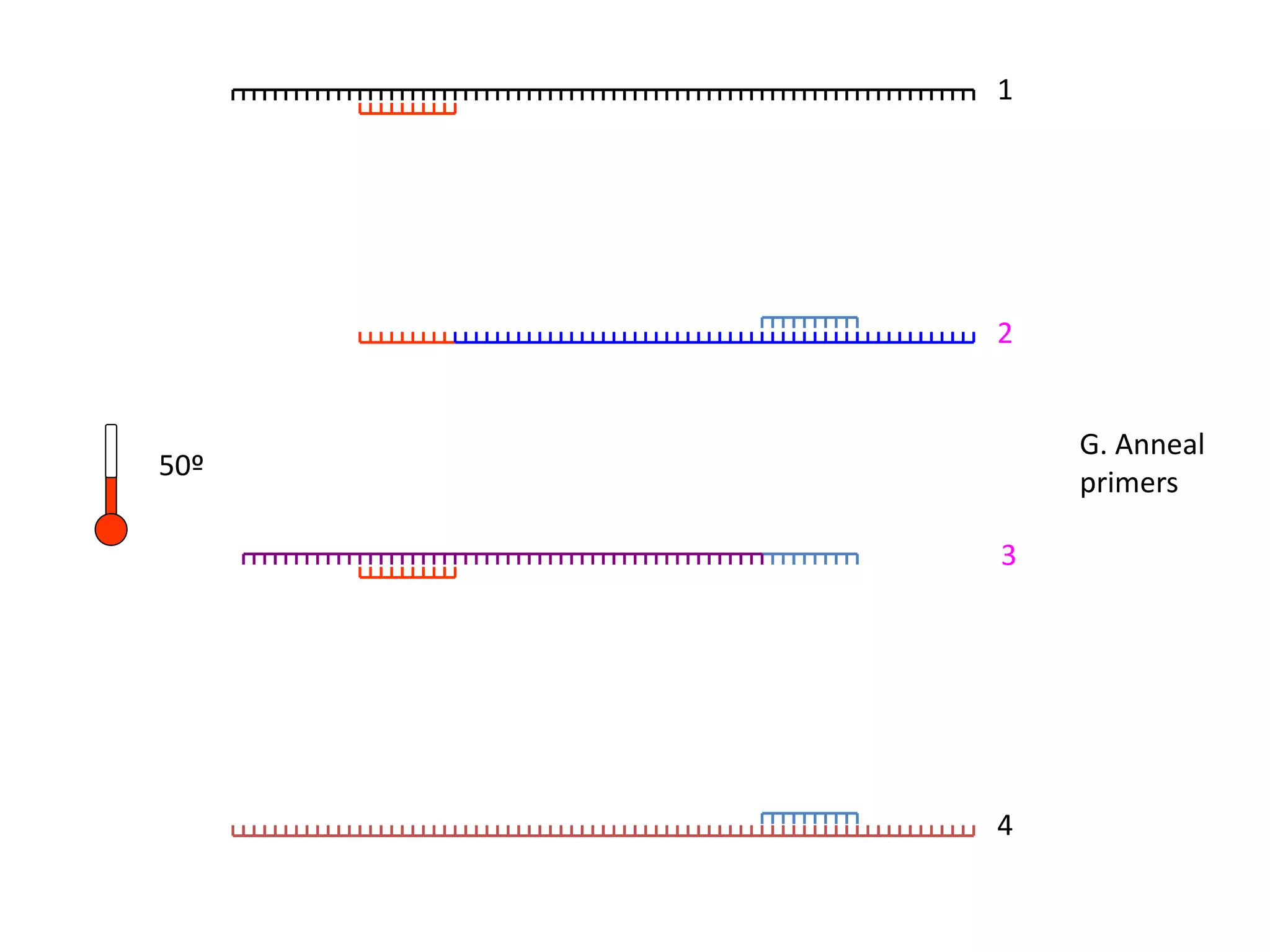
50º
G. Anneal
primers
1
2
3
4
Taq
Taq
Taq
Taq
72º
H.
Polymerase
binds
1
2
3
4
Taq
Taq
Taq
Taq
I. Copy
strands
72º
Second
round of
cDNA
synthesis (8
strands)
1
2
3
4
J.
Denature at 96º
Anneal primers at
50º
1
2
3
4
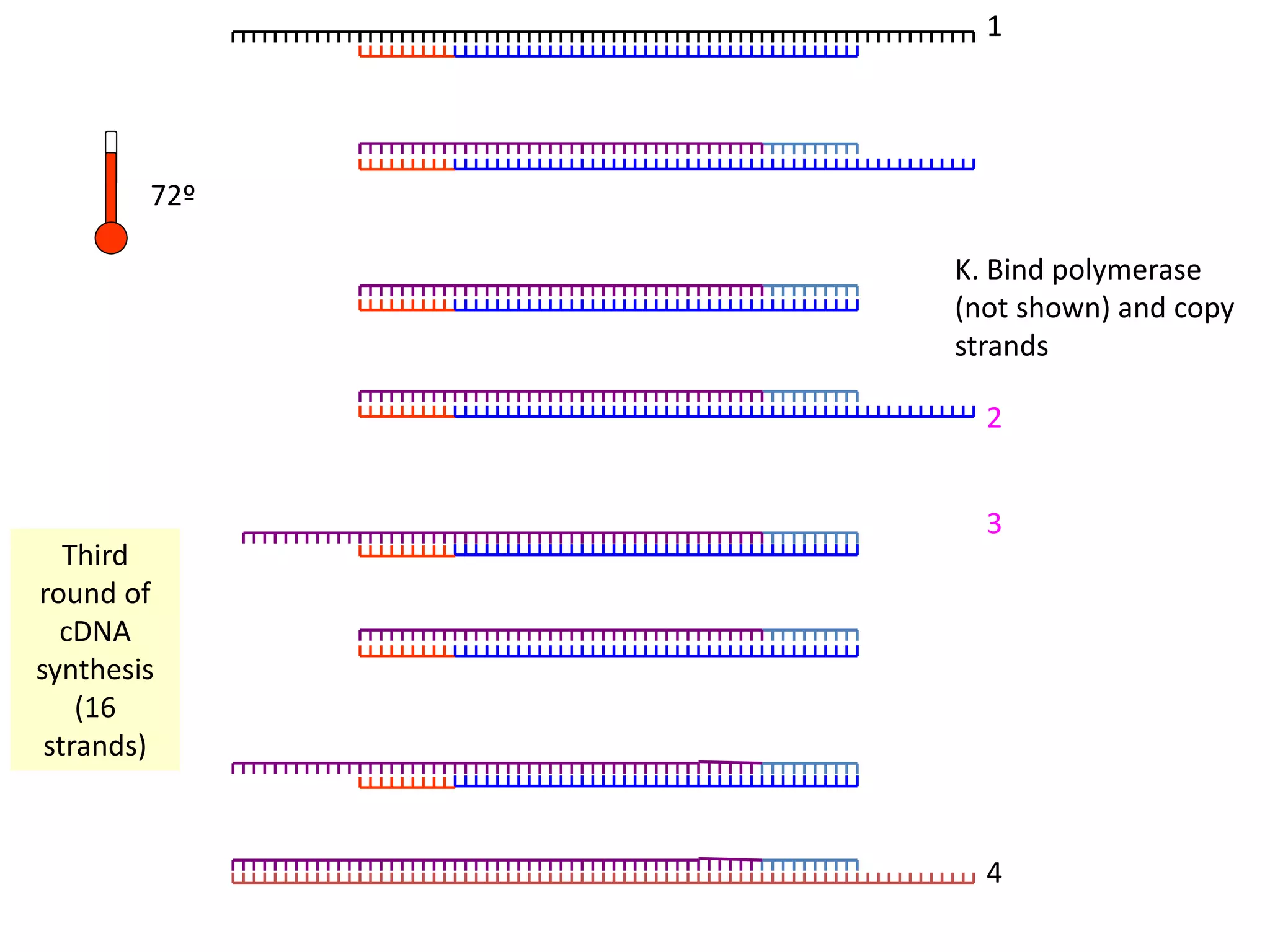
72º
K. Bind polymerase
(not shown) and copy
strands
Third
round of
cDNA
synthesis
(16
strands)
1
2
3
4
L.
Denature at 96º
Anneal primers at
50º
1
2
3
4
M.
Copy strands at
72º
Fourth
round of
cDNA
synthesis
(32
strands)
72º
1
2
3
4
cDNA
strands (32)
are now
shown as
lines
1
2
3
4
After 5 rounds
there are 32
double strands of
which 24 (75%) are
are same size
The exponential amplification via reverse transcription polymerase chain reaction
provides for a highly sensitive technique in which a very low copy number of RNA
molecules can be detected. RT-PCR is widely used in the diagnosis of genetic
diseases and, semiquantitatively, in the determination of the abundance of specific
different RNA molecules within a cell or tissue as a measure of gene expression.
•Research methods- For example, Lin et al. used qRT-PCR to measure expression
of Gal genes in yeast cells.
•Gene Insertion- RT-PCR can also be very useful in the insertion of eukaryotic genes
into prokaryotes. RT-PCR is commonly used in studying the genomes of viruses
whose genomes are composed of RNA, such as Influenzavirus A and retroviruses like
HIV.
•Genetic Disease Diagnosis- RT-PCR can be used to diagnose genetic disease such
as Lesch–Nyhan syndrome. Also can be used as a test for bird flu- H7N9.
•Cancer Detection- Scientists are working on ways to use RT-PCR in cancer
detection to help improve prognosis, and monitor response to therapy
•RT-PCR is commonly used in studying the genomes of viruses whose genomes are
composed of RNA, such as Influenzavirus A and retroviruses like HIV.
Application of RT-PCR
Thank You!

Introduction of RT PCR

  • 1.
    Rt-PCR Course: Fundamental ofgenetic engineering and biotechnology Course code: GEB302 Course Instructor: Dr. Mohiuddin Kabir Presented by: Bitali Islam Nilmoni Bushra Mohammad Nabil Hossain Md. Shabab Mehebub
  • 2.
    Introduction of RT-PCR RTPCR - Reverse transcription polymerase Chain reaction. •Reverse transcription polymerase chain reaction (RT- PCR) is one of many variants of polymerase chain reaction (PCR). •It was introduced in 1977 . • The discovery of reverse transcriptase during the study of viral replication of genetic material led to the development of RT-PCR. •RT-PCR is used to qualitatively detect gene expression through creation of complementary DNA (cDNA) transcripts from RNA. •This technique is commonly used in molecular biology to detect RNA expression.
  • 3.
  • 4.
    RT-PCR Principles There areseveral types of RT PCR Principles. One step RT PCR • RT-PCR can also be carried out as one-step RT-PCR in which all reaction components are mixed in one tube prior to initiation of the reaction. • One-step RT-PCR offers simplicity and convenience and minimizes the possibility for contamination. • The resulting cDNA cannot be used for detecting multiple messages from a single RNA sample as in two-step RT-PCR. Two step RT PCR • Traditionally, RT-PCR involves two steps: the RT reaction and PCR amplification. • RNA is first reverse transcribed into complementary DNA ( cDNA ) using an enzyme, reverse transcriptase. • The resulting cDNA is used as templates for subsequent PCR amplification using primers specific for one or more genes.
  • 5.
    RT-PCR Principles Quantification ofRT-PCR products can largely be divided into two categories: end- point and real-time. • End-point RT-PCR : measurement approaches of end-point RT-PCR detect gene expression levels by the use of fluorescent dyes like ethidium bromide, Phosphorus-32 labeling of PCR products using phosphorimager. End- point RT-PCR is commonly achieved using three different methods: relative, competitive and comparative. • Real-time RT-PCR: the analysis and detection of PCR products in real-time has consequently led to the widespread adoption of real-time RT-PCR for the analysis of gene expression. • There are four different fluorescent DNA probes for the detection of PCR products: SYBR Green, TaqMan, Molecular Beacons, and Scorpions. All of these probes allow the detection of PCR products by generating a fluorescent signal.
  • 6.
  • 7.
    Double strand cDNA AAAAA TTTTTRT AAAAA TTTTT RT RTAAAAA TTTTT Oligo dTprimer is bound to mRNA Reverse transcriptase (RT) copies first cDNA strand Reverse transcriptase digests and displaces mRNA and copies second strand of cDNA Conversion of mRNA to cDNA by Reverse Transcription
  • 8.
    A. Double strand DNA B.Denature96º 50º C. Anneal primers 50º D. Polymerase binds 72º Taq Taq
  • 9.
  • 10.
  • 11.
  • 12.
  • 13.
  • 14.
    1 2 3 4 72º K. Bind polymerase (notshown) and copy strands Third round of cDNA synthesis (16 strands)
  • 15.
  • 16.
    1 2 3 4 M. Copy strands at 72º Fourth roundof cDNA synthesis (32 strands) 72º
  • 17.
  • 18.
    1 2 3 4 After 5 rounds thereare 32 double strands of which 24 (75%) are are same size
  • 19.
    The exponential amplificationvia reverse transcription polymerase chain reaction provides for a highly sensitive technique in which a very low copy number of RNA molecules can be detected. RT-PCR is widely used in the diagnosis of genetic diseases and, semiquantitatively, in the determination of the abundance of specific different RNA molecules within a cell or tissue as a measure of gene expression. •Research methods- For example, Lin et al. used qRT-PCR to measure expression of Gal genes in yeast cells. •Gene Insertion- RT-PCR can also be very useful in the insertion of eukaryotic genes into prokaryotes. RT-PCR is commonly used in studying the genomes of viruses whose genomes are composed of RNA, such as Influenzavirus A and retroviruses like HIV. •Genetic Disease Diagnosis- RT-PCR can be used to diagnose genetic disease such as Lesch–Nyhan syndrome. Also can be used as a test for bird flu- H7N9. •Cancer Detection- Scientists are working on ways to use RT-PCR in cancer detection to help improve prognosis, and monitor response to therapy •RT-PCR is commonly used in studying the genomes of viruses whose genomes are composed of RNA, such as Influenzavirus A and retroviruses like HIV. Application of RT-PCR
  • 20.