-Sanket Kulkarni-
The Kirkpatrick Model for
Training Program Evaluation
Monday, August 19,
2013
Monday, August 19, 2013
1
Model developed by Donald L Kirkpatrick,
Professor at Emeritus, University Of
Wisconsin.
Also known as Kirkpatrick’s Four Level of
Evaluation.
Model is used to evaluate Training Program.
It is considered an industry standard across
HR and Training Communities.
Kirkpatrick Model for
Training Program Evaluation
(source: http://www.businessballs.com/kirkpatricklearningevaluationmodel.
Monday, August 19, 2013
2
Kirkpatrick Model for
Training Program Evaluation
Monday, August 19, 2013
3
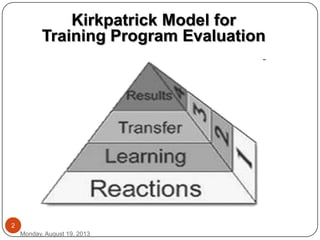
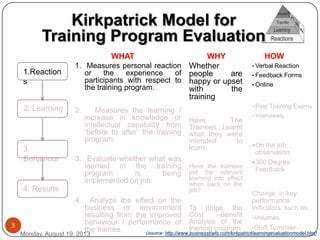
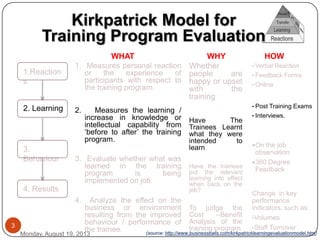
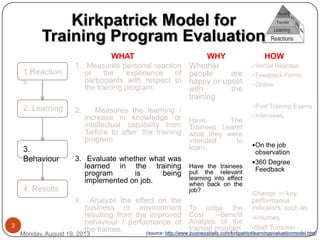
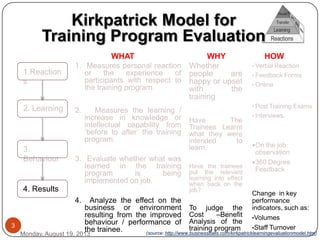
1. Measures personal reaction
or the experience of
participants with respect to
the training program.
2. Measures the learning /
increase in knowledge or
intellectual capability from
‘before to after’ the training
program.
3. Evaluate whether what was
learned in the training
program is being
implemented on job.
4. Analyze the effect on the
business or environment
resulting from the improved
behaviour / performance of
the trainee. (source: http://www.businessballs.com/kirkpatricklearningevaluationmodel.htm)
1.Reaction
s
2. Learning
3.
Behaviour
4. Results
Kirkpatrick Model for
Training Program Evaluation
Whether
people are
happy or upset
with the
training
Have The
Trainees Learnt
what they were
intended to
learn.
Have the trainees
put the relevant
learning into effect
when back on the
job?
To judge the
Cost –Benefit
Analysis of the
training program
• Verbal Reaction
• Feedback Forms
• Online
• Post Training Exams
• Interviews.
On the job
observation
360 Degree
Feedback
Change in key
performance
indicators, such as:
•Volumes
•Staff Turnover
WHAT WHY HOW
Monday, August 19, 2013
3
1. Measures personal reaction
or the experience of
participants with respect to
the training program.
2. Measures the learning /
increase in knowledge or
intellectual capability from
‘before to after’ the training
program.
3. Evaluate whether what was
learned in the training
program is being
implemented on job.
4. Analyze the effect on the
business or environment
resulting from the improved
behaviour / performance of
the trainee. (source: http://www.businessballs.com/kirkpatricklearningevaluationmodel.htm)
1.Reaction
s
2. Learning
3.
Behaviour
4. Results
Kirkpatrick Model for
Training Program Evaluation
Whether
people are
happy or upset
with the
training
Have The
Trainees Learnt
what they were
intended to
learn.
Have the trainees
put the relevant
learning into effect
when back on the
job?
To judge the
Cost –Benefit
Analysis of the
training program
• Verbal Reaction
• Feedback Forms
• Online
• Post Training Exams
• Interviews.
On the job
observation
360 Degree
Feedback
Change in key
performance
indicators, such as:
•Volumes
•Staff Turnover
WHAT WHY HOW
Monday, August 19, 2013
3
1. Measures personal reaction
or the experience of
participants with respect to
the training program.
2. Measures the learning /
increase in knowledge or
intellectual capability from
‘before to after’ the training
program.
3. Evaluate whether what was
learned in the training
program is being
implemented on job.
4. Analyze the effect on the
business or environment
resulting from the improved
behaviour / performance of
the trainee. (source: http://www.businessballs.com/kirkpatricklearningevaluationmodel.htm)
1.Reaction
s
2. Learning
3.
Behaviour
4. Results
Kirkpatrick Model for
Training Program Evaluation
Whether
people are
happy or upset
with the
training
Have The
Trainees Learnt
what they were
intended to
learn.
Have the trainees
put the relevant
learning into effect
when back on the
job?
To judge the
Cost –Benefit
Analysis of the
training program
• Verbal Reaction
• Feedback Forms
• Online
• Post Training Exams
• Interviews.
On the job
observation
360 Degree
Feedback
Change in key
performance
indicators, such as:
•Volumes
•Staff Turnover
WHAT WHY HOW
Monday, August 19, 2013
3
1. Measures personal reaction
or the experience of
participants with respect to
the training program.
2. Measures the learning /
increase in knowledge or
intellectual capability from
‘before to after’ the training
program.
3. Evaluate whether what was
learned in the training
program is being
implemented on job.
4. Analyze the effect on the
business or environment
resulting from the improved
behaviour / performance of
the trainee. (source: http://www.businessballs.com/kirkpatricklearningevaluationmodel.htm)
1.Reaction
s
2. Learning
3.
Behaviour
4. Results
Kirkpatrick Model for
Training Program Evaluation
Whether
people are
happy or upset
with the
training
Have The
Trainees Learnt
what they were
intended to
learn.
Have the trainees
put the relevant
learning into effect
when back on the
job?
To judge the
Cost –Benefit
Analysis of the
training program
• Verbal Reaction
• Feedback Forms
• Online
• Post Training Exams
• Interviews.
On the job
observation
360 Degree
Feedback
Change in key
performance
indicators, such as:
•Volumes
•Staff Turnover
WHAT WHY HOW
…THANK YOU…

Kirkpatrick model

  • 1.
    -Sanket Kulkarni- The KirkpatrickModel for Training Program Evaluation Monday, August 19, 2013
  • 2.
    Monday, August 19,2013 1 Model developed by Donald L Kirkpatrick, Professor at Emeritus, University Of Wisconsin. Also known as Kirkpatrick’s Four Level of Evaluation. Model is used to evaluate Training Program. It is considered an industry standard across HR and Training Communities. Kirkpatrick Model for Training Program Evaluation (source: http://www.businessballs.com/kirkpatricklearningevaluationmodel.
  • 3.
    Monday, August 19,2013 2 Kirkpatrick Model for Training Program Evaluation
  • 4.
    Monday, August 19,2013 3 1. Measures personal reaction or the experience of participants with respect to the training program. 2. Measures the learning / increase in knowledge or intellectual capability from ‘before to after’ the training program. 3. Evaluate whether what was learned in the training program is being implemented on job. 4. Analyze the effect on the business or environment resulting from the improved behaviour / performance of the trainee. (source: http://www.businessballs.com/kirkpatricklearningevaluationmodel.htm) 1.Reaction s 2. Learning 3. Behaviour 4. Results Kirkpatrick Model for Training Program Evaluation Whether people are happy or upset with the training Have The Trainees Learnt what they were intended to learn. Have the trainees put the relevant learning into effect when back on the job? To judge the Cost –Benefit Analysis of the training program • Verbal Reaction • Feedback Forms • Online • Post Training Exams • Interviews. On the job observation 360 Degree Feedback Change in key performance indicators, such as: •Volumes •Staff Turnover WHAT WHY HOW
  • 5.
    Monday, August 19,2013 3 1. Measures personal reaction or the experience of participants with respect to the training program. 2. Measures the learning / increase in knowledge or intellectual capability from ‘before to after’ the training program. 3. Evaluate whether what was learned in the training program is being implemented on job. 4. Analyze the effect on the business or environment resulting from the improved behaviour / performance of the trainee. (source: http://www.businessballs.com/kirkpatricklearningevaluationmodel.htm) 1.Reaction s 2. Learning 3. Behaviour 4. Results Kirkpatrick Model for Training Program Evaluation Whether people are happy or upset with the training Have The Trainees Learnt what they were intended to learn. Have the trainees put the relevant learning into effect when back on the job? To judge the Cost –Benefit Analysis of the training program • Verbal Reaction • Feedback Forms • Online • Post Training Exams • Interviews. On the job observation 360 Degree Feedback Change in key performance indicators, such as: •Volumes •Staff Turnover WHAT WHY HOW
  • 6.
    Monday, August 19,2013 3 1. Measures personal reaction or the experience of participants with respect to the training program. 2. Measures the learning / increase in knowledge or intellectual capability from ‘before to after’ the training program. 3. Evaluate whether what was learned in the training program is being implemented on job. 4. Analyze the effect on the business or environment resulting from the improved behaviour / performance of the trainee. (source: http://www.businessballs.com/kirkpatricklearningevaluationmodel.htm) 1.Reaction s 2. Learning 3. Behaviour 4. Results Kirkpatrick Model for Training Program Evaluation Whether people are happy or upset with the training Have The Trainees Learnt what they were intended to learn. Have the trainees put the relevant learning into effect when back on the job? To judge the Cost –Benefit Analysis of the training program • Verbal Reaction • Feedback Forms • Online • Post Training Exams • Interviews. On the job observation 360 Degree Feedback Change in key performance indicators, such as: •Volumes •Staff Turnover WHAT WHY HOW
  • 7.
    Monday, August 19,2013 3 1. Measures personal reaction or the experience of participants with respect to the training program. 2. Measures the learning / increase in knowledge or intellectual capability from ‘before to after’ the training program. 3. Evaluate whether what was learned in the training program is being implemented on job. 4. Analyze the effect on the business or environment resulting from the improved behaviour / performance of the trainee. (source: http://www.businessballs.com/kirkpatricklearningevaluationmodel.htm) 1.Reaction s 2. Learning 3. Behaviour 4. Results Kirkpatrick Model for Training Program Evaluation Whether people are happy or upset with the training Have The Trainees Learnt what they were intended to learn. Have the trainees put the relevant learning into effect when back on the job? To judge the Cost –Benefit Analysis of the training program • Verbal Reaction • Feedback Forms • Online • Post Training Exams • Interviews. On the job observation 360 Degree Feedback Change in key performance indicators, such as: •Volumes •Staff Turnover WHAT WHY HOW
  • 8.