Program Evaluation
Joy Anne R. Puazo
Marie Buena S. Bunsoy
Evaluation
Evaluation
◦ The systematic gathering of information
for purposes of making decisions
◦ - Richards et al. (1985. p. 98)
Evaluation
“Systematic educational evaluation
consists of a formal assessment of
the worth of educational
phenomena.”
- Popham (1975, p.8)
Evaluation
“Evaluation is the determination of the
worth of a thing. It includes obtaining
information for use in judging the worth
of the program, product, procedure, or
object, or the potential utility of
alternative approaches designed to attain
specified objectives.”
- Worthen and Sanders (1973, p.19)
Evaluation
“Evaluation is the systematic collection and
analysis of all relevant information
necessary to promote the improvement of
the curriculum and assess its
effectiveness within the context of the
particular institutions involved.”
- Brown
Evaluation
 Testing
◦ Procedures that are based on test, whether
they be criterion-referenced or norm-
referenced in nature.
 Measurement
◦ Testing is included; other types of
measurements that result in quantitative data
such as attendance records, questionnaires,
teacher-student ratings
Evaluation
Evaluation
◦More qualitative in nature
Case studies, classroom
observations, meetings,
diaries, and conversations
Approaches to Program Evaluation
 Product-oriented approaches
◦Focus: goals and instructional
objectives
◦Tyler, Hammond, and Metfessel
and Michael
Product-oriented approaches
 The programs should be built on explicitly
defined goals, specified in terms of the
society, the students, the subject matter,
as well as on measurable behavioral
objectives.
 Purpose: To determine whether the
objectives have been achieved, and
whether the goals have been met.
- Tyler
Product-oriented approaches
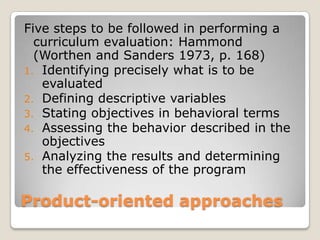
Five steps to be followed in performing a
curriculum evaluation: Hammond
(Worthen and Sanders 1973, p. 168)
1. Identifying precisely what is to be
evaluated
2. Defining descriptive variables
3. Stating objectives in behavioral terms
4. Assessing the behavior described in the
objectives
5. Analyzing the results and determining
the effectiveness of the program
Product-oriented approaches
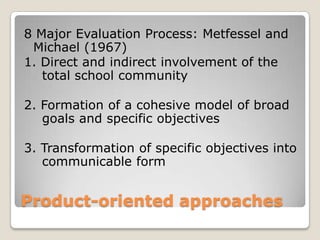
8 Major Evaluation Process: Metfessel and
Michael (1967)
1. Direct and indirect involvement of the
total school community
2. Formation of a cohesive model of broad
goals and specific objectives
3. Transformation of specific objectives into
communicable form
Product-oriented approaches
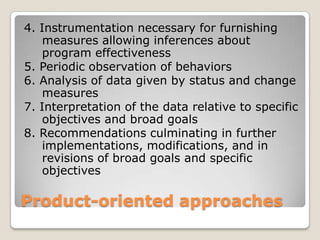
4. Instrumentation necessary for furnishing
measures allowing inferences about
program effectiveness
5. Periodic observation of behaviors
6. Analysis of data given by status and change
measures
7. Interpretation of the data relative to specific
objectives and broad goals
8. Recommendations culminating in further
implementations, modifications, and in
revisions of broad goals and specific
objectives
Approaches to Program Evaluation
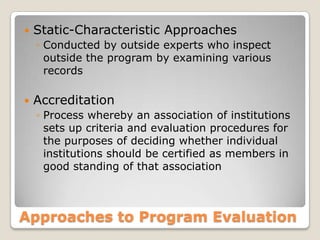
 Static-Characteristic Approaches
◦ Conducted by outside experts who inspect
outside the program by examining various
records
 Accreditation
◦ Process whereby an association of institutions
sets up criteria and evaluation procedures for
the purposes of deciding whether individual
institutions should be certified as members in
good standing of that association
Static-Characteristic Approaches
“A major reason for the diminishing interest in
accreditation conceptions of evaluation is the
recognition of their almost total reliance on intrinsic
rather than extrinsic factors. Although there are some
intuitive support for the proposition that these
process factors are associated with the final outcomes
of an instructional sequence, the scarcity of the
empirical evidence to confirm the relationship has
created growing dissatisfaction with the accreditation
approach among the educators.”
- Popham (1975, p. 25)
Approaches to Program Evaluation
 Process-Oriented Approaches (Scriven
and Stake)
 Scriven’s Model/Goal-free evaluation
◦ Limits are not set on studying the
expected effects of the program vis-à-
vis the goals
Process-Oriented Approaches
 Countenance model (Stake; 1967)
1. Begin with a rationale
2. Fix on descriptive operations
3. End with judgmental operations at 3 levels:
 Antecedents
 Transactions
 Outcomes
Approaches to Program Evaluation
 Decision-Facilitation Approaches
◦ Evaluators attempt to avoid making
judgments
◦ Gathering information that will help the
administrators and faculty in the program
make their own judgments and evaluation
◦ Examples: CICP, CSE, Discrepancy model
Decision-Facilitation Approaches
 CIPP (Context, Input, Process, Product)
 4 key elements in performing program evaluation:
Stufflebeam (1974)
1. Evaluation is performed in the service of decision making,
hence it should provide information that is useful to
decision makers.
2. Evaluation is a cyclic, continuing process and therefore
must be implemented through a systematic program.
3. The evaluation process includes 3 main steps of
delineating, obtaining, and providing. (methodology)
4. The delineating and providing steps in the evaluation
process are interface activities requiring collaboration.
Decision-Facilitation Approaches
 CSE (Center for the Study of Evaluation)
 5 different categories of decisions (Alkin; 1969)
1. System assessment
2. Program planning
3. Program implementation
4. Program improvement
5. Program certification
Decision-Facilitation Approaches
 Discrepancy Model (Provus; 1971)
“Program evaluation is the process of (1)
defining program standards; (2)
determining whether the discrepancy
exists between some aspect of program
performance and the standards governing
the aspect of the program; and (3) using
discrepancy information either to change
performance or to change program
standards.”
Decision-Facilitation Approaches
 5 stages that shows that discrepancy
model is a process-oriented approach:
1. Program description stage
2. Program installation stage
3. Treatment adjustment stage
4. Goal achievement analysis stage
5. Cost-benefit analysis
Three Dimensions that Shape Point of View
on Evaluation:
1. Formative vs. Summative
2. Process vs. Product
3. Quantitative vs. Qualitative
Three Dimensions
Purpose of Information
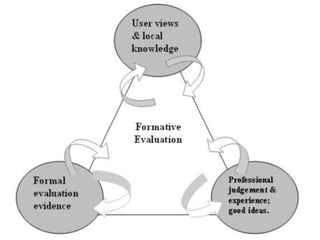
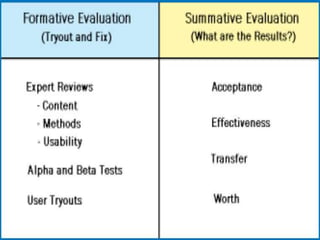
 Formative evaluation
◦ During the ongoing curriculum dev’t process
◦ To collect and analyze information that will help
in improving the curriculum
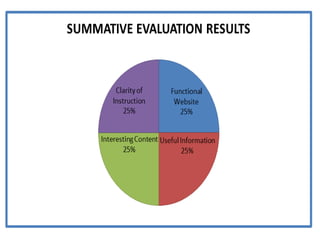
 Summative evaluation
◦ End of a program
◦ To determine the degree to which the program
is successful, efficient, and effective.
Weakness of Summative
Evaluation
Most language program are
continuing institutions that
do not conveniently come to
an end so that such
evaluation can be performed
Benefits of Summative Evaluation
 Identifying the success and failure of the
program
 Provides an opportunity to stand back or
consider what has been achieved in the
longer view
 Combination of F and S:
◦ Can put the program and its staff in a strong
position for responding any crises that might
be brought on by the evaluation from outside
the program
Three Dimensions
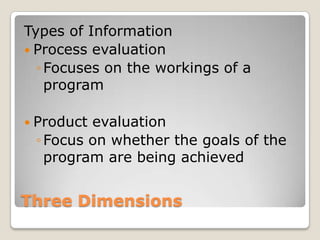
Types of Information
 Process evaluation
◦Focuses on the workings of a
program
 Product evaluation
◦Focus on whether the goals of the
program are being achieved
Three Dimensions
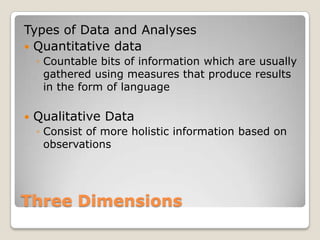
Types of Data and Analyses
 Quantitative data
◦ Countable bits of information which are usually
gathered using measures that produce results
in the form of language
 Qualitative Data
◦ Consist of more holistic information based on
observations
Doing Program
Evaluation
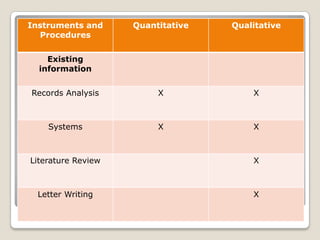
Instruments and
Procedures
Quantitative Qualitative
Existing
information
Records Analysis X X
Systems X X
Literature Review X
Letter Writing X
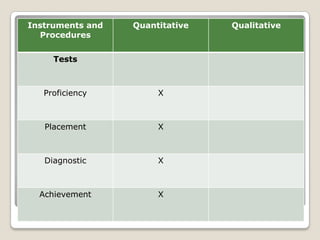
Instruments and
Procedures
Quantitative Qualitative
Tests
Proficiency X
Placement X
Diagnostic X
Achievement X
Instruments and
Procedures
Quantitative Qualitative
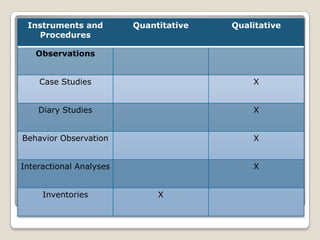
Observations
Case Studies X
Diary Studies X
Behavior Observation X
Interactional Analyses X
Inventories X
Instruments and
Procedures
Quantitative Qualitative
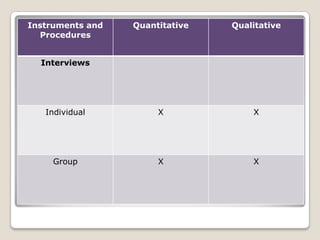
Interviews
Individual X X
Group X X
Instruments and
Procedures
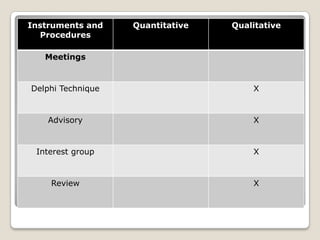
Quantitative Qualitative
Meetings
Delphi Technique X
Advisory X
Interest group X
Review X
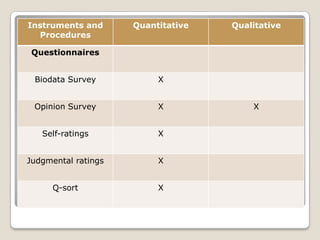
Instruments and
Procedures
Quantitative Qualitative
Questionnaires
Biodata Survey X
Opinion Survey X X
Self-ratings X
Judgmental ratings X
Q-sort X
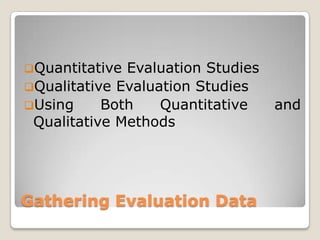
Gathering Evaluation Data
Quantitative Evaluation Studies
Qualitative Evaluation Studies
Using Both Quantitative and
Qualitative Methods
Gathering Evaluation Data
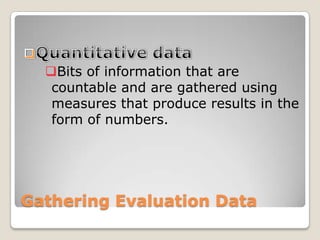
Bits of information that are
countable and are gathered using
measures that produce results in the
form of numbers.
Gathering Evaluation Data
The importance of using quantitative
data is not so much in the collection
of those data, but rather in the
analysis of the data, which should be
carried out in such a way that
patterns emerge.
Gathering Evaluation Data
A classic example of what many
people think an evaluation study
ought to be is a quantitative,
statistics-based experimental study
designed to investigate the
effectiveness of a given program.
Gathering Evaluation Data
Key Terms:
Experimental Group
One that receives the treatment
Control Group
Receives no treatment
Gathering Evaluation Data
is something that the
experimenter does to the experimental
group or rather than an experience
through which they go (as in learning
experience).
Gathering Evaluation Data
The purpose of giving treatment to
the experimental group and nothing
to the control group is to determine
whether the treatment has been
effective.
Gathering Evaluation Data
Consists of information that is more
holistic than quantitative data.
Gathering Evaluation Data
To collect data in order to analyze
them in such a way that patterns
emerge so that sense can be made of
the results and the quality of the
program can be evaluated.
Gathering Evaluation Data
Using Both Quantitative and Qualitative
Methods
Both types of data can yield valuable information
in any evaluation, and therefore ignoring either
type of information would be pointless and self-
defeating. Sound evaluation practices will be
based on all available perspectives so that many
types of information can be gathered to
strengthen the evaluation process and ensure that
the resulting decisions will be as informed,
accurate, and useful as possible.
Program Components as Data Sources
The purpose of gathering all this
information is, of course, to determine the
effectiveness of the program, so as to
improve each of the components and the
ways that they work together.
Program Components as Data Sources
The overall purpose of evaluation is to
determine the general effectiveness of
the program, usually for purposes of
improving it or defending its utility to
outside administrators or agencies.
Naturally, the curriculum components
under discussion are needs analysis,
objectives, testing, materials, teaching,
and the evaluation itself.
Program Components as Data Sources
Quantitative study that demonstrates the
students (who receive a language learning
treatment) significantly outperformed a control
group (who did not receive the treatment) is
really only showing that the treatment in question
is better than nothing.
Lynch (1986)
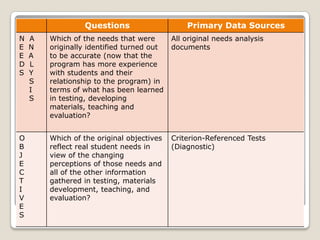
Questions Primary Data Sources
N A
E N
E A
D L
S Y
S
I
S
Which of the needs that were
originally identified turned out
to be accurate (now that the
program has more experience
with students and their
relationship to the program) in
terms of what has been learned
in testing, developing
materials, teaching and
evaluation?
All original needs analysis
documents
O
B
J
E
C
T
I
V
E
S
Which of the original objectives
reflect real student needs in
view of the changing
perceptions of those needs and
all of the other information
gathered in testing, materials
development, teaching, and
evaluation?
Criterion-Referenced Tests
(Diagnostic)
T
E
S
T
I
N
G
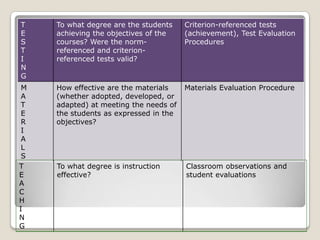
To what degree are the students
achieving the objectives of the
courses? Were the norm-
referenced and criterion-
referenced tests valid?
Criterion-referenced tests
(achievement), Test Evaluation
Procedures
M
A
T
E
R
I
A
L
S
How effective are the materials
(whether adopted, developed, or
adapted) at meeting the needs of
the students as expressed in the
objectives?
Materials Evaluation Procedure
T
E
A
C
H
I
N
G
To what degree is instruction
effective?
Classroom observations and
student evaluations
Program Component as Data Sources
More detailed questions:
What were the original perception of the
students’ needs?
How accurate was this initial thinking (now that
we have more experience with the students and
their relationship to the said program)?
Which of the original needs, especially as
reflected in the goals and objectives, are useful
and which are not useful?
What newly perceived needs must be addressed?
How do these relate to those perceptions that
were found to be accurate? How must be the
goals and objectives be adjusted accordingly?
Program Component as Data Sources
Efficient?
Evaluators could set up a study to investigate
the degree to which the amount of time can
be compressed to make the learning process
more efficient.
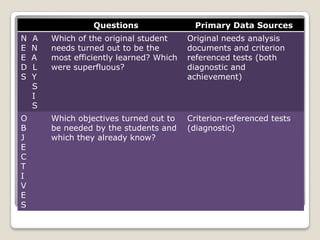
Questions Primary Data Sources
N A
E N
E A
D L
S Y
S
I
S
Which of the original student
needs turned out to be the
most efficiently learned? Which
were superfluous?
Original needs analysis
documents and criterion
referenced tests (both
diagnostic and
achievement)
O
B
J
E
C
T
I
V
E
S
Which objectives turned out to
be needed by the students and
which they already know?
Criterion-referenced tests
(diagnostic)
T
E
S
T
I
N
G
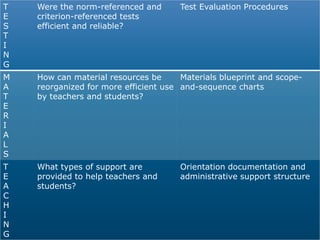
Were the norm-referenced and
criterion-referenced tests
efficient and reliable?
Test Evaluation Procedures
M
A
T
E
R
I
A
L
S
How can material resources be
reorganized for more efficient use
by teachers and students?
Materials blueprint and scope-
and-sequence charts
T
E
A
C
H
I
N
G
What types of support are
provided to help teachers and
students?
Orientation documentation and
administrative support structure
Program Component as Data Sources
Attitudes
The third general area concern in
language program evaluation will
usually center on the attitudes of the
teachers, students, and administrators
regarding the various components of
the curriculum as they were
implemented in the program.
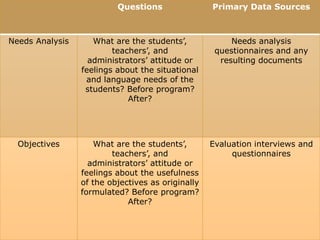
Questions Primary Data Sources
Needs Analysis What are the students’,
teachers’, and
administrators’ attitude or
feelings about the situational
and language needs of the
students? Before program?
After?
Needs analysis
questionnaires and any
resulting documents
Objectives What are the students’,
teachers’, and
administrators’ attitude or
feelings about the usefulness
of the objectives as originally
formulated? Before program?
After?
Evaluation interviews and
questionnaires
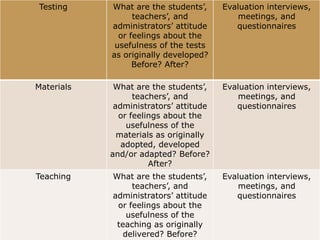
Testing What are the students’,
teachers’, and
administrators’ attitude
or feelings about the
usefulness of the tests
as originally developed?
Before? After?
Evaluation interviews,
meetings, and
questionnaires
Materials What are the students’,
teachers’, and
administrators’ attitude
or feelings about the
usefulness of the
materials as originally
adopted, developed
and/or adapted? Before?
After?
Evaluation interviews,
meetings, and
questionnaires
Teaching What are the students’,
teachers’, and
administrators’ attitude
or feelings about the
usefulness of the
teaching as originally
delivered? Before?
Evaluation interviews,
meetings, and
questionnaires
Program evaluation

Program evaluation

  • 1.
    Program Evaluation Joy AnneR. Puazo Marie Buena S. Bunsoy
  • 2.
    Evaluation Evaluation ◦ The systematicgathering of information for purposes of making decisions ◦ - Richards et al. (1985. p. 98)
  • 3.
    Evaluation “Systematic educational evaluation consistsof a formal assessment of the worth of educational phenomena.” - Popham (1975, p.8)
  • 4.
    Evaluation “Evaluation is thedetermination of the worth of a thing. It includes obtaining information for use in judging the worth of the program, product, procedure, or object, or the potential utility of alternative approaches designed to attain specified objectives.” - Worthen and Sanders (1973, p.19)
  • 5.
    Evaluation “Evaluation is thesystematic collection and analysis of all relevant information necessary to promote the improvement of the curriculum and assess its effectiveness within the context of the particular institutions involved.” - Brown
  • 6.
    Evaluation  Testing ◦ Proceduresthat are based on test, whether they be criterion-referenced or norm- referenced in nature.  Measurement ◦ Testing is included; other types of measurements that result in quantitative data such as attendance records, questionnaires, teacher-student ratings
  • 7.
    Evaluation Evaluation ◦More qualitative innature Case studies, classroom observations, meetings, diaries, and conversations
  • 8.
    Approaches to ProgramEvaluation  Product-oriented approaches ◦Focus: goals and instructional objectives ◦Tyler, Hammond, and Metfessel and Michael
  • 9.
    Product-oriented approaches  Theprograms should be built on explicitly defined goals, specified in terms of the society, the students, the subject matter, as well as on measurable behavioral objectives.  Purpose: To determine whether the objectives have been achieved, and whether the goals have been met. - Tyler
  • 10.
    Product-oriented approaches Five stepsto be followed in performing a curriculum evaluation: Hammond (Worthen and Sanders 1973, p. 168) 1. Identifying precisely what is to be evaluated 2. Defining descriptive variables 3. Stating objectives in behavioral terms 4. Assessing the behavior described in the objectives 5. Analyzing the results and determining the effectiveness of the program
  • 11.
    Product-oriented approaches 8 MajorEvaluation Process: Metfessel and Michael (1967) 1. Direct and indirect involvement of the total school community 2. Formation of a cohesive model of broad goals and specific objectives 3. Transformation of specific objectives into communicable form
  • 12.
    Product-oriented approaches 4. Instrumentationnecessary for furnishing measures allowing inferences about program effectiveness 5. Periodic observation of behaviors 6. Analysis of data given by status and change measures 7. Interpretation of the data relative to specific objectives and broad goals 8. Recommendations culminating in further implementations, modifications, and in revisions of broad goals and specific objectives
  • 13.
    Approaches to ProgramEvaluation  Static-Characteristic Approaches ◦ Conducted by outside experts who inspect outside the program by examining various records  Accreditation ◦ Process whereby an association of institutions sets up criteria and evaluation procedures for the purposes of deciding whether individual institutions should be certified as members in good standing of that association
  • 14.
    Static-Characteristic Approaches “A majorreason for the diminishing interest in accreditation conceptions of evaluation is the recognition of their almost total reliance on intrinsic rather than extrinsic factors. Although there are some intuitive support for the proposition that these process factors are associated with the final outcomes of an instructional sequence, the scarcity of the empirical evidence to confirm the relationship has created growing dissatisfaction with the accreditation approach among the educators.” - Popham (1975, p. 25)
  • 15.
    Approaches to ProgramEvaluation  Process-Oriented Approaches (Scriven and Stake)  Scriven’s Model/Goal-free evaluation ◦ Limits are not set on studying the expected effects of the program vis-à- vis the goals
  • 16.
    Process-Oriented Approaches  Countenancemodel (Stake; 1967) 1. Begin with a rationale 2. Fix on descriptive operations 3. End with judgmental operations at 3 levels:  Antecedents  Transactions  Outcomes
  • 17.
    Approaches to ProgramEvaluation  Decision-Facilitation Approaches ◦ Evaluators attempt to avoid making judgments ◦ Gathering information that will help the administrators and faculty in the program make their own judgments and evaluation ◦ Examples: CICP, CSE, Discrepancy model
  • 18.
    Decision-Facilitation Approaches  CIPP(Context, Input, Process, Product)  4 key elements in performing program evaluation: Stufflebeam (1974) 1. Evaluation is performed in the service of decision making, hence it should provide information that is useful to decision makers. 2. Evaluation is a cyclic, continuing process and therefore must be implemented through a systematic program. 3. The evaluation process includes 3 main steps of delineating, obtaining, and providing. (methodology) 4. The delineating and providing steps in the evaluation process are interface activities requiring collaboration.
  • 19.
    Decision-Facilitation Approaches  CSE(Center for the Study of Evaluation)  5 different categories of decisions (Alkin; 1969) 1. System assessment 2. Program planning 3. Program implementation 4. Program improvement 5. Program certification
  • 20.
    Decision-Facilitation Approaches  DiscrepancyModel (Provus; 1971) “Program evaluation is the process of (1) defining program standards; (2) determining whether the discrepancy exists between some aspect of program performance and the standards governing the aspect of the program; and (3) using discrepancy information either to change performance or to change program standards.”
  • 21.
    Decision-Facilitation Approaches  5stages that shows that discrepancy model is a process-oriented approach: 1. Program description stage 2. Program installation stage 3. Treatment adjustment stage 4. Goal achievement analysis stage 5. Cost-benefit analysis
  • 22.
    Three Dimensions thatShape Point of View on Evaluation: 1. Formative vs. Summative 2. Process vs. Product 3. Quantitative vs. Qualitative
  • 23.
    Three Dimensions Purpose ofInformation  Formative evaluation ◦ During the ongoing curriculum dev’t process ◦ To collect and analyze information that will help in improving the curriculum  Summative evaluation ◦ End of a program ◦ To determine the degree to which the program is successful, efficient, and effective.
  • 24.
    Weakness of Summative Evaluation Mostlanguage program are continuing institutions that do not conveniently come to an end so that such evaluation can be performed
  • 25.
    Benefits of SummativeEvaluation  Identifying the success and failure of the program  Provides an opportunity to stand back or consider what has been achieved in the longer view  Combination of F and S: ◦ Can put the program and its staff in a strong position for responding any crises that might be brought on by the evaluation from outside the program
  • 29.
    Three Dimensions Types ofInformation  Process evaluation ◦Focuses on the workings of a program  Product evaluation ◦Focus on whether the goals of the program are being achieved
  • 30.
    Three Dimensions Types ofData and Analyses  Quantitative data ◦ Countable bits of information which are usually gathered using measures that produce results in the form of language  Qualitative Data ◦ Consist of more holistic information based on observations
  • 31.
  • 32.
    Instruments and Procedures Quantitative Qualitative Existing information RecordsAnalysis X X Systems X X Literature Review X Letter Writing X
  • 33.
  • 34.
    Instruments and Procedures Quantitative Qualitative Observations CaseStudies X Diary Studies X Behavior Observation X Interactional Analyses X Inventories X
  • 35.
  • 36.
    Instruments and Procedures Quantitative Qualitative Meetings DelphiTechnique X Advisory X Interest group X Review X
  • 37.
    Instruments and Procedures Quantitative Qualitative Questionnaires BiodataSurvey X Opinion Survey X X Self-ratings X Judgmental ratings X Q-sort X
  • 38.
    Gathering Evaluation Data QuantitativeEvaluation Studies Qualitative Evaluation Studies Using Both Quantitative and Qualitative Methods
  • 39.
    Gathering Evaluation Data Bitsof information that are countable and are gathered using measures that produce results in the form of numbers.
  • 40.
    Gathering Evaluation Data Theimportance of using quantitative data is not so much in the collection of those data, but rather in the analysis of the data, which should be carried out in such a way that patterns emerge.
  • 41.
    Gathering Evaluation Data Aclassic example of what many people think an evaluation study ought to be is a quantitative, statistics-based experimental study designed to investigate the effectiveness of a given program.
  • 42.
    Gathering Evaluation Data KeyTerms: Experimental Group One that receives the treatment Control Group Receives no treatment
  • 43.
    Gathering Evaluation Data issomething that the experimenter does to the experimental group or rather than an experience through which they go (as in learning experience).
  • 44.
    Gathering Evaluation Data Thepurpose of giving treatment to the experimental group and nothing to the control group is to determine whether the treatment has been effective.
  • 45.
    Gathering Evaluation Data Consistsof information that is more holistic than quantitative data.
  • 46.
    Gathering Evaluation Data Tocollect data in order to analyze them in such a way that patterns emerge so that sense can be made of the results and the quality of the program can be evaluated.
  • 47.
    Gathering Evaluation Data UsingBoth Quantitative and Qualitative Methods Both types of data can yield valuable information in any evaluation, and therefore ignoring either type of information would be pointless and self- defeating. Sound evaluation practices will be based on all available perspectives so that many types of information can be gathered to strengthen the evaluation process and ensure that the resulting decisions will be as informed, accurate, and useful as possible.
  • 48.
    Program Components asData Sources The purpose of gathering all this information is, of course, to determine the effectiveness of the program, so as to improve each of the components and the ways that they work together.
  • 49.
    Program Components asData Sources The overall purpose of evaluation is to determine the general effectiveness of the program, usually for purposes of improving it or defending its utility to outside administrators or agencies. Naturally, the curriculum components under discussion are needs analysis, objectives, testing, materials, teaching, and the evaluation itself.
  • 50.
    Program Components asData Sources Quantitative study that demonstrates the students (who receive a language learning treatment) significantly outperformed a control group (who did not receive the treatment) is really only showing that the treatment in question is better than nothing. Lynch (1986)
  • 51.
    Questions Primary DataSources N A E N E A D L S Y S I S Which of the needs that were originally identified turned out to be accurate (now that the program has more experience with students and their relationship to the program) in terms of what has been learned in testing, developing materials, teaching and evaluation? All original needs analysis documents O B J E C T I V E S Which of the original objectives reflect real student needs in view of the changing perceptions of those needs and all of the other information gathered in testing, materials development, teaching, and evaluation? Criterion-Referenced Tests (Diagnostic)
  • 52.
    T E S T I N G To what degreeare the students achieving the objectives of the courses? Were the norm- referenced and criterion- referenced tests valid? Criterion-referenced tests (achievement), Test Evaluation Procedures M A T E R I A L S How effective are the materials (whether adopted, developed, or adapted) at meeting the needs of the students as expressed in the objectives? Materials Evaluation Procedure T E A C H I N G To what degree is instruction effective? Classroom observations and student evaluations
  • 53.
    Program Component asData Sources More detailed questions: What were the original perception of the students’ needs? How accurate was this initial thinking (now that we have more experience with the students and their relationship to the said program)? Which of the original needs, especially as reflected in the goals and objectives, are useful and which are not useful? What newly perceived needs must be addressed? How do these relate to those perceptions that were found to be accurate? How must be the goals and objectives be adjusted accordingly?
  • 54.
    Program Component asData Sources Efficient? Evaluators could set up a study to investigate the degree to which the amount of time can be compressed to make the learning process more efficient.
  • 55.
    Questions Primary DataSources N A E N E A D L S Y S I S Which of the original student needs turned out to be the most efficiently learned? Which were superfluous? Original needs analysis documents and criterion referenced tests (both diagnostic and achievement) O B J E C T I V E S Which objectives turned out to be needed by the students and which they already know? Criterion-referenced tests (diagnostic)
  • 56.
    T E S T I N G Were the norm-referencedand criterion-referenced tests efficient and reliable? Test Evaluation Procedures M A T E R I A L S How can material resources be reorganized for more efficient use by teachers and students? Materials blueprint and scope- and-sequence charts T E A C H I N G What types of support are provided to help teachers and students? Orientation documentation and administrative support structure
  • 57.
    Program Component asData Sources Attitudes The third general area concern in language program evaluation will usually center on the attitudes of the teachers, students, and administrators regarding the various components of the curriculum as they were implemented in the program.
  • 58.
    Questions Primary DataSources Needs Analysis What are the students’, teachers’, and administrators’ attitude or feelings about the situational and language needs of the students? Before program? After? Needs analysis questionnaires and any resulting documents Objectives What are the students’, teachers’, and administrators’ attitude or feelings about the usefulness of the objectives as originally formulated? Before program? After? Evaluation interviews and questionnaires
  • 59.
    Testing What arethe students’, teachers’, and administrators’ attitude or feelings about the usefulness of the tests as originally developed? Before? After? Evaluation interviews, meetings, and questionnaires Materials What are the students’, teachers’, and administrators’ attitude or feelings about the usefulness of the materials as originally adopted, developed and/or adapted? Before? After? Evaluation interviews, meetings, and questionnaires Teaching What are the students’, teachers’, and administrators’ attitude or feelings about the usefulness of the teaching as originally delivered? Before? Evaluation interviews, meetings, and questionnaires