Safeena Majeed, A.A
PALB 6132
et54y65udfdsgfdgf
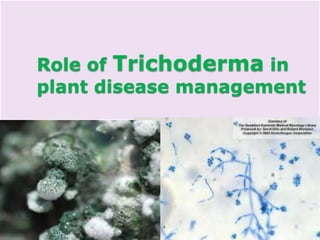
Role of Trichoderma in
plant disease management
 Trichoderma spp. are present in nearly all agricultural
soils.
 They are the most prevalent culturable fungi.
 Many species in this genus can be characterized as
opportunistic avirulent plant symbionts.
 This refers to the ability of several
Trichoderma species to form mutualistic endophytic
relationships with several plant species.
 The genomes of several Trichoderma species have
been sequenced.
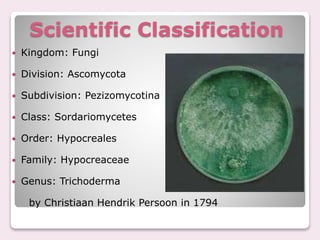
Scientific Classification
 Kingdom: Fungi
 Division: Ascomycota
 Subdivision: Pezizomycotina
 Class: Sordariomycetes
 Order: Hypocreales
 Family: Hypocreaceae
 Genus: Trichoderma
by Christiaan Hendrik Persoon in 1794
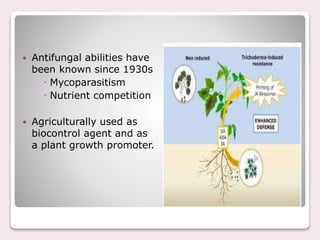
 Antifungal abilities have
been known since 1930s
 Mycoparasitism
 Nutrient competition
 Agriculturally used as
biocontrol agent and as
a plant growth promoter.
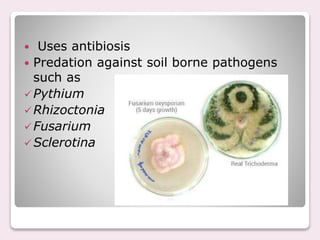
 Uses antibiosis
 Predation against soil borne pathogens
such as
Pythium
Rhizoctonia
Fusarium
Sclerotina
How the colony looks
 Cultures are fast growing at 25–30 °C, but some
species at 45 °C.
 Media: CMD or PDA.
 Mycelium are not typically obvious on CMD.
 Conidia typically form within one week in compact or
loose tufts.
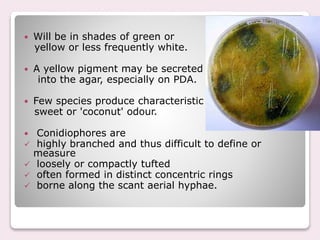
 Will be in shades of green or
yellow or less frequently white.
 A yellow pigment may be secreted
into the agar, especially on PDA.
 Few species produce characteristic
sweet or 'coconut' odour.
 Conidiophores are
 highly branched and thus difficult to define or
measure
 loosely or compactly tufted
 often formed in distinct concentric rings
 borne along the scant aerial hyphae.
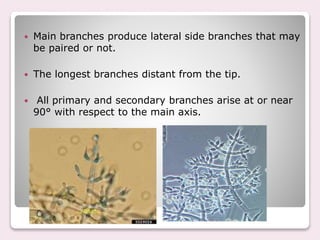
 Main branches produce lateral side branches that may
be paired or not.
 The longest branches distant from the tip.
 All primary and secondary branches arise at or near
90° with respect to the main axis.
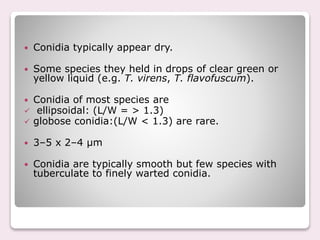
 Conidia typically appear dry.
 Some species they held in drops of clear green or
yellow liquid (e.g. T. virens, T. flavofuscum).
 Conidia of most species are
 ellipsoidal: (L/W = > 1.3)
 globose conidia:(L/W < 1.3) are rare.
 3–5 x 2–4 µm
 Conidia are typically smooth but few species with
tuberculate to finely warted conidia.
Occurence
 Frequently isolated from
forest or agricultural soils
at all latitudes
 Hypocrea species are
most frequently found on
bark or on decorticated
wood.
 Many species grow on
bracket fungi e.g. H.
Pulvinata
 Bird's nest fungi - H.
Latizonata
 Agarics - H. avellanea.
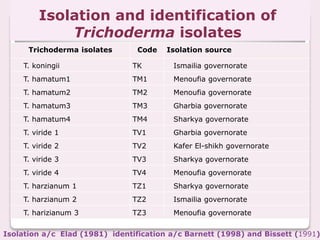
Trichoderma isolates Code Isolation source
T. koningii TK Ismailia governorate
T. hamatum1 TM1 Menoufia governorate
T. hamatum2 TM2 Menoufia governorate
T. hamatum3 TM3 Gharbia governorate
T. hamatum4 TM4 Sharkya governorate
T. viride 1 TV1 Gharbia governorate
T. viride 2 TV2 Kafer El-shikh governorate
T. viride 3 TV3 Sharkya governorate
T. viride 4 TV4 Menoufia governorate
T. harzianum 1 TZ1 Sharkya governorate
T. harzianum 2 TZ2 Ismailia governorate
T. harizianum 3 TZ3 Menoufia governorate
Isolation a/c Elad (1981) identification a/c Barnett (1998) and Bissett (1991)
Isolation and identification of
Trichoderma isolates
 Genetic Modification
◦ Wild strains
 Heterokaryotic – contain nuclei of dissimilar
genotypes within a single organism
◦ Biocontrol strains
 Homokaryotic – contain nuclei which are similar
or identical
 Allows genetic distinction and non-variability
◦ IMPORTANT FOR QUALITY CONTROL
Why buy/develop a product
that is readily available in the
soil?
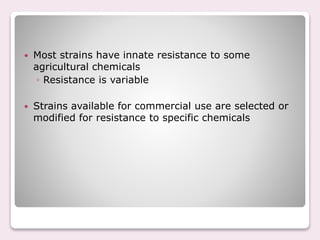
 Most strains have innate resistance to some
agricultural chemicals
◦ Resistance is variable
 Strains available for commercial use are selected or
modified for resistance to specific chemicals
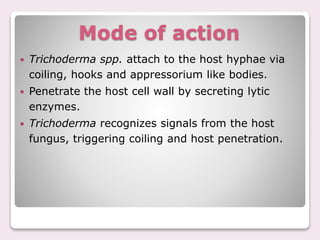
Mode of action
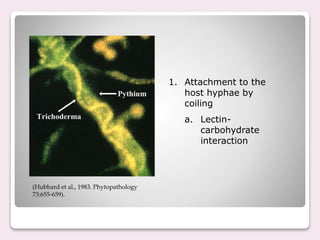
 Trichoderma spp. attach to the host hyphae via
coiling, hooks and appressorium like bodies.
 Penetrate the host cell wall by secreting lytic
enzymes.
 Trichoderma recognizes signals from the host
fungus, triggering coiling and host penetration.
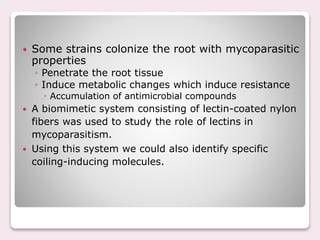
 Some strains colonize the root with mycoparasitic
properties
◦ Penetrate the root tissue
◦ Induce metabolic changes which induce resistance
 Accumulation of antimicrobial compounds
 A biomimetic system consisting of lectin-coated nylon
fibers was used to study the role of lectins in
mycoparasitism.
 Using this system we could also identify specific
coiling-inducing molecules.
1. Attachment to the
host hyphae by
coiling
a. Lectin-
carbohydrate
interaction
(Hubbard et al., 1983. Phytopathology
73:655-659).
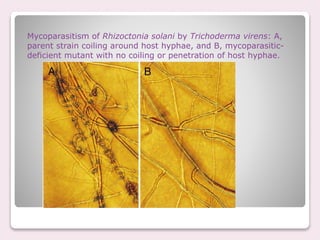
Mycoparasitism of Rhizoctonia solani by Trichoderma virens: A,
parent strain coiling around host hyphae, and B, mycoparasitic-
deficient mutant with no coiling or penetration of host hyphae.
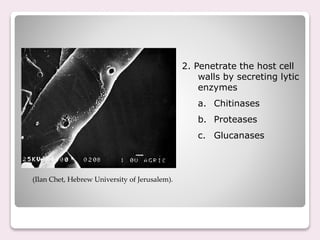
2. Penetrate the host cell
walls by secreting lytic
enzymes
a. Chitinases
b. Proteases
c. Glucanases
(Ilan Chet, Hebrew University of Jerusalem).
Antibiotics produced
 Trichodermin
 Dermadin
 Trichoviridin
 Sesquiterpenes
 Trichozianines
 Isonitriles
 Pentyl analogues
 Gliotoxin
 Gliovirin
Growth inhibition of Pythium ultimum by the Trichoderma
virens– produced antibiotic gliovirin: A, parent strain, and B,
gliovirin-deficient mutant.
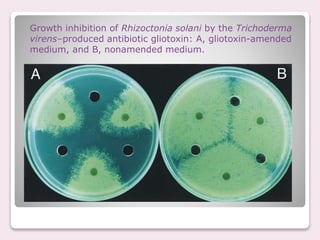
Growth inhibition of Rhizoctonia solani by the Trichoderma
virens–produced antibiotic gliotoxin: A, gliotoxin-amended
medium, and B, nonamended medium.
a.Pythium
aphanidermatum
b. Rhizoctonia Solani
c. Trichoderma
against Pythium
aphanidermatum
d. Trichoderma
against
Rhizoctonia Solani
Inhibition of P. aphanidermatum and R.
solani growth in presence of Trichoderma
• Control of root and foliar pathogens
1. Induced resistance.
2. Biological control of diseases by direct attack of
plant pathogenic fungi.
3. Mycoparasitism
4. Antibiosis
 Competition for nutrients or space
•Changes in the microfloral composition on roots.
.
Role in plants
• Enhanced nutrient uptake.
• Enhanced solubilization of soil nutrients.
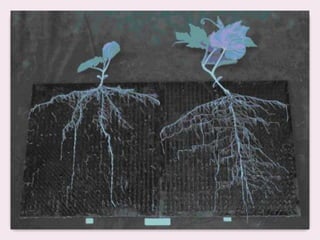
• Enhanced root development.
• Increased root hair formation
• Tolerance to stress through enhanced root and plant
development
• Solubilization of inorganic nutrients
• Induced resistance
• Inactivation of the pathogen’s enzymes
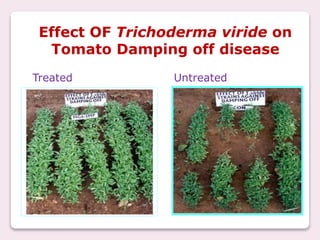
Effect OF Trichoderma viride on
Tomato Damping off disease
Treated Untreated
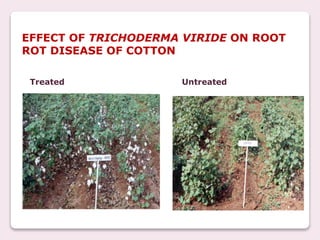
EFFECT OF TRICHODERMA VIRIDE ON ROOT
ROT DISEASE OF COTTON
Treated Untreated
TRICHODERMA VIRIDE vs COWPEA
ROOT ROT
Treated Untreated
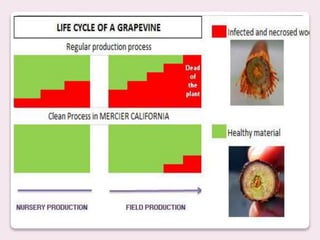
●Inoculate Trichoderma in the rootstock and the graft.
●The uniqueness of the process is that the rootstock and the
scion are both inoculated during process.
 T-22
 Commercial available Trichoderma formulation.
 Used as seed coating material.
 Protects roots from diseases caused by Pythium,
Rhizoctonia and Fusarium.
 Interacts with the Rhizosphere, near the root
hairs and increases the available form of nutrients
needed by plants.
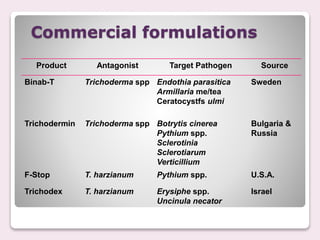
Commercial formulations
Product Antagonist Target Pathogen Source
Binab-T Trichoderma spp Endothia parasitica
Armillaria me/tea
Ceratocystfs ulmi
Sweden
Trichodermin Trichoderma spp Botrytis cinerea
Pythium spp.
Sclerotinia
Sclerotiarum
Verticillium
Bulgaria &
Russia
F-Stop T. harzianum Pythium spp. U.S.A.
Trichodex T. harzianum Erysiphe spp.
Uncinula necator
Israel
Commercial products
Applications
 Bio control agent.
 Medical use: Cyclosporine A, an immunosuppressant
in organ transplants to prevent rejection.
 Industrial uses: enzyme production-
Trichoderma reesei -cellulase and hemicellulase
Trichoderma longibrachiatum -xylanase
Trichoderma harzianum -chitinase
Conclusion
 Transgenes
 Biocontrol microbes contain a large number of
genes which allow biocontrol to occur
 Cloned several genes from Trichoderma as
transgenes
◦ Produce crops which are resistant to plant diseases
 Currently not commercially available
 The isolates of T. harizianum and T. viride were the
most active against R.Solani and P. aphnidermatum
Trichoderma

Trichoderma

  • 1.
    Safeena Majeed, A.A PALB6132 et54y65udfdsgfdgf
  • 2.
    Role of Trichodermain plant disease management
  • 3.
     Trichoderma spp.are present in nearly all agricultural soils.  They are the most prevalent culturable fungi.  Many species in this genus can be characterized as opportunistic avirulent plant symbionts.  This refers to the ability of several Trichoderma species to form mutualistic endophytic relationships with several plant species.  The genomes of several Trichoderma species have been sequenced.
  • 4.
    Scientific Classification  Kingdom:Fungi  Division: Ascomycota  Subdivision: Pezizomycotina  Class: Sordariomycetes  Order: Hypocreales  Family: Hypocreaceae  Genus: Trichoderma by Christiaan Hendrik Persoon in 1794
  • 5.
     Antifungal abilitieshave been known since 1930s  Mycoparasitism  Nutrient competition  Agriculturally used as biocontrol agent and as a plant growth promoter.
  • 6.
     Uses antibiosis Predation against soil borne pathogens such as Pythium Rhizoctonia Fusarium Sclerotina
  • 7.
    How the colonylooks  Cultures are fast growing at 25–30 °C, but some species at 45 °C.  Media: CMD or PDA.  Mycelium are not typically obvious on CMD.  Conidia typically form within one week in compact or loose tufts.
  • 8.
     Will bein shades of green or yellow or less frequently white.  A yellow pigment may be secreted into the agar, especially on PDA.  Few species produce characteristic sweet or 'coconut' odour.  Conidiophores are  highly branched and thus difficult to define or measure  loosely or compactly tufted  often formed in distinct concentric rings  borne along the scant aerial hyphae.
  • 9.
     Main branchesproduce lateral side branches that may be paired or not.  The longest branches distant from the tip.  All primary and secondary branches arise at or near 90° with respect to the main axis.
  • 10.
     Conidia typicallyappear dry.  Some species they held in drops of clear green or yellow liquid (e.g. T. virens, T. flavofuscum).  Conidia of most species are  ellipsoidal: (L/W = > 1.3)  globose conidia:(L/W < 1.3) are rare.  3–5 x 2–4 µm  Conidia are typically smooth but few species with tuberculate to finely warted conidia.
  • 11.
    Occurence  Frequently isolatedfrom forest or agricultural soils at all latitudes  Hypocrea species are most frequently found on bark or on decorticated wood.  Many species grow on bracket fungi e.g. H. Pulvinata  Bird's nest fungi - H. Latizonata  Agarics - H. avellanea.
  • 12.
    Trichoderma isolates CodeIsolation source T. koningii TK Ismailia governorate T. hamatum1 TM1 Menoufia governorate T. hamatum2 TM2 Menoufia governorate T. hamatum3 TM3 Gharbia governorate T. hamatum4 TM4 Sharkya governorate T. viride 1 TV1 Gharbia governorate T. viride 2 TV2 Kafer El-shikh governorate T. viride 3 TV3 Sharkya governorate T. viride 4 TV4 Menoufia governorate T. harzianum 1 TZ1 Sharkya governorate T. harzianum 2 TZ2 Ismailia governorate T. harizianum 3 TZ3 Menoufia governorate Isolation a/c Elad (1981) identification a/c Barnett (1998) and Bissett (1991) Isolation and identification of Trichoderma isolates
  • 13.
     Genetic Modification ◦Wild strains  Heterokaryotic – contain nuclei of dissimilar genotypes within a single organism ◦ Biocontrol strains  Homokaryotic – contain nuclei which are similar or identical  Allows genetic distinction and non-variability ◦ IMPORTANT FOR QUALITY CONTROL Why buy/develop a product that is readily available in the soil?
  • 14.
     Most strainshave innate resistance to some agricultural chemicals ◦ Resistance is variable  Strains available for commercial use are selected or modified for resistance to specific chemicals
  • 15.
    Mode of action Trichoderma spp. attach to the host hyphae via coiling, hooks and appressorium like bodies.  Penetrate the host cell wall by secreting lytic enzymes.  Trichoderma recognizes signals from the host fungus, triggering coiling and host penetration.
  • 16.
     Some strainscolonize the root with mycoparasitic properties ◦ Penetrate the root tissue ◦ Induce metabolic changes which induce resistance  Accumulation of antimicrobial compounds  A biomimetic system consisting of lectin-coated nylon fibers was used to study the role of lectins in mycoparasitism.  Using this system we could also identify specific coiling-inducing molecules.
  • 17.
    1. Attachment tothe host hyphae by coiling a. Lectin- carbohydrate interaction (Hubbard et al., 1983. Phytopathology 73:655-659).
  • 18.
    Mycoparasitism of Rhizoctoniasolani by Trichoderma virens: A, parent strain coiling around host hyphae, and B, mycoparasitic- deficient mutant with no coiling or penetration of host hyphae.
  • 19.
    2. Penetrate thehost cell walls by secreting lytic enzymes a. Chitinases b. Proteases c. Glucanases (Ilan Chet, Hebrew University of Jerusalem).
  • 20.
    Antibiotics produced  Trichodermin Dermadin  Trichoviridin  Sesquiterpenes  Trichozianines  Isonitriles  Pentyl analogues  Gliotoxin  Gliovirin
  • 21.
    Growth inhibition ofPythium ultimum by the Trichoderma virens– produced antibiotic gliovirin: A, parent strain, and B, gliovirin-deficient mutant.
  • 22.
    Growth inhibition ofRhizoctonia solani by the Trichoderma virens–produced antibiotic gliotoxin: A, gliotoxin-amended medium, and B, nonamended medium.
  • 23.
    a.Pythium aphanidermatum b. Rhizoctonia Solani c.Trichoderma against Pythium aphanidermatum d. Trichoderma against Rhizoctonia Solani Inhibition of P. aphanidermatum and R. solani growth in presence of Trichoderma
  • 24.
    • Control ofroot and foliar pathogens 1. Induced resistance. 2. Biological control of diseases by direct attack of plant pathogenic fungi. 3. Mycoparasitism 4. Antibiosis  Competition for nutrients or space •Changes in the microfloral composition on roots. . Role in plants
  • 25.
    • Enhanced nutrientuptake. • Enhanced solubilization of soil nutrients. • Enhanced root development. • Increased root hair formation • Tolerance to stress through enhanced root and plant development • Solubilization of inorganic nutrients • Induced resistance • Inactivation of the pathogen’s enzymes
  • 27.
    Effect OF Trichodermaviride on Tomato Damping off disease Treated Untreated
  • 28.
    EFFECT OF TRICHODERMAVIRIDE ON ROOT ROT DISEASE OF COTTON Treated Untreated
  • 29.
    TRICHODERMA VIRIDE vsCOWPEA ROOT ROT Treated Untreated
  • 30.
    ●Inoculate Trichoderma inthe rootstock and the graft. ●The uniqueness of the process is that the rootstock and the scion are both inoculated during process.
  • 33.
     T-22  Commercialavailable Trichoderma formulation.  Used as seed coating material.  Protects roots from diseases caused by Pythium, Rhizoctonia and Fusarium.  Interacts with the Rhizosphere, near the root hairs and increases the available form of nutrients needed by plants.
  • 34.
    Commercial formulations Product AntagonistTarget Pathogen Source Binab-T Trichoderma spp Endothia parasitica Armillaria me/tea Ceratocystfs ulmi Sweden Trichodermin Trichoderma spp Botrytis cinerea Pythium spp. Sclerotinia Sclerotiarum Verticillium Bulgaria & Russia F-Stop T. harzianum Pythium spp. U.S.A. Trichodex T. harzianum Erysiphe spp. Uncinula necator Israel
  • 35.
  • 37.
    Applications  Bio controlagent.  Medical use: Cyclosporine A, an immunosuppressant in organ transplants to prevent rejection.  Industrial uses: enzyme production- Trichoderma reesei -cellulase and hemicellulase Trichoderma longibrachiatum -xylanase Trichoderma harzianum -chitinase
  • 38.
    Conclusion  Transgenes  Biocontrolmicrobes contain a large number of genes which allow biocontrol to occur  Cloned several genes from Trichoderma as transgenes ◦ Produce crops which are resistant to plant diseases  Currently not commercially available  The isolates of T. harizianum and T. viride were the most active against R.Solani and P. aphnidermatum