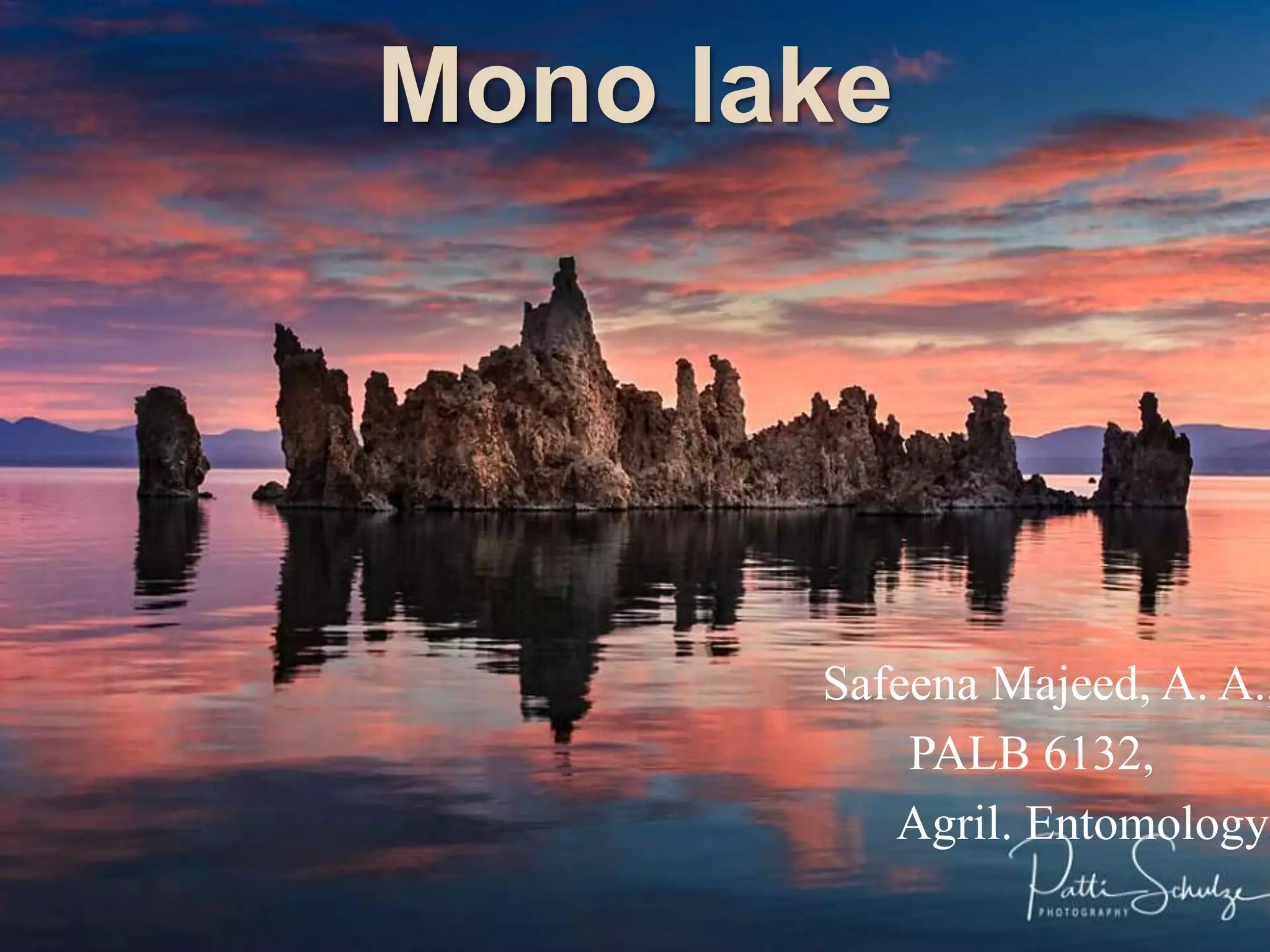
Mono lake
Safeena Majeed, A. A.,
PALB 6132,
Agril. Entomology.
An inhospitable lake……
 pH=10
 Bases contribute to a concentration of 500 mmol/L
 Death sentence
Kirakpatrick, 20172
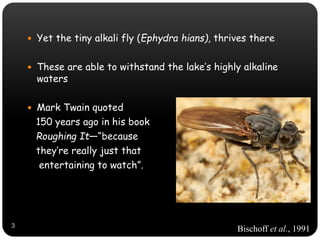
 Yet the tiny alkali fly (Ephydra hians), thrives there
 These are able to withstand the lake’s highly alkaline
waters
 Mark Twain quoted
150 years ago in his book
Roughing It—“because
they’re really just that
entertaining to watch”.
Bischoff et al., 19913
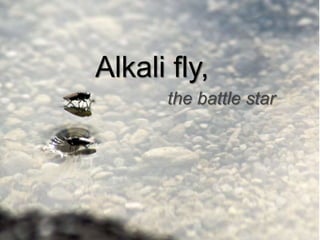
the battle star
Alkali fly,
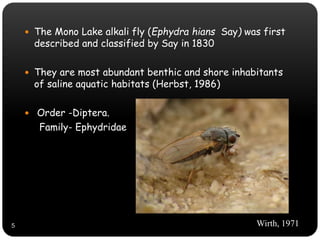
 The Mono Lake alkali fly (Ephydra hians Say) was first
described and classified by Say in 1830
 They are most abundant benthic and shore inhabitants
of saline aquatic habitats (Herbst, 1986)
 Order -Diptera.
Family- Ephydridae
Wirth, 19715
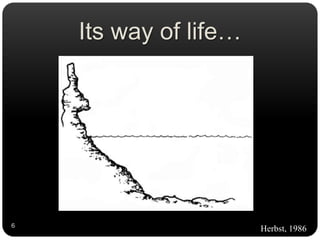
Its way of life…
Herbst, 19866
7
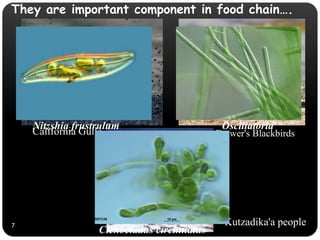
California Gulls Brewer's Blackbirds
Kutzadika'a people
Ctenocladus circinnatus
OscillatoriaNitzshia frustrulum
They are important component in food chain….
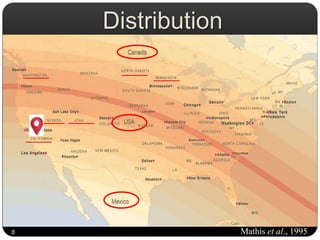
Distribution
Mathis et al., 19958
What make the flies to survive
?
 Modified malpighian tubules with lime gland
 Morphological modifications
 Osmoregulation
9
Objective of the study,
• Morphological and ultrastructural description of
malpighian tubules of the alkali fly larve, comparision
to other dipteran flies.
• Analysis of comparision of the white granular
substances of modified tubules.
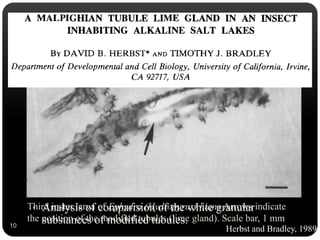
Third instar larva of Ephydra (Hydropyrus) hians Arrows indicate
the position of the modified tubules (lime gland). Scale bar, 1 mm
10
Herbst and Bradley, 1989
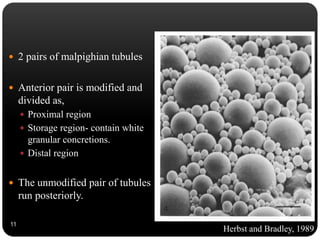
 2 pairs of malpighian tubules
 Anterior pair is modified and
divided as,
 Proximal region
 Storage region- contain white
granular concretions.
 Distal region
 The unmodified pair of tubules
run posteriorly.
11
Herbst and Bradley, 1989
Lime gland of alkali fly
12 Herbst and Bradley, 1989
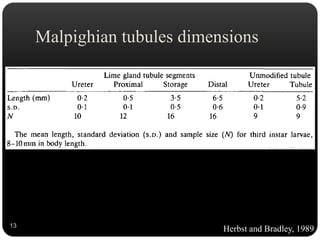
Malpighian tubules dimensions
13
Herbst and Bradley, 1989
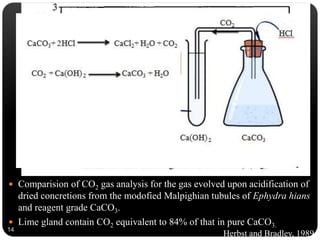
 Comparision of CO2 gas analysis for the gas evolved upon acidification of
dried concretions from the modofied Malpighian tubules of Ephydra hians
and reagent grade CaCO3.
 Lime gland contain CO2 equivalent to 84% of that in pure CaCO3.
colourless milky
14
Herbst and Bradley, 1989
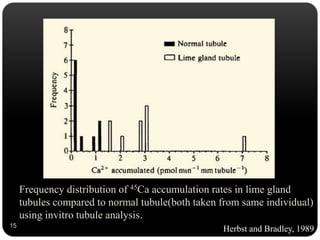
Frequency distribution of 45Ca accumulation rates in lime gland
tubules compared to normal tubule(both taken from same individual)
using invitro tubule analysis.
15
Herbst and Bradley, 1989
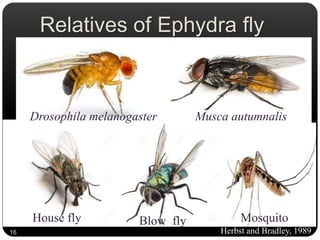
Relatives of Ephydra fly
House fly Blow fly Mosquito
Musca autumnalisDrosophila melanogaster
16 Herbst and Bradley, 1989
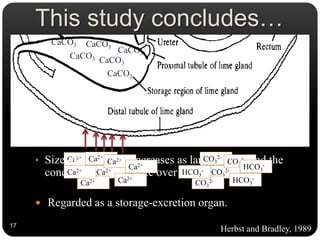
Ca2+
This study concludes…
17
• Size of lime gland increases as larvae grow, and the
concretions accumulate over the three instars.
 Regarded as a storage-excretion organ.
Ca2+
Ca2+
Ca2+
Ca2+
Ca2+
Ca2+
Ca2+
CO3
2-
CO3
2-
CO3
2-
CO3
2-
HCO3
-
HCO3
-
HCO3
-
CaCO3
CaCO3
CaCO3 CaCO3
CaCO3
CaCO3
Herbst and Bradley, 1989
What make the flies to survive
?
 Modified malpighian tubules with lime gland
 Morphological modifications.
 Osmoregulation
18
19
Objective of the study,
• To study the physical mechanisms underlying the process of
not wetting.
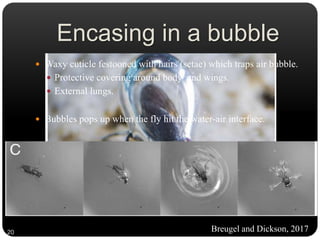
Encasing in a bubble
 Waxy cuticle festooned with hairs (setae) which traps air bubble.
 Protective covering around body and wings.
 External lungs.
 Bubbles pops up when the fly hit the water-air interface.
Breugel and Dickson, 201720
Angle of entry
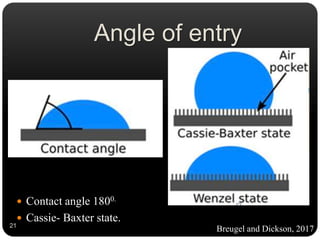
 Contact angle 1800.
 Cassie- Baxter state.
Breugel and Dickson, 201721
Force required to enter
MLW
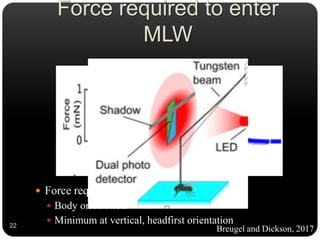
 Force required to enter varied with,
 Body orientation
 Minimum at vertical, headfirst orientation
Breugel and Dickson, 201722
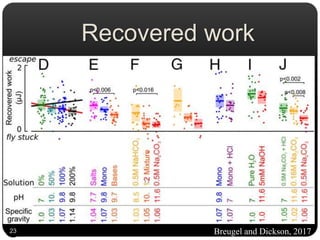
 In pure water, the work required to submerge the fly is largely
recovered when it is pulled out of the water.
 Thus, we use the term “recovered work” as a measure of how
easy it is for the flies to escape the water.
Recovered work
Breugel and Dickson, 201723
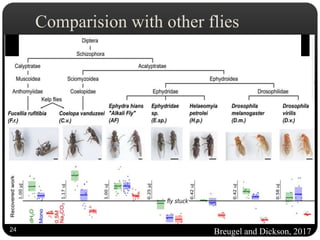
Comparision with other flies
Breugel and Dickson, 201724
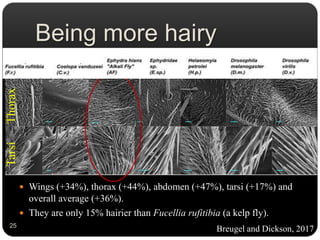
Being more hairy
 Wings (+34%), thorax (+44%), abdomen (+47%), tarsi (+17%) and
overall average (+36%).
 They are only 15% hairier than Fucellia rufitibia (a kelp fly).
ThoraxTarsi
Breugel and Dickson, 201725
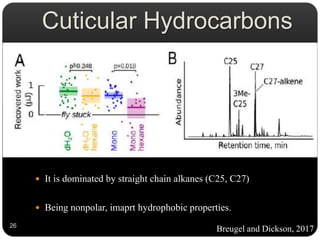
Cuticular Hydrocarbons
 It is dominated by straight chain alkanes (C25, C27)
 Being nonpolar, imaprt hydrophobic properties.
Breugel and Dickson, 201726
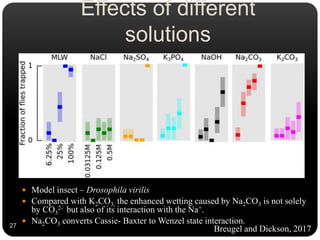
Effects of different
solutions
 Model insect – Drosophila virilis
 Compared with K2CO3, the enhanced wetting caused by Na2CO3 is not solely
by CO3
2- but also of its interaction with the Na+.
 Na2CO3 converts Cassie- Baxter to Wenzel state interaction.
Breugel and Dickson, 201727
28
 High concentration of Na2CO3 wet the setose cuticle
of the flies.
 Na2CO3 create a negative charge at the air–water
interface, that facilitates wetting.
 Compared with six other species of flies, alkali flies
are better able to resist wetting.
 denser layer of setae on their cuticle forming bubble.
 prevalence of smaller non-polar cuticular hydrocarbons
This study concludes…
Breugel and Dickson, 2017
What make the flies to survive
?
 Modified malpighian tubules with lime gland
 Morphological modifications.
 Osmoregulation
29
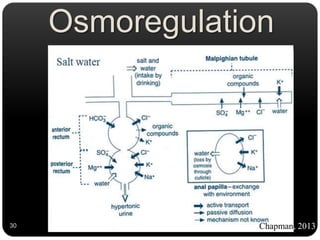
Terrestrial
Osmoregulation
30 Chapman, 2013
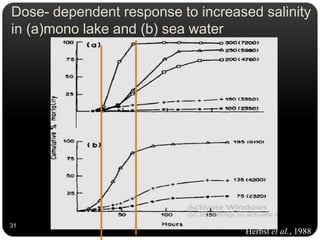
Dose- dependent response to increased salinity
in (a)mono lake and (b) sea water
Herbst et al., 1988
31
Herbst et al., 1988
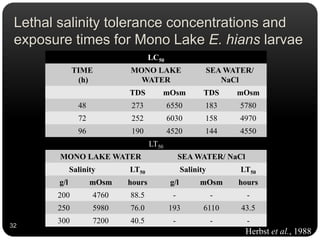
Lethal salinity tolerance concentrations and
exposure times for Mono Lake E. hians larvae
32
LC50
TIME
(h)
MONO LAKE
WATER
SEA WATER/
NaCl
TDS mOsm TDS mOsm
48 273 6550 183 5780
72 252 6030 158 4970
96 190 4520 144 4550
LT50
MONO LAKE WATER SEA WATER/ NaCl
Salinity LT50 Salinity LT50
g/l mOsm hours g/l mOsm hours
200 4760 88.5 - - -
250 5980 76.0 193 6110 43.5
300 7200 40.5 - - -
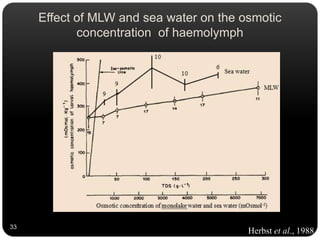
Effect of MLW and sea water on the osmotic
concentration of haemolymph
Herbst et al., 1988
33
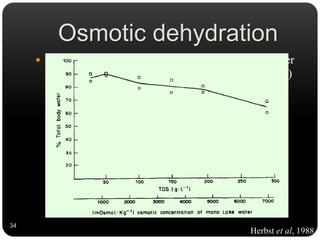
Osmotic dehydration
 It is an operation used for the partial removal of water
from tissues by immersion in a hyper-tonic (osmotic)
solution.
MLW
Herbst et al, 1988
34
35
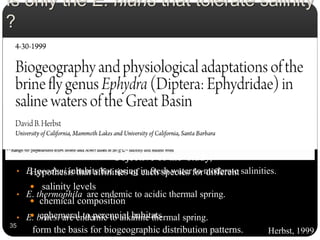
• E. geodeni inhabits hot spring in fresh water to moderate salinities.
• E. thermophila are endemic to acidic thermal spring.
• E. bruesi are endemic to alkaline thermal spring.
Is only the E. hians that tolerate salinity
?
Herbst, 1999
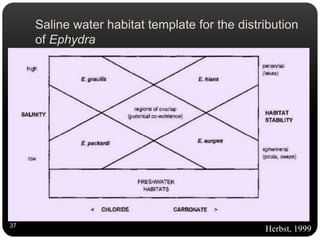
Objective of the study,
Hypothesis that affinities of each species for different
 salinity levels
 chemical composition
 ephemeral to perennial habitats
form the basis for biogeographic distribution patterns.
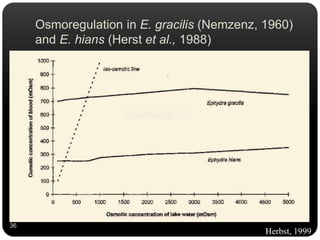
Osmoregulation in E. gracilis (Nemzenz, 1960)
and E. hians (Herst et al., 1988)
Herbst, 1999
36
Saline water habitat template for the distribution
of Ephydra
Herbst, 199937
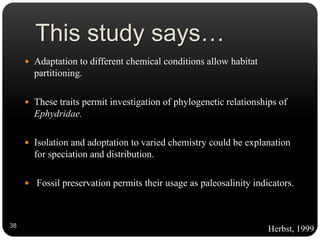
This study says…
 Adaptation to different chemical conditions allow habitat
partitioning.
 These traits permit investigation of phylogenetic relationships of
Ephydridae.
 Isolation and adoptation to varied chemistry could be explanation
for speciation and distribution.
 Fossil preservation permits their usage as paleosalinity indicators.
Herbst, 199938
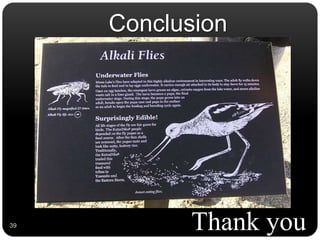
Conclusion
Thank you39

Ephydra fly and the saline monolake

  • 1.
    Mono lake Safeena Majeed,A. A., PALB 6132, Agril. Entomology.
  • 2.
    An inhospitable lake…… pH=10  Bases contribute to a concentration of 500 mmol/L  Death sentence Kirakpatrick, 20172
  • 3.
     Yet thetiny alkali fly (Ephydra hians), thrives there  These are able to withstand the lake’s highly alkaline waters  Mark Twain quoted 150 years ago in his book Roughing It—“because they’re really just that entertaining to watch”. Bischoff et al., 19913
  • 4.
  • 5.
     The MonoLake alkali fly (Ephydra hians Say) was first described and classified by Say in 1830  They are most abundant benthic and shore inhabitants of saline aquatic habitats (Herbst, 1986)  Order -Diptera. Family- Ephydridae Wirth, 19715
  • 6.
    Its way oflife… Herbst, 19866
  • 7.
    7 California Gulls Brewer'sBlackbirds Kutzadika'a people Ctenocladus circinnatus OscillatoriaNitzshia frustrulum They are important component in food chain….
  • 8.
  • 9.
    What make theflies to survive ?  Modified malpighian tubules with lime gland  Morphological modifications  Osmoregulation 9
  • 10.
    Objective of thestudy, • Morphological and ultrastructural description of malpighian tubules of the alkali fly larve, comparision to other dipteran flies. • Analysis of comparision of the white granular substances of modified tubules. Third instar larva of Ephydra (Hydropyrus) hians Arrows indicate the position of the modified tubules (lime gland). Scale bar, 1 mm 10 Herbst and Bradley, 1989
  • 11.
     2 pairsof malpighian tubules  Anterior pair is modified and divided as,  Proximal region  Storage region- contain white granular concretions.  Distal region  The unmodified pair of tubules run posteriorly. 11 Herbst and Bradley, 1989
  • 12.
    Lime gland ofalkali fly 12 Herbst and Bradley, 1989
  • 13.
  • 14.
     Comparision ofCO2 gas analysis for the gas evolved upon acidification of dried concretions from the modofied Malpighian tubules of Ephydra hians and reagent grade CaCO3.  Lime gland contain CO2 equivalent to 84% of that in pure CaCO3. colourless milky 14 Herbst and Bradley, 1989
  • 15.
    Frequency distribution of45Ca accumulation rates in lime gland tubules compared to normal tubule(both taken from same individual) using invitro tubule analysis. 15 Herbst and Bradley, 1989
  • 16.
    Relatives of Ephydrafly House fly Blow fly Mosquito Musca autumnalisDrosophila melanogaster 16 Herbst and Bradley, 1989
  • 17.
    Ca2+ This study concludes… 17 •Size of lime gland increases as larvae grow, and the concretions accumulate over the three instars.  Regarded as a storage-excretion organ. Ca2+ Ca2+ Ca2+ Ca2+ Ca2+ Ca2+ Ca2+ CO3 2- CO3 2- CO3 2- CO3 2- HCO3 - HCO3 - HCO3 - CaCO3 CaCO3 CaCO3 CaCO3 CaCO3 CaCO3 Herbst and Bradley, 1989
  • 18.
    What make theflies to survive ?  Modified malpighian tubules with lime gland  Morphological modifications.  Osmoregulation 18
  • 19.
    19 Objective of thestudy, • To study the physical mechanisms underlying the process of not wetting.
  • 20.
    Encasing in abubble  Waxy cuticle festooned with hairs (setae) which traps air bubble.  Protective covering around body and wings.  External lungs.  Bubbles pops up when the fly hit the water-air interface. Breugel and Dickson, 201720
  • 21.
    Angle of entry Contact angle 1800.  Cassie- Baxter state. Breugel and Dickson, 201721
  • 22.
    Force required toenter MLW  Force required to enter varied with,  Body orientation  Minimum at vertical, headfirst orientation Breugel and Dickson, 201722
  • 23.
     In purewater, the work required to submerge the fly is largely recovered when it is pulled out of the water.  Thus, we use the term “recovered work” as a measure of how easy it is for the flies to escape the water. Recovered work Breugel and Dickson, 201723
  • 24.
    Comparision with otherflies Breugel and Dickson, 201724
  • 25.
    Being more hairy Wings (+34%), thorax (+44%), abdomen (+47%), tarsi (+17%) and overall average (+36%).  They are only 15% hairier than Fucellia rufitibia (a kelp fly). ThoraxTarsi Breugel and Dickson, 201725
  • 26.
    Cuticular Hydrocarbons  Itis dominated by straight chain alkanes (C25, C27)  Being nonpolar, imaprt hydrophobic properties. Breugel and Dickson, 201726
  • 27.
    Effects of different solutions Model insect – Drosophila virilis  Compared with K2CO3, the enhanced wetting caused by Na2CO3 is not solely by CO3 2- but also of its interaction with the Na+.  Na2CO3 converts Cassie- Baxter to Wenzel state interaction. Breugel and Dickson, 201727
  • 28.
    28  High concentrationof Na2CO3 wet the setose cuticle of the flies.  Na2CO3 create a negative charge at the air–water interface, that facilitates wetting.  Compared with six other species of flies, alkali flies are better able to resist wetting.  denser layer of setae on their cuticle forming bubble.  prevalence of smaller non-polar cuticular hydrocarbons This study concludes… Breugel and Dickson, 2017
  • 29.
    What make theflies to survive ?  Modified malpighian tubules with lime gland  Morphological modifications.  Osmoregulation 29
  • 30.
  • 31.
    Dose- dependent responseto increased salinity in (a)mono lake and (b) sea water Herbst et al., 1988 31
  • 32.
    Herbst et al.,1988 Lethal salinity tolerance concentrations and exposure times for Mono Lake E. hians larvae 32 LC50 TIME (h) MONO LAKE WATER SEA WATER/ NaCl TDS mOsm TDS mOsm 48 273 6550 183 5780 72 252 6030 158 4970 96 190 4520 144 4550 LT50 MONO LAKE WATER SEA WATER/ NaCl Salinity LT50 Salinity LT50 g/l mOsm hours g/l mOsm hours 200 4760 88.5 - - - 250 5980 76.0 193 6110 43.5 300 7200 40.5 - - -
  • 33.
    Effect of MLWand sea water on the osmotic concentration of haemolymph Herbst et al., 1988 33
  • 34.
    Osmotic dehydration  Itis an operation used for the partial removal of water from tissues by immersion in a hyper-tonic (osmotic) solution. MLW Herbst et al, 1988 34
  • 35.
    35 • E. geodeniinhabits hot spring in fresh water to moderate salinities. • E. thermophila are endemic to acidic thermal spring. • E. bruesi are endemic to alkaline thermal spring. Is only the E. hians that tolerate salinity ? Herbst, 1999 Objective of the study, Hypothesis that affinities of each species for different  salinity levels  chemical composition  ephemeral to perennial habitats form the basis for biogeographic distribution patterns.
  • 36.
    Osmoregulation in E.gracilis (Nemzenz, 1960) and E. hians (Herst et al., 1988) Herbst, 1999 36
  • 37.
    Saline water habitattemplate for the distribution of Ephydra Herbst, 199937
  • 38.
    This study says… Adaptation to different chemical conditions allow habitat partitioning.  These traits permit investigation of phylogenetic relationships of Ephydridae.  Isolation and adoptation to varied chemistry could be explanation for speciation and distribution.  Fossil preservation permits their usage as paleosalinity indicators. Herbst, 199938
  • 39.