Associational
resistance mediated by
natural enemies
Safeena Majeed, A A
PA1TAH082
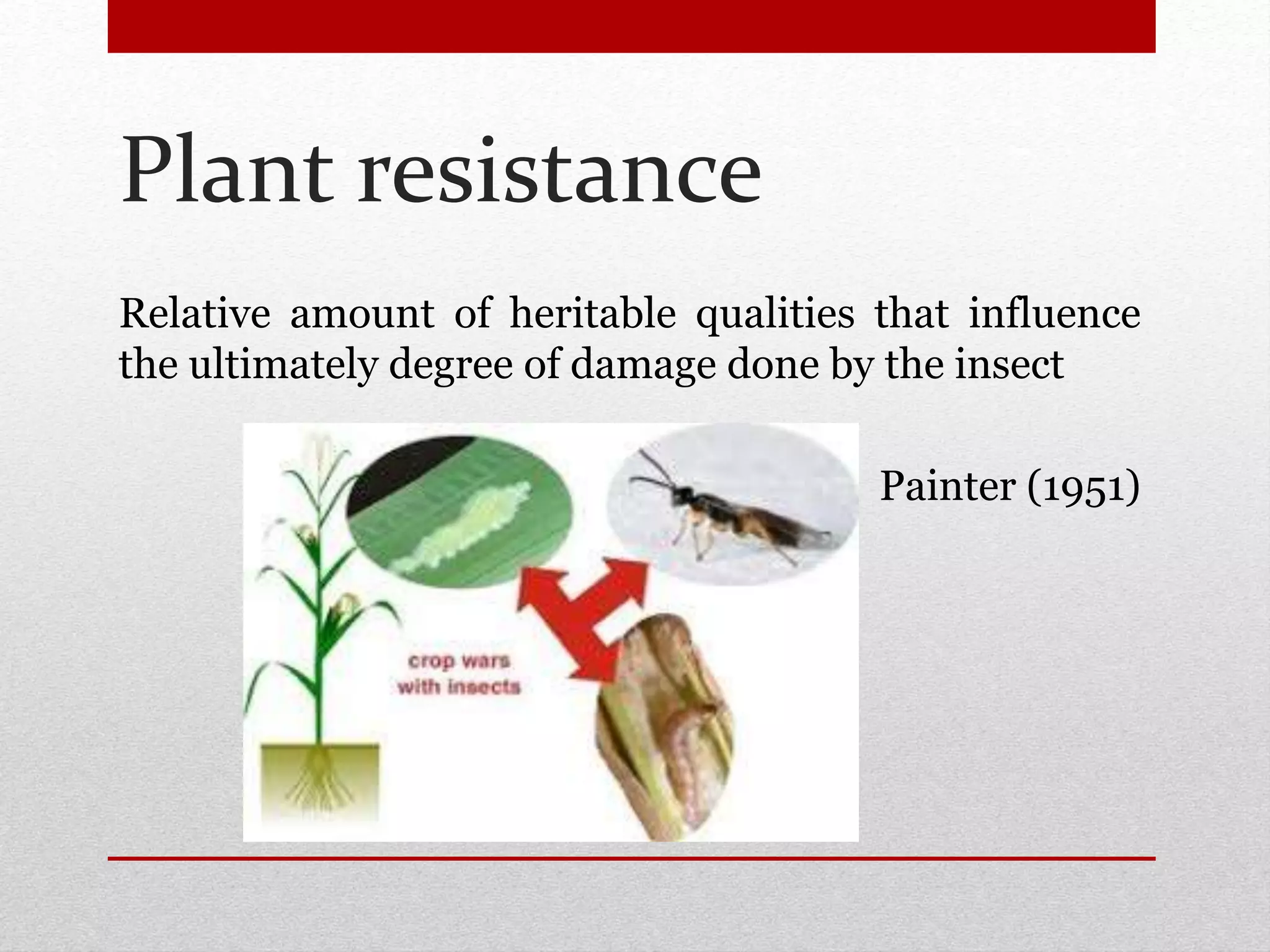
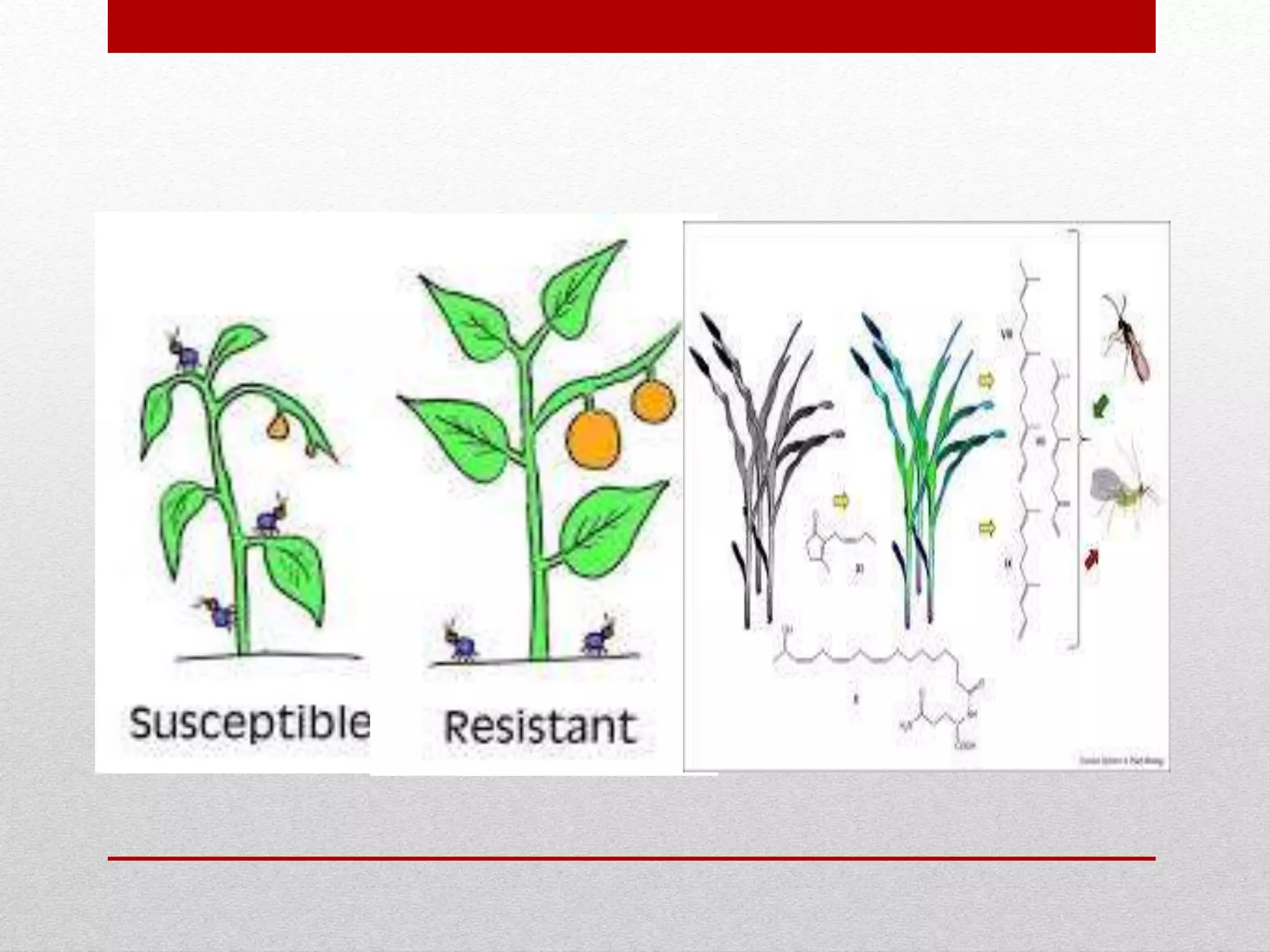
Plant resistance
Relative amount of heritable qualities that influence
the ultimately degree of damage done by the insect
Painter (1951)
Plant v/s insect
Attack rates of plants by insect herbivores are affected
by
• Host plant defenses
• Host plant nutrition
• Community composition- most plant species exist in
communities
Stilling et al., 2003
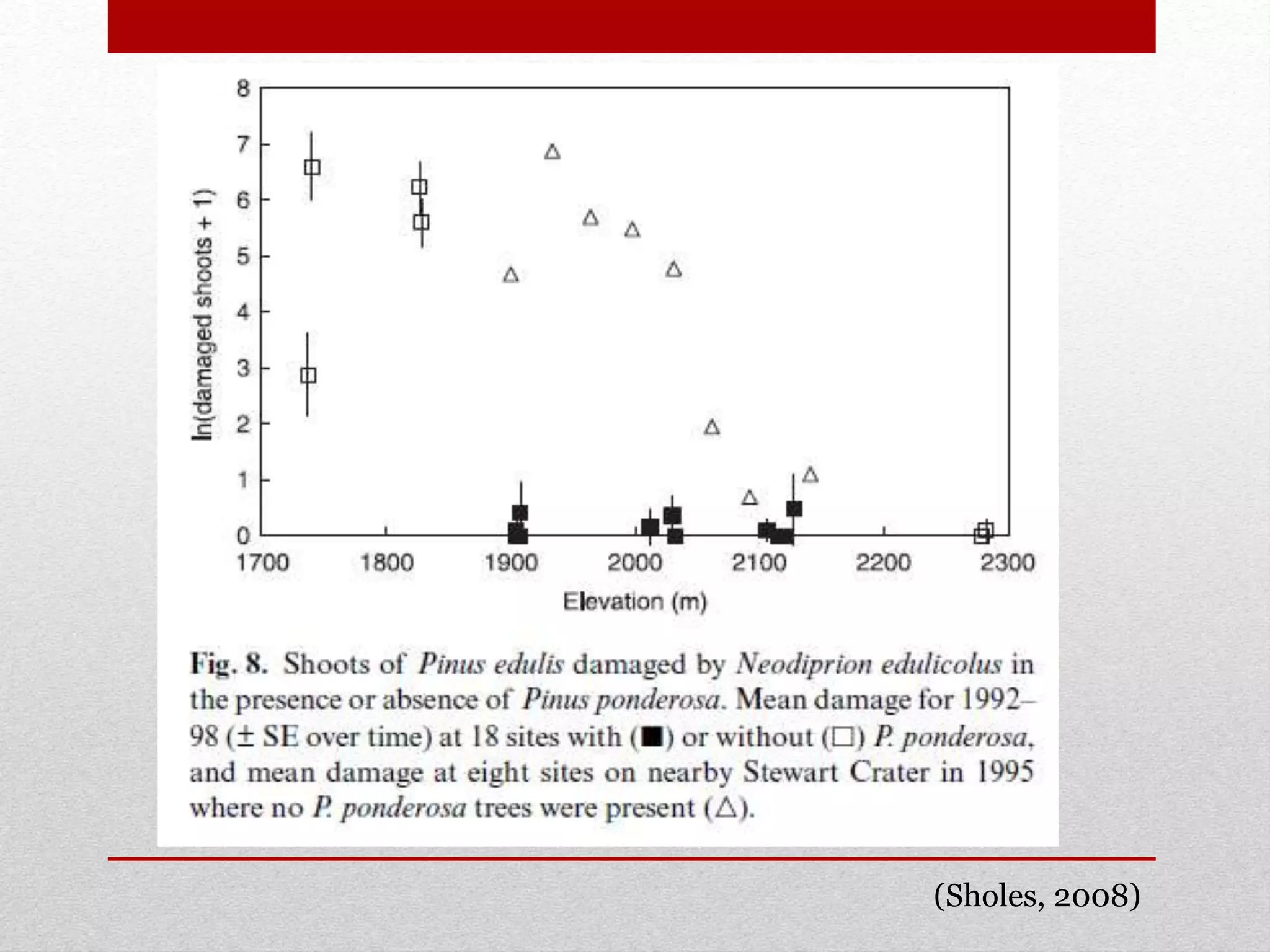
(Sholes, 2008)
Repellent Plant Hypothesis
• Less palatable neighbours can repel herbivores from
plant patches.
• Sometimes, one plant species may emit volatile
chemical stimuli that interfere with the host-finding
ability of phytophagous insects searching for other
species
Stilling et al., 2003
Attractant Decoy Hypothesis
• Finally, plants of higher palatability may attract
herbivores away from other plant species
• Trap crops are often used- to lure pests away from
economically important crops.
Stilling et al., 2003
Natural Enemies Hypothesis
• Natural enemies are often more abundant in diverse
plant communities
• most enemies are generalists
• better survive on the greater richness of herbivores there.
• Generalists often suppress herbivore populations more
in polycultures than in monocultures
• Much less- effects of plant community composition on
specialists enemies, particularly parasitoids-
importance in biological control
Russell, 1989
Associational Resistance
• Resistance mediated by the third trophic level–the
natural enemies of the herbivores.
• Association of herbivore-susceptible plant species
with herbivore-resistant plant species can reduce
the herbivore density on the susceptible plant
species. This is known as associational resistance
Stilling et al., 2003
• Neighbours may reduce damage to a focal plant by
lowering specialist herbivore loads associational
resistance hypothesis
• Enhance damage by increasing generalist herbivore
loads associational susceptibility hypothesis
Plath et al., 2012
Factors contributing
• Chemical and physical interference of neighboring
plant species
• Greater abundances and diversity of natural
enemies
• Host density is predicted to have strong effects on
specialist - resource concentration hypothesis
Plath et al., 2012
Resource Concentration
Hypothesis
Specialist herbivore loads increase with higher
densities of the host plant in a given area unit, as
specialist herbivores may locate their host plant more
easily and stay longer in patches with high host plant
densities.
Plath et al., 2012
Associational
Susceptibility Hypothesis
• Plants in diverse stands may suffer more from
herbivore attack than plants in single-species stands
• Occur when,
• principal pests are generalist herbivores, benefit from
the broader diet range of diverse plant communities
• plant is a less-preferred host growing in close
proximity to a highly preferred host, allows a spill-over
of generalist herbivores after depletion of the favored
host plant
Plath et al., 2012
Associational resistance
v/s susceptibility
• Associational effects of tree diversity on herbivory patterns
• Tropical focal tree Tabebuia rosea
• Tree monocultures and mixed stands.
• Chrysomelid Walterianella inscripta
• Pyralid Eulepte gastralis
• Tree diversity exerted opposite effects on tree infestation by
the two herbivores
Plath et al., 2011
• Resource concentration effects for the chrysomelid beetle
- favored by tree monoculture
• Resource dilution effects for the pyralid caterpillar
favored by tree mixture
Plath et al., 2011
• Herbivore damage
was higher in mixed
stands than in
monocultures
• Indicates that T. rosea
did not benefit from
associational
resistance
• Experienced
associational
susceptibility
Plath et al., 2011
Odour-masking’ substances
• Release of OMS into the air by non-host plant
species is considered to confer some protection to
the associated host plants.
• The possibility that the odour of the host plant could
be ‘masked’ by that of the non-host plant
• now seems much less likely, though not impossible
Finch & Collier, 2000
Host plant selection by the cabbage root fly
• was disrupted when its host plants were surrounded by a
range of different plants
• weeds spurrey (Spergula arvensis)
• peas (Pisum sativum)
• rye-grass (Lolium perenne)
• clover
• each of these non-host plants has a different odour
profile
• capable of preventing an adapted specialist insect from
finding its host plants
Finch & Collier, 2000
AR mediated by NE
• Examined parasitism levels of hosts in simple and diverse
plant communities
• Higher rates of parasitism in plant monocultures,
• ease of searching
• lack of disruption of chemical cues
• Addition of plant species to a community can increase the
effectiveness of some specialist NEs
• As a result of spilling over of NEs from herbivores on one
host plant species to herbivores on another plant species.
• AR- the herbivore population decreases on one host plant
species by adding another species- mediated by NEs
AR in Asphondylia borrichiae
• The gall midge, Asphondylia borrichiae Rossi and Strong
(Diptera: Cecidomyiidae)
• Attacks the terminals of both Borrichia and Iva
• Borrichia suffering higher rates of galling.
• Host-plant choice experiments & recent electrophoretic
studies
• each host plant supports its own race of A. borrichiae
• Both races share the same specialist parasitoids.
Stilling et al., 2003
Hymenopteran parasitoids
• Rileya cecidomyiae Ashmead (Eurytomidae)
• Tenuipetiolus teredon (Walker) (Eurytomidae)
• Torymus umbilicatus (Gahan) (Torymidae)
• Galeopsomyia haemon (Walker) (Eulophidae)
• Most parasitoid- similar size, with similar length
ovipositors & attack galls of similar size.
• T. umbilicatus, a large torymid
• ovipositor twice as long as those of the other species
• more common in large galls since it can oviposit last
• feed on either fly larvae or other parasitoid larvae
hyperparasitism.
Endoparasitic
Ecto & facultative
hyperparasite
Stilling et al., 2003
• Bagging experiments confirmed that T. umbilicatus
- attacks galls after the other three species
• Both parasitoids and gall flies are multivoltine with
overlapping generations.
Stilling et al., 2003
(a) Avg. gall density/1000 stems
(b) % parasitism of flies inside galls
Stilling et al., 2003
Changes in parasitoid community
Stilling et al., 2003
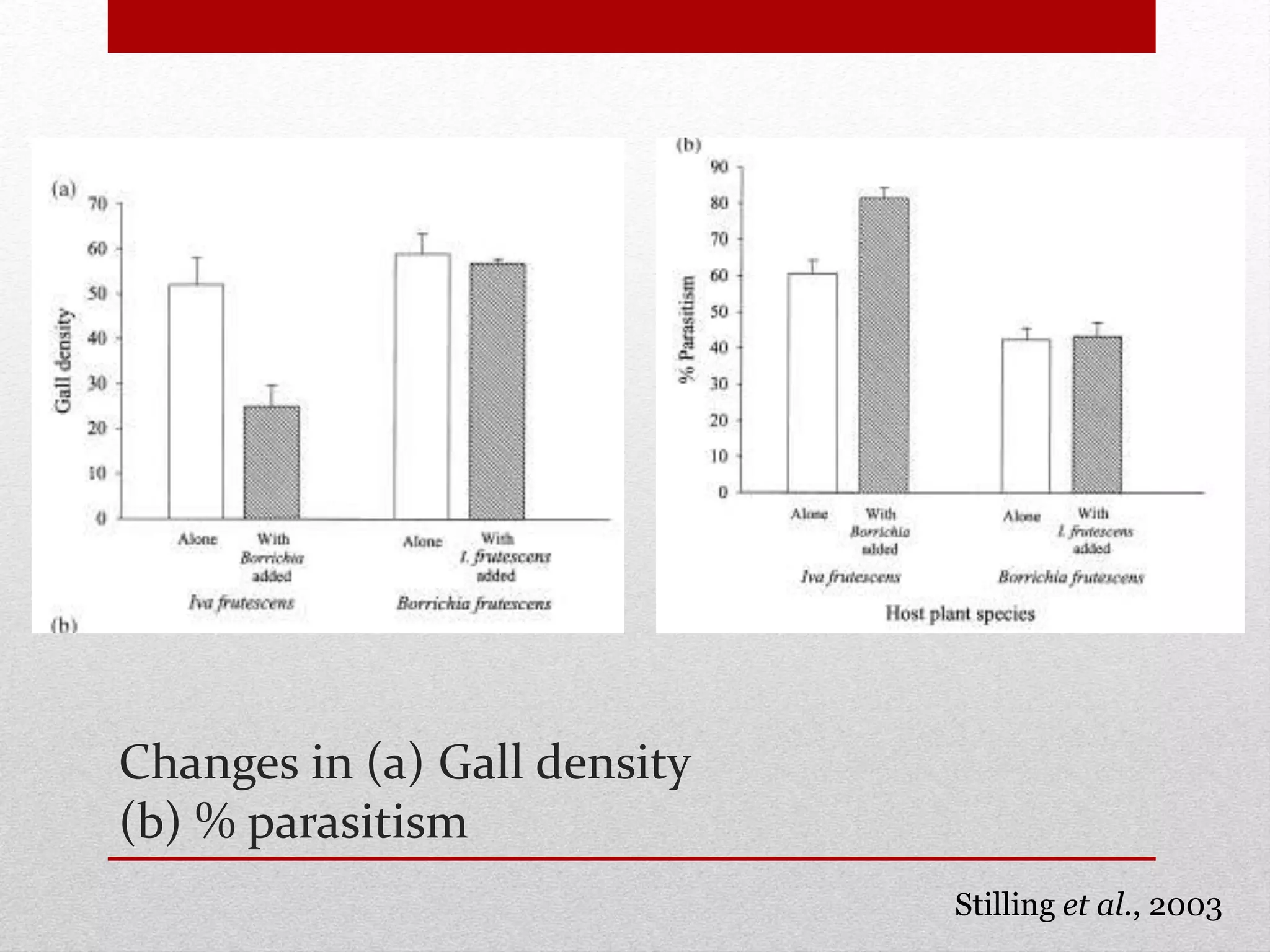
Changes in (a) Gall density
(b) % parasitism
Stilling et al., 2003
• In this case, the ARs are strongly asymmetrical.
• Asphondylia galls on Borrichia are much larger than those
on the Iva with larger Torymus umbilicatus parasitoid
• When Borrichia is present- source of Torymus parasitoids -
easily parasitisation of flies in the small galls of the Iva sp.
• Parasitism levels on Iva flies are significantly higher in the
presence of Borrichia than on pure patches
• Parasitoids that attack the Iva flies are small - cannot
parasitise the fly larvae within bigger Borrichia galls and
hence parasitism on Borrichiais unchanged in the presence
of Iva. These results are consistent
Conclusion
• Mixed planting not always benefits- AS
• Have implications for the design of new planted
forests, which are mostly managed as monocultures
• Identity and biology of herbivore species has to be
taken into account when attempting to predict
damage patterns
• AR – mediated by NEs
Future line of work
• Relative strength & frequency of AR mediated by NEs
• Relative patch sizes of host plants
• Relative distances between host patches
• Host choice of natural enemies
• Relative dispersal distances of both herbivores and
their natural enemies
Thank you

Associational resistance

  • 1.
    Associational resistance mediated by naturalenemies Safeena Majeed, A A PA1TAH082
  • 3.
    Plant resistance Relative amountof heritable qualities that influence the ultimately degree of damage done by the insect Painter (1951)
  • 4.
    Plant v/s insect Attackrates of plants by insect herbivores are affected by • Host plant defenses • Host plant nutrition • Community composition- most plant species exist in communities Stilling et al., 2003
  • 5.
  • 6.
    Repellent Plant Hypothesis •Less palatable neighbours can repel herbivores from plant patches. • Sometimes, one plant species may emit volatile chemical stimuli that interfere with the host-finding ability of phytophagous insects searching for other species Stilling et al., 2003
  • 7.
    Attractant Decoy Hypothesis •Finally, plants of higher palatability may attract herbivores away from other plant species • Trap crops are often used- to lure pests away from economically important crops. Stilling et al., 2003
  • 8.
    Natural Enemies Hypothesis •Natural enemies are often more abundant in diverse plant communities • most enemies are generalists • better survive on the greater richness of herbivores there. • Generalists often suppress herbivore populations more in polycultures than in monocultures • Much less- effects of plant community composition on specialists enemies, particularly parasitoids- importance in biological control Russell, 1989
  • 9.
    Associational Resistance • Resistancemediated by the third trophic level–the natural enemies of the herbivores. • Association of herbivore-susceptible plant species with herbivore-resistant plant species can reduce the herbivore density on the susceptible plant species. This is known as associational resistance Stilling et al., 2003
  • 10.
    • Neighbours mayreduce damage to a focal plant by lowering specialist herbivore loads associational resistance hypothesis • Enhance damage by increasing generalist herbivore loads associational susceptibility hypothesis Plath et al., 2012
  • 11.
    Factors contributing • Chemicaland physical interference of neighboring plant species • Greater abundances and diversity of natural enemies • Host density is predicted to have strong effects on specialist - resource concentration hypothesis Plath et al., 2012
  • 12.
    Resource Concentration Hypothesis Specialist herbivoreloads increase with higher densities of the host plant in a given area unit, as specialist herbivores may locate their host plant more easily and stay longer in patches with high host plant densities. Plath et al., 2012
  • 13.
    Associational Susceptibility Hypothesis • Plantsin diverse stands may suffer more from herbivore attack than plants in single-species stands • Occur when, • principal pests are generalist herbivores, benefit from the broader diet range of diverse plant communities • plant is a less-preferred host growing in close proximity to a highly preferred host, allows a spill-over of generalist herbivores after depletion of the favored host plant Plath et al., 2012
  • 14.
    Associational resistance v/s susceptibility •Associational effects of tree diversity on herbivory patterns • Tropical focal tree Tabebuia rosea • Tree monocultures and mixed stands. • Chrysomelid Walterianella inscripta • Pyralid Eulepte gastralis • Tree diversity exerted opposite effects on tree infestation by the two herbivores Plath et al., 2011
  • 15.
    • Resource concentrationeffects for the chrysomelid beetle - favored by tree monoculture • Resource dilution effects for the pyralid caterpillar favored by tree mixture Plath et al., 2011
  • 16.
    • Herbivore damage washigher in mixed stands than in monocultures • Indicates that T. rosea did not benefit from associational resistance • Experienced associational susceptibility Plath et al., 2011
  • 17.
    Odour-masking’ substances • Releaseof OMS into the air by non-host plant species is considered to confer some protection to the associated host plants. • The possibility that the odour of the host plant could be ‘masked’ by that of the non-host plant • now seems much less likely, though not impossible Finch & Collier, 2000
  • 18.
    Host plant selectionby the cabbage root fly • was disrupted when its host plants were surrounded by a range of different plants • weeds spurrey (Spergula arvensis) • peas (Pisum sativum) • rye-grass (Lolium perenne) • clover • each of these non-host plants has a different odour profile • capable of preventing an adapted specialist insect from finding its host plants Finch & Collier, 2000
  • 19.
    AR mediated byNE • Examined parasitism levels of hosts in simple and diverse plant communities • Higher rates of parasitism in plant monocultures, • ease of searching • lack of disruption of chemical cues • Addition of plant species to a community can increase the effectiveness of some specialist NEs • As a result of spilling over of NEs from herbivores on one host plant species to herbivores on another plant species. • AR- the herbivore population decreases on one host plant species by adding another species- mediated by NEs
  • 21.
    AR in Asphondyliaborrichiae • The gall midge, Asphondylia borrichiae Rossi and Strong (Diptera: Cecidomyiidae) • Attacks the terminals of both Borrichia and Iva • Borrichia suffering higher rates of galling. • Host-plant choice experiments & recent electrophoretic studies • each host plant supports its own race of A. borrichiae • Both races share the same specialist parasitoids. Stilling et al., 2003
  • 22.
    Hymenopteran parasitoids • Rileyacecidomyiae Ashmead (Eurytomidae) • Tenuipetiolus teredon (Walker) (Eurytomidae) • Torymus umbilicatus (Gahan) (Torymidae) • Galeopsomyia haemon (Walker) (Eulophidae) • Most parasitoid- similar size, with similar length ovipositors & attack galls of similar size. • T. umbilicatus, a large torymid • ovipositor twice as long as those of the other species • more common in large galls since it can oviposit last • feed on either fly larvae or other parasitoid larvae hyperparasitism. Endoparasitic Ecto & facultative hyperparasite Stilling et al., 2003
  • 23.
    • Bagging experimentsconfirmed that T. umbilicatus - attacks galls after the other three species • Both parasitoids and gall flies are multivoltine with overlapping generations. Stilling et al., 2003
  • 24.
    (a) Avg. galldensity/1000 stems (b) % parasitism of flies inside galls Stilling et al., 2003
  • 25.
    Changes in parasitoidcommunity Stilling et al., 2003
  • 26.
    Changes in (a)Gall density (b) % parasitism Stilling et al., 2003
  • 27.
    • In thiscase, the ARs are strongly asymmetrical. • Asphondylia galls on Borrichia are much larger than those on the Iva with larger Torymus umbilicatus parasitoid • When Borrichia is present- source of Torymus parasitoids - easily parasitisation of flies in the small galls of the Iva sp. • Parasitism levels on Iva flies are significantly higher in the presence of Borrichia than on pure patches • Parasitoids that attack the Iva flies are small - cannot parasitise the fly larvae within bigger Borrichia galls and hence parasitism on Borrichiais unchanged in the presence of Iva. These results are consistent
  • 28.
    Conclusion • Mixed plantingnot always benefits- AS • Have implications for the design of new planted forests, which are mostly managed as monocultures • Identity and biology of herbivore species has to be taken into account when attempting to predict damage patterns • AR – mediated by NEs
  • 29.
    Future line ofwork • Relative strength & frequency of AR mediated by NEs • Relative patch sizes of host plants • Relative distances between host patches • Host choice of natural enemies • Relative dispersal distances of both herbivores and their natural enemies
  • 30.