Global trade & risk of Invasive Alien
Species
Safeena Majeed AA
PA1TAH082
Definitions
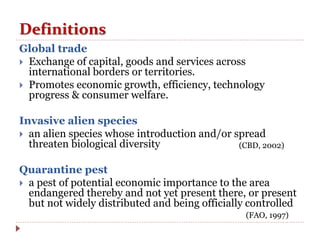
Global trade
 Exchange of capital, goods and services across
international borders or territories.
 Promotes economic growth, efficiency, technology
progress & consumer welfare.
Invasive alien species
 an alien species whose introduction and/or spread
threaten biological diversity
Quarantine pest
 a pest of potential economic importance to the area
endangered thereby and not yet present there, or present
but not widely distributed and being officially controlled
(CBD, 2002)
(FAO, 1997)
 Risk analysis: means the complete process composed of
hazard identification, risk assessment, risk management
and risk communication.
 Risk assessment: means the evaluation of the likelihood
and the biological and economic consequences of entry,
establishment and spread of a hazard within the territory of
an importing country.
 Risk management: means the process of identifying,
selecting and implementing measures that can be applied to
reduce the level of risk.
OIE
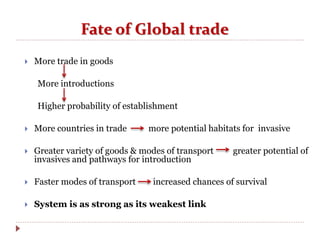
Fate of Global trade
 More trade in goods
More introductions
Higher probability of establishment
 More countries in trade more potential habitats for invasive
 Greater variety of goods & modes of transport greater potential of
invasives and pathways for introduction
 Faster modes of transport increased chances of survival
 System is as strong as its weakest link
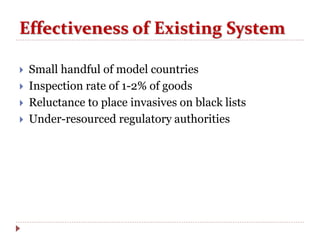
Effectiveness of Existing System
 Small handful of model countries
 Inspection rate of 1-2% of goods
 Reluctance to place invasives on black lists
 Under-resourced regulatory authorities
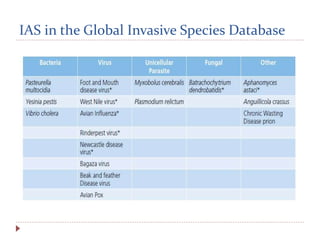
IAS in the Global Invasive Species Database
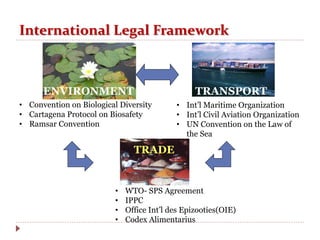
International Legal Framework
TRADE
• Int’l Maritime Organization
• Int’l Civil Aviation Organization
• UN Convention on the Law of
the Sea
• Convention on Biological Diversity
• Cartagena Protocol on Biosafety
• Ramsar Convention
ENVIRONMENT TRANSPORT
• WTO- SPS Agreement
• IPPC
• Office Int’l des Epizooties(OIE)
• Codex Alimentarius
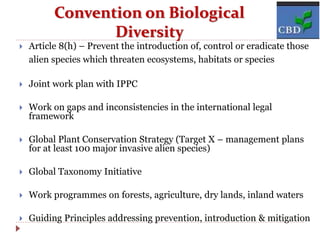
Convention on Biological
Diversity
 Article 8(h) – Prevent the introduction of, control or eradicate those
alien species which threaten ecosystems, habitats or species
 Joint work plan with IPPC
 Work on gaps and inconsistencies in the international legal
framework
 Global Plant Conservation Strategy (Target X – management plans
for at least 100 major invasive alien species)
 Global Taxonomy Initiative
 Work programmes on forests, agriculture, dry lands, inland waters
 Guiding Principles addressing prevention, introduction & mitigation
Guiding principle
1. Precautionary approach
 Risk Analysis wrt principle 15 of the 1992 Rio Declaration on
Environment and Development & Preamble of the CBD
7. Border control and quarantine measures
 Intentional introductions of alien species are subject to
appropriate authorization (principle 10)
 Risk analysis
 Early detection systems
10. Intentional introduction
 risk analysis/ environmental impact assessment
 Authorize a proposed introduction to ecological regions country
 Permit only those species that are unlikely to threaten biological
diversity.
Cartagena Protocol on Biosafety
 Article 15 (Risk assessment) “… to identify and
evaluate the possible adverse effects of living
modified organisms on the conservation and
sustainable use of biological diversity”
 October, 2oo8, Bangkok, Thailand
 Trade in alien invasive species
 Considering alien species can pose significant threats to
biodiversity
 Species of fauna and flora in commercial trade are likely to be
introduced to new habitat as a result of international trade
 Consider the problems in developing national legislation and
regulations that deal with the trade in live animals or plants
Convention on the Int’l Trade in
Endangered Species
Int’l Treaty on PGR for Food &
Agriculture
 Article 5 – Conservation
 Survey and inventory PGR for food and agriculture
 Status and degree of variation in existing populations
 Including populations that are of potential use and, as
feasible, assess any threats to them
Int’l Plant Protection Convention
 Article 1(1)
 prevent the spread and introduction of pests of plants and plant
products
 promote appropriate measures for their control
 adopt the legislative, technical and administrative measures
specified in this Convention
 Article 4(2) -Responsibilities of an official NPPO
 protection of endangered areas
 designation, maintenance and surveillance of pest free areas
 areas of low pest prevalence
 ISPM 11 (rev)
 Pest risk analysis for quarantine pests
 analysis of environmental risks and LMO
Global Invasive Species Programme (1997)
 Conserve biodiversity and sustain human livelihoods by minimizing
the spread and impact of IAS.
 Partner organizations- CABI, IUCN, The Nature Conservancy
 In its first phase
 focused IAS assessments
 developed guides and toolkits for policy, regulation, prevention and
management
 adoption by the CBD of a work programme on IAS.
 During a second phase
 implemented activities to engage and inform governments
 stimulate action and cooperation, between governments and different
sectors (e.g. environment and agriculture) to address IAS threats.
 Following the global economic recession- difficulties in securing &
become dormant
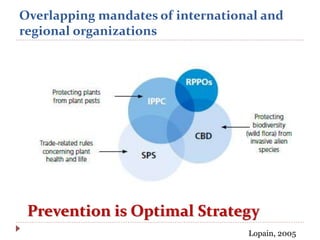
Overlapping mandates of international and
regional organizations
Lopain, 2005
Prevention is Optimal Strategy
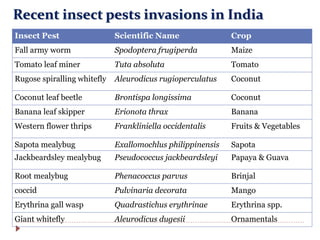
Recent insect pests invasions in India
Insect Pest Scientific Name Crop
Fall army worm Spodoptera frugiperda Maize
Tomato leaf miner Tuta absoluta Tomato
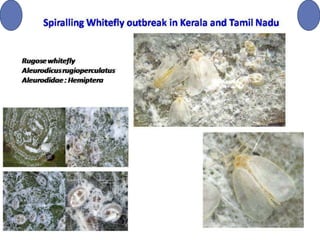
Rugose spiralling whitefly Aleurodicus rugioperculatus Coconut
Coconut leaf beetle Brontispa longissima Coconut
Banana leaf skipper Erionota thrax Banana
Western flower thrips Frankliniella occidentalis Fruits & Vegetables
Sapota mealybug Exallomochlus philippinensis Sapota
Jackbeardsley mealybug Pseudococcus jackbeardsleyi Papaya & Guava
Root mealybug Phenacoccus parvus Brinjal
coccid Pulvinaria decorata Mango
Erythrina gall wasp Quadrastichus erythrinae Erythrina spp.
Giant whitefly Aleurodicus dugesii Ornamentals
Fall army worm Spodoptera frugiperda
 Invasive pest from US
 Spread to Brazil, Argentina, Africa & India
 Shivamogga- 2018, later to Karur (TN)
 “Pest war”- TN state govt.
 Attacks emerging leaf whorl of 15 days old crop
 Holes arranged in straight line
 Tips & shank of the corn
 Clean cultivation, summer ploughing, wider spacing (60*25cm)
 50kg neem cake
 Imidachloprid/ thiamethaxam 70WS @10gm/kg seed
 Emamectin benzoate
Tomato Leaf Miner, Tuta absoluta
 Tomato Leaf Miner was observed for the first time on
tomato and potato crop in Pune, Maharashtra, and 6
districts of Karnataka.
 Most serious threat for tomato production worldwide.
 Severe infestation (50-87% plants affected) was observed
in several tomato fields (Sridhar et al.,2014).
 (Muniappan.,2015) stated that if T. absoluta invades rest
of the world, the tomato pest management cost may rise
up to $ 500 M per year.
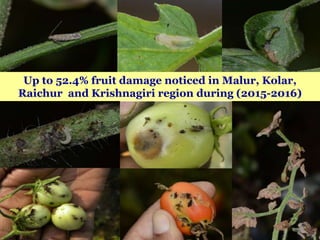
Up to 52.4% fruit damage noticed in Malur, Kolar,
Raichur and Krishnagiri region during (2015-2016)
Rugose Spiralling Whitefly (RSW)
 Invasive pest on coconut -Pollachi (TN) and Palakkad- 2016.
 As a polyphagous pest with more than 200 host plants
 Host plants : Psidium guajava; Musa sp., Myristica fragrans;
Colacasia sp., Garcinia sp., Annona muricata; Murraya koenigii;
Spondias mombin; Mangifera indica and Artocarpus heterophyllus in
coconut homesteads.
 In outer whorls, progressing towards the inner whorls, but emerging
fronds were not infested.
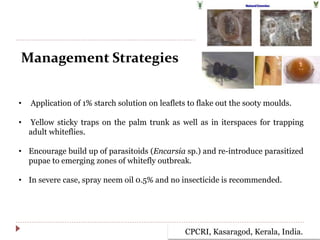
Management Strategies
• Application of 1% starch solution on leaflets to flake out the sooty moulds.
• Yellow sticky traps on the palm trunk as well as in iterspaces for trapping
adult whiteflies.
• Encourage build up of parasitoids (Encarsia sp.) and re-introduce parasitized
pupae to emerging zones of whitefly outbreak.
• In severe case, spray neem oil 0.5% and no insecticide is recommended.
CPCRI, Kasaragod, Kerala, India.
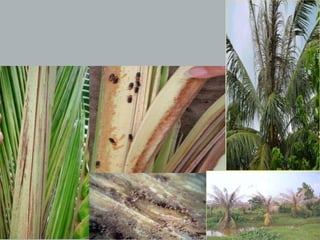
Coconut Leaf Beetle, Brontispa longissima
 Damaging pests of coconut and other palms.
 Native to Indonesia, extensive loss in Maldives, Myanmar and
Indonesia.
 80-90% of seedling infestation with 40% of the leaf area damage
in Kasargod
 ‘Red alert’ has been issued
 Quarantine thorough screening of baggage for ornamental palms
at entry points into the country
(CPCRI, 2015)
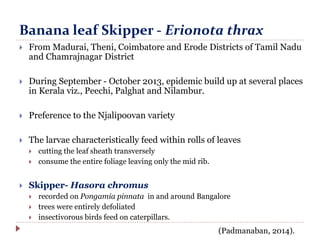
Banana leaf Skipper - Erionota thrax
 From Madurai, Theni, Coimbatore and Erode Districts of Tamil Nadu
and Chamrajnagar District
 During September - October 2013, epidemic build up at several places
in Kerala viz., Peechi, Palghat and Nilambur.
 Preference to the Njalipoovan variety
 The larvae characteristically feed within rolls of leaves
 cutting the leaf sheath transversely
 consume the entire foliage leaving only the mid rib.
 Skipper- Hasora chromus
 recorded on Pongamia pinnata in and around Bangalore
 trees were entirely defoliated
 insectivorous birds feed on caterpillars.
(Padmanaban, 2014).
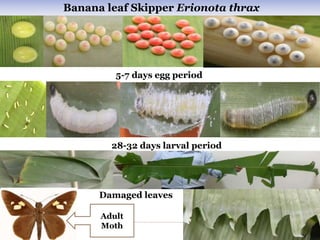
5-7 days egg period
28-32 days larval period
Damaged leaves
Banana leaf Skipper Erionota thrax
Adult
Moth
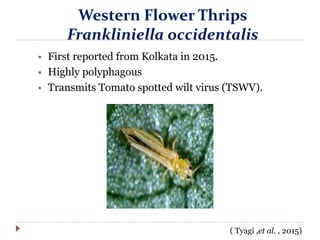
Western Flower Thrips
Frankliniella occidentalis
 First reported from Kolkata in 2015.
 Highly polyphagous
 Transmits Tomato spotted wilt virus (TSWV).
( Tyagi ,et al. , 2015)
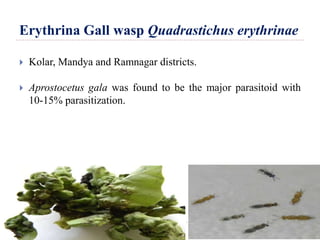
Erythrina Gall wasp Quadrastichus erythrinae
 Kolar, Mandya and Ramnagar districts.
 Aprostocetus gala was found to be the major parasitoid with
10-15% parasitization.
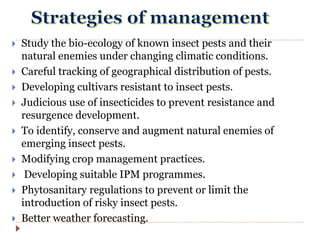
 Study the bio-ecology of known insect pests and their
natural enemies under changing climatic conditions.
 Careful tracking of geographical distribution of pests.
 Developing cultivars resistant to insect pests.
 Judicious use of insecticides to prevent resistance and
resurgence development.
 To identify, conserve and augment natural enemies of
emerging insect pests.
 Modifying crop management practices.
 Developing suitable IPM programmes.
 Phytosanitary regulations to prevent or limit the
introduction of risky insect pests.
 Better weather forecasting.
Thank you

Global trade and Invasive insects

  • 1.
    Global trade &risk of Invasive Alien Species Safeena Majeed AA PA1TAH082
  • 2.
    Definitions Global trade  Exchangeof capital, goods and services across international borders or territories.  Promotes economic growth, efficiency, technology progress & consumer welfare. Invasive alien species  an alien species whose introduction and/or spread threaten biological diversity Quarantine pest  a pest of potential economic importance to the area endangered thereby and not yet present there, or present but not widely distributed and being officially controlled (CBD, 2002) (FAO, 1997)
  • 3.
     Risk analysis:means the complete process composed of hazard identification, risk assessment, risk management and risk communication.  Risk assessment: means the evaluation of the likelihood and the biological and economic consequences of entry, establishment and spread of a hazard within the territory of an importing country.  Risk management: means the process of identifying, selecting and implementing measures that can be applied to reduce the level of risk. OIE
  • 4.
    Fate of Globaltrade  More trade in goods More introductions Higher probability of establishment  More countries in trade more potential habitats for invasive  Greater variety of goods & modes of transport greater potential of invasives and pathways for introduction  Faster modes of transport increased chances of survival  System is as strong as its weakest link
  • 5.
    Effectiveness of ExistingSystem  Small handful of model countries  Inspection rate of 1-2% of goods  Reluctance to place invasives on black lists  Under-resourced regulatory authorities
  • 6.
    IAS in theGlobal Invasive Species Database
  • 7.
    International Legal Framework TRADE •Int’l Maritime Organization • Int’l Civil Aviation Organization • UN Convention on the Law of the Sea • Convention on Biological Diversity • Cartagena Protocol on Biosafety • Ramsar Convention ENVIRONMENT TRANSPORT • WTO- SPS Agreement • IPPC • Office Int’l des Epizooties(OIE) • Codex Alimentarius
  • 8.
    Convention on Biological Diversity Article 8(h) – Prevent the introduction of, control or eradicate those alien species which threaten ecosystems, habitats or species  Joint work plan with IPPC  Work on gaps and inconsistencies in the international legal framework  Global Plant Conservation Strategy (Target X – management plans for at least 100 major invasive alien species)  Global Taxonomy Initiative  Work programmes on forests, agriculture, dry lands, inland waters  Guiding Principles addressing prevention, introduction & mitigation
  • 9.
    Guiding principle 1. Precautionaryapproach  Risk Analysis wrt principle 15 of the 1992 Rio Declaration on Environment and Development & Preamble of the CBD 7. Border control and quarantine measures  Intentional introductions of alien species are subject to appropriate authorization (principle 10)  Risk analysis  Early detection systems 10. Intentional introduction  risk analysis/ environmental impact assessment  Authorize a proposed introduction to ecological regions country  Permit only those species that are unlikely to threaten biological diversity.
  • 10.
    Cartagena Protocol onBiosafety  Article 15 (Risk assessment) “… to identify and evaluate the possible adverse effects of living modified organisms on the conservation and sustainable use of biological diversity”
  • 11.
     October, 2oo8,Bangkok, Thailand  Trade in alien invasive species  Considering alien species can pose significant threats to biodiversity  Species of fauna and flora in commercial trade are likely to be introduced to new habitat as a result of international trade  Consider the problems in developing national legislation and regulations that deal with the trade in live animals or plants Convention on the Int’l Trade in Endangered Species
  • 12.
    Int’l Treaty onPGR for Food & Agriculture  Article 5 – Conservation  Survey and inventory PGR for food and agriculture  Status and degree of variation in existing populations  Including populations that are of potential use and, as feasible, assess any threats to them
  • 13.
    Int’l Plant ProtectionConvention  Article 1(1)  prevent the spread and introduction of pests of plants and plant products  promote appropriate measures for their control  adopt the legislative, technical and administrative measures specified in this Convention  Article 4(2) -Responsibilities of an official NPPO  protection of endangered areas  designation, maintenance and surveillance of pest free areas  areas of low pest prevalence  ISPM 11 (rev)  Pest risk analysis for quarantine pests  analysis of environmental risks and LMO
  • 14.
    Global Invasive SpeciesProgramme (1997)  Conserve biodiversity and sustain human livelihoods by minimizing the spread and impact of IAS.  Partner organizations- CABI, IUCN, The Nature Conservancy  In its first phase  focused IAS assessments  developed guides and toolkits for policy, regulation, prevention and management  adoption by the CBD of a work programme on IAS.  During a second phase  implemented activities to engage and inform governments  stimulate action and cooperation, between governments and different sectors (e.g. environment and agriculture) to address IAS threats.  Following the global economic recession- difficulties in securing & become dormant
  • 15.
    Overlapping mandates ofinternational and regional organizations Lopain, 2005 Prevention is Optimal Strategy
  • 16.
    Recent insect pestsinvasions in India Insect Pest Scientific Name Crop Fall army worm Spodoptera frugiperda Maize Tomato leaf miner Tuta absoluta Tomato Rugose spiralling whitefly Aleurodicus rugioperculatus Coconut Coconut leaf beetle Brontispa longissima Coconut Banana leaf skipper Erionota thrax Banana Western flower thrips Frankliniella occidentalis Fruits & Vegetables Sapota mealybug Exallomochlus philippinensis Sapota Jackbeardsley mealybug Pseudococcus jackbeardsleyi Papaya & Guava Root mealybug Phenacoccus parvus Brinjal coccid Pulvinaria decorata Mango Erythrina gall wasp Quadrastichus erythrinae Erythrina spp. Giant whitefly Aleurodicus dugesii Ornamentals
  • 17.
    Fall army wormSpodoptera frugiperda  Invasive pest from US  Spread to Brazil, Argentina, Africa & India  Shivamogga- 2018, later to Karur (TN)  “Pest war”- TN state govt.  Attacks emerging leaf whorl of 15 days old crop  Holes arranged in straight line  Tips & shank of the corn  Clean cultivation, summer ploughing, wider spacing (60*25cm)  50kg neem cake  Imidachloprid/ thiamethaxam 70WS @10gm/kg seed  Emamectin benzoate
  • 18.
    Tomato Leaf Miner,Tuta absoluta  Tomato Leaf Miner was observed for the first time on tomato and potato crop in Pune, Maharashtra, and 6 districts of Karnataka.  Most serious threat for tomato production worldwide.  Severe infestation (50-87% plants affected) was observed in several tomato fields (Sridhar et al.,2014).  (Muniappan.,2015) stated that if T. absoluta invades rest of the world, the tomato pest management cost may rise up to $ 500 M per year.
  • 19.
    Up to 52.4%fruit damage noticed in Malur, Kolar, Raichur and Krishnagiri region during (2015-2016)
  • 20.
    Rugose Spiralling Whitefly(RSW)  Invasive pest on coconut -Pollachi (TN) and Palakkad- 2016.  As a polyphagous pest with more than 200 host plants  Host plants : Psidium guajava; Musa sp., Myristica fragrans; Colacasia sp., Garcinia sp., Annona muricata; Murraya koenigii; Spondias mombin; Mangifera indica and Artocarpus heterophyllus in coconut homesteads.  In outer whorls, progressing towards the inner whorls, but emerging fronds were not infested.
  • 22.
    Management Strategies • Applicationof 1% starch solution on leaflets to flake out the sooty moulds. • Yellow sticky traps on the palm trunk as well as in iterspaces for trapping adult whiteflies. • Encourage build up of parasitoids (Encarsia sp.) and re-introduce parasitized pupae to emerging zones of whitefly outbreak. • In severe case, spray neem oil 0.5% and no insecticide is recommended. CPCRI, Kasaragod, Kerala, India.
  • 23.
    Coconut Leaf Beetle,Brontispa longissima  Damaging pests of coconut and other palms.  Native to Indonesia, extensive loss in Maldives, Myanmar and Indonesia.  80-90% of seedling infestation with 40% of the leaf area damage in Kasargod  ‘Red alert’ has been issued  Quarantine thorough screening of baggage for ornamental palms at entry points into the country (CPCRI, 2015)
  • 25.
    Banana leaf Skipper- Erionota thrax  From Madurai, Theni, Coimbatore and Erode Districts of Tamil Nadu and Chamrajnagar District  During September - October 2013, epidemic build up at several places in Kerala viz., Peechi, Palghat and Nilambur.  Preference to the Njalipoovan variety  The larvae characteristically feed within rolls of leaves  cutting the leaf sheath transversely  consume the entire foliage leaving only the mid rib.  Skipper- Hasora chromus  recorded on Pongamia pinnata in and around Bangalore  trees were entirely defoliated  insectivorous birds feed on caterpillars. (Padmanaban, 2014).
  • 26.
    5-7 days eggperiod 28-32 days larval period Damaged leaves Banana leaf Skipper Erionota thrax Adult Moth
  • 27.
    Western Flower Thrips Frankliniellaoccidentalis  First reported from Kolkata in 2015.  Highly polyphagous  Transmits Tomato spotted wilt virus (TSWV). ( Tyagi ,et al. , 2015)
  • 28.
    Erythrina Gall waspQuadrastichus erythrinae  Kolar, Mandya and Ramnagar districts.  Aprostocetus gala was found to be the major parasitoid with 10-15% parasitization.
  • 29.
     Study thebio-ecology of known insect pests and their natural enemies under changing climatic conditions.  Careful tracking of geographical distribution of pests.  Developing cultivars resistant to insect pests.  Judicious use of insecticides to prevent resistance and resurgence development.  To identify, conserve and augment natural enemies of emerging insect pests.  Modifying crop management practices.  Developing suitable IPM programmes.  Phytosanitary regulations to prevent or limit the introduction of risky insect pests.  Better weather forecasting.
  • 30.