seminar onSOLID PHASE EXTRACTION AND APPLICATIONMODH SUDIP C.PA/2010/11NIPER HYDERABAD
Introduction
Principle
Types Solid phases
Experimental steps
Trace enrichment
Solid phase micro extraction (SPME)
Comparison with HPLC
Application               Contents2
What is the solid phase extraction?3
DEFINATION OF SOLID PHASE EXTRACTION (SPE):“A  solid  phase  extraction  consists  of bringing a liquid or gaseous test sample in contact with a solid phase, whereby the analyte is selectively adsorbed on the surface of the solid phase” Other solvents (liquids or gases)added to remove possible adsorbed matrix componentsEluting solvent added to desorb analyte selectively4
SYNONYMSLiquid-solid extraction     Column extraction    Digital chromatography    Bonded phase extraction     Selective adsorption techniques5
  Strategies for solid phase extraction Active substance can be:Unretained- while matrix interference are adsorbed
Retained-while matrix interference are washed through6
Retained-while matrix interference are washed through7
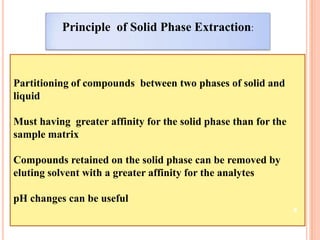
Principle  of Solid Phase Extraction:Partitioning of compounds  between two phases of solid and  liquid Must having  greater affinity for the solid phase than for the sample matrixCompounds retained on the solid phase can be removed by eluting solvent with a greater affinity for the analytes pH changes can be useful8
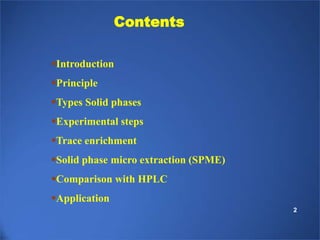
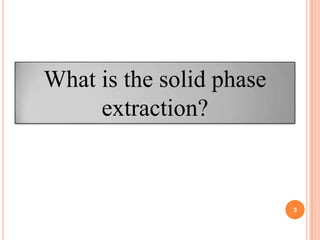
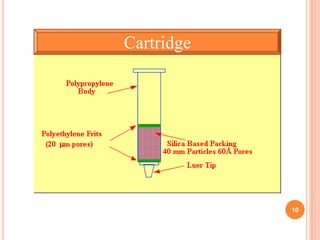
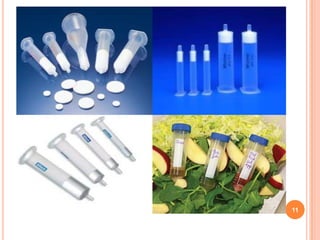
In  modern SPE the  adsorbent  is  packed between two flitted disks in  polypropylene cartridgeand  liquid  phases  are  passed through the cartridge either by suction or by positive pressure9
Cartridge10
11
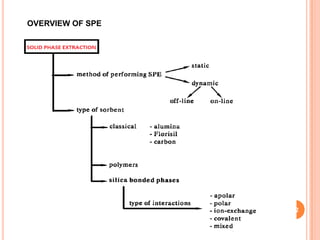
OVERVIEW OF SPE12
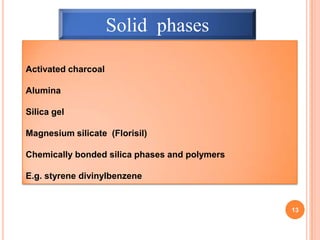
Solid  phases Activated charcoalAluminaSilica gelMagnesium silicate  (Florisil)Chemically bonded silica phases and polymersE.g. styrene divinylbenzene13
According to chemical nature of The functional group  bonded to the silica or the copolymer The resulting phases are classified as Non-polar
Polar
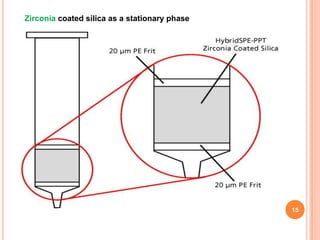
Ion exchangers It gives different mode of chromatographyOther  solid supports Polymeric resins, cellulose and zirconia14
Zirconia coated silica as a stationary phase15
       Examples of  selective stationary phasesReaction of phenobarbitone with pentafluorobenzyl bromide  onto the adsorbent Amphetamine by Chiral derivatization of solid PhasesDoxorubicin by the metal-loaded phases in which metal cation is loaded onto a reagent-labelled phaseMolecularly imprinted polymers  synthetic polymeric materials with specific cavitiesdesigned for a template molecule16
Technical Data - Solid Phase Extraction (SPE) Media  ProductSorbent     Abbreviations                       Description ODS           Octadecyl silica                    5% carbon loadODS-4        Octadecyl silica                    14% carbon load, end capped*ODS-5        Octadecyl silica                    18% carbon load, end cappedC-8             Octyl silica                             8.5% carbon load, end cappedFLO           Florisil™                                 Magnesium silicate NH2            Weak anion exchanger        Primary amineSAX            Strong anion exchanger      Quaternary amine (-NR3+)SCX            Strong cation exchanger     Aromatic benzene sulfonic acidSIL             Normal phase silica  * End capping masks residual silanol groups, reducing ionic affinity for amines.17
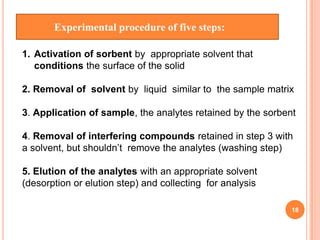
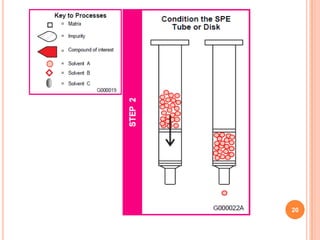
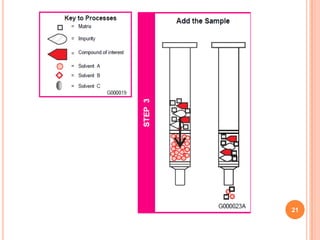
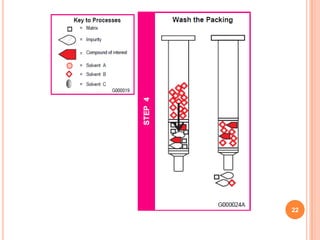
             Experimental procedure of five steps:Activation of sorbent by  appropriate solvent that conditions the surface of the solid2. Removal of  solvent by  liquid  similar to  the sample matrix3. Application of sample, the analytes retained by the sorbent 4. Removal of interfering compounds retained in step 3 with a solvent, but shouldn’t  remove the analytes (washing step)5.Elution of the analytes with an appropriate solvent (desorption or elution step) and collecting  for analysis 18
19
20
21
22
23
Other technique can be usedSupercritical fluid Thermal desorption for analytes of high volatility and thermal stabilityThermal desorption  with GC  for occupational hygiene analysis24
Analyte  eluted with an organic, relatively volatile solvent is evaporated to drynessThen residue  dissolved in  appropriate solventDue to evaporation step, speed with SPE is lost25
        IMMUNOAFFINITY PHASES:Highly selective packings  of Immunoaffinity phases of specific antibody immobilised on solid support such as agarose or silicaUseful  for selective extraction of biological importanceSubstanceDiagnosis of cancer ELISA TEST  26
IMMUNOAFFINITY PHASES27
    TRACE ENRICHMENT WITH SPESensitivity depends onPhysicochemical properties of the  AnalyteDetection systemSelective clean-up Isolation and concentration step28
   Solid phase microextraction: SPME is the technique in which by using special instrument, sampling is possible in a vapour state29
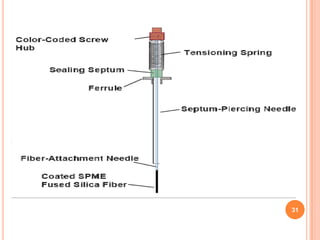
   Design of SPMESyringe  like  instrumentFused silica fiber of  a small size and cylindrical shapeconnected to  stainless-steel tube for additional mechanical strength  and repeated sampling30
31
Fused  silica  fibre  coated with thin film of several polymeric stationary phasesReusable and replaceableSmall size and cylindrical geometry of fiberPlacement into  sample or headspace is  easyLoading in desorption chamber of GC orInterphase of the HPLC without any modification of Plunger 32
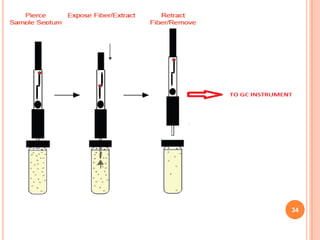
    Working with SPMEFiber is first drawn into the syringe needleLowered into the vial by pressing the plungerFiber cleaned before analysis  to remove contaminantsCleaning can be performed in the desorption chamber of HPLC by running solventCleaned fiber coating is exposed to a sample matrix for a predetermined, fixed period33
34
Limits of detection at the µg/L level with using a flame Ionization detector Limits of detection as low as ng/ L can be reached  with an ion-trap mass spectrometer35
Extraction can be performed in                                                                          two ways1) Headspace SPME or HS-SPMEFiber is exposed in the vapour phase above a gaseous, liquid, or solid sample2) Direct immersion or DI-SPMEFiber is directly immersed  in liquid samples36
Available SPME Fibres, by Film Type•Absorption Fibres-Polydimethylsiloxane (PDMS) 7, 30, and 100μm                      Unpolar-Polyacrylate (PA)                                                                            Polar-Polyethylene glycol (PEG)                                                            Polar •Adsorption fibres (with particles)                                                               -Carboxen-polydimethylsiloxane (CAR-PDMS)                       Adsorption-Polydimethylsiloxane-  divinylbenzene (PDMS-DVB)          Adsorption-Divinylbenzene/ Carboxen-Polydimethylsiloxane (DVB-CAR-PDMS)                                                                         Adsorption  37
SPME applied to liquid, gaseous or heavily contaminated samples chemicals likeSubstituted benzene compounds Polyaromatic hydrocarbonsNitro- and chlorophenols Naphthols volatile organochlorine compounds polychlorinated biphenyl congeners caffeineMetallic ions 38
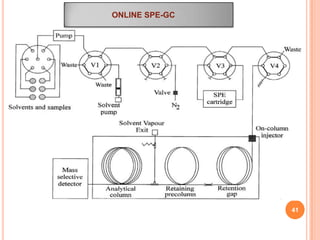
The SPE process can be performed in a two ways:         On-line         Off-lineIn offline SPE eluate from the cartridge is introduced into the chromatograph by means of an injection valveIn on-line SPE the extraction cartridge is inserted as  part of  chromatographic equipment, as loops or high pressure stream of the mobile phase39
Types of online SPE:SPE-GC(SPME-GC)SPE-HPLC40
                    ONLINE SPE-GC41
           ONLINE SPE-HPLC42
10ppb Nitrosamines in Water: SPME-GC/MSChromatogram courtesy of J. Clark, Liggett Group, Inc.43
ONLINE SPE-HPLCTHT= Tetra hydro thiophene44
Comparison of SPE-HPLC and SPME-GC    SPE-HPLC            SPME-GCUniversality                                  Compounds                       +++                      +Detection                                       Sensitivity                           ++                    +++                                                       Selectivity                          +++                     ++                                                       Identification                       +                      +++                                                       Detection limit (µ/ L)       0.05-0.8              0.2-5   Reproducibility (%)                                                               1-15                   4-14Analysis time                                                                            90                      20Sample volume (mL)                                                               200                      2Automation                                                                              +++                   +++Simplicity                                                                                    +                     +++   45
Comparison of SPE  and  HPLC Theoretical basis as HPLCRetention and selectivity remain unaffected by particle sizeEfficiency dependent on:Particle sizeColumn geometryTypical number of platesHPLC ~ 10,000SPE  < 50Minimum Selectivity(alpha)for  Rs=1.2HPLC  1.06SPE    3.9546

solid phase extraction and application

  • 1.
    seminar onSOLID PHASE EXTRACTION AND APPLICATIONMODH SUDIP C.PA/2010/11NIPER HYDERABAD
  • 2.
  • 3.
  • 4.
  • 5.
  • 6.
  • 7.
    Solid phase microextraction (SPME)
  • 8.
  • 9.
    Application Contents2
  • 10.
    What is thesolid phase extraction?3
  • 11.
    DEFINATION OF SOLIDPHASE EXTRACTION (SPE):“A solid phase extraction consists of bringing a liquid or gaseous test sample in contact with a solid phase, whereby the analyte is selectively adsorbed on the surface of the solid phase” Other solvents (liquids or gases)added to remove possible adsorbed matrix componentsEluting solvent added to desorb analyte selectively4
  • 12.
    SYNONYMSLiquid-solid extraction Column extraction Digital chromatography Bonded phase extraction Selective adsorption techniques5
  • 13.
    Strategiesfor solid phase extraction Active substance can be:Unretained- while matrix interference are adsorbed
  • 14.
  • 15.
  • 16.
    Principle ofSolid Phase Extraction:Partitioning of compounds between two phases of solid and liquid Must having greater affinity for the solid phase than for the sample matrixCompounds retained on the solid phase can be removed by eluting solvent with a greater affinity for the analytes pH changes can be useful8
  • 17.
    In modernSPE the adsorbent is packed between two flitted disks in polypropylene cartridgeand liquid phases are passed through the cartridge either by suction or by positive pressure9
  • 18.
  • 19.
  • 20.
  • 21.
    Solid phasesActivated charcoalAluminaSilica gelMagnesium silicate (Florisil)Chemically bonded silica phases and polymersE.g. styrene divinylbenzene13
  • 22.
    According to chemicalnature of The functional group bonded to the silica or the copolymer The resulting phases are classified as Non-polar
  • 23.
  • 24.
    Ion exchangers Itgives different mode of chromatographyOther solid supports Polymeric resins, cellulose and zirconia14
  • 25.
    Zirconia coated silicaas a stationary phase15
  • 26.
    Examples of selective stationary phasesReaction of phenobarbitone with pentafluorobenzyl bromide onto the adsorbent Amphetamine by Chiral derivatization of solid PhasesDoxorubicin by the metal-loaded phases in which metal cation is loaded onto a reagent-labelled phaseMolecularly imprinted polymers synthetic polymeric materials with specific cavitiesdesigned for a template molecule16
  • 27.
    Technical Data -Solid Phase Extraction (SPE) Media ProductSorbent Abbreviations Description ODS Octadecyl silica 5% carbon loadODS-4 Octadecyl silica 14% carbon load, end capped*ODS-5 Octadecyl silica 18% carbon load, end cappedC-8 Octyl silica 8.5% carbon load, end cappedFLO Florisil™ Magnesium silicate NH2 Weak anion exchanger Primary amineSAX Strong anion exchanger Quaternary amine (-NR3+)SCX Strong cation exchanger Aromatic benzene sulfonic acidSIL Normal phase silica  * End capping masks residual silanol groups, reducing ionic affinity for amines.17
  • 28.
    Experimental procedure of five steps:Activation of sorbent by appropriate solvent that conditions the surface of the solid2. Removal of solvent by liquid similar to the sample matrix3. Application of sample, the analytes retained by the sorbent 4. Removal of interfering compounds retained in step 3 with a solvent, but shouldn’t remove the analytes (washing step)5.Elution of the analytes with an appropriate solvent (desorption or elution step) and collecting for analysis 18
  • 29.
  • 30.
  • 31.
  • 32.
  • 33.
  • 34.
    Other technique canbe usedSupercritical fluid Thermal desorption for analytes of high volatility and thermal stabilityThermal desorption with GC for occupational hygiene analysis24
  • 35.
    Analyte elutedwith an organic, relatively volatile solvent is evaporated to drynessThen residue dissolved in appropriate solventDue to evaporation step, speed with SPE is lost25
  • 36.
    IMMUNOAFFINITY PHASES:Highly selective packings of Immunoaffinity phases of specific antibody immobilised on solid support such as agarose or silicaUseful for selective extraction of biological importanceSubstanceDiagnosis of cancer ELISA TEST  26
  • 37.
  • 38.
    TRACE ENRICHMENT WITH SPESensitivity depends onPhysicochemical properties of the AnalyteDetection systemSelective clean-up Isolation and concentration step28
  • 39.
    Solid phase microextraction: SPME is the technique in which by using special instrument, sampling is possible in a vapour state29
  • 40.
    Design of SPMESyringe like instrumentFused silica fiber of a small size and cylindrical shapeconnected to stainless-steel tube for additional mechanical strength and repeated sampling30
  • 41.
  • 42.
    Fused silica fibre coated with thin film of several polymeric stationary phasesReusable and replaceableSmall size and cylindrical geometry of fiberPlacement into sample or headspace is easyLoading in desorption chamber of GC orInterphase of the HPLC without any modification of Plunger 32
  • 43.
    Working with SPMEFiber is first drawn into the syringe needleLowered into the vial by pressing the plungerFiber cleaned before analysis to remove contaminantsCleaning can be performed in the desorption chamber of HPLC by running solventCleaned fiber coating is exposed to a sample matrix for a predetermined, fixed period33
  • 44.
  • 45.
    Limits of detectionat the µg/L level with using a flame Ionization detector Limits of detection as low as ng/ L can be reached with an ion-trap mass spectrometer35
  • 46.
    Extraction can beperformed in two ways1) Headspace SPME or HS-SPMEFiber is exposed in the vapour phase above a gaseous, liquid, or solid sample2) Direct immersion or DI-SPMEFiber is directly immersed in liquid samples36
  • 47.
    Available SPME Fibres,by Film Type•Absorption Fibres-Polydimethylsiloxane (PDMS) 7, 30, and 100μm Unpolar-Polyacrylate (PA) Polar-Polyethylene glycol (PEG) Polar •Adsorption fibres (with particles) -Carboxen-polydimethylsiloxane (CAR-PDMS) Adsorption-Polydimethylsiloxane- divinylbenzene (PDMS-DVB) Adsorption-Divinylbenzene/ Carboxen-Polydimethylsiloxane (DVB-CAR-PDMS) Adsorption  37
  • 48.
    SPME applied toliquid, gaseous or heavily contaminated samples chemicals likeSubstituted benzene compounds Polyaromatic hydrocarbonsNitro- and chlorophenols Naphthols volatile organochlorine compounds polychlorinated biphenyl congeners caffeineMetallic ions 38
  • 49.
    The SPE processcan be performed in a two ways: On-line Off-lineIn offline SPE eluate from the cartridge is introduced into the chromatograph by means of an injection valveIn on-line SPE the extraction cartridge is inserted as part of chromatographic equipment, as loops or high pressure stream of the mobile phase39
  • 50.
    Types of onlineSPE:SPE-GC(SPME-GC)SPE-HPLC40
  • 51.
    ONLINE SPE-GC41
  • 52.
    ONLINE SPE-HPLC42
  • 53.
    10ppb Nitrosamines inWater: SPME-GC/MSChromatogram courtesy of J. Clark, Liggett Group, Inc.43
  • 54.
    ONLINE SPE-HPLCTHT= Tetrahydro thiophene44
  • 55.
    Comparison of SPE-HPLCand SPME-GC SPE-HPLC SPME-GCUniversality Compounds +++ +Detection Sensitivity ++ +++ Selectivity +++ ++ Identification + +++ Detection limit (µ/ L) 0.05-0.8 0.2-5   Reproducibility (%) 1-15 4-14Analysis time 90 20Sample volume (mL) 200 2Automation +++ +++Simplicity + +++   45
  • 56.
    Comparison of SPE and HPLC Theoretical basis as HPLCRetention and selectivity remain unaffected by particle sizeEfficiency dependent on:Particle sizeColumn geometryTypical number of platesHPLC ~ 10,000SPE < 50Minimum Selectivity(alpha)for Rs=1.2HPLC 1.06SPE 3.9546