ACUTE MEDICAL EMERGENCIES
          Part 1
            SYED RAZA
   Cardiologist & Acute Physician
Objectives
•   1. Rapid Assessment
•   2.Intial timely management
•   3.Asking for help
•   4.Liasion with consultant
•   5. Do NO Harm
•   6.Arrangement for transfer
•   7.Communication
•   8.Documentation
Acute Coronary Syndrome
• ECG within 10 mins of arrival
• Serial ECGs
• Cardiac Troponin I/T > 6h from onset pain (± 12h
  if negative, and still suspicious of cardiac pain)
• CardioDetect
• FBC, U+E, LFT, Glucose, Clotting, CRP
• CXR (to exclude other diagnoses)
• TIMI SCORE (for NSTEMI/UA) – Assess risk factors
Acute Coronary Syndrome
• Top Tip: Put an IV cannula in ASAP, cardiac arrest is
  possible
• OXYGEN high flow, if hypoxic
• IV (DIA)MORPHINE 2.5-10 mg + IV METOCLOPRAMIDE
  10 mg, if pain severe
• PO ASPIRIN 300 mg stat; then 75 mg od
• PO CLOPIDOGREL 300 mg stat
• (NSTEMI/UA) SC ENOXAPARIN 1 mg/kg bd.
• (STEMI) Primary percutaneous intervention (PCI)
  Contact BDF
• Thrombolysis (if <12h); IV TENECTEPLASE 30-50 mg
• Key Management Decision
• (STEMI) PCI or Thrombolysis (both <12h)
Acute Heart Failure
• Top Tip: Find out cause of heart failure
  (including exclusion of a MI)
• CXR, ECG (MI?)
• O2 saturation ± ABG
• Urinalysis (nephrotic?)
• FBC, CRP, BNP
• U+E, LFT, Clotting, Glucose, Troponin I (MI?)
Acute Heart Failure
•   Sit up
•   OYXGEN (high flow) if low SPO2
•   IV MORPHINE 2.5-5.0 mg
•    IV GTN infusion 10-200 mcg/min
•   IV FUROSEMIDE 40 mg od (80 mg if creat. 120-200; 120 mg if 200-
    400; 250 mg, if 400+)
•   SC ENOXAPARIN 1 mg/kg (esp, if in AF)
    ± ?ACS protocol, if ?MI
•   Key Management Decisions
•   ECHO (not necessary acutely, will need later to exclude valvular
    heart disease or cardiomyopathy)
•   CPAP
•   CCU/ITU - Transfer
•   DC Cardioversion (if new AF/flutter, and <24h)
Acute Kidney Injury
• Key Investigations
• Urinalysis (heavy proteinuria /microscopic
  haematuria = glomerular disease)
• U+E, LFT, Bone, Glucose, CK
• FBC, ESR, CRP, INR, VBG/ABG
• NGAL (Neutrophil Gelatinase associated
  Lipocalin)
• ECG, CXR
• Renal US – exclude obstruction
Acute Kidney Injury
• Top Tip: Rehydrate, exclude obstruction (ultrasound),
  stop nephrotoxic drugs
• Rx underlying cause (especially sepsis, stop drugs)
• Assess fluid status
• IV + FLUIDS (dry), or
• ± PO/IV FUROSEMIDE 80-250 mg od/bd (wet)
• ± IV INSULIN 10 units in 50 mls 50% DEXTROSE over 30
  mins (if hyperkalaemic)
• ± Urinary catheter
• Key Management Decisions
• IV fluids or diuretics
• Dialysis
Severe Acute Asthma
•   Assess severity
•   Peak flow meter
•   ABG, ECG, CXR
•   FBC, CRP, U+E, LFT, Bone, Glucose
•   Sputum culture
    Blood culture
Severe Acute Asthma
• NEB SALBUTAMOL 5.0 mg qds (or continuously
  until improvement noted)
• NEB IPATROPIUM BROMIDE 500 mcg qds
• IV HYDROCORTISONE 100 mg qds (severe) or PO
  PREDNISOLONE 30 mg od (less)
• OXYGEN, if hypoxic, to achieve saturation of 95-
  97%
• ± IV MAGNESIUM SULPHATE 2 g, over 20
  minutes; can be repeated
• +/- Antibiotics
Diabetic Ketoacidosis
• Glucose (BM) + Capillary Blood Test for
  ketones
• FBC, CRP
• U+E, LFT, Glucose, HbA1C ± Troponin I
• ECG, CXR
• ABG, Blood Culture
• Urinalysis (ketones?) ± MSU
Diabetic Ketoacidosis
• INSULIN (ACTRAPID, 50 units in 50 mls N saline),
  start infusion at 0.1 units/kg/hr
• SC ENOXAPARIN 40 mg od
• IV Normal Saline 1 litre stat.500 ml 1st hour,
  500ml in 2 hrs, 500 ml in 4 hours ,then as per I/O
• + K supplement
• Treat if any overt sepsis
• Key Management Decision
• ITU
Severe Sepsis
• Top Tip: Lack of temperature and/or
  normal/low WC can indicate a worse
  prognosis.
• lack of hypotension does not exclude
  diagnosis.
Severe Sepsis
    Oxygen if SPO2 < 94%
•   Blood Culture
•   IV antibiotics within one hour
•   Fluid resuscitation
•   Lactate and Hb
•   Catheterise, if necessary - and monitor urine output

• Key Management Decisions
• ? Need for central IV access
• ITU/ventilation – does patient need inotropic or ventilatory
  support?
• Source control (eg drainage of abscess or removal of foreign
  body)
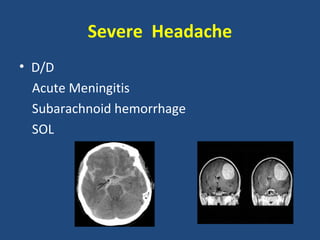
Severe Headache
• D/D
  Acute Meningitis
  Subarachnoid hemorrhage
  SOL
Severe Headache
• Analgesic
• Keep NPO
• I/V cannula
• CBC, CRP, Blood culture if meningitis suspected
• I/V Cefotaxime 2 gram stat if meningitis
  suspected
• Arrange for CT Brain
• ? LP
Acute Upper GI Bleed
•   Vitals/Postural BP
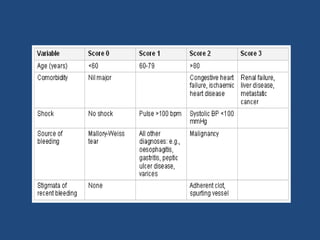
•   Rockall score
•   NPO
•   Urinary Cath. I/O charting
•   2 Large bore (Brown/Grey) i/v cannula
•   CBC, Clotting, LFT, KFT
•   Cross match 6 units of blood
Acute Upper GI Bleed
• Treat any clotting disorder
  i.e. FFP, Prothrombin Concentrate Complex,
       Vitamin K
  Urinary Cath.
• Start volume expander : Gelofusine/N Saline
   while awaiting Blood
• Ensure if taking Aspirin/NSAIDs/Anticoagulant.
• Known peptic ulcer disease
• Alert Gastroenterologist
Do:
•   group and save all patients
•   act on vital signs
•   use large-bore cannulas
•   use CVP access in high risk patients
•   correct coagulopathy in patients with
    cirrhosis.
    Don’t:
•   rely on Hb alone to guide red cell transfusion.
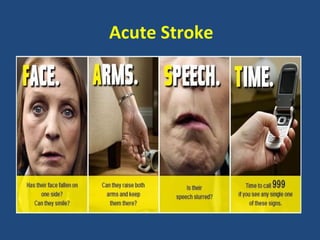
Acute Stroke
Key Initial Management
• Brief history
• Vitals , examination(neurology),GCS
• Gain I/V access. Urinary cath.
• Lab: CBC, KFT, Clotting, LFT, BG & ECG ,CXR
• Keep NPO until swallow is assessed/Aspirin
  rectal if indicated.
• Management of hypertension.
• Urgent transfer for CT brain
Acute Pulmonary Embolism
•   Sudden onset SOB
•   Pleuritic chest pain
•   Haemoptysis
•   Tachycardia /Tachypnea
•   SPO2 not very reliable
•   Risk factors for PE
•   Well’s Score
Initial Work Up
• CXR
• ECG
• ABG, D-DIMER, Clotting, CBC
• Heparin if clinical suspicion is moderate/high
  even before diagnosis is confirmed.
• Arrange for urgent CTPA.
• V-Q scan /US Doppler legs in special cases
Acute  medical emergencies

Acute medical emergencies

  • 1.
    ACUTE MEDICAL EMERGENCIES Part 1 SYED RAZA Cardiologist & Acute Physician
  • 2.
    Objectives • 1. Rapid Assessment • 2.Intial timely management • 3.Asking for help • 4.Liasion with consultant • 5. Do NO Harm • 6.Arrangement for transfer • 7.Communication • 8.Documentation
  • 3.
    Acute Coronary Syndrome •ECG within 10 mins of arrival • Serial ECGs • Cardiac Troponin I/T > 6h from onset pain (± 12h if negative, and still suspicious of cardiac pain) • CardioDetect • FBC, U+E, LFT, Glucose, Clotting, CRP • CXR (to exclude other diagnoses) • TIMI SCORE (for NSTEMI/UA) – Assess risk factors
  • 4.
    Acute Coronary Syndrome •Top Tip: Put an IV cannula in ASAP, cardiac arrest is possible • OXYGEN high flow, if hypoxic • IV (DIA)MORPHINE 2.5-10 mg + IV METOCLOPRAMIDE 10 mg, if pain severe • PO ASPIRIN 300 mg stat; then 75 mg od • PO CLOPIDOGREL 300 mg stat • (NSTEMI/UA) SC ENOXAPARIN 1 mg/kg bd. • (STEMI) Primary percutaneous intervention (PCI) Contact BDF • Thrombolysis (if <12h); IV TENECTEPLASE 30-50 mg
  • 5.
    • Key ManagementDecision • (STEMI) PCI or Thrombolysis (both <12h)
  • 6.
    Acute Heart Failure •Top Tip: Find out cause of heart failure (including exclusion of a MI) • CXR, ECG (MI?) • O2 saturation ± ABG • Urinalysis (nephrotic?) • FBC, CRP, BNP • U+E, LFT, Clotting, Glucose, Troponin I (MI?)
  • 7.
    Acute Heart Failure • Sit up • OYXGEN (high flow) if low SPO2 • IV MORPHINE 2.5-5.0 mg • IV GTN infusion 10-200 mcg/min • IV FUROSEMIDE 40 mg od (80 mg if creat. 120-200; 120 mg if 200- 400; 250 mg, if 400+) • SC ENOXAPARIN 1 mg/kg (esp, if in AF) ± ?ACS protocol, if ?MI • Key Management Decisions • ECHO (not necessary acutely, will need later to exclude valvular heart disease or cardiomyopathy) • CPAP • CCU/ITU - Transfer • DC Cardioversion (if new AF/flutter, and <24h)
  • 8.
    Acute Kidney Injury •Key Investigations • Urinalysis (heavy proteinuria /microscopic haematuria = glomerular disease) • U+E, LFT, Bone, Glucose, CK • FBC, ESR, CRP, INR, VBG/ABG • NGAL (Neutrophil Gelatinase associated Lipocalin) • ECG, CXR • Renal US – exclude obstruction
  • 9.
    Acute Kidney Injury •Top Tip: Rehydrate, exclude obstruction (ultrasound), stop nephrotoxic drugs • Rx underlying cause (especially sepsis, stop drugs) • Assess fluid status • IV + FLUIDS (dry), or • ± PO/IV FUROSEMIDE 80-250 mg od/bd (wet) • ± IV INSULIN 10 units in 50 mls 50% DEXTROSE over 30 mins (if hyperkalaemic) • ± Urinary catheter • Key Management Decisions • IV fluids or diuretics • Dialysis
  • 10.
    Severe Acute Asthma • Assess severity • Peak flow meter • ABG, ECG, CXR • FBC, CRP, U+E, LFT, Bone, Glucose • Sputum culture Blood culture
  • 11.
    Severe Acute Asthma •NEB SALBUTAMOL 5.0 mg qds (or continuously until improvement noted) • NEB IPATROPIUM BROMIDE 500 mcg qds • IV HYDROCORTISONE 100 mg qds (severe) or PO PREDNISOLONE 30 mg od (less) • OXYGEN, if hypoxic, to achieve saturation of 95- 97% • ± IV MAGNESIUM SULPHATE 2 g, over 20 minutes; can be repeated • +/- Antibiotics
  • 12.
    Diabetic Ketoacidosis • Glucose(BM) + Capillary Blood Test for ketones • FBC, CRP • U+E, LFT, Glucose, HbA1C ± Troponin I • ECG, CXR • ABG, Blood Culture • Urinalysis (ketones?) ± MSU
  • 13.
    Diabetic Ketoacidosis • INSULIN(ACTRAPID, 50 units in 50 mls N saline), start infusion at 0.1 units/kg/hr • SC ENOXAPARIN 40 mg od • IV Normal Saline 1 litre stat.500 ml 1st hour, 500ml in 2 hrs, 500 ml in 4 hours ,then as per I/O • + K supplement • Treat if any overt sepsis • Key Management Decision • ITU
  • 14.
    Severe Sepsis • TopTip: Lack of temperature and/or normal/low WC can indicate a worse prognosis. • lack of hypotension does not exclude diagnosis.
  • 15.
    Severe Sepsis Oxygen if SPO2 < 94% • Blood Culture • IV antibiotics within one hour • Fluid resuscitation • Lactate and Hb • Catheterise, if necessary - and monitor urine output • Key Management Decisions • ? Need for central IV access • ITU/ventilation – does patient need inotropic or ventilatory support? • Source control (eg drainage of abscess or removal of foreign body)
  • 16.
    Severe Headache • D/D Acute Meningitis Subarachnoid hemorrhage SOL
  • 17.
    Severe Headache • Analgesic •Keep NPO • I/V cannula • CBC, CRP, Blood culture if meningitis suspected • I/V Cefotaxime 2 gram stat if meningitis suspected • Arrange for CT Brain • ? LP
  • 18.
    Acute Upper GIBleed • Vitals/Postural BP • Rockall score • NPO • Urinary Cath. I/O charting • 2 Large bore (Brown/Grey) i/v cannula • CBC, Clotting, LFT, KFT • Cross match 6 units of blood
  • 20.
    Acute Upper GIBleed • Treat any clotting disorder i.e. FFP, Prothrombin Concentrate Complex, Vitamin K Urinary Cath. • Start volume expander : Gelofusine/N Saline while awaiting Blood • Ensure if taking Aspirin/NSAIDs/Anticoagulant. • Known peptic ulcer disease • Alert Gastroenterologist
  • 21.
    Do: • group and save all patients • act on vital signs • use large-bore cannulas • use CVP access in high risk patients • correct coagulopathy in patients with cirrhosis. Don’t: • rely on Hb alone to guide red cell transfusion.
  • 22.
  • 23.
    Key Initial Management •Brief history • Vitals , examination(neurology),GCS • Gain I/V access. Urinary cath. • Lab: CBC, KFT, Clotting, LFT, BG & ECG ,CXR • Keep NPO until swallow is assessed/Aspirin rectal if indicated. • Management of hypertension. • Urgent transfer for CT brain
  • 24.
    Acute Pulmonary Embolism • Sudden onset SOB • Pleuritic chest pain • Haemoptysis • Tachycardia /Tachypnea • SPO2 not very reliable • Risk factors for PE • Well’s Score
  • 25.
    Initial Work Up •CXR • ECG • ABG, D-DIMER, Clotting, CBC • Heparin if clinical suspicion is moderate/high even before diagnosis is confirmed. • Arrange for urgent CTPA. • V-Q scan /US Doppler legs in special cases