IABP by Rubina Shehzadi 1
Intra aortic Balloon Pump(IABP
By: RubinaShehzad
(BSN,Mphil,Public Healt
Objectives
At the end of this presentation you will be able to learn:
 Define Intra Aortic Balloon Pump(IABP)
 Mechanics of IABP
 Indications & Contra indications
 IABP Settings
 IABP wave form Interpretation
 Variations in IABP
 IABP frequency
 Timing Errors and manifestations
 Complication & prevention of IABP
 Nursing care plan of Patient with IABP
IABP by Rubina Shehzadi 3
Intra Aortic Balloon Pump
(IABP)
An intra-aortic balloon pump (IABP) is a type of therapeutic
device which helps heart to pump more blood. You may need
it if your heart is unable to pump enough blood for your body.
The IABP consists of a thin, flexible tube called a catheter.
Attached to the tip of the catheter is a long balloon.
“The intra-aortic balloon pump is a mechanical device that
increases myocardial oxygen perfusion and indirectly increases
cardiac output through afterload reduction. It consists of a
cylindrical polyurethane balloon that sits in the aorta,
approximately 2 centimeters(0.79in) from the left subclavian
artery”
IABP by Rubina Shehzadi 4
IABP by Rubina Shehzadi 5
Intra Aortic Balloon Pump
(IABP)
 It consists of two parts: a balloon inserted into the
aorta, one of the large arteries through which blood
passes from the heart to the rest of the body; and a
machine/console outside the body.
 It gives temporary support for the left ventricle by
mechanically displacing blood within aorta.
 It is the most common and widely used methods of
mechanical circulatory support.
 It is used in surgical and non-surgical patients of
cardiogenic shock.
IABP by Rubina Shehzadi 6
Insertion of IABP
 The device is introduced from the femoral artery and
guided into the aorta till its tip is just distal to the left
subclavian artery takeoff from the aortic arch by using an
X-ray camera to move it.
 The device is hooked up to a machine that tells the balloon
when to get bigger and when to get smaller.
 It uses helium to blow up the balloon because helium won’t
cause problems in body if it leaks.
 Therefore, when properly positioned, the IABP occupies
the entire descending thoracic aorta and much of the
suprarenal abdominal aorta.
 Although fluoroscopy/echocardiography can help guide
placement, they are not absolutely necessary in emergent
situations.
IABP by Rubina Shehzadi 7
IABP by Rubina Shehzadi 8
IABP by Rubina Shehzadi 9
How long can an intra
aortic balloon pump stay in?
 Sometimes the Intra-aortic-balloon pump(IABP) stays in
for up to one week
 in rare instances, staying in for up to two weeks,
therefore increasing the risk of infection.
IABP by Rubina Shehzadi 10
Indications of IABP
 IABP therapy is a short-term treatment. It is mostly used
to treat cardiogenic shock. That’s when your heart can’t
pump enough blood to meet the needs of your body.
Some heart problems can cause cardiogenic shock.
These include:
 Unstable angina
 Heart attack
 Certain abnormal heart rhythms
 Heart failure
 Heart defects
 As a bridge to cardiac transplantation
IABP by Rubina Shehzadi 11
Contra Indications
 Aortic Insufficiency
 Aortic aneurysm
 Aortic dissection
 Limb ischemia
 Thromboembolism
IABP by Rubina Shehzadi 12
Core Principle of IABP
Therapy
 Synchronized counterpulsation is the core principle of
IABP therapy.
 This describes inflation in diastole and deflation in
systole of a balloon situated in the descending aorta.
 The overall aim is to improve myocardial function by
 myocardial oxygen supply
 myocardial oxygen demand
 Input and removal of helium gas causes inflation and
deflation of the balloon. The timing of balloon inflation
and deflation is based upon the aortic pressure
waveform and the electrocardiogram.
IABP by Rubina Shehzadi 13
IABP by Rubina Shehzadi 14
Cont….
 The balloon inflation occurs immediately after aortic
valve closure and balloon deflation just before opening of
the aortic value.
 Inflation and deflation of the balloon have two major
effects:
 Inflation during diastole causes blood displacement into
the proximal aorta, resulting in increased coronary
blood flow, while Deflation during systole reduces aortic
volume and afterload through a vacuum effect
IABP by Rubina Shehzadi
.
15
Augmentation on a balloon
pump
 Balloon inflation and diastolic augmentation. As the
aortic valve closes in end-systole (this correlates with
the dicrotic notch) the IABP balloon inflation pushes
blood against the closed valve. ... Thus, as
 “the balloon inflates in diastole, it creates a peak of
pressure, which is the diastolic augmentation”
IABP by Rubina Shehzadi 16
 IABP counter-pulsation rapidly stabilizes patients in
cardiogenic shock.
 The greatest improvement in cardiac index and
pulmonary capillary wedge pressure occurs in patients
with mechanical defects complicating acute myocardial
infarction (MI), ie, mitral regurgitation(MR) or
ventricular septal defect(VSD)
IABP by Rubina Shehzadi 17
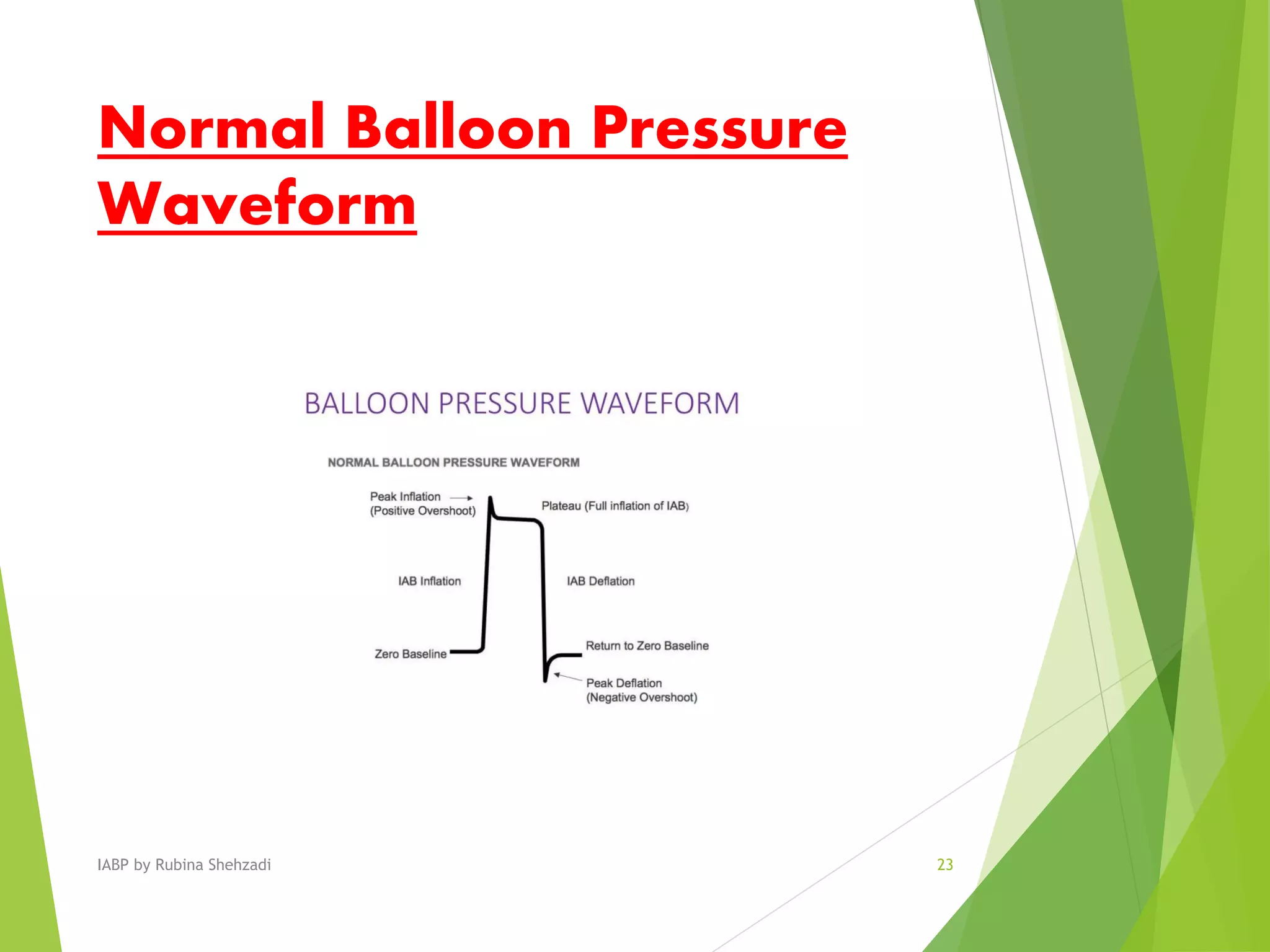
IABP balloon waveform
 The normal IABP balloon waveform
 The balloon itself has a pressure transducer, and it
generates a waveform.
IABP by Rubina Shehzadi 18
ECG triggering of the IABP
The basic principles are:
 Inflation of the balloon is triggered by the the beginning of
diastole, which correlates with the middle of the T-
wave. The balloon is timed to deflate at the very end of
diastole. This correlates with the R-wave on the ECG, and
this is the most commonly used trigger for balloon
deflation.
 In atrial fibrillation, the ECG trigger is timed to deflate on
the R wave as usual, but the R-R interval (which governs
the timing of the balloon remaining inflated) varies. The R
wave timing can also be of the "pattern" type, where
normal QRS morphology is expected, or "peak" type where -
if your QRS is monstrously misshapen - the IABP will choose
the maximum voltage peak and use that instead.
IABP by Rubina Shehzadi 19
IABP by Rubina Shehzadi 20
IABP by Rubina Shehzadi 21
IABP by Rubina Shehzadi 22
Normal Balloon Pressure
Waveform
IABP by Rubina Shehzadi 23
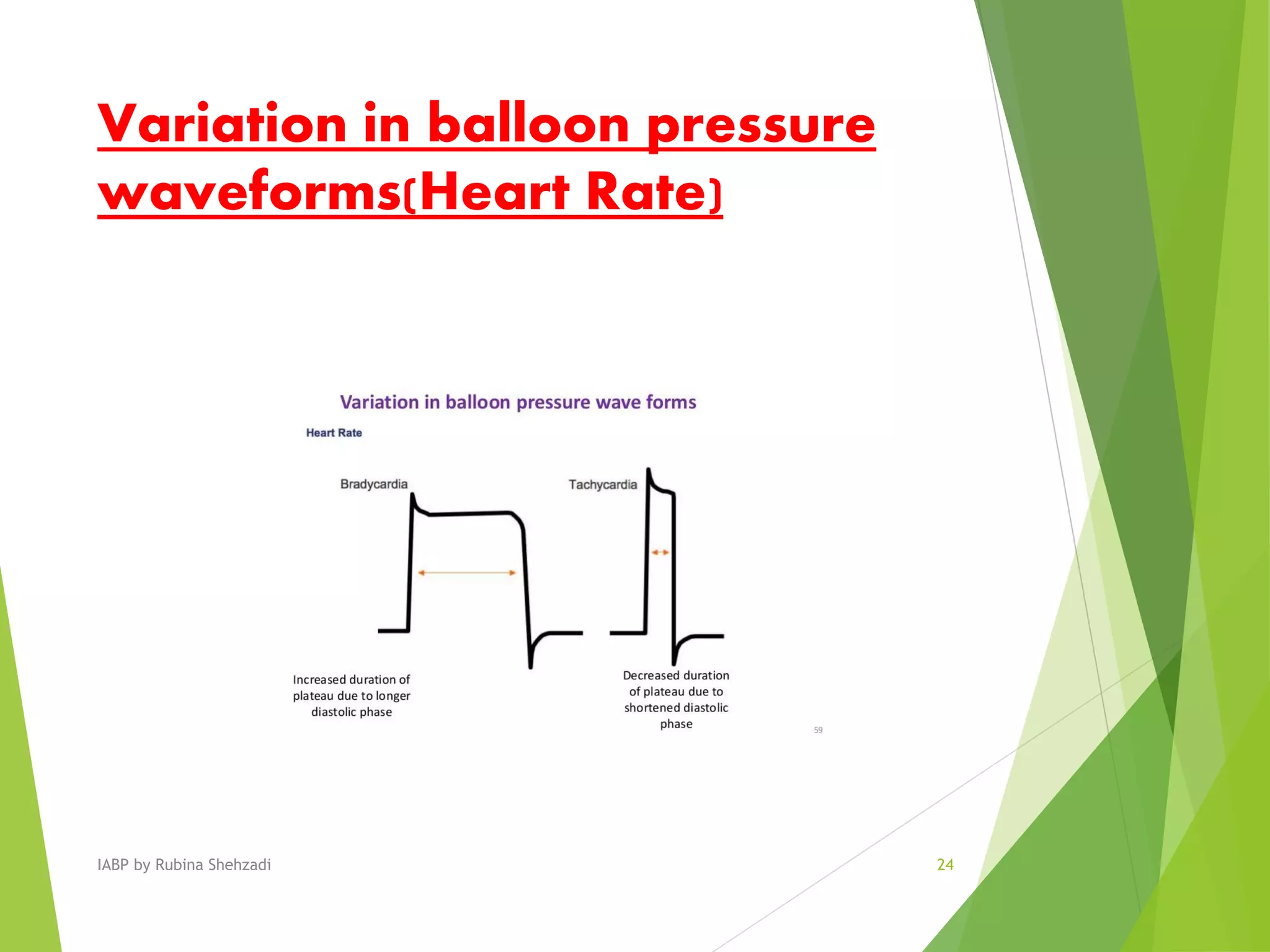
Variation in balloon pressure
waveforms(Heart Rate)
IABP by Rubina Shehzadi 24
Variation in balloon pressure
waveforms(Rhythum)
IABP by Rubina Shehzadi 25
Variation in balloon pressure
waveforms(Gas leak)
IABP by Rubina Shehzadi 26
Variation in balloon pressure
waveforms(Cathetar Kinking)
IABP by Rubina Shehzadi 27
Balloon too large syndrome
IABP by Rubina Shehzadi 28
Complications of IABP
 Infection at site of insertion
 Hematoma and bleeding at insertion site
 Limb ischemia, absent pulses
 Thrombocytopenia
 Coagulation disturbances
 Aortic dissection
 Displacement of the balloon catheter obstructing left
subclavian artery or renal artery perfusion
 Vascular complications
 Balloon leak, rupture, gas loss from the balloon
 Timing issues
IABP by Rubina Shehzadi 29
Limb Ischemia & Bleeding
 Cause of Limb ischaemia are obstruction of a small or
diseased femoral artery by the catheter, formation of
thrombus from direct arterial injury during IABP insertion
and thromboembolism.
 Bleeding at the insertion site is due to anticoagulation
therapy or associated thrombocytopenia.
 Patients receiving IABP therapy are normally maintained on
an anticoagulation regimen to avoid thrombus formation .
 Baseline full blood count and anticoagulation screen should
be reserved prior to and during therapy to observe for
changes such as a decrease in haemoglobin and to monitor
the effect of anticoagulation therapy prescribed.
IABP by Rubina Shehzadi 30
Weaning and Removal of IABP

Once the patient’s condition has stabilized the IABP is
considered for removal. This is preceded by a process of
weaning the pump from 1:1 to 1:2 and finally 1:3
 Observing the patient for ischaemic chest pain or
development of heart failure symptoms such as
breathlessness, hypotension and tachycardia. Once the
patient is stable the IABP can be removed.
IABP by Rubina Shehzadi 31
Nursing care For IABP patients
 Post removal the patient is kept on bed rest with the
leg kept straight as per local guidelines.
 Nursing care involves observing for recurrence of
symptoms as well as checking the insertion site for
haematoma formation ooze or symptoms suggestive of
retroperitoneal bleed every 15 minutes for the first
hour, half hourly for the next two hours and thereafter
hourly or as clinical acuity dictates. In addition lower
limb perfusion is assessed at these times confirming
adequate perfusion and presence of pedal pulses.
 IABP is a form of circulatory support for those
presenting with ischaemia or heart failure. Nursing care
involves care of the pump as well as assessing patient
from a cardiovascular and hemodynamic perspective .
IABP by Rubina Shehzadi 32
IABP by Rubina Shehzadi 33

Intra Aortic Balloon Pump by Rubina Shehzadi RN

  • 1.
    IABP by RubinaShehzadi 1
  • 2.
    Intra aortic BalloonPump(IABP By: RubinaShehzad (BSN,Mphil,Public Healt
  • 3.
    Objectives At the endof this presentation you will be able to learn:  Define Intra Aortic Balloon Pump(IABP)  Mechanics of IABP  Indications & Contra indications  IABP Settings  IABP wave form Interpretation  Variations in IABP  IABP frequency  Timing Errors and manifestations  Complication & prevention of IABP  Nursing care plan of Patient with IABP IABP by Rubina Shehzadi 3
  • 4.
    Intra Aortic BalloonPump (IABP) An intra-aortic balloon pump (IABP) is a type of therapeutic device which helps heart to pump more blood. You may need it if your heart is unable to pump enough blood for your body. The IABP consists of a thin, flexible tube called a catheter. Attached to the tip of the catheter is a long balloon. “The intra-aortic balloon pump is a mechanical device that increases myocardial oxygen perfusion and indirectly increases cardiac output through afterload reduction. It consists of a cylindrical polyurethane balloon that sits in the aorta, approximately 2 centimeters(0.79in) from the left subclavian artery” IABP by Rubina Shehzadi 4
  • 5.
    IABP by RubinaShehzadi 5
  • 6.
    Intra Aortic BalloonPump (IABP)  It consists of two parts: a balloon inserted into the aorta, one of the large arteries through which blood passes from the heart to the rest of the body; and a machine/console outside the body.  It gives temporary support for the left ventricle by mechanically displacing blood within aorta.  It is the most common and widely used methods of mechanical circulatory support.  It is used in surgical and non-surgical patients of cardiogenic shock. IABP by Rubina Shehzadi 6
  • 7.
    Insertion of IABP The device is introduced from the femoral artery and guided into the aorta till its tip is just distal to the left subclavian artery takeoff from the aortic arch by using an X-ray camera to move it.  The device is hooked up to a machine that tells the balloon when to get bigger and when to get smaller.  It uses helium to blow up the balloon because helium won’t cause problems in body if it leaks.  Therefore, when properly positioned, the IABP occupies the entire descending thoracic aorta and much of the suprarenal abdominal aorta.  Although fluoroscopy/echocardiography can help guide placement, they are not absolutely necessary in emergent situations. IABP by Rubina Shehzadi 7
  • 8.
    IABP by RubinaShehzadi 8
  • 9.
    IABP by RubinaShehzadi 9
  • 10.
    How long canan intra aortic balloon pump stay in?  Sometimes the Intra-aortic-balloon pump(IABP) stays in for up to one week  in rare instances, staying in for up to two weeks, therefore increasing the risk of infection. IABP by Rubina Shehzadi 10
  • 11.
    Indications of IABP IABP therapy is a short-term treatment. It is mostly used to treat cardiogenic shock. That’s when your heart can’t pump enough blood to meet the needs of your body. Some heart problems can cause cardiogenic shock. These include:  Unstable angina  Heart attack  Certain abnormal heart rhythms  Heart failure  Heart defects  As a bridge to cardiac transplantation IABP by Rubina Shehzadi 11
  • 12.
    Contra Indications  AorticInsufficiency  Aortic aneurysm  Aortic dissection  Limb ischemia  Thromboembolism IABP by Rubina Shehzadi 12
  • 13.
    Core Principle ofIABP Therapy  Synchronized counterpulsation is the core principle of IABP therapy.  This describes inflation in diastole and deflation in systole of a balloon situated in the descending aorta.  The overall aim is to improve myocardial function by  myocardial oxygen supply  myocardial oxygen demand  Input and removal of helium gas causes inflation and deflation of the balloon. The timing of balloon inflation and deflation is based upon the aortic pressure waveform and the electrocardiogram. IABP by Rubina Shehzadi 13
  • 14.
    IABP by RubinaShehzadi 14
  • 15.
    Cont….  The ballooninflation occurs immediately after aortic valve closure and balloon deflation just before opening of the aortic value.  Inflation and deflation of the balloon have two major effects:  Inflation during diastole causes blood displacement into the proximal aorta, resulting in increased coronary blood flow, while Deflation during systole reduces aortic volume and afterload through a vacuum effect IABP by Rubina Shehzadi . 15
  • 16.
    Augmentation on aballoon pump  Balloon inflation and diastolic augmentation. As the aortic valve closes in end-systole (this correlates with the dicrotic notch) the IABP balloon inflation pushes blood against the closed valve. ... Thus, as  “the balloon inflates in diastole, it creates a peak of pressure, which is the diastolic augmentation” IABP by Rubina Shehzadi 16
  • 17.
     IABP counter-pulsationrapidly stabilizes patients in cardiogenic shock.  The greatest improvement in cardiac index and pulmonary capillary wedge pressure occurs in patients with mechanical defects complicating acute myocardial infarction (MI), ie, mitral regurgitation(MR) or ventricular septal defect(VSD) IABP by Rubina Shehzadi 17
  • 18.
    IABP balloon waveform The normal IABP balloon waveform  The balloon itself has a pressure transducer, and it generates a waveform. IABP by Rubina Shehzadi 18
  • 19.
    ECG triggering ofthe IABP The basic principles are:  Inflation of the balloon is triggered by the the beginning of diastole, which correlates with the middle of the T- wave. The balloon is timed to deflate at the very end of diastole. This correlates with the R-wave on the ECG, and this is the most commonly used trigger for balloon deflation.  In atrial fibrillation, the ECG trigger is timed to deflate on the R wave as usual, but the R-R interval (which governs the timing of the balloon remaining inflated) varies. The R wave timing can also be of the "pattern" type, where normal QRS morphology is expected, or "peak" type where - if your QRS is monstrously misshapen - the IABP will choose the maximum voltage peak and use that instead. IABP by Rubina Shehzadi 19
  • 20.
    IABP by RubinaShehzadi 20
  • 21.
    IABP by RubinaShehzadi 21
  • 22.
    IABP by RubinaShehzadi 22
  • 23.
  • 24.
    Variation in balloonpressure waveforms(Heart Rate) IABP by Rubina Shehzadi 24
  • 25.
    Variation in balloonpressure waveforms(Rhythum) IABP by Rubina Shehzadi 25
  • 26.
    Variation in balloonpressure waveforms(Gas leak) IABP by Rubina Shehzadi 26
  • 27.
    Variation in balloonpressure waveforms(Cathetar Kinking) IABP by Rubina Shehzadi 27
  • 28.
    Balloon too largesyndrome IABP by Rubina Shehzadi 28
  • 29.
    Complications of IABP Infection at site of insertion  Hematoma and bleeding at insertion site  Limb ischemia, absent pulses  Thrombocytopenia  Coagulation disturbances  Aortic dissection  Displacement of the balloon catheter obstructing left subclavian artery or renal artery perfusion  Vascular complications  Balloon leak, rupture, gas loss from the balloon  Timing issues IABP by Rubina Shehzadi 29
  • 30.
    Limb Ischemia &Bleeding  Cause of Limb ischaemia are obstruction of a small or diseased femoral artery by the catheter, formation of thrombus from direct arterial injury during IABP insertion and thromboembolism.  Bleeding at the insertion site is due to anticoagulation therapy or associated thrombocytopenia.  Patients receiving IABP therapy are normally maintained on an anticoagulation regimen to avoid thrombus formation .  Baseline full blood count and anticoagulation screen should be reserved prior to and during therapy to observe for changes such as a decrease in haemoglobin and to monitor the effect of anticoagulation therapy prescribed. IABP by Rubina Shehzadi 30
  • 31.
    Weaning and Removalof IABP  Once the patient’s condition has stabilized the IABP is considered for removal. This is preceded by a process of weaning the pump from 1:1 to 1:2 and finally 1:3  Observing the patient for ischaemic chest pain or development of heart failure symptoms such as breathlessness, hypotension and tachycardia. Once the patient is stable the IABP can be removed. IABP by Rubina Shehzadi 31
  • 32.
    Nursing care ForIABP patients  Post removal the patient is kept on bed rest with the leg kept straight as per local guidelines.  Nursing care involves observing for recurrence of symptoms as well as checking the insertion site for haematoma formation ooze or symptoms suggestive of retroperitoneal bleed every 15 minutes for the first hour, half hourly for the next two hours and thereafter hourly or as clinical acuity dictates. In addition lower limb perfusion is assessed at these times confirming adequate perfusion and presence of pedal pulses.  IABP is a form of circulatory support for those presenting with ischaemia or heart failure. Nursing care involves care of the pump as well as assessing patient from a cardiovascular and hemodynamic perspective . IABP by Rubina Shehzadi 32
  • 33.
    IABP by RubinaShehzadi 33