BY
I.G.Shanmugapriya
Junior Research Fellow
C/O , Dr. Rohit Kumar Rana,
Nanomaterials Laboratory,
CSIR-IICT, Hyderabad.
1
2
3
fg
Tightly packed ceramic
has high zeta potential
To find the rate of flocculation respect to change
in pH in the Waste water treatment process
Stability of the emulsion
4
The 2nd Virial Coefficient (A2) is a property describing the interaction strength between
the particles and the solvent or appropriate dispersant medium.
A2>0 means the
particles ‘like’ the
solvent more than
itself, and will tend
to stay as a stable
solution
A2=0 means the
particle-solvent
interaction strength
is equivalent to the
molecule-molecule
interaction
When A2 <0
means the
particle ‘likes’
itself more than
the solvent, and
therefore may
aggregate
SIZE
MEASUREM
ENT
(DIAMETER)
0.3 nm
to 10 µm
SIZE
RANGE FOR
ZETA
POTENTIAL
(DIAMETER)
3.8 nm
to 100
µm
MOLECULA
R WEIGHT
(DALTONS)
342 Da
to 2x10⁷
Da
Liquid
Medium
5
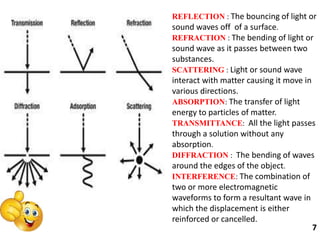
REFLECTION : The bouncing of light or
sound waves off of a surface.
REFRACTION : The bending of light or
sound wave as it passes between two
substances.
SCATTERING : Light or sound wave
interact with matter causing it move in
various directions.
ABSORPTION: The transfer of light
energy to particles of matter.
TRANSMITTANCE: All the light passes
through a solution without any
absorption.
DIFFRACTION : The bending of waves
around the edges of the object.
INTERFERENCE: The combination of
two or more electromagnetic
waveforms to form a resultant wave in
which the displacement is either
reinforced or cancelled.
7
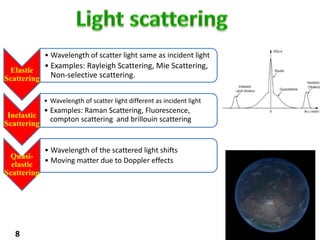
Elastic
Scattering
• Wavelength of scatter light same as incident light
• Examples: Rayleigh Scattering, Mie Scattering,
Non-selective scattering.
Inelastic
Scattering
• Wavelength of scatter light different as incident light
• Examples: Raman Scattering, Fluorescence,
compton scattering and brillouin scattering
Quasi-
elastic
Scattering
• Wavelength of the scattered light shifts
• Moving matter due to Doppler effects
8
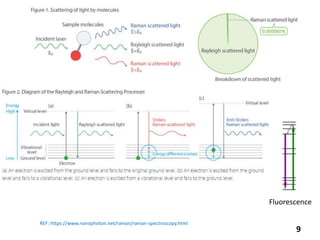
REF: https://www.nanophoton.net/raman/raman-spectroscopy.html
Fluorescence
9
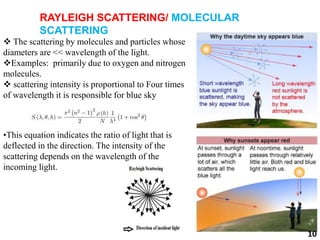
RAYLEIGH SCATTERING/ MOLECULAR
SCATTERING
 The scattering by molecules and particles whose
diameters are << wavelength of the light.
Examples: primarily due to oxygen and nitrogen
molecules.
 scattering intensity is proportional to Four times
of wavelength it is responsible for blue sky
•This equation indicates the ratio of light that is
deflected in the direction. The intensity of the
scattering depends on the wavelength of the
incoming light.
10
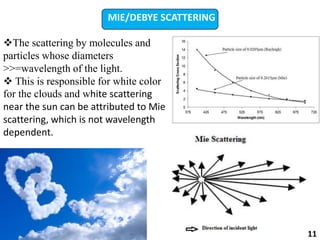
MIE/DEBYE SCATTERING
The scattering by molecules and
particles whose diameters
>>=wavelength of the light.
 This is responsible for white color
for the clouds and white scattering
near the sun can be attributed to Mie
scattering, which is not wavelength
dependent.
11
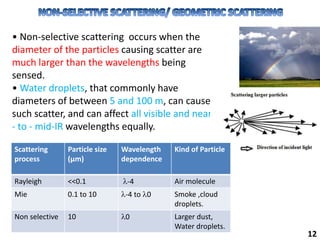
• Non-selective scattering occurs when the
diameter of the particles causing scatter are
much larger than the wavelengths being
sensed.
• Water droplets, that commonly have
diameters of between 5 and 100 m, can cause
such scatter, and can affect all visible and near
- to - mid-IR wavelengths equally.
Scattering
process
Particle size
(µm)
Wavelength
dependence
Kind of Particle
Rayleigh <<0.1 -4 Air molecule
Mie 0.1 to 10 -4 to 0 Smoke ,cloud
droplets.
Non selective 10 0 Larger dust,
Water droplets.
12
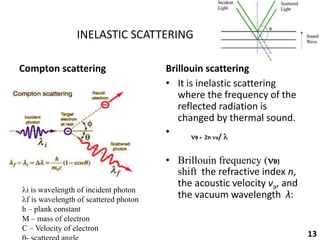
INELASTIC SCATTERING
Compton scattering Brillouin scattering
• It is inelastic scattering
where the frequency of the
reflected radiation is
changed by thermal sound.
•
• Brillouin frequency (B)
shift the refractive index n,
the acoustic velocity va, and
the vacuum wavelength λ:
B = 2n a/ 
i is wavelength of incident photon
f is wavelength of scattered photon
h – plank constant
M – mass of electron
C – Velocity of electron
13
NANO
DECI
CENTI
MILLI
MICRO
femto
PICO
14
Orthogonal Techniques
Particle Size Range
15
16
17
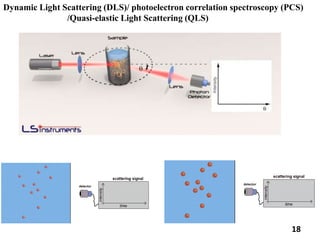
Dynamic Light Scattering (DLS)/ photoelectron correlation spectroscopy (PCS)
/Quasi-elastic Light Scattering (QLS)
18
19
LASER
DETECTOR
LASER
DETECTOR
CONSTRUCTIVE
INTERFERENCE
DISTRUCTIVE
INTERFERENCE
20
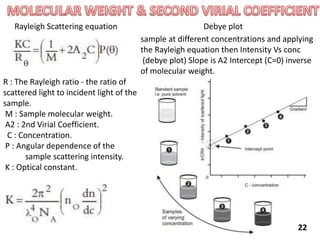
21
Debye plotRayleigh Scattering equation
sample at different concentrations and applying
the Rayleigh equation then Intensity Vs conc
(debye plot) Slope is A2 Intercept (C=0) inverse
of molecular weight.
R : The Rayleigh ratio - the ratio of
scattered light to incident light of the
sample.
M : Sample molecular weight.
A2 : 2nd Virial Coefficient.
C : Concentration.
P : Angular dependence of the
sample scattering intensity.
K : Optical constant.
22
Particles with more positive than +30 Mv
or more negative than -30 Mv are stable. 23
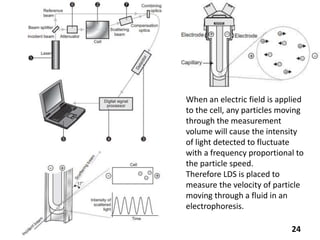
When an electric field is applied
to the cell, any particles moving
through the measurement
volume will cause the intensity
of light detected to fluctuate
with a frequency proportional to
the particle speed.
Therefore LDS is placed to
measure the velocity of particle
moving through a fluid in an
electrophoresis.
24
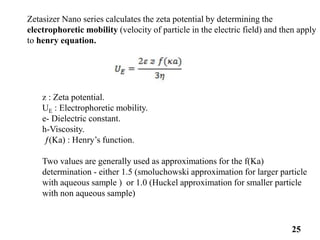
z : Zeta potential.
UE : Electrophoretic mobility.
e- Dielectric constant.
h-Viscosity.
ƒ(Ka) : Henry’s function.
Two values are generally used as approximations for the f(Ka)
determination - either 1.5 (smoluchowski approximation for larger particle
with aqueous sample ) or 1.0 (Huckel approximation for smaller particle
with non aqueous sample)
Zetasizer Nano series calculates the zeta potential by determining the
electrophoretic mobility (velocity of particle in the electric field) and then apply
to henry equation.
25
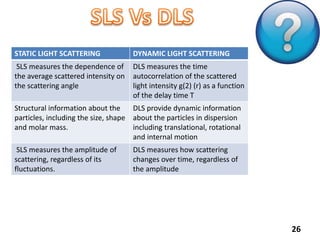
STATIC LIGHT SCATTERING DYNAMIC LIGHT SCATTERING
SLS measures the dependence of
the average scattered intensity on
the scattering angle
DLS measures the time
autocorrelation of the scattered
light intensity g(2) (r) as a function
of the delay time T
Structural information about the
particles, including the size, shape
and molar mass.
DLS provide dynamic information
about the particles in dispersion
including translational, rotational
and internal motion
SLS measures the amplitude of
scattering, regardless of its
fluctuations.
DLS measures how scattering
changes over time, regardless of
the amplitude
26
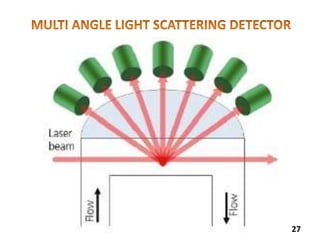
27
28
29

dynamic light scattering

  • 1.
    BY I.G.Shanmugapriya Junior Research Fellow C/O, Dr. Rohit Kumar Rana, Nanomaterials Laboratory, CSIR-IICT, Hyderabad. 1
  • 2.
  • 3.
  • 4.
    Tightly packed ceramic hashigh zeta potential To find the rate of flocculation respect to change in pH in the Waste water treatment process Stability of the emulsion 4
  • 5.
    The 2nd VirialCoefficient (A2) is a property describing the interaction strength between the particles and the solvent or appropriate dispersant medium. A2>0 means the particles ‘like’ the solvent more than itself, and will tend to stay as a stable solution A2=0 means the particle-solvent interaction strength is equivalent to the molecule-molecule interaction When A2 <0 means the particle ‘likes’ itself more than the solvent, and therefore may aggregate SIZE MEASUREM ENT (DIAMETER) 0.3 nm to 10 µm SIZE RANGE FOR ZETA POTENTIAL (DIAMETER) 3.8 nm to 100 µm MOLECULA R WEIGHT (DALTONS) 342 Da to 2x10⁷ Da Liquid Medium 5
  • 7.
    REFLECTION : Thebouncing of light or sound waves off of a surface. REFRACTION : The bending of light or sound wave as it passes between two substances. SCATTERING : Light or sound wave interact with matter causing it move in various directions. ABSORPTION: The transfer of light energy to particles of matter. TRANSMITTANCE: All the light passes through a solution without any absorption. DIFFRACTION : The bending of waves around the edges of the object. INTERFERENCE: The combination of two or more electromagnetic waveforms to form a resultant wave in which the displacement is either reinforced or cancelled. 7
  • 8.
    Elastic Scattering • Wavelength ofscatter light same as incident light • Examples: Rayleigh Scattering, Mie Scattering, Non-selective scattering. Inelastic Scattering • Wavelength of scatter light different as incident light • Examples: Raman Scattering, Fluorescence, compton scattering and brillouin scattering Quasi- elastic Scattering • Wavelength of the scattered light shifts • Moving matter due to Doppler effects 8
  • 9.
  • 10.
    RAYLEIGH SCATTERING/ MOLECULAR SCATTERING The scattering by molecules and particles whose diameters are << wavelength of the light. Examples: primarily due to oxygen and nitrogen molecules.  scattering intensity is proportional to Four times of wavelength it is responsible for blue sky •This equation indicates the ratio of light that is deflected in the direction. The intensity of the scattering depends on the wavelength of the incoming light. 10
  • 11.
    MIE/DEBYE SCATTERING The scatteringby molecules and particles whose diameters >>=wavelength of the light.  This is responsible for white color for the clouds and white scattering near the sun can be attributed to Mie scattering, which is not wavelength dependent. 11
  • 12.
    • Non-selective scatteringoccurs when the diameter of the particles causing scatter are much larger than the wavelengths being sensed. • Water droplets, that commonly have diameters of between 5 and 100 m, can cause such scatter, and can affect all visible and near - to - mid-IR wavelengths equally. Scattering process Particle size (µm) Wavelength dependence Kind of Particle Rayleigh <<0.1 -4 Air molecule Mie 0.1 to 10 -4 to 0 Smoke ,cloud droplets. Non selective 10 0 Larger dust, Water droplets. 12
  • 13.
    INELASTIC SCATTERING Compton scatteringBrillouin scattering • It is inelastic scattering where the frequency of the reflected radiation is changed by thermal sound. • • Brillouin frequency (B) shift the refractive index n, the acoustic velocity va, and the vacuum wavelength λ: B = 2n a/  i is wavelength of incident photon f is wavelength of scattered photon h – plank constant M – mass of electron C – Velocity of electron 13
  • 14.
  • 15.
  • 16.
  • 17.
  • 18.
    Dynamic Light Scattering(DLS)/ photoelectron correlation spectroscopy (PCS) /Quasi-elastic Light Scattering (QLS) 18
  • 19.
  • 20.
  • 21.
  • 22.
    Debye plotRayleigh Scatteringequation sample at different concentrations and applying the Rayleigh equation then Intensity Vs conc (debye plot) Slope is A2 Intercept (C=0) inverse of molecular weight. R : The Rayleigh ratio - the ratio of scattered light to incident light of the sample. M : Sample molecular weight. A2 : 2nd Virial Coefficient. C : Concentration. P : Angular dependence of the sample scattering intensity. K : Optical constant. 22
  • 23.
    Particles with morepositive than +30 Mv or more negative than -30 Mv are stable. 23
  • 24.
    When an electricfield is applied to the cell, any particles moving through the measurement volume will cause the intensity of light detected to fluctuate with a frequency proportional to the particle speed. Therefore LDS is placed to measure the velocity of particle moving through a fluid in an electrophoresis. 24
  • 25.
    z : Zetapotential. UE : Electrophoretic mobility. e- Dielectric constant. h-Viscosity. ƒ(Ka) : Henry’s function. Two values are generally used as approximations for the f(Ka) determination - either 1.5 (smoluchowski approximation for larger particle with aqueous sample ) or 1.0 (Huckel approximation for smaller particle with non aqueous sample) Zetasizer Nano series calculates the zeta potential by determining the electrophoretic mobility (velocity of particle in the electric field) and then apply to henry equation. 25
  • 26.
    STATIC LIGHT SCATTERINGDYNAMIC LIGHT SCATTERING SLS measures the dependence of the average scattered intensity on the scattering angle DLS measures the time autocorrelation of the scattered light intensity g(2) (r) as a function of the delay time T Structural information about the particles, including the size, shape and molar mass. DLS provide dynamic information about the particles in dispersion including translational, rotational and internal motion SLS measures the amplitude of scattering, regardless of its fluctuations. DLS measures how scattering changes over time, regardless of the amplitude 26
  • 27.
  • 28.
  • 29.