THE H.N.S.B LTD. SCIENCE COLLEGE, HIMATNAGAR
CLASS SEMINAR
M.Sc SEM-I
Subject :- INORGANIC CHEMISTRY
Paper :- CHN- 401
Topic :- Nucleophilic displacement reaction
Presented By Guided By
Kajal Patel Dr. N. I. Patel sir
Content……
- SN1 Reaction
- SN2 Reaction
The SN1Reaction
 Substitution
 Nucleophilic
 Unimolecular
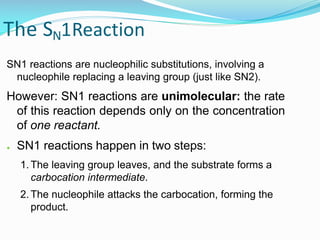
The SN1Reaction
SN1 reactions are nucleophilic substitutions, involving a
nucleophile replacing a leaving group (just like SN2).
However: SN1 reactions are unimolecular: the rate
of this reaction depends only on the concentration
of one reactant.
● SN1 reactions happen in two steps:
1. The leaving group leaves, and the substrate forms a
carbocation intermediate.
2. The nucleophile attacks the carbocation, forming the
product.
The SN1Reaction
Carbocation
Intermediate
Substrate
Products
The SN1Reaction
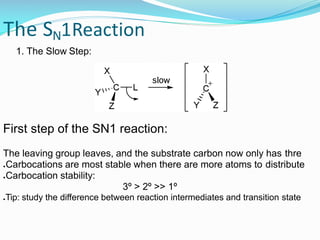
1. The Slow Step:
First step of the SN1 reaction:
The leaving group leaves, and the substrate carbon now only has thre
●Carbocations are most stable when there are more atoms to distribute
●Carbocation stability:
3º > 2º >> 1º
●Tip: study the difference between reaction intermediates and transition state
The SN1Reaction
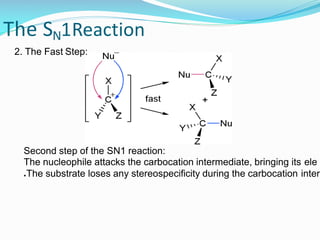
2. The Fast Step:
Second step of the SN1 reaction:
The nucleophile attacks the carbocation intermediate, bringing its ele
●The substrate loses any stereospecificity during the carbocation inter
The SN2Reaction
Substitution
Nucleophilic
Bimolecular
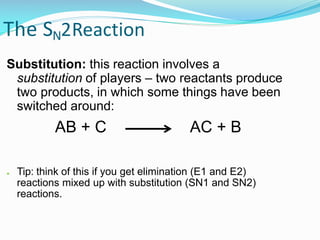
The SN2Reaction
Substitution: this reaction involves a
substitution of players – two reactants produce
two products, in which some things have been
switched around:
AB + C AC + B
● Tip: think of this if you get elimination (E1 and E2)
reactions mixed up with substitution (SN1 and SN2)
reactions.
The SN2Reaction
Transition State
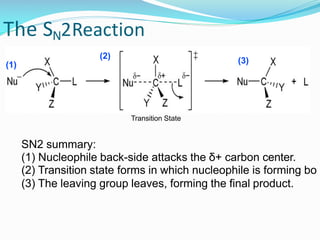
SN2 summary:
(1) Nucleophile back-side attacks the δ+ carbon center.
(2) Transition state forms in which nucleophile is forming bo
(3) The leaving group leaves, forming the final product.
(2)
(1) (3)
The SN2Reaction
Nucleophilic: these reactions involve a
nucleophile (Nuc:-) replacing a leaving group.
● Nucleophiles attack the substrate, donating an
electron pair to the new bond, and replacing
the leaving group (a substitution).
● Tip: Remember the role of a nucleophile by its Greek
roots: Nucleo-(nucleus)-phile-(lover) – it is attracted to
the nucleus, which is positively charged! Nucleophiles are
therefore negatively charged or strongly δ-.
The SN2Reaction
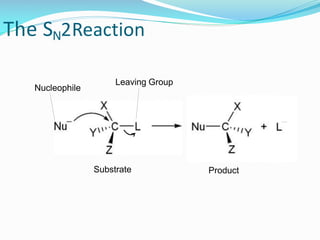
Substrate
Nucleophile
Leaving Group
Product
The SN2Reaction
Bimolecular: A bimolecular reaction is one
whose rate depends on the concentrations of
two of its reactants.
● SN2 reactions happen in one step – the
nucleophile attacks the substrate as the
leaving group leaves the substrate.
● Tip: Recall that the rate of a reaction depends on the
slowest step. In bimolecular reactions, therefore, the slow
step involves two reactants. For SN2 reactions, there are
only two reactants; this means that the slow step is the
only step.
The SN2Reaction
Notes:
●In the SN2 reaction, the nucleophile attacks from the
most δ+ region
●This back-side attack causes an inversion (study the previous slide)
●The nucleophile must be able to reach the δ+ carbon center that it is
●Tip: see chapter 6 of your textbook to learn what makes a good nucleophile o
Sn1 and sn2 reaction

Sn1 and sn2 reaction

  • 1.
    THE H.N.S.B LTD.SCIENCE COLLEGE, HIMATNAGAR CLASS SEMINAR M.Sc SEM-I Subject :- INORGANIC CHEMISTRY Paper :- CHN- 401 Topic :- Nucleophilic displacement reaction Presented By Guided By Kajal Patel Dr. N. I. Patel sir
  • 2.
  • 3.
    The SN1Reaction  Substitution Nucleophilic  Unimolecular
  • 4.
    The SN1Reaction SN1 reactionsare nucleophilic substitutions, involving a nucleophile replacing a leaving group (just like SN2). However: SN1 reactions are unimolecular: the rate of this reaction depends only on the concentration of one reactant. ● SN1 reactions happen in two steps: 1. The leaving group leaves, and the substrate forms a carbocation intermediate. 2. The nucleophile attacks the carbocation, forming the product.
  • 5.
  • 6.
    The SN1Reaction 1. TheSlow Step: First step of the SN1 reaction: The leaving group leaves, and the substrate carbon now only has thre ●Carbocations are most stable when there are more atoms to distribute ●Carbocation stability: 3º > 2º >> 1º ●Tip: study the difference between reaction intermediates and transition state
  • 7.
    The SN1Reaction 2. TheFast Step: Second step of the SN1 reaction: The nucleophile attacks the carbocation intermediate, bringing its ele ●The substrate loses any stereospecificity during the carbocation inter
  • 8.
  • 9.
    The SN2Reaction Substitution: thisreaction involves a substitution of players – two reactants produce two products, in which some things have been switched around: AB + C AC + B ● Tip: think of this if you get elimination (E1 and E2) reactions mixed up with substitution (SN1 and SN2) reactions.
  • 10.
    The SN2Reaction Transition State SN2summary: (1) Nucleophile back-side attacks the δ+ carbon center. (2) Transition state forms in which nucleophile is forming bo (3) The leaving group leaves, forming the final product. (2) (1) (3)
  • 11.
    The SN2Reaction Nucleophilic: thesereactions involve a nucleophile (Nuc:-) replacing a leaving group. ● Nucleophiles attack the substrate, donating an electron pair to the new bond, and replacing the leaving group (a substitution). ● Tip: Remember the role of a nucleophile by its Greek roots: Nucleo-(nucleus)-phile-(lover) – it is attracted to the nucleus, which is positively charged! Nucleophiles are therefore negatively charged or strongly δ-.
  • 12.
  • 13.
    The SN2Reaction Bimolecular: Abimolecular reaction is one whose rate depends on the concentrations of two of its reactants. ● SN2 reactions happen in one step – the nucleophile attacks the substrate as the leaving group leaves the substrate. ● Tip: Recall that the rate of a reaction depends on the slowest step. In bimolecular reactions, therefore, the slow step involves two reactants. For SN2 reactions, there are only two reactants; this means that the slow step is the only step.
  • 14.
    The SN2Reaction Notes: ●In theSN2 reaction, the nucleophile attacks from the most δ+ region ●This back-side attack causes an inversion (study the previous slide) ●The nucleophile must be able to reach the δ+ carbon center that it is ●Tip: see chapter 6 of your textbook to learn what makes a good nucleophile o