Easy assessment of
musculoskeletal system
for GPs
Aspects of examining the
musculoskeletal system
 Revisiting the basics
 GALS
 Video
 Some bits and pieces / a personal view
History
 “Have you any pain or stiffness in your
muscles, joints or back?”
 “Do you have any trouble getting up or
down stairs?”
 “Do you have any difficulty getting
dressed?”
Revisiting the basics
 Inspection Look
 Palpation Feel
 Movement Move
 Stability
 Function
 Compare with opposite side
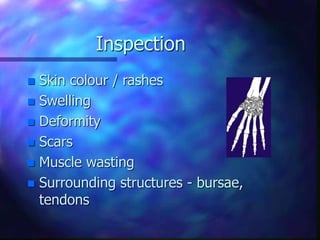
Inspection
 Skin colour / rashes
 Swelling
 Deformity
 Scars
 Muscle wasting
 Surrounding structures - bursae,
tendons
Palpation
 Nature of swelling
–bony
–synovial
–effusion
 Warmth
 Tenderness
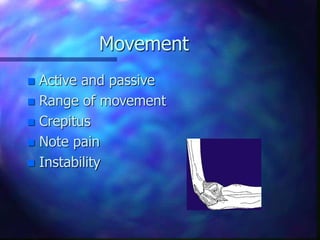
Movement
 Active and passive
 Range of movement
 Crepitus
 Note pain
 Instability
Stability
 Subluxation or dislocation
– MCP
– Radioulnar
– subtalar
– MTP
Function
 Lower limbs - gait
 Hands
–pincer grip
–power grip
G A L S
 Doherty, Dacre, Dieppe and Snaith (1992)
The GALS locomotor screen, Annals of
Rheumatic diseases 51: 1165-9
 GAIT
 ARMS
 LEGS
 SPINE
G A L S
 “…provide a valuable screening test for
use in general practice”
 “the procedure can be viewed as a
general functional (disability), as well as
a basic musculoskeletal assessment”
 “..be useful in selective situations as a
rapid test of functional performance and
to screen out regional locomotor
abnormalities that merit closer scrutiny”
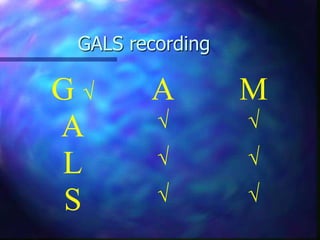
GALS recording
G  A M
A  
L  
S  
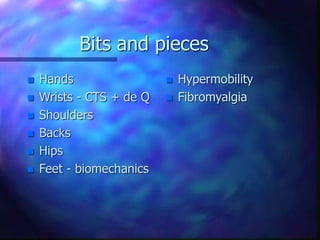
Bits and pieces
 Hands
 Wrists - CTS + de Q
 Shoulders
 Backs
 Hips
 Feet - biomechanics
 Hypermobility
 Fibromyalgia
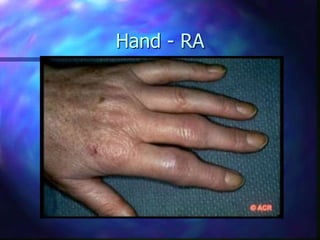
Hand - RA
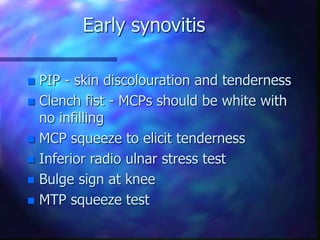
Early synovitis
 PIP - skin discolouration and tenderness
 Clench fist - MCPs should be white with
no infilling
 MCP squeeze to elicit tenderness
 Inferior radio ulnar stress test
 Bulge sign at knee
 MTP squeeze test
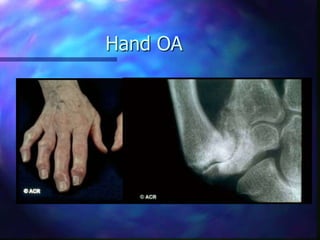
Hand OA
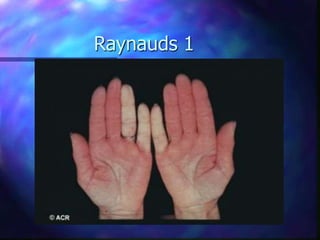
Raynauds 1
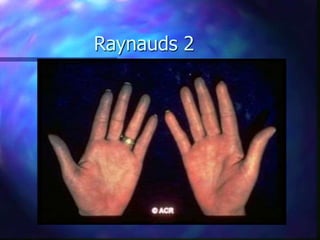
Raynauds 2
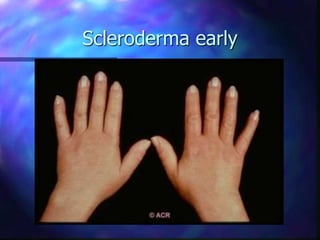
Scleroderma early
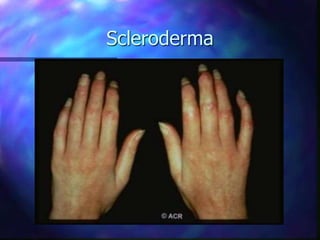
Scleroderma
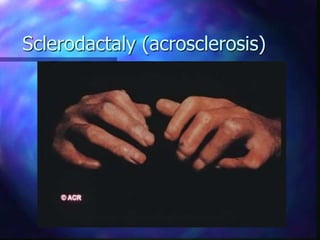
Sclerodactaly (acrosclerosis)
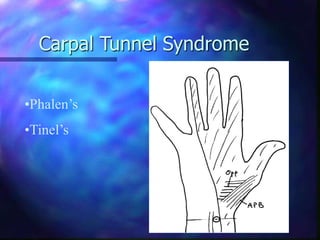
Carpal Tunnel Syndrome
•Phalen’s
•Tinel’s
De Quervains tenosynovitis
 APL and EPB tendons
 tender over radial styloid
 sometimes nodule (thickened sheath)
 Finkelsteins test
 Rest it
 Inject it
Shoulders
 Shoulder or not
 Glenohumeral or not - external rotation
 Tenderness
– bicipital groove
– subacromial
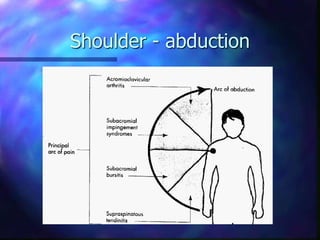
 Painful arc of abduction
Shoulder - abduction
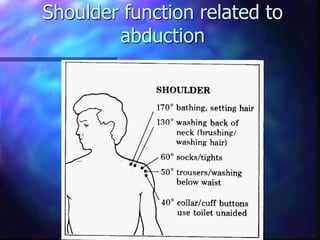
Shoulder function related to
abduction
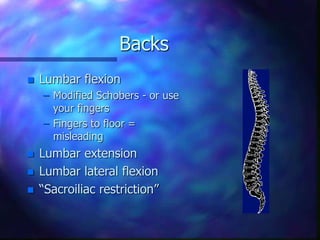
Backs
 Lumbar flexion
– Modified Schobers - or use
your fingers
– Fingers to floor =
misleading
 Lumbar extension
 Lumbar lateral flexion
 “Sacroiliac restriction”
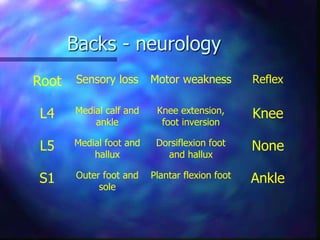
Backs - neurology
Root Sensory loss Motor weakness Reflex
L4 Medial calf and
ankle
Knee extension,
foot inversion
Knee
L5 Medial foot and
hallux
Dorsiflexion foot
and hallux
None
S1 Outer foot and
sole
Plantar flexion foot Ankle
Hips
 Internal rotation - can examine sitting
 Trochanteric bursitis
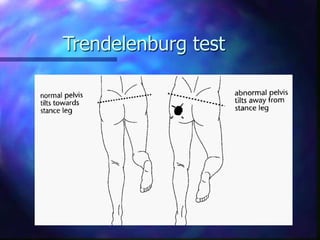
 Trendelenburg - to distinguish lumbosacral from
hip pain
Trendelenburg test
Foot - biomechanics
 Swing phase
 Stance phase
– Contact (27%)
– Midstance (40%)
– Propulsive (33%)
Biomechanics - stance phase
 Contact
– outer border heel strikes then
– PRONATION at subtalar joint shifts centre
gravity medially
– causes tibia to internally rotate
– purpose is shock absorption/adaption
uneven ground
Biomechanics - stance phase (2)
 Midstance
– forefoot loaded
– subtalar joint supinates
– causes tibia to externally rotate
– foot is converted to rigid lever ready for
propulsion
– ends with heel lift
Biomechanics - stance phase (3)
 Propulsion
– app 25% bodyweight on metatarsals and
toes (esp 1st)
– ends with toes off
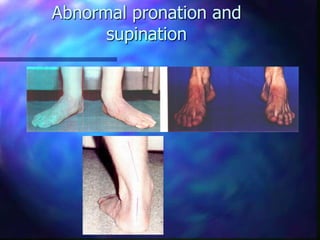
Abnormal pronation and
supination
Over pronation
 Subtalar pronation
unchecked
 longitudinal arch
stretches and
flattens
 excess rotation of
tibia
 Hallux valgus
 Plantar fasciitis
 Achilles tendonitis
 Post tibial tendonitis
 stress# navicular
 anterior knee pain
 low back pain
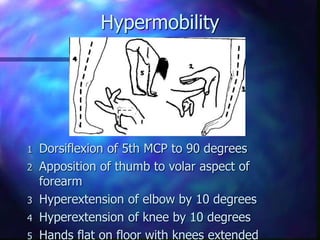
Hypermobility
1 Dorsiflexion of 5th MCP to 90 degrees
2 Apposition of thumb to volar aspect of
forearm
3 Hyperextension of elbow by 10 degrees
4 Hyperextension of knee by 10 degrees
5 Hands flat on floor with knees extended
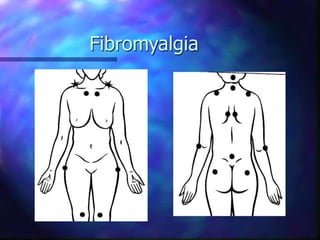
Fibromyalgia
The End

Musculoskeletal Examination.ppt

  • 1.
    Easy assessment of musculoskeletalsystem for GPs Aspects of examining the musculoskeletal system
  • 2.
     Revisiting thebasics  GALS  Video  Some bits and pieces / a personal view
  • 3.
    History  “Have youany pain or stiffness in your muscles, joints or back?”  “Do you have any trouble getting up or down stairs?”  “Do you have any difficulty getting dressed?”
  • 5.
    Revisiting the basics Inspection Look  Palpation Feel  Movement Move  Stability  Function  Compare with opposite side
  • 6.
    Inspection  Skin colour/ rashes  Swelling  Deformity  Scars  Muscle wasting  Surrounding structures - bursae, tendons
  • 7.
    Palpation  Nature ofswelling –bony –synovial –effusion  Warmth  Tenderness
  • 8.
    Movement  Active andpassive  Range of movement  Crepitus  Note pain  Instability
  • 9.
    Stability  Subluxation ordislocation – MCP – Radioulnar – subtalar – MTP
  • 10.
    Function  Lower limbs- gait  Hands –pincer grip –power grip
  • 12.
    G A LS  Doherty, Dacre, Dieppe and Snaith (1992) The GALS locomotor screen, Annals of Rheumatic diseases 51: 1165-9  GAIT  ARMS  LEGS  SPINE
  • 13.
    G A LS  “…provide a valuable screening test for use in general practice”  “the procedure can be viewed as a general functional (disability), as well as a basic musculoskeletal assessment”  “..be useful in selective situations as a rapid test of functional performance and to screen out regional locomotor abnormalities that merit closer scrutiny”
  • 14.
    GALS recording G A M A   L   S  
  • 16.
    Bits and pieces Hands  Wrists - CTS + de Q  Shoulders  Backs  Hips  Feet - biomechanics  Hypermobility  Fibromyalgia
  • 17.
  • 18.
    Early synovitis  PIP- skin discolouration and tenderness  Clench fist - MCPs should be white with no infilling  MCP squeeze to elicit tenderness  Inferior radio ulnar stress test  Bulge sign at knee  MTP squeeze test
  • 19.
  • 20.
  • 21.
  • 22.
  • 23.
  • 24.
  • 25.
  • 26.
    De Quervains tenosynovitis APL and EPB tendons  tender over radial styloid  sometimes nodule (thickened sheath)  Finkelsteins test  Rest it  Inject it
  • 27.
    Shoulders  Shoulder ornot  Glenohumeral or not - external rotation  Tenderness – bicipital groove – subacromial  Painful arc of abduction
  • 28.
  • 29.
  • 30.
    Backs  Lumbar flexion –Modified Schobers - or use your fingers – Fingers to floor = misleading  Lumbar extension  Lumbar lateral flexion  “Sacroiliac restriction”
  • 31.
    Backs - neurology RootSensory loss Motor weakness Reflex L4 Medial calf and ankle Knee extension, foot inversion Knee L5 Medial foot and hallux Dorsiflexion foot and hallux None S1 Outer foot and sole Plantar flexion foot Ankle
  • 32.
    Hips  Internal rotation- can examine sitting  Trochanteric bursitis  Trendelenburg - to distinguish lumbosacral from hip pain
  • 33.
  • 34.
    Foot - biomechanics Swing phase  Stance phase – Contact (27%) – Midstance (40%) – Propulsive (33%)
  • 35.
    Biomechanics - stancephase  Contact – outer border heel strikes then – PRONATION at subtalar joint shifts centre gravity medially – causes tibia to internally rotate – purpose is shock absorption/adaption uneven ground
  • 36.
    Biomechanics - stancephase (2)  Midstance – forefoot loaded – subtalar joint supinates – causes tibia to externally rotate – foot is converted to rigid lever ready for propulsion – ends with heel lift
  • 37.
    Biomechanics - stancephase (3)  Propulsion – app 25% bodyweight on metatarsals and toes (esp 1st) – ends with toes off
  • 38.
  • 39.
    Over pronation  Subtalarpronation unchecked  longitudinal arch stretches and flattens  excess rotation of tibia  Hallux valgus  Plantar fasciitis  Achilles tendonitis  Post tibial tendonitis  stress# navicular  anterior knee pain  low back pain
  • 40.
    Hypermobility 1 Dorsiflexion of5th MCP to 90 degrees 2 Apposition of thumb to volar aspect of forearm 3 Hyperextension of elbow by 10 degrees 4 Hyperextension of knee by 10 degrees 5 Hands flat on floor with knees extended
  • 41.
  • 42.