Musculoskeletal examination
DR THIT LWIN
Basic principles
• Observe the general appearance of patient.
• Do not cause the patient additional pain.
• Compare the limb with opposite side.
• Assess active before passive movements.
• Use standard terminology when describing position and movement.
equipment
• Measuring tape
• Tendon hammer
• Goniometer
GALS SCREEN
• Gait, Arm, Leg, Spine
• 3 Questions
-Do you have any pain or stiffness in your
muscle, joint or back?
-Can you dress yourself without difficulty?
- Can you walk up and down stairs without
difficulty?
Gait
• Look- ask the patient to walk for several steps.
• Limp is an abnormal gait.
• Antalgic gait- short stance phase
• Tredelenburg gait- when weight bearing on the
affected side, the contralateral hemipelvis falls.
• High stepping gait- foot drop due to common peroneal
nerve injury.
Gait cycle
1.Heel-strike: initial contact of the heel with the floor.
2.Foot flat: weight is transferred onto this leg.
3.Mid-stance: the weight is aligned and balanced on this leg.
4.Heel-off: the heel lifts off the floor as the foot rises but the toes
remain in contact with the floor.
5.Toe-off: as the foot continues to rise the toes lift off the floor.
6.Swing: the foot swings forward and comes back into contact
with the floor with a heel strike (and the gait cycle repeats).
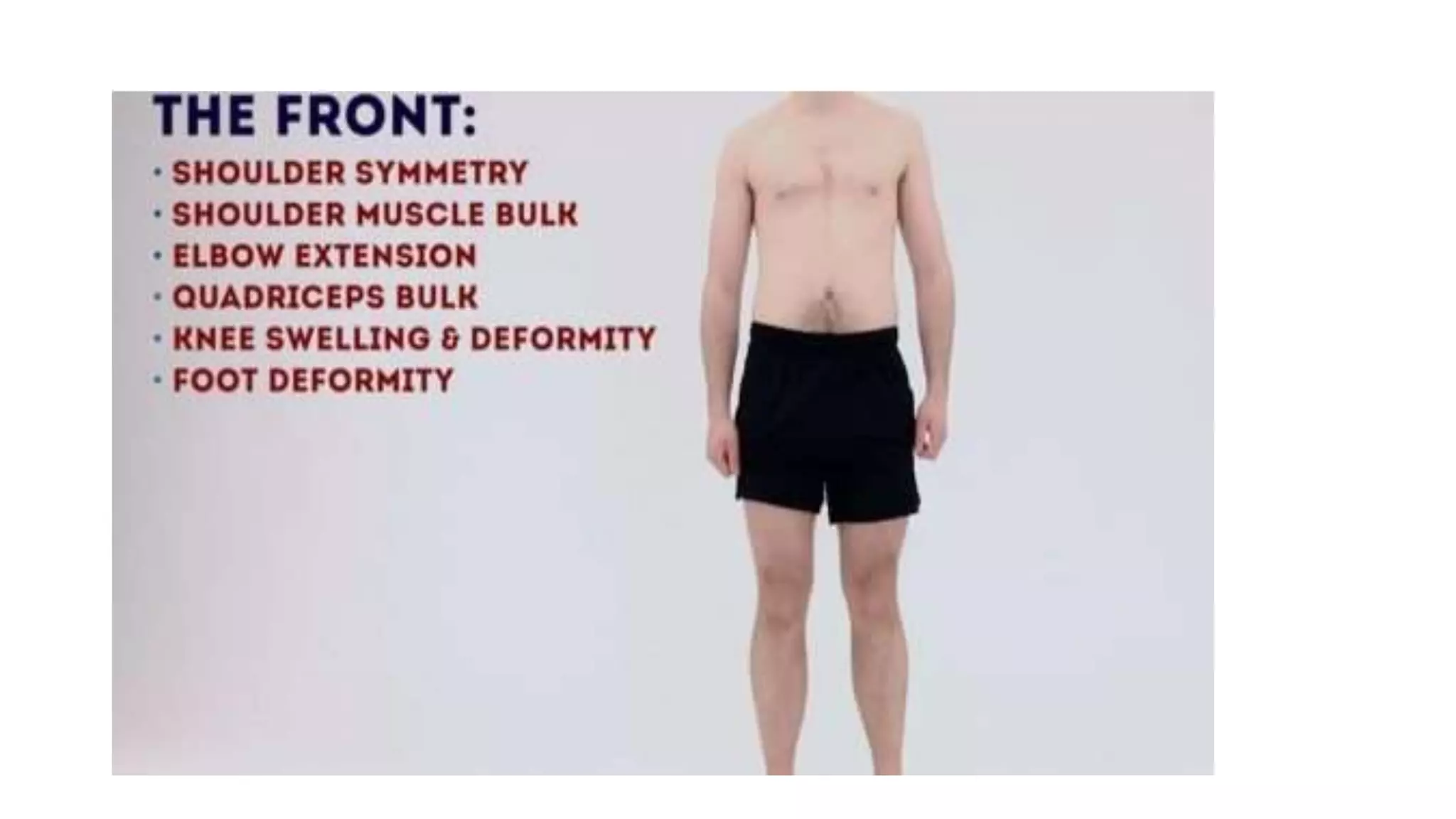
• Anterior inspection
• Posture: asymmetry (facial, shoulder) indicate joint pathology or torticollis,
scoliosis.
• Scars: location of scars may indicate previous history of surgery history or
previous joint trauma.
• Joint swelling: asymmetry in the size of joints that may suggest unilateral
swelling (e.g. effusion, inflammatory arthropathy, septic arthritis).
• Joint erythema: suggestive of active inflammation (e.g. inflammatory
arthropathy or septic arthritis).
• Muscle bulk: asymmetry in upper and lower limb muscle bulk (e.g. deltoids,
pectorals, biceps brachii, quadriceps femoris). Asymmetry may be caused by
disuse atrophy (secondary to joint pathology) or lower motor neuron injury.
• Elbow extension: inspect the patient’s carrying angle which should be between 5-
15°. An increased carrying angle is known as cubitus valgus. Cubitus valgus is
typically associated with previous elbow joint trauma or congenital deformity (e.g.
Turner’s syndrome). A decreased carrying angle is known as cubitus varus or
‘gunstock deformity’. Cubitus varus typically develops after supracondylar fracture
of the humerus.
• Valgus joint deformity: the bone segment distal to the joint is angled laterally.
resulting in the knees ‘knocking’ together.
• Varus joint deformity: the bone segment distal to the joint is angled medially,
resulting in a bowlegged appearance.
• Pelvic tilt: lateral pelvic tilt can be caused by scoliosis, leg length discrepancy or hip
abductor weakness.
• (FFD)Fixed flexion deformity of the toes: subtypes include hammer-toe and
mallet-toe.
• Big toe: note any evidence of lateral (hallux valgus) or medial (hallux varus)
angulation.
Lateral inspection
• Cervical lordosis: hyperlordosis is associated with chronic (e.g. osteoarthritis)
degenerative joint disease.
• Thoracic kyphosis: the normal amount of thoracic kyphosis is between 20-45º.
Hyperkyphosis is associated with Scheuermann’s disease (congenital wedging of
the vertebrae).Gibbus
• Lumbar lordosis: loss of normal lumbar lordosis suggests sacroiliac joint disease
(e.g. ankylosing spondylitis).
• Knee joint hyperextension: causes include ligamentous damage and
hypermobility syndrome.
• Foot arch: inspect for evidence of flat feet (pes planus) or an abnormally raised
foot arch (pes cavus).
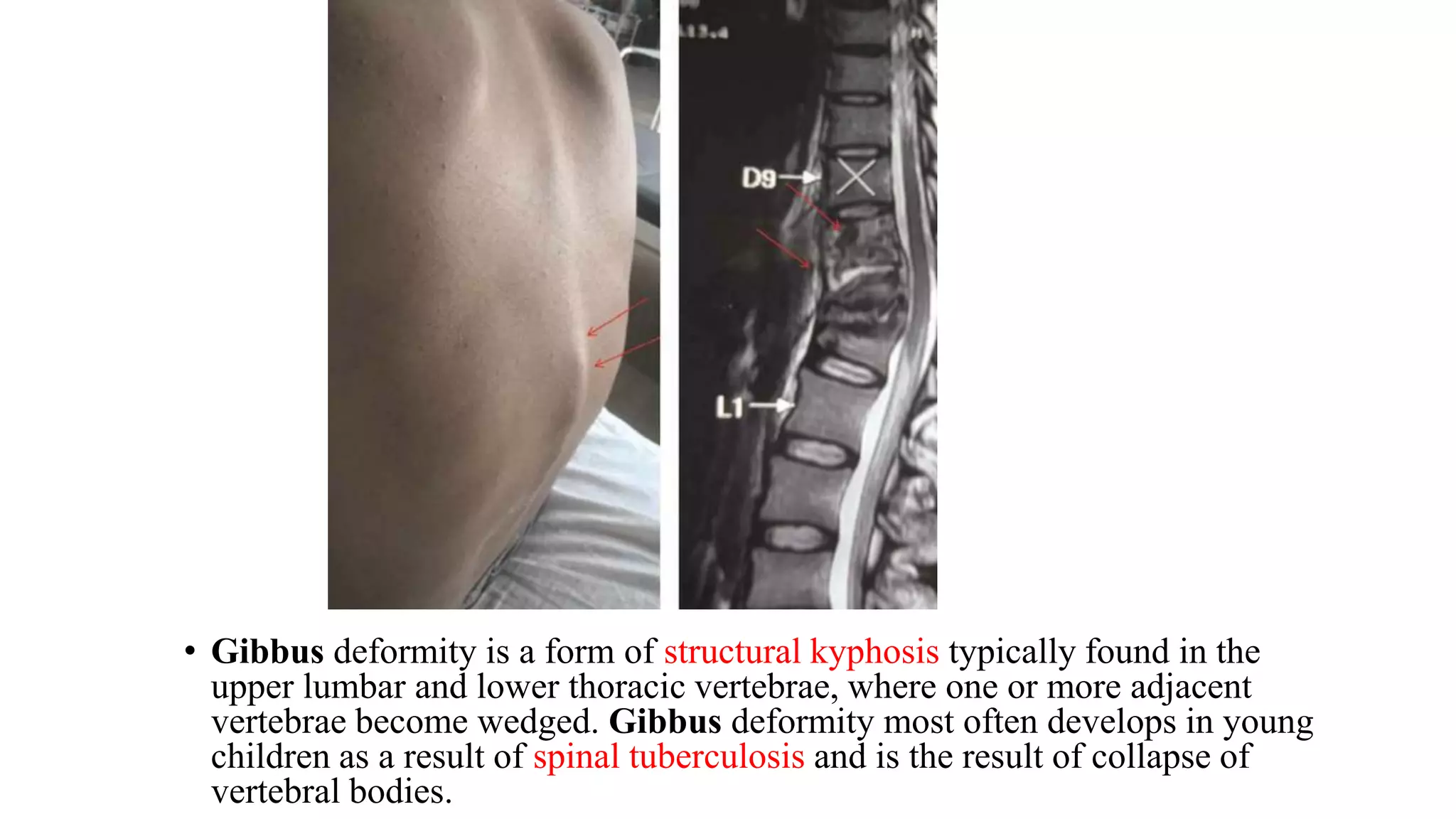
• Gibbus deformity is a form of structural kyphosis typically found in the
upper lumbar and lower thoracic vertebrae, where one or more adjacent
vertebrae become wedged. Gibbus deformity most often develops in young
children as a result of spinal tuberculosis and is the result of collapse of
vertebral bodies.
• Posterior inspection
• Muscle bulk: note any asymmetry in upper and lower limb muscle bulk (e.g.
deltoid, trapezius, triceps brachii, gluteal muscles, hamstrings, calves). Asymmetry
may be caused by disuse atrophy (secondary to joint pathology) or lower motor
neuron injury.
• Spinal alignment: inspect for lateral curvature of the spine suggestive of
scoliosis.
• Iliac crest alignment: misalignment may indicate a leg length discrepancy or hip
abductor weakness.
• Popliteal swellings: possible causes (Baker’s cyst) or (popliteal aneurysm
typically pulsatile).
• Achille’s tendon thickening: associated with Achille’s tendonitis.
• Valgus joint deformity: Genu valgus
• Varus joint deformity: Genu varus angled medially.
In varus deformity of the ankle, the foot is turned inward in relation to the tibia.
Arms
• Ask the patient to:
1. put his hand behind his head.(Restricted range of movement is suggestive of shoulder or elbow
pathology (e.g. osteoarthritis).
•Excessive range of movement indicates hypermobility.)
2. place the elbows by side of the body and bend them 90, turn the palm up and
down.
3. put the arms straight out in front of the body.(Restriction of supination is suggestive of
wrist or elbow pathology (e.g. osteoarthritis).
Inspect the thenar and hypothenar eminences for evidence of muscle wasting.
4. bend the arms up to touch the shoulder
5. make a ‘prayer sign’.
6. clench the fists.(deformities of small joint of hand)
7. touch each finger tip with his thumb.(precision grip)(co-ordination of the small joints
of the fingers and thumbs)
8. Grip strength.). may be reduced due to pain (e.g. swelling of the small joints of the hand) or due
to lower motor neuron lesions (e.g. median nerve damage secondary to carpal tunnel syndrome
9.MCP joint squeeze
Prayer sign
• Palmar erythema
• Nail changes: pitting and loosening (psoriatic
arthritis),fungal nail infection(DF)
• Heberden’s node (OA)
• Bouchard’s node
• Rotational deformity of ring finger
LEGS
• Passive knee flexion Normal ROM: 0-140°
• Passive knee extension
• Passive internal rotation of hip(Normal ROM 40°)
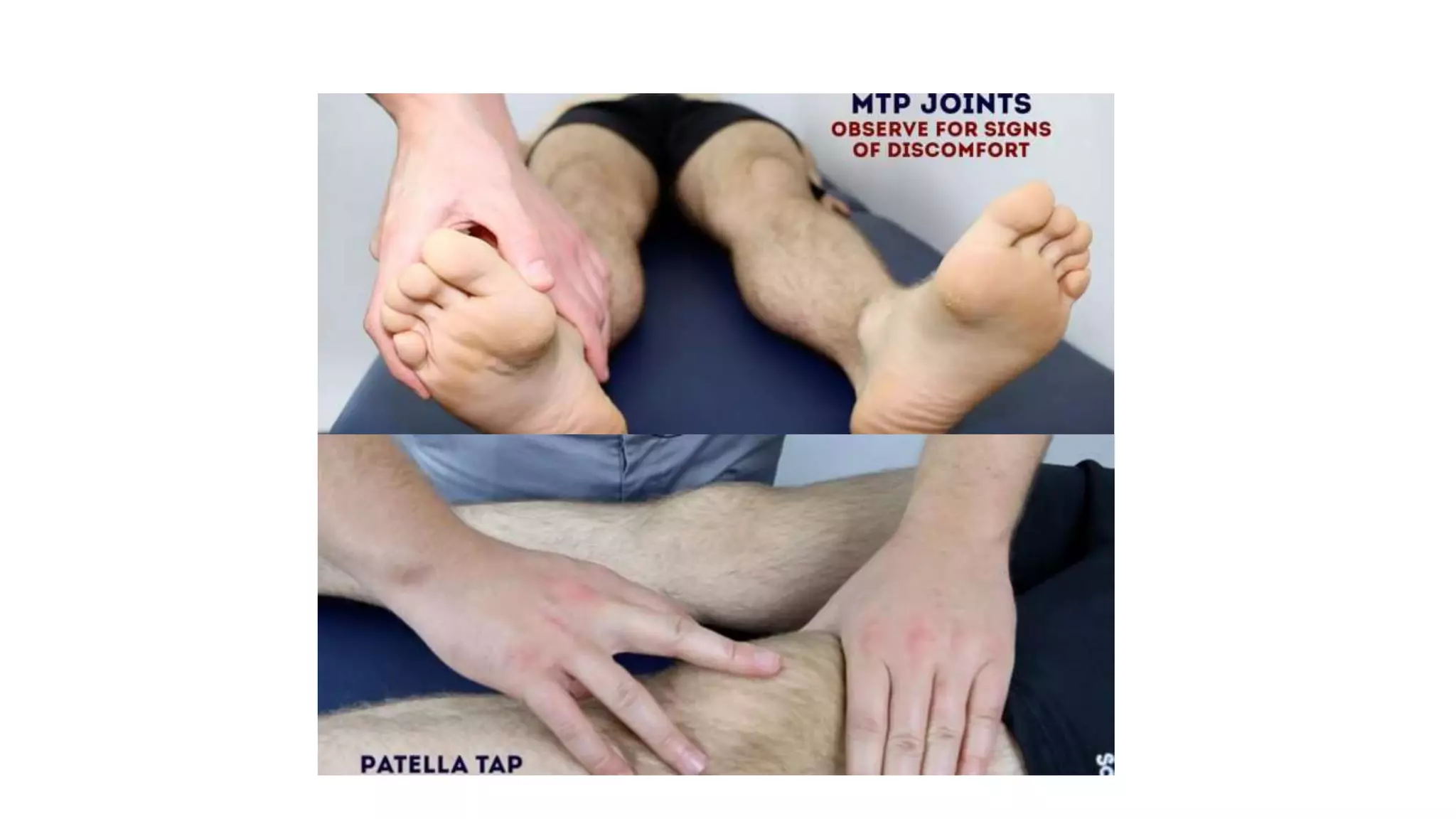
• MTP joint squeeze
• Extra-articular manifestation of musculoskeletal condition
Reactive
arthritis
Assessing hypermobility(Beighton Score)
• Bring the thumb back to touch the
forearm. 1 point each side
• Extend the little
finger>90 1 point each side
• Extend the elbow
>10 1 point each side
• Extend the knee
>10 1 point each side
• Touch the floor with palms of hands
and knee straight 1point.
• A score of 6 or more indicates
hypermobility.
MUSCULOSKELETAL EXAMINATION Y3.pptx

MUSCULOSKELETAL EXAMINATION Y3.pptx

  • 1.
  • 2.
    Basic principles • Observethe general appearance of patient. • Do not cause the patient additional pain. • Compare the limb with opposite side. • Assess active before passive movements. • Use standard terminology when describing position and movement.
  • 3.
    equipment • Measuring tape •Tendon hammer • Goniometer
  • 4.
    GALS SCREEN • Gait,Arm, Leg, Spine • 3 Questions -Do you have any pain or stiffness in your muscle, joint or back? -Can you dress yourself without difficulty? - Can you walk up and down stairs without difficulty?
  • 5.
    Gait • Look- askthe patient to walk for several steps. • Limp is an abnormal gait. • Antalgic gait- short stance phase • Tredelenburg gait- when weight bearing on the affected side, the contralateral hemipelvis falls. • High stepping gait- foot drop due to common peroneal nerve injury.
  • 6.
    Gait cycle 1.Heel-strike: initialcontact of the heel with the floor. 2.Foot flat: weight is transferred onto this leg. 3.Mid-stance: the weight is aligned and balanced on this leg. 4.Heel-off: the heel lifts off the floor as the foot rises but the toes remain in contact with the floor. 5.Toe-off: as the foot continues to rise the toes lift off the floor. 6.Swing: the foot swings forward and comes back into contact with the floor with a heel strike (and the gait cycle repeats).
  • 9.
    • Anterior inspection •Posture: asymmetry (facial, shoulder) indicate joint pathology or torticollis, scoliosis. • Scars: location of scars may indicate previous history of surgery history or previous joint trauma. • Joint swelling: asymmetry in the size of joints that may suggest unilateral swelling (e.g. effusion, inflammatory arthropathy, septic arthritis). • Joint erythema: suggestive of active inflammation (e.g. inflammatory arthropathy or septic arthritis). • Muscle bulk: asymmetry in upper and lower limb muscle bulk (e.g. deltoids, pectorals, biceps brachii, quadriceps femoris). Asymmetry may be caused by disuse atrophy (secondary to joint pathology) or lower motor neuron injury.
  • 10.
    • Elbow extension:inspect the patient’s carrying angle which should be between 5- 15°. An increased carrying angle is known as cubitus valgus. Cubitus valgus is typically associated with previous elbow joint trauma or congenital deformity (e.g. Turner’s syndrome). A decreased carrying angle is known as cubitus varus or ‘gunstock deformity’. Cubitus varus typically develops after supracondylar fracture of the humerus. • Valgus joint deformity: the bone segment distal to the joint is angled laterally. resulting in the knees ‘knocking’ together. • Varus joint deformity: the bone segment distal to the joint is angled medially, resulting in a bowlegged appearance. • Pelvic tilt: lateral pelvic tilt can be caused by scoliosis, leg length discrepancy or hip abductor weakness. • (FFD)Fixed flexion deformity of the toes: subtypes include hammer-toe and mallet-toe. • Big toe: note any evidence of lateral (hallux valgus) or medial (hallux varus) angulation.
  • 17.
    Lateral inspection • Cervicallordosis: hyperlordosis is associated with chronic (e.g. osteoarthritis) degenerative joint disease. • Thoracic kyphosis: the normal amount of thoracic kyphosis is between 20-45º. Hyperkyphosis is associated with Scheuermann’s disease (congenital wedging of the vertebrae).Gibbus • Lumbar lordosis: loss of normal lumbar lordosis suggests sacroiliac joint disease (e.g. ankylosing spondylitis). • Knee joint hyperextension: causes include ligamentous damage and hypermobility syndrome. • Foot arch: inspect for evidence of flat feet (pes planus) or an abnormally raised foot arch (pes cavus).
  • 18.
    • Gibbus deformityis a form of structural kyphosis typically found in the upper lumbar and lower thoracic vertebrae, where one or more adjacent vertebrae become wedged. Gibbus deformity most often develops in young children as a result of spinal tuberculosis and is the result of collapse of vertebral bodies.
  • 21.
    • Posterior inspection •Muscle bulk: note any asymmetry in upper and lower limb muscle bulk (e.g. deltoid, trapezius, triceps brachii, gluteal muscles, hamstrings, calves). Asymmetry may be caused by disuse atrophy (secondary to joint pathology) or lower motor neuron injury. • Spinal alignment: inspect for lateral curvature of the spine suggestive of scoliosis. • Iliac crest alignment: misalignment may indicate a leg length discrepancy or hip abductor weakness. • Popliteal swellings: possible causes (Baker’s cyst) or (popliteal aneurysm typically pulsatile). • Achille’s tendon thickening: associated with Achille’s tendonitis. • Valgus joint deformity: Genu valgus • Varus joint deformity: Genu varus angled medially. In varus deformity of the ankle, the foot is turned inward in relation to the tibia.
  • 23.
    Arms • Ask thepatient to: 1. put his hand behind his head.(Restricted range of movement is suggestive of shoulder or elbow pathology (e.g. osteoarthritis). •Excessive range of movement indicates hypermobility.) 2. place the elbows by side of the body and bend them 90, turn the palm up and down. 3. put the arms straight out in front of the body.(Restriction of supination is suggestive of wrist or elbow pathology (e.g. osteoarthritis). Inspect the thenar and hypothenar eminences for evidence of muscle wasting. 4. bend the arms up to touch the shoulder 5. make a ‘prayer sign’. 6. clench the fists.(deformities of small joint of hand) 7. touch each finger tip with his thumb.(precision grip)(co-ordination of the small joints of the fingers and thumbs) 8. Grip strength.). may be reduced due to pain (e.g. swelling of the small joints of the hand) or due to lower motor neuron lesions (e.g. median nerve damage secondary to carpal tunnel syndrome 9.MCP joint squeeze
  • 26.
  • 29.
    • Palmar erythema •Nail changes: pitting and loosening (psoriatic arthritis),fungal nail infection(DF) • Heberden’s node (OA) • Bouchard’s node
  • 35.
  • 36.
    LEGS • Passive kneeflexion Normal ROM: 0-140° • Passive knee extension • Passive internal rotation of hip(Normal ROM 40°) • MTP joint squeeze
  • 43.
    • Extra-articular manifestationof musculoskeletal condition
  • 46.
  • 47.
    Assessing hypermobility(Beighton Score) •Bring the thumb back to touch the forearm. 1 point each side • Extend the little finger>90 1 point each side • Extend the elbow >10 1 point each side • Extend the knee >10 1 point each side • Touch the floor with palms of hands and knee straight 1point. • A score of 6 or more indicates hypermobility.