.
ADULT HEALTH NURSING POST GRADUATE PROGRAM
ADULT HEALTH NURSING ASSESSMENT SEMINAR PRESENTATION
TITLE: ASSESSMENT OF MUSCLOSKELETAL SYSTEM
PR By: MESFIN SHIFARA ID NO: 185/15
SUB TO : BIKILA (Ass’t Professor)
JUNE, 2023
ETHIOPIA ,FITCHE
1
PRESENTATION OUTLINE
♣ Objective
♣ Anatomy and physiology overview of Musculoskeletal
system
♣ Assessment of MSS and techniques of examination
♣ Summary
♣ References
2
LEARNING OBJECTIVES
♣ At end of this session the learner will be able to:
♠ discus the important aspects of history taking in relation to
musculoskeletal disorder
♠ Demonstrate basic skills of physical examination of the
musculoskeletal system
♠ Interpretation of physical findings related to the MSS
disorder .
3
INTRODUCTION
Anatomy and physiology overview
♣ The musculoskeletal system includes:
♠ Bones
♠Joints
♠Muscles
♠Tendons
♠ligaments,
♠Bursae of the body.
4
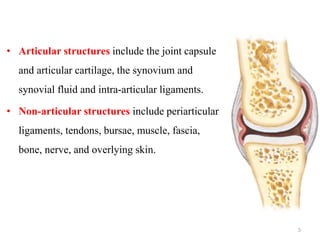
• Articular structures include the joint capsule
and articular cartilage, the synovium and
synovial fluid and intra-articular ligaments.
• Non-articular structures include periarticular
ligaments, tendons, bursae, muscle, fascia,
bone, nerve, and overlying skin.
5
♠ The ends of long bones are covered at the joints by
articular cartilage, which is tough, elastic, avascular
tissue
♠ Long bones are designed for weight bearing and
movement.
♠ Flat bones are important sites of hematopoiesis and
frequently protect vital organs
6
♣ Bone is composed of :
♠ Cells
♠ protein matrix,
♠ mineral deposits.
♣ The cells are three basic types:
♠ Osteoblasts
♠ osteoclasts
♠ osteocytes
7
8
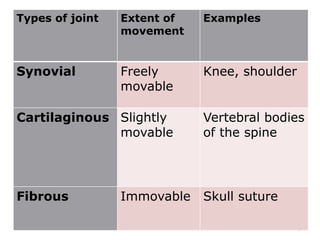
Types of joint Extent of
movement
Examples
Synovial Freely
movable
Knee, shoulder
Cartilaginous Slightly
movable
Vertebral bodies
of the spine
Fibrous Immovable Skull suture
LIGAMENTS
♠ Bands of connective tissue that connect bone to bone
♠ Either limit or enhance movement
♠ Provide joint stability
♠ Enhance joint strength
TENDONS
♠ Fibrous connective tissue bands that connect bone to
muscles
♠ Enable bones to move when muscles contract
9
MUSCLES
♣ Skeletal (voluntary)
♠ Allows voluntary movement
♣ Smooth (involuntary)
♠ Muscle movement controlled by internal mechanism
♠ e.g., muscles in bladder wall and GI system
♣ Cardiac (involuntary)
♠ Found in heart
10
FUNCTION OF MUSCULOSKELETAL SYSTEM
♠Support body structure
♠Protection
♠Mobility
♠ Hold the bones together
♠ Blood cell production and reservoir
♠Minerals reservoir
11
TERMS USED TO DESCRIBE JOINT MOVEMENT
♠ Flexion – bend that decrease angle between bones
♠ Extension – straightening a limb to increase the angle of
joint
♠ Abduction – moving a limb away from the body’s midline
♠ Adduction – moving a limb towards the body or beyond it
♠ Internal rotation – turning a body part towards midline
12
♠ External rotation – turning a body part away from
midline
♠ Circumduction – circular movement of a body part
♠ Supination – turning the palm upwards
♠ Pronation – turning the palm downwards
♠ Inversion – turning the foot inward
♠ Eversion – turning the foot outward
13
CHANGES IN OLDER ADULT
♣ Musculoskeletal changes can be due to:
♠ Aging process
♠ Decreased activity
♠ Lifestyle factors
♣ Joint and disk cartilage dehydrates causing loss of
flexibility contributes to degenerative joint disease
(osteoarthritis); joints stiffen, lose ROM
14
CHANGES IN OLDER ADULT CONT…
♠ Cause stooped posture, changing center of gravity
♠ Elderly at greater risk for falls
♠ Endocrine changes cause skeletal muscle atrophy
♠ Muscle tone decreases
15
♠ When assessing the MSS keep in mind that injury or
inflammation of any part of the system can cause pain,
stiffness, or alteration in motor strength or mobility.
♠ MSS assessment is conducted from head to toe with
inspection and palpation
♠ Assessment of MSS done firstly when the client walks,
moves in bed or performs any type of physical activity
16
ASSESSMENT OF MUSCULOSKELETAL SYSTEM
ASSESSMENT OF MSS CONT…
♠ Biographic data
♠ Chief complaint
♠ HPI
♠ Past health history- these includes TB, polio, DM, soft
tissue infection, & neuromuscular disabilities.
♠ Medications- regarding prescription, herbal products &
nutritional supplements.
17
cont.…
♠ Women should be question about their menstrual hx. , use
of hormone therapy, Calcium and vitamin D supplements
are important for postmenopausal women.
♠ Surgery or other treatments- past hospitalizations from
musculoskeletal problems.
♠ The age and sex of the patient can be significant in
understanding the nature of the disorder and planning the
treatment.
18
SPECIFIC QUESTIONS ABOUT THE MSS.
♣ Should include queries and elaborations on the
following aspects:
♠Pain
♠Stiffness
♠ Swelling
♠Buckling or the locking of a joint
♠Deformity
♠History of trauma including mechanism of injury
19
♣ If a patient complains of a thigh pain for example, the
following questions should be raised and need to be
understood in detail:
♠ The character of the pain
♠ Its specific location
♠ The frequency in which the pain occurs
♠ The duration and variation of the pain if any
♠ Aggravating or relieving factors
♠ Distribution or radiation of the pain to other locations
♠ Intensity and course should be determined.
20
PHYSICAL EXAMINATION OF MSS
♣ IMPORTANT AREAS OF MAJOR JOINTS
♠ Inspection for joint symmetry, alignment and bony deformities
♠ Inspection and palpation of surrounding tissues for skin changes,
nodules, muscle atrophy, crepitus
♠ ROM and maneuvers to test joint function and stability, integrity of
ligaments, tendons, bursae, especially if pain or trauma
♠ Assessment of inflammation or arthritis, especially swelling,
warmth, tenderness, redness.
21
…
♠ During the interview you have evaluated the patient’s
ability to carry out normal activities of daily living.
♠ Keep these abilities in mind during your physical
examination.
22
TECHNIQUES OF ASSESSMENT
♠ These are summarized in the musculoskeletal examination as:-
♠ Look, Feel, Move, Measure and the Compare.
1. OBSERVATION
♠ Examination of the MSS should begin by observing the general
status of the patient on presentation.
E.g. Abnormal standing gait due to apparent shortening of the right
lower limb. by general inspection at the first contact of the patient.
23
PART OF THE GENERAL OBSERVATION
♠ Look for obvious deformities
♠ A general description of the skin, including texture, scars
and pigmentation
♠ Overall gait pattern of the patient
♠ Pattern of movements of the extremities
24
Cont….
♠ Is there a swelling?
If so, is the swelling diffuse or localized?
♠ Is there bruising?
If so, it might suggest trauma with a point of impact.
♠ Is there any other discoloration or edema?
This might occur as a localized response to trauma or
infection.
♠ Is there muscle wasting?
This usually occurs as a result from denervation of the
affected muscle.
25
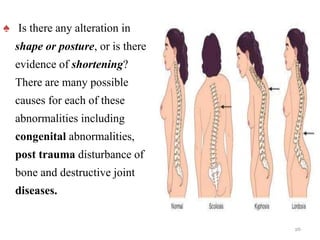
♠ Is there any alteration in
shape or posture, or is there
evidence of shortening?
There are many possible
causes for each of these
abnormalities including
congenital abnormalities,
post trauma disturbance of
bone and destructive joint
diseases.
26
2. FEEL:
♣ Important points which should be noted during palpation include the
following:
1. Is the joint warm? If the temperature is found to be increased,
assess if it is diffuse or localized.
2. Is there tenderness?
If yes, note if it is diffuse or localized. When tenderness is diffuse,
the cause is likely to be an inflammatory process.
The common cause for localized tenderness is local trauma.
27
3. MOVE
♣ On examination for a joint movement, assess for:
♠ Any limitation in range of the normal joint motion
♣ Evidence of movements in an abnormal plane
There are two forms of joint movement which need to be checked:
1. Active movement, where the patient moves the joint actively
2. Passive movement, where the examiner moves the joint for the
test.
28
4. MEASUREMENT
♠ Measurement is an important part of musculoskeletal examination.
♠ It helps to assess for any difference in circumference or
length of a limb.
♠ Detecting a difference in circumference of a limb from a
reference point may indicate a decrease in muscle
volume (atrophy) or a swelling of an area
29
Cont…
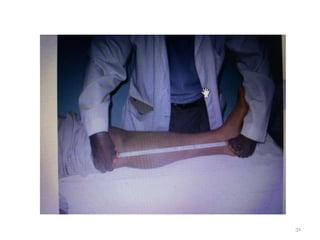
♣ For the lower limb for example, the following lengths can
be measured:
ƒ Real Length: This is a measure from two prominent
points of a single bone.
♠ It indicates that there is a real shortening of that specific
bone due to fracture and/or displacement.
E.g. tibial measurement (condyle and medialmalleolus)
30
31
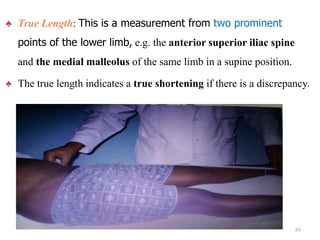
♠ True Length: This is a measurement from two prominent
points of the lower limb, e.g. the anterior superior iliac spine
and the medial malleolus of the same limb in a supine position.
♠ The true length indicates a true shortening if there is a discrepancy.
32
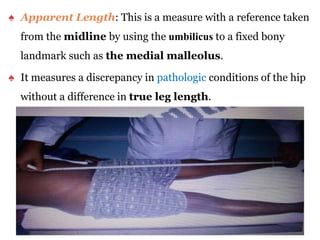
♠ Apparent Length: This is a measure with a reference taken
from the midline by using the umbilicus to a fixed bony
landmark such as the medial malleolus.
♠ It measures a discrepancy in pathologic conditions of the hip
without a difference in true leg length.
33
N.B: Any examination of a limb or a joint has always to be
compared to that of the opposite side of the limb.
► NECESSARY EQUIPMENTS
1. Glove
2. Measuring tape
3. Percussion hummer
4. Other physical examination equipments
34
ASSESSMENT OF THE JOINTS
♠ Using the techniques inspection and palpation, examine
the individual joint or groups of joints for
♠ Range of motion
♠ Limitation of motion as in arthritis, fibrosis, bony fixation
♠ Any sign of inflammation; swelling, tenderness, local
hotness, redness of the skin, deformities, symmetry of the
involvement.
35
ASSESSMENT OF MUSCLE
♣ Atrophy of muscle is caused by
♠ Motor neuron disease
♠ Rheumatoid arthritis
♠ Protein-energy malnutrition
36
MUSCLE TONE
♣ Muscle tone is defined as a slight residual tension
maintained by a normal muscles with an intact nerve supply
when it relaxed voluntary.
♣ Technique
♠ Ask the patient to relax.
♠ Take one hand with your hand, while supporting the elbow,
flex and extend the patients finger, wrist, and elbow, and put
the shoulder through moderate range motion.
37
MUSCLE TONE…
♠ Then combine this action in to a single smooth movement
and note the degree of resistance.
♠ Normally, the hand moves back and forth freely but is not
completely floppy(flacid).
♠ Marked floppiness indicates hypo tonic muscle (flaccid
paralysis)
38
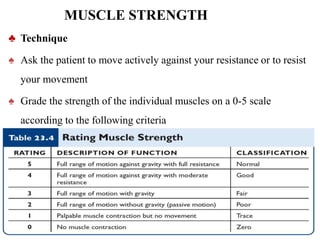
MUSCLE STRENGTH
♣ Technique
♠ Ask the patient to move actively against your resistance or to resist
your movement
♠ Grade the strength of the individual muscles on a 0-5 scale
according to the following criteria
39
STRENGTH…
♣ Weakness (paresis) or plegia (paralysis) may be caused by;
♠ Peripheral or central nerve damage
♠ Musculoskeletal problems
♠ Problems of neuron transmission
 Symmetrical weakness of the proximal muscles suggests a
myopathy (disorder of the muscles).
 Symmetrical weakness of the distal muscles suggests a
polyneuropathy (disorder of peripheral nerves)
40
RANGE OF MOTION
♣ Start by asking the patient to move through an active ROM (joints
moved by patient).
♣ Proceed to passive ROM (joints moved by examiner) if active range
of motion is abnormal.
Active
♣ Ask the patient to move each joint through a full range of motion.
♣ Note the degree and type (pain, weakness, etc.) of any limitations.
♣ Always compare with the other side.
♣ Proceed to passive range of motion if abnormalities are found.
41
Passive…
♠ Ask the patient to relax and allow you to support the
extremity to be examined.
♠ Gently move each joint through its full range of motion.
♠ Note the degree and type (pain) of any limitation.
♠ Always compare with the other side.
42
SPECIFIC JOINTS TO BE EXAMINED
♣ Fingers - flexion/extension; abduction/adduction
♣ Thumb - flexion/extension; abduction/adduction
♣ Wrist - flexion/extension; radial/ulnar deviation
♣ Forearm - pronation/supination (function of BOTH elbow
and wrist)
♣ Elbow - flexion/extension
♣ Shoulder - flexion/extension; internal/external
rotation:abdactio/adduction .
43
JOINTS …
♠ Hip - flexion/extension; abduction/adduction;
internal/external rotation
♠ Knee - flexion/extension
♠ Ankle - flexion (plantar flexion)/extension (dorsiflexion)
♠ Foot - inversion/ eversion
♠ Toes - flexion/extension
♠ Spine - flexion/extension; right/left bending; right/left
rotation
44
ASSESSMENT OF THE BONE
♠ Inspect any deformities
♠ mal-alignment
♠ fracture.
♠ Palpate for tenderness
45
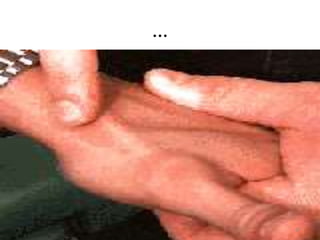
SPECIAL TESTS …
♣ Upper Extremities
♠ Snuffbox Tenderness (Scaphoid)
1. Identify the "anatomic snuffbox" between the extensor
pollicis longus and brevis (extending the thumb makes
these structures more prominent).
2. Press firmly straight down with your index finger or thumb.
3. Any tenderness in this area is highly suggestive of
scaphoid fracture
46
…
47
DROPARM TEST (ROTATOR CUFF)
♠ Start with the patient's arm abducted 90 degrees.
♠ Ask the patient to slowly lower the arm.
♣ If the rotator cuff (especially the supraspinatus) is torn, the
patient will be unable to lower the arm slowly and smoothly.
Impingement Sign
♠ Start with the patient's arm relaxed and the shoulder in neutral
rotation
♠ Abduct the arm to 90 degrees.
♠ Significant shoulder pain as the arm is raised suggests an
impingement of the rotator cuff against the acromion.
48
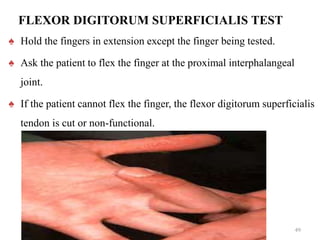
FLEXOR DIGITORUM SUPERFICIALIS TEST
♠ Hold the fingers in extension except the finger being tested.
♠ Ask the patient to flex the finger at the proximal interphalangeal
joint.
♠ If the patient cannot flex the finger, the flexor digitorum superficialis
tendon is cut or non-functional.
49
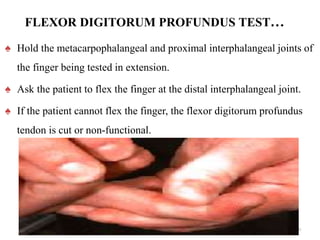
FLEXOR DIGITORUM PROFUNDUS TEST…
♠ Hold the metacarpophalangeal and proximal interphalangeal joints of
the finger being tested in extension.
♠ Ask the patient to flex the finger at the distal interphalangeal joint.
♠ If the patient cannot flex the finger, the flexor digitorum profundus
tendon is cut or non-functional.
50
VASCULAR AND NEUROLOGIC TESTS OF JOINTS
♣ Allen Test (Radial/ Ulnar Arteries)
♠ Ask the patient to make a tight fist.
♠ Compress both the ulnar and radial arteries to stop blood flowing to
the hand.
♠ Ask the patient to open the hand.
♠ Release pressure on the ulnar side
♠ The hand should "pink" up in a few seconds unless the ulnar
artery is occluded.
♠ Repeat the process for the radial artery as indicated.
51
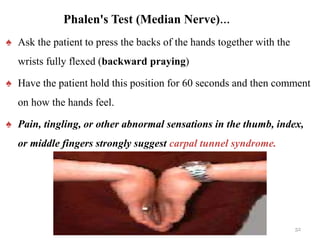
Phalen's Test (Median Nerve)…
♠ Ask the patient to press the backs of the hands together with the
wrists fully flexed (backward praying)
♠ Have the patient hold this position for 60 seconds and then comment
on how the hands feel.
♠ Pain, tingling, or other abnormal sensations in the thumb, index,
or middle fingers strongly suggest carpal tunnel syndrome.
52
Tinel's Sign (Median Nerve) …
♠ Use your middle finger or a reflex hammer to tap over
the carpal tunnel
♠ Pain, tingling, or electric sensations strongly suggest
carpal tunnel syndrome.
53
LOWER EXTREMITIES
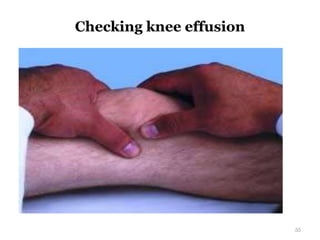
♣ Ballotte Patella (Major Knee Effusion)
♠ Ask the patient to lie supine on the exam table with leg
muscles relaxed.
♠ Press the patella downward and quickly release it
♠ If the patella visibly rebounds, a large knee effusion
(excess fluid in the knee) is present.
54
Checking knee effusion
55
BACK
♣ Straight Leg Raising (L5/S1 Nerve Roots)
♠ Ask the patient to lie supine on the exam table with knees straight.
♠ Grasp the leg near the heel and raise the leg slowly towards the
ceiling.
♠ Pain in L5 or S1 distribution suggests nerve root compression or
tension (radicular pain).
♠ Dorsiflex the foot while maintaining the raised position of the leg.
♠ Increased pain strengthens the likelihood of a nerve root problem.
♠ Repeat the process with the opposite leg.
♠ Increased pain on the opposite side indicates that a nerve root
problem is almost certain. 56
BACK
♠ FABER Test (Hips/Sacroiliac Joints)
♠ FABER stands for Flexion, Abduction, and External Rotation of
the hip.
♠ This test is used to distinguish hip or sacroiliac joint pathology
from spine problems.
57
BACK…
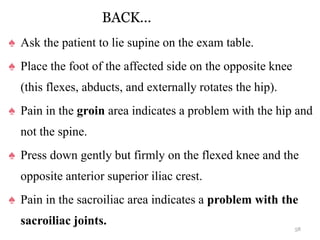
♠ Ask the patient to lie supine on the exam table.
♠ Place the foot of the affected side on the opposite knee
(this flexes, abducts, and externally rotates the hip).
♠ Pain in the groin area indicates a problem with the hip and
not the spine.
♠ Press down gently but firmly on the flexed knee and the
opposite anterior superior iliac crest.
♠ Pain in the sacroiliac area indicates a problem with the
sacroiliac joints.
58
SUMMERY
♠ Musculoskeletal System is a system consists skeleton,
skeleton muscles ,tendons and ligaments.
♠ The muscloskeletal system used for protection, produces
blood cells ,stores minerals and facilitate movement.
♠ From four techniques of examinations inspection and
palpation are mostly used to assess muscloskeletal system
59
REFERENCES
1. J. Gordon Betts, Anatomy & Physiology Tyler junior
college. http://cnx.Org/content/col11496/1.8
2. Jarvis, C. (2020) ‘Physical Examination & Health
Assessment With Ann Eckhardt , PhD , RN’.
3. Bates (2007) , An Overview of Physical Examination and
History Taking Physical Examination and History
Taking The
4. Gashaw Messele, Mensur Osman, Zeki Abdurahman
Physical Diagnosis LECTURE NOTES For Health
Science Students
60
61

Mesfin.SH. Assess't Presentstion final.pptx

  • 1.
    . ADULT HEALTH NURSINGPOST GRADUATE PROGRAM ADULT HEALTH NURSING ASSESSMENT SEMINAR PRESENTATION TITLE: ASSESSMENT OF MUSCLOSKELETAL SYSTEM PR By: MESFIN SHIFARA ID NO: 185/15 SUB TO : BIKILA (Ass’t Professor) JUNE, 2023 ETHIOPIA ,FITCHE 1
  • 2.
    PRESENTATION OUTLINE ♣ Objective ♣Anatomy and physiology overview of Musculoskeletal system ♣ Assessment of MSS and techniques of examination ♣ Summary ♣ References 2
  • 3.
    LEARNING OBJECTIVES ♣ Atend of this session the learner will be able to: ♠ discus the important aspects of history taking in relation to musculoskeletal disorder ♠ Demonstrate basic skills of physical examination of the musculoskeletal system ♠ Interpretation of physical findings related to the MSS disorder . 3
  • 4.
    INTRODUCTION Anatomy and physiologyoverview ♣ The musculoskeletal system includes: ♠ Bones ♠Joints ♠Muscles ♠Tendons ♠ligaments, ♠Bursae of the body. 4
  • 5.
    • Articular structuresinclude the joint capsule and articular cartilage, the synovium and synovial fluid and intra-articular ligaments. • Non-articular structures include periarticular ligaments, tendons, bursae, muscle, fascia, bone, nerve, and overlying skin. 5
  • 6.
    ♠ The endsof long bones are covered at the joints by articular cartilage, which is tough, elastic, avascular tissue ♠ Long bones are designed for weight bearing and movement. ♠ Flat bones are important sites of hematopoiesis and frequently protect vital organs 6
  • 7.
    ♣ Bone iscomposed of : ♠ Cells ♠ protein matrix, ♠ mineral deposits. ♣ The cells are three basic types: ♠ Osteoblasts ♠ osteoclasts ♠ osteocytes 7
  • 8.
    8 Types of jointExtent of movement Examples Synovial Freely movable Knee, shoulder Cartilaginous Slightly movable Vertebral bodies of the spine Fibrous Immovable Skull suture
  • 9.
    LIGAMENTS ♠ Bands ofconnective tissue that connect bone to bone ♠ Either limit or enhance movement ♠ Provide joint stability ♠ Enhance joint strength TENDONS ♠ Fibrous connective tissue bands that connect bone to muscles ♠ Enable bones to move when muscles contract 9
  • 10.
    MUSCLES ♣ Skeletal (voluntary) ♠Allows voluntary movement ♣ Smooth (involuntary) ♠ Muscle movement controlled by internal mechanism ♠ e.g., muscles in bladder wall and GI system ♣ Cardiac (involuntary) ♠ Found in heart 10
  • 11.
    FUNCTION OF MUSCULOSKELETALSYSTEM ♠Support body structure ♠Protection ♠Mobility ♠ Hold the bones together ♠ Blood cell production and reservoir ♠Minerals reservoir 11
  • 12.
    TERMS USED TODESCRIBE JOINT MOVEMENT ♠ Flexion – bend that decrease angle between bones ♠ Extension – straightening a limb to increase the angle of joint ♠ Abduction – moving a limb away from the body’s midline ♠ Adduction – moving a limb towards the body or beyond it ♠ Internal rotation – turning a body part towards midline 12
  • 13.
    ♠ External rotation– turning a body part away from midline ♠ Circumduction – circular movement of a body part ♠ Supination – turning the palm upwards ♠ Pronation – turning the palm downwards ♠ Inversion – turning the foot inward ♠ Eversion – turning the foot outward 13
  • 14.
    CHANGES IN OLDERADULT ♣ Musculoskeletal changes can be due to: ♠ Aging process ♠ Decreased activity ♠ Lifestyle factors ♣ Joint and disk cartilage dehydrates causing loss of flexibility contributes to degenerative joint disease (osteoarthritis); joints stiffen, lose ROM 14
  • 15.
    CHANGES IN OLDERADULT CONT… ♠ Cause stooped posture, changing center of gravity ♠ Elderly at greater risk for falls ♠ Endocrine changes cause skeletal muscle atrophy ♠ Muscle tone decreases 15
  • 16.
    ♠ When assessingthe MSS keep in mind that injury or inflammation of any part of the system can cause pain, stiffness, or alteration in motor strength or mobility. ♠ MSS assessment is conducted from head to toe with inspection and palpation ♠ Assessment of MSS done firstly when the client walks, moves in bed or performs any type of physical activity 16 ASSESSMENT OF MUSCULOSKELETAL SYSTEM
  • 17.
    ASSESSMENT OF MSSCONT… ♠ Biographic data ♠ Chief complaint ♠ HPI ♠ Past health history- these includes TB, polio, DM, soft tissue infection, & neuromuscular disabilities. ♠ Medications- regarding prescription, herbal products & nutritional supplements. 17
  • 18.
    cont.… ♠ Women shouldbe question about their menstrual hx. , use of hormone therapy, Calcium and vitamin D supplements are important for postmenopausal women. ♠ Surgery or other treatments- past hospitalizations from musculoskeletal problems. ♠ The age and sex of the patient can be significant in understanding the nature of the disorder and planning the treatment. 18
  • 19.
    SPECIFIC QUESTIONS ABOUTTHE MSS. ♣ Should include queries and elaborations on the following aspects: ♠Pain ♠Stiffness ♠ Swelling ♠Buckling or the locking of a joint ♠Deformity ♠History of trauma including mechanism of injury 19
  • 20.
    ♣ If apatient complains of a thigh pain for example, the following questions should be raised and need to be understood in detail: ♠ The character of the pain ♠ Its specific location ♠ The frequency in which the pain occurs ♠ The duration and variation of the pain if any ♠ Aggravating or relieving factors ♠ Distribution or radiation of the pain to other locations ♠ Intensity and course should be determined. 20
  • 21.
    PHYSICAL EXAMINATION OFMSS ♣ IMPORTANT AREAS OF MAJOR JOINTS ♠ Inspection for joint symmetry, alignment and bony deformities ♠ Inspection and palpation of surrounding tissues for skin changes, nodules, muscle atrophy, crepitus ♠ ROM and maneuvers to test joint function and stability, integrity of ligaments, tendons, bursae, especially if pain or trauma ♠ Assessment of inflammation or arthritis, especially swelling, warmth, tenderness, redness. 21
  • 22.
    … ♠ During theinterview you have evaluated the patient’s ability to carry out normal activities of daily living. ♠ Keep these abilities in mind during your physical examination. 22
  • 23.
    TECHNIQUES OF ASSESSMENT ♠These are summarized in the musculoskeletal examination as:- ♠ Look, Feel, Move, Measure and the Compare. 1. OBSERVATION ♠ Examination of the MSS should begin by observing the general status of the patient on presentation. E.g. Abnormal standing gait due to apparent shortening of the right lower limb. by general inspection at the first contact of the patient. 23
  • 24.
    PART OF THEGENERAL OBSERVATION ♠ Look for obvious deformities ♠ A general description of the skin, including texture, scars and pigmentation ♠ Overall gait pattern of the patient ♠ Pattern of movements of the extremities 24
  • 25.
    Cont…. ♠ Is therea swelling? If so, is the swelling diffuse or localized? ♠ Is there bruising? If so, it might suggest trauma with a point of impact. ♠ Is there any other discoloration or edema? This might occur as a localized response to trauma or infection. ♠ Is there muscle wasting? This usually occurs as a result from denervation of the affected muscle. 25
  • 26.
    ♠ Is thereany alteration in shape or posture, or is there evidence of shortening? There are many possible causes for each of these abnormalities including congenital abnormalities, post trauma disturbance of bone and destructive joint diseases. 26
  • 27.
    2. FEEL: ♣ Importantpoints which should be noted during palpation include the following: 1. Is the joint warm? If the temperature is found to be increased, assess if it is diffuse or localized. 2. Is there tenderness? If yes, note if it is diffuse or localized. When tenderness is diffuse, the cause is likely to be an inflammatory process. The common cause for localized tenderness is local trauma. 27
  • 28.
    3. MOVE ♣ Onexamination for a joint movement, assess for: ♠ Any limitation in range of the normal joint motion ♣ Evidence of movements in an abnormal plane There are two forms of joint movement which need to be checked: 1. Active movement, where the patient moves the joint actively 2. Passive movement, where the examiner moves the joint for the test. 28
  • 29.
    4. MEASUREMENT ♠ Measurementis an important part of musculoskeletal examination. ♠ It helps to assess for any difference in circumference or length of a limb. ♠ Detecting a difference in circumference of a limb from a reference point may indicate a decrease in muscle volume (atrophy) or a swelling of an area 29
  • 30.
    Cont… ♣ For thelower limb for example, the following lengths can be measured: ƒ Real Length: This is a measure from two prominent points of a single bone. ♠ It indicates that there is a real shortening of that specific bone due to fracture and/or displacement. E.g. tibial measurement (condyle and medialmalleolus) 30
  • 31.
  • 32.
    ♠ True Length:This is a measurement from two prominent points of the lower limb, e.g. the anterior superior iliac spine and the medial malleolus of the same limb in a supine position. ♠ The true length indicates a true shortening if there is a discrepancy. 32
  • 33.
    ♠ Apparent Length:This is a measure with a reference taken from the midline by using the umbilicus to a fixed bony landmark such as the medial malleolus. ♠ It measures a discrepancy in pathologic conditions of the hip without a difference in true leg length. 33
  • 34.
    N.B: Any examinationof a limb or a joint has always to be compared to that of the opposite side of the limb. ► NECESSARY EQUIPMENTS 1. Glove 2. Measuring tape 3. Percussion hummer 4. Other physical examination equipments 34
  • 35.
    ASSESSMENT OF THEJOINTS ♠ Using the techniques inspection and palpation, examine the individual joint or groups of joints for ♠ Range of motion ♠ Limitation of motion as in arthritis, fibrosis, bony fixation ♠ Any sign of inflammation; swelling, tenderness, local hotness, redness of the skin, deformities, symmetry of the involvement. 35
  • 36.
    ASSESSMENT OF MUSCLE ♣Atrophy of muscle is caused by ♠ Motor neuron disease ♠ Rheumatoid arthritis ♠ Protein-energy malnutrition 36
  • 37.
    MUSCLE TONE ♣ Muscletone is defined as a slight residual tension maintained by a normal muscles with an intact nerve supply when it relaxed voluntary. ♣ Technique ♠ Ask the patient to relax. ♠ Take one hand with your hand, while supporting the elbow, flex and extend the patients finger, wrist, and elbow, and put the shoulder through moderate range motion. 37
  • 38.
    MUSCLE TONE… ♠ Thencombine this action in to a single smooth movement and note the degree of resistance. ♠ Normally, the hand moves back and forth freely but is not completely floppy(flacid). ♠ Marked floppiness indicates hypo tonic muscle (flaccid paralysis) 38
  • 39.
    MUSCLE STRENGTH ♣ Technique ♠Ask the patient to move actively against your resistance or to resist your movement ♠ Grade the strength of the individual muscles on a 0-5 scale according to the following criteria 39
  • 40.
    STRENGTH… ♣ Weakness (paresis)or plegia (paralysis) may be caused by; ♠ Peripheral or central nerve damage ♠ Musculoskeletal problems ♠ Problems of neuron transmission  Symmetrical weakness of the proximal muscles suggests a myopathy (disorder of the muscles).  Symmetrical weakness of the distal muscles suggests a polyneuropathy (disorder of peripheral nerves) 40
  • 41.
    RANGE OF MOTION ♣Start by asking the patient to move through an active ROM (joints moved by patient). ♣ Proceed to passive ROM (joints moved by examiner) if active range of motion is abnormal. Active ♣ Ask the patient to move each joint through a full range of motion. ♣ Note the degree and type (pain, weakness, etc.) of any limitations. ♣ Always compare with the other side. ♣ Proceed to passive range of motion if abnormalities are found. 41
  • 42.
    Passive… ♠ Ask thepatient to relax and allow you to support the extremity to be examined. ♠ Gently move each joint through its full range of motion. ♠ Note the degree and type (pain) of any limitation. ♠ Always compare with the other side. 42
  • 43.
    SPECIFIC JOINTS TOBE EXAMINED ♣ Fingers - flexion/extension; abduction/adduction ♣ Thumb - flexion/extension; abduction/adduction ♣ Wrist - flexion/extension; radial/ulnar deviation ♣ Forearm - pronation/supination (function of BOTH elbow and wrist) ♣ Elbow - flexion/extension ♣ Shoulder - flexion/extension; internal/external rotation:abdactio/adduction . 43
  • 44.
    JOINTS … ♠ Hip- flexion/extension; abduction/adduction; internal/external rotation ♠ Knee - flexion/extension ♠ Ankle - flexion (plantar flexion)/extension (dorsiflexion) ♠ Foot - inversion/ eversion ♠ Toes - flexion/extension ♠ Spine - flexion/extension; right/left bending; right/left rotation 44
  • 45.
    ASSESSMENT OF THEBONE ♠ Inspect any deformities ♠ mal-alignment ♠ fracture. ♠ Palpate for tenderness 45
  • 46.
    SPECIAL TESTS … ♣Upper Extremities ♠ Snuffbox Tenderness (Scaphoid) 1. Identify the "anatomic snuffbox" between the extensor pollicis longus and brevis (extending the thumb makes these structures more prominent). 2. Press firmly straight down with your index finger or thumb. 3. Any tenderness in this area is highly suggestive of scaphoid fracture 46
  • 47.
  • 48.
    DROPARM TEST (ROTATORCUFF) ♠ Start with the patient's arm abducted 90 degrees. ♠ Ask the patient to slowly lower the arm. ♣ If the rotator cuff (especially the supraspinatus) is torn, the patient will be unable to lower the arm slowly and smoothly. Impingement Sign ♠ Start with the patient's arm relaxed and the shoulder in neutral rotation ♠ Abduct the arm to 90 degrees. ♠ Significant shoulder pain as the arm is raised suggests an impingement of the rotator cuff against the acromion. 48
  • 49.
    FLEXOR DIGITORUM SUPERFICIALISTEST ♠ Hold the fingers in extension except the finger being tested. ♠ Ask the patient to flex the finger at the proximal interphalangeal joint. ♠ If the patient cannot flex the finger, the flexor digitorum superficialis tendon is cut or non-functional. 49
  • 50.
    FLEXOR DIGITORUM PROFUNDUSTEST… ♠ Hold the metacarpophalangeal and proximal interphalangeal joints of the finger being tested in extension. ♠ Ask the patient to flex the finger at the distal interphalangeal joint. ♠ If the patient cannot flex the finger, the flexor digitorum profundus tendon is cut or non-functional. 50
  • 51.
    VASCULAR AND NEUROLOGICTESTS OF JOINTS ♣ Allen Test (Radial/ Ulnar Arteries) ♠ Ask the patient to make a tight fist. ♠ Compress both the ulnar and radial arteries to stop blood flowing to the hand. ♠ Ask the patient to open the hand. ♠ Release pressure on the ulnar side ♠ The hand should "pink" up in a few seconds unless the ulnar artery is occluded. ♠ Repeat the process for the radial artery as indicated. 51
  • 52.
    Phalen's Test (MedianNerve)… ♠ Ask the patient to press the backs of the hands together with the wrists fully flexed (backward praying) ♠ Have the patient hold this position for 60 seconds and then comment on how the hands feel. ♠ Pain, tingling, or other abnormal sensations in the thumb, index, or middle fingers strongly suggest carpal tunnel syndrome. 52
  • 53.
    Tinel's Sign (MedianNerve) … ♠ Use your middle finger or a reflex hammer to tap over the carpal tunnel ♠ Pain, tingling, or electric sensations strongly suggest carpal tunnel syndrome. 53
  • 54.
    LOWER EXTREMITIES ♣ BallottePatella (Major Knee Effusion) ♠ Ask the patient to lie supine on the exam table with leg muscles relaxed. ♠ Press the patella downward and quickly release it ♠ If the patella visibly rebounds, a large knee effusion (excess fluid in the knee) is present. 54
  • 55.
  • 56.
    BACK ♣ Straight LegRaising (L5/S1 Nerve Roots) ♠ Ask the patient to lie supine on the exam table with knees straight. ♠ Grasp the leg near the heel and raise the leg slowly towards the ceiling. ♠ Pain in L5 or S1 distribution suggests nerve root compression or tension (radicular pain). ♠ Dorsiflex the foot while maintaining the raised position of the leg. ♠ Increased pain strengthens the likelihood of a nerve root problem. ♠ Repeat the process with the opposite leg. ♠ Increased pain on the opposite side indicates that a nerve root problem is almost certain. 56
  • 57.
    BACK ♠ FABER Test(Hips/Sacroiliac Joints) ♠ FABER stands for Flexion, Abduction, and External Rotation of the hip. ♠ This test is used to distinguish hip or sacroiliac joint pathology from spine problems. 57
  • 58.
    BACK… ♠ Ask thepatient to lie supine on the exam table. ♠ Place the foot of the affected side on the opposite knee (this flexes, abducts, and externally rotates the hip). ♠ Pain in the groin area indicates a problem with the hip and not the spine. ♠ Press down gently but firmly on the flexed knee and the opposite anterior superior iliac crest. ♠ Pain in the sacroiliac area indicates a problem with the sacroiliac joints. 58
  • 59.
    SUMMERY ♠ Musculoskeletal Systemis a system consists skeleton, skeleton muscles ,tendons and ligaments. ♠ The muscloskeletal system used for protection, produces blood cells ,stores minerals and facilitate movement. ♠ From four techniques of examinations inspection and palpation are mostly used to assess muscloskeletal system 59
  • 60.
    REFERENCES 1. J. GordonBetts, Anatomy & Physiology Tyler junior college. http://cnx.Org/content/col11496/1.8 2. Jarvis, C. (2020) ‘Physical Examination & Health Assessment With Ann Eckhardt , PhD , RN’. 3. Bates (2007) , An Overview of Physical Examination and History Taking Physical Examination and History Taking The 4. Gashaw Messele, Mensur Osman, Zeki Abdurahman Physical Diagnosis LECTURE NOTES For Health Science Students 60
  • 61.