Prof Sriram Chandra Mishra
Kayachikitsa Department
VYDS Ayurved Mahavidyalaya, Khurja
WEIGHT LOSS
↓
EMACIATION, CACHEXIA
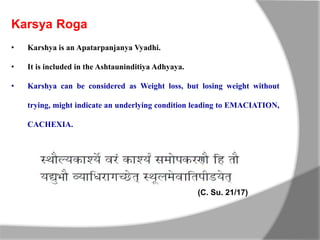
(C. Su. 21/17)
Karsya Roga
• Karshya is an Apatarpanjanya Vyadhi.
• It is included in the Ashtauninditiya Adhyaya.
• Karshya can be considered as Weight loss, but losing weight without
trying, might indicate an underlying condition leading to EMACIATION,
CACHEXIA.
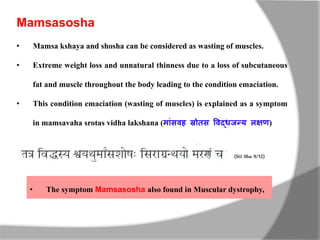
Mamsasosha
• Mamsa kshaya and shosha can be considered as wasting of muscles.
• Extreme weight loss and unnatural thinness due to a loss of subcutaneous
fat and muscle throughout the body leading to the condition emaciation.
• This condition emaciation (wasting of muscles) is explained as a symptom
in mamsavaha srotas vidha lakshana (म ांसवह स्रोतस ववद्धजन्य लक्षण)
(SU. Sha.9/12)
• The symptom Mamsasosha also found in Muscular dystrophy,
Weight loss
• Increased metabolism (hypermetabolic), inadequate consumption
or assimilation of nutrient, or excessive nutrient loss contributes to
significant weight loss.
• Unexplained weight loss, or losing weight without trying, can be a
cause for concern, might indicate an underlying condition.
Emaciation
• Extreme weight loss and unnatural thinness due to a loss
of subcutaneous fat (the fatty, or adipose tissue beneath the skin)
and muscle throughout the body
• It is a serious, usually chronic and progressive condition
characterized by significant (>20%) body weight loss.
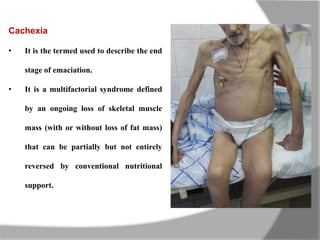
Cachexia
• It is the termed used to describe the end
stage of emaciation.
• It is a multifactorial syndrome defined
by an ongoing loss of skeletal muscle
mass (with or without loss of fat mass)
that can be partially but not entirely
reversed by conventional nutritional
support.
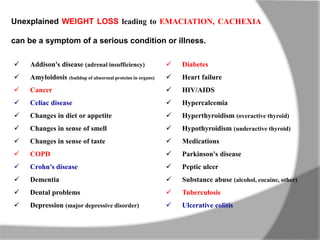
Unexplained WEIGHT LOSS leading to EMACIATION, CACHEXIA
can be a symptom of a serious condition or illness.
 Diabetes
 Heart failure
 HIV/AIDS
 Hypercalcemia
 Hyperthyroidism (overactive thyroid)
 Hypothyroidism (underactive thyroid)
 Medications
 Parkinson's disease
 Peptic ulcer
 Substance abuse (alcohol, cocaine, other)
 Tuberculosis
 Ulcerative colitis
 Addison's disease (adrenal insufficiency)
 Amyloidosis (buildup of abnormal proteins in organs)
 Cancer
 Celiac disease
 Changes in diet or appetite
 Changes in sense of smell
 Changes in sense of taste
 COPD
 Crohn's disease
 Dementia
 Dental problems
 Depression (major depressive disorder)
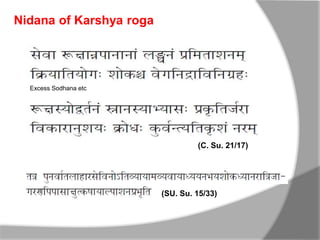
Nidana of Karshya roga
(C. Su. 21/17)
Excess Sodhana etc
(SU. Su. 15/33)
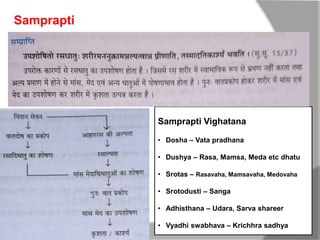
Samprapti
Samprapti Vighatana
• Dosha – Vata pradhana
• Dushya – Rasa, Mamsa, Meda etc dhatu
• Srotas – Rasavaha, Mamsavaha, Medovaha
• Srotodusti – Sanga
• Adhisthana – Udara, Sarva shareer
• Vyadhi swabhava – Krichhra sadhya
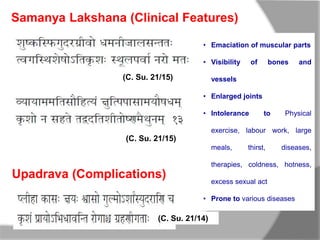
Samanya Lakshana (Clinical Features)
• Emaciation of muscular parts
• Visibility of bones and
vessels
• Enlarged joints
• Intolerance to Physical
exercise, labour work, large
meals, thirst, diseases,
therapies, coldness, hotness,
excess sexual act
• Prone to various diseases
(C. Su. 21/15)
(C. Su. 21/15)
Upadrava (Complications)
(C. Su. 21/14)
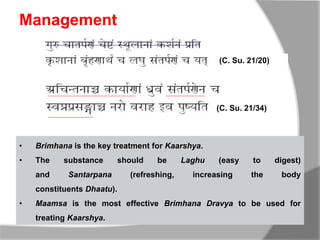
Management
(C. Su. 21/20)
(C. Su. 21/34)
• Brimhana is the key treatment for Kaarshya.
• The substance should be Laghu (easy to digest)
and Santarpana (refreshing, increasing the body
constituents Dhaatu).
• Maamsa is the most effective Brimhana Dravya to be used for
treating Kaarshya.
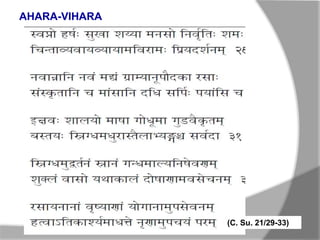
(C. Su. 21/29-33)
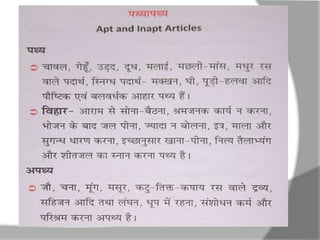
AHARA-VIHARA
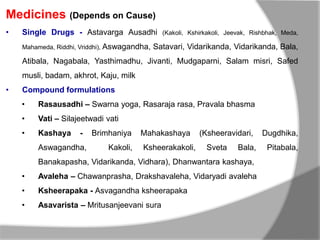
Medicines (Depends on Cause)
• Single Drugs - Astavarga Ausadhi (Kakoli, Kshirkakoli, Jeevak, Rishbhak, Meda,
Mahameda, Riddhi, Vriddhi), Aswagandha, Satavari, Vidarikanda, Vidarikanda, Bala,
Atibala, Nagabala, Yasthimadhu, Jivanti, Mudgaparni, Salam misri, Safed
musli, badam, akhrot, Kaju, milk
• Compound formulations
• Rasausadhi – Swarna yoga, Rasaraja rasa, Pravala bhasma
• Vati – Silajeetwadi vati
• Kashaya - Brimhaniya Mahakashaya (Ksheeravidari, Dugdhika,
Aswagandha, Kakoli, Ksheerakakoli, Sveta Bala, Pitabala,
Banakapasha, Vidarikanda, Vidhara), Dhanwantara kashaya,
• Avaleha – Chawanprasha, Drakshavaleha, Vidaryadi avaleha
• Ksheerapaka - Asvagandha ksheerapaka
• Asavarista – Mritusanjeevani sura
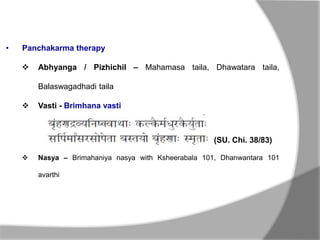
• Panchakarma therapy
 Abhyanga / Pizhichil – Mahamasa taila, Dhawatara taila,
Balaswagadhadi taila
 Vasti - Brimhana vasti
 Nasya – Brimahaniya nasya with Ksheerabala 101, Dhanwantara 101
avarthi
(SU. Chi. 38/83)
Karsya & Mamsasosha
Karsya & Mamsasosha

Karsya & Mamsasosha

  • 1.
    Prof Sriram ChandraMishra Kayachikitsa Department VYDS Ayurved Mahavidyalaya, Khurja WEIGHT LOSS ↓ EMACIATION, CACHEXIA
  • 2.
    (C. Su. 21/17) KarsyaRoga • Karshya is an Apatarpanjanya Vyadhi. • It is included in the Ashtauninditiya Adhyaya. • Karshya can be considered as Weight loss, but losing weight without trying, might indicate an underlying condition leading to EMACIATION, CACHEXIA.
  • 3.
    Mamsasosha • Mamsa kshayaand shosha can be considered as wasting of muscles. • Extreme weight loss and unnatural thinness due to a loss of subcutaneous fat and muscle throughout the body leading to the condition emaciation. • This condition emaciation (wasting of muscles) is explained as a symptom in mamsavaha srotas vidha lakshana (म ांसवह स्रोतस ववद्धजन्य लक्षण) (SU. Sha.9/12) • The symptom Mamsasosha also found in Muscular dystrophy,
  • 4.
    Weight loss • Increasedmetabolism (hypermetabolic), inadequate consumption or assimilation of nutrient, or excessive nutrient loss contributes to significant weight loss. • Unexplained weight loss, or losing weight without trying, can be a cause for concern, might indicate an underlying condition. Emaciation • Extreme weight loss and unnatural thinness due to a loss of subcutaneous fat (the fatty, or adipose tissue beneath the skin) and muscle throughout the body • It is a serious, usually chronic and progressive condition characterized by significant (>20%) body weight loss.
  • 5.
    Cachexia • It isthe termed used to describe the end stage of emaciation. • It is a multifactorial syndrome defined by an ongoing loss of skeletal muscle mass (with or without loss of fat mass) that can be partially but not entirely reversed by conventional nutritional support.
  • 6.
    Unexplained WEIGHT LOSSleading to EMACIATION, CACHEXIA can be a symptom of a serious condition or illness.  Diabetes  Heart failure  HIV/AIDS  Hypercalcemia  Hyperthyroidism (overactive thyroid)  Hypothyroidism (underactive thyroid)  Medications  Parkinson's disease  Peptic ulcer  Substance abuse (alcohol, cocaine, other)  Tuberculosis  Ulcerative colitis  Addison's disease (adrenal insufficiency)  Amyloidosis (buildup of abnormal proteins in organs)  Cancer  Celiac disease  Changes in diet or appetite  Changes in sense of smell  Changes in sense of taste  COPD  Crohn's disease  Dementia  Dental problems  Depression (major depressive disorder)
  • 7.
    Nidana of Karshyaroga (C. Su. 21/17) Excess Sodhana etc (SU. Su. 15/33)
  • 8.
    Samprapti Samprapti Vighatana • Dosha– Vata pradhana • Dushya – Rasa, Mamsa, Meda etc dhatu • Srotas – Rasavaha, Mamsavaha, Medovaha • Srotodusti – Sanga • Adhisthana – Udara, Sarva shareer • Vyadhi swabhava – Krichhra sadhya
  • 9.
    Samanya Lakshana (ClinicalFeatures) • Emaciation of muscular parts • Visibility of bones and vessels • Enlarged joints • Intolerance to Physical exercise, labour work, large meals, thirst, diseases, therapies, coldness, hotness, excess sexual act • Prone to various diseases (C. Su. 21/15) (C. Su. 21/15) Upadrava (Complications) (C. Su. 21/14)
  • 10.
    Management (C. Su. 21/20) (C.Su. 21/34) • Brimhana is the key treatment for Kaarshya. • The substance should be Laghu (easy to digest) and Santarpana (refreshing, increasing the body constituents Dhaatu). • Maamsa is the most effective Brimhana Dravya to be used for treating Kaarshya.
  • 11.
  • 12.
    Medicines (Depends onCause) • Single Drugs - Astavarga Ausadhi (Kakoli, Kshirkakoli, Jeevak, Rishbhak, Meda, Mahameda, Riddhi, Vriddhi), Aswagandha, Satavari, Vidarikanda, Vidarikanda, Bala, Atibala, Nagabala, Yasthimadhu, Jivanti, Mudgaparni, Salam misri, Safed musli, badam, akhrot, Kaju, milk • Compound formulations • Rasausadhi – Swarna yoga, Rasaraja rasa, Pravala bhasma • Vati – Silajeetwadi vati • Kashaya - Brimhaniya Mahakashaya (Ksheeravidari, Dugdhika, Aswagandha, Kakoli, Ksheerakakoli, Sveta Bala, Pitabala, Banakapasha, Vidarikanda, Vidhara), Dhanwantara kashaya, • Avaleha – Chawanprasha, Drakshavaleha, Vidaryadi avaleha • Ksheerapaka - Asvagandha ksheerapaka • Asavarista – Mritusanjeevani sura
  • 13.
    • Panchakarma therapy Abhyanga / Pizhichil – Mahamasa taila, Dhawatara taila, Balaswagadhadi taila  Vasti - Brimhana vasti  Nasya – Brimahaniya nasya with Ksheerabala 101, Dhanwantara 101 avarthi (SU. Chi. 38/83)