RESTRUCTURING OF THE
SUPPLY CHAIN MANAGEMENT
PRACTICES
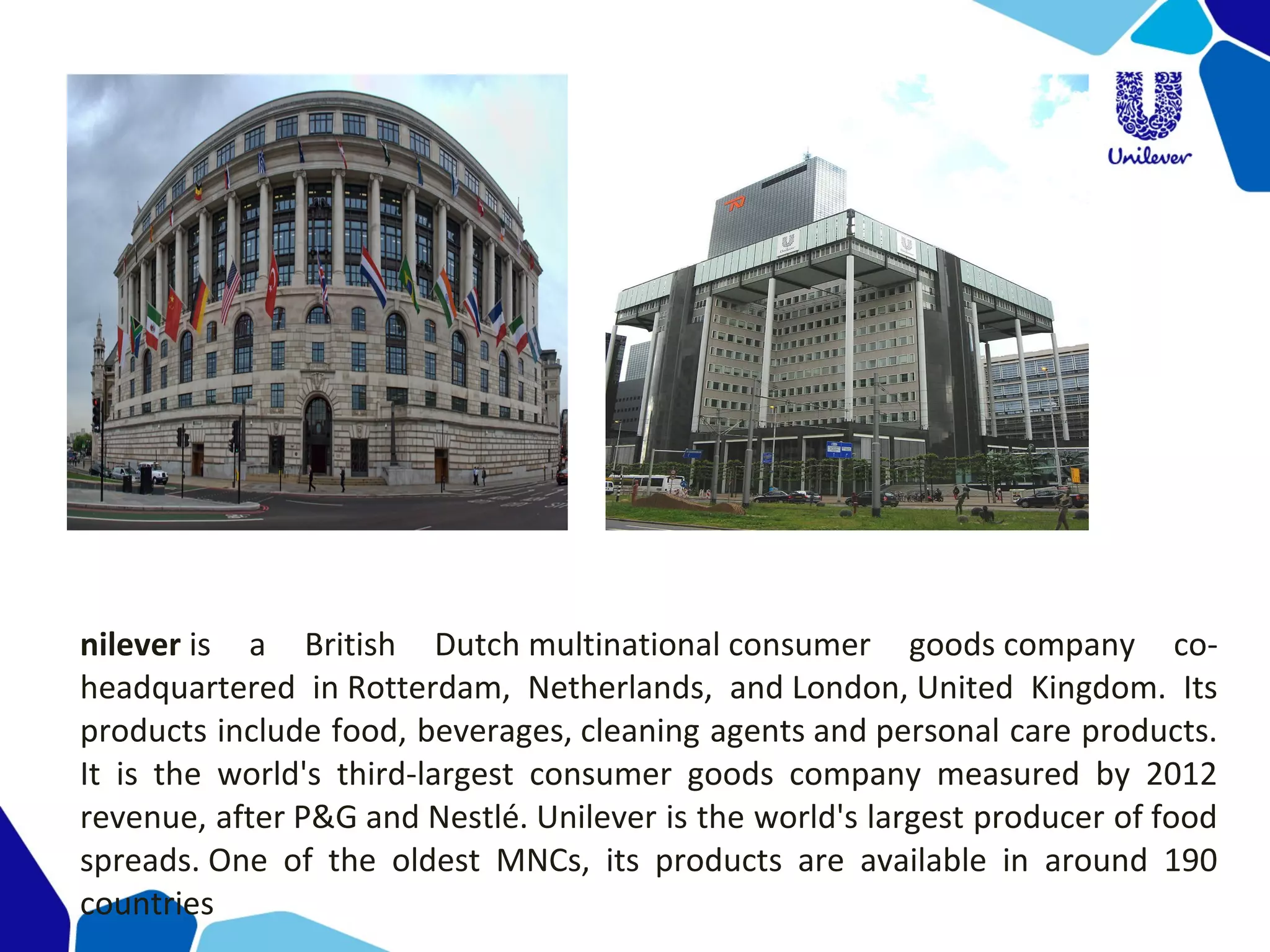
nilever is  a  British  Dutch multinational consumer  goods company  co-
headquartered  in Rotterdam,  Netherlands,  and London, United  Kingdom.  Its 
products include food, beverages, cleaning agents and personal care products. 
It  is  the  world's  third-largest  consumer  goods  company  measured  by  2012 
revenue, after P&G and Nestlé. Unilever is the world's largest producer of food 
spreads. One  of  the  oldest  MNCs,  its  products  are  available  in  around  190 
countries
Unilever claims that in 1 min. the world would have used 330,000
of its products.
Unilever’s portfolio of
categories
Leading category
positions
Ice Cream &
Beverages
Personal Care
Homecare
Savoury,
Dressings
& Spreads
Strong category positions
OVERVIEW &
BACKGROUND
• Unilever is one of the world's leading suppliers of fast-
moving consumer goods. It has its three major global 
divisions - Foods, home care and personal care.
• Vision: Our  Vision  is  to  help  people  feel  good,  look 
good and get more out of life with brands and services 
that are good for them and good for others.
• Mission: In  the  last  five  years,  we  have  built  our 
business by focusing on our brands, streamlining how 
we  work,  and  improving  our  insight  into  the  evolving 
needs and tastes of consumers. Now we are taking the 
next  step  in  simplification  -  by  aligning  ourselves 
around a clear common mission.
• Unilever  was  formed  in  1930  with  the  merger  of  British  soap 
company Lever brothers and Dutch Margarine company Margarine 
Unie.
• During  1960’s  and  1970’s  it  expanded  by  horizontal  and  vertical 
integration emerging as a diversified conglomerate.
• In 1980’s it decided to have a more focused approach and referred 
to  it  as  “core  strategy”  and  focused  on  four  industries  –  Food, 
Personal  care,  health  care  and  specialty  industry,  this  decision 
involved acquisition and divestiture of brands.
• As  a  result  of  this  it  developed  an  extensive  range  of  product 
categories under each business segment.
• Unilever found itself becoming inflexible due to its huge operation 
and  other  inefficiencies.  To  come  out  of  this  mess  it  decided  to 
restructure its strategy
• They reduced their product category from 50 to 13 
and  by  mid-1990’s  it  has  acquired  over  64  food 
business.
• Food business recession in the Western Europe (their 
main  market)  and  US  had  severely  affected  its 
business  and  they  had  to  shutdown  many  of  their 
companies, to increase its sales 
• It focused on different product segment for different 
countries  based  on  their  sales  potential  which 
doubled their sales.
• Due  to  this  restructuring  the  operating  margin 
reached over 11% and return on capital over 22%. It 
also became the second largest packaged consumer 
goods company and the third largest firm
EASONS FOR RESTRUCTURING OF
SUPPLY CHAIN
1. Its announcement of special interim dividend
2. The growing popularity of internet and telecom stocks were 
moving consumers away from the old stock.
Thus in the year 2000 Unilever announced a five year growth 
strategy to bring a significant change in the company. This 
initiative  was  named  as  “Path  to  Growth  Strategy”.  It 
announced a comprehensive restructuring in their operation 
and business and their SCM.
HORT TERM GAINS AND LONG TERM
PERSPECTIVE
1. In December 2001, Unilever was declared as the winner in 
the Aberdeen’s groups.
2. Best  practices  in  E-procurement  contest  by  implementing 
the Ariba buyer E-procurement solution.
3. Unilever  established    the  European  Ariba  Academy  to 
provide multiple site implementation and virtual training.
4. The  initiative  named  ‘Path  to  Growth’  aimed  in  achieving 
the annual top line growth of 5%-6% and operating margins 
over 16% by 2004.
•€15.3 billion spent on raw
materials and packaging from
over 10,000 suppliers
in 2009.
Raw materials and ingredients
Our share of world volume:
Preliminary data pending audit.
SUPPLY CHAIN
RESTRUCTURING
• Unilever decided to cut down its vast brand portfolio from
1600 to 400 in order to enable its complete focus.
• Unilever focused on 400 key brands including Dove soap,
Lipton tea, Calvin Klein fragrances, Close-up toothpaste,
Magnum ice-cream and Omo fabric detergent. Tail brands fall
away, good brands stay.
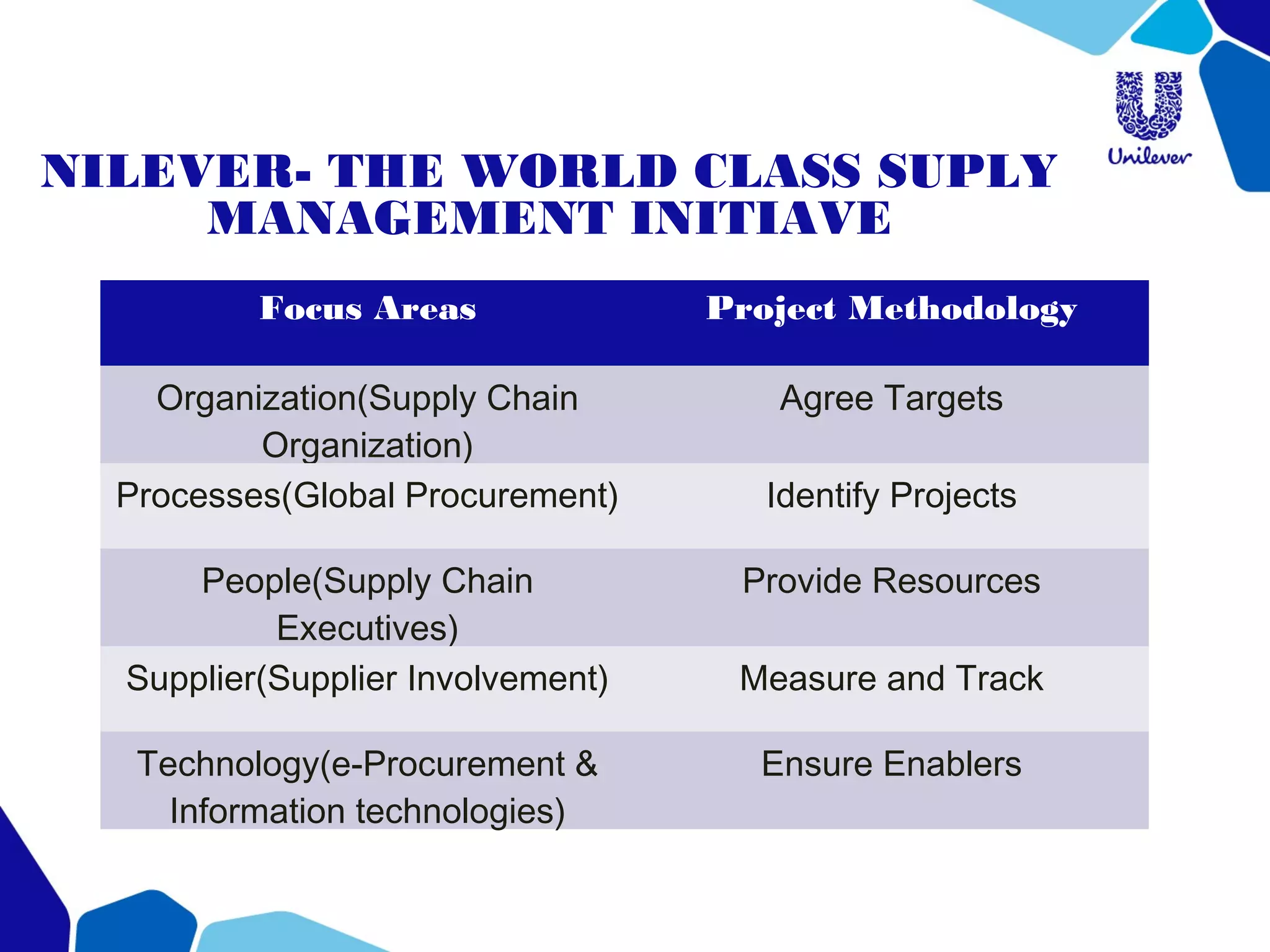
• The SCM restructuring plan was built around five focus areas.
NILEVER- THE WORLD CLASS SUPLY
MANAGEMENT INITIAVE
Focus Areas Project Methodology
Organization(Supply Chain
Organization)
Agree Targets
Processes(Global Procurement) Identify Projects
People(Supply Chain
Executives)
Provide Resources
Supplier(Supplier Involvement) Measure and Track
Technology(e-Procurement &
Information technologies)
Ensure Enablers
• Unilever decided to make significant changes to its supply
chain of 380 manufacturing plants across the world, by
focusing on 150 key factories.
The major thrust areas were:
1. Implementing executive purchasing.
2. Attracting, developing and retaining world class supply
management executives.
3. Professionalizing the purchase of non-production items.
4. Enabling e-sourcing in all worldwide facilities.
5. Accelerating and leveraging simplification of supply chain.
6. Driving information and management.
SUPPLY CHAIN
ORGANIZATION
•Unilever manages a
number of
partnerships
globally.
Customer partnerships
•Around one-fifth of
Unilever’s sales are
through ten major retail
chains.
•Our products are sold in
over 10 million small
shops in developing and
emerging markets.
•50% of sales from
developing and emerging
markets.
ISTRIBUTION
AND RETAILING
• The supply chain division installed two electronic
communication system, one of which was Internet-centric.
• These systems were frequently used to collect and share
information on all supply chain management activities in the
company.
• The electronic systems were helpful as they provided ready
access to information that enabled supply management
executives to analyze projects based on their size, risk and
resources.
• Unilever focused on fostering healthy relationship with its
suppliers.
• According to an Unilever supplier, the company was forming
collaborative rather than a traditional combative relationship.
SOURCING
• Sourcing (Sourcing Mgmt. Div.) had to take place at the Global
level, it would ensure cost savings and leverage.
• Ensure that best practices in Supply Mgmt. were shared
between the Food and Home & Personal Care product
businesses. (Polcer)
• For production purchases Unilever setup more than 40 global
commodity teams that included supply managers.
• Products Globally sourced included: Alkalis, Surfactants, Oils,
Flexible Packaging and Plastic Molding
• 1 Global Commodity team received the “Path to Growth”
gold award for innovating the corrugated packaging material,
used in 110 European factories, saving costs and reducing the
supply base.
• Regional Commodity teams also setup because purchases at
regional level at times better than global level. (Regional over
Global)
• Global Commodity teams involved in Cross Divisional
Purchases as well. (Production and Non Production items)
• Sourcing for non-production items for both Food and Home &
Personal Care Businesses were combined as they weren’t
consumer related.
• Economies of Scale easily achievable for non-production items
and these items were not involved in the Company’s
innovation processes.
• Non production item executives encouraged by company in
strategic sourcing of these items, as company believed that
these executives knew better of industry than the Supply
Mgmt. team.
E-
PROCUREMENT
• Pre-restructuring SCM, Unilever’s various companies
worldwide, managed procurement activities of their respective
companies. Companies were independent w.r.t systems and
staff.
• The above policy was costly, missed better opportunities at
making deals in purchase with suppliers.
• 1990s, Unilever on acquisition spree, above process results in
redundancies.
• 2000, procurement & distribution system through e-commerce
and internet. Use of web-based applications.
• March, 2000: Unilever partners with Ariba B2B platform.
• Ariba initially used for non-inventory and indirect expense
areas. Simplifying and streamlining worldwide purchases
from larger supplier base.
• According to Charles B. Strauss, President, NA, Unilever;
benefits of Ariba:
- Consolidate purchase
- Enhance scale for company and supplier
- Guarantee quality merchandise
- Automatically create information base to manage these
materials
• 2 major and several other web based applications used:
 Ariba ORMS B2B Procurement
 Ariba Network Commerce Service
• Employees involved in purchasing were given access to Ariba
• 2002: e-procurement enters into more continents for purchase
purpose.
• Oct, 2002: Unilever partnered with A T Kearney, leading global
consulting firm to reduce costs in procurement and SCM.
• 2003: 20% of Unilever procurement activities web-based.
Reverse auctions used for procurement, web based for cheaper
purchases.
OTHER INFORMATION
TECHNOLOGY
INITIAVES
• Until 2000 Unilever had a decentralized IT infrastructure with multiple
IT environments
• It was using many legacy systems and ERP systems(SAP, BPCS, MFG Pro
and FOURTH SHIFT)
• It was using well established intranet services linked with 70000
desktops worldwide which helped the company executives across world
access and share knowledge.
• The company felt that this infrastructure would not support the kind of
Quick Information transfer needed.
• Hence it needed a global information network that will enable its
executives to access actionable info on both regional and global basis.
HANGES BROUGHT IN IT STRUCTURE
• In late 2000, company launched the UIP program.
• The major goal was to harness the data from seven
regional business groups and over 300 operating units
which were supported by numerous IT environments.
Goals of UIP
1. To understand consumer needs better and plan accordingly
with key suppliers
2. Monitor the progress of the top 400 brands and their
respective competitors
3. Identify the means to achieve world class supply
management and to financial reporting and business
intelligence services to Unilever mgmt.
• “the data warehouse should be regularly fed with relevant
information from sources without having any performance issues of
OS” – President UIP
• Benefits of UIP were: Durable, Scalable, Easily maintained and
flexible to changes that will occur over time.
• The major dynamic information system used was KALIDO, business
objects data integrator and business objects rapid marts.
• KALIDO was used as a information integration solution to collect
and store data from diverse global systems, it enabled commonality
across its global systems, cross-referenced by the same master
data warehouse ensuring accuracy and consistency of info.
• Major function of Business Objects Data Integrator at Unilever
was to extract data(worldwide), convert it into usable business
information then load it in the master data warehouse.
It provided:
1. Business logic
2. A prepackaged batch
3. Real-time data movement for analytics and data-intensive
integration projects such as SCM & CRM, thus helping decision
making in both areas.
• In early 2001, Unilever decided to use RFID technology
enabled to track the movement of consumer products
• According to Unilever, the RFID based system enabled the
company to track the position of each products at all times.
• Its effective in collaborative planning, forecasting and
replenishment(CPFR) which was tested in 3 Phases:
1. Pallets
2. Goods
3. Individual items.
DISTRIBUTION
NILEVER RESTRUCTURING DISTRIBUTION NETWORK
ne warehouse in each region
peration handover to third party
roblem faced by warehouse
igh value & lower turn over products – special storage
ow value & High turn over products - floor loaded
So, to solve this problem –
teps taken to eliminate inefficiency shipping process and
to reduce cost
ombined shipping process
ransportation software tool - eRFX Solution
Prepared by Tigris consulting that reduce cost by 15%
Advantages of the Tigris’ eRFX Solution
ustomize supplier proposal
educe truck load by 25%
SUPPLY CHAIN AND
INNOVATION
• Unilever had integrated SCM with its innovation process at Global and
Regional level
 Innovation
• To improve existing products and create new ones that consumers
love
• Unilever R&D teams work on breakthroughs that will build a brighter
future for customer, company and environment
 Global Level – SCM division appoint representatives who provide list of
potential suppliers to innovation team
 Regional Level – SCM division appoint innovation manager to help
innovation groups to identify potential suppliers.
BUILDING THE
GROUNDS FOR LONG
TERM BASE
• Unilever achieved $14.24 billion in savings from its SCM and
procurement initiatives in 2003
• Company mainly focuses on procurement technology and processes
which helped in reducing procurement costs and strengthening its
relationship with suppliers.
• Emerged as the leader in the consumer packaged industry for technology
adoption with its e procurement and technology initiatives.
• Unilever came up with a project to extent the dove brand to deodorants.
They tried to come up with a packaging for dove deodorant that fit for
gentle image of dove.
ROWTH OF UNILEVER IN OPERATING
PROFIT MARGIN
n 2002 fiscal, Unilever’s operating margin increase to
14.9%, 1% and 3.8% increase over it margin in 2001 and
1999.
• In the mid 2003 the 2nd
mega distribution centre in North
America, which began its operation in Carlisle and in north east
region.
• Three mega distribution centers in Texas, Califonia and Illinois
were schedule to be opened by the end of 2003.
• Unilever was moving ahead with its supply chain restructuring
projects and expected to meet its target of $1.56 billion in late
2003.
• Company has adopted long term outcomes initiatives which it
fits with the overall organizational restructuring program.
ARUP RANJAN ROUT () PURNISHA DASGUPTA (32)
RAHUL AUDDYA (33) RAJPRITAM PARASAR (35)
RAKTIM RAJKHOWA (36) SANTOSH KUMAR DAS ()

Unilever Supply Chain Management

  • 1.
    RESTRUCTURING OF THE SUPPLYCHAIN MANAGEMENT PRACTICES
  • 2.
    nilever is  a  British Dutch multinational consumer  goods company  co- headquartered  in Rotterdam,  Netherlands,  and London, United  Kingdom.  Its  products include food, beverages, cleaning agents and personal care products.  It  is  the  world's  third-largest  consumer  goods  company  measured  by  2012  revenue, after P&G and Nestlé. Unilever is the world's largest producer of food  spreads. One  of  the  oldest  MNCs,  its  products  are  available  in  around  190  countries
  • 3.
    Unilever claims thatin 1 min. the world would have used 330,000 of its products.
  • 4.
    Unilever’s portfolio of categories Leadingcategory positions Ice Cream & Beverages Personal Care Homecare Savoury, Dressings & Spreads Strong category positions
  • 5.
  • 6.
    • Unilever is one of the world's leading suppliers of fast- moving consumer goods. It has its three major global  divisions - Foods, home care and personal care. • Vision:Our  Vision  is  to  help  people  feel  good,  look  good and get more out of life with brands and services  that are good for them and good for others. • Mission: In  the  last  five  years,  we  have  built  our  business by focusing on our brands, streamlining how  we  work,  and  improving  our  insight  into  the  evolving  needs and tastes of consumers. Now we are taking the  next  step  in  simplification  -  by  aligning  ourselves  around a clear common mission.
  • 7.
    • Unilever  was formed  in  1930  with  the  merger  of  British  soap  company Lever brothers and Dutch Margarine company Margarine  Unie. • During  1960’s  and  1970’s  it  expanded  by  horizontal  and  vertical  integration emerging as a diversified conglomerate. • In 1980’s it decided to have a more focused approach and referred  to  it  as  “core  strategy”  and  focused  on  four  industries  –  Food,  Personal  care,  health  care  and  specialty  industry,  this  decision  involved acquisition and divestiture of brands. • As  a  result  of  this  it  developed  an  extensive  range  of  product  categories under each business segment. • Unilever found itself becoming inflexible due to its huge operation  and  other  inefficiencies.  To  come  out  of  this  mess  it  decided  to  restructure its strategy
  • 8.
    • They reduced their product category from 50 to 13  and  by mid-1990’s  it  has  acquired  over  64  food  business. • Food business recession in the Western Europe (their  main  market)  and  US  had  severely  affected  its  business  and  they  had  to  shutdown  many  of  their  companies, to increase its sales  • It focused on different product segment for different  countries  based  on  their  sales  potential  which  doubled their sales. • Due  to  this  restructuring  the  operating  margin  reached over 11% and return on capital over 22%. It  also became the second largest packaged consumer  goods company and the third largest firm
  • 9.
    EASONS FOR RESTRUCTURINGOF SUPPLY CHAIN 1. Its announcement of special interim dividend 2. The growing popularity of internet and telecom stocks were  moving consumers away from the old stock. Thus in the year 2000 Unilever announced a five year growth  strategy to bring a significant change in the company. This  initiative  was  named  as  “Path  to  Growth  Strategy”.  It  announced a comprehensive restructuring in their operation  and business and their SCM.
  • 10.
    HORT TERM GAINSAND LONG TERM PERSPECTIVE 1. In December 2001, Unilever was declared as the winner in  the Aberdeen’s groups. 2. Best  practices  in  E-procurement  contest  by  implementing  the Ariba buyer E-procurement solution. 3. Unilever  established    the  European  Ariba  Academy  to  provide multiple site implementation and virtual training. 4. The  initiative  named  ‘Path  to  Growth’  aimed  in  achieving  the annual top line growth of 5%-6% and operating margins  over 16% by 2004.
  • 11.
    •€15.3 billion spenton raw materials and packaging from over 10,000 suppliers in 2009. Raw materials and ingredients Our share of world volume: Preliminary data pending audit.
  • 12.
  • 13.
    • Unilever decidedto cut down its vast brand portfolio from 1600 to 400 in order to enable its complete focus. • Unilever focused on 400 key brands including Dove soap, Lipton tea, Calvin Klein fragrances, Close-up toothpaste, Magnum ice-cream and Omo fabric detergent. Tail brands fall away, good brands stay. • The SCM restructuring plan was built around five focus areas.
  • 14.
    NILEVER- THE WORLDCLASS SUPLY MANAGEMENT INITIAVE Focus Areas Project Methodology Organization(Supply Chain Organization) Agree Targets Processes(Global Procurement) Identify Projects People(Supply Chain Executives) Provide Resources Supplier(Supplier Involvement) Measure and Track Technology(e-Procurement & Information technologies) Ensure Enablers
  • 15.
    • Unilever decidedto make significant changes to its supply chain of 380 manufacturing plants across the world, by focusing on 150 key factories. The major thrust areas were: 1. Implementing executive purchasing. 2. Attracting, developing and retaining world class supply management executives. 3. Professionalizing the purchase of non-production items. 4. Enabling e-sourcing in all worldwide facilities. 5. Accelerating and leveraging simplification of supply chain. 6. Driving information and management.
  • 16.
  • 17.
    •Unilever manages a numberof partnerships globally. Customer partnerships •Around one-fifth of Unilever’s sales are through ten major retail chains. •Our products are sold in over 10 million small shops in developing and emerging markets. •50% of sales from developing and emerging markets. ISTRIBUTION AND RETAILING
  • 18.
    • The supplychain division installed two electronic communication system, one of which was Internet-centric. • These systems were frequently used to collect and share information on all supply chain management activities in the company. • The electronic systems were helpful as they provided ready access to information that enabled supply management executives to analyze projects based on their size, risk and resources. • Unilever focused on fostering healthy relationship with its suppliers. • According to an Unilever supplier, the company was forming collaborative rather than a traditional combative relationship.
  • 19.
  • 20.
    • Sourcing (SourcingMgmt. Div.) had to take place at the Global level, it would ensure cost savings and leverage. • Ensure that best practices in Supply Mgmt. were shared between the Food and Home & Personal Care product businesses. (Polcer) • For production purchases Unilever setup more than 40 global commodity teams that included supply managers. • Products Globally sourced included: Alkalis, Surfactants, Oils, Flexible Packaging and Plastic Molding
  • 21.
    • 1 GlobalCommodity team received the “Path to Growth” gold award for innovating the corrugated packaging material, used in 110 European factories, saving costs and reducing the supply base. • Regional Commodity teams also setup because purchases at regional level at times better than global level. (Regional over Global) • Global Commodity teams involved in Cross Divisional Purchases as well. (Production and Non Production items)
  • 22.
    • Sourcing fornon-production items for both Food and Home & Personal Care Businesses were combined as they weren’t consumer related. • Economies of Scale easily achievable for non-production items and these items were not involved in the Company’s innovation processes. • Non production item executives encouraged by company in strategic sourcing of these items, as company believed that these executives knew better of industry than the Supply Mgmt. team.
  • 23.
  • 24.
    • Pre-restructuring SCM,Unilever’s various companies worldwide, managed procurement activities of their respective companies. Companies were independent w.r.t systems and staff. • The above policy was costly, missed better opportunities at making deals in purchase with suppliers. • 1990s, Unilever on acquisition spree, above process results in redundancies. • 2000, procurement & distribution system through e-commerce and internet. Use of web-based applications.
  • 25.
    • March, 2000:Unilever partners with Ariba B2B platform. • Ariba initially used for non-inventory and indirect expense areas. Simplifying and streamlining worldwide purchases from larger supplier base. • According to Charles B. Strauss, President, NA, Unilever; benefits of Ariba: - Consolidate purchase - Enhance scale for company and supplier - Guarantee quality merchandise - Automatically create information base to manage these materials
  • 26.
    • 2 majorand several other web based applications used:  Ariba ORMS B2B Procurement  Ariba Network Commerce Service • Employees involved in purchasing were given access to Ariba • 2002: e-procurement enters into more continents for purchase purpose. • Oct, 2002: Unilever partnered with A T Kearney, leading global consulting firm to reduce costs in procurement and SCM. • 2003: 20% of Unilever procurement activities web-based. Reverse auctions used for procurement, web based for cheaper purchases.
  • 27.
  • 28.
    • Until 2000Unilever had a decentralized IT infrastructure with multiple IT environments • It was using many legacy systems and ERP systems(SAP, BPCS, MFG Pro and FOURTH SHIFT) • It was using well established intranet services linked with 70000 desktops worldwide which helped the company executives across world access and share knowledge. • The company felt that this infrastructure would not support the kind of Quick Information transfer needed. • Hence it needed a global information network that will enable its executives to access actionable info on both regional and global basis.
  • 29.
    HANGES BROUGHT INIT STRUCTURE • In late 2000, company launched the UIP program. • The major goal was to harness the data from seven regional business groups and over 300 operating units which were supported by numerous IT environments. Goals of UIP 1. To understand consumer needs better and plan accordingly with key suppliers 2. Monitor the progress of the top 400 brands and their respective competitors 3. Identify the means to achieve world class supply management and to financial reporting and business intelligence services to Unilever mgmt.
  • 30.
    • “the datawarehouse should be regularly fed with relevant information from sources without having any performance issues of OS” – President UIP • Benefits of UIP were: Durable, Scalable, Easily maintained and flexible to changes that will occur over time. • The major dynamic information system used was KALIDO, business objects data integrator and business objects rapid marts. • KALIDO was used as a information integration solution to collect and store data from diverse global systems, it enabled commonality across its global systems, cross-referenced by the same master data warehouse ensuring accuracy and consistency of info.
  • 31.
    • Major functionof Business Objects Data Integrator at Unilever was to extract data(worldwide), convert it into usable business information then load it in the master data warehouse. It provided: 1. Business logic 2. A prepackaged batch 3. Real-time data movement for analytics and data-intensive integration projects such as SCM & CRM, thus helping decision making in both areas.
  • 32.
    • In early2001, Unilever decided to use RFID technology enabled to track the movement of consumer products • According to Unilever, the RFID based system enabled the company to track the position of each products at all times. • Its effective in collaborative planning, forecasting and replenishment(CPFR) which was tested in 3 Phases: 1. Pallets 2. Goods 3. Individual items.
  • 33.
  • 34.
    NILEVER RESTRUCTURING DISTRIBUTIONNETWORK ne warehouse in each region peration handover to third party roblem faced by warehouse igh value & lower turn over products – special storage ow value & High turn over products - floor loaded So, to solve this problem –
  • 35.
    teps taken toeliminate inefficiency shipping process and to reduce cost ombined shipping process ransportation software tool - eRFX Solution Prepared by Tigris consulting that reduce cost by 15% Advantages of the Tigris’ eRFX Solution ustomize supplier proposal educe truck load by 25%
  • 36.
  • 37.
    • Unilever hadintegrated SCM with its innovation process at Global and Regional level  Innovation • To improve existing products and create new ones that consumers love • Unilever R&D teams work on breakthroughs that will build a brighter future for customer, company and environment  Global Level – SCM division appoint representatives who provide list of potential suppliers to innovation team  Regional Level – SCM division appoint innovation manager to help innovation groups to identify potential suppliers.
  • 38.
  • 39.
    • Unilever achieved$14.24 billion in savings from its SCM and procurement initiatives in 2003 • Company mainly focuses on procurement technology and processes which helped in reducing procurement costs and strengthening its relationship with suppliers. • Emerged as the leader in the consumer packaged industry for technology adoption with its e procurement and technology initiatives. • Unilever came up with a project to extent the dove brand to deodorants. They tried to come up with a packaging for dove deodorant that fit for gentle image of dove.
  • 40.
    ROWTH OF UNILEVERIN OPERATING PROFIT MARGIN n 2002 fiscal, Unilever’s operating margin increase to 14.9%, 1% and 3.8% increase over it margin in 2001 and 1999.
  • 41.
    • In themid 2003 the 2nd mega distribution centre in North America, which began its operation in Carlisle and in north east region. • Three mega distribution centers in Texas, Califonia and Illinois were schedule to be opened by the end of 2003. • Unilever was moving ahead with its supply chain restructuring projects and expected to meet its target of $1.56 billion in late 2003. • Company has adopted long term outcomes initiatives which it fits with the overall organizational restructuring program.
  • 42.
    ARUP RANJAN ROUT() PURNISHA DASGUPTA (32) RAHUL AUDDYA (33) RAJPRITAM PARASAR (35) RAKTIM RAJKHOWA (36) SANTOSH KUMAR DAS ()