ID : MBA 00905452
ID : MBA 00905451
ID : MBA 00905439
ID : MBA 00905450
Rahul
Chandra
Nath
Razia
Sultana
Mohammad
Shafaet
Karim
Md.
Miftahul
Huda
Sharifee
Group Name :
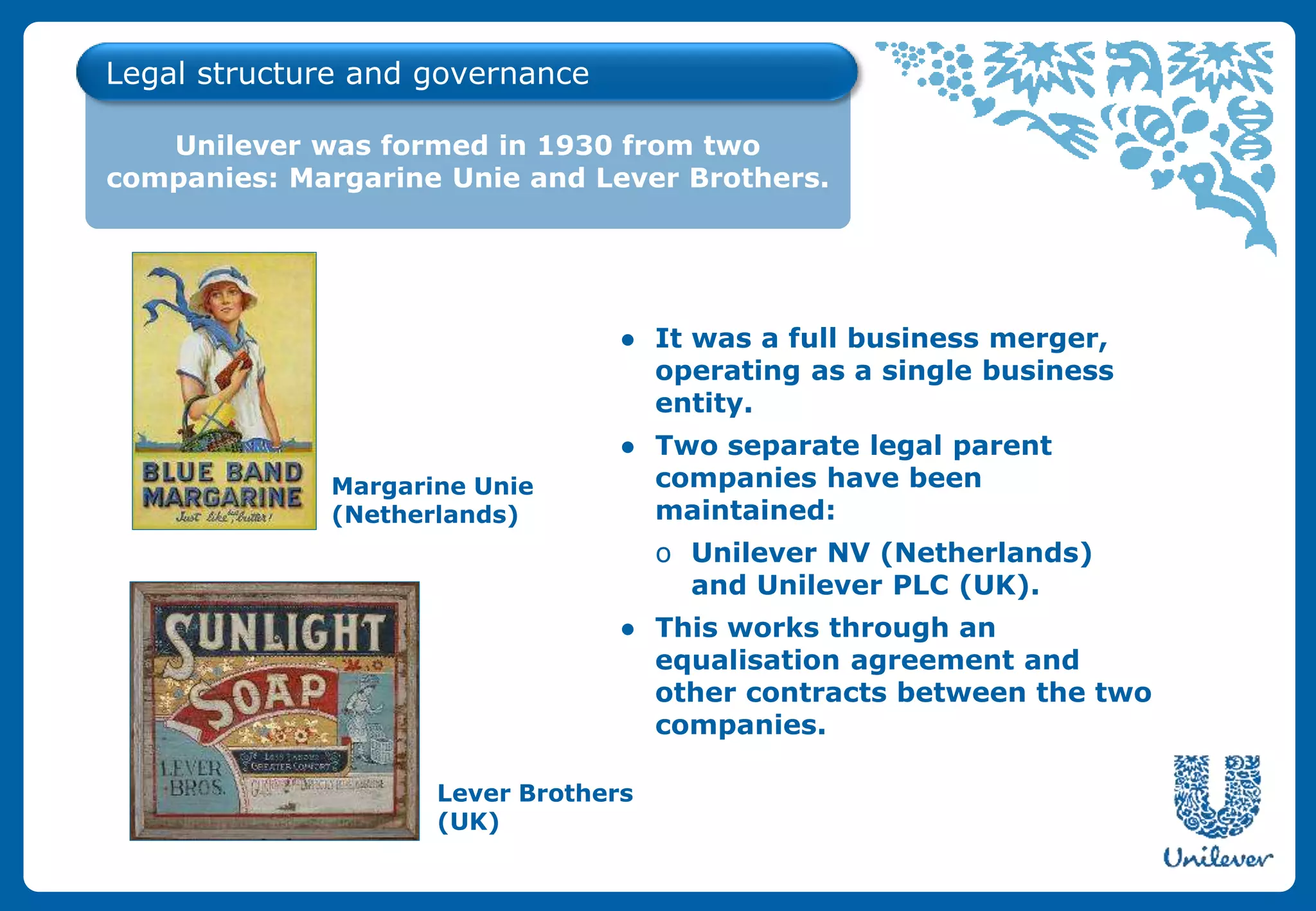
Unilever was formed in 1930 from two
companies: Margarine Unie and Lever Brothers.
Legal structure and governance
Margarine Unie
(Netherlands)
Lever Brothers
(UK)
● It was a full business merger,
operating as a single business
entity.
● Two separate legal parent
companies have been
maintained:
o Unilever NV (Netherlands)
and Unilever PLC (UK).
● This works through an
equalisation agreement and
other contracts between the two
companies.
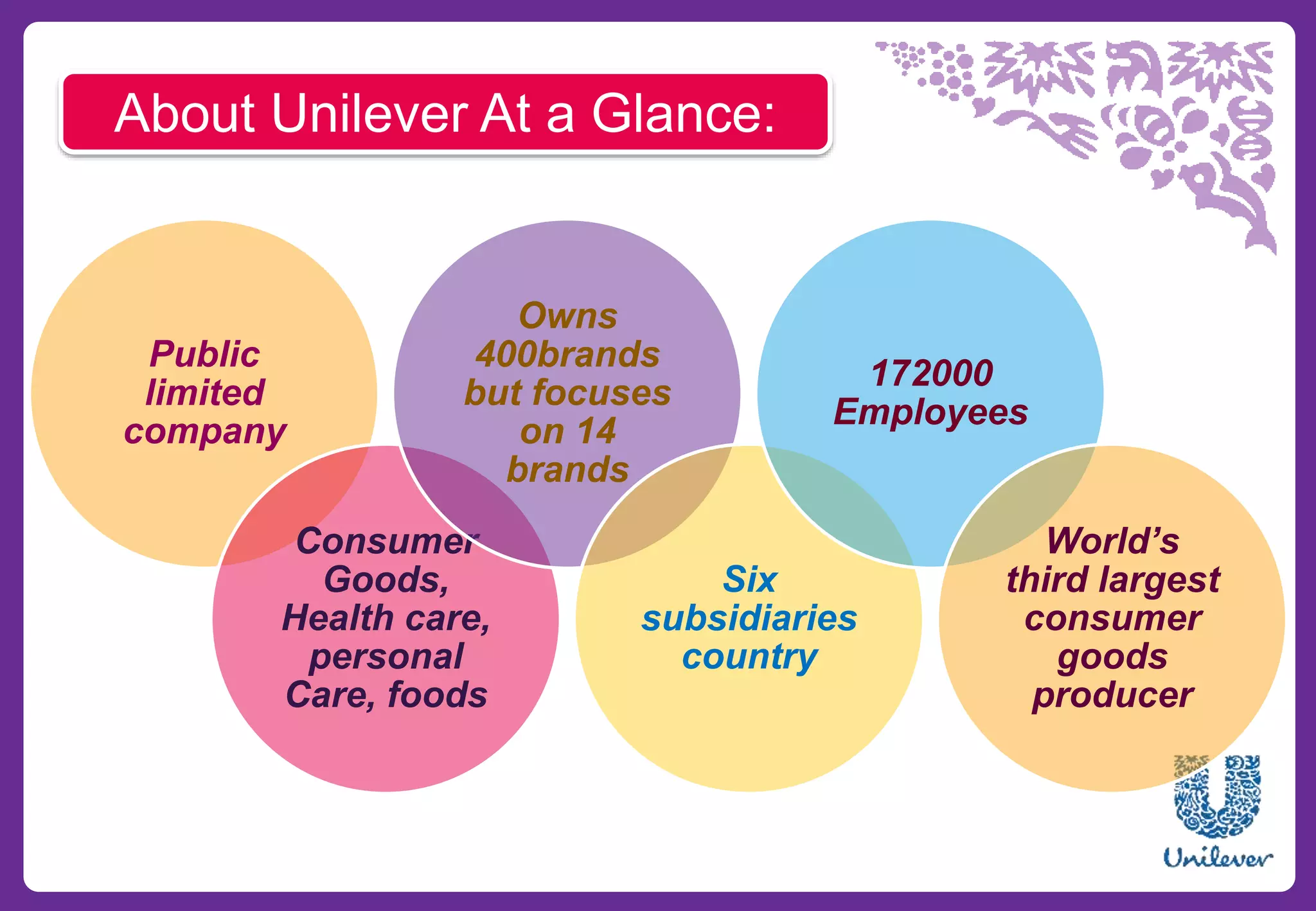
About Unilever At a Glance:
Public
limited
company
Consumer
Goods,
Health care,
personal
Care, foods
Owns
400brands
but focuses
on 14
brands
Six
subsidiaries
country
172000
Employees
World’s
third largest
consumer
goods
producer
 1885 - 1899: Product innovation, 19th Century Style
 1900 - 1909: New focus on raw materials
 1910 - 1919: A decade of change
 1920 - 1929: Unilever is formed
 1930 - 1939: Overcoming challenges
 1940 - 1949: Focusing on local needs
 1950 - 1959: The post-war consumer boom
 1960 - 1969: A time for growth
 1970 - 1979: Diversifying in a tough climate
 1980 - 1989: Focusing on the core
 1990 - 1999: Restructuring and consolidating
 2000 - 2009: Forging new paths
Unilever Timeline
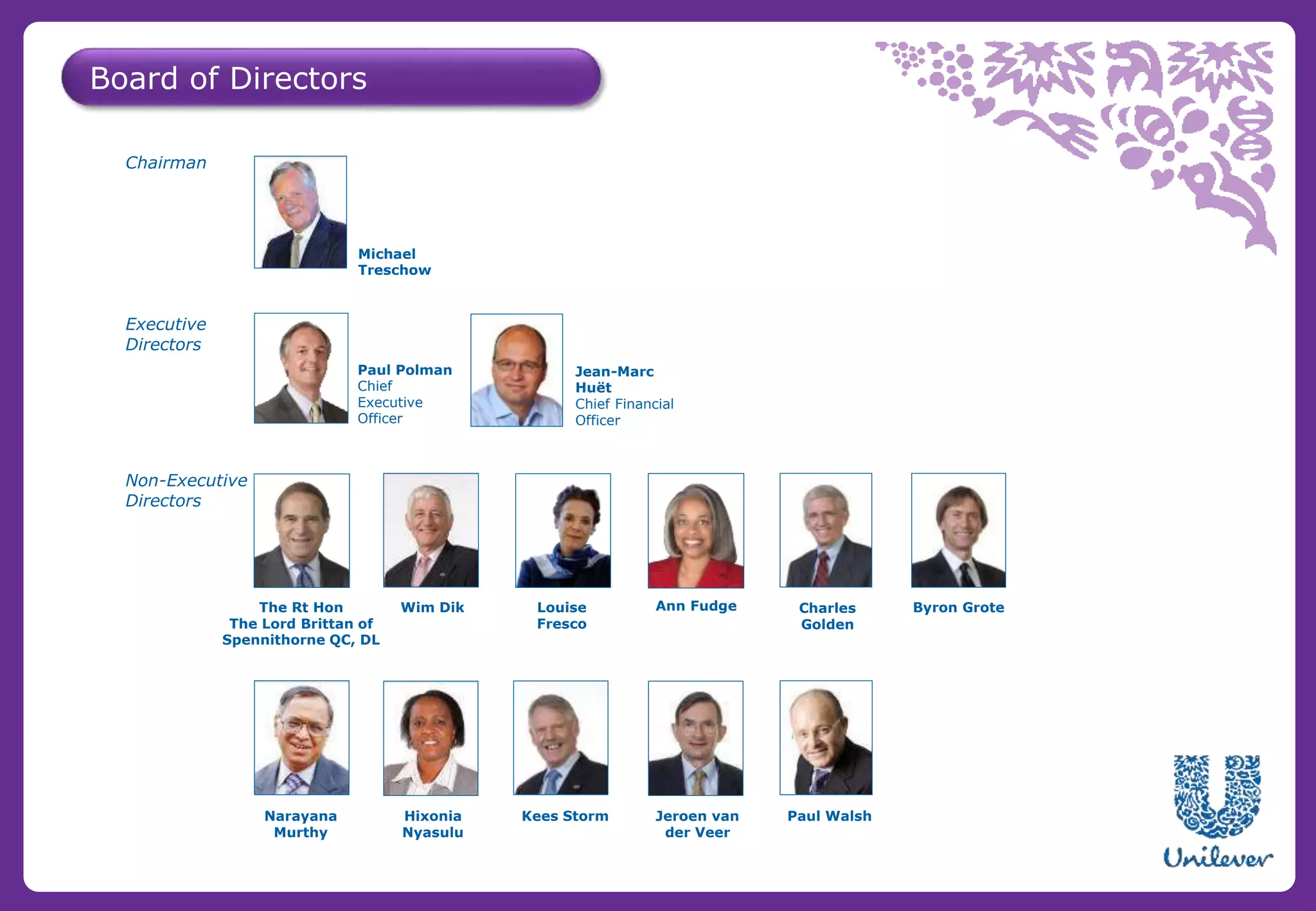
Board of Directors
Chairman
Michael
Treschow
Paul Polman
Chief
Executive
Officer
Jean-Marc
Huët
Chief Financial
Officer
Executive
Directors
Non-Executive
Directors
The Rt Hon
The Lord Brittan of
Spennithorne QC, DL
Wim Dik Louise
Fresco
Ann Fudge Charles
Golden
Byron Grote
Narayana
Murthy
Hixonia
Nyasulu
Kees Storm Jeroen van
der Veer
Paul Walsh
A global management team
Sandy
Ogg
Chief HR
Officer
Geneviève
Berger
Chief R&D
Officer
Michael Polk
President
Global Foods,
Home &
Personal Care
Harish
Manwani
President
Asia, Africa
and Central
& Eastern
Europe
Doug
Baillie
President
Western
Europe
Dave Lewis
President
AmericasPaul Polman
Chief Executive
Officer
Pier Luigi
Sigismondi
Chief Supply
Chain Officer
Jean-Marc
Huët
Chief
Financial
Officer
Keith Weed
Chief Marketing
and
Communications
Officer
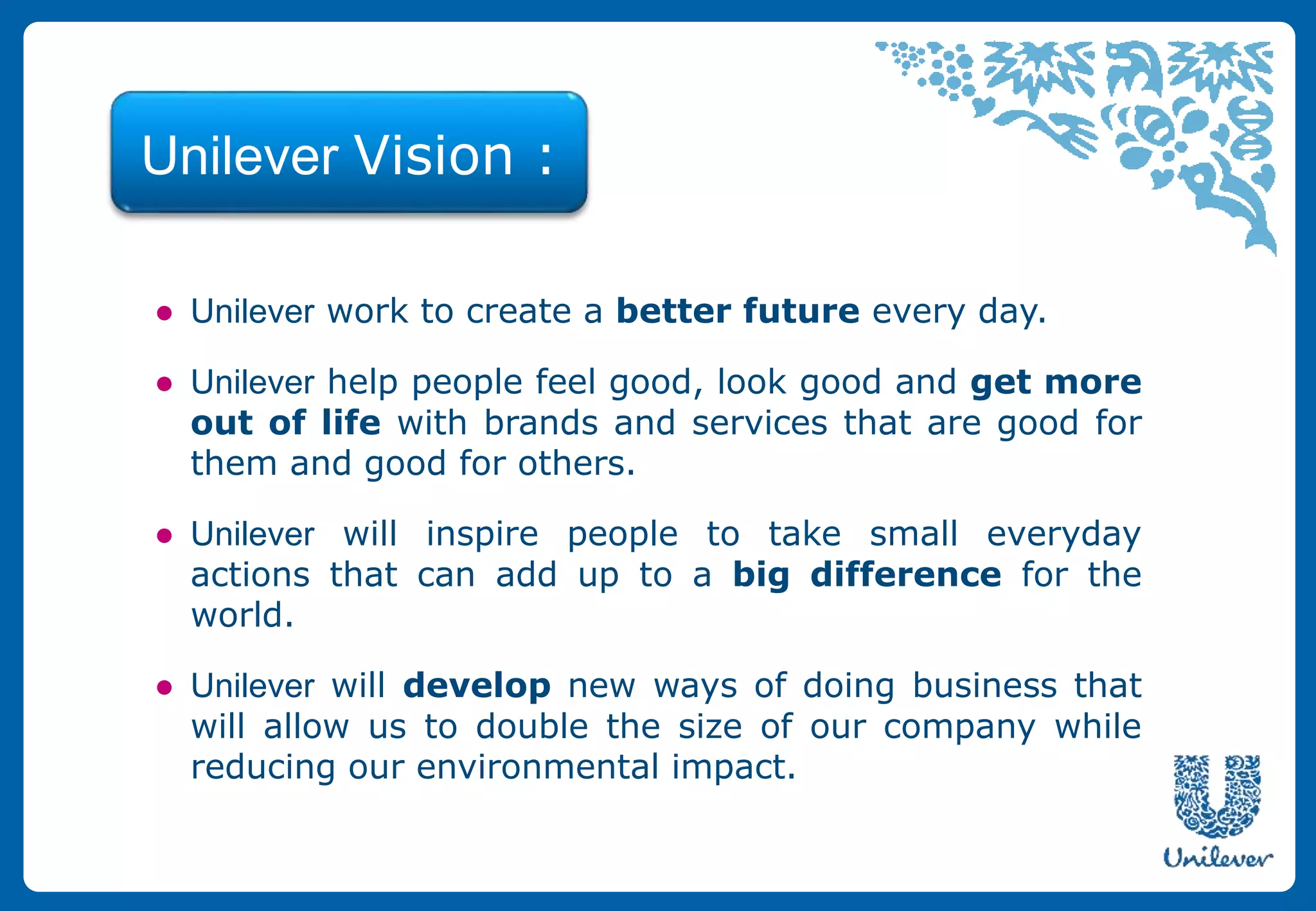
Unilever Vision :
● Unilever work to create a better future every day.
● Unilever help people feel good, look good and get more
out of life with brands and services that are good for
them and good for others.
● Unilever will inspire people to take small everyday
actions that can add up to a big difference for the
world.
● Unilever will develop new ways of doing business that
will allow us to double the size of our company while
reducing our environmental impact.
Categories,
Brands and Regions
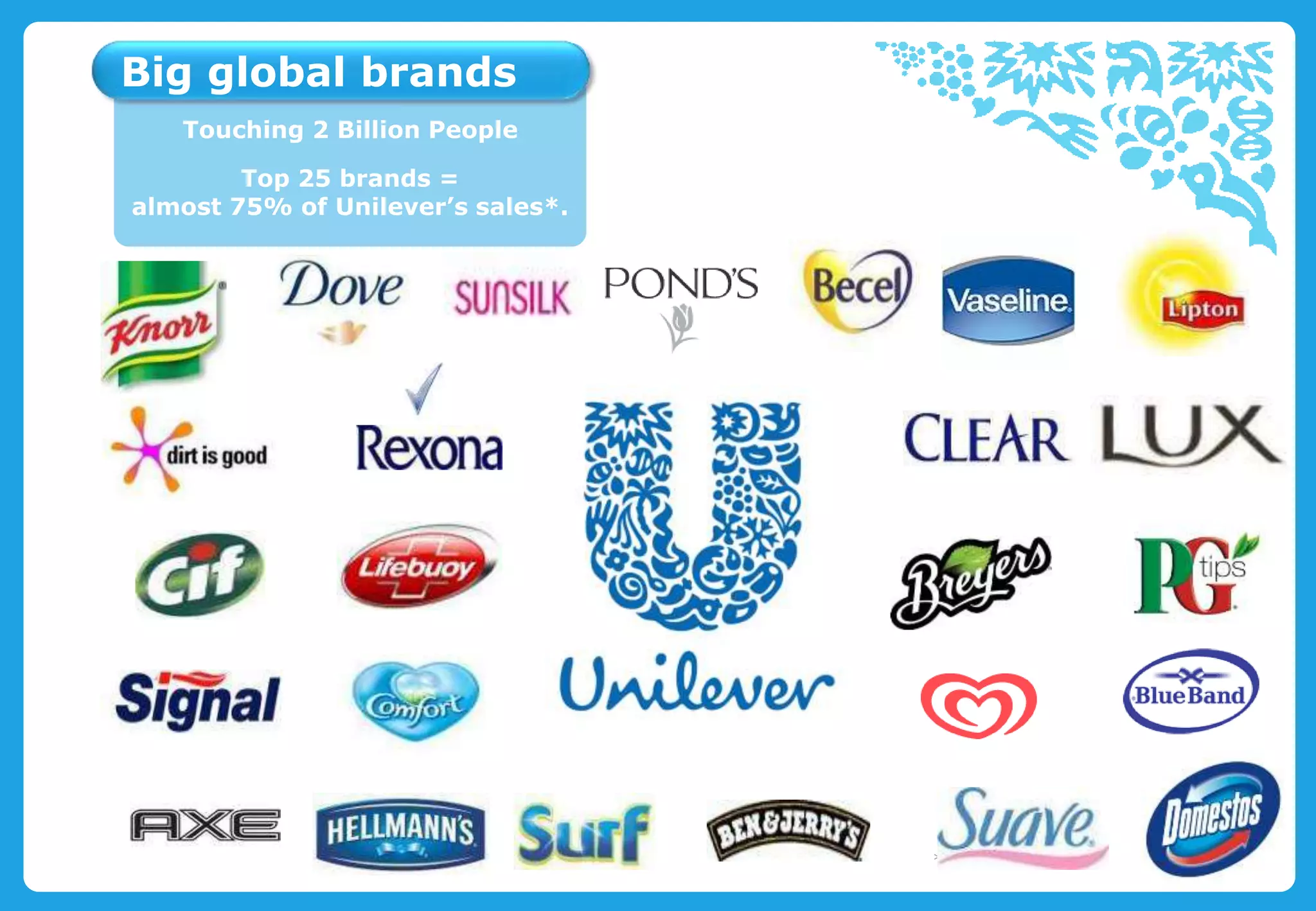
Touching 2 Billion People
Top 25 brands =
almost 75% of Unilever’s sales*.
* As at end 2009
Big global brands
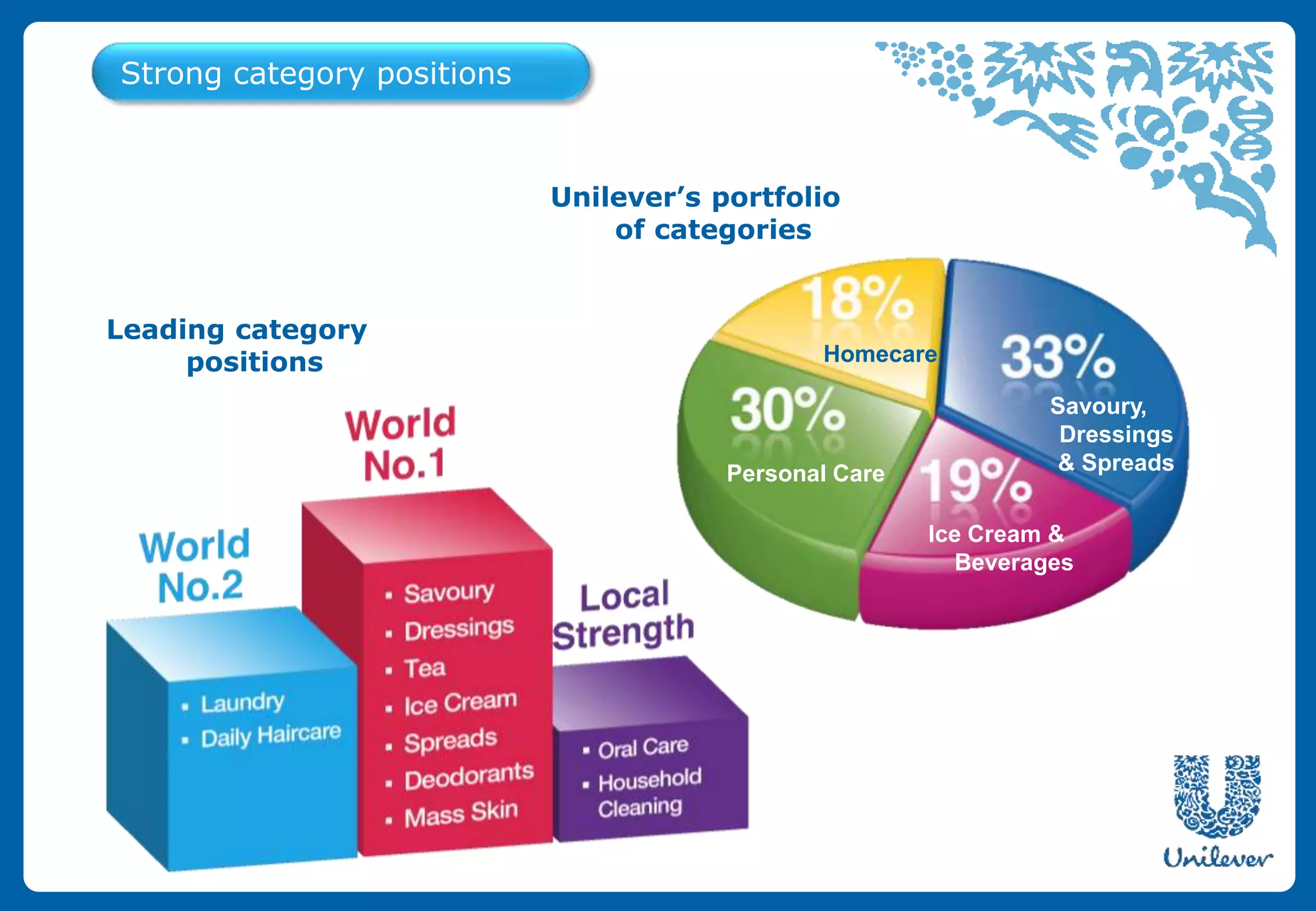
Unilever’s portfolio
of categories
Leading category
positions
Ice Cream &
Beverages
Personal Care
Homecare
Savoury,
Dressings
& Spreads
Strong category positions
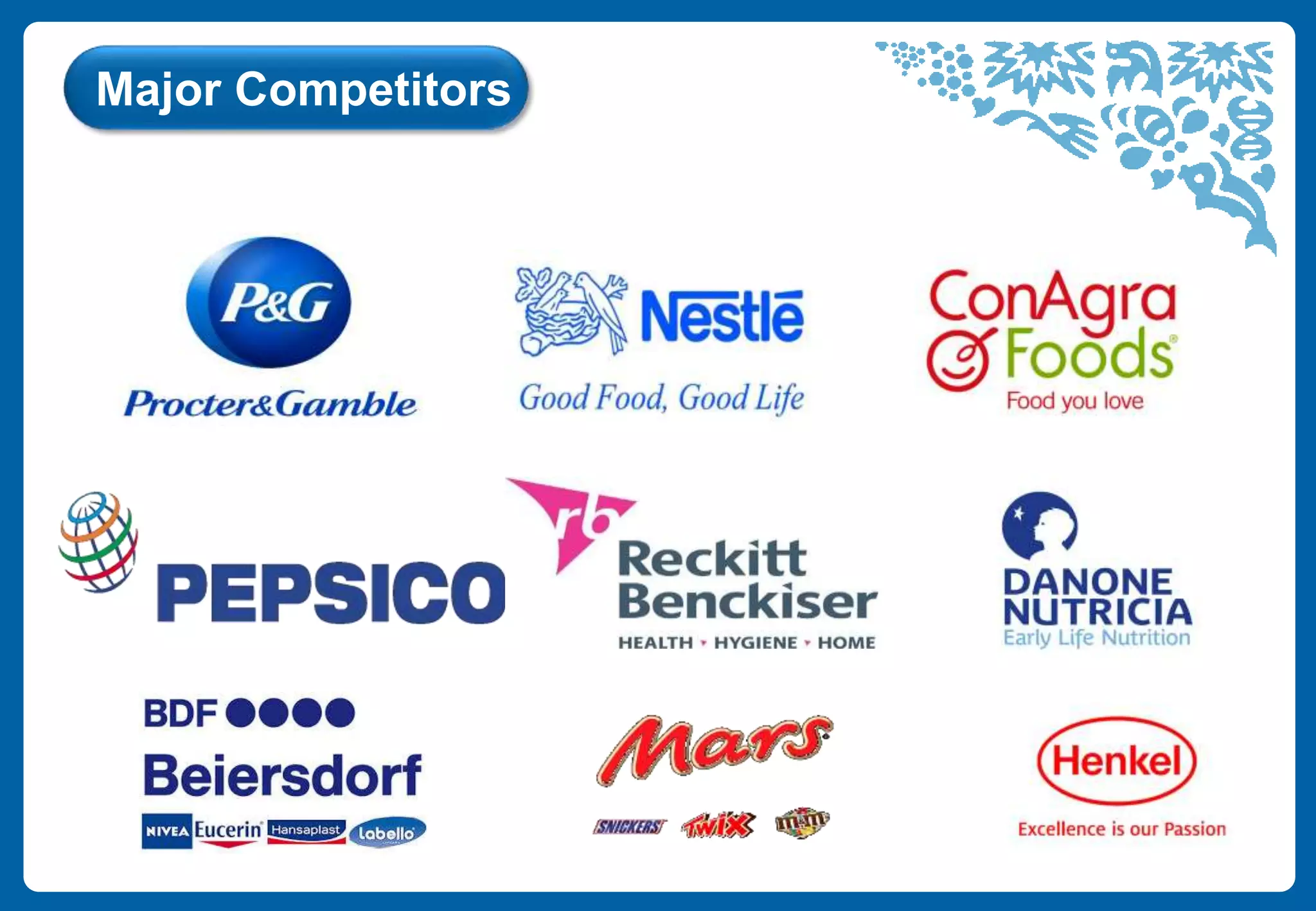
Major Competitors
13
14
€15.3 billion spent on raw materials
and packaging from over
10,000 suppliers in 2009.
Raw materials and ingredients
share of world volume:
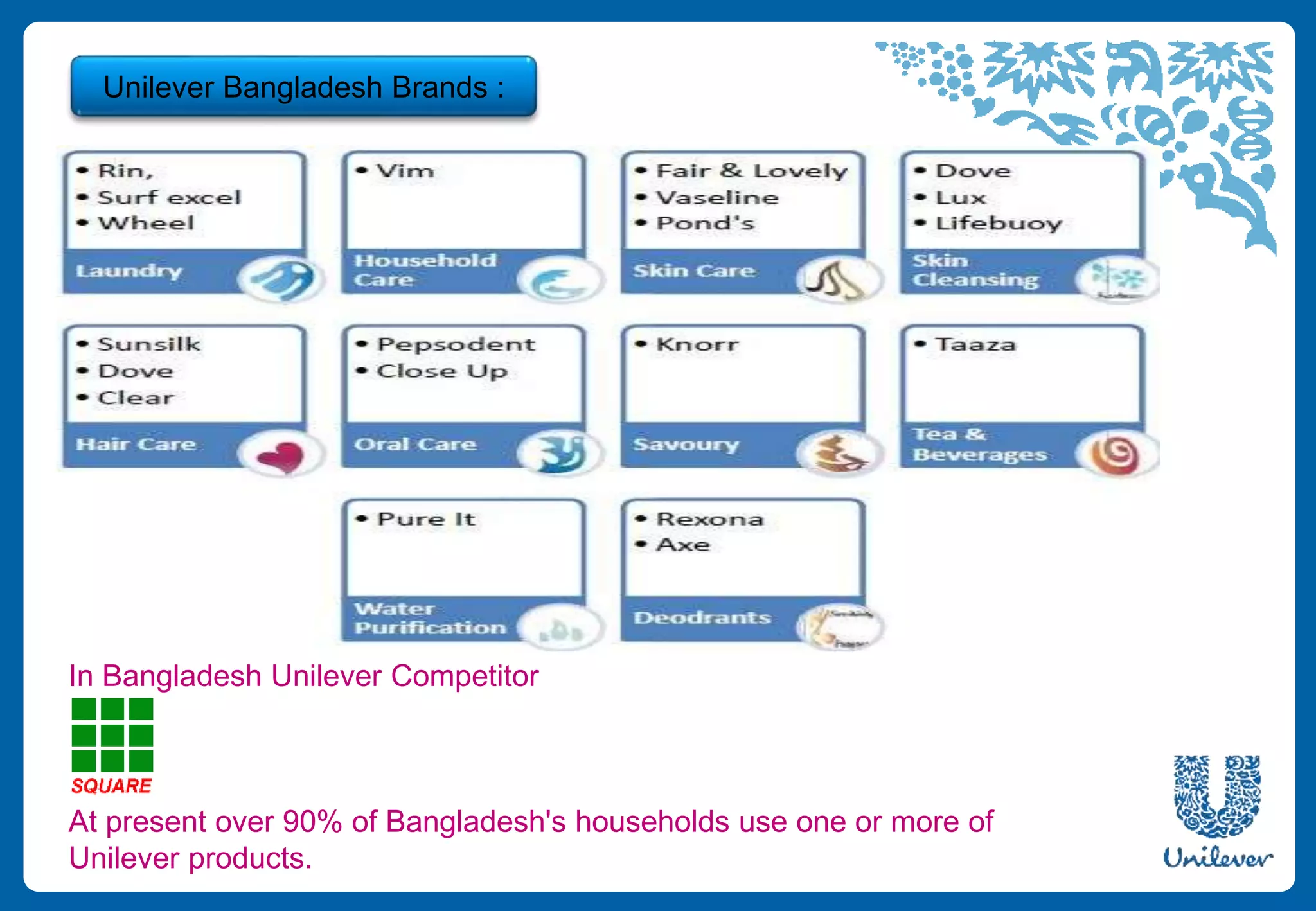
Unilever Bangladesh Brands :
In Bangladesh Unilever Competitor
At present over 90% of Bangladesh's households use one or more of
Unilever products.
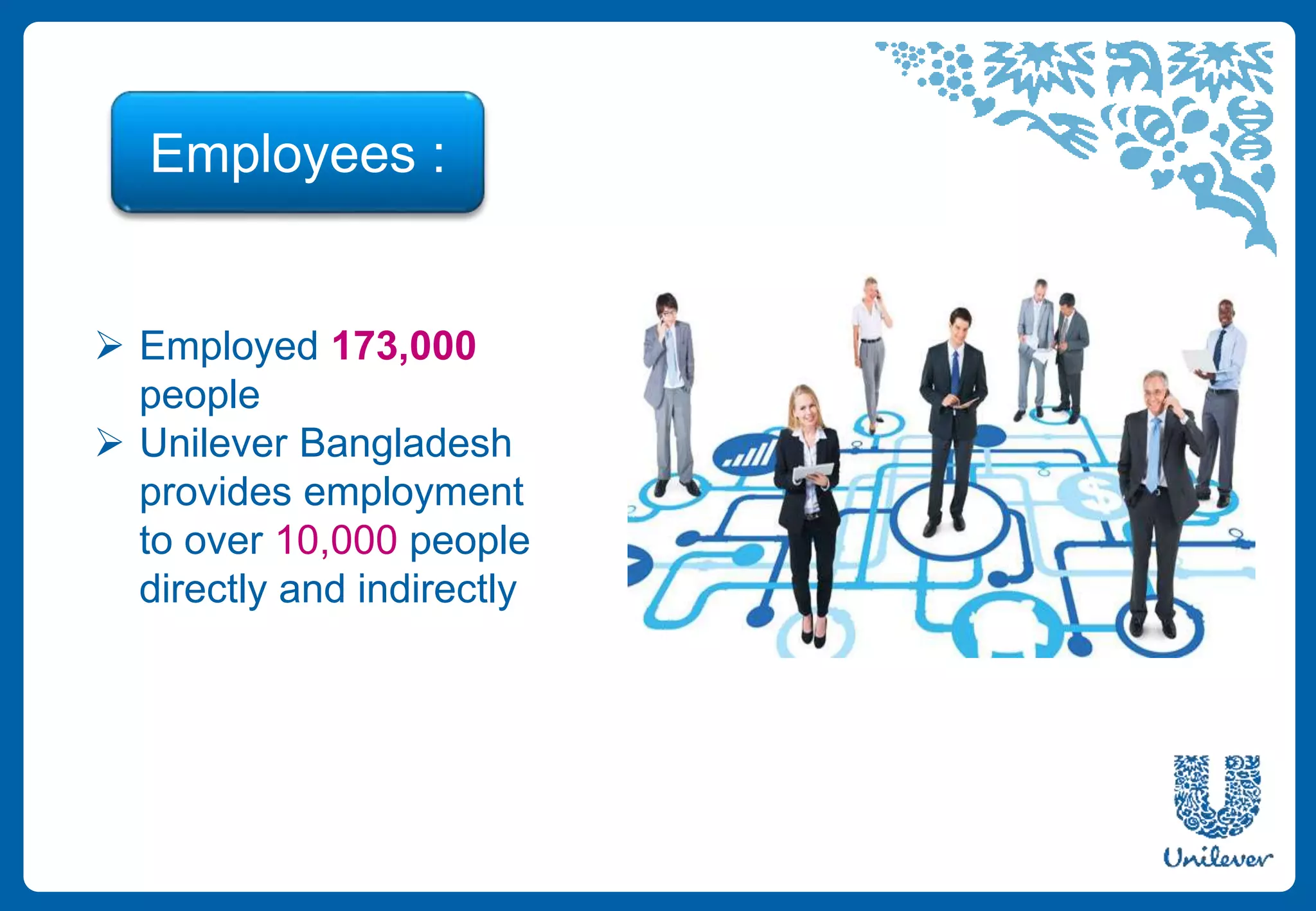
Employees :
 Employed 173,000
people
 Unilever Bangladesh
provides employment
to over 10,000 people
directly and indirectly
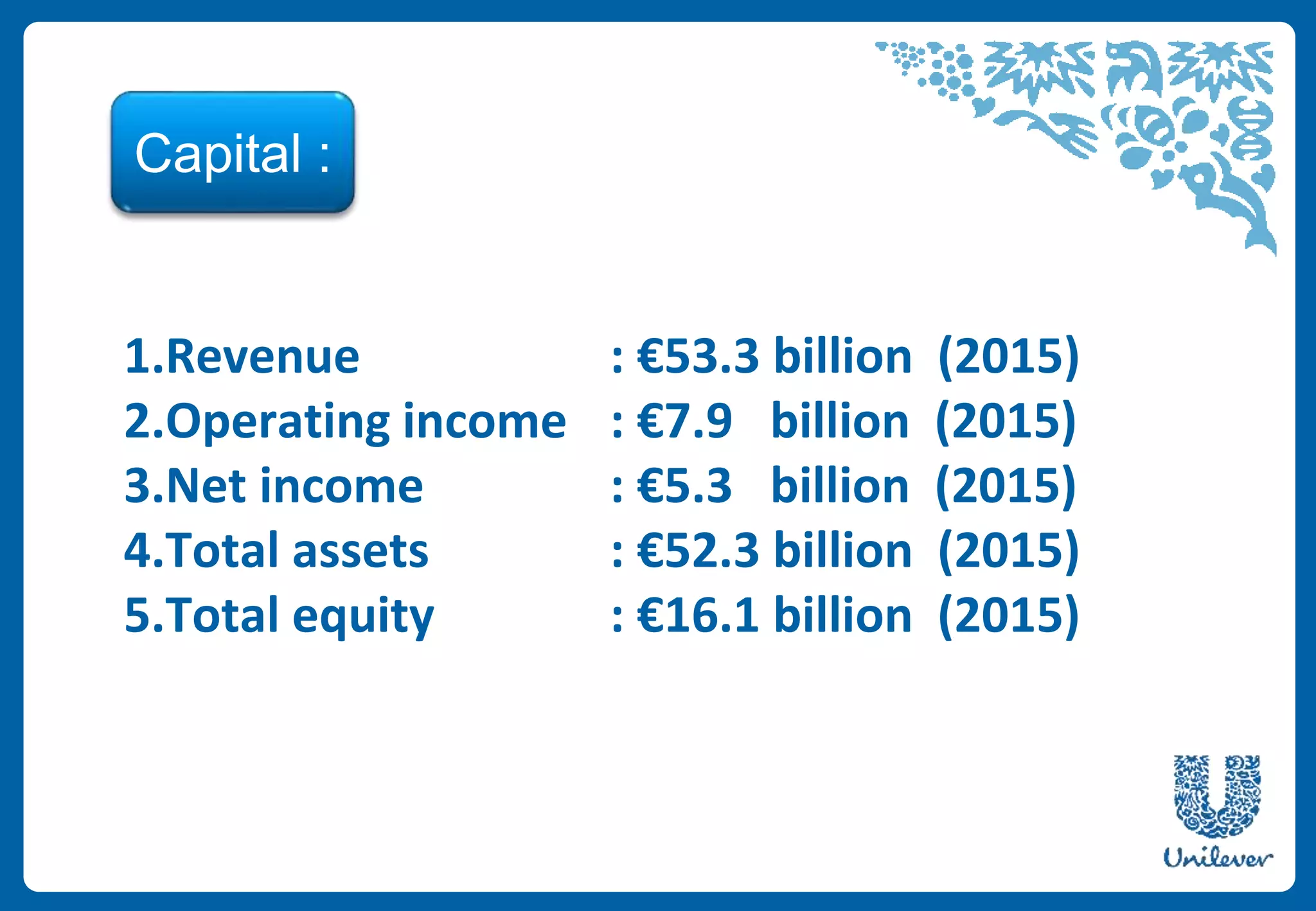
Capital :
1.Revenue : €53.3 billion (2015)
2.Operating income : €7.9 billion (2015)
3.Net income : €5.3 billion (2015)
4.Total assets : €52.3 billion (2015)
5.Total equity : €16.1 billion (2015)
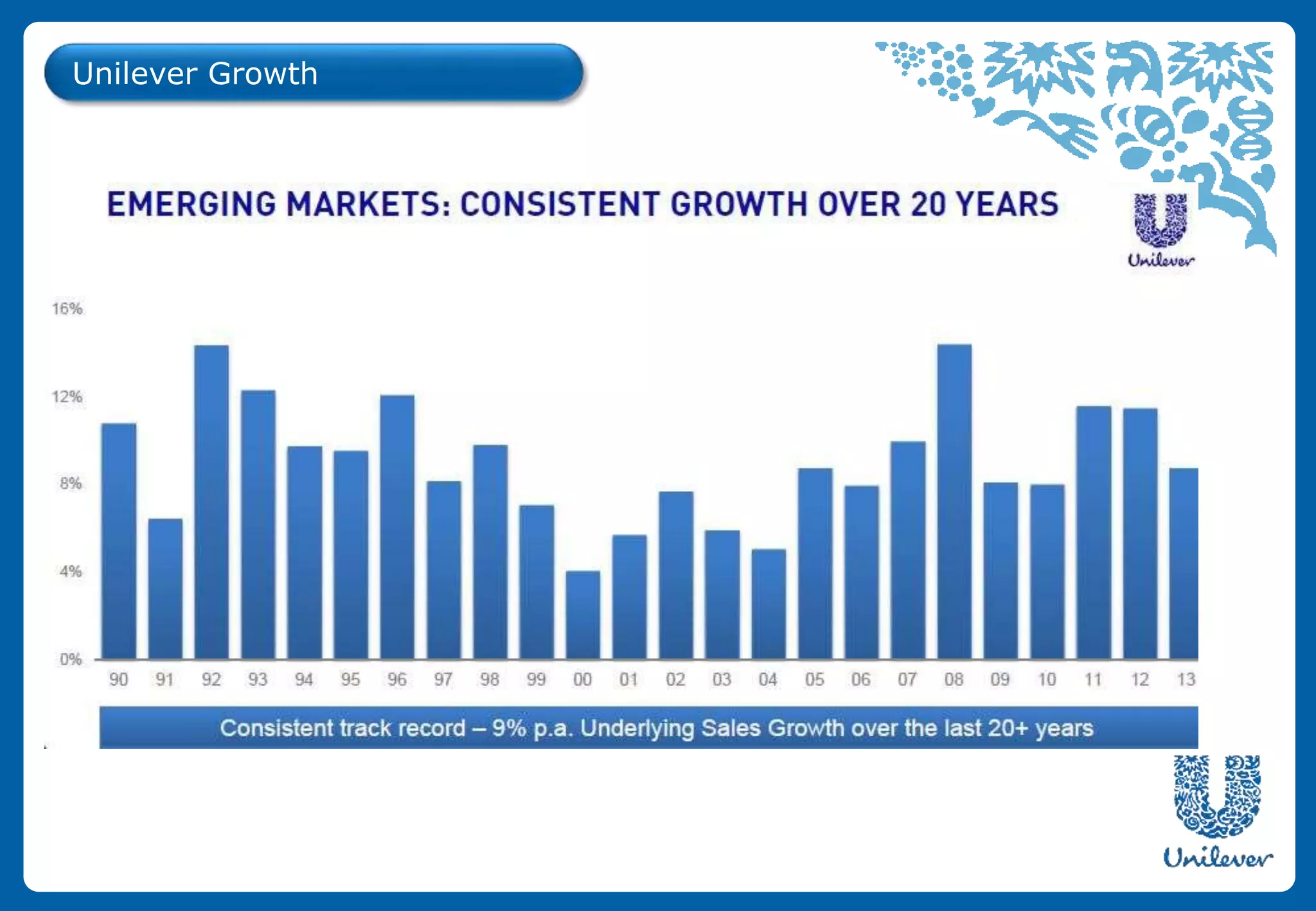
Unilever Growth
21
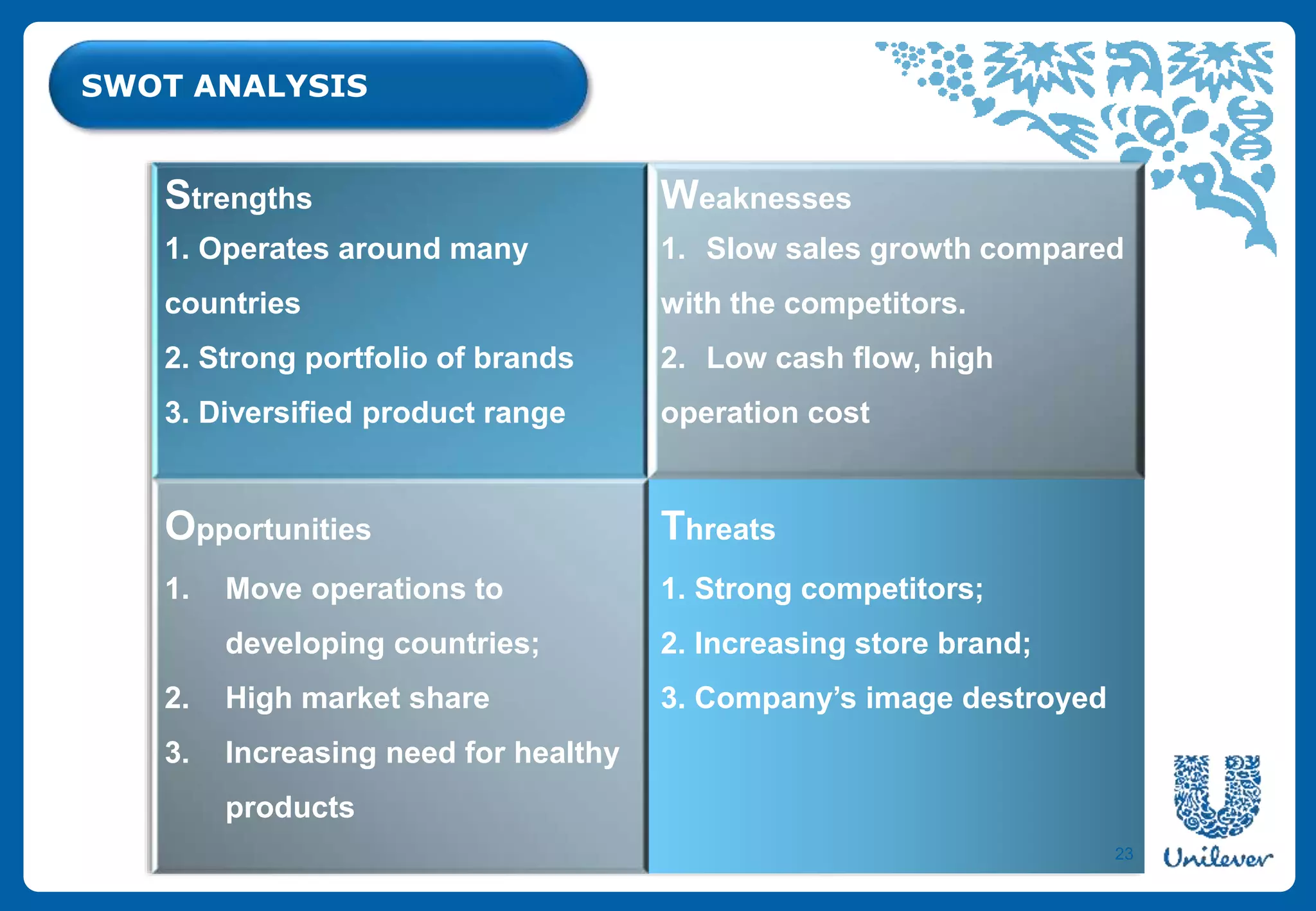
Strengths
1. Operates around many
countries
2. Strong portfolio of brands
3. Diversified product range
Weaknesses
1. Slow sales growth compared
with the competitors.
2. Low cash flow, high
operation cost
Opportunities
1. Move operations to
developing countries;
2. High market share
3. Increasing need for healthy
products
Threats
1. Strong competitors;
2. Increasing store brand;
3. Company’s image destroyed
SWOT ANALYSIS
23
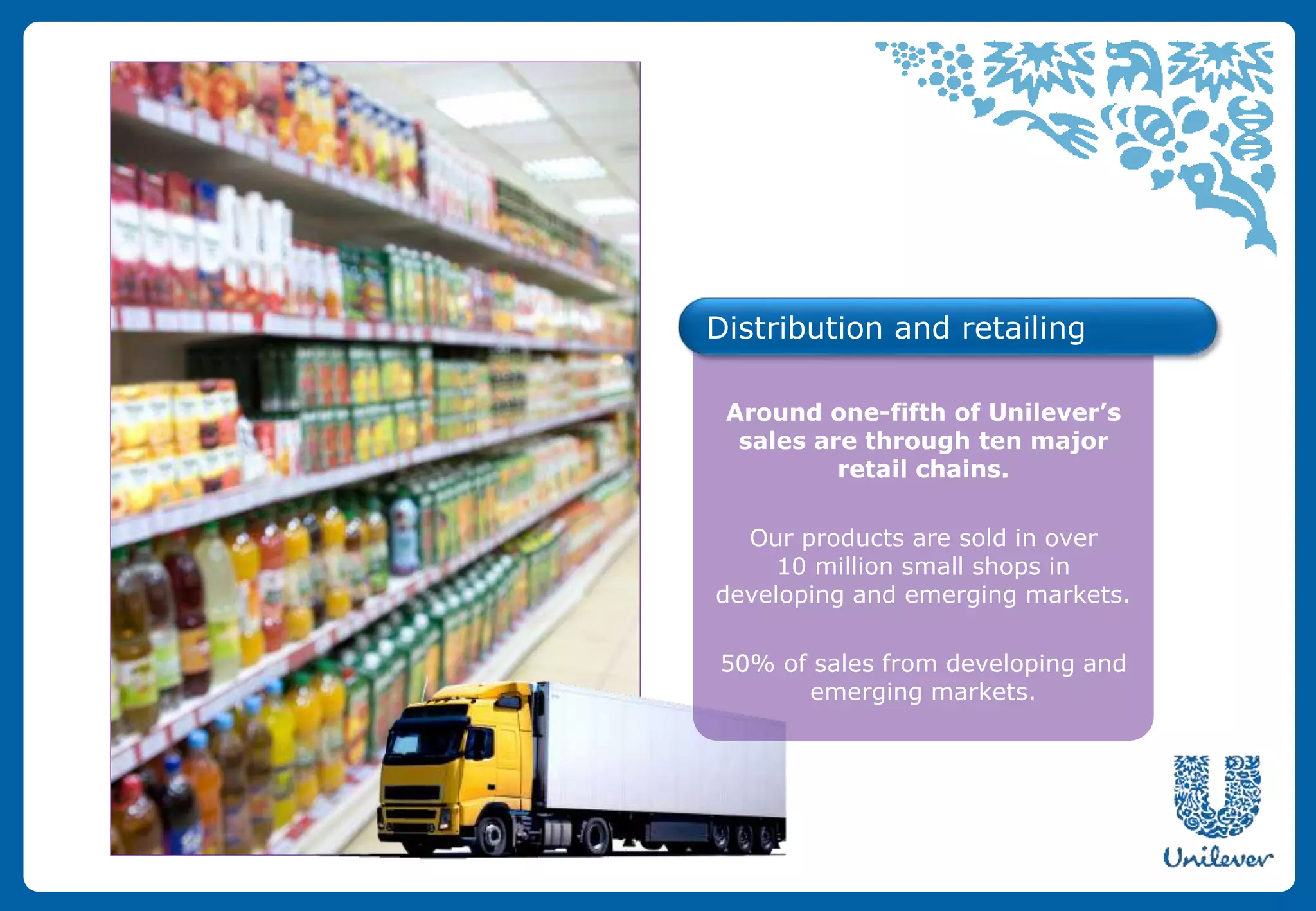
Around one-fifth of Unilever’s
sales are through ten major
retail chains.
Our products are sold in over
10 million small shops in
developing and emerging markets.
50% of sales from developing and
emerging markets.
Distribution and retailing
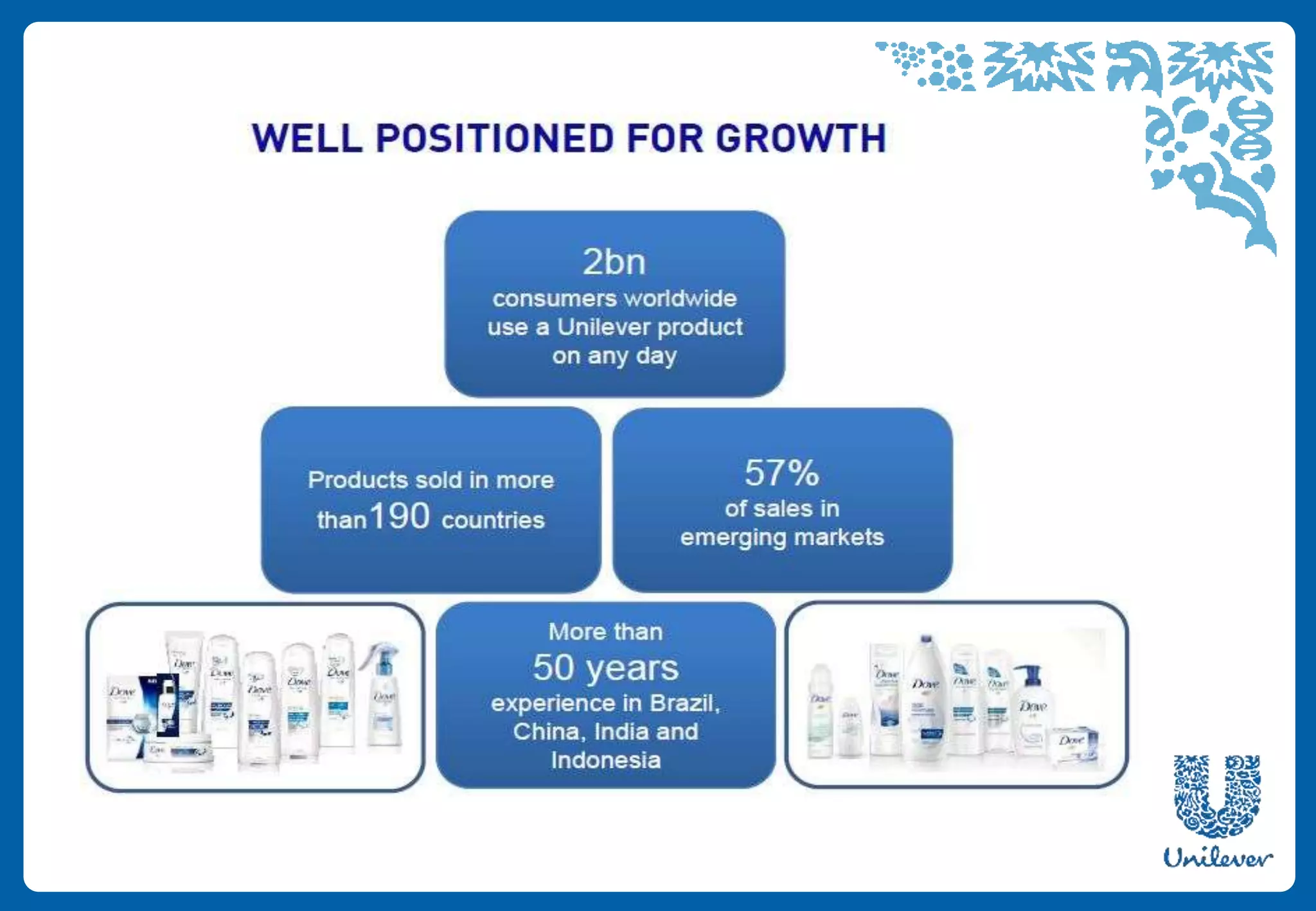
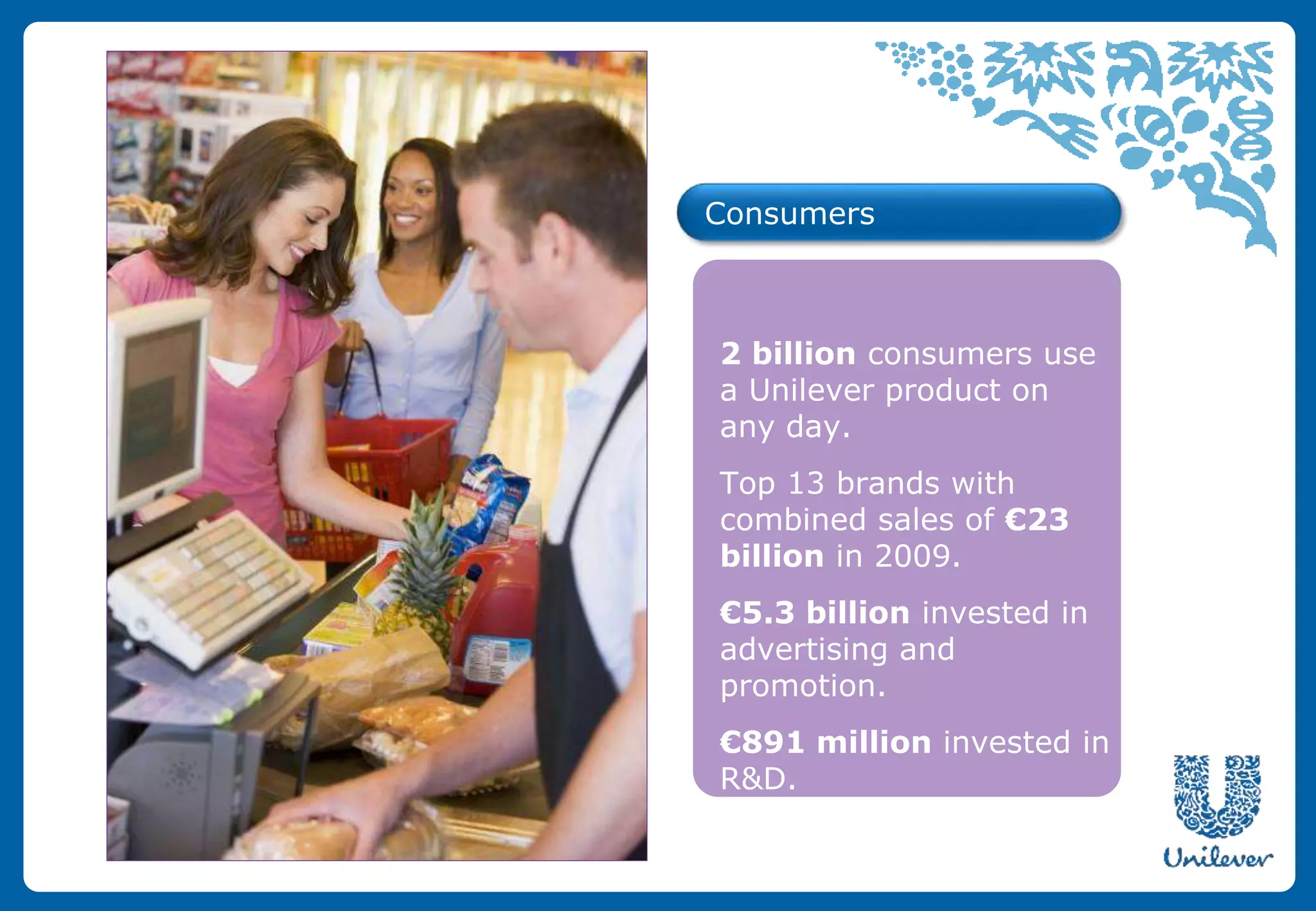
2 billion consumers use
a Unilever product on
any day.
Top 13 brands with
combined sales of €23
billion in 2009.
€5.3 billion invested in
advertising and
promotion.
€891 million invested in
R&D.
Consumers
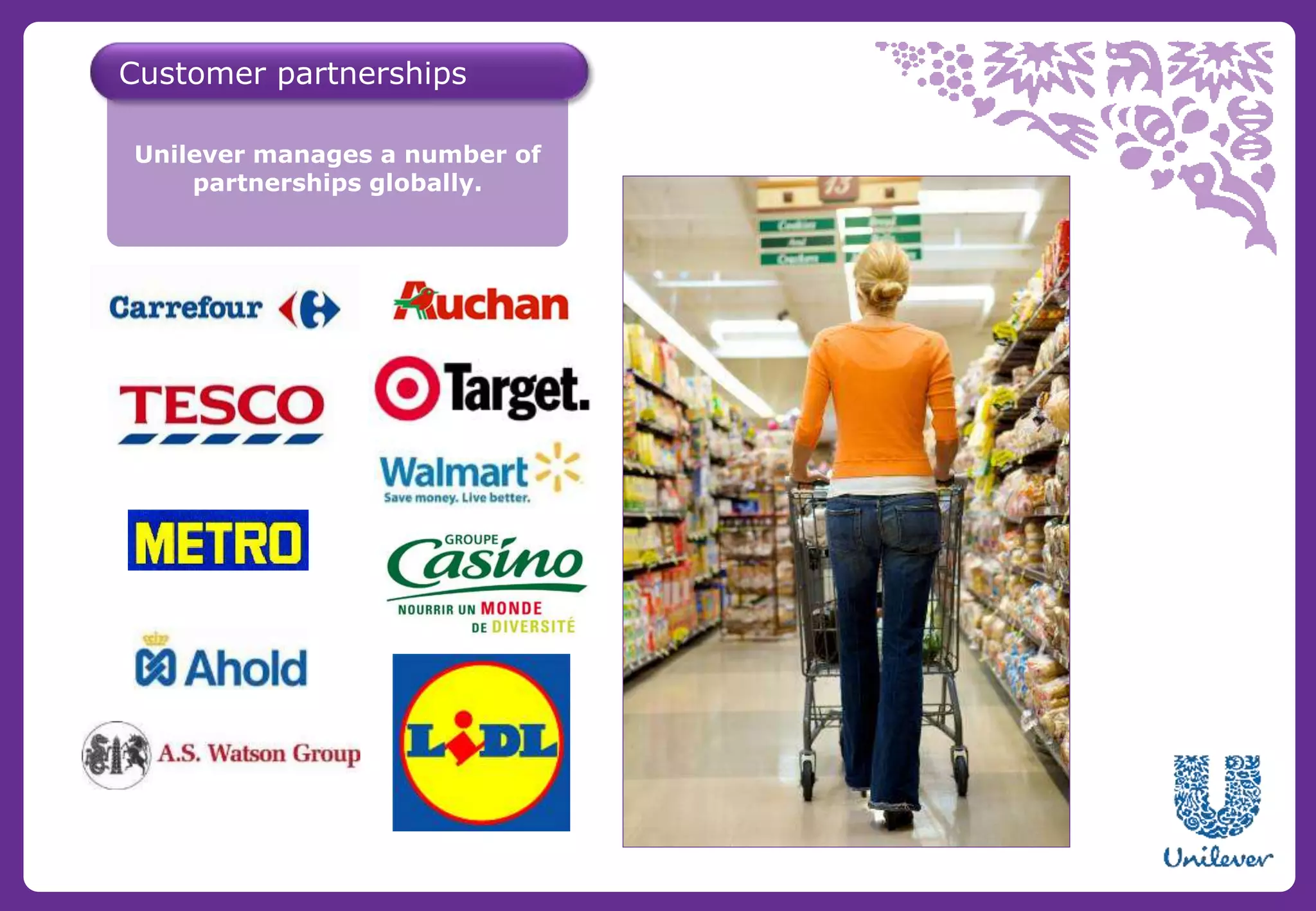
Unilever manages a number of
partnerships globally.
Customer partnerships
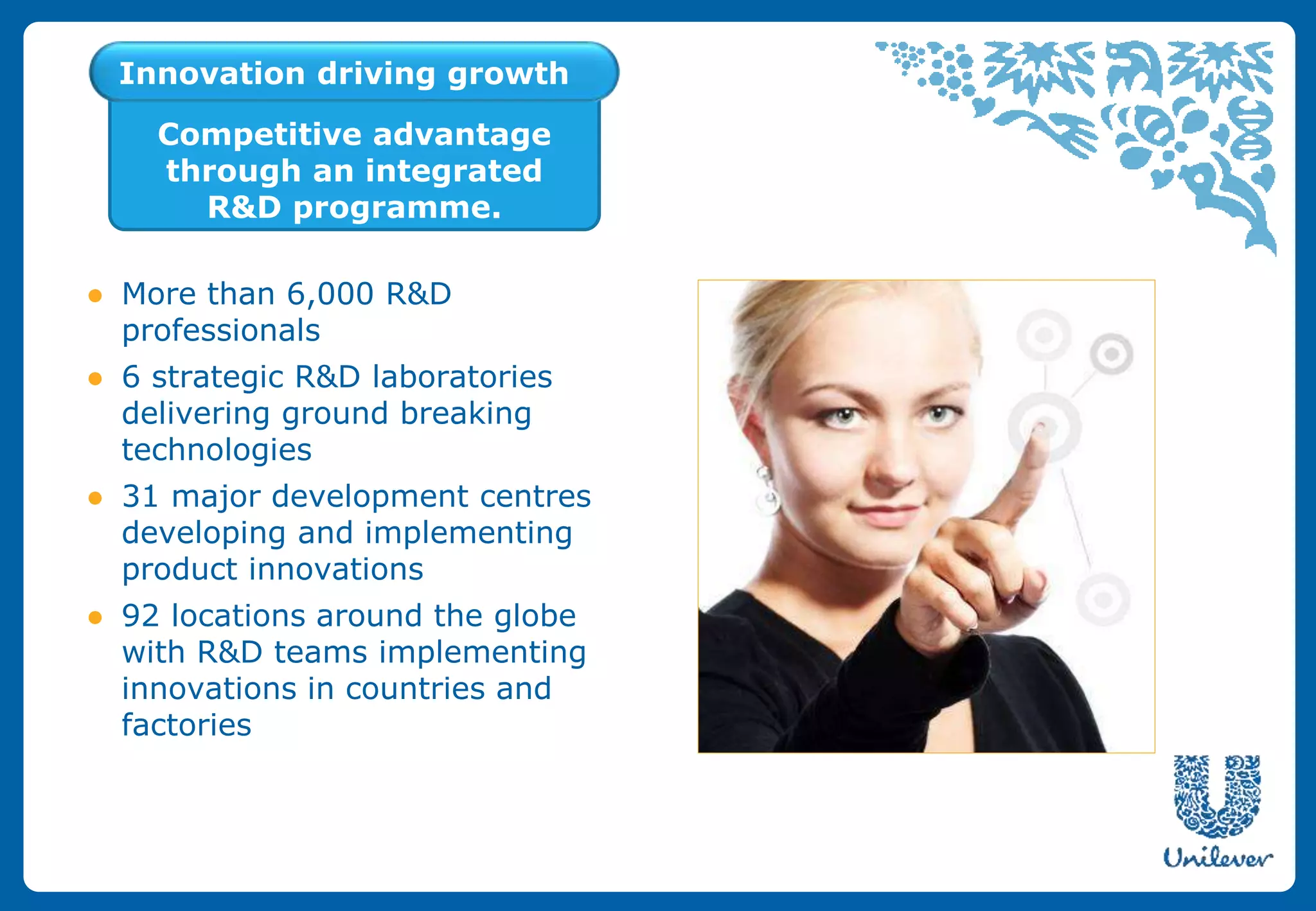
Competitive advantage
through an integrated
R&D programme.
Innovation driving growth
● More than 6,000 R&D
professionals
● 6 strategic R&D laboratories
delivering ground breaking
technologies
● 31 major development centres
developing and implementing
product innovations
● 92 locations around the globe
with R&D teams implementing
innovations in countries and
factories
Social and Environment
Helping society through
our products and
programmes
• 133 million people reached by Lifebuoy
handwashing programmes since 2002
• 15 million people in 3 million households
in India provided with safe drinking water
through Pureit
• 44% of our products in line with
internationally accepted guidelines for
saturated and trans fats, sugar and salt
• Nearly 17 million school meals delivered to
80,000 children in 2009 through our
partnership with the World Food
Programme
• 45,000 women entrepreneurs reach 3
million consumers in 100,000 Indian
villages selling Unilever products door to
door
Social
264 manufacturing sites.
Continuous improvement in
eco-efficiency in factories
(1995–2009):
● 41% reduction in CO2 from
energy
● 65% reduction in water use
● 73% reduction in total waste
Manufacturing
Working in partnership is crucial in
developing and delivering some of
our major sustainability
commitments.
UN World Food
Programme: to feed
hungry children and
improve their nutrition
World Heart Federation:
to promote heart health
Global Alliance for
Improved Nutrition: to
co-create new
approaches in food
fortification to address
malnutrition
FDI World Dental
Federation: to improve
oral health
Global Public-Private
Partnership for
Handwashing with soap:
to promote good
hygiene practice
UN Global Compact: to
align business operations
and strategies in the
areas of human rights,
labour, environment and
anti-corruption
Our principal global partnerships are with:
Working with others
Unilever Presentation

Unilever Presentation

  • 3.
    ID : MBA00905452 ID : MBA 00905451 ID : MBA 00905439 ID : MBA 00905450 Rahul Chandra Nath Razia Sultana Mohammad Shafaet Karim Md. Miftahul Huda Sharifee Group Name :
  • 4.
    Unilever was formedin 1930 from two companies: Margarine Unie and Lever Brothers. Legal structure and governance Margarine Unie (Netherlands) Lever Brothers (UK) ● It was a full business merger, operating as a single business entity. ● Two separate legal parent companies have been maintained: o Unilever NV (Netherlands) and Unilever PLC (UK). ● This works through an equalisation agreement and other contracts between the two companies.
  • 5.
    About Unilever Ata Glance: Public limited company Consumer Goods, Health care, personal Care, foods Owns 400brands but focuses on 14 brands Six subsidiaries country 172000 Employees World’s third largest consumer goods producer
  • 6.
     1885 -1899: Product innovation, 19th Century Style  1900 - 1909: New focus on raw materials  1910 - 1919: A decade of change  1920 - 1929: Unilever is formed  1930 - 1939: Overcoming challenges  1940 - 1949: Focusing on local needs  1950 - 1959: The post-war consumer boom  1960 - 1969: A time for growth  1970 - 1979: Diversifying in a tough climate  1980 - 1989: Focusing on the core  1990 - 1999: Restructuring and consolidating  2000 - 2009: Forging new paths Unilever Timeline
  • 7.
    Board of Directors Chairman Michael Treschow PaulPolman Chief Executive Officer Jean-Marc Huët Chief Financial Officer Executive Directors Non-Executive Directors The Rt Hon The Lord Brittan of Spennithorne QC, DL Wim Dik Louise Fresco Ann Fudge Charles Golden Byron Grote Narayana Murthy Hixonia Nyasulu Kees Storm Jeroen van der Veer Paul Walsh
  • 8.
    A global managementteam Sandy Ogg Chief HR Officer Geneviève Berger Chief R&D Officer Michael Polk President Global Foods, Home & Personal Care Harish Manwani President Asia, Africa and Central & Eastern Europe Doug Baillie President Western Europe Dave Lewis President AmericasPaul Polman Chief Executive Officer Pier Luigi Sigismondi Chief Supply Chain Officer Jean-Marc Huët Chief Financial Officer Keith Weed Chief Marketing and Communications Officer
  • 9.
    Unilever Vision : ●Unilever work to create a better future every day. ● Unilever help people feel good, look good and get more out of life with brands and services that are good for them and good for others. ● Unilever will inspire people to take small everyday actions that can add up to a big difference for the world. ● Unilever will develop new ways of doing business that will allow us to double the size of our company while reducing our environmental impact.
  • 10.
  • 11.
    Touching 2 BillionPeople Top 25 brands = almost 75% of Unilever’s sales*. * As at end 2009 Big global brands
  • 12.
    Unilever’s portfolio of categories Leadingcategory positions Ice Cream & Beverages Personal Care Homecare Savoury, Dressings & Spreads Strong category positions
  • 13.
  • 14.
  • 15.
    €15.3 billion spenton raw materials and packaging from over 10,000 suppliers in 2009. Raw materials and ingredients share of world volume:
  • 16.
    Unilever Bangladesh Brands: In Bangladesh Unilever Competitor At present over 90% of Bangladesh's households use one or more of Unilever products.
  • 17.
    Employees :  Employed173,000 people  Unilever Bangladesh provides employment to over 10,000 people directly and indirectly
  • 18.
    Capital : 1.Revenue :€53.3 billion (2015) 2.Operating income : €7.9 billion (2015) 3.Net income : €5.3 billion (2015) 4.Total assets : €52.3 billion (2015) 5.Total equity : €16.1 billion (2015)
  • 20.
  • 21.
  • 23.
    Strengths 1. Operates aroundmany countries 2. Strong portfolio of brands 3. Diversified product range Weaknesses 1. Slow sales growth compared with the competitors. 2. Low cash flow, high operation cost Opportunities 1. Move operations to developing countries; 2. High market share 3. Increasing need for healthy products Threats 1. Strong competitors; 2. Increasing store brand; 3. Company’s image destroyed SWOT ANALYSIS 23
  • 24.
    Around one-fifth ofUnilever’s sales are through ten major retail chains. Our products are sold in over 10 million small shops in developing and emerging markets. 50% of sales from developing and emerging markets. Distribution and retailing
  • 25.
    2 billion consumersuse a Unilever product on any day. Top 13 brands with combined sales of €23 billion in 2009. €5.3 billion invested in advertising and promotion. €891 million invested in R&D. Consumers
  • 26.
    Unilever manages anumber of partnerships globally. Customer partnerships
  • 27.
    Competitive advantage through anintegrated R&D programme. Innovation driving growth ● More than 6,000 R&D professionals ● 6 strategic R&D laboratories delivering ground breaking technologies ● 31 major development centres developing and implementing product innovations ● 92 locations around the globe with R&D teams implementing innovations in countries and factories
  • 28.
  • 29.
    Helping society through ourproducts and programmes • 133 million people reached by Lifebuoy handwashing programmes since 2002 • 15 million people in 3 million households in India provided with safe drinking water through Pureit • 44% of our products in line with internationally accepted guidelines for saturated and trans fats, sugar and salt • Nearly 17 million school meals delivered to 80,000 children in 2009 through our partnership with the World Food Programme • 45,000 women entrepreneurs reach 3 million consumers in 100,000 Indian villages selling Unilever products door to door Social
  • 30.
    264 manufacturing sites. Continuousimprovement in eco-efficiency in factories (1995–2009): ● 41% reduction in CO2 from energy ● 65% reduction in water use ● 73% reduction in total waste Manufacturing
  • 31.
    Working in partnershipis crucial in developing and delivering some of our major sustainability commitments. UN World Food Programme: to feed hungry children and improve their nutrition World Heart Federation: to promote heart health Global Alliance for Improved Nutrition: to co-create new approaches in food fortification to address malnutrition FDI World Dental Federation: to improve oral health Global Public-Private Partnership for Handwashing with soap: to promote good hygiene practice UN Global Compact: to align business operations and strategies in the areas of human rights, labour, environment and anti-corruption Our principal global partnerships are with: Working with others