www.dicamp.eu
Strategic Analysis of
Unilever
Innovation Management Master
Module: Innovation Strategy
By: Roukaya ISSAOUI
www.dicamp.eu
Agenda
•Introduction
•1-Company Overview
•Unilever mission and Vision.
•2-Competitive Environment :
• Home and personal Care industry
• Competitors
• Porter 5 forces analysis
• Unilever VS Procter and Gamble
•Packaged food and beverage Industry
•Competitors
• Porter 5 forces analysis
• Unilever VS Nestlé
•3- Unilever Strategies and moves
•4-Marketing strategy
•5-Innovation strategy
•6-Situation of Unilever and SWOT analysis
•7- Recapitulation
www.dicamp.eu
Introduction
Unilever is one of the world’s top makers
of packaged consumer goods operating
in 190 countries and have a large brand
portfolio of over 400 brands under two
divisions : Foods and Home & Personal
care. Unilever is one of the world’s top
three food firms with Nestle and Kraft-
and the world’s second largest packaged
consumer goods company –behind
Procter & Gamble. The main success
factor of the company is the constant
focus on innovative product
developments
www.dicamp.eu
Company Overview
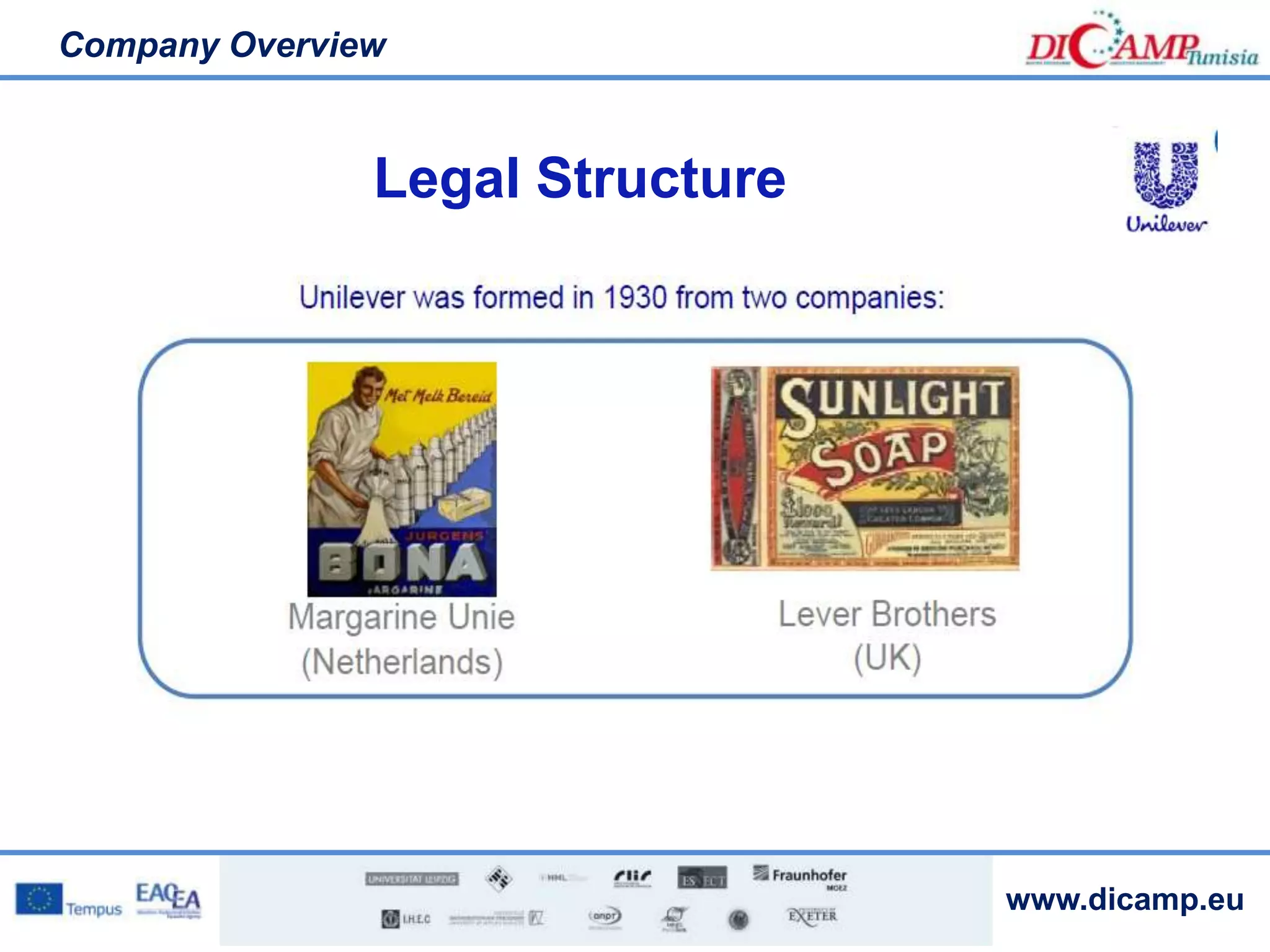
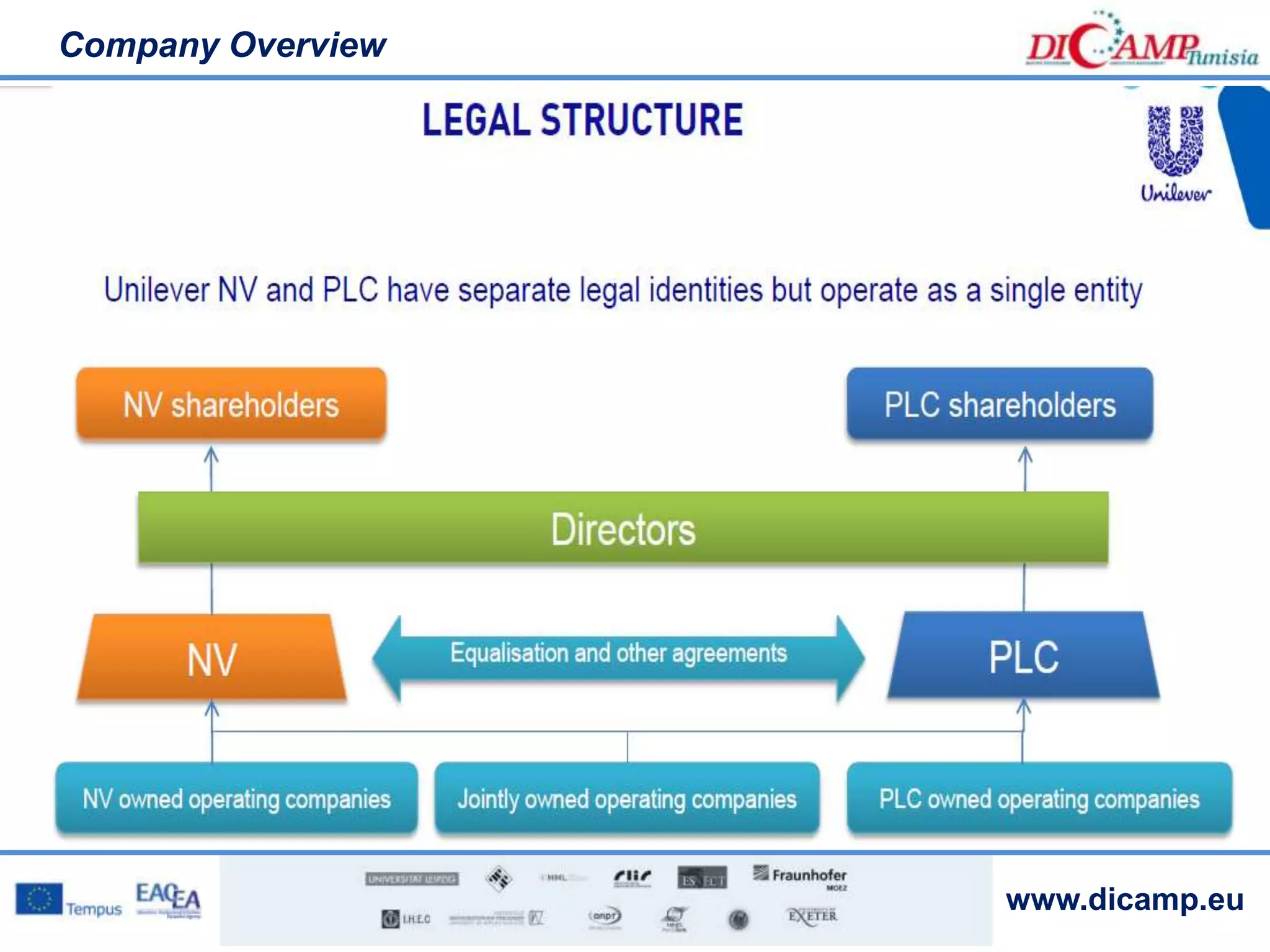
Legal Structure
www.dicamp.eu
Company Overview
www.dicamp.eu
Company Overview
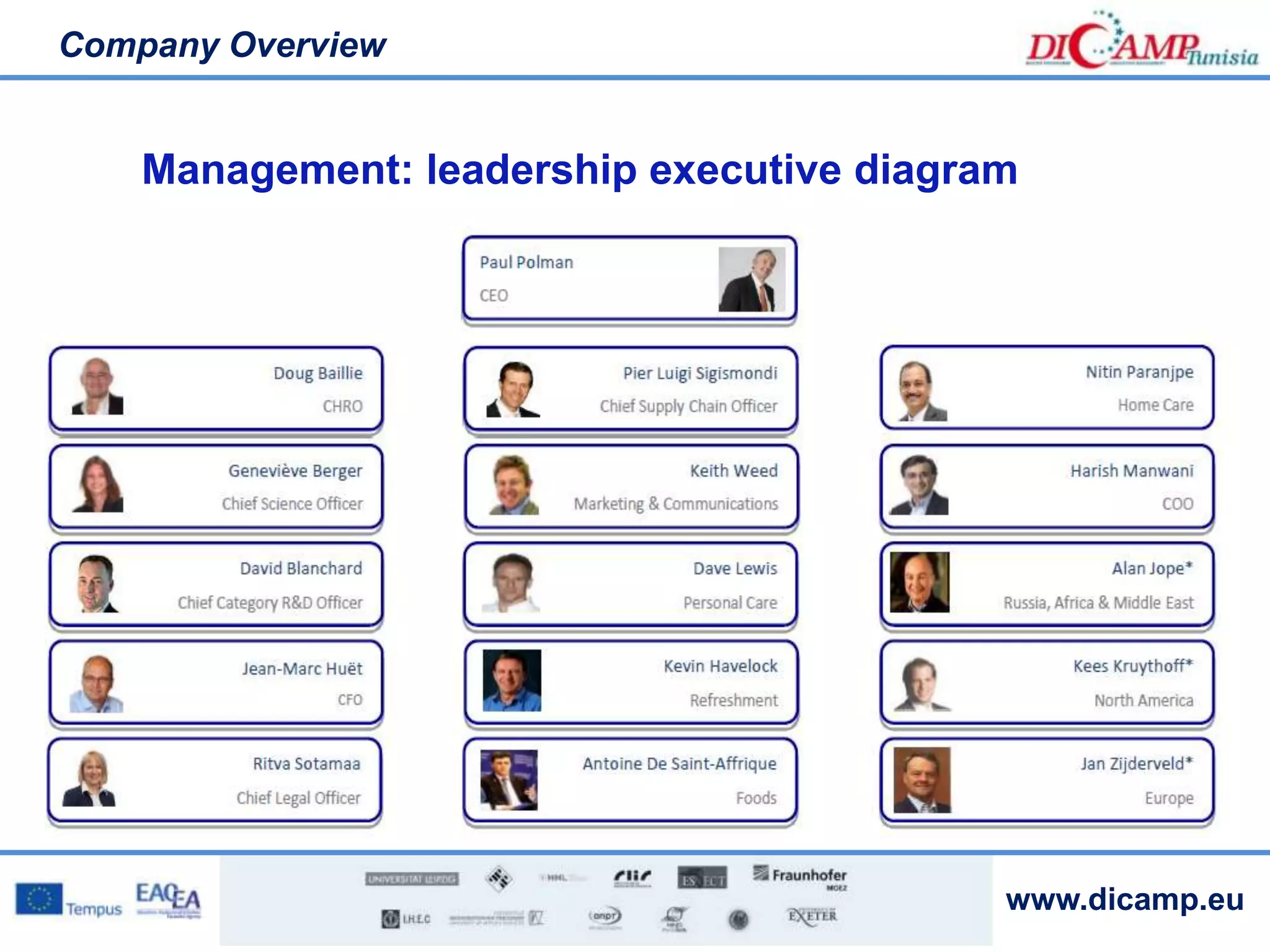
Management: leadership executive diagram
www.dicamp.eu
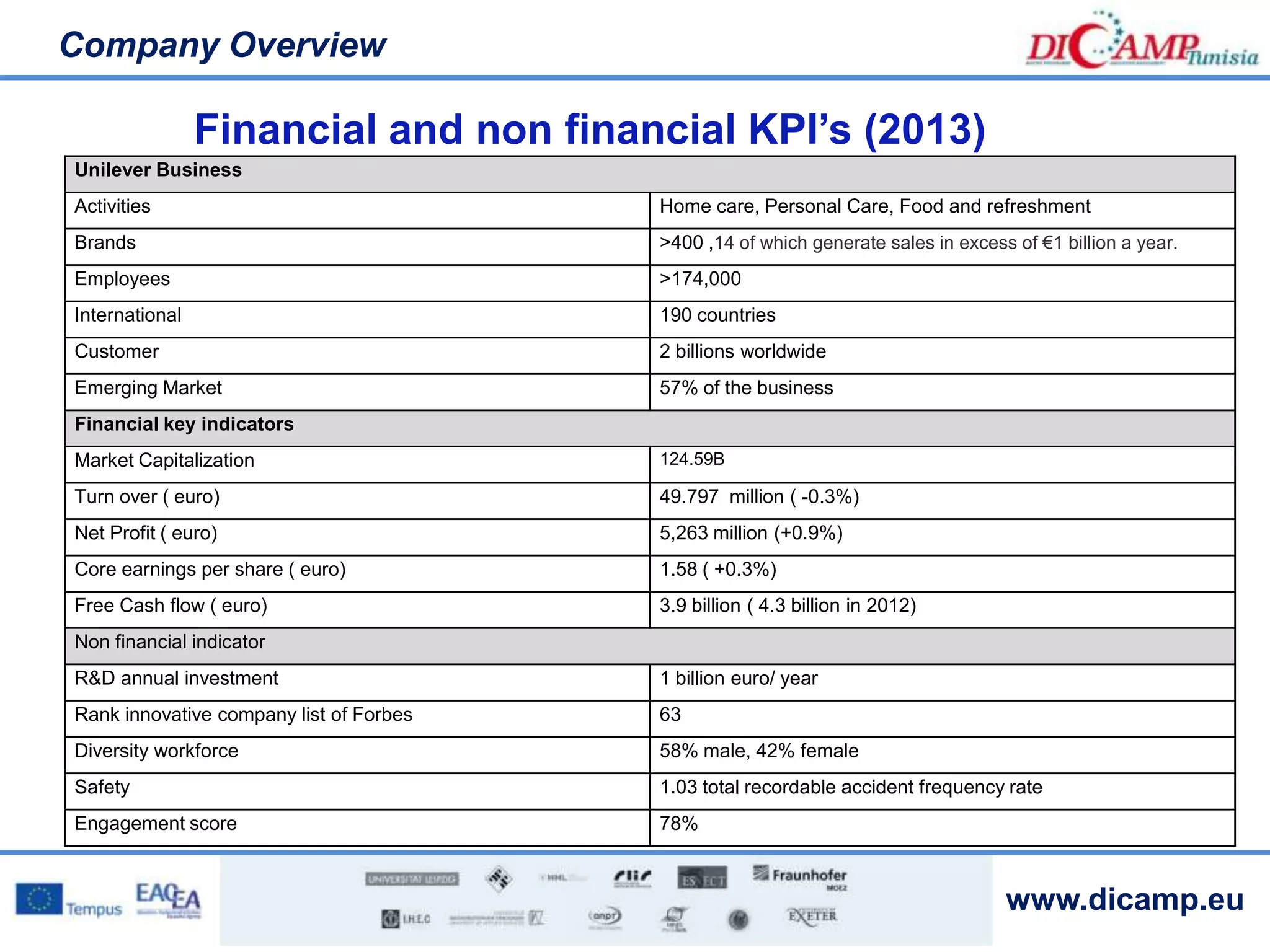
Unilever Business
Activities Home care, Personal Care, Food and refreshment
Brands >400 ,14 of which generate sales in excess of €1 billion a year.
Employees >174,000
International 190 countries
Customer 2 billions worldwide
Emerging Market 57% of the business
Financial key indicators
Market Capitalization 124.59B
Turn over ( euro) 49.797 million ( -0.3%)
Net Profit ( euro) 5,263 million (+0.9%)
Core earnings per share ( euro) 1.58 ( +0.3%)
Free Cash flow ( euro) 3.9 billion ( 4.3 billion in 2012)
Non financial indicator
R&D annual investment 1 billion euro/ year
Rank innovative company list of Forbes 63
Diversity workforce 58% male, 42% female
Safety 1.03 total recordable accident frequency rate
Engagement score 78%
Company Overview
Financial and non financial KPI’s (2013)
www.dicamp.eu
Mission and Vision
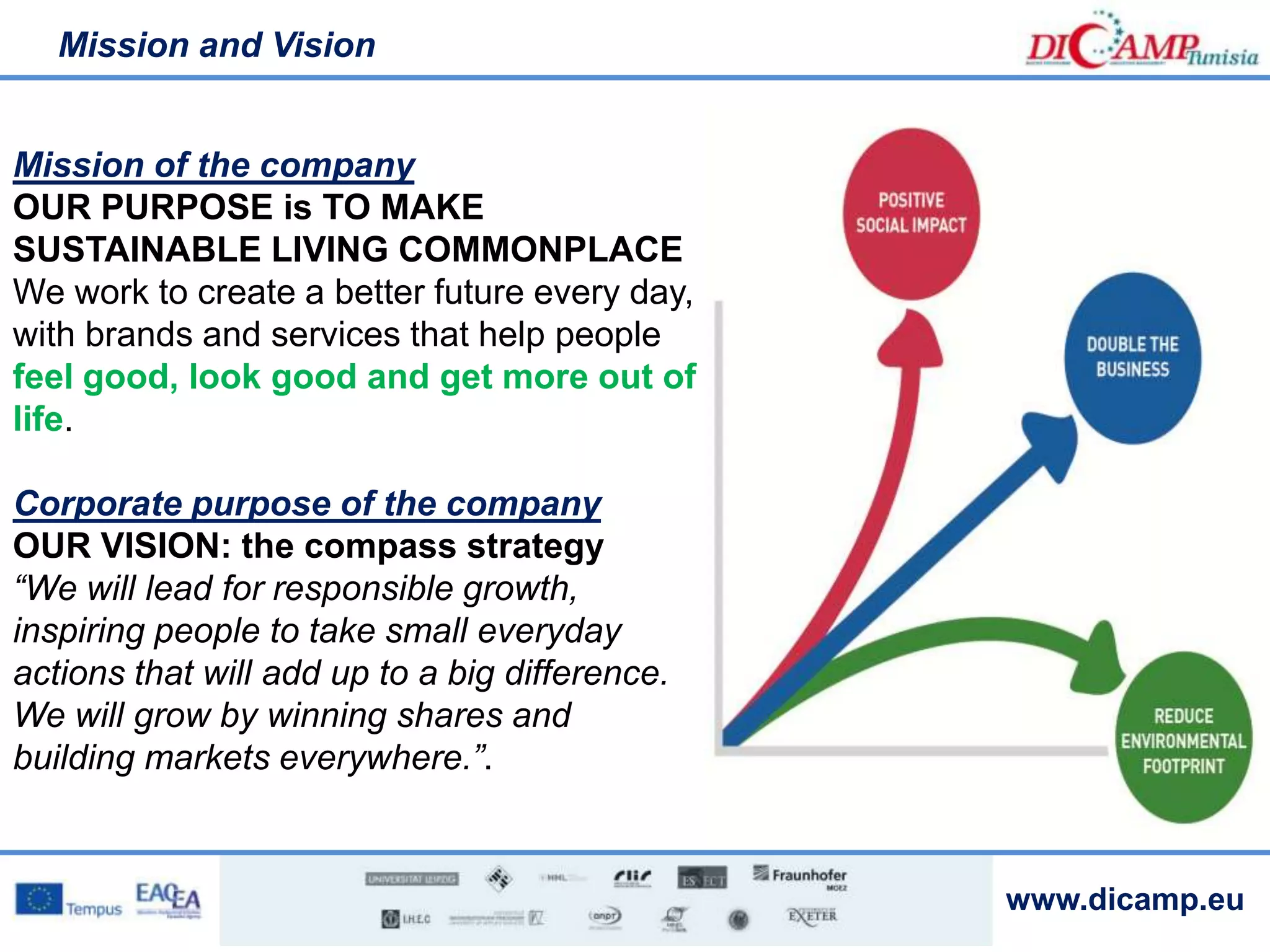
Mission of the company
OUR PURPOSE is TO MAKE
SUSTAINABLE LIVING COMMONPLACE
We work to create a better future every day,
with brands and services that help people
feel good, look good and get more out of
life.
Corporate purpose of the company
OUR VISION: the compass strategy
“We will lead for responsible growth,
inspiring people to take small everyday
actions that will add up to a big difference.
We will grow by winning shares and
building markets everywhere.”.
www.dicamp.eu
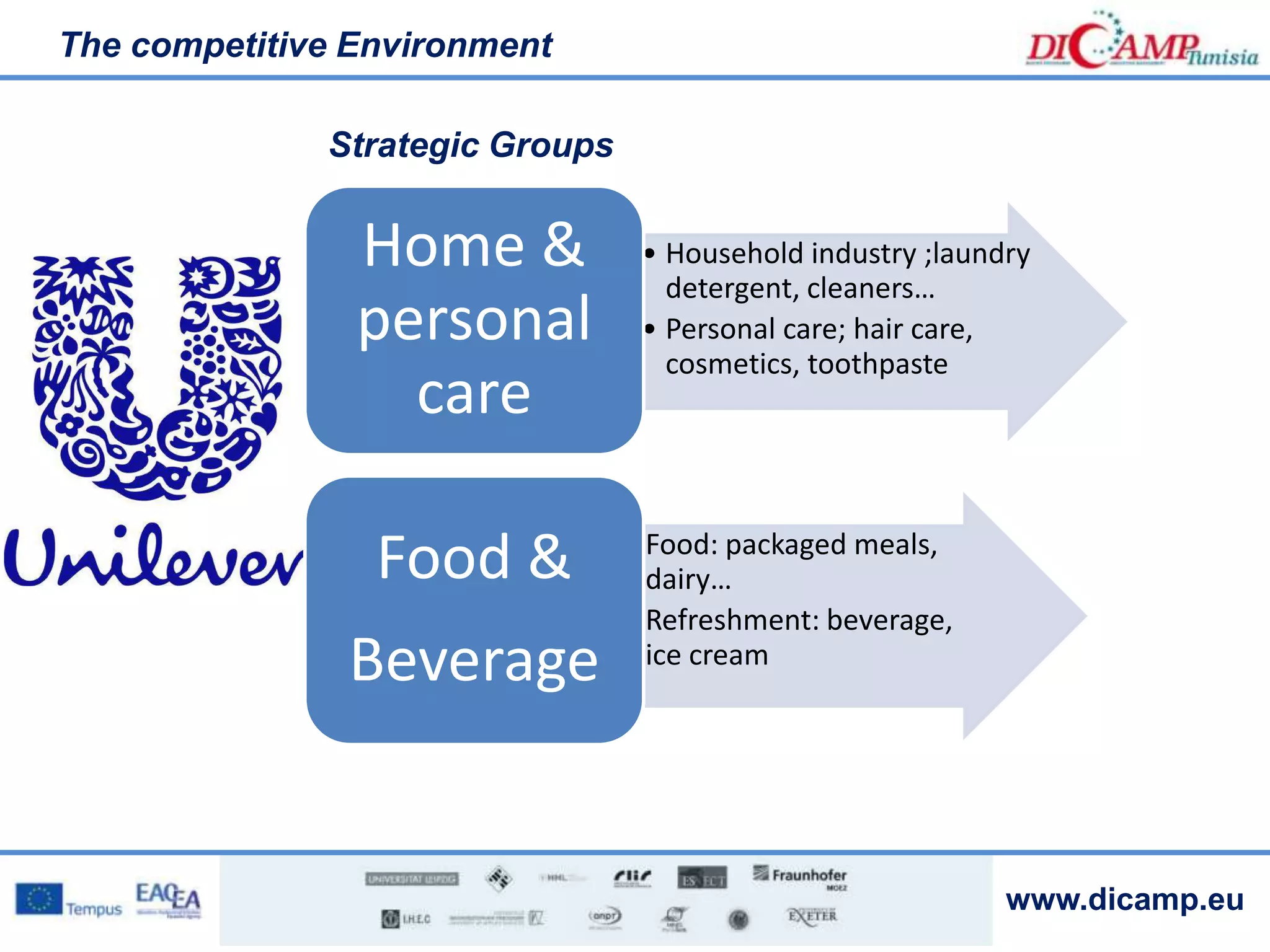
The competitive Environment
• Household industry ;laundry
detergent, cleaners…
• Personal care; hair care,
cosmetics, toothpaste
Home &
personal
care
• Food: packaged meals,
dairy…
• Refreshment: beverage,
ice cream
Food &
Beverage
Strategic Groups
www.dicamp.eu
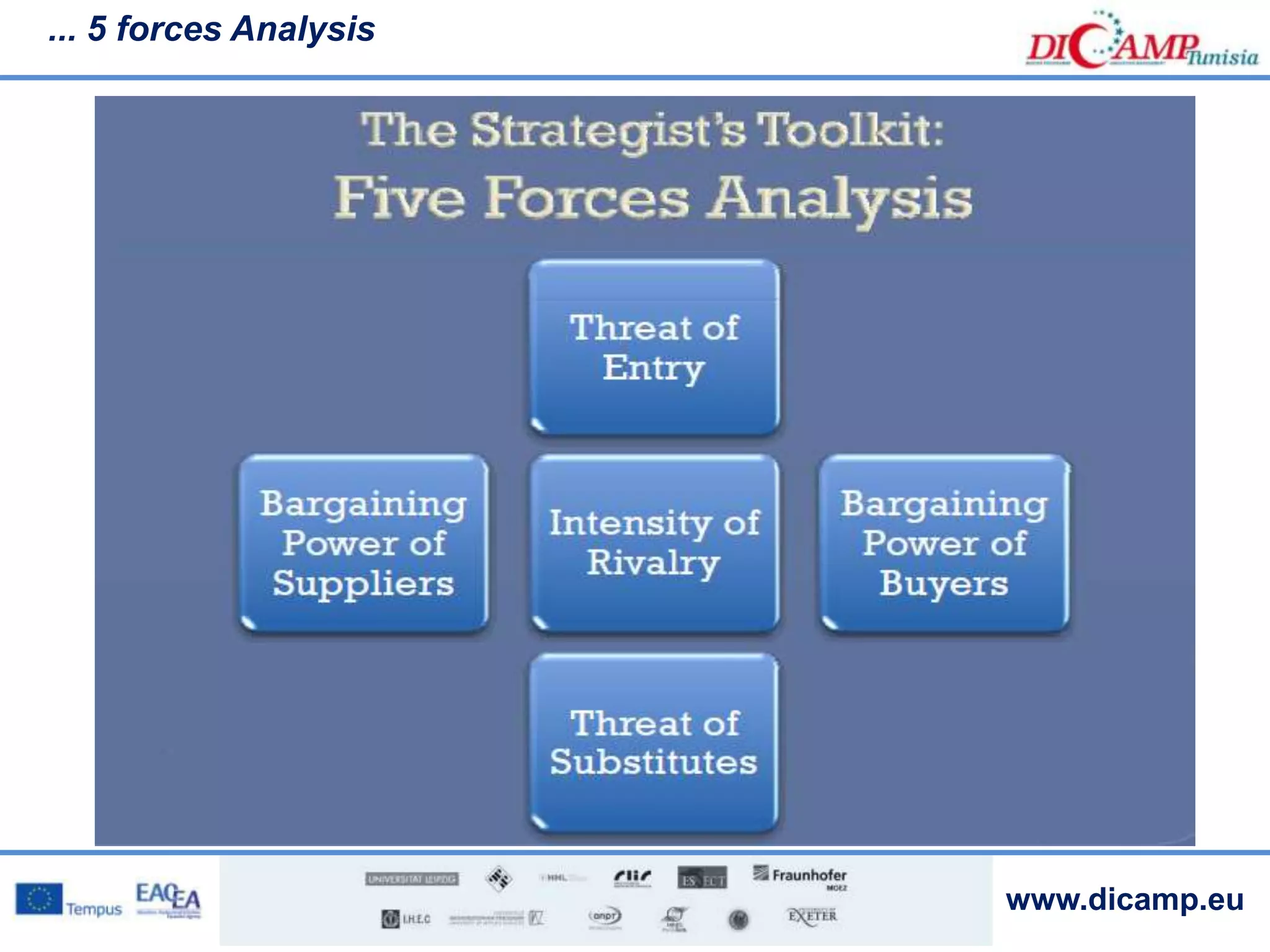
... 5 forces Analysis
www.dicamp.eu
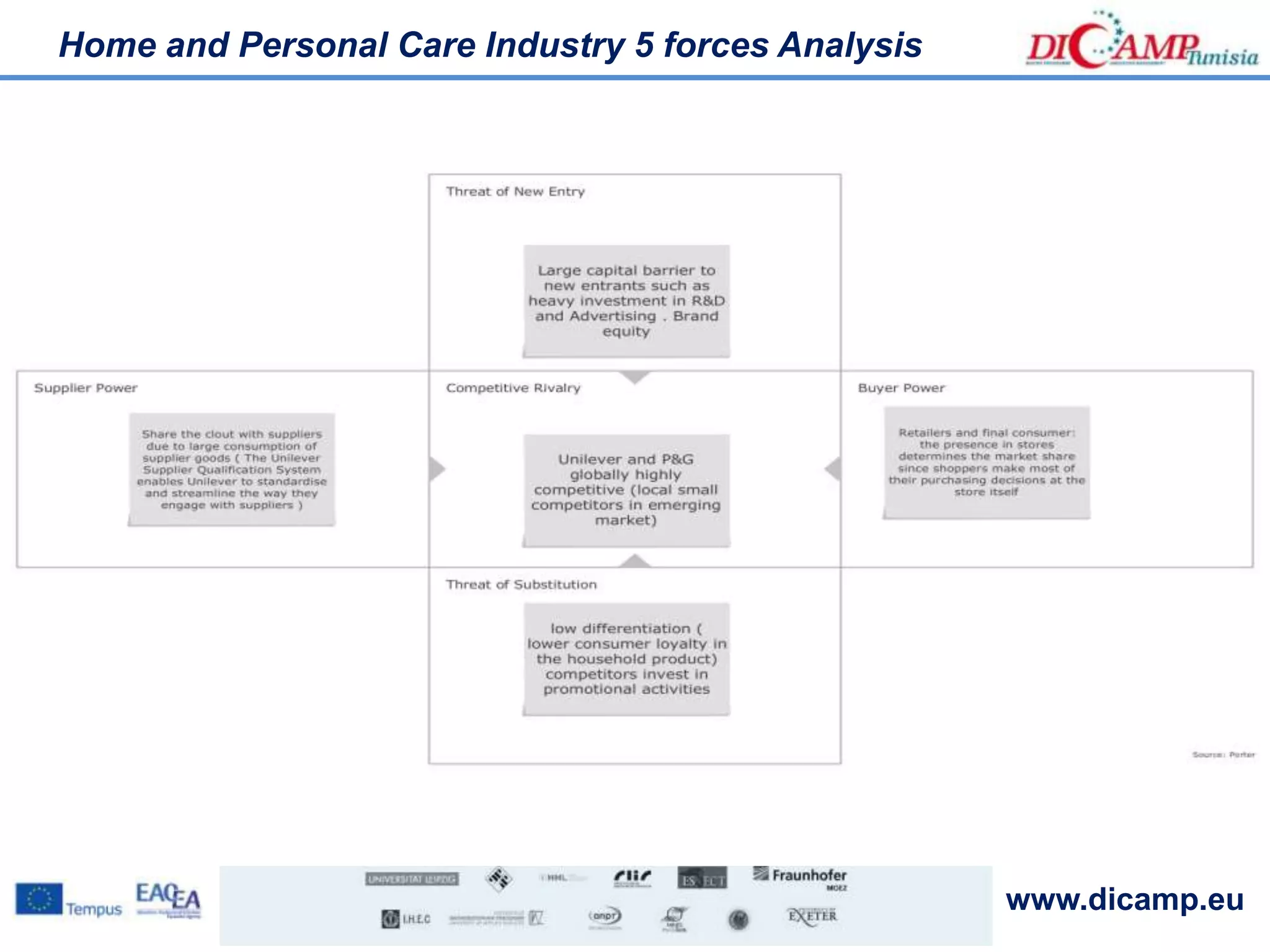
Home and Personal Care Industry 5 forces Analysis
www.dicamp.eu
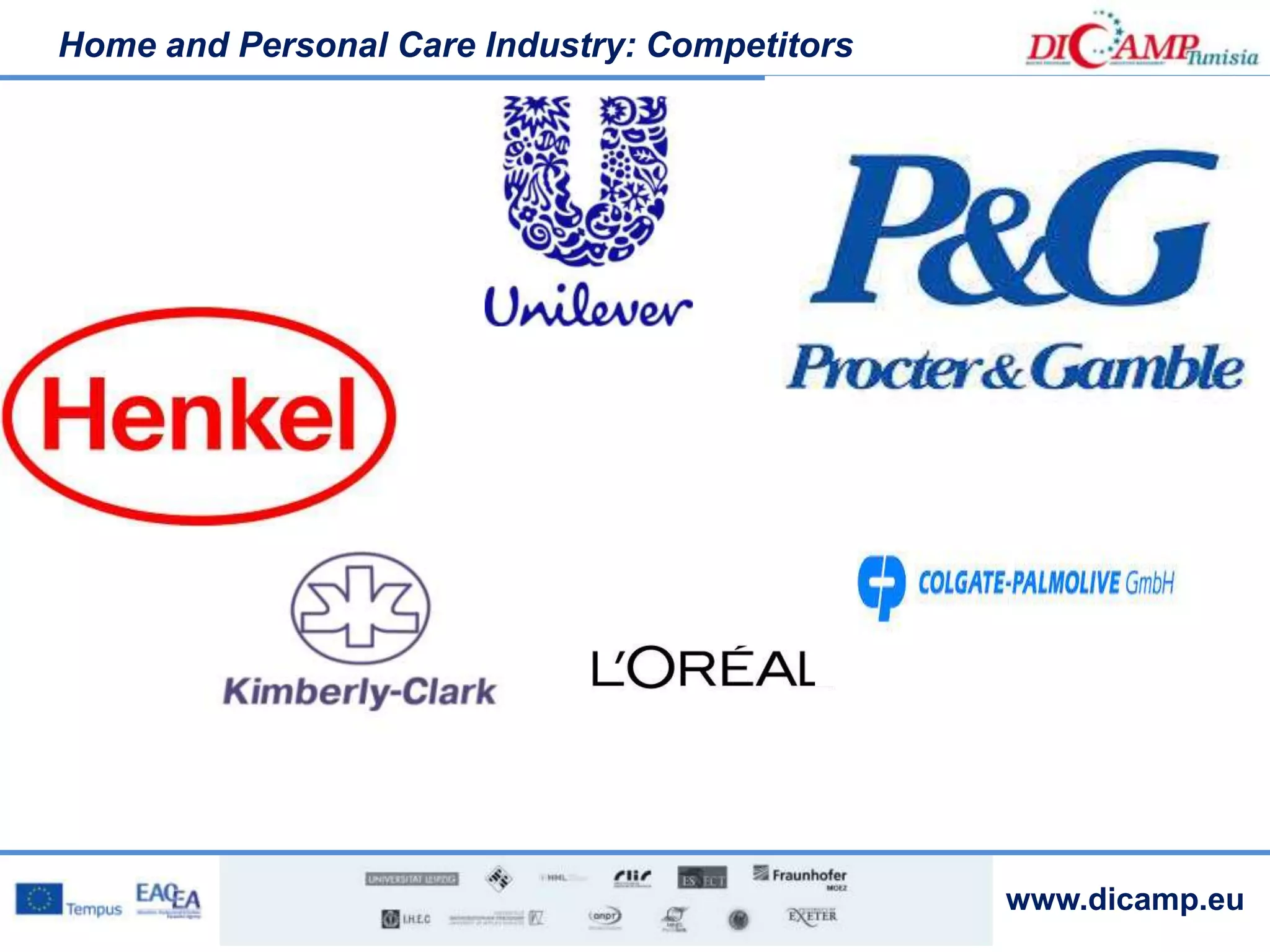
Home and Personal Care Industry: Competitors
www.dicamp.eu
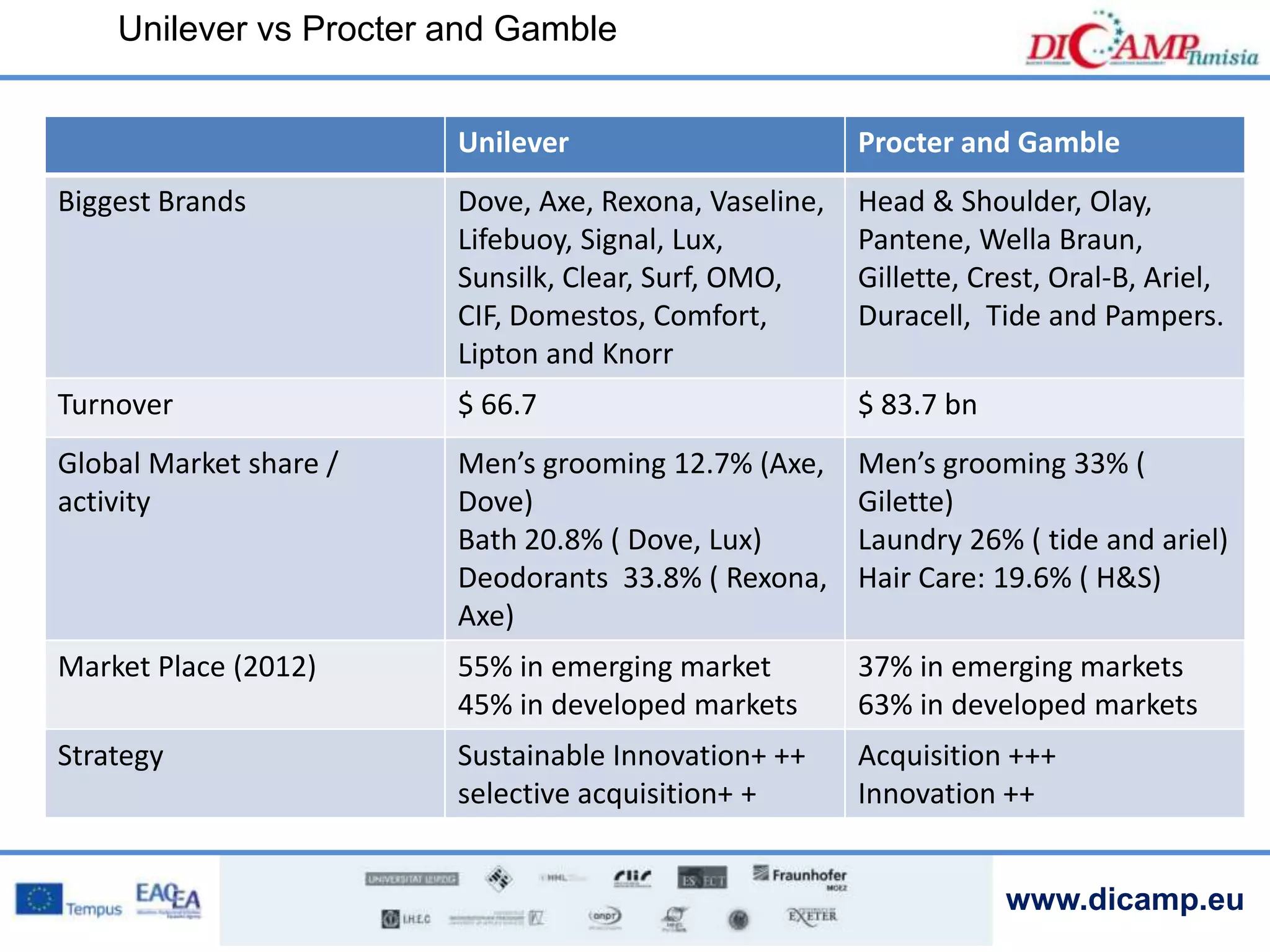
Unilever Procter and Gamble
Biggest Brands Dove, Axe, Rexona, Vaseline,
Lifebuoy, Signal, Lux,
Sunsilk, Clear, Surf, OMO,
CIF, Domestos, Comfort,
Lipton and Knorr
Head & Shoulder, Olay,
Pantene, Wella Braun,
Gillette, Crest, Oral-B, Ariel,
Duracell, Tide and Pampers.
Turnover $ 66.7 $ 83.7 bn
Global Market share /
activity
Men’s grooming 12.7% (Axe,
Dove)
Bath 20.8% ( Dove, Lux)
Deodorants 33.8% ( Rexona,
Axe)
Men’s grooming 33% (
Gilette)
Laundry 26% ( tide and ariel)
Hair Care: 19.6% ( H&S)
Market Place (2012) 55% in emerging market
45% in developed markets
37% in emerging markets
63% in developed markets
Strategy Sustainable Innovation+ ++
selective acquisition+ +
Acquisition +++
Innovation ++
Unilever vs Procter and Gamble
www.dicamp.eu
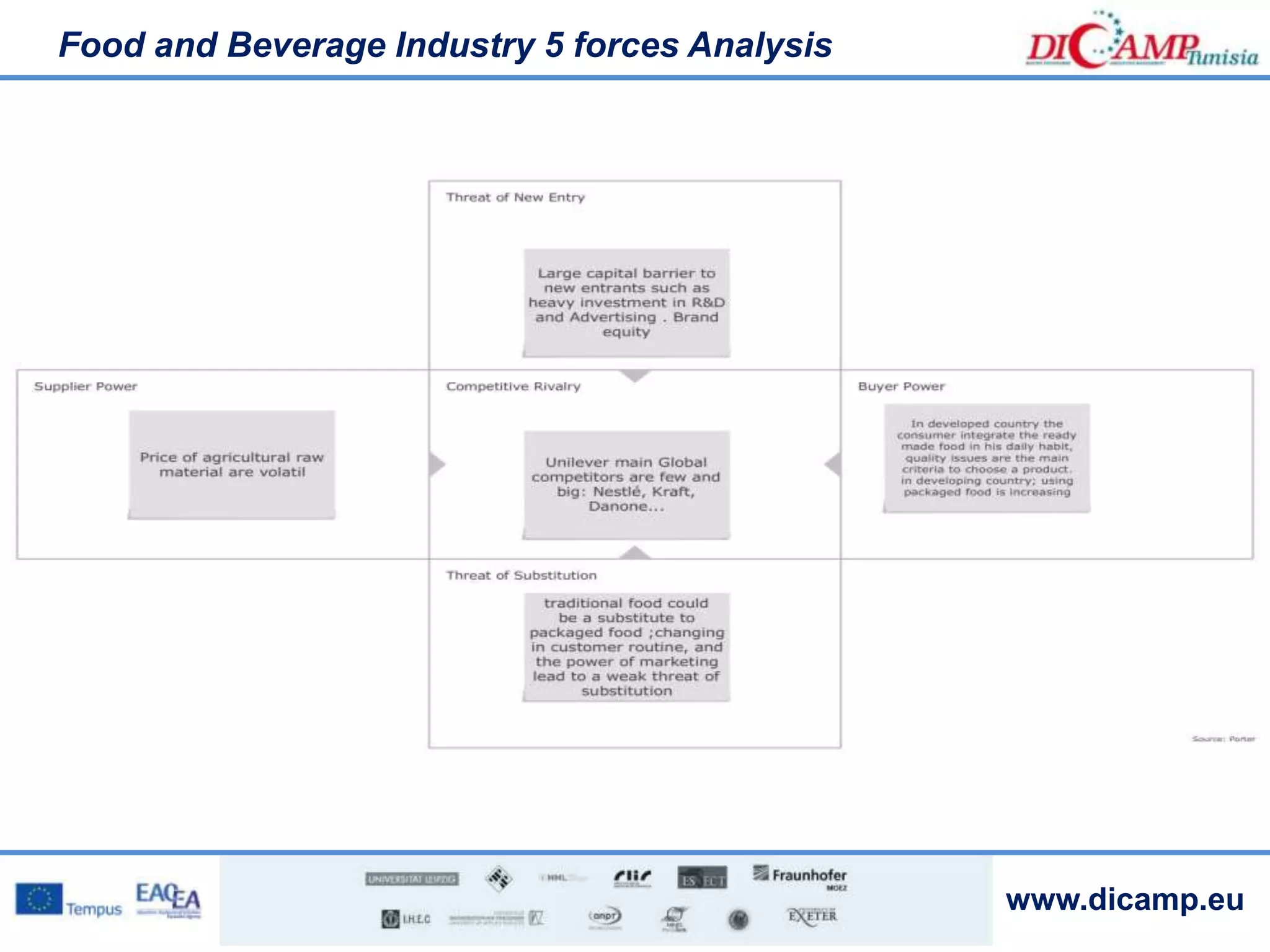
Food and Beverage Industry 5 forces Analysis
www.dicamp.eu
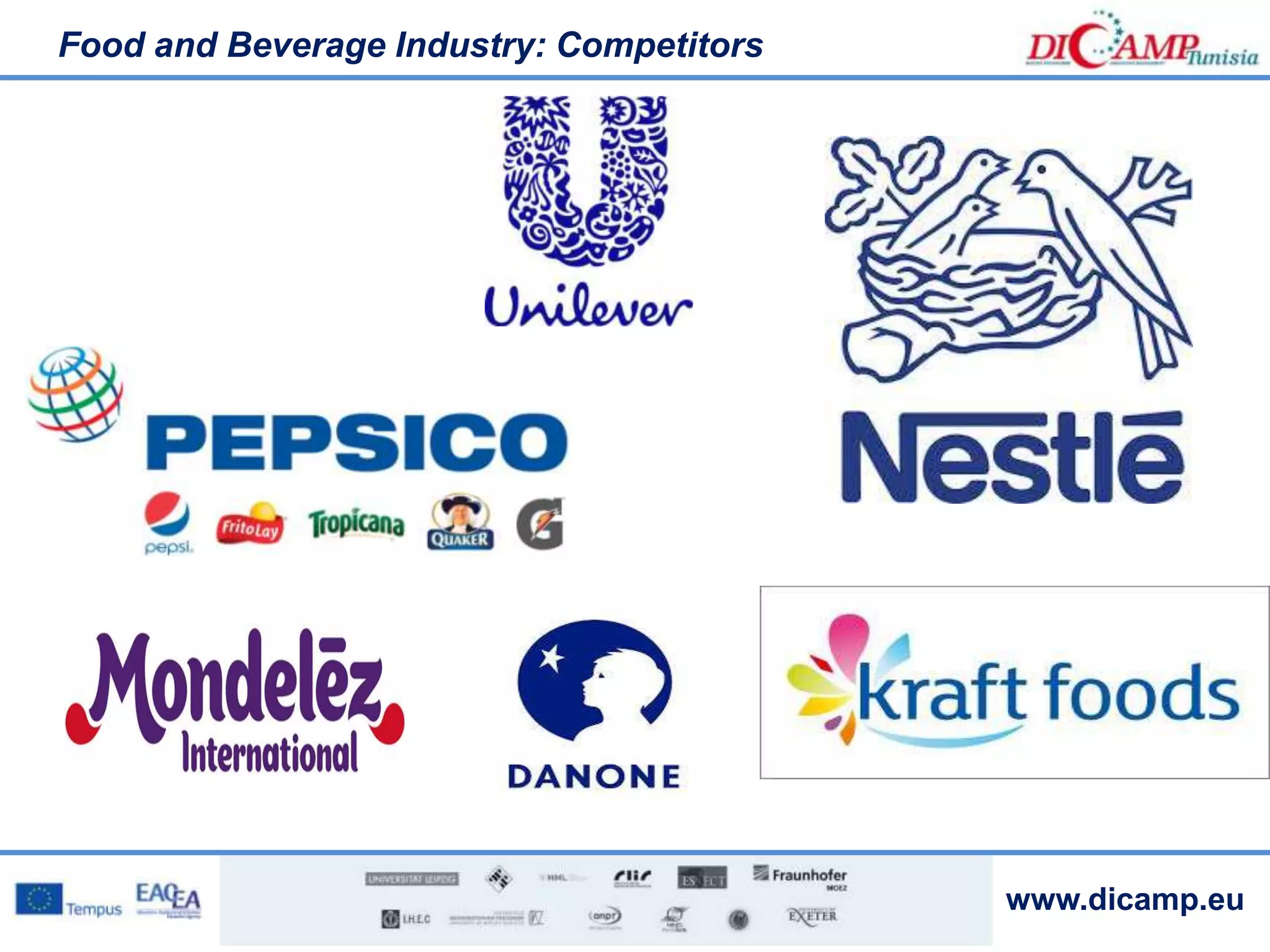
Food and Beverage Industry: Competitors
www.dicamp.eu
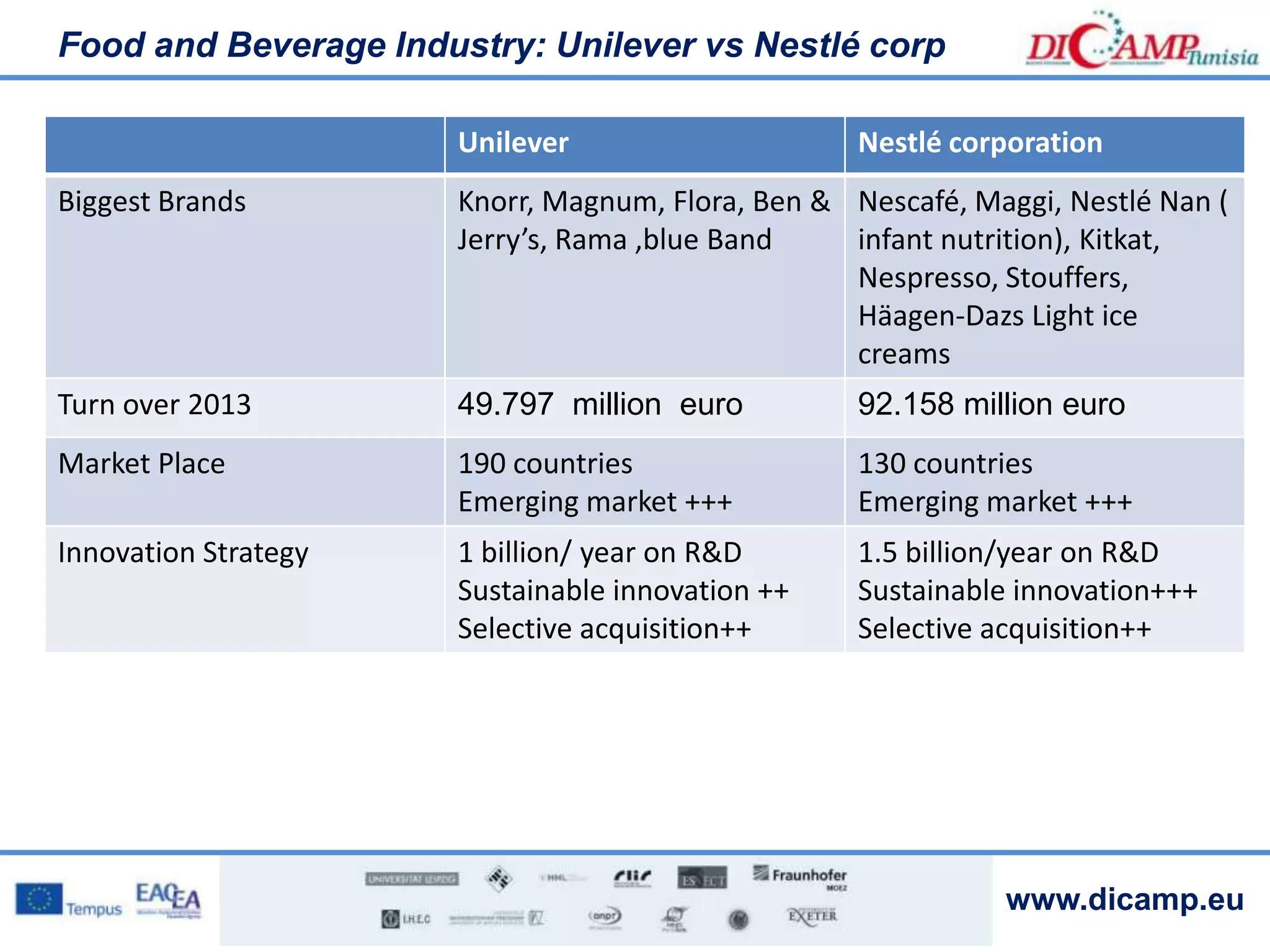
Food and Beverage Industry: Unilever vs Nestlé corp
Unilever Nestlé corporation
Biggest Brands Knorr, Magnum, Flora, Ben &
Jerry’s, Rama ,blue Band
Nescafé, Maggi, Nestlé Nan (
infant nutrition), Kitkat,
Nespresso, Stouffers,
Häagen-Dazs Light ice
creams
Turn over 2013 49.797 million euro 92.158 million euro
Market Place 190 countries
Emerging market +++
130 countries
Emerging market +++
Innovation Strategy 1 billion/ year on R&D
Sustainable innovation ++
Selective acquisition++
1.5 billion/year on R&D
Sustainable innovation+++
Selective acquisition++
www.dicamp.eu
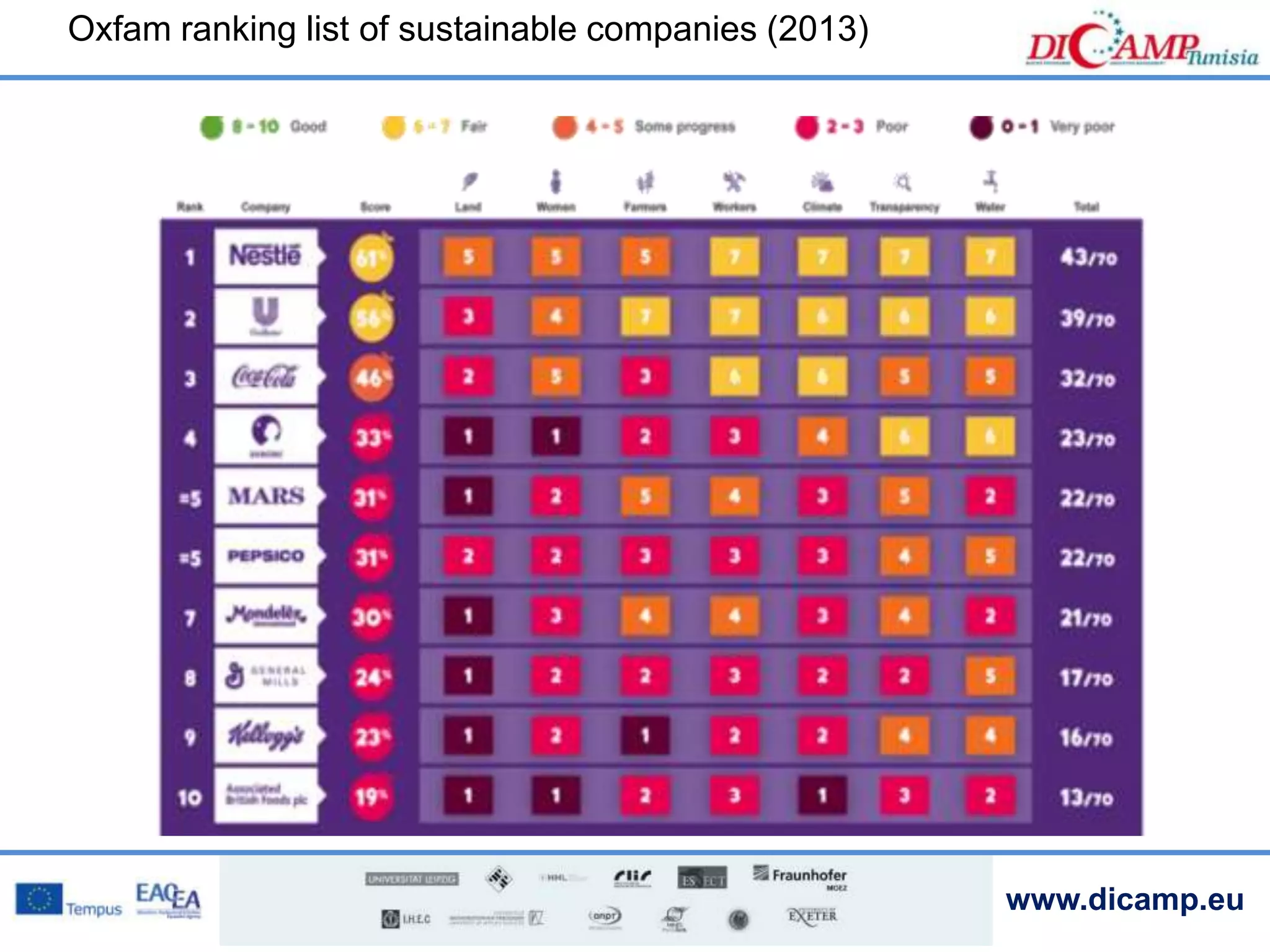
Oxfam ranking list of sustainable companies (2013)
www.dicamp.eu
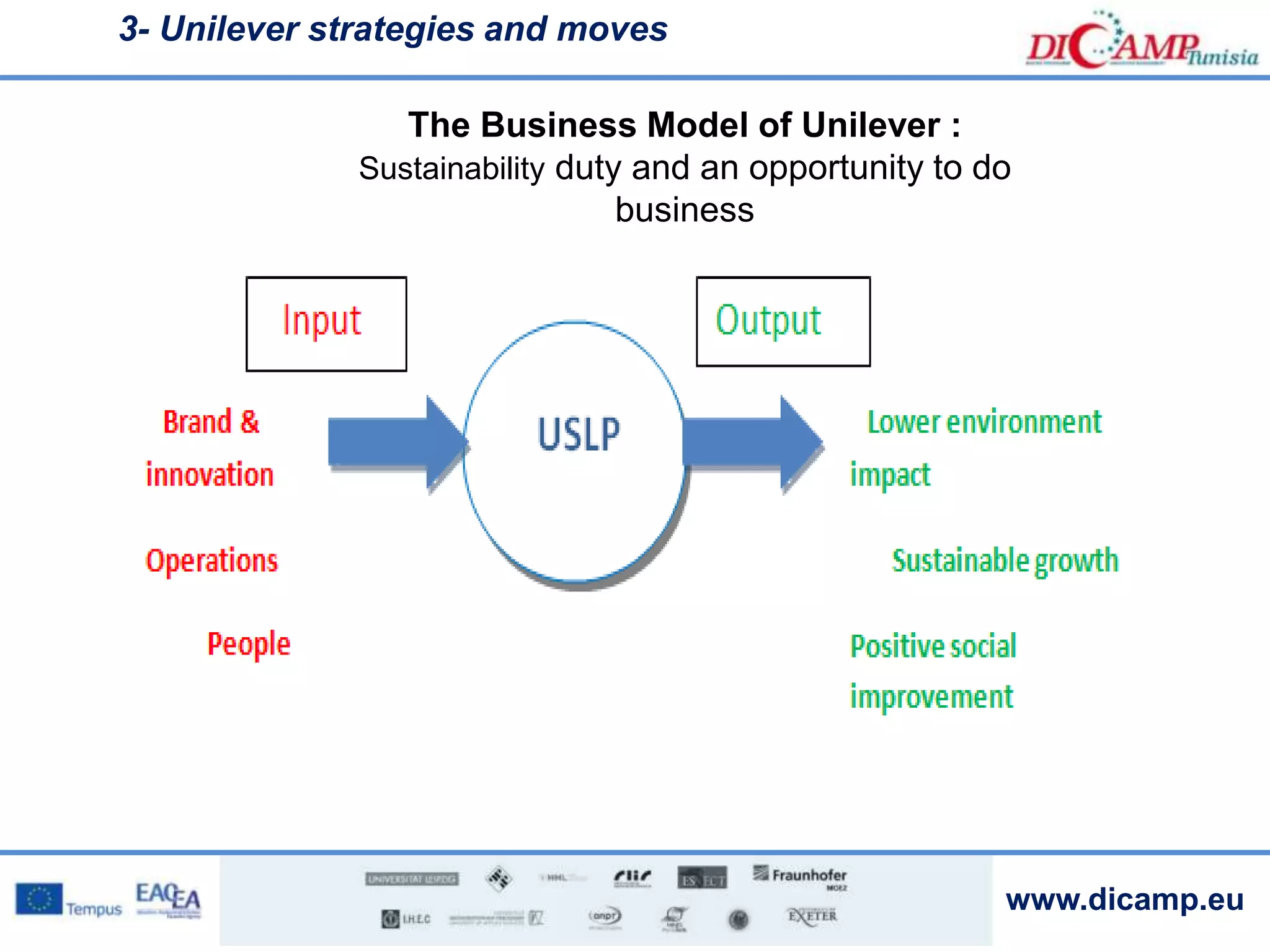
3- Unilever strategies and moves
The Business Model of Unilever :
Sustainability duty and an opportunity to do
business
www.dicamp.eu
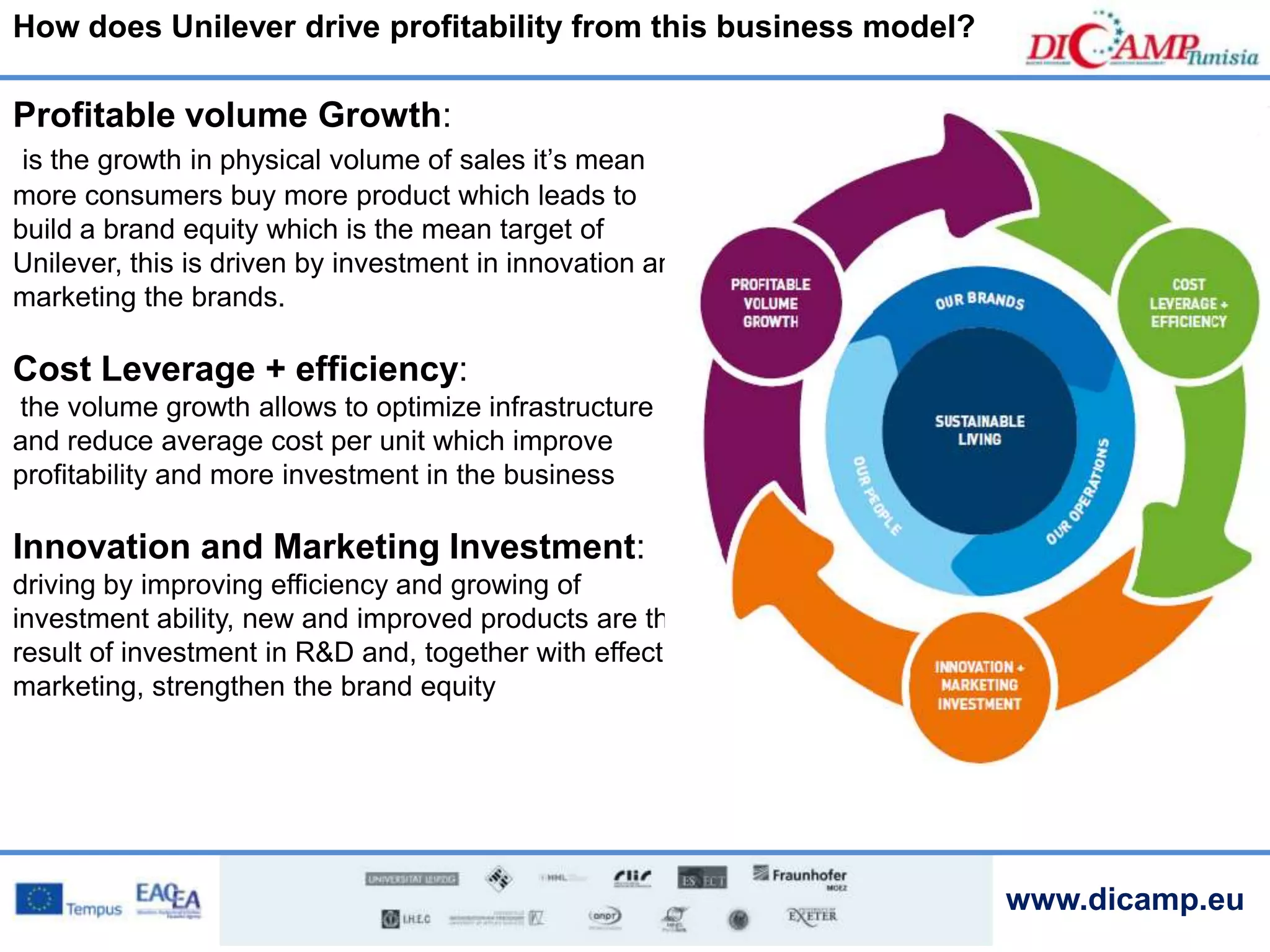
Profitable volume Growth:
is the growth in physical volume of sales it’s mean
more consumers buy more product which leads to
build a brand equity which is the mean target of
Unilever, this is driven by investment in innovation and
marketing the brands.
Cost Leverage + efficiency:
the volume growth allows to optimize infrastructure
and reduce average cost per unit which improve
profitability and more investment in the business
Innovation and Marketing Investment:
driving by improving efficiency and growing of
investment ability, new and improved products are the
result of investment in R&D and, together with effective
marketing, strengthen the brand equity
How does Unilever drive profitability from this business model?
www.dicamp.eu
4-Marketing strategy
Building brand equity
The aim objective of Unilever is building brand equity, according to the business
Dictionary “the brand equity is a brand's power derived from the name recognition that it
has earned over time, which translates into higher sales volume and higher profit
margins against competing brands”. Unilever’s strategy is to connect brands with
people’s live and needs by creating Brand with Purpose.
Brand with purpose via program
As a marketing strategy to win market share in emerging market, Unilever
associate programs and purpose to their brands which identify and respond to
the local need of people, for example in Africa in a region with vit A deficient
children, Rama and Blue Band margarines are fortified with 7vitamines
including vit A.
Brand with purpose strategy is another competitive advantage of Unilever to
establish strong Brand Equity.
www.dicamp.eu
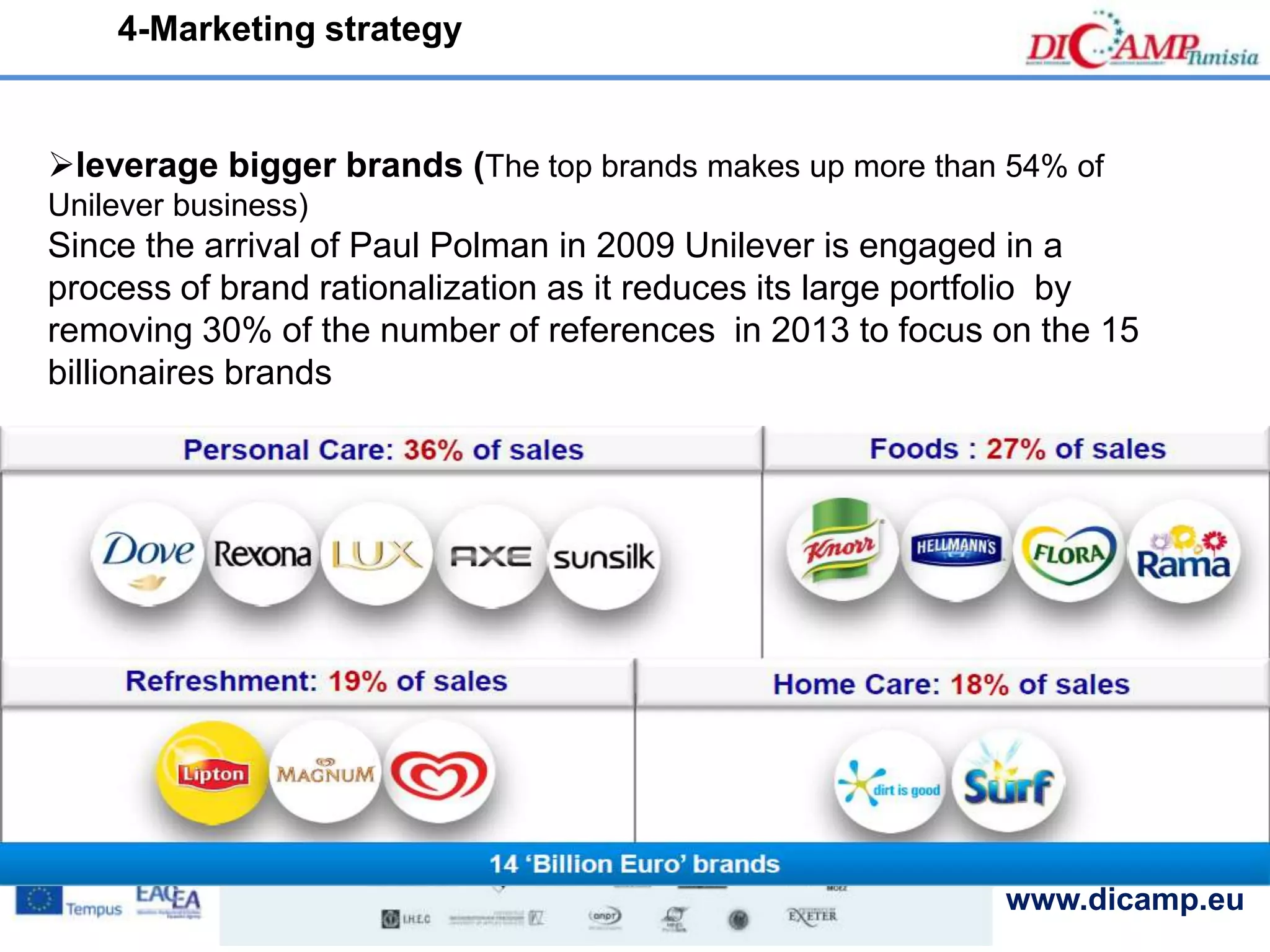
leverage bigger brands (The top brands makes up more than 54% of
Unilever business)
Since the arrival of Paul Polman in 2009 Unilever is engaged in a
process of brand rationalization as it reduces its large portfolio by
removing 30% of the number of references in 2013 to focus on the 15
billionaires brands
4-Marketing strategy
www.dicamp.eu
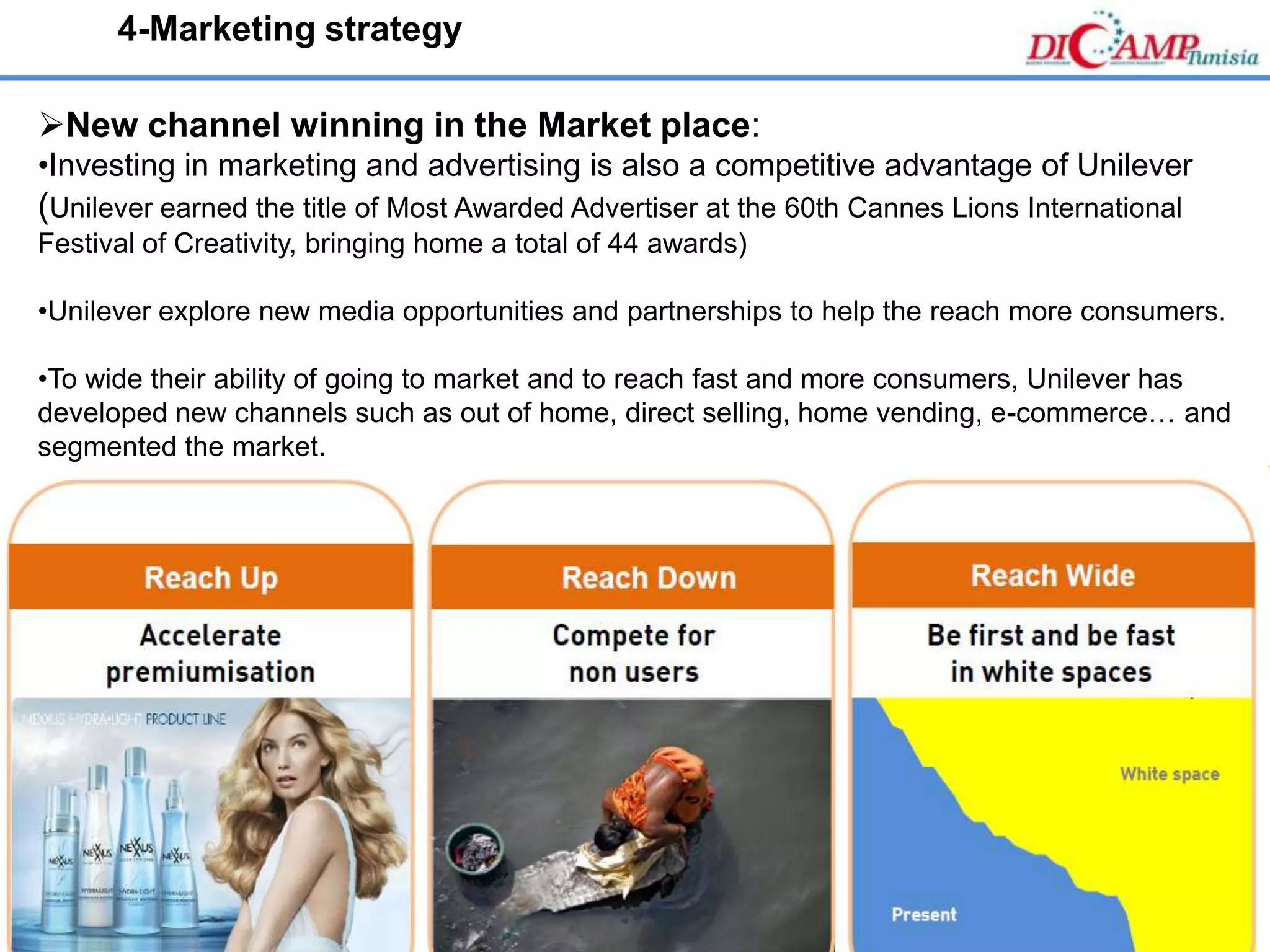
New channel winning in the Market place:
•Investing in marketing and advertising is also a competitive advantage of Unilever
(Unilever earned the title of Most Awarded Advertiser at the 60th Cannes Lions International
Festival of Creativity, bringing home a total of 44 awards)
•Unilever explore new media opportunities and partnerships to help the reach more consumers.
•To wide their ability of going to market and to reach fast and more consumers, Unilever has
developed new channels such as out of home, direct selling, home vending, e-commerce… and
segmented the market.
4-Marketing strategy
www.dicamp.eu
The innovation strategy:
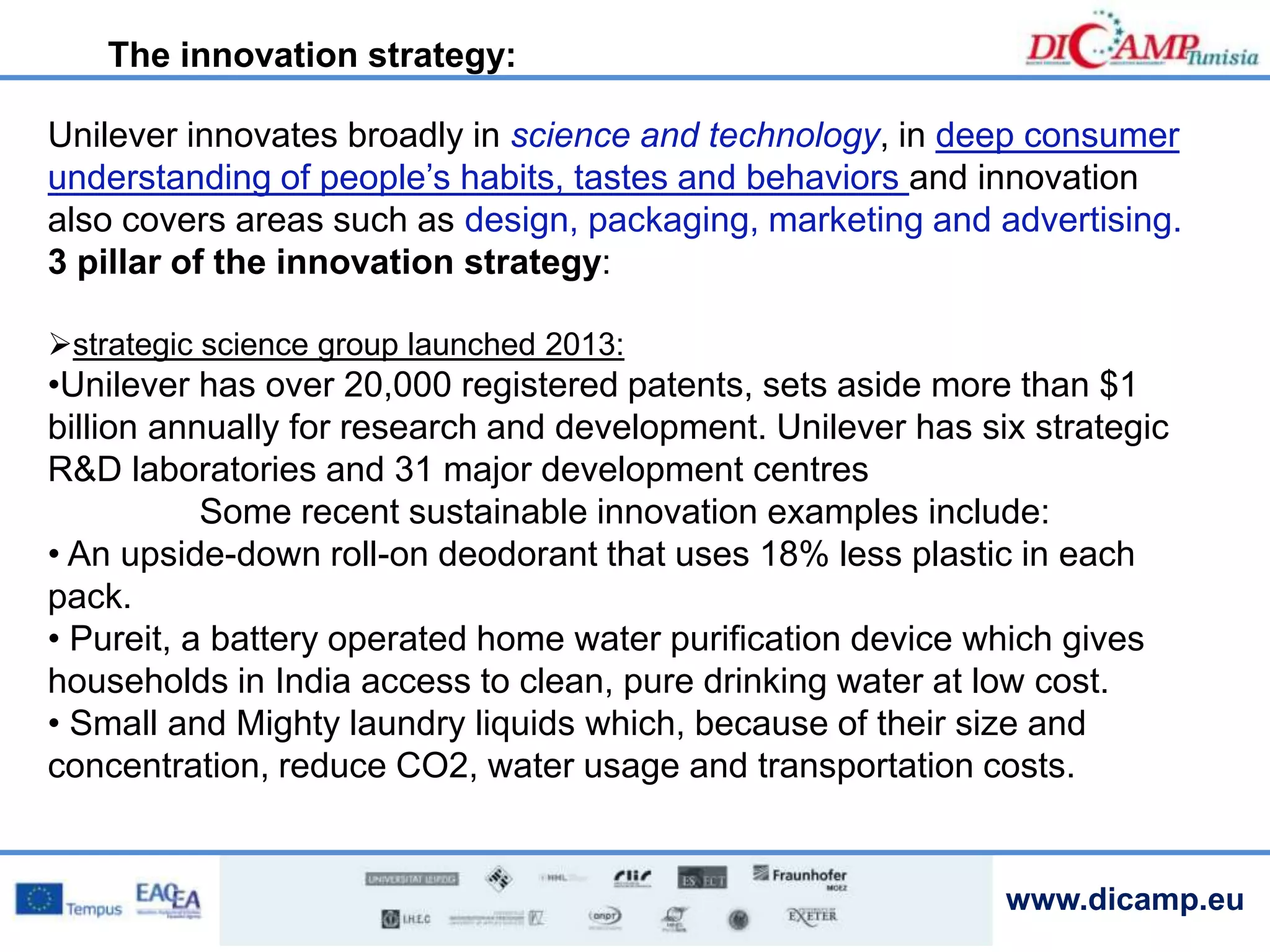
Unilever innovates broadly in science and technology, in deep consumer
understanding of people’s habits, tastes and behaviors and innovation
also covers areas such as design, packaging, marketing and advertising.
3 pillar of the innovation strategy:
strategic science group launched 2013:
•Unilever has over 20,000 registered patents, sets aside more than $1
billion annually for research and development. Unilever has six strategic
R&D laboratories and 31 major development centres
Some recent sustainable innovation examples include:
• An upside-down roll-on deodorant that uses 18% less plastic in each
pack.
• Pureit, a battery operated home water purification device which gives
households in India access to clean, pure drinking water at low cost.
• Small and Mighty laundry liquids which, because of their size and
concentration, reduce CO2, water usage and transportation costs.
www.dicamp.eu
open innovation:
•Unilever has been in using open innovation for years, and in 2009
established an open innovation unit to work with outside partners.
• Unilever is looking outside their walls for sustainable innovation
, they launched an online platform offering experts the opportunity
to help the company find the technical solutions it needs.
•Unilever has also published the key areas in which it wants to
innovate such as better packaging, safe drinking water and
sustainable washing…
The innovation strategy:
www.dicamp.eu
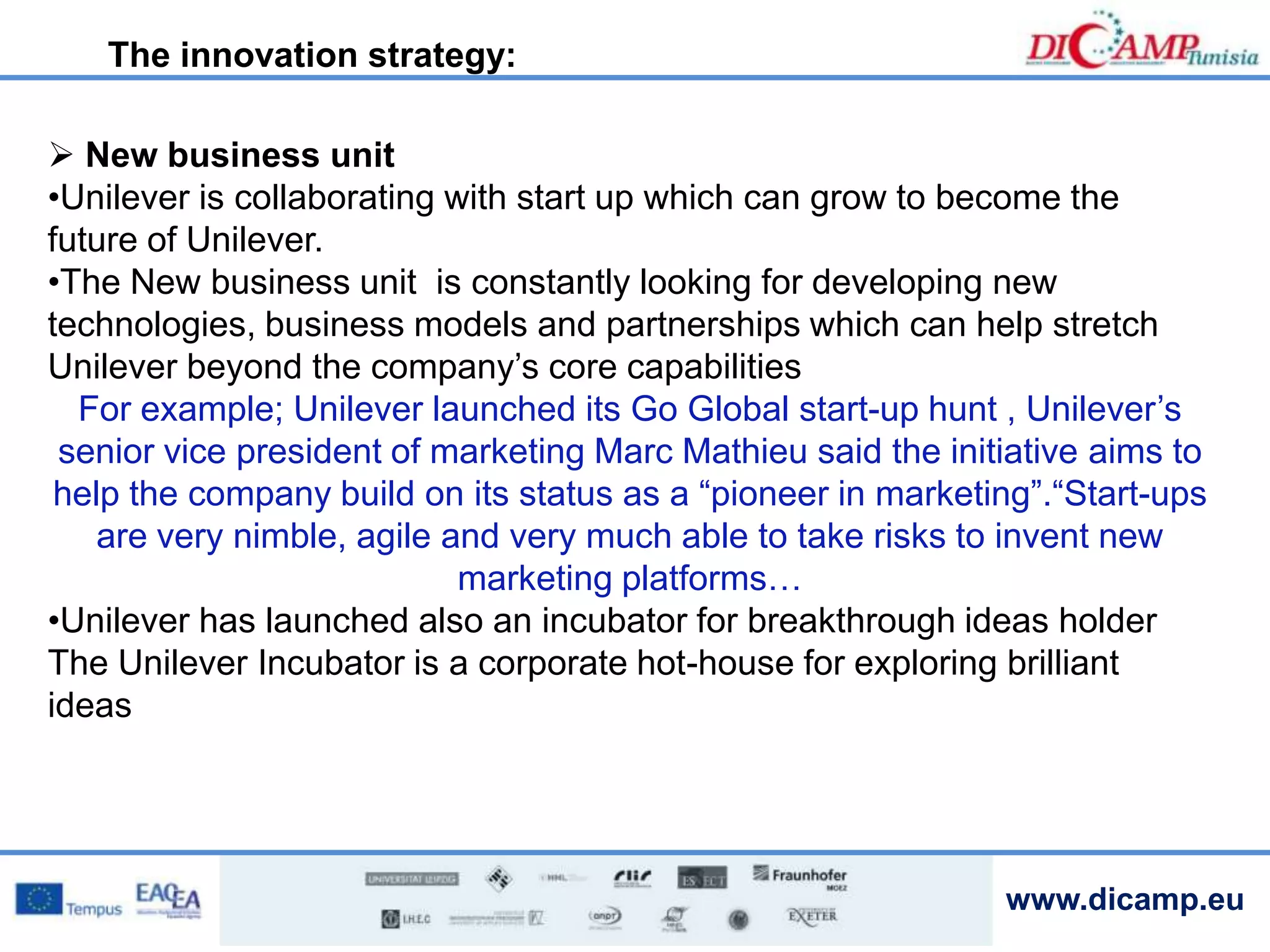
 New business unit
•Unilever is collaborating with start up which can grow to become the
future of Unilever.
•The New business unit is constantly looking for developing new
technologies, business models and partnerships which can help stretch
Unilever beyond the company’s core capabilities
For example; Unilever launched its Go Global start-up hunt , Unilever’s
senior vice president of marketing Marc Mathieu said the initiative aims to
help the company build on its status as a “pioneer in marketing”.“Start-ups
are very nimble, agile and very much able to take risks to invent new
marketing platforms…
•Unilever has launched also an incubator for breakthrough ideas holder
The Unilever Incubator is a corporate hot-house for exploring brilliant
ideas
The innovation strategy:
www.dicamp.eu
SWOT Analysis
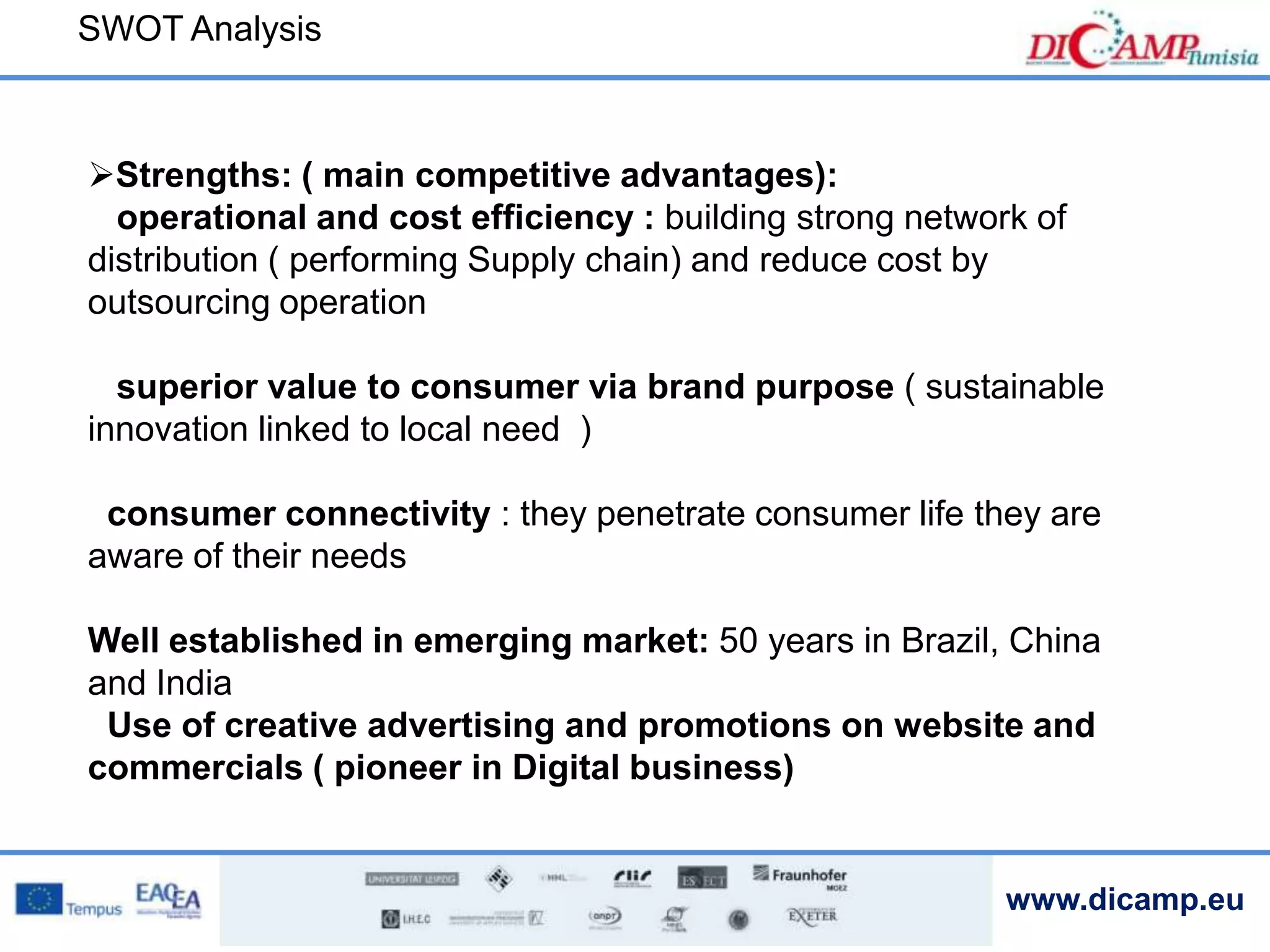
Strengths: ( main competitive advantages):
operational and cost efficiency : building strong network of
distribution ( performing Supply chain) and reduce cost by
outsourcing operation
superior value to consumer via brand purpose ( sustainable
innovation linked to local need )
consumer connectivity : they penetrate consumer life they are
aware of their needs
Well established in emerging market: 50 years in Brazil, China
and India
Use of creative advertising and promotions on website and
commercials ( pioneer in Digital business)
www.dicamp.eu
SWOT Analysis
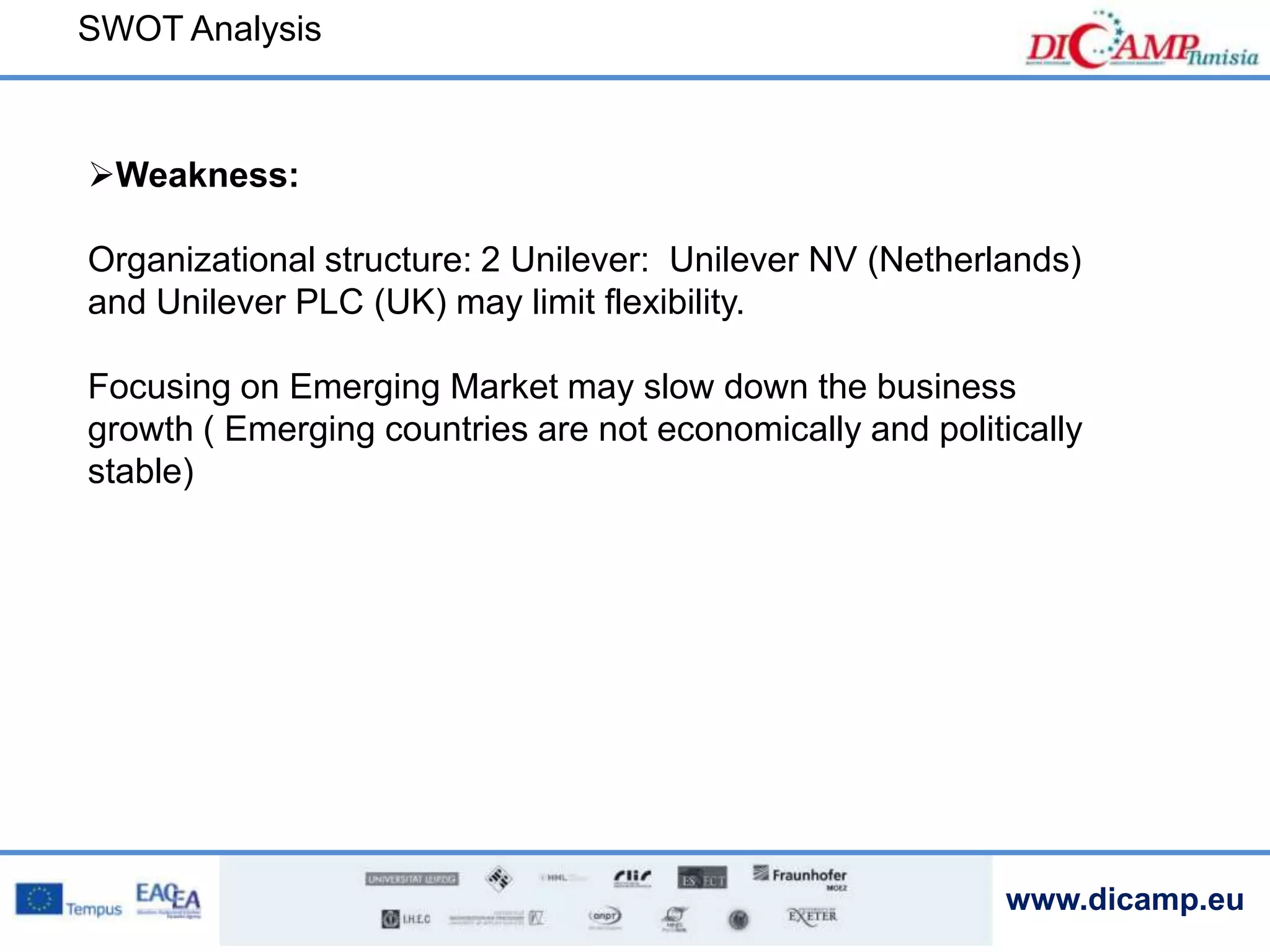
Weakness:
Organizational structure: 2 Unilever: Unilever NV (Netherlands)
and Unilever PLC (UK) may limit flexibility.
Focusing on Emerging Market may slow down the business
growth ( Emerging countries are not economically and politically
stable)
www.dicamp.eu
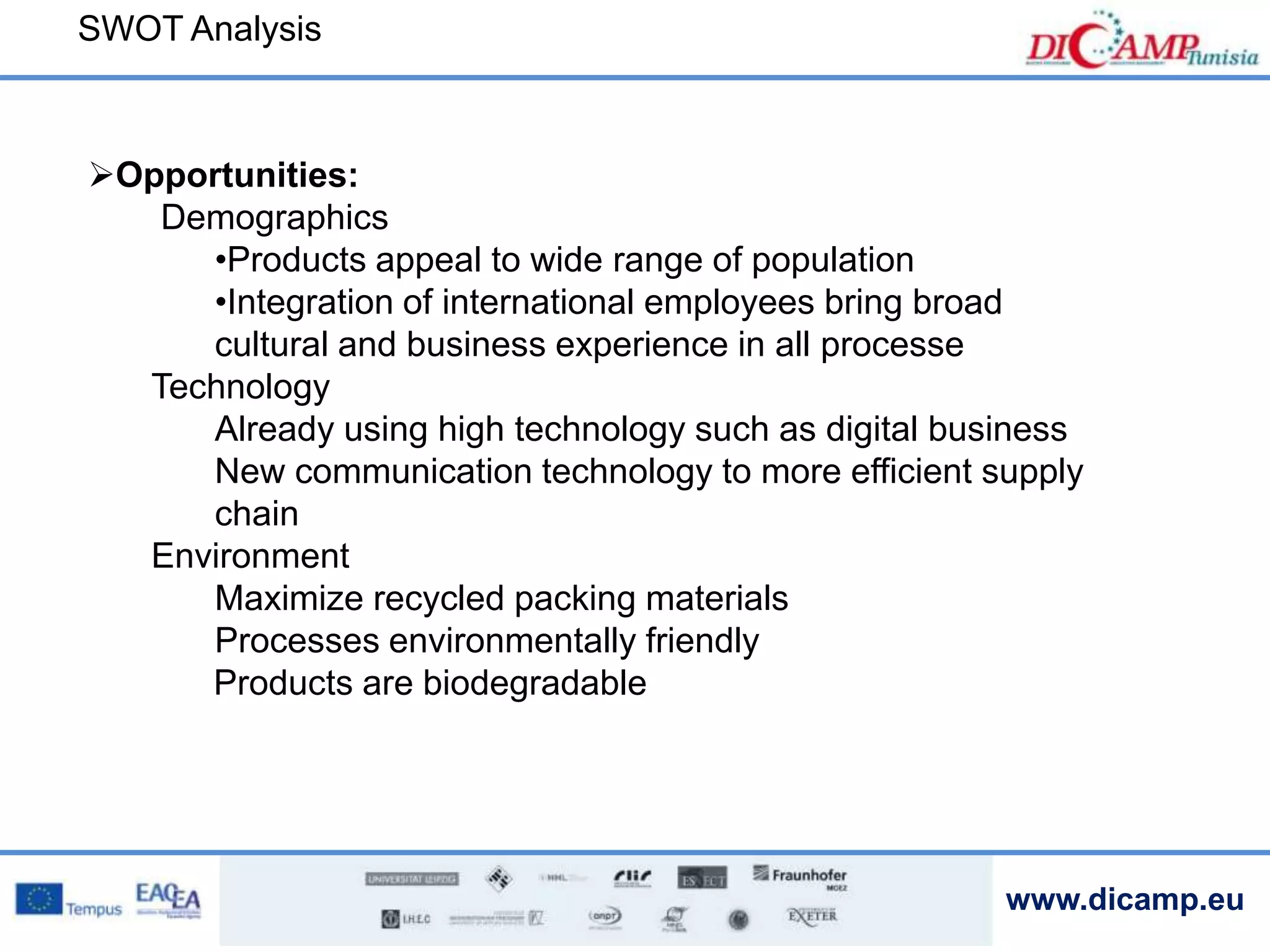
Opportunities:
Demographics
•Products appeal to wide range of population
•Integration of international employees bring broad
cultural and business experience in all processe
Technology
Already using high technology such as digital business
New communication technology to more efficient supply
chain
Environment
Maximize recycled packing materials
Processes environmentally friendly
Products are biodegradable
SWOT Analysis
www.dicamp.eu
Threats
Economic
Internal turmoil in third world countries
Ventures in developing countries are jointly owned
Politics:
Non stable politic situation in some country of emerging
market
Environment
Increased regulations
SWOT Analysis
www.dicamp.eu
Conclusion
Since 2010, Unilever start the Unilever Sustainable Plan and it became
The spirit of its corporate strategy: to double size the business whilst reduce
its environmental impact and increase social impact.
Unilever invest in Sustainable Innovation: they believe that innovation is the
motor to connect Unilever product to consumer life (reach up premium
consumer, reach down: poor communities, reach wide: to be the first to
understand consumer and meet his need) : this is a competitive advantage
to reduce the gap between Unilever and their big competitors
Unilever is one of the first companies to look outside their walls by giving the
opportunity to expert and start ups to collaborate and share Unilever Vision.
Unilever also invest huge amount on Marketing to reduce the power of
substitution.
www.dicamp.eu

Strategic analysis of unilever (USLP 2012-2013)

  • 1.
    www.dicamp.eu Strategic Analysis of Unilever InnovationManagement Master Module: Innovation Strategy By: Roukaya ISSAOUI
  • 2.
    www.dicamp.eu Agenda •Introduction •1-Company Overview •Unilever missionand Vision. •2-Competitive Environment : • Home and personal Care industry • Competitors • Porter 5 forces analysis • Unilever VS Procter and Gamble •Packaged food and beverage Industry •Competitors • Porter 5 forces analysis • Unilever VS Nestlé •3- Unilever Strategies and moves •4-Marketing strategy •5-Innovation strategy •6-Situation of Unilever and SWOT analysis •7- Recapitulation
  • 3.
    www.dicamp.eu Introduction Unilever is oneof the world’s top makers of packaged consumer goods operating in 190 countries and have a large brand portfolio of over 400 brands under two divisions : Foods and Home & Personal care. Unilever is one of the world’s top three food firms with Nestle and Kraft- and the world’s second largest packaged consumer goods company –behind Procter & Gamble. The main success factor of the company is the constant focus on innovative product developments
  • 4.
  • 5.
  • 6.
  • 7.
    www.dicamp.eu Unilever Business Activities Homecare, Personal Care, Food and refreshment Brands >400 ,14 of which generate sales in excess of €1 billion a year. Employees >174,000 International 190 countries Customer 2 billions worldwide Emerging Market 57% of the business Financial key indicators Market Capitalization 124.59B Turn over ( euro) 49.797 million ( -0.3%) Net Profit ( euro) 5,263 million (+0.9%) Core earnings per share ( euro) 1.58 ( +0.3%) Free Cash flow ( euro) 3.9 billion ( 4.3 billion in 2012) Non financial indicator R&D annual investment 1 billion euro/ year Rank innovative company list of Forbes 63 Diversity workforce 58% male, 42% female Safety 1.03 total recordable accident frequency rate Engagement score 78% Company Overview Financial and non financial KPI’s (2013)
  • 8.
    www.dicamp.eu Mission and Vision Missionof the company OUR PURPOSE is TO MAKE SUSTAINABLE LIVING COMMONPLACE We work to create a better future every day, with brands and services that help people feel good, look good and get more out of life. Corporate purpose of the company OUR VISION: the compass strategy “We will lead for responsible growth, inspiring people to take small everyday actions that will add up to a big difference. We will grow by winning shares and building markets everywhere.”.
  • 9.
    www.dicamp.eu The competitive Environment •Household industry ;laundry detergent, cleaners… • Personal care; hair care, cosmetics, toothpaste Home & personal care • Food: packaged meals, dairy… • Refreshment: beverage, ice cream Food & Beverage Strategic Groups
  • 10.
  • 11.
    www.dicamp.eu Home and PersonalCare Industry 5 forces Analysis
  • 12.
    www.dicamp.eu Home and PersonalCare Industry: Competitors
  • 13.
    www.dicamp.eu Unilever Procter andGamble Biggest Brands Dove, Axe, Rexona, Vaseline, Lifebuoy, Signal, Lux, Sunsilk, Clear, Surf, OMO, CIF, Domestos, Comfort, Lipton and Knorr Head & Shoulder, Olay, Pantene, Wella Braun, Gillette, Crest, Oral-B, Ariel, Duracell, Tide and Pampers. Turnover $ 66.7 $ 83.7 bn Global Market share / activity Men’s grooming 12.7% (Axe, Dove) Bath 20.8% ( Dove, Lux) Deodorants 33.8% ( Rexona, Axe) Men’s grooming 33% ( Gilette) Laundry 26% ( tide and ariel) Hair Care: 19.6% ( H&S) Market Place (2012) 55% in emerging market 45% in developed markets 37% in emerging markets 63% in developed markets Strategy Sustainable Innovation+ ++ selective acquisition+ + Acquisition +++ Innovation ++ Unilever vs Procter and Gamble
  • 14.
    www.dicamp.eu Food and BeverageIndustry 5 forces Analysis
  • 15.
    www.dicamp.eu Food and BeverageIndustry: Competitors
  • 16.
    www.dicamp.eu Food and BeverageIndustry: Unilever vs Nestlé corp Unilever Nestlé corporation Biggest Brands Knorr, Magnum, Flora, Ben & Jerry’s, Rama ,blue Band Nescafé, Maggi, Nestlé Nan ( infant nutrition), Kitkat, Nespresso, Stouffers, Häagen-Dazs Light ice creams Turn over 2013 49.797 million euro 92.158 million euro Market Place 190 countries Emerging market +++ 130 countries Emerging market +++ Innovation Strategy 1 billion/ year on R&D Sustainable innovation ++ Selective acquisition++ 1.5 billion/year on R&D Sustainable innovation+++ Selective acquisition++
  • 17.
    www.dicamp.eu Oxfam ranking listof sustainable companies (2013)
  • 18.
    www.dicamp.eu 3- Unilever strategiesand moves The Business Model of Unilever : Sustainability duty and an opportunity to do business
  • 19.
    www.dicamp.eu Profitable volume Growth: isthe growth in physical volume of sales it’s mean more consumers buy more product which leads to build a brand equity which is the mean target of Unilever, this is driven by investment in innovation and marketing the brands. Cost Leverage + efficiency: the volume growth allows to optimize infrastructure and reduce average cost per unit which improve profitability and more investment in the business Innovation and Marketing Investment: driving by improving efficiency and growing of investment ability, new and improved products are the result of investment in R&D and, together with effective marketing, strengthen the brand equity How does Unilever drive profitability from this business model?
  • 20.
    www.dicamp.eu 4-Marketing strategy Building brandequity The aim objective of Unilever is building brand equity, according to the business Dictionary “the brand equity is a brand's power derived from the name recognition that it has earned over time, which translates into higher sales volume and higher profit margins against competing brands”. Unilever’s strategy is to connect brands with people’s live and needs by creating Brand with Purpose. Brand with purpose via program As a marketing strategy to win market share in emerging market, Unilever associate programs and purpose to their brands which identify and respond to the local need of people, for example in Africa in a region with vit A deficient children, Rama and Blue Band margarines are fortified with 7vitamines including vit A. Brand with purpose strategy is another competitive advantage of Unilever to establish strong Brand Equity.
  • 21.
    www.dicamp.eu leverage bigger brands(The top brands makes up more than 54% of Unilever business) Since the arrival of Paul Polman in 2009 Unilever is engaged in a process of brand rationalization as it reduces its large portfolio by removing 30% of the number of references in 2013 to focus on the 15 billionaires brands 4-Marketing strategy
  • 22.
    www.dicamp.eu New channel winningin the Market place: •Investing in marketing and advertising is also a competitive advantage of Unilever (Unilever earned the title of Most Awarded Advertiser at the 60th Cannes Lions International Festival of Creativity, bringing home a total of 44 awards) •Unilever explore new media opportunities and partnerships to help the reach more consumers. •To wide their ability of going to market and to reach fast and more consumers, Unilever has developed new channels such as out of home, direct selling, home vending, e-commerce… and segmented the market. 4-Marketing strategy
  • 23.
    www.dicamp.eu The innovation strategy: Unileverinnovates broadly in science and technology, in deep consumer understanding of people’s habits, tastes and behaviors and innovation also covers areas such as design, packaging, marketing and advertising. 3 pillar of the innovation strategy: strategic science group launched 2013: •Unilever has over 20,000 registered patents, sets aside more than $1 billion annually for research and development. Unilever has six strategic R&D laboratories and 31 major development centres Some recent sustainable innovation examples include: • An upside-down roll-on deodorant that uses 18% less plastic in each pack. • Pureit, a battery operated home water purification device which gives households in India access to clean, pure drinking water at low cost. • Small and Mighty laundry liquids which, because of their size and concentration, reduce CO2, water usage and transportation costs.
  • 24.
    www.dicamp.eu open innovation: •Unilever hasbeen in using open innovation for years, and in 2009 established an open innovation unit to work with outside partners. • Unilever is looking outside their walls for sustainable innovation , they launched an online platform offering experts the opportunity to help the company find the technical solutions it needs. •Unilever has also published the key areas in which it wants to innovate such as better packaging, safe drinking water and sustainable washing… The innovation strategy:
  • 25.
    www.dicamp.eu  New businessunit •Unilever is collaborating with start up which can grow to become the future of Unilever. •The New business unit is constantly looking for developing new technologies, business models and partnerships which can help stretch Unilever beyond the company’s core capabilities For example; Unilever launched its Go Global start-up hunt , Unilever’s senior vice president of marketing Marc Mathieu said the initiative aims to help the company build on its status as a “pioneer in marketing”.“Start-ups are very nimble, agile and very much able to take risks to invent new marketing platforms… •Unilever has launched also an incubator for breakthrough ideas holder The Unilever Incubator is a corporate hot-house for exploring brilliant ideas The innovation strategy:
  • 26.
    www.dicamp.eu SWOT Analysis Strengths: (main competitive advantages): operational and cost efficiency : building strong network of distribution ( performing Supply chain) and reduce cost by outsourcing operation superior value to consumer via brand purpose ( sustainable innovation linked to local need ) consumer connectivity : they penetrate consumer life they are aware of their needs Well established in emerging market: 50 years in Brazil, China and India Use of creative advertising and promotions on website and commercials ( pioneer in Digital business)
  • 27.
    www.dicamp.eu SWOT Analysis Weakness: Organizational structure:2 Unilever: Unilever NV (Netherlands) and Unilever PLC (UK) may limit flexibility. Focusing on Emerging Market may slow down the business growth ( Emerging countries are not economically and politically stable)
  • 28.
    www.dicamp.eu Opportunities: Demographics •Products appeal towide range of population •Integration of international employees bring broad cultural and business experience in all processe Technology Already using high technology such as digital business New communication technology to more efficient supply chain Environment Maximize recycled packing materials Processes environmentally friendly Products are biodegradable SWOT Analysis
  • 29.
    www.dicamp.eu Threats Economic Internal turmoil inthird world countries Ventures in developing countries are jointly owned Politics: Non stable politic situation in some country of emerging market Environment Increased regulations SWOT Analysis
  • 30.
    www.dicamp.eu Conclusion Since 2010, Unileverstart the Unilever Sustainable Plan and it became The spirit of its corporate strategy: to double size the business whilst reduce its environmental impact and increase social impact. Unilever invest in Sustainable Innovation: they believe that innovation is the motor to connect Unilever product to consumer life (reach up premium consumer, reach down: poor communities, reach wide: to be the first to understand consumer and meet his need) : this is a competitive advantage to reduce the gap between Unilever and their big competitors Unilever is one of the first companies to look outside their walls by giving the opportunity to expert and start ups to collaborate and share Unilever Vision. Unilever also invest huge amount on Marketing to reduce the power of substitution.
  • 31.