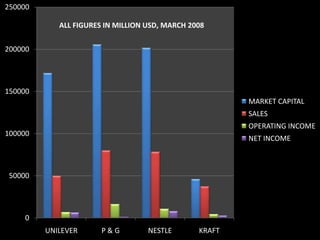
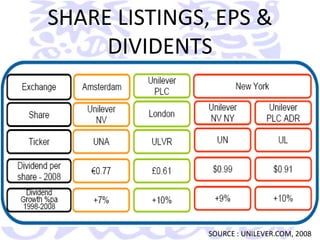
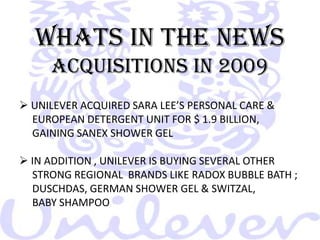
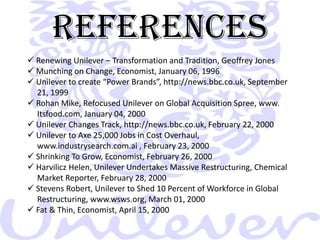
UNILEVERA TROUBLED GIANT
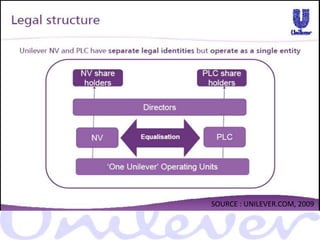
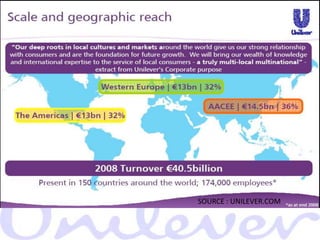
SOURCE : UNILEVER.COM, 2009
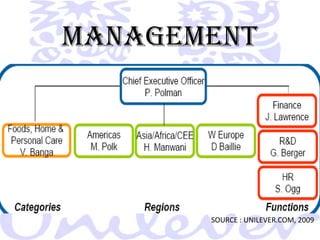
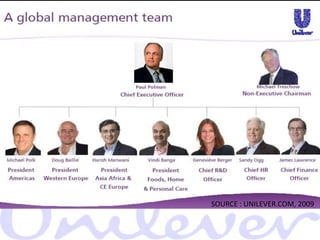
MANAGEMENTSOURCE : UNILEVER.COM, 2009
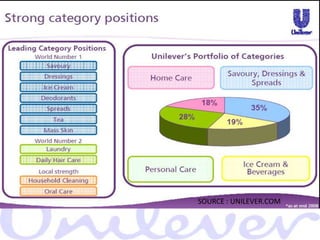
SOURCE : UNILEVER.COM, 2009
SOURCE : UNILEVER.COM
BACKGROUND NOTE
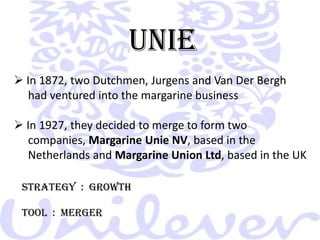
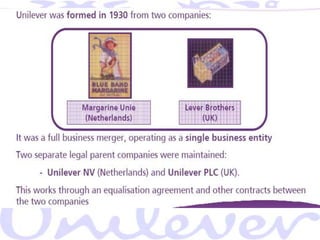
UNIE In 1872, two Dutchmen, Jurgens and Van Der Bergh        had ventured into the margarine business In 1927, they decided to merge to form two      companies, Margarine Unie NV, based in the       Netherlands and Margarine Union Ltd, based in the UKSTRATEGY  :  GROWTHTOOL  :  MERGER
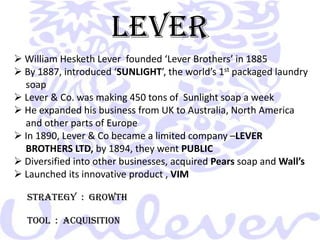
LEVER William Hesketh Lever  founded ‘Lever Brothers’ in 1885
 By 1887, introduced ‘SUNLIGHT’, the world’s 1st packaged laundry      soap Lever & Co. was making 450 tons of  Sunlight soap a week
 He expanded his business from UK to Australia, North America        and other parts of Europe In 1890, Lever & Co became a limited company –LEVER      BROTHERS LTD, by 1894, they went PUBLIC Diversified into other businesses, acquired Pears soap and Wall’s
 Launched its innovative product , VIMSTRATEGY  :  GROWTHTOOL  :  ACQUISITION
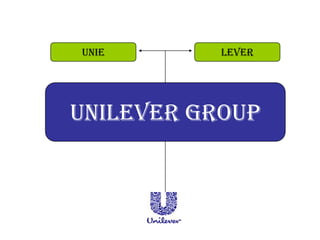
UNIELEVERUnilever GROUP
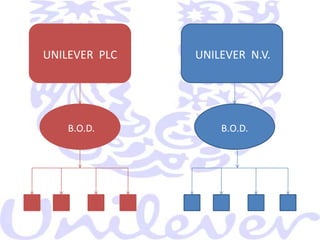
UNILEVER  PLCUNILEVER  N.V.B.O.D.B.O.D.
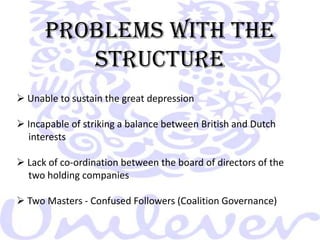
PROBLEMS WITH THE STRUCTURE Unable to sustain the great depression
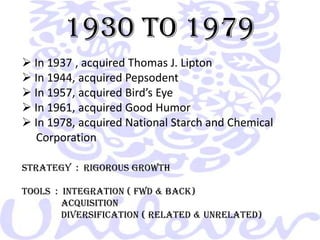
 Incapable of striking a balance between British and Dutch      interests Lack of co-ordination between the board of directors of the      two holding companies Two Masters - Confused Followers (Coalition Governance)1930 to 1979 In 1937 , acquired Thomas J. Lipton
 In 1944, acquired Pepsodent
 In 1957, acquired Bird’s Eye
 In 1961, acquired Good Humor
 In 1978, acquired National Starch and Chemical      CorporationSTRATEGY  :  rigorous GROWTHTOOLS  :  integration ( fwd & back)	   acquisition	   Diversification ( related & unrelated)
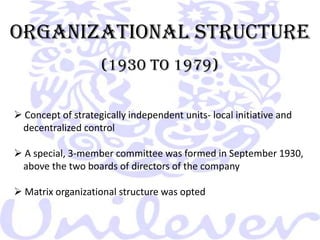
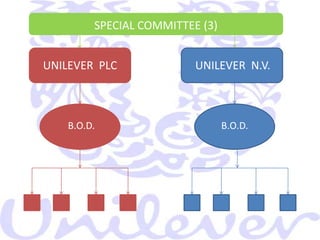
ORGANIZATIONAL STRUCTURE(1930 to 1979) Concept of strategically independent units- local initiative and     decentralized control A special, 3-member committee was formed in September 1930,     above the two boards of directors of the company Matrix organizational structure was optedSPECIAL COMMITTEE (3)UNILEVER  PLCUNILEVER  N.V.B.O.D.B.O.D.
PROBLEM WITH THE STRUCTUREConcept of strategically independent units led to high cost structure from duplication of manufacturing facilities at various locations
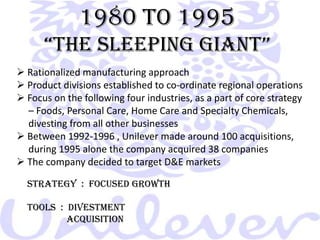
1980 to 1995“the sleeping giant” Rationalized manufacturing approach
 Product divisions established to co-ordinate regional operations
 Focus on the following four industries, as a part of core strategy       – Foods, Personal Care, Home Care and Specialty Chemicals,        divesting from all other businesses Between 1992-1996 , Unilever made around 100 acquisitions,      during 1995 alone the company acquired 38 companies The company decided to target D&E marketsSTRATEGY  :  FOCUSED GROWTHTOOLS  :  DIVESTMENT	   ACQUISITION
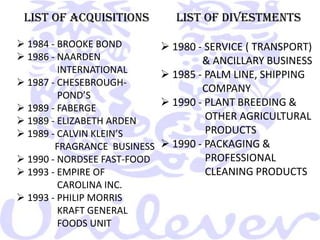
List of acquisitions 1984 - BROOKE BOND
 1986 - NAARDEN                  INTERNATIONAL 1987 - CHESEBROUGH-                 POND’S 1989 - FABERGE
 1989 - ELIZABETH ARDEN
 1989 - CALVIN KLEIN’S                 FRAGRANCE  BUSINESS 1990 - NORDSEE FAST-FOOD
 1993 - EMPIRE OF                  CAROLINA INC. 1993 - PHILIP MORRIS                  KRAFT GENERAL                    FOODS UNITList of Divestments 1980 - SERVICE ( TRANSPORT)                 & ANCILLARY BUSINESS  1985 - PALM LINE, SHIPPING                 COMPANY 1990 - PLANT BREEDING &                  OTHER AGRICULTURAL                        PRODUCTS 1990 - PACKAGING &                  PROFESSIONAL                         CLEANING PRODUCTS
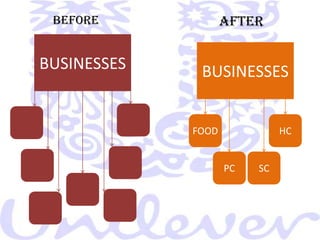
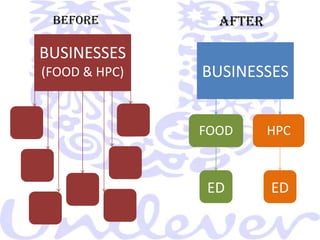
BEFOREafterBUSINESSESBUSINESSESFOODHCPCSC
PROBLEMS WITH THE STRUCTURE The unending acquisitions made the operations cumbersome  and      the company became inflexible to adapt to the market dynamism Performance drift
 Organizational fatigue
 Excess of bureaucracy
 Confusion – of accountability and responsibility
 Conflicting priorities in the special committee
 Decision making became constipated
 Structural detritus , accumulated over decades
 Absolute chaotic condition
 Extra levels of complexity were imposed on an already convoluted      structure
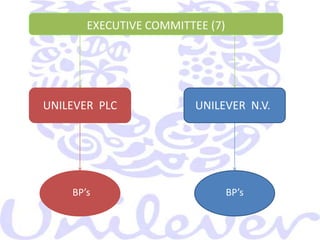
1996 TO 1999breakthrough restructuring 3- Member special committee which existed since the birth of      Unilever got dissolved , to give way to a 7- Member Executive      committee The company appointed its 1st Chairman (Niall FitzGerald, an      Irishman) not carrying a British or a Dutch passport Two layers of the organizational structure consisting of the world-     wide business   coordinators and the network of Regional      Directors were swept away to form a single team of 14 business      Presidents Company’s operations were grouped by product , instead of      geographical regions From Centrally – Driven expansion to branched expansion…Unilever wanted to grow as much by local      pull as by global push Focus on Company’s Core Competences
 Introduction to the new management      incentive system (Variable Pay)STRATEGY  :  SUSTAINABILITYTOOL  :  restructuring
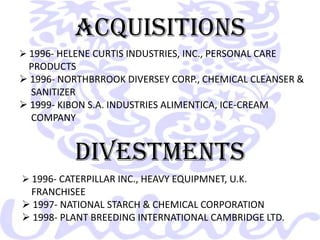
ACQUISITIONS1996- HELENE CURTIS INDUSTRIES, INC., PERSONAL CARE     PRODUCTS 1996- NORTHBRROOK DIVERSEY CORP., CHEMICAL CLEANSER &      SANITIZER 1999- KIBON S.A. INDUSTRIES ALIMENTICA, ICE-CREAM      COMPANYDIVESTMENTS1996- CATERPILLAR INC., HEAVY EQUIPMNET, U.K.     FRANCHISEE 1997- NATIONAL STARCH & CHEMICAL CORPORATION
 1998- PLANT BREEDING INTERNATIONAL CAMBRIDGE LTD.EXECUTIVE COMMITTEE (7)UNILEVER  PLCUNILEVER  N.V.BP’sBP’s
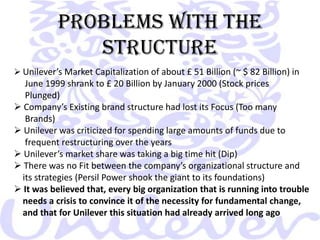
PROBLEMS WITH THE STRUCTUREUnilever’s Market Capitalization of about £ 51 Billion (~ $ 82 Billion) in       June 1999 shrank to £ 20 Billion by January 2000 (Stock prices      Plunged) Company’s Existing brand structure had lost its Focus (Too many      Brands) Unilever was criticized for spending large amounts of funds due to      frequent restructuring over the years Unilever’s market share was taking a big time hit (Dip)
 There was no Fit between the company’s organizational structure and      its strategies (Persil Power shook the giant to its foundations)It was believed that, every big organization that is running into trouble     needs a crisis to convince it of the necessity for fundamental change,     and that for Unilever this situation had already arrived long ago
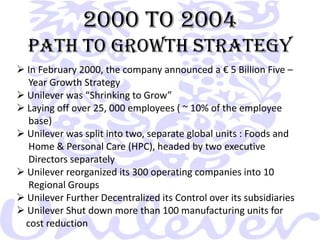
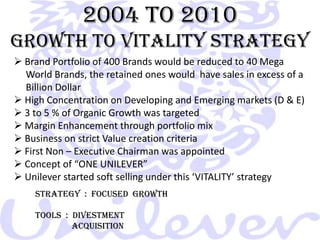
2000 TO 2004PATH TO GROWTH STRATEGY In February 2000, the company announced a € 5 Billion Five –      Year Growth Strategy Unilever was “Shrinking to Grow”
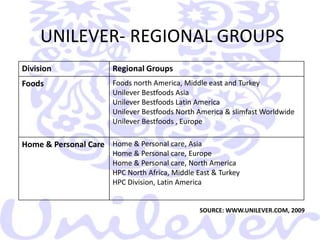
 Laying off over 25, 000 employees ( ~ 10% of the employee      base) Unilever was split into two, separate global units : Foods and      Home & Personal Care (HPC), headed by two executive         Directors separately Unilever reorganized its 300 operating companies into 10      Regional Groups Unilever Further Decentralized its Control over its subsidiaries
 Unilever Shut down more than 100 manufacturing units for     cost reduction
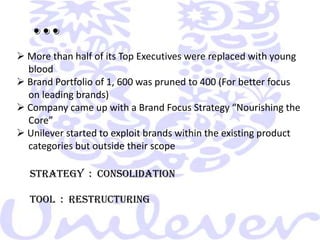
… More than half of its Top Executives were replaced with young      blood Brand Portfolio of 1, 600 was pruned to 400 (For better focus        on leading brands) Company came up with a Brand Focus Strategy “Nourishing the      Core” Unilever started to exploit brands within the existing product      categories but outside their scopeSTRATEGY  :  CONSOLIDATIONTOOL  :  restructuring
 UNILEVER- REGIONAL GROUPSSOURCE: WWW.UNILEVER.COM, 2009
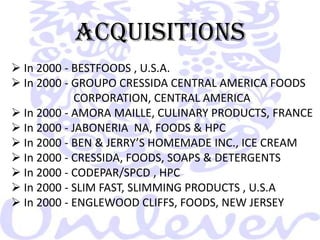
ACQUISITIONS In 2000 - BESTFOODS , U.S.A.

Unilever

  • 1.
  • 2.
  • 3.
  • 4.
  • 5.
  • 6.
  • 7.
  • 8.
    UNIE In 1872,two Dutchmen, Jurgens and Van Der Bergh had ventured into the margarine business In 1927, they decided to merge to form two companies, Margarine Unie NV, based in the Netherlands and Margarine Union Ltd, based in the UKSTRATEGY : GROWTHTOOL : MERGER
  • 9.
    LEVER William HeskethLever founded ‘Lever Brothers’ in 1885
  • 10.
    By 1887,introduced ‘SUNLIGHT’, the world’s 1st packaged laundry soap Lever & Co. was making 450 tons of Sunlight soap a week
  • 11.
    He expandedhis business from UK to Australia, North America and other parts of Europe In 1890, Lever & Co became a limited company –LEVER BROTHERS LTD, by 1894, they went PUBLIC Diversified into other businesses, acquired Pears soap and Wall’s
  • 12.
    Launched itsinnovative product , VIMSTRATEGY : GROWTHTOOL : ACQUISITION
  • 13.
  • 15.
    UNILEVER PLCUNILEVER N.V.B.O.D.B.O.D.
  • 16.
    PROBLEMS WITH THESTRUCTURE Unable to sustain the great depression
  • 17.
    Incapable ofstriking a balance between British and Dutch interests Lack of co-ordination between the board of directors of the two holding companies Two Masters - Confused Followers (Coalition Governance)1930 to 1979 In 1937 , acquired Thomas J. Lipton
  • 18.
    In 1944,acquired Pepsodent
  • 19.
    In 1957,acquired Bird’s Eye
  • 20.
    In 1961,acquired Good Humor
  • 21.
    In 1978,acquired National Starch and Chemical CorporationSTRATEGY : rigorous GROWTHTOOLS : integration ( fwd & back) acquisition Diversification ( related & unrelated)
  • 22.
    ORGANIZATIONAL STRUCTURE(1930 to1979) Concept of strategically independent units- local initiative and decentralized control A special, 3-member committee was formed in September 1930, above the two boards of directors of the company Matrix organizational structure was optedSPECIAL COMMITTEE (3)UNILEVER PLCUNILEVER N.V.B.O.D.B.O.D.
  • 23.
    PROBLEM WITH THESTRUCTUREConcept of strategically independent units led to high cost structure from duplication of manufacturing facilities at various locations
  • 24.
    1980 to 1995“thesleeping giant” Rationalized manufacturing approach
  • 25.
    Product divisionsestablished to co-ordinate regional operations
  • 26.
    Focus onthe following four industries, as a part of core strategy – Foods, Personal Care, Home Care and Specialty Chemicals, divesting from all other businesses Between 1992-1996 , Unilever made around 100 acquisitions, during 1995 alone the company acquired 38 companies The company decided to target D&E marketsSTRATEGY : FOCUSED GROWTHTOOLS : DIVESTMENT ACQUISITION
  • 27.
    List of acquisitions1984 - BROOKE BOND
  • 28.
    1986 -NAARDEN INTERNATIONAL 1987 - CHESEBROUGH- POND’S 1989 - FABERGE
  • 29.
    1989 -ELIZABETH ARDEN
  • 30.
    1989 -CALVIN KLEIN’S FRAGRANCE BUSINESS 1990 - NORDSEE FAST-FOOD
  • 31.
    1993 -EMPIRE OF CAROLINA INC. 1993 - PHILIP MORRIS KRAFT GENERAL FOODS UNITList of Divestments 1980 - SERVICE ( TRANSPORT) & ANCILLARY BUSINESS 1985 - PALM LINE, SHIPPING COMPANY 1990 - PLANT BREEDING & OTHER AGRICULTURAL PRODUCTS 1990 - PACKAGING & PROFESSIONAL CLEANING PRODUCTS
  • 32.
  • 33.
    PROBLEMS WITH THESTRUCTURE The unending acquisitions made the operations cumbersome and the company became inflexible to adapt to the market dynamism Performance drift
  • 34.
  • 35.
    Excess ofbureaucracy
  • 36.
    Confusion –of accountability and responsibility
  • 37.
    Conflicting prioritiesin the special committee
  • 38.
    Decision makingbecame constipated
  • 39.
    Structural detritus, accumulated over decades
  • 40.
  • 41.
    Extra levelsof complexity were imposed on an already convoluted structure
  • 42.
    1996 TO 1999breakthroughrestructuring 3- Member special committee which existed since the birth of Unilever got dissolved , to give way to a 7- Member Executive committee The company appointed its 1st Chairman (Niall FitzGerald, an Irishman) not carrying a British or a Dutch passport Two layers of the organizational structure consisting of the world- wide business coordinators and the network of Regional Directors were swept away to form a single team of 14 business Presidents Company’s operations were grouped by product , instead of geographical regions From Centrally – Driven expansion to branched expansion…Unilever wanted to grow as much by local pull as by global push Focus on Company’s Core Competences
  • 43.
    Introduction tothe new management incentive system (Variable Pay)STRATEGY : SUSTAINABILITYTOOL : restructuring
  • 44.
    ACQUISITIONS1996- HELENE CURTISINDUSTRIES, INC., PERSONAL CARE PRODUCTS 1996- NORTHBRROOK DIVERSEY CORP., CHEMICAL CLEANSER & SANITIZER 1999- KIBON S.A. INDUSTRIES ALIMENTICA, ICE-CREAM COMPANYDIVESTMENTS1996- CATERPILLAR INC., HEAVY EQUIPMNET, U.K. FRANCHISEE 1997- NATIONAL STARCH & CHEMICAL CORPORATION
  • 45.
    1998- PLANTBREEDING INTERNATIONAL CAMBRIDGE LTD.EXECUTIVE COMMITTEE (7)UNILEVER PLCUNILEVER N.V.BP’sBP’s
  • 46.
    PROBLEMS WITH THESTRUCTUREUnilever’s Market Capitalization of about £ 51 Billion (~ $ 82 Billion) in June 1999 shrank to £ 20 Billion by January 2000 (Stock prices Plunged) Company’s Existing brand structure had lost its Focus (Too many Brands) Unilever was criticized for spending large amounts of funds due to frequent restructuring over the years Unilever’s market share was taking a big time hit (Dip)
  • 47.
    There wasno Fit between the company’s organizational structure and its strategies (Persil Power shook the giant to its foundations)It was believed that, every big organization that is running into trouble needs a crisis to convince it of the necessity for fundamental change, and that for Unilever this situation had already arrived long ago
  • 48.
    2000 TO 2004PATHTO GROWTH STRATEGY In February 2000, the company announced a € 5 Billion Five – Year Growth Strategy Unilever was “Shrinking to Grow”
  • 49.
    Laying offover 25, 000 employees ( ~ 10% of the employee base) Unilever was split into two, separate global units : Foods and Home & Personal Care (HPC), headed by two executive Directors separately Unilever reorganized its 300 operating companies into 10 Regional Groups Unilever Further Decentralized its Control over its subsidiaries
  • 50.
    Unilever Shutdown more than 100 manufacturing units for cost reduction
  • 51.
    … More thanhalf of its Top Executives were replaced with young blood Brand Portfolio of 1, 600 was pruned to 400 (For better focus on leading brands) Company came up with a Brand Focus Strategy “Nourishing the Core” Unilever started to exploit brands within the existing product categories but outside their scopeSTRATEGY : CONSOLIDATIONTOOL : restructuring
  • 52.
    UNILEVER- REGIONALGROUPSSOURCE: WWW.UNILEVER.COM, 2009
  • 53.
    ACQUISITIONS In 2000- BESTFOODS , U.S.A.