P&G and Unilever
Organizational Structure
Lessons to Learn
Presented by
GROUP 7 SECTION-B
Himanshu Dhamija UM15081
Saif Hasan Rizvi UM15105
Rahul Kumar Jena UM15101
Sibasis Mohapatra UM15111
Varanasi Arjun UM15121
Yasasvi Santosh UM15123
Procter and Gamble
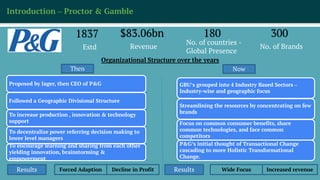
Introduction – Proctor & Gamble
1837 $83.06bn 180 300
RevenueEstd.
No. of countries -
Global Presence
No. of Brands
Organizational Structure over the years
Then Now
Proposed by Jager, then CEO of P&G
Followed a Geographic Divisional Structure
To increase production , innovation & technology
support
To decentralize power referring decision making to
lower level managers
To encourage learning and sharing from each other
yielding innovation, brainstorming &
empowerment
GBU’s grouped into 4 Industry Based Sectors –
Industry-wise and geographic focus
Streamlining the resources by concentrating on few
brands
Focus on common consumer benefits, share
common technologies, and face common
competitors
P&G’s initial thought of Transactional Change
cascading to more Holistic Transformational
Change.
Results Forced Adaption Decline in Profit Results Wide Focus Increased revenue
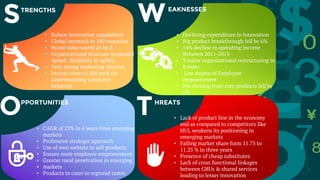
STRENGTHS
WEAKNESSES
OPPORTUNITIES
THREATS
• Robust innovation capabilities
• Global outreach to 180 countries
• Brand value worth 24 bn $
• Organizational structure promoted
Speed , flexibility & agility
• Very strong marketing channel
• Invests close to 500 mn$ for
Understanding consumer
behavior
• Declining expenditure in Innovation
• Big product breakthrough fell by 6%
• 14% decline in operating Income
Between 2011-2013
• 3 major organizational restructuring in
8 years
• Low degree of Employee
empowerment
• Net earning from core products fell by
6%
• CAGR of 23% in 4 years from emerging
markets
• Profensive strategic approach
• Use of own website to sell products
• Ensure more employee empowerment
• Greater rural penetration in emerging
• markets
• Products to cater to regional tastes
• Lack of product line in the economy
end as compared to competitors like
HUL weakens its positioning in
emerging markets
• Falling market share form 11.75 to
11.25 % in three years
• Presence of cheap substitutes
• Lack of cross functional linkages
between GBUs & shared services
leading to lesser innovation
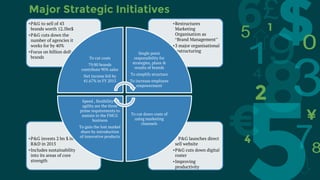
Major Strategic Initiatives
• P&G launches direct
sell website
•P&G cuts down digital
roster
•Improving
productivity
•P&G invests 2 bn $ in
R&D in 2015
•Includes sustainability
into its areas of core
strength
•Restructures
Marketing
Organisation as
“Brand Management”
•3 major organisational
restructuring
•P&G to sell of 43
brands worth 12.5bn$
•P&G cuts down the
number of agencies it
works for by 40%
•Focus on billion dollar
brands To cut costs
79/80 brands
contribute 90% sales
Net income fell by
41.67% in FY 2015
Single point
responsibility for
strategies, plans &
results of brands
To simplify structure
To increase employee
empowerment
To cut down costs of
using marketing
channels
Speed , flexibility &
agility are the three
prime requirements to
sustain in the FMCG
business
To gain the lost market
share by introduction
of innovative products
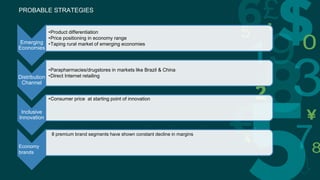
Emerging
Economies
•Product differentiation
•Price positioning in economy range
•Taping rural market of emerging economies
Distribution
Channel
•Parapharmacies/drugstores in markets like Brazil & China
•Direct Internet retailing
Inclusive
Innovation
•Consumer price at starting point of innovation
Economy
brands
8 premium brand segments have shown constant decline in margins
PROBABLE STRATEGIES
Strategic Approach
⊸Type of strategy: Normative Re-educative
⊸ Two way communication - regular feedback & a conducive climate
⊸ Greater degree of customization/localisation (in terms of schemes / products)
⊸Type of typology: Prospective Typology
⊸ Aggressive Planning and implementation so as to get first mover advantage
⊸ Greater empowerment to the lower level executives so as to make them accountable
⊸Type of approach:Adhocratic
⊸ Lean and mean – so as to reduce costs and concentrate the resources on best selling brands
⊸ Focus on innovation and improvement
⊸Type of Control: Implementation
⊸Implementation-adding small elements of innovation into everyday P&G processes in order to enact
cultural change.
Proactive Defensive Profensive
Unilever
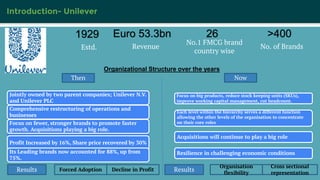
Introduction- Unilever
1929 Euro 53.3bn 26 >400
RevenueEstd.
No.1 FMCG brand
country wise
No. of Brands
Organizational Structure over the years
Then Now
Jointly owned by two parent companies; Unilever N.V.
and Unilever PLC
Comprehensive restructuring of operations and
businesses
Focus on fewer, stronger brands to promote faster
growth. Acquisitions playing a big role.
Profit Increased by 16%, Share price recovered by 30%
Its Leading brands now accounted for 88%, up from
75%.
Focus on big products, reduce stock keeping units (SKUs),
improve working capital management, cut headcount.
Each level within the hierarchy serves a different function
allowing the other levels of the organisation to concentrate
on their core roles
Acquisitions will continue to play a big role
Resilience in challenging economic conditions
Results Forced Adoption Decline in Profit Results
Organisation
flexibility
Cross sectional
representation
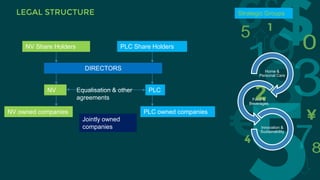
NV Share Holders PLC Share Holders
DIRECTORS
NV PLCEqualisation & other
agreements
NV owned companies PLC owned companies
Jointly owned
companies
LEGAL STRUCTURE Strategic Groups
Home &
Personal Care
Food &
Beverages
Innovation &
Sustainability
STRENGTHS
WEAKNESSES
OPPORTUNITIES
THREATS
• Strong Parentage and hence
Strong Brand Equity
• Strong Brand Portfolio
• Unmatched Distribution
Network
• Excellent Research and
Development
• Losing Market Share in most
categories due to
competitors strong Brands
• High Advertising Costs
• Declining Export Level
• Mimic Brands
• Large Domestic Market
• Large Untapped Market
available
• Changing Lifestyle and
Rising Income Levels
• Export Potential-
expansionist Policies
• Opportunity in Food Sector
• Increasing cost of Raw
Material
• Intense and increasing
competition from local as
well as MNC Players
• Competition from
unbranded Products
• Competition from its own
brands
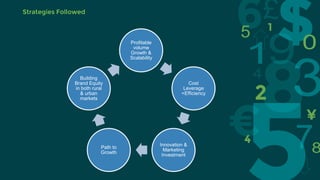
Profitable
volume
Growth &
Scalability
Cost
Leverage
+Efficiency
Innovation &
Marketing
Investment
Path to
Growth
Building
Brand Equity
in both rural
& urban
markets
Strategies Followed
Current Issues with HUL
• Hindustan Unilever's aggressive advertising and discounts failed to lift
sales(Sales fell by 2.7% in 2014)
• Absence of a funnel of new products in the pipeline( New product
success rate fell by 5%)
• Weakening of emerging markets last year that made Unilever's third
quarter sales the weakest in five years(Profit margin fell by 4.4%in 2014)
• Sustainability challenges
•Attempt to shrink the environmental footprint( Carbon foot print
reduction was 12 % in 2014-2015 compared to targeted 32%)
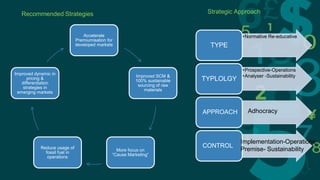
Accelerate
Premiumisation for
developed markets
Improved SCM &
100% sustainable
sourcing of raw
materials
More focus on
“Cause Marketing”
Reduce usage of
fossil fuel in
operations
Improved dynamic in
pricing &
differentiation
strategies in
emerging markets
•Normative Re-educative
TYPE
•Prospective-Operations
•Analyser -Sustainability
TYPLOLGY
APPROACH Adhocracy
CONTROL
Implementation-Operations
Premise- Sustainability
Recommended Strategies Strategic Approach
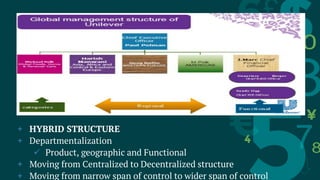
+ HYBRID STRUCTURE
+ Departmentalization
 Product, geographic and Functional
+ Moving from Centralized to Decentralized structure
+ Moving from narrow span of control to wider span of control
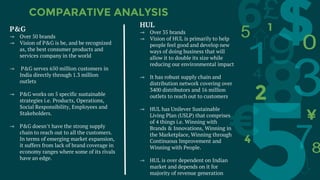
COMPARATIVE ANALYSIS
P&G
⊸ Over 50 brands
⊸ Vision of P&G is be, and be recognized
as, the best consumer products and
services company in the world
⊸ P&G serves 650 million customers in
India directly through 1.3 million
outlets
⊸ P&G works on 5 specific sustainable
strategies i.e. Products, Operations,
Social Responsibility, Employees and
Stakeholders.
⊸ P&G doesn’t have the strong supply
chain to reach out to all the customers.
In terms of emerging market expansion,
it suffers from lack of brand coverage in
economy ranges where some of its rivals
have an edge.
HUL
⊸ Over 35 brands
⊸ Vision of HUL is primarily to help
people feel good and develop new
ways of doing business that will
allow it to double its size while
reducing our environmental impact
⊸ It has robust supply chain and
distribution network covering over
3400 distributors and 16 million
outlets to reach out to customers
⊸ HUL has Unilever Sustainable
Living Plan (USLP) that comprises
of 4 things i.e. Winning with
Brands & Innovations, Winning in
the Marketplace, Winning through
Continuous Improvement and
Winning with People.
⊸ HUL is over dependent on Indian
market and depends on it for
majority of revenue generation
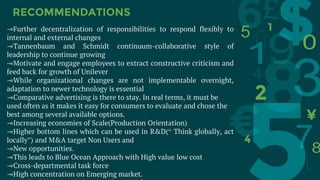
RECOMMENDATIONS
⊸Further decentralization of responsibilities to respond flexibly to
internal and external changes
⊸Tannenbaum and Schmidt continuum-collaborative style of
leadership to continue growing
⊸Motivate and engage employees to extract constructive criticism and
feed back for growth of Unilever
⊸While organizational changes are not implementable overnight,
adaptation to newer technology is essential
⊸Comparative advertising is there to stay. In real terms, it must be
used often as it makes it easy for consumers to evaluate and chose the
best among several available options.
⊸Increasing economies of Scale(Production Orientation)
⊸Higher bottom lines which can be used in R&D(“ Think globally, act
locally”) and M&A target Non Users and
⊸New opportunities.
⊸This leads to Blue Ocean Approach with High value low cost
⊸Cross-departmental task force
⊸High concentration on Emerging market.
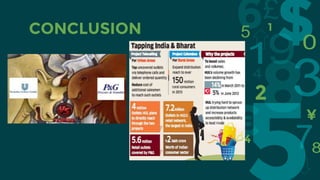
CONCLUSION
Thanks!

Osd section b group 7

  • 1.
    P&G and Unilever OrganizationalStructure Lessons to Learn Presented by GROUP 7 SECTION-B Himanshu Dhamija UM15081 Saif Hasan Rizvi UM15105 Rahul Kumar Jena UM15101 Sibasis Mohapatra UM15111 Varanasi Arjun UM15121 Yasasvi Santosh UM15123
  • 2.
  • 3.
    Introduction – Proctor& Gamble 1837 $83.06bn 180 300 RevenueEstd. No. of countries - Global Presence No. of Brands Organizational Structure over the years Then Now Proposed by Jager, then CEO of P&G Followed a Geographic Divisional Structure To increase production , innovation & technology support To decentralize power referring decision making to lower level managers To encourage learning and sharing from each other yielding innovation, brainstorming & empowerment GBU’s grouped into 4 Industry Based Sectors – Industry-wise and geographic focus Streamlining the resources by concentrating on few brands Focus on common consumer benefits, share common technologies, and face common competitors P&G’s initial thought of Transactional Change cascading to more Holistic Transformational Change. Results Forced Adaption Decline in Profit Results Wide Focus Increased revenue
  • 4.
    STRENGTHS WEAKNESSES OPPORTUNITIES THREATS • Robust innovationcapabilities • Global outreach to 180 countries • Brand value worth 24 bn $ • Organizational structure promoted Speed , flexibility & agility • Very strong marketing channel • Invests close to 500 mn$ for Understanding consumer behavior • Declining expenditure in Innovation • Big product breakthrough fell by 6% • 14% decline in operating Income Between 2011-2013 • 3 major organizational restructuring in 8 years • Low degree of Employee empowerment • Net earning from core products fell by 6% • CAGR of 23% in 4 years from emerging markets • Profensive strategic approach • Use of own website to sell products • Ensure more employee empowerment • Greater rural penetration in emerging • markets • Products to cater to regional tastes • Lack of product line in the economy end as compared to competitors like HUL weakens its positioning in emerging markets • Falling market share form 11.75 to 11.25 % in three years • Presence of cheap substitutes • Lack of cross functional linkages between GBUs & shared services leading to lesser innovation
  • 5.
    Major Strategic Initiatives •P&G launches direct sell website •P&G cuts down digital roster •Improving productivity •P&G invests 2 bn $ in R&D in 2015 •Includes sustainability into its areas of core strength •Restructures Marketing Organisation as “Brand Management” •3 major organisational restructuring •P&G to sell of 43 brands worth 12.5bn$ •P&G cuts down the number of agencies it works for by 40% •Focus on billion dollar brands To cut costs 79/80 brands contribute 90% sales Net income fell by 41.67% in FY 2015 Single point responsibility for strategies, plans & results of brands To simplify structure To increase employee empowerment To cut down costs of using marketing channels Speed , flexibility & agility are the three prime requirements to sustain in the FMCG business To gain the lost market share by introduction of innovative products
  • 6.
    Emerging Economies •Product differentiation •Price positioningin economy range •Taping rural market of emerging economies Distribution Channel •Parapharmacies/drugstores in markets like Brazil & China •Direct Internet retailing Inclusive Innovation •Consumer price at starting point of innovation Economy brands 8 premium brand segments have shown constant decline in margins PROBABLE STRATEGIES
  • 7.
    Strategic Approach ⊸Type ofstrategy: Normative Re-educative ⊸ Two way communication - regular feedback & a conducive climate ⊸ Greater degree of customization/localisation (in terms of schemes / products) ⊸Type of typology: Prospective Typology ⊸ Aggressive Planning and implementation so as to get first mover advantage ⊸ Greater empowerment to the lower level executives so as to make them accountable ⊸Type of approach:Adhocratic ⊸ Lean and mean – so as to reduce costs and concentrate the resources on best selling brands ⊸ Focus on innovation and improvement ⊸Type of Control: Implementation ⊸Implementation-adding small elements of innovation into everyday P&G processes in order to enact cultural change. Proactive Defensive Profensive
  • 8.
  • 9.
    Introduction- Unilever 1929 Euro53.3bn 26 >400 RevenueEstd. No.1 FMCG brand country wise No. of Brands Organizational Structure over the years Then Now Jointly owned by two parent companies; Unilever N.V. and Unilever PLC Comprehensive restructuring of operations and businesses Focus on fewer, stronger brands to promote faster growth. Acquisitions playing a big role. Profit Increased by 16%, Share price recovered by 30% Its Leading brands now accounted for 88%, up from 75%. Focus on big products, reduce stock keeping units (SKUs), improve working capital management, cut headcount. Each level within the hierarchy serves a different function allowing the other levels of the organisation to concentrate on their core roles Acquisitions will continue to play a big role Resilience in challenging economic conditions Results Forced Adoption Decline in Profit Results Organisation flexibility Cross sectional representation
  • 10.
    NV Share HoldersPLC Share Holders DIRECTORS NV PLCEqualisation & other agreements NV owned companies PLC owned companies Jointly owned companies LEGAL STRUCTURE Strategic Groups Home & Personal Care Food & Beverages Innovation & Sustainability
  • 11.
    STRENGTHS WEAKNESSES OPPORTUNITIES THREATS • Strong Parentageand hence Strong Brand Equity • Strong Brand Portfolio • Unmatched Distribution Network • Excellent Research and Development • Losing Market Share in most categories due to competitors strong Brands • High Advertising Costs • Declining Export Level • Mimic Brands • Large Domestic Market • Large Untapped Market available • Changing Lifestyle and Rising Income Levels • Export Potential- expansionist Policies • Opportunity in Food Sector • Increasing cost of Raw Material • Intense and increasing competition from local as well as MNC Players • Competition from unbranded Products • Competition from its own brands
  • 12.
    Profitable volume Growth & Scalability Cost Leverage +Efficiency Innovation & Marketing Investment Pathto Growth Building Brand Equity in both rural & urban markets Strategies Followed
  • 13.
    Current Issues withHUL • Hindustan Unilever's aggressive advertising and discounts failed to lift sales(Sales fell by 2.7% in 2014) • Absence of a funnel of new products in the pipeline( New product success rate fell by 5%) • Weakening of emerging markets last year that made Unilever's third quarter sales the weakest in five years(Profit margin fell by 4.4%in 2014) • Sustainability challenges •Attempt to shrink the environmental footprint( Carbon foot print reduction was 12 % in 2014-2015 compared to targeted 32%)
  • 14.
    Accelerate Premiumisation for developed markets ImprovedSCM & 100% sustainable sourcing of raw materials More focus on “Cause Marketing” Reduce usage of fossil fuel in operations Improved dynamic in pricing & differentiation strategies in emerging markets •Normative Re-educative TYPE •Prospective-Operations •Analyser -Sustainability TYPLOLGY APPROACH Adhocracy CONTROL Implementation-Operations Premise- Sustainability Recommended Strategies Strategic Approach
  • 15.
    + HYBRID STRUCTURE +Departmentalization  Product, geographic and Functional + Moving from Centralized to Decentralized structure + Moving from narrow span of control to wider span of control
  • 16.
    COMPARATIVE ANALYSIS P&G ⊸ Over50 brands ⊸ Vision of P&G is be, and be recognized as, the best consumer products and services company in the world ⊸ P&G serves 650 million customers in India directly through 1.3 million outlets ⊸ P&G works on 5 specific sustainable strategies i.e. Products, Operations, Social Responsibility, Employees and Stakeholders. ⊸ P&G doesn’t have the strong supply chain to reach out to all the customers. In terms of emerging market expansion, it suffers from lack of brand coverage in economy ranges where some of its rivals have an edge. HUL ⊸ Over 35 brands ⊸ Vision of HUL is primarily to help people feel good and develop new ways of doing business that will allow it to double its size while reducing our environmental impact ⊸ It has robust supply chain and distribution network covering over 3400 distributors and 16 million outlets to reach out to customers ⊸ HUL has Unilever Sustainable Living Plan (USLP) that comprises of 4 things i.e. Winning with Brands & Innovations, Winning in the Marketplace, Winning through Continuous Improvement and Winning with People. ⊸ HUL is over dependent on Indian market and depends on it for majority of revenue generation
  • 17.
    RECOMMENDATIONS ⊸Further decentralization ofresponsibilities to respond flexibly to internal and external changes ⊸Tannenbaum and Schmidt continuum-collaborative style of leadership to continue growing ⊸Motivate and engage employees to extract constructive criticism and feed back for growth of Unilever ⊸While organizational changes are not implementable overnight, adaptation to newer technology is essential ⊸Comparative advertising is there to stay. In real terms, it must be used often as it makes it easy for consumers to evaluate and chose the best among several available options. ⊸Increasing economies of Scale(Production Orientation) ⊸Higher bottom lines which can be used in R&D(“ Think globally, act locally”) and M&A target Non Users and ⊸New opportunities. ⊸This leads to Blue Ocean Approach with High value low cost ⊸Cross-departmental task force ⊸High concentration on Emerging market.
  • 18.
  • 19.