P.Prashanthan
Advance Dip in Business Management
ADBM-EVE-161P-028
Product Life Cycle
Contents……
• Introduction of the Company
• Product description
• Stage in the product life cycle
• The target market segments
and the targeting strategy
• Branting and the product
characteristics
• Pricing Strategy
• Distribution strategy and
marketing channels
• Promotional strategy and
methods
• Improvements Suggestions
The Company….
• Celebrating 131 years of sharing happiness since the Coca-Cola story began on May
8, 1886
• Coca-Cola’s journey in Sri Lanka 56 years from April 1961
• Coca-Cola Beverages Sri Lanka Ltd – Registered Name In Sri Lanka,
Headquartered in Biyagama
• Coca-Cola the world’s largest beverage company, portfolio of more than 3,500
product variants, 17 billion dollar brands and operations in more than 200 countries
worldwide
• Coca-Cola's market capitalization at roughly US$188 billion
• Total revenue US$41.863 billion in 2016 worldwide
Product description……
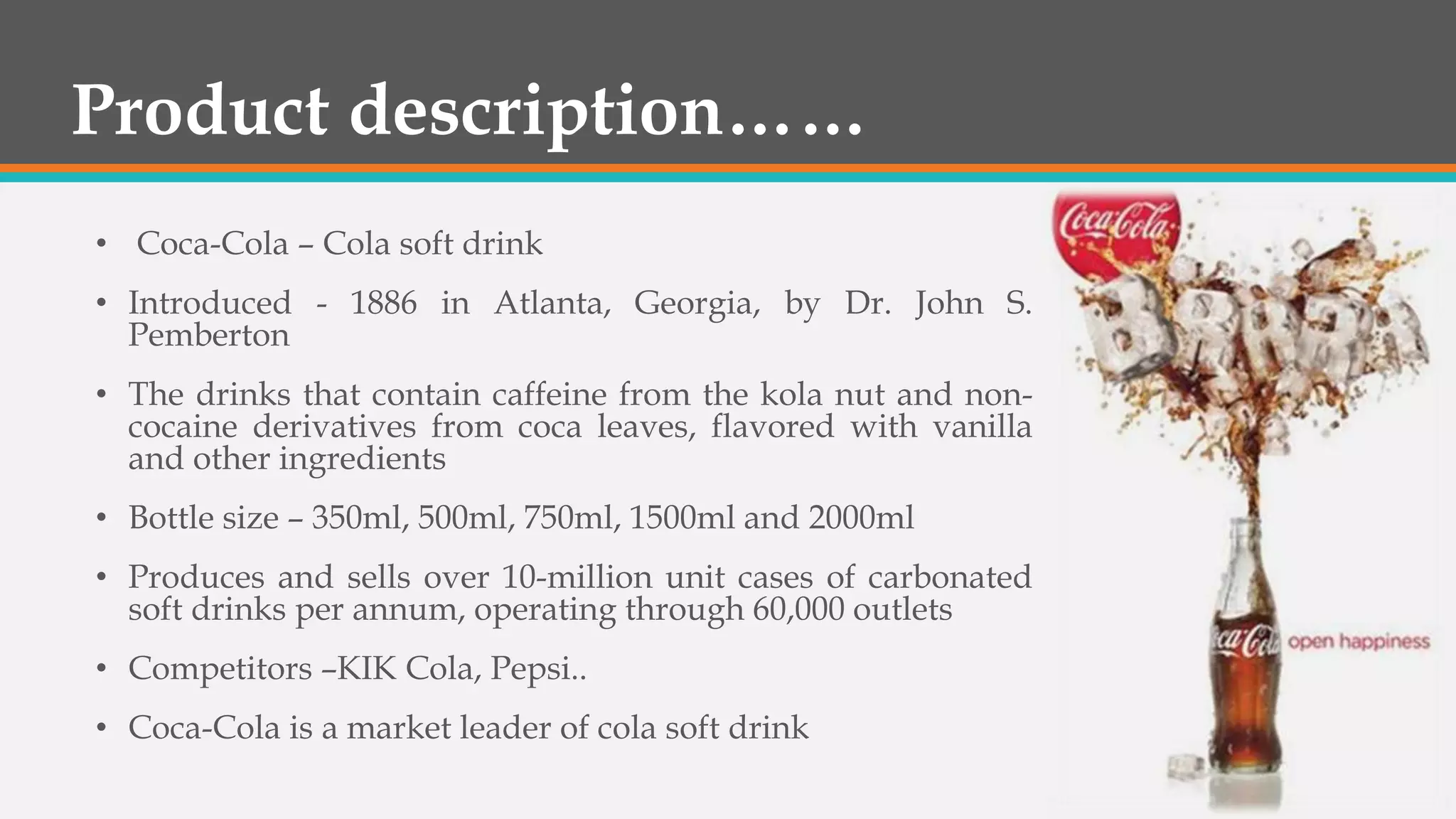
• Coca-Cola – Cola soft drink
• Introduced - 1886 in Atlanta, Georgia, by Dr. John S.
Pemberton
• The drinks that contain caffeine from the kola nut and non-
cocaine derivatives from coca leaves, flavored with vanilla
and other ingredients
• Bottle size – 350ml, 500ml, 750ml, 1500ml and 2000ml
• Produces and sells over 10-million unit cases of carbonated
soft drinks per annum, operating through 60,000 outlets
• Competitors –KIK Cola, Pepsi..
• Coca-Cola is a market leader of cola soft drink
Stage in the Product Life Cycle……
• Currently Coca-Cola is under the maturity
stage due to the solidity and capability of
keeping a large and loyal group of stable
customers
• The company is traveling longer period of
time in the maturity stage then all other
stages, when it is introduced in western
countries
• Coca-cola still in the growth stage of Asian Countries
The target market segments and the targeting
strategy….
Geographic segmentation
• Climate - Coca Cola’s consumption in
the summer is 60% than 40% in the
winter; therefore, the company's sales
are higher in the summer. It also
focuses in hot area in the world
Demographic segmentation
• Age- 15-25 years old and 40 plus
• Gender- targets both genders with
wide variety drinks
• Income- segments different income
level. for example, by packaging: for
low level income the company is
selling returnable glass bottle; or high
level income, the company is selling
coke in tins
Psychographics segmentation
• People who are brand conscious will
not drink beverages of less known
brands. They will try to show their
status by drinking Coca-Cola
• The level of education is another factor
that the company is paying attention to
In an high percentage education socity
Branding and the product characteristics…..
• Coca-Cola is the most popular and biggest-selling soft drink in history, as well as
one of the most recognizable brands in the world
• Coca-cola – Unique brand name and stylish logo design & color, etc…
• Shape of the bottle design – Unique bottle design
• Sub brands - Sprite, Fanta, Diet Coke, Coca-Cola Zero, Coca-cola life, Coca-cola
light and Minute Maid ,Etc….
• World famous personalities using for promotion activities, which attracts the
customer worldwide
• Using affordable price staring from 35.00 Rs
• Manufactures products based on Age group – (Ex:-Sugar free soft drink – Coca
cola Zero)
• Available deferent sizes of bottles in the market based on customer needs
Pricing Strategy….
• Price should be set according to the
product demand of public
• Price should be that which gives the
company maximum revenue
• Price should not be too low or too high
than the price competitor is charging
from their customers otherwise nobody
will buy your product
• Price must be keeping the view of your
target market.
Example:-
Promotional Pricing
Coca Cola reducing the price during
festival calibration like Ramadan on its
rate up to 5 Rupees on 1.5 liter bottle
Market Penetration Pricing
Coca Cola’s objective is to target every
consumer of the country so Coca Cola is
set its prices at such a level which no one
can offer to its consumers
Distribution strategy and marketing
channels…..
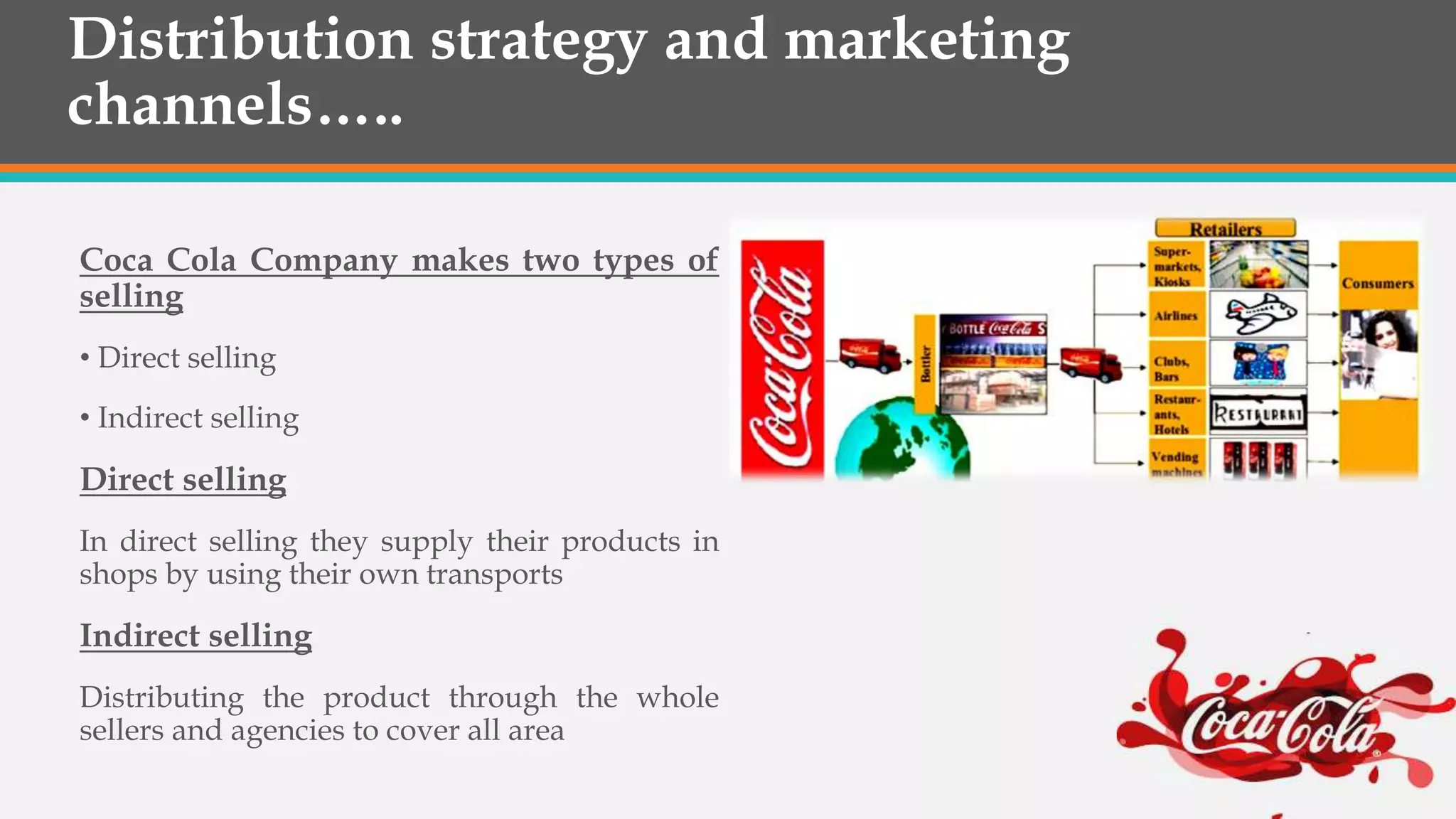
Coca Cola Company makes two types of
selling
• Direct selling
• Indirect selling
Direct selling
In direct selling they supply their products in
shops by using their own transports
Indirect selling
Distributing the product through the whole
sellers and agencies to cover all area
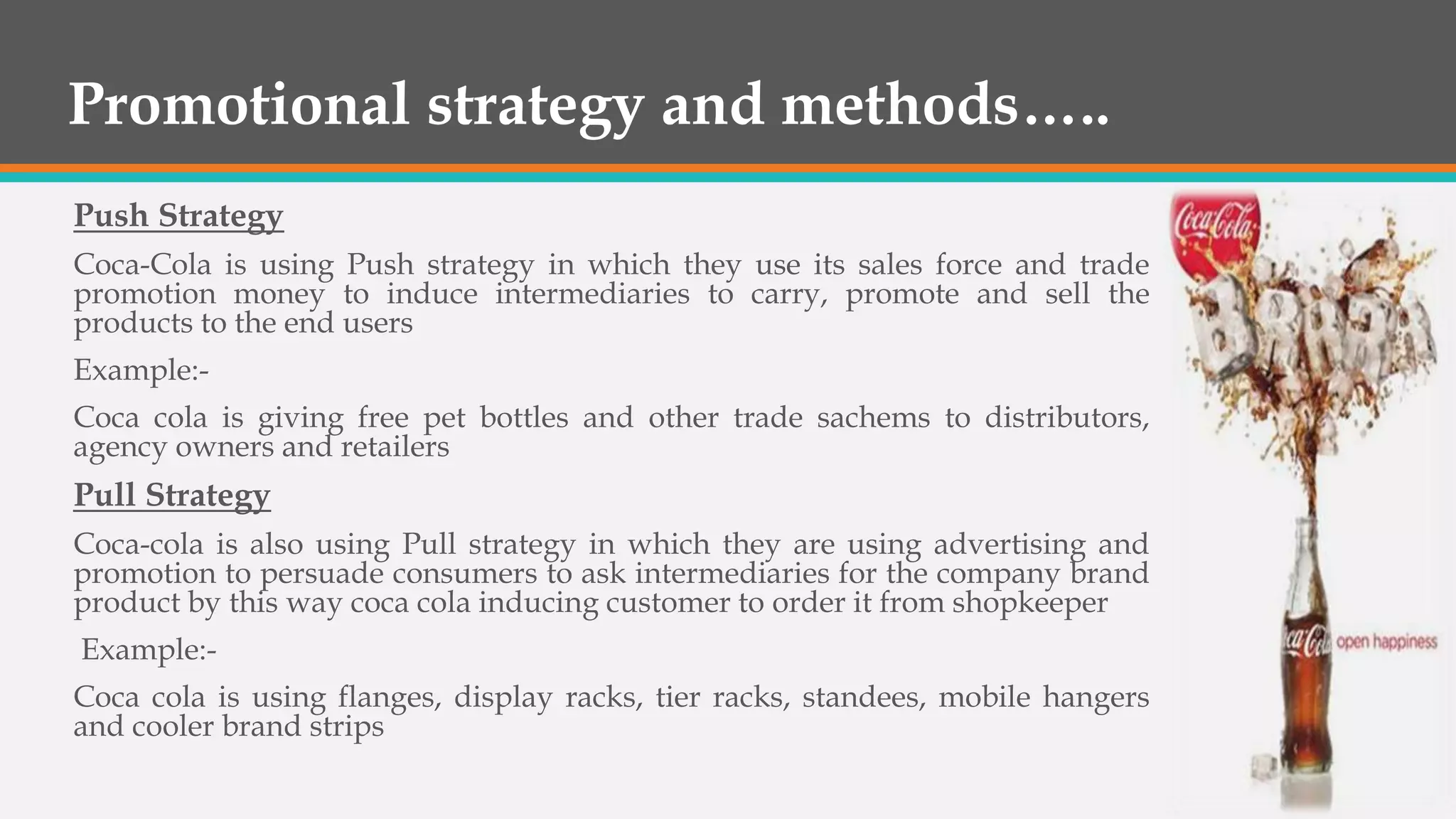
Promotional strategy and methods…..
Push Strategy
Coca-Cola is using Push strategy in which they use its sales force and trade
promotion money to induce intermediaries to carry, promote and sell the
products to the end users
Example:-
Coca cola is giving free pet bottles and other trade sachems to distributors,
agency owners and retailers
Pull Strategy
Coca-cola is also using Pull strategy in which they are using advertising and
promotion to persuade consumers to ask intermediaries for the company brand
product by this way coca cola inducing customer to order it from shopkeeper
Example:-
Coca cola is using flanges, display racks, tier racks, standees, mobile hangers
and cooler brand strips
Improvements Suggestions…..
• The company can make a change in the taste
of the product
•The company can make a change in the design
of the brand name
• Can make a change in the style of the bottle
design
•Increase the number of distributors and
participate in welfare events
Product life cycle   coca cola

Product life cycle coca cola

  • 1.
    P.Prashanthan Advance Dip inBusiness Management ADBM-EVE-161P-028 Product Life Cycle
  • 2.
    Contents…… • Introduction ofthe Company • Product description • Stage in the product life cycle • The target market segments and the targeting strategy • Branting and the product characteristics • Pricing Strategy • Distribution strategy and marketing channels • Promotional strategy and methods • Improvements Suggestions
  • 3.
    The Company…. • Celebrating131 years of sharing happiness since the Coca-Cola story began on May 8, 1886 • Coca-Cola’s journey in Sri Lanka 56 years from April 1961 • Coca-Cola Beverages Sri Lanka Ltd – Registered Name In Sri Lanka, Headquartered in Biyagama • Coca-Cola the world’s largest beverage company, portfolio of more than 3,500 product variants, 17 billion dollar brands and operations in more than 200 countries worldwide • Coca-Cola's market capitalization at roughly US$188 billion • Total revenue US$41.863 billion in 2016 worldwide
  • 4.
    Product description…… • Coca-Cola– Cola soft drink • Introduced - 1886 in Atlanta, Georgia, by Dr. John S. Pemberton • The drinks that contain caffeine from the kola nut and non- cocaine derivatives from coca leaves, flavored with vanilla and other ingredients • Bottle size – 350ml, 500ml, 750ml, 1500ml and 2000ml • Produces and sells over 10-million unit cases of carbonated soft drinks per annum, operating through 60,000 outlets • Competitors –KIK Cola, Pepsi.. • Coca-Cola is a market leader of cola soft drink
  • 5.
    Stage in theProduct Life Cycle…… • Currently Coca-Cola is under the maturity stage due to the solidity and capability of keeping a large and loyal group of stable customers • The company is traveling longer period of time in the maturity stage then all other stages, when it is introduced in western countries • Coca-cola still in the growth stage of Asian Countries
  • 6.
    The target marketsegments and the targeting strategy…. Geographic segmentation • Climate - Coca Cola’s consumption in the summer is 60% than 40% in the winter; therefore, the company's sales are higher in the summer. It also focuses in hot area in the world Demographic segmentation • Age- 15-25 years old and 40 plus • Gender- targets both genders with wide variety drinks • Income- segments different income level. for example, by packaging: for low level income the company is selling returnable glass bottle; or high level income, the company is selling coke in tins Psychographics segmentation • People who are brand conscious will not drink beverages of less known brands. They will try to show their status by drinking Coca-Cola • The level of education is another factor that the company is paying attention to In an high percentage education socity
  • 7.
    Branding and theproduct characteristics….. • Coca-Cola is the most popular and biggest-selling soft drink in history, as well as one of the most recognizable brands in the world • Coca-cola – Unique brand name and stylish logo design & color, etc… • Shape of the bottle design – Unique bottle design • Sub brands - Sprite, Fanta, Diet Coke, Coca-Cola Zero, Coca-cola life, Coca-cola light and Minute Maid ,Etc…. • World famous personalities using for promotion activities, which attracts the customer worldwide • Using affordable price staring from 35.00 Rs • Manufactures products based on Age group – (Ex:-Sugar free soft drink – Coca cola Zero) • Available deferent sizes of bottles in the market based on customer needs
  • 8.
    Pricing Strategy…. • Priceshould be set according to the product demand of public • Price should be that which gives the company maximum revenue • Price should not be too low or too high than the price competitor is charging from their customers otherwise nobody will buy your product • Price must be keeping the view of your target market. Example:- Promotional Pricing Coca Cola reducing the price during festival calibration like Ramadan on its rate up to 5 Rupees on 1.5 liter bottle Market Penetration Pricing Coca Cola’s objective is to target every consumer of the country so Coca Cola is set its prices at such a level which no one can offer to its consumers
  • 9.
    Distribution strategy andmarketing channels….. Coca Cola Company makes two types of selling • Direct selling • Indirect selling Direct selling In direct selling they supply their products in shops by using their own transports Indirect selling Distributing the product through the whole sellers and agencies to cover all area
  • 10.
    Promotional strategy andmethods….. Push Strategy Coca-Cola is using Push strategy in which they use its sales force and trade promotion money to induce intermediaries to carry, promote and sell the products to the end users Example:- Coca cola is giving free pet bottles and other trade sachems to distributors, agency owners and retailers Pull Strategy Coca-cola is also using Pull strategy in which they are using advertising and promotion to persuade consumers to ask intermediaries for the company brand product by this way coca cola inducing customer to order it from shopkeeper Example:- Coca cola is using flanges, display racks, tier racks, standees, mobile hangers and cooler brand strips
  • 11.
    Improvements Suggestions….. • Thecompany can make a change in the taste of the product •The company can make a change in the design of the brand name • Can make a change in the style of the bottle design •Increase the number of distributors and participate in welfare events