Composition
The basic Concepts rules of Composition.
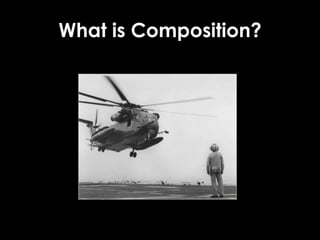
What is Composition?
Composition is:
• A musical score
• Something you write for English class
• Organic substance used in farming
• Arrangement of visual elements
Composition
The word composition means combining or
putting together parts to form a whole.
Composition can apply to many works of
human endeavor, in fact anything that is
arranged or ‘put together’ using conscious
thought.
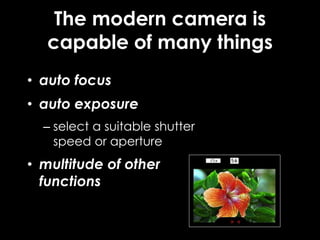
The modern camera is
capable of many things
• auto focus
• auto exposure
– select a suitable shutter
speed or aperture
• multitude of other
functions
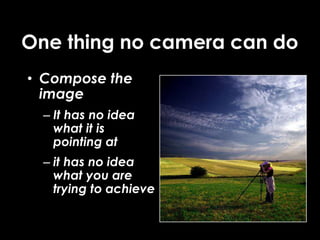
One thing no camera can do
• Compose the
image
– It has no idea
what it is
pointing at
– it has no idea
what you are
trying to achieve
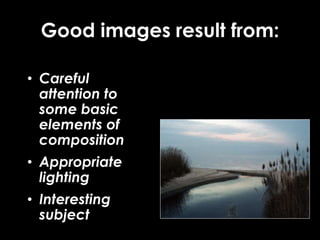
Good images result from:
• Careful
attention to
some basic
elements of
composition
• Appropriate
lighting
• Interesting
subject
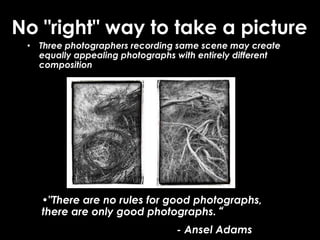
No "right" way to take a picture
• Three photographers recording same scene may create
equally appealing photographs with entirely different
composition
•"There are no rules for good photographs,
there are only good photographs.“
- Ansel Adams
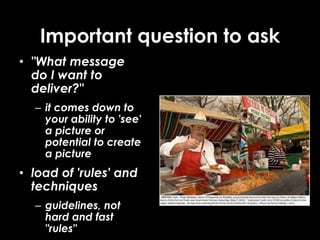
Important question to ask
• "What message
do I want to
deliver?"
– it comes down to
your ability to 'see'
a picture or
potential to create
a picture
• load of 'rules' and
techniques
– guidelines, not
hard and fast
"rules"
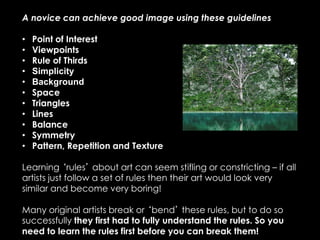
A novice can achieve good image using these guidelines
• Point of Interest
• Viewpoints
• Rule of Thirds
• Simplicity
• Background
• Space
• Triangles
• Lines
• Balance
• Symmetry
• Pattern, Repetition and Texture
Learning ‘rules’ about art can seem stifling or constricting – if all
artists just follow a set of rules then their art would look very
similar and become very boring!
Many original artists break or ‘bend’ these rules, but to do so
successfully they first had to fully understand the rules. So you
need to learn the rules first before you can break them!
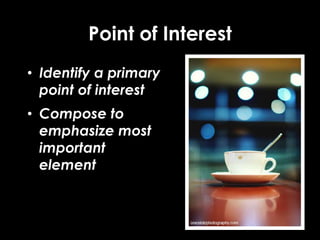
Point of Interest
• Identify a primary
point of interest
• Compose to
emphasize most
important
element
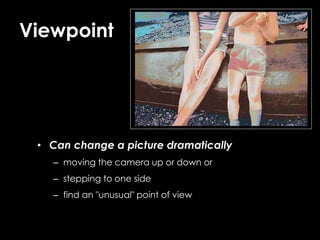
Viewpoint
• Can change a picture dramatically
– moving the camera up or down or
– stepping to one side
– find an "unusual" point of view
3 basic ways to adjust
viewpoint
• Physically move objects relative to
each other
– Only really works with still life photography
• Tell people to move relative to each
other or other objects
– Only works with people who can hear you
3 basic ways to adjust
viewpoint
• Move
– Usually the most effective way to control
composition
– easiest and yet most important
• wander about and see if you can improve on
your original composition by changing your
viewpoint
• much difference can had by walking a few
feet
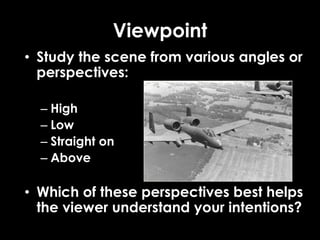
Viewpoint
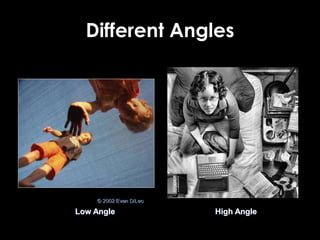
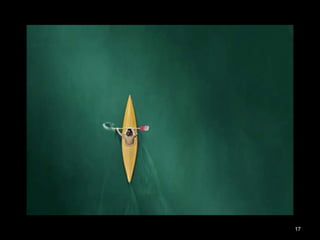
• Study the scene from various angles or
perspectives:
– High
– Low
– Straight on
– Above
• Which of these perspectives best helps
the viewer understand your intentions?
Different Angles
Low Angle High Angle
© 2002 Evan DiLeo
17
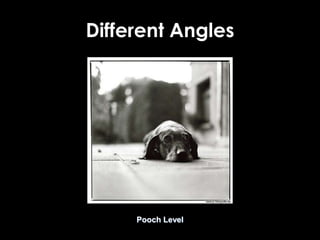
Different Angles
Pooch Level
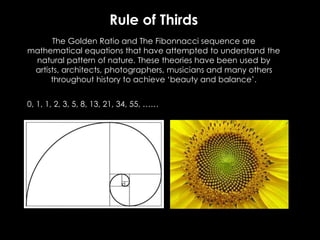
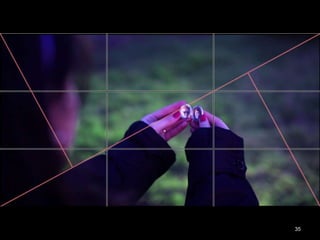
The Golden Ratio and The Fibonnacci sequence are
mathematical equations that have attempted to understand the
natural pattern of nature. These theories have been used by
artists, architects, photographers, musicians and many others
throughout history to achieve ‘beauty and balance’.
0, 1, 1, 2, 3, 5, 8, 13, 21, 34, 55, ……
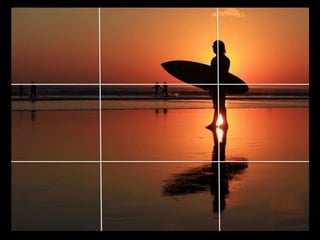
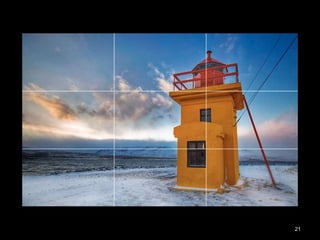
Rule of Thirds
21
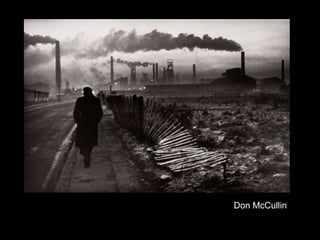
Don McCullin
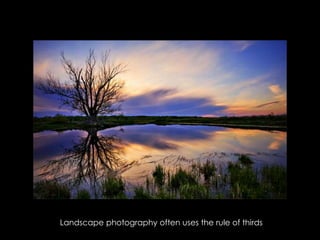
Landscape photography often uses the rule of thirds
Example of Simplicity
Simplicity
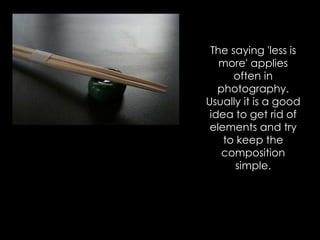
The saying 'less is
more' applies
often in
photography.
Usually it is a good
idea to get rid of
elements and try
to keep the
composition
simple.
Simplicity
• Only the things you want the viewer to see
appear in the picture
• numerous objects cluttering up the
background - message lost
• can’t find an angle or framing to isolate
subject
– consider using depth of field control to keep the
background out of focus
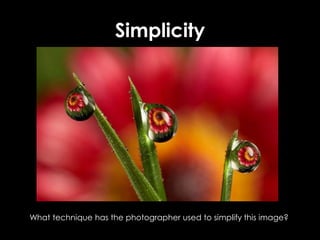
What technique has the photographer used to simplify this image?
Simplicity
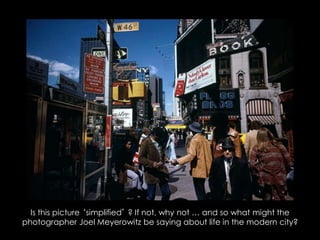
Is this picture ‘simplified’ ? If not, why not … and so what might the
photographer Joel Meyerowitz be saying about life in the modern city?
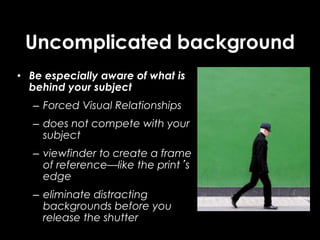
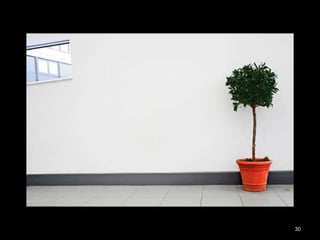
Uncomplicated background
• Be especially aware of what is
behind your subject
– Forced Visual Relationships
– does not compete with your
subject
– viewfinder to create a frame
of reference—like the print’s
edge
– eliminate distracting
backgrounds before you
release the shutter
30
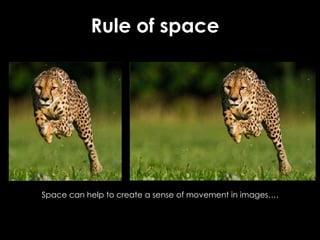
Rule of space
Space can help to create a sense of movement in images….
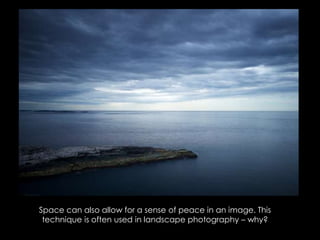
Space can also allow for a sense of peace in an image. This
technique is often used in landscape photography – why?
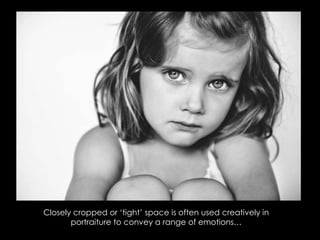
Closely cropped or ‘tight’ space is often used creatively in
portraiture to convey a range of emotions…
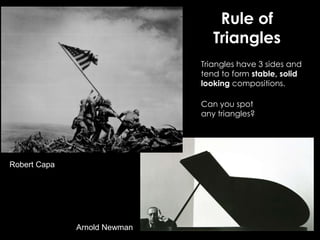
Rule of
Triangles
Triangles have 3 sides and
tend to form stable, solid
looking compositions.
Arnold Newman
Can you spot
any triangles?
Robert Capa
35
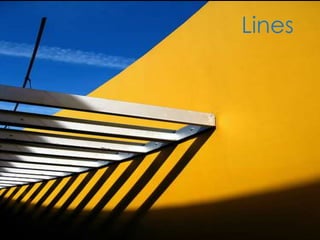
Example of Lines Lines
Lines
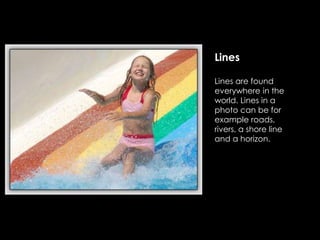
Lines are found
everywhere in the
world. Lines in a
photo can be for
example roads,
rivers, a shore line
and a horizon.
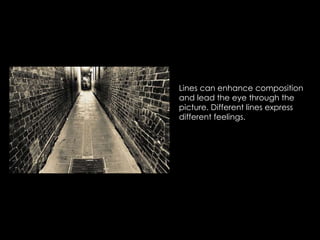
Lines can enhance composition
and lead the eye through the
picture. Different lines express
different feelings.
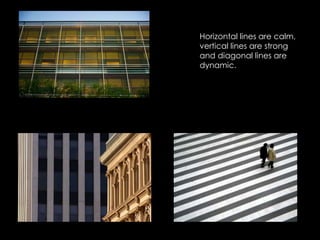
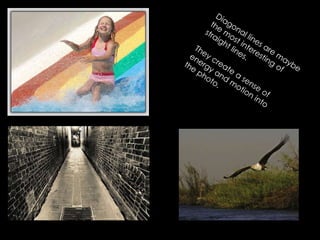
Horizontal lines are calm,
vertical lines are strong
and diagonal lines are
dynamic.
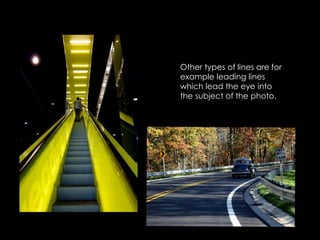
Other types of lines are for
example leading lines
which lead the eye into
the subject of the photo.
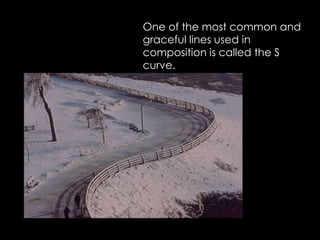
One of the most common and
graceful lines used in
composition is called the S
curve.
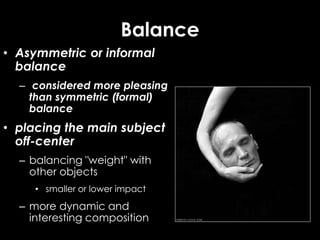
Balance
• Asymmetric or informal
balance
– considered more pleasing
than symmetric (formal)
balance
• placing the main subject
off-center
– balancing "weight" with
other objects
• smaller or lower impact
– more dynamic and
interesting composition
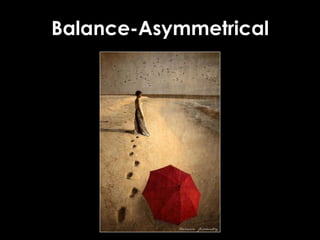
Balance-Asymmetrical
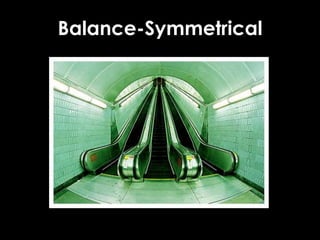
Balance-Symmetrical
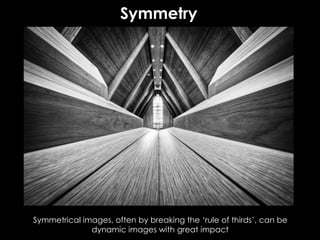
Symmetry
Symmetrical images, often by breaking the ‘rule of thirds’, can be
dynamic images with great impact
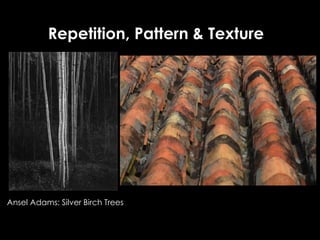
Repetition, Pattern & Texture
Ansel Adams: Silver Birch Trees
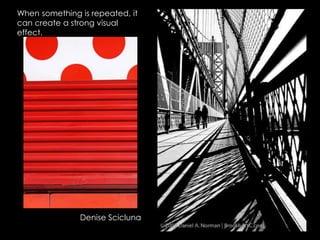
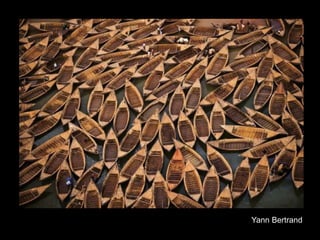
When something is repeated, it
can create a strong visual
effect.
Denise Scicluna
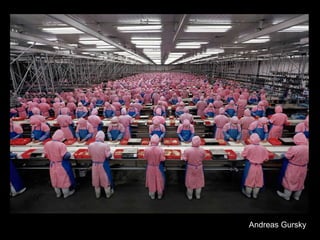
Andreas Gursky
Yann Bertrand
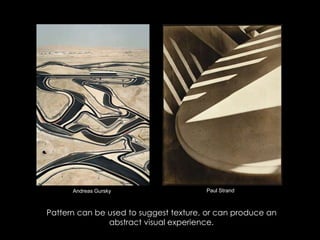
Andreas Gursky Paul Strand
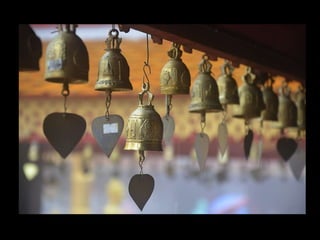
Pattern can be used to suggest texture, or can produce an
abstract visual experience.
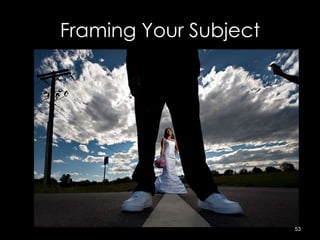
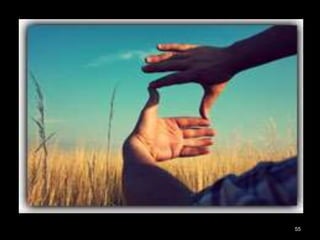
Framing Your Subject
53
54
55

Composition Concepts & Guidelines

  • 1.
    Composition The basic Conceptsrules of Composition.
  • 2.
  • 3.
    Composition is: • Amusical score • Something you write for English class • Organic substance used in farming • Arrangement of visual elements
  • 4.
    Composition The word compositionmeans combining or putting together parts to form a whole. Composition can apply to many works of human endeavor, in fact anything that is arranged or ‘put together’ using conscious thought.
  • 5.
    The modern camerais capable of many things • auto focus • auto exposure – select a suitable shutter speed or aperture • multitude of other functions
  • 6.
    One thing nocamera can do • Compose the image – It has no idea what it is pointing at – it has no idea what you are trying to achieve
  • 7.
    Good images resultfrom: • Careful attention to some basic elements of composition • Appropriate lighting • Interesting subject
  • 8.
    No "right" wayto take a picture • Three photographers recording same scene may create equally appealing photographs with entirely different composition •"There are no rules for good photographs, there are only good photographs.“ - Ansel Adams
  • 9.
    Important question toask • "What message do I want to deliver?" – it comes down to your ability to 'see' a picture or potential to create a picture • load of 'rules' and techniques – guidelines, not hard and fast "rules"
  • 10.
    A novice canachieve good image using these guidelines • Point of Interest • Viewpoints • Rule of Thirds • Simplicity • Background • Space • Triangles • Lines • Balance • Symmetry • Pattern, Repetition and Texture Learning ‘rules’ about art can seem stifling or constricting – if all artists just follow a set of rules then their art would look very similar and become very boring! Many original artists break or ‘bend’ these rules, but to do so successfully they first had to fully understand the rules. So you need to learn the rules first before you can break them!
  • 11.
    Point of Interest •Identify a primary point of interest • Compose to emphasize most important element
  • 12.
    Viewpoint • Can changea picture dramatically – moving the camera up or down or – stepping to one side – find an "unusual" point of view
  • 13.
    3 basic waysto adjust viewpoint • Physically move objects relative to each other – Only really works with still life photography • Tell people to move relative to each other or other objects – Only works with people who can hear you
  • 14.
    3 basic waysto adjust viewpoint • Move – Usually the most effective way to control composition – easiest and yet most important • wander about and see if you can improve on your original composition by changing your viewpoint • much difference can had by walking a few feet
  • 15.
    Viewpoint • Study thescene from various angles or perspectives: – High – Low – Straight on – Above • Which of these perspectives best helps the viewer understand your intentions?
  • 16.
    Different Angles Low AngleHigh Angle © 2002 Evan DiLeo
  • 17.
  • 18.
  • 19.
    The Golden Ratioand The Fibonnacci sequence are mathematical equations that have attempted to understand the natural pattern of nature. These theories have been used by artists, architects, photographers, musicians and many others throughout history to achieve ‘beauty and balance’. 0, 1, 1, 2, 3, 5, 8, 13, 21, 34, 55, …… Rule of Thirds
  • 21.
  • 22.
  • 23.
    Landscape photography oftenuses the rule of thirds
  • 24.
  • 25.
    The saying 'lessis more' applies often in photography. Usually it is a good idea to get rid of elements and try to keep the composition simple.
  • 26.
    Simplicity • Only thethings you want the viewer to see appear in the picture • numerous objects cluttering up the background - message lost • can’t find an angle or framing to isolate subject – consider using depth of field control to keep the background out of focus
  • 27.
    What technique hasthe photographer used to simplify this image? Simplicity
  • 28.
    Is this picture‘simplified’ ? If not, why not … and so what might the photographer Joel Meyerowitz be saying about life in the modern city?
  • 29.
    Uncomplicated background • Beespecially aware of what is behind your subject – Forced Visual Relationships – does not compete with your subject – viewfinder to create a frame of reference—like the print’s edge – eliminate distracting backgrounds before you release the shutter
  • 30.
  • 31.
    Rule of space Spacecan help to create a sense of movement in images….
  • 32.
    Space can alsoallow for a sense of peace in an image. This technique is often used in landscape photography – why?
  • 33.
    Closely cropped or‘tight’ space is often used creatively in portraiture to convey a range of emotions…
  • 34.
    Rule of Triangles Triangles have3 sides and tend to form stable, solid looking compositions. Arnold Newman Can you spot any triangles? Robert Capa
  • 35.
  • 36.
  • 37.
    Lines Lines are found everywherein the world. Lines in a photo can be for example roads, rivers, a shore line and a horizon.
  • 38.
    Lines can enhancecomposition and lead the eye through the picture. Different lines express different feelings.
  • 39.
    Horizontal lines arecalm, vertical lines are strong and diagonal lines are dynamic.
  • 41.
    Other types oflines are for example leading lines which lead the eye into the subject of the photo.
  • 42.
    One of themost common and graceful lines used in composition is called the S curve.
  • 43.
    Balance • Asymmetric orinformal balance – considered more pleasing than symmetric (formal) balance • placing the main subject off-center – balancing "weight" with other objects • smaller or lower impact – more dynamic and interesting composition
  • 44.
  • 45.
  • 46.
    Symmetry Symmetrical images, oftenby breaking the ‘rule of thirds’, can be dynamic images with great impact
  • 47.
    Repetition, Pattern &Texture Ansel Adams: Silver Birch Trees
  • 48.
    When something isrepeated, it can create a strong visual effect. Denise Scicluna
  • 49.
  • 51.
  • 52.
    Andreas Gursky PaulStrand Pattern can be used to suggest texture, or can produce an abstract visual experience.
  • 53.
  • 54.
  • 55.