NET SHAPE
FORGING
PROCESS
Introduction :
 The term NET indicates that NO subsequent machining or finishing of a forged surface
is required
 Secondary operations may be required to produce minor holes, threads, and other
such details
 PRECISION Forging is sometimes described as Close-tolerance forging / Flash less
Forging
 Cold-forging processes are traditionally precision processes.
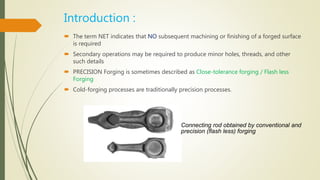
Connecting rod obtained by conventional and
precision (flash less) forging
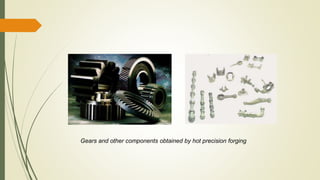
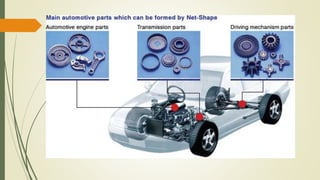
Gears and other components obtained by hot precision forging
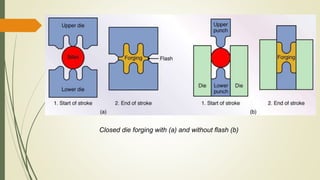
Closed die forging with (a) and without flash (b)
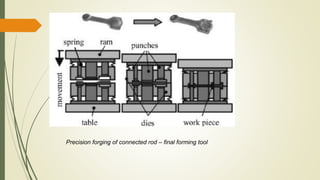
Precision forging of connected rod – final forming tool
Tooling Design Considerations:
 The dimensions of the forged part will be decreased relative to the dimensions of the die
cavity by the thickness of the forging lubricant at die closure.
 metal flow patterns are an important consideration in precision forging.
 The magnitude of chilling must also be evaluated because the flow stress of the metal is a
function of temperature.
 The workability of the work piece material is a quantitative measure of how much deformation
can be accommodated without cracking or other forms of failure
 Workability is more critical in precision forging than in conventional forging because higher
deformation levels may be required to achieve the tolerances
 Mathematical models of the forging process based on the finite-element method have been
developed to aid the forging design engineer in the required analyses.
 The goal of net shape, or at least near-net shape, dictates that precision forging tooling will
be more detailed and complex in comparison with conventional tooling
Process Control Considerations:
 Precision of the Tooling
 The tolerance achieved in the forging will clearly be no better than the tolerance of the
tooling.
 the tolerance bands for precision forge tooling must be set at a small fraction of the desired
forging tolerances
 After the precision forge tooling is built, it should be inspected to ensure that it meets the
design requirements
 After the tooling is placed in service, its precision will deteriorate because of wear. Die wear
is an important factor in determining die life in precision forging.
 Precision of the Setup
 Control of the alignment and setup of the tooling in the forging press is just as important as
the tolerance of the tooling itself.
 The setup of the tooling affects the thickness of the forged part
 Precision of the Preform. In a one-hit precision forging process, the preform is simply the
slug of raw material sheared or cut from bar or coil stock.
 In a progressive forging operation, the preform is the product of a series of intermediate
forging operations. In both cases, the quality of the preform is of concern because it limits
the precision of the finished forging.
 Control of Lubrication. Of all forging variables, the performance of the lubricant may be
the most difficult to quantify.
 Lubrication influences the total forging load, the degree to which the metal will fill the
cavities of the dies, the uniformity of the resultant metallurgical microstructure, and the
surface quality of the forged product.
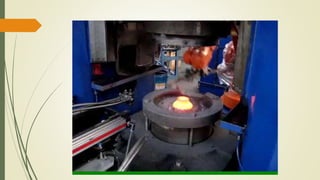
 Automatic lubrication equipment is frequently used to achieve greater consistency.
Advantages of Precision Forging:
 The motivation for precision forging is the elimination, or at least the reduction,
of the costs associated with this machining allowance.
 The weight of a traditional forging is often more than twice the weight of the
finished part after machining.
 A study performed by the forging industry association estimated that 20 to 40%
of the weight of conventional closed-die forgings is expended as flash.
 The design of a precision forging usually minimizes and sometimes completely
eliminates the flash
 Mechanical properties of a precision forging are often superior to those of a
forging that has undergone extensive machining
Applications of Precision Forging
 Physical Considerations:
 A primary consideration is that the forging must be able to be removed from the tooling
after the forging process is completed
 surfaces parallel to the forging axis will often generate high frictional forces with the tooling
during ejection of the part
 Chilling of the work piece material by the relatively cooler tooling restricts the metal flow
 Economic considerations:
 If only the costs of the forging process itself are considered, precision forging will generally
be more costly than traditional forging.
 cost differential associated with precision forging is a fixed cost, that is, independent of the
actual number of pieces forged.
Thank You

Net shape forging process

  • 1.
  • 2.
    Introduction :  Theterm NET indicates that NO subsequent machining or finishing of a forged surface is required  Secondary operations may be required to produce minor holes, threads, and other such details  PRECISION Forging is sometimes described as Close-tolerance forging / Flash less Forging  Cold-forging processes are traditionally precision processes. Connecting rod obtained by conventional and precision (flash less) forging
  • 3.
    Gears and othercomponents obtained by hot precision forging
  • 4.
    Closed die forgingwith (a) and without flash (b)
  • 5.
    Precision forging ofconnected rod – final forming tool
  • 6.
    Tooling Design Considerations: The dimensions of the forged part will be decreased relative to the dimensions of the die cavity by the thickness of the forging lubricant at die closure.  metal flow patterns are an important consideration in precision forging.  The magnitude of chilling must also be evaluated because the flow stress of the metal is a function of temperature.  The workability of the work piece material is a quantitative measure of how much deformation can be accommodated without cracking or other forms of failure  Workability is more critical in precision forging than in conventional forging because higher deformation levels may be required to achieve the tolerances  Mathematical models of the forging process based on the finite-element method have been developed to aid the forging design engineer in the required analyses.  The goal of net shape, or at least near-net shape, dictates that precision forging tooling will be more detailed and complex in comparison with conventional tooling
  • 7.
    Process Control Considerations: Precision of the Tooling  The tolerance achieved in the forging will clearly be no better than the tolerance of the tooling.  the tolerance bands for precision forge tooling must be set at a small fraction of the desired forging tolerances  After the precision forge tooling is built, it should be inspected to ensure that it meets the design requirements  After the tooling is placed in service, its precision will deteriorate because of wear. Die wear is an important factor in determining die life in precision forging.  Precision of the Setup  Control of the alignment and setup of the tooling in the forging press is just as important as the tolerance of the tooling itself.  The setup of the tooling affects the thickness of the forged part
  • 8.
     Precision ofthe Preform. In a one-hit precision forging process, the preform is simply the slug of raw material sheared or cut from bar or coil stock.  In a progressive forging operation, the preform is the product of a series of intermediate forging operations. In both cases, the quality of the preform is of concern because it limits the precision of the finished forging.  Control of Lubrication. Of all forging variables, the performance of the lubricant may be the most difficult to quantify.  Lubrication influences the total forging load, the degree to which the metal will fill the cavities of the dies, the uniformity of the resultant metallurgical microstructure, and the surface quality of the forged product.  Automatic lubrication equipment is frequently used to achieve greater consistency.
  • 10.
    Advantages of PrecisionForging:  The motivation for precision forging is the elimination, or at least the reduction, of the costs associated with this machining allowance.  The weight of a traditional forging is often more than twice the weight of the finished part after machining.  A study performed by the forging industry association estimated that 20 to 40% of the weight of conventional closed-die forgings is expended as flash.  The design of a precision forging usually minimizes and sometimes completely eliminates the flash  Mechanical properties of a precision forging are often superior to those of a forging that has undergone extensive machining
  • 12.
    Applications of PrecisionForging  Physical Considerations:  A primary consideration is that the forging must be able to be removed from the tooling after the forging process is completed  surfaces parallel to the forging axis will often generate high frictional forces with the tooling during ejection of the part  Chilling of the work piece material by the relatively cooler tooling restricts the metal flow  Economic considerations:  If only the costs of the forging process itself are considered, precision forging will generally be more costly than traditional forging.  cost differential associated with precision forging is a fixed cost, that is, independent of the actual number of pieces forged.
  • 13.