Pontics


           Preeti kalia
      IInd year PG student
     Dept of Prosthodontics
A.E.C.S Maaruti College of Dental
            Sciences
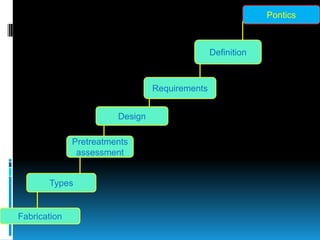
Pontics


                                                Definition


                                 Requirements


                        Design

              Pretreatments
               assessment


       Types


Fabrication
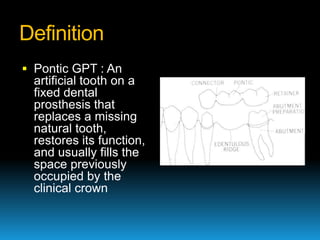
Definition
๏‚ง Pontic GPT : An
  artificial tooth on a
  fixed dental
  prosthesis that
  replaces a missing
  natural tooth,
  restores its function,
  and usually fills the
  space previously
  occupied by the
  clinical crown
Definition
๏‚ง Acc to Tylman โ€“pontic is the
 suspended member of a fixed
 partial denture. it replaces the lost
 natural tooth, restores function
 ,and occupies the space of the
 missing tooth.
Ideal requirements of pontics
๏‚ง   Smooth surfaced and convex in all
    directions

๏‚ง   Easily cleansable

๏‚ง   Pinpoint pressure free contact on the
    ridge

๏‚ง   No irritation to the gingival tissues
Ideal requirement of pontics
๏‚ง Facilitate plaque control

๏‚ง Emergence profile

๏‚ง Strength and longevity

๏‚ง Be esthetic
Ideal requirements of pontics
๏‚ง Restore function

๏‚ง No abutment overloading

๏‚ง Color stable
Functions of pontics
๏‚ง Mastication

๏‚ง Speech

๏‚ง Esthetics
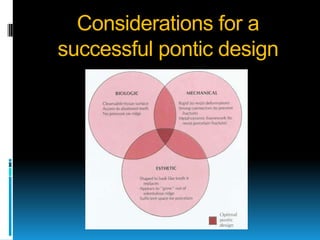
Considerations for a
successful pontic design
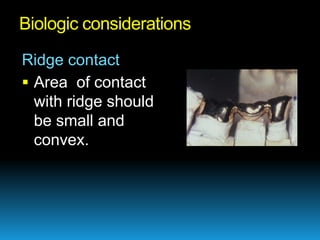
Biologic considerations

Ridge contact
๏‚ง Area of contact
  with ridge should
  be small and
  convex.
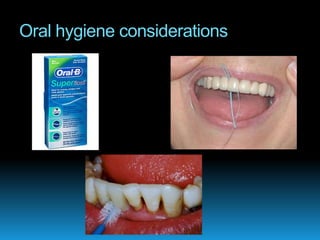
Oral hygiene considerations
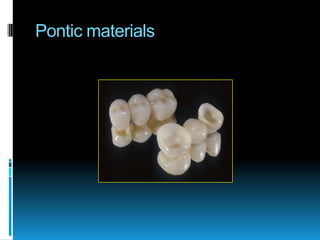
Pontic materials
๏‚ง Differences in the plaque-retaining capacities
       of.samples of a Type III gold, gold for
       veneering with porcelain, a vacuum-fired
     bonded porcelain Veneer, and an acrylic resin.

     ๏‚ง After 48 hours in vivo, the Ceramco metal
       and Type III gold specimens accumulated
        significantly more dark stains than acrylic
        ones


Wise. M et al and Dykema .R, The plaque-retaining capacity of four dental
materials,J Proshtet 1975;33:178
Occlusal forces

๏‚ง Reduce buccolingual width โ€“ 30%
  to lessen occlusal forces
๏‚ง 12% increase in chewing efficiency
๏‚ง Pontics with normal occlusal widths
  โ€“ in the occlusal third area
Mechanical considerations

๏‚ง   Improper choice of materials
๏‚ง   Poor framework design
๏‚ง   Poor tooth preparation
๏‚ง   Poor occlusion
๏‚ง      It can be seen that the maximum tensile stress
     at the solder joint, mesial to the second molar and
     above the gingiva, was reduced from2,400
     p.s.i, in the conventional pontic to 1,200 p.s.i, in
     the sanitary pontic and finally to 720 p.s.i, in the
     modified sanitary pontic.

 ๏‚ง For the solder joint distal to the second
     premolar, also above till gingiva, the reductions
     were in the order of 1,920 (C.P.)to 960 (S.P.) to
     720 p.s.i. (M.S.P.).

Hood, J. A. Stress and deflection of three different pontic designs. J Prosthet
Dent 33:54-59, 1975
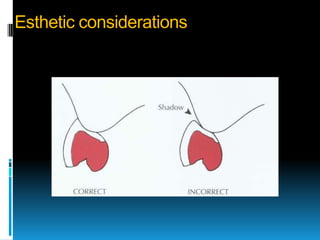
Esthetic considerations
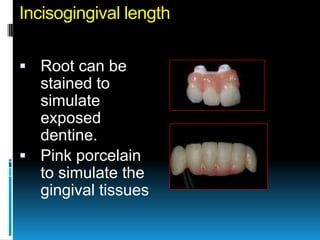
Incisogingival length

๏‚ง Root can be
  stained to
  simulate
  exposed
  dentine.
๏‚ง Pink porcelain
  to simulate the
  gingival tissues
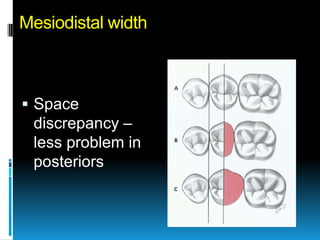
Mesiodistal width


๏‚ง Space
 discrepancy โ€“
 less problem in
 posteriors
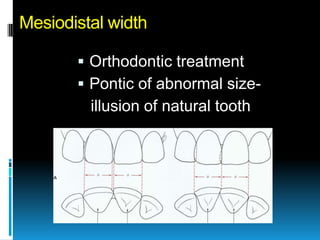
Mesiodistal width

       ๏‚ง Orthodontic treatment
       ๏‚ง Pontic of abnormal size-
         illusion of natural tooth
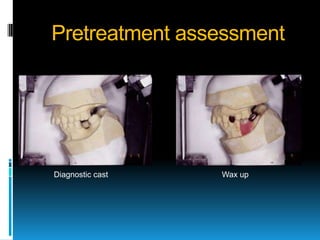
Pretreatment assessment


Diagnostic cast   Wax up
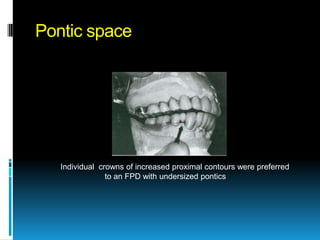
Pontic space


   Individual crowns of increased proximal contours were preferred
                to an FPD with undersized pontics
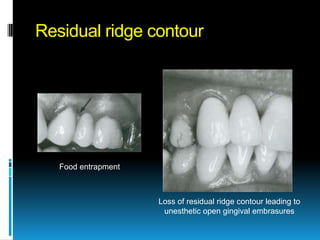
Residual ridge contour


   Food entrapment


                     Loss of residual ridge contour leading to
                      unesthetic open gingival embrasures
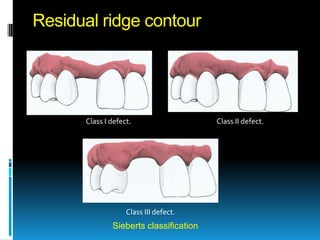
Residual ridge contour


      Class I defect.                   Class II defect.


                   Class III defect.
              Sieberts classification
Residual ridge contour

Abrams et al showed
Class I defects to constitute 32.4%
Class II- 2.9%
Class III- 55.9%
8.8% having no defects
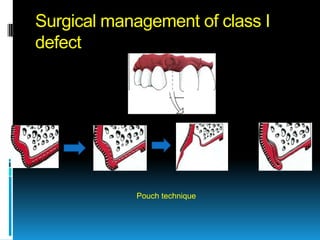
Surgical management of class I
defect


            Pouch technique
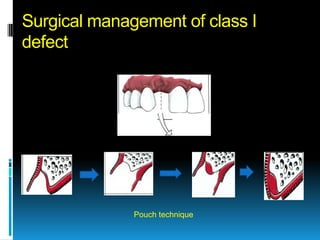
Surgical management of class I
defect


              Pouch technique
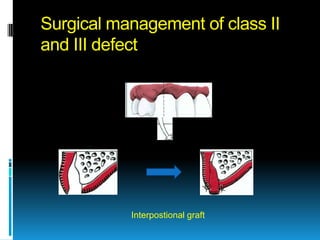
Surgical management of class II
and III defect


           Interpostional graft
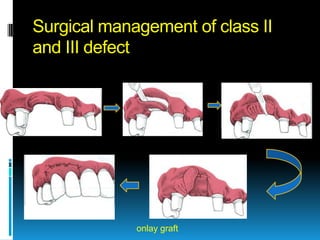
Surgical management of class II
and III defect


             onlay graft
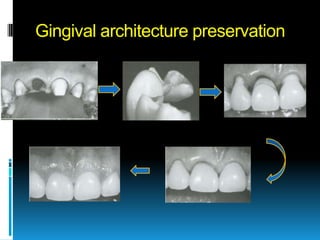
Gingival architecture preservation
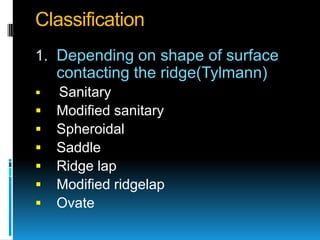
Classification
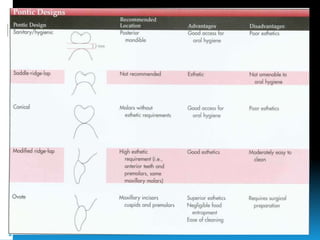
1. Depending on shape of surface
    contacting the ridge(Tylmann)
๏‚ง   Sanitary
๏‚ง   Modified sanitary
๏‚ง   Spheroidal
๏‚ง   Saddle
๏‚ง   Ridge lap
๏‚ง   Modified ridgelap
๏‚ง   Ovate
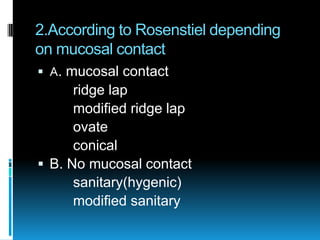
2.According to Rosenstiel depending
on mucosal contact
๏‚ง A. mucosal contact
      ridge lap
      modified ridge lap
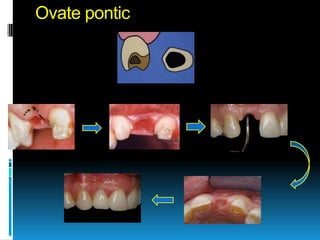
      ovate
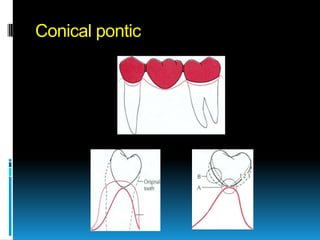
      conical
๏‚ง B. No mucosal contact
      sanitary(hygenic)
      modified sanitary
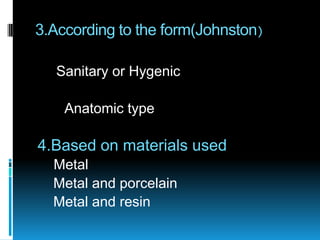
3.According to the form(Johnston)

   Sanitary or Hygenic

    Anatomic type

4.Based on materials used
  Metal
  Metal and porcelain
  Metal and resin
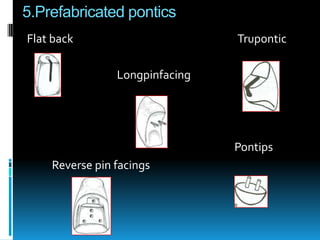
5.Prefabricated pontics
Flat back                       Trupontic

                Longpinfacing


                                Pontips
    Reverse pin facings
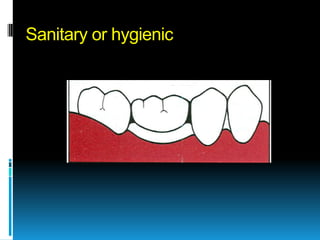
Sanitary or hygienic
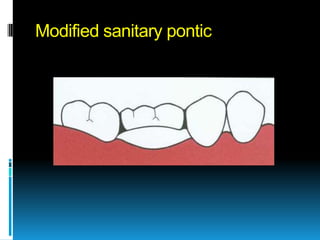
Modified sanitary pontic
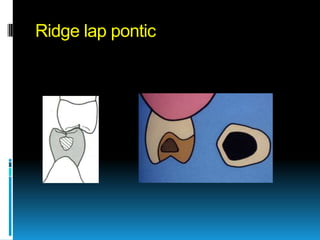
Ridge lap pontic
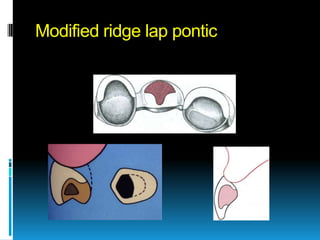
Modified ridge lap pontic
Conical pontic
Ovate pontic
Modified ovate pontic

๏‚ง   Contact more labially than ovate pontic
๏‚ง   Easier to clean
๏‚ง   No need of surgical augmentation
๏‚ง   Push the labial gingival margin away to
    floss


Liu.S,J Esthet Restor Dent 16:273-283, 2004
Residual ridge contour
  ๏‚ง To determine the frequency and the
    nature of tissue reactions of
    underlying residual ridge mucosa to
    specific pontic designs, and
  ๏‚ง To compare the frequency and the
    nature of tissue reactions of residual
    ridge mucosa to various materials
    used in pontic construction.

Stein.R.S , Pontic residual ridge relationship, J Proshtet Dent 1966;16: 251-285
Metal Ceramic pontics
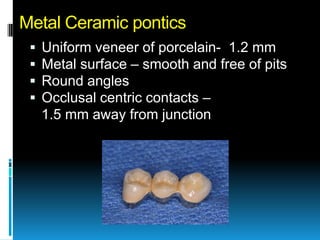
 ๏‚ง   Uniform veneer of porcelain- 1.2 mm
 ๏‚ง   Metal surface โ€“ smooth and free of pits
 ๏‚ง   Round angles
 ๏‚ง   Occlusal centric contacts โ€“
     1.5 mm away from junction
Metal ceramic pontics


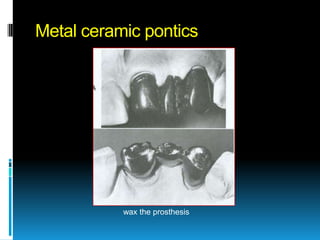
           wax the prosthesis
All ceramic pontics
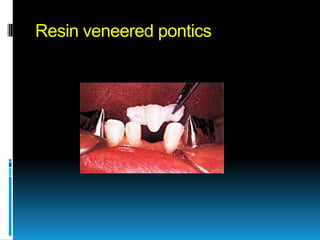
Resin veneered pontics
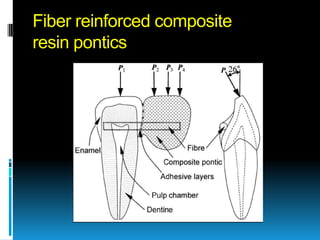
Fiber reinforced composite
resin pontics
Pontic fabrication

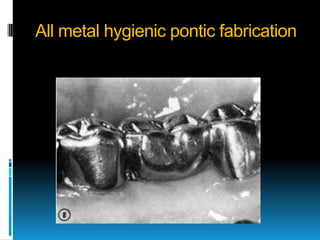
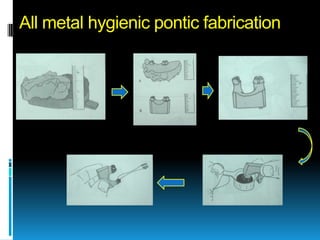
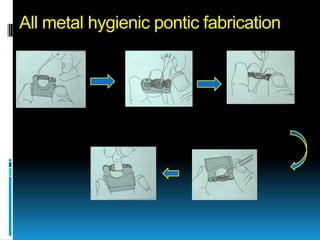
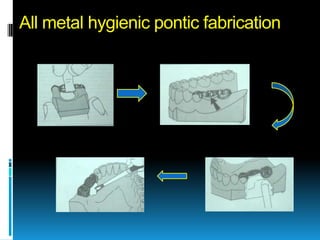
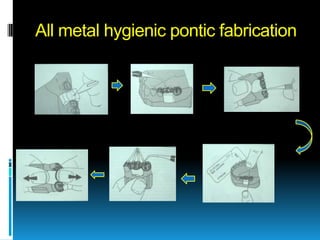
๏‚ง All metal hygienic pontic
๏‚ง Metal ceramic pontic
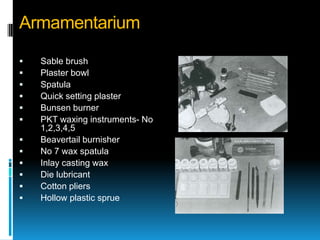
Armamentarium

๏‚ง   Sable brush
๏‚ง   Plaster bowl
๏‚ง   Spatula
๏‚ง   Quick setting plaster
๏‚ง   Bunsen burner
๏‚ง   PKT waxing instruments- No
    1,2,3,4,5
๏‚ง   Beavertail burnisher
๏‚ง   No 7 wax spatula
๏‚ง   Inlay casting wax
๏‚ง   Die lubricant
๏‚ง   Cotton pliers
๏‚ง   Hollow plastic sprue
All metal hygienic pontic fabrication
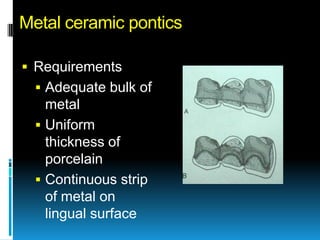
Metal ceramic pontics

๏‚ง Requirements
  ๏‚ง Adequate bulk of
    metal
  ๏‚ง Uniform
    thickness of
    porcelain
  ๏‚ง Continuous strip
    of metal on
    lingual surface
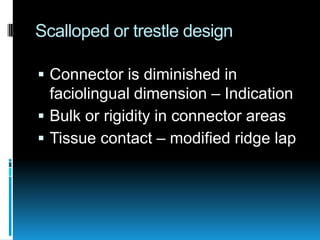
Scalloped or trestle design

๏‚ง Connector is diminished in
  faciolingual dimension โ€“ Indication
๏‚ง Bulk or rigidity in connector areas
๏‚ง Tissue contact โ€“ modified ridge lap
Metal ceramic pontics

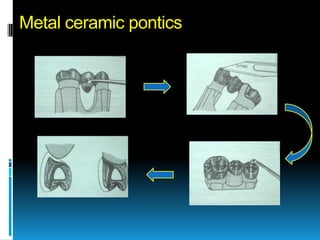
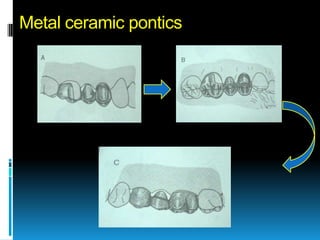
๏‚ง To produce continuous contour and
  uniform thickness of porcelain โ€“
  fabricate wax pattern to full contour
  and cut back
๏‚ง Fabricate the copings โ€“ No 7 wax
  spatula
๏‚ง Blue inlay wax stick โ€“ edentulous
  area
Metal ceramic pontics
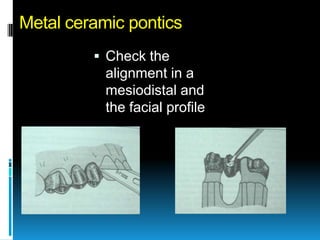
         ๏‚ง Check the
           alignment in a
           mesiodistal and
           the facial profile
Metal ceramic pontics
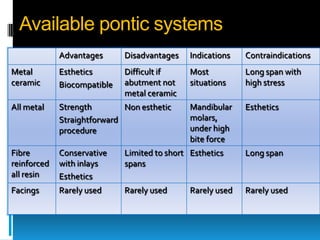
Available pontic systems
             Advantages      Disadvantages    Indications   Contraindications
Metal        Esthetics       Difficult if     Most          Long span with
ceramic      Biocompatible   abutment not     situations    high stress
                             metal ceramic
All metal    Strength        Non esthetic     Mandibular    Esthetics
             Straightforward                  molars,
             procedure                        under high
                                              bite force
Fibre        Conservative    Limited to short Esthetics     Long span
reinforced   with inlays     spans
all resin    Esthetics
Facings      Rarely used     Rarely used      Rarely used   Rarely used
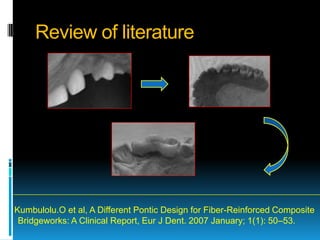
Review of literature


Kumbulolu.O et al, A Different Pontic Design for Fiber-Reinforced Composite
 Bridgeworks: A Clinical Report, Eur J Dent. 2007 January; 1(1): 50โ€“53.
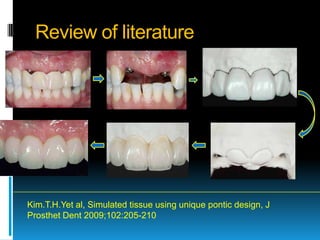
Review of literature


Kim.T.H.Yet al, Simulated tissue using unique pontic design, J
Prosthet Dent 2009;102:205-210
References
๏‚ง Malone W.F.P., Koth D.L., Cavazos E.
 : Tylmanโ€™s theory of practice of fixed
 prosthodontics. 8 Ed., lshiyaku
 publications, 1993,357-370

๏‚ง Rosenstiel R.F., Land M.F., Fujimot J.:
 Contemporary fixed prosthodontics.
 4th Ed., Mosby
 Publications, 2007, 616-648
References
๏‚ง Shillingburg H.T., Hobo S., Whisett
 L.D., Jacobi R., Brackett S.E.
 Fundamentals of fixed prosthodontics,
 3 Ed., Quintessence
 Publication,2007,India ,485-506

๏‚ง Stein.R.S , Pontic residual ridge
 relationship, J Proshtet Dent 1966;16:
 251-285
References
๏‚ง Wise. M et al and Dykema .R, The
 plaque-retaining capacity of four dental
 materials,J Proshtet 1975;33:178

๏‚ง Liu.S ,Use of a modified ovate pontic in
 areas of ridge defects: A report of 2
 cases, J Esthet Restor Dent 16:273-
 283, 2004
References

๏‚ง Kumbulolu.O et al, A Different Pontic
 Design for Fiber-Reinforced Composite
Bridgeworks: A Clinical Report, Eur J
 Dent. 2007 January; 1(1): 50โ€“53.

Kim.T.H.Yet al, Simulated tissue using
  unique pontic design, J Prosthet Dent
  2009;102:205-210
References

๏‚ง R.Duane Douglas ,Pontic design

๏‚ง FPDpontic wax up .ppt

๏‚ง FPD.ppt

Pontics

  • 1.
    Pontics Preeti kalia IInd year PG student Dept of Prosthodontics A.E.C.S Maaruti College of Dental Sciences
  • 2.
    Pontics Definition Requirements Design Pretreatments assessment Types Fabrication
  • 3.
    Definition ๏‚ง Pontic GPT: An artificial tooth on a fixed dental prosthesis that replaces a missing natural tooth, restores its function, and usually fills the space previously occupied by the clinical crown
  • 4.
    Definition ๏‚ง Acc toTylman โ€“pontic is the suspended member of a fixed partial denture. it replaces the lost natural tooth, restores function ,and occupies the space of the missing tooth.
  • 5.
    Ideal requirements ofpontics ๏‚ง Smooth surfaced and convex in all directions ๏‚ง Easily cleansable ๏‚ง Pinpoint pressure free contact on the ridge ๏‚ง No irritation to the gingival tissues
  • 6.
    Ideal requirement ofpontics ๏‚ง Facilitate plaque control ๏‚ง Emergence profile ๏‚ง Strength and longevity ๏‚ง Be esthetic
  • 7.
    Ideal requirements ofpontics ๏‚ง Restore function ๏‚ง No abutment overloading ๏‚ง Color stable
  • 8.
    Functions of pontics ๏‚งMastication ๏‚ง Speech ๏‚ง Esthetics
  • 9.
  • 10.
    Biologic considerations Ridge contact ๏‚งArea of contact with ridge should be small and convex.
  • 11.
  • 12.
  • 13.
    ๏‚ง Differences inthe plaque-retaining capacities of.samples of a Type III gold, gold for veneering with porcelain, a vacuum-fired bonded porcelain Veneer, and an acrylic resin. ๏‚ง After 48 hours in vivo, the Ceramco metal and Type III gold specimens accumulated significantly more dark stains than acrylic ones Wise. M et al and Dykema .R, The plaque-retaining capacity of four dental materials,J Proshtet 1975;33:178
  • 14.
    Occlusal forces ๏‚ง Reducebuccolingual width โ€“ 30% to lessen occlusal forces ๏‚ง 12% increase in chewing efficiency ๏‚ง Pontics with normal occlusal widths โ€“ in the occlusal third area
  • 15.
    Mechanical considerations ๏‚ง Improper choice of materials ๏‚ง Poor framework design ๏‚ง Poor tooth preparation ๏‚ง Poor occlusion
  • 16.
    ๏‚ง It can be seen that the maximum tensile stress at the solder joint, mesial to the second molar and above the gingiva, was reduced from2,400 p.s.i, in the conventional pontic to 1,200 p.s.i, in the sanitary pontic and finally to 720 p.s.i, in the modified sanitary pontic. ๏‚ง For the solder joint distal to the second premolar, also above till gingiva, the reductions were in the order of 1,920 (C.P.)to 960 (S.P.) to 720 p.s.i. (M.S.P.). Hood, J. A. Stress and deflection of three different pontic designs. J Prosthet Dent 33:54-59, 1975
  • 17.
  • 18.
    Incisogingival length ๏‚ง Rootcan be stained to simulate exposed dentine. ๏‚ง Pink porcelain to simulate the gingival tissues
  • 19.
    Mesiodistal width ๏‚ง Space discrepancy โ€“ less problem in posteriors
  • 20.
    Mesiodistal width ๏‚ง Orthodontic treatment ๏‚ง Pontic of abnormal size- illusion of natural tooth
  • 21.
  • 22.
    Pontic space Individual crowns of increased proximal contours were preferred to an FPD with undersized pontics
  • 23.
    Residual ridge contour Food entrapment Loss of residual ridge contour leading to unesthetic open gingival embrasures
  • 24.
    Residual ridge contour Class I defect. Class II defect. Class III defect. Sieberts classification
  • 25.
    Residual ridge contour Abramset al showed Class I defects to constitute 32.4% Class II- 2.9% Class III- 55.9% 8.8% having no defects
  • 26.
    Surgical management ofclass I defect Pouch technique
  • 27.
    Surgical management ofclass I defect Pouch technique
  • 28.
    Surgical management ofclass II and III defect Interpostional graft
  • 29.
    Surgical management ofclass II and III defect onlay graft
  • 30.
  • 31.
    Classification 1. Depending onshape of surface contacting the ridge(Tylmann) ๏‚ง Sanitary ๏‚ง Modified sanitary ๏‚ง Spheroidal ๏‚ง Saddle ๏‚ง Ridge lap ๏‚ง Modified ridgelap ๏‚ง Ovate
  • 32.
    2.According to Rosenstieldepending on mucosal contact ๏‚ง A. mucosal contact ridge lap modified ridge lap ovate conical ๏‚ง B. No mucosal contact sanitary(hygenic) modified sanitary
  • 33.
    3.According to theform(Johnston) Sanitary or Hygenic Anatomic type 4.Based on materials used Metal Metal and porcelain Metal and resin
  • 34.
    5.Prefabricated pontics Flat back Trupontic Longpinfacing Pontips Reverse pin facings
  • 35.
  • 36.
  • 37.
  • 38.
  • 39.
  • 40.
  • 41.
    Modified ovate pontic ๏‚ง Contact more labially than ovate pontic ๏‚ง Easier to clean ๏‚ง No need of surgical augmentation ๏‚ง Push the labial gingival margin away to floss Liu.S,J Esthet Restor Dent 16:273-283, 2004
  • 42.
    Residual ridge contour ๏‚ง To determine the frequency and the nature of tissue reactions of underlying residual ridge mucosa to specific pontic designs, and ๏‚ง To compare the frequency and the nature of tissue reactions of residual ridge mucosa to various materials used in pontic construction. Stein.R.S , Pontic residual ridge relationship, J Proshtet Dent 1966;16: 251-285
  • 44.
    Metal Ceramic pontics ๏‚ง Uniform veneer of porcelain- 1.2 mm ๏‚ง Metal surface โ€“ smooth and free of pits ๏‚ง Round angles ๏‚ง Occlusal centric contacts โ€“ 1.5 mm away from junction
  • 45.
    Metal ceramic pontics wax the prosthesis
  • 46.
  • 47.
  • 48.
  • 49.
    Pontic fabrication ๏‚ง Allmetal hygienic pontic ๏‚ง Metal ceramic pontic
  • 50.
    Armamentarium ๏‚ง Sable brush ๏‚ง Plaster bowl ๏‚ง Spatula ๏‚ง Quick setting plaster ๏‚ง Bunsen burner ๏‚ง PKT waxing instruments- No 1,2,3,4,5 ๏‚ง Beavertail burnisher ๏‚ง No 7 wax spatula ๏‚ง Inlay casting wax ๏‚ง Die lubricant ๏‚ง Cotton pliers ๏‚ง Hollow plastic sprue
  • 51.
    All metal hygienicpontic fabrication
  • 52.
    All metal hygienicpontic fabrication
  • 53.
    All metal hygienicpontic fabrication
  • 54.
    All metal hygienicpontic fabrication
  • 55.
    All metal hygienicpontic fabrication
  • 56.
    Metal ceramic pontics ๏‚งRequirements ๏‚ง Adequate bulk of metal ๏‚ง Uniform thickness of porcelain ๏‚ง Continuous strip of metal on lingual surface
  • 57.
    Scalloped or trestledesign ๏‚ง Connector is diminished in faciolingual dimension โ€“ Indication ๏‚ง Bulk or rigidity in connector areas ๏‚ง Tissue contact โ€“ modified ridge lap
  • 58.
    Metal ceramic pontics ๏‚งTo produce continuous contour and uniform thickness of porcelain โ€“ fabricate wax pattern to full contour and cut back ๏‚ง Fabricate the copings โ€“ No 7 wax spatula ๏‚ง Blue inlay wax stick โ€“ edentulous area
  • 59.
    Metal ceramic pontics ๏‚ง Check the alignment in a mesiodistal and the facial profile
  • 60.
  • 61.
  • 62.
    Available pontic systems Advantages Disadvantages Indications Contraindications Metal Esthetics Difficult if Most Long span with ceramic Biocompatible abutment not situations high stress metal ceramic All metal Strength Non esthetic Mandibular Esthetics Straightforward molars, procedure under high bite force Fibre Conservative Limited to short Esthetics Long span reinforced with inlays spans all resin Esthetics Facings Rarely used Rarely used Rarely used Rarely used
  • 63.
    Review of literature Kumbulolu.Oet al, A Different Pontic Design for Fiber-Reinforced Composite Bridgeworks: A Clinical Report, Eur J Dent. 2007 January; 1(1): 50โ€“53.
  • 64.
    Review of literature Kim.T.H.Yetal, Simulated tissue using unique pontic design, J Prosthet Dent 2009;102:205-210
  • 65.
    References ๏‚ง Malone W.F.P.,Koth D.L., Cavazos E. : Tylmanโ€™s theory of practice of fixed prosthodontics. 8 Ed., lshiyaku publications, 1993,357-370 ๏‚ง Rosenstiel R.F., Land M.F., Fujimot J.: Contemporary fixed prosthodontics. 4th Ed., Mosby Publications, 2007, 616-648
  • 66.
    References ๏‚ง Shillingburg H.T.,Hobo S., Whisett L.D., Jacobi R., Brackett S.E. Fundamentals of fixed prosthodontics, 3 Ed., Quintessence Publication,2007,India ,485-506 ๏‚ง Stein.R.S , Pontic residual ridge relationship, J Proshtet Dent 1966;16: 251-285
  • 67.
    References ๏‚ง Wise. Met al and Dykema .R, The plaque-retaining capacity of four dental materials,J Proshtet 1975;33:178 ๏‚ง Liu.S ,Use of a modified ovate pontic in areas of ridge defects: A report of 2 cases, J Esthet Restor Dent 16:273- 283, 2004
  • 68.
    References ๏‚ง Kumbulolu.O etal, A Different Pontic Design for Fiber-Reinforced Composite Bridgeworks: A Clinical Report, Eur J Dent. 2007 January; 1(1): 50โ€“53. Kim.T.H.Yet al, Simulated tissue using unique pontic design, J Prosthet Dent 2009;102:205-210
  • 69.
    References ๏‚ง R.Duane Douglas,Pontic design ๏‚ง FPDpontic wax up .ppt ๏‚ง FPD.ppt