Drugs for constipation and diarrhoea
Dr. S. Parasuraman M.Pharm., Ph.D.,
Senior Lecturer, Faculty of Pharmacy,
AIMST University,
Bedong 08100, Malaysia.
Drugs for constipation
• These are drugs that promote evacuation of
bowels. A distinction is sometimes made
according to the intensity of action.
a) Laxative or aperient: milder action, elimination of
soft but formed stools.
b) Purgative or cathartic: stronger action resulting in
more fluid evacuation.
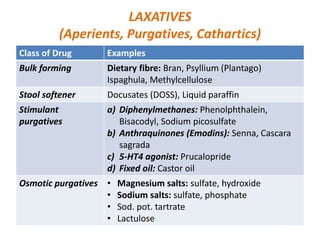
LAXATIVES
(Aperients, Purgatives, Cathartics)
Class of Drug Examples
Bulk forming Dietary fibre: Bran, Psyllium (Plantago)
Ispaghula, Methylcellulose
Stool softener Docusates (DOSS), Liquid paraffin
Stimulant
purgatives
a) Diphenylmethanes: Phenolphthalein,
Bisacodyl, Sodium picosulfate
b) Anthraquinones (Emodins): Senna, Cascara
sagrada
c) 5-HT4 agonist: Prucalopride
d) Fixed oil: Castor oil
Osmotic purgatives • Magnesium salts: sulfate, hydroxide
• Sodium salts: sulfate, phosphate
• Sod. pot. tartrate
• Lactulose
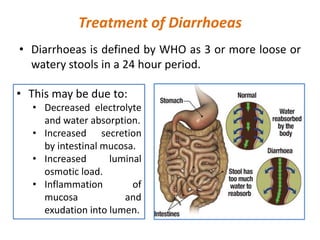
Treatment of Diarrhoeas
• Diarrhoeas is defined by WHO as 3 or more loose or
watery stools in a 24 hour period.
• This may be due to:
• Decreased electrolyte
and water absorption.
• Increased secretion
by intestinal mucosa.
• Increased luminal
osmotic load.
• Inflammation of
mucosa and
exudation into lumen.
Treatment of Diarrhoeas
• Principles of management:
– Treatment of fluid depletion, shock and acidosis.
– Maintenance of nutrition.
– Drug therapy.
Treatment of Diarrhoeas
• Rehydration
– Intravenous rehydration (NaCl : 85 mM [5 g]; KCl : 13 mM
[1 g]; NaHCO3: 48 mM [4 g] in 1 L of water or 5% glucose
solution)
– Oral rehydration
• Maintenance of nutrition
– Simple foods like breast milk or ½ strength buffalo milk,
boiled potato, rice, chicken soup, banana, sago, etc. should
be given as soon as the patient can eat.
Treatment of Diarrhoeas
• Drug therapy
– Drugs used in diarrhoeas may be categorised into:
1. Specific antimicrobial drugs
2. Probiotics
3. Drugs for inflammaory bowel disease (IBD)
4. Nonspecific antidiarrhoeal drugs.
Treatment of Diarrhoeas
1. Specific antimicrobial drugs
a) Antimicrobials are of no value, in diarrhoea due to
noninfective causes
b) Antimicrobials in severe disease
• Travellers’ diarrhoea: cotrimoxazole, norfloxacin,
doxycycline reduce the duration of diarrhoea.
• Rifamycin active against E.coli and many other gut
pathogens. It has also been used in diarrhoeal phase of
IBS as well as for prophylaxis before and after gut
surgery.
Treatment of Diarrhoeas
b) Antimicrobials in severe disease
• Enteropathogenic Escherichia coli (EPEC):
Cotrimoxazole, or a fluoroquinolone or colistin may be
used in acute cases and in infants.
• Shigella enteritis: May be treated with ciprofloxacin or
norfloxacin.
• Nontyphoid Salmonella: May be treated with a
fluoroquinolone, cotrimoxazole or ampicillin.
• Yersinia enterocolitica: Cotrimoxazole is the most
suitable drug in severe cases; ciprofloxacin is an
alternative.
Treatment of Diarrhoeas
b) Antimicrobials in specific disease
Antimicrobials are regular used for the treatment of Cholera
(fluid replacement, tetracyclines), Campylobacter jejuni
(Norfloxacin and other fluoroquinolones), Clostridium difficile
(metronidazole), diarrhoea associated with bacterial growth
(tetracycline or metronidazole) in blind loops/diverticulitis,
amoebiasis (metronidazole, diloxanide furoate) and giardiasis
(metronidazole, diloxanide furoate).
Treatment of Diarrhoeas
2. Probiotics
– Probiotics are microbial cell preparations, either live
cultures or lyophillised powders.
– Organisms most commonly used are Lactobacillus sp.,
Bifidobacterium, Streptococcus faecalis, Enterococcus sp.
and the yeast Saccharomyces boulardii, etc.
Treatment of Diarrhoeas
3. Drugs for inflammaory bowel disease (IBD)
– IBD is a chronic relapsing inflammatory disease of the
ileum, colon, or both, that may be associated with
systemic manifestations. The two major types of IBD are
ulcerative colitis (UC) and Crohn’s disease (CrD).
– The drugs used in UC and CrD are the same, but their
roles and efficacy do differ. Drugs used in IBD can be
grouped into:
• 5-Amino salicylic acid (5-ASA) compounds
[Sulfasalazine, Mesalazine, Balsalazide]
• Corticosteroids
• Immunosuppressants
• TNFα inhibitors
Treatment of Diarrhoeas
4. Nonspecific antidiarrhoeal drugs.
– These drugs can be grouped into:
a) Absorbants (ispaghula, methyl cellulose, carboxy
methyl cellulose which absorb water and swell) and
adsorbants (kaolin, pectin, attapulgite are believed
to adsorb bacterial toxins in the gut)
b) Antisecretory drugs (Racecadotril, Loperamide,
Atropinic drugs such as neostigmine,
metoclopramide)
c) Antimotility drugs (Diphenoxylate, Loperamide)
Drugs for constipation

Drugs for constipation

  • 1.
    Drugs for constipationand diarrhoea Dr. S. Parasuraman M.Pharm., Ph.D., Senior Lecturer, Faculty of Pharmacy, AIMST University, Bedong 08100, Malaysia.
  • 2.
    Drugs for constipation •These are drugs that promote evacuation of bowels. A distinction is sometimes made according to the intensity of action. a) Laxative or aperient: milder action, elimination of soft but formed stools. b) Purgative or cathartic: stronger action resulting in more fluid evacuation.
  • 3.
    LAXATIVES (Aperients, Purgatives, Cathartics) Classof Drug Examples Bulk forming Dietary fibre: Bran, Psyllium (Plantago) Ispaghula, Methylcellulose Stool softener Docusates (DOSS), Liquid paraffin Stimulant purgatives a) Diphenylmethanes: Phenolphthalein, Bisacodyl, Sodium picosulfate b) Anthraquinones (Emodins): Senna, Cascara sagrada c) 5-HT4 agonist: Prucalopride d) Fixed oil: Castor oil Osmotic purgatives • Magnesium salts: sulfate, hydroxide • Sodium salts: sulfate, phosphate • Sod. pot. tartrate • Lactulose
  • 4.
    Treatment of Diarrhoeas •Diarrhoeas is defined by WHO as 3 or more loose or watery stools in a 24 hour period. • This may be due to: • Decreased electrolyte and water absorption. • Increased secretion by intestinal mucosa. • Increased luminal osmotic load. • Inflammation of mucosa and exudation into lumen.
  • 5.
    Treatment of Diarrhoeas •Principles of management: – Treatment of fluid depletion, shock and acidosis. – Maintenance of nutrition. – Drug therapy.
  • 6.
    Treatment of Diarrhoeas •Rehydration – Intravenous rehydration (NaCl : 85 mM [5 g]; KCl : 13 mM [1 g]; NaHCO3: 48 mM [4 g] in 1 L of water or 5% glucose solution) – Oral rehydration • Maintenance of nutrition – Simple foods like breast milk or ½ strength buffalo milk, boiled potato, rice, chicken soup, banana, sago, etc. should be given as soon as the patient can eat.
  • 7.
    Treatment of Diarrhoeas •Drug therapy – Drugs used in diarrhoeas may be categorised into: 1. Specific antimicrobial drugs 2. Probiotics 3. Drugs for inflammaory bowel disease (IBD) 4. Nonspecific antidiarrhoeal drugs.
  • 8.
    Treatment of Diarrhoeas 1.Specific antimicrobial drugs a) Antimicrobials are of no value, in diarrhoea due to noninfective causes b) Antimicrobials in severe disease • Travellers’ diarrhoea: cotrimoxazole, norfloxacin, doxycycline reduce the duration of diarrhoea. • Rifamycin active against E.coli and many other gut pathogens. It has also been used in diarrhoeal phase of IBS as well as for prophylaxis before and after gut surgery.
  • 9.
    Treatment of Diarrhoeas b)Antimicrobials in severe disease • Enteropathogenic Escherichia coli (EPEC): Cotrimoxazole, or a fluoroquinolone or colistin may be used in acute cases and in infants. • Shigella enteritis: May be treated with ciprofloxacin or norfloxacin. • Nontyphoid Salmonella: May be treated with a fluoroquinolone, cotrimoxazole or ampicillin. • Yersinia enterocolitica: Cotrimoxazole is the most suitable drug in severe cases; ciprofloxacin is an alternative.
  • 10.
    Treatment of Diarrhoeas b)Antimicrobials in specific disease Antimicrobials are regular used for the treatment of Cholera (fluid replacement, tetracyclines), Campylobacter jejuni (Norfloxacin and other fluoroquinolones), Clostridium difficile (metronidazole), diarrhoea associated with bacterial growth (tetracycline or metronidazole) in blind loops/diverticulitis, amoebiasis (metronidazole, diloxanide furoate) and giardiasis (metronidazole, diloxanide furoate).
  • 11.
    Treatment of Diarrhoeas 2.Probiotics – Probiotics are microbial cell preparations, either live cultures or lyophillised powders. – Organisms most commonly used are Lactobacillus sp., Bifidobacterium, Streptococcus faecalis, Enterococcus sp. and the yeast Saccharomyces boulardii, etc.
  • 12.
    Treatment of Diarrhoeas 3.Drugs for inflammaory bowel disease (IBD) – IBD is a chronic relapsing inflammatory disease of the ileum, colon, or both, that may be associated with systemic manifestations. The two major types of IBD are ulcerative colitis (UC) and Crohn’s disease (CrD). – The drugs used in UC and CrD are the same, but their roles and efficacy do differ. Drugs used in IBD can be grouped into: • 5-Amino salicylic acid (5-ASA) compounds [Sulfasalazine, Mesalazine, Balsalazide] • Corticosteroids • Immunosuppressants • TNFα inhibitors
  • 13.
    Treatment of Diarrhoeas 4.Nonspecific antidiarrhoeal drugs. – These drugs can be grouped into: a) Absorbants (ispaghula, methyl cellulose, carboxy methyl cellulose which absorb water and swell) and adsorbants (kaolin, pectin, attapulgite are believed to adsorb bacterial toxins in the gut) b) Antisecretory drugs (Racecadotril, Loperamide, Atropinic drugs such as neostigmine, metoclopramide) c) Antimotility drugs (Diphenoxylate, Loperamide)

Editor's Notes

  • #13 Crohn's disease is a type of IBD that may affect any part of the gastrointestinal tract from mouth to anus. Ulcerative colitis (UC) is a long-term condition that results in inflammation and ulcers of the colon and rectum.