Hybrid MPC for Attitude Control of Spacecraft with
Impulsive Thrusters
P. Sopasakisa, D. Bernardinia,c, H. Strauchb,
S. Bennanid and A. Bemporada,c
a Institute for Advanced Studies Lucca,
b Airbus DS, c ODYS Srl
d European Space Agency
July 14, 2015
Control objectives
Operate in barbecue mode with ωx = 5 deg · s−1,
Achieve high pointing accuracy using impulsive thrusters
Low actuation count
Reasonable computational complexity
1 / 15
I. Attitude Modelling
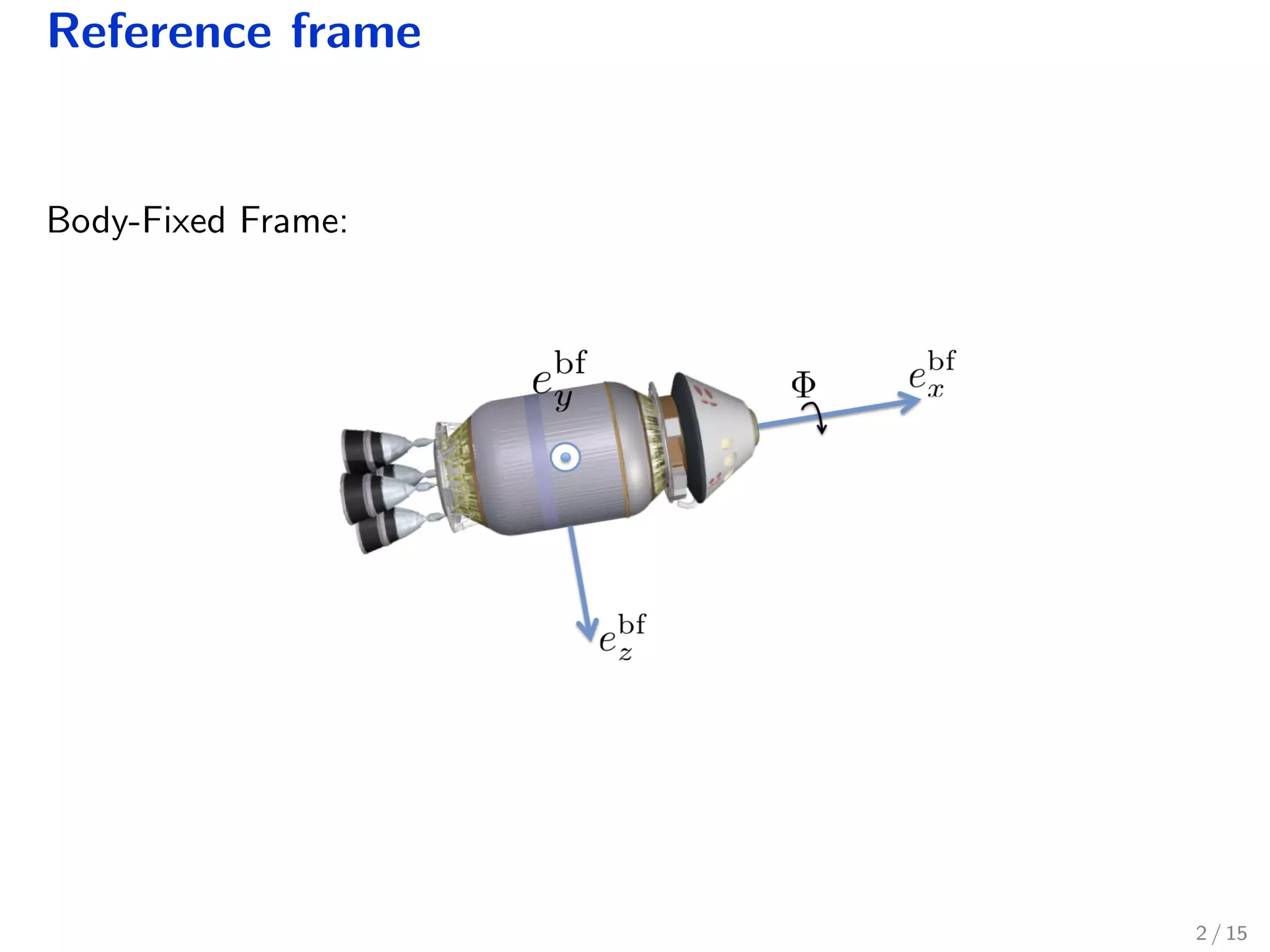
Reference frame
Body-Fixed Frame:
2 / 15
Nonlinear dynamical model
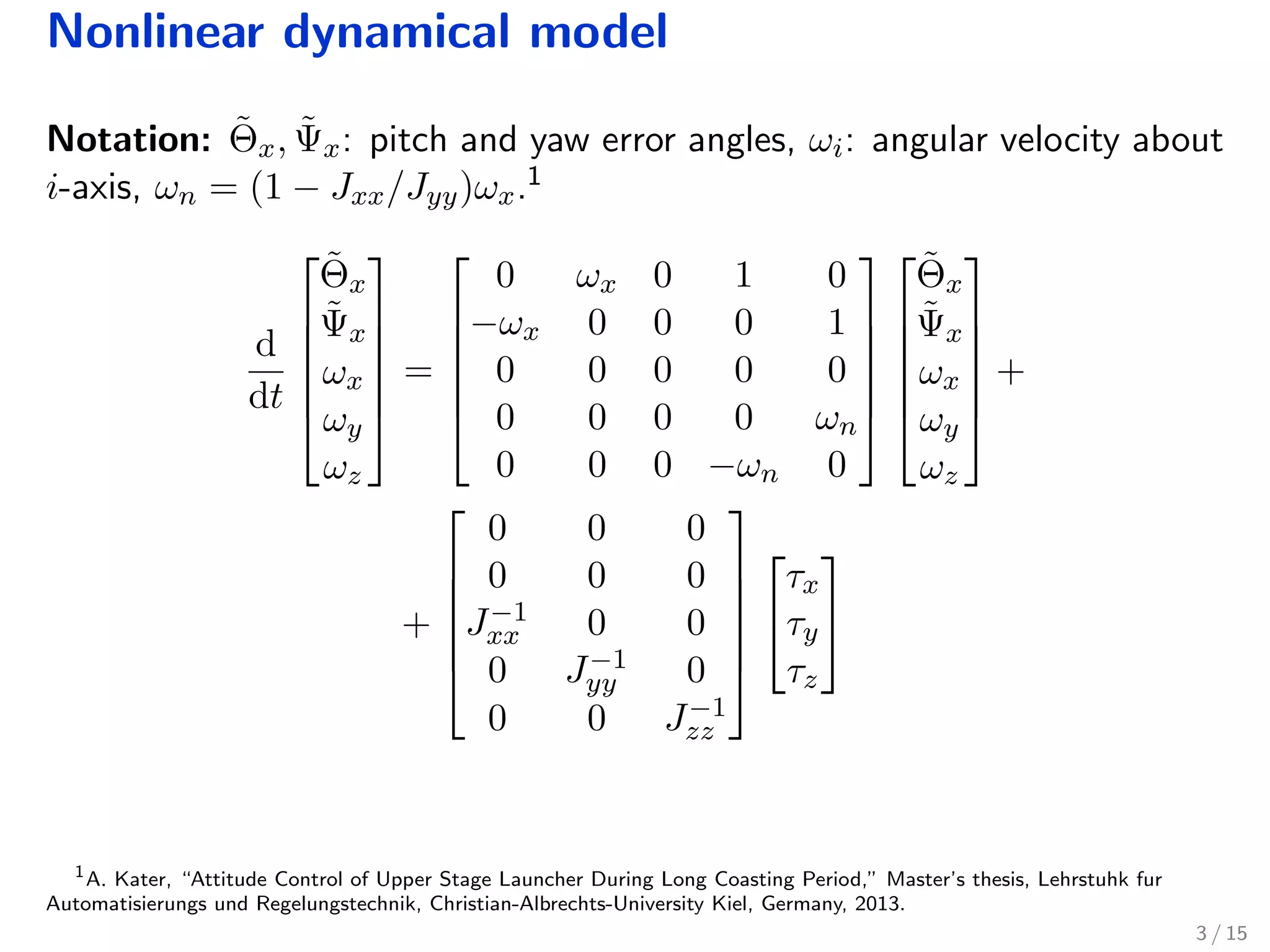
Notation: ˜Θx, ˜Ψx: pitch and yaw error angles, ωi: angular velocity about
i-axis, ωn = (1 − Jxx/Jyy)ωx.1
d
dt






˜Θx
˜Ψx
ωx
ωy
ωz






=






0 ωx 0 1 0
−ωx 0 0 0 1
0 0 0 0 0
0 0 0 0 ωn
0 0 0 −ωn 0












˜Θx
˜Ψx
ωx
ωy
ωz






+
+






0 0 0
0 0 0
J−1
xx 0 0
0 J−1
yy 0
0 0 J−1
zz








τx
τy
τz


1
A. Kater, “Attitude Control of Upper Stage Launcher During Long Coasting Period,” Master’s thesis, Lehrstuhk fur
Automatisierungs und Regelungstechnik, Christian-Albrechts-University Kiel, Germany, 2013.
3 / 15
Linear Dynamical Model
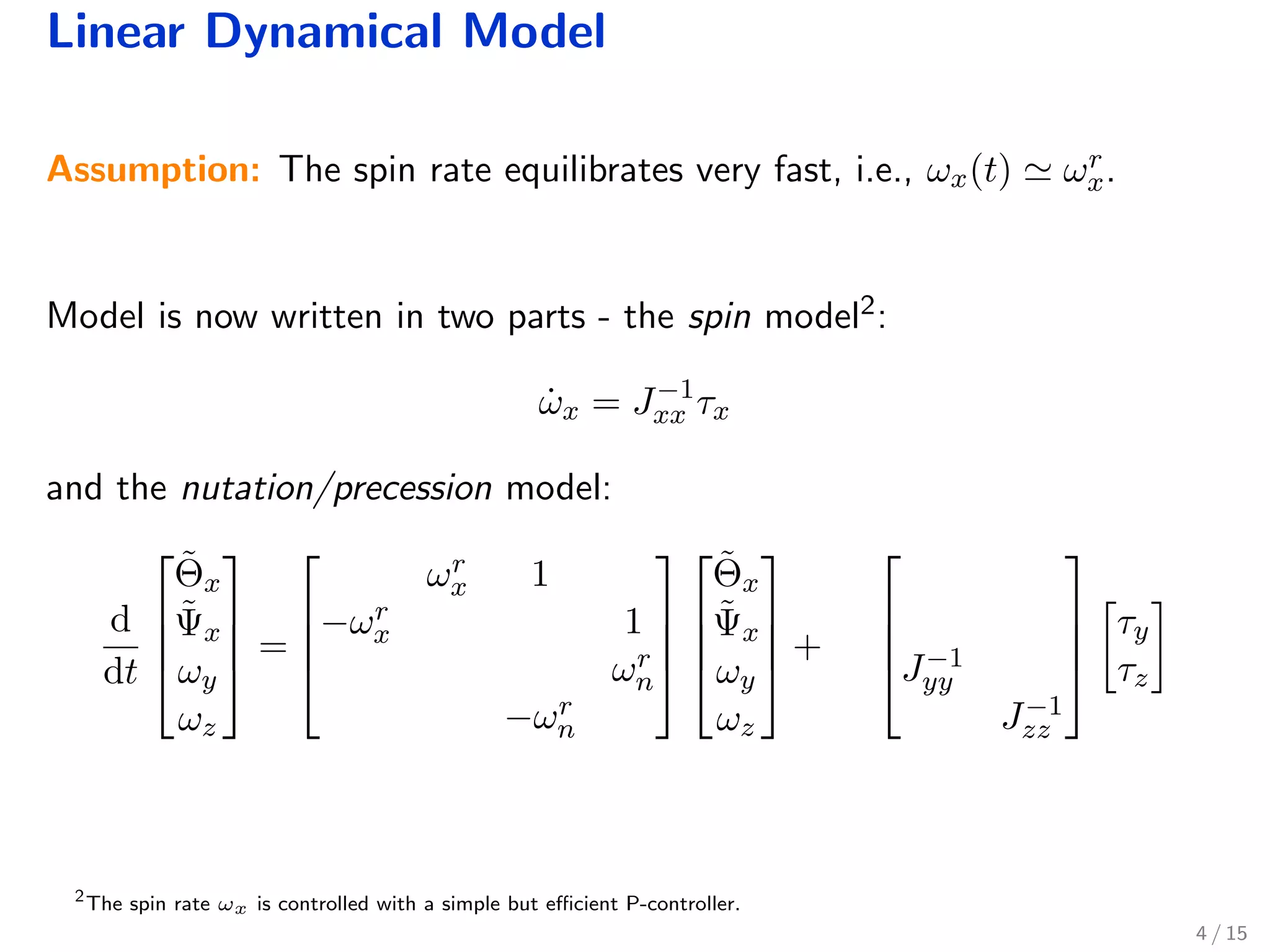
Assumption: The spin rate equilibrates very fast, i.e., ωx(t) ωr
x.
Model is now written in two parts - the spin model2:
˙ωx = J−1
xx τx
and the nutation/precession model:
d
dt




˜Θx
˜Ψx
ωy
ωz



 =




ωr
x 1
−ωr
x 1
ωr
n
−ωr
n








˜Θx
˜Ψx
ωy
ωz



 +



J−1
yy
J−1
zz




τy
τz
2
The spin rate ωx is controlled with a simple but efficient P-controller.
4 / 15
Linear Dynamical Model
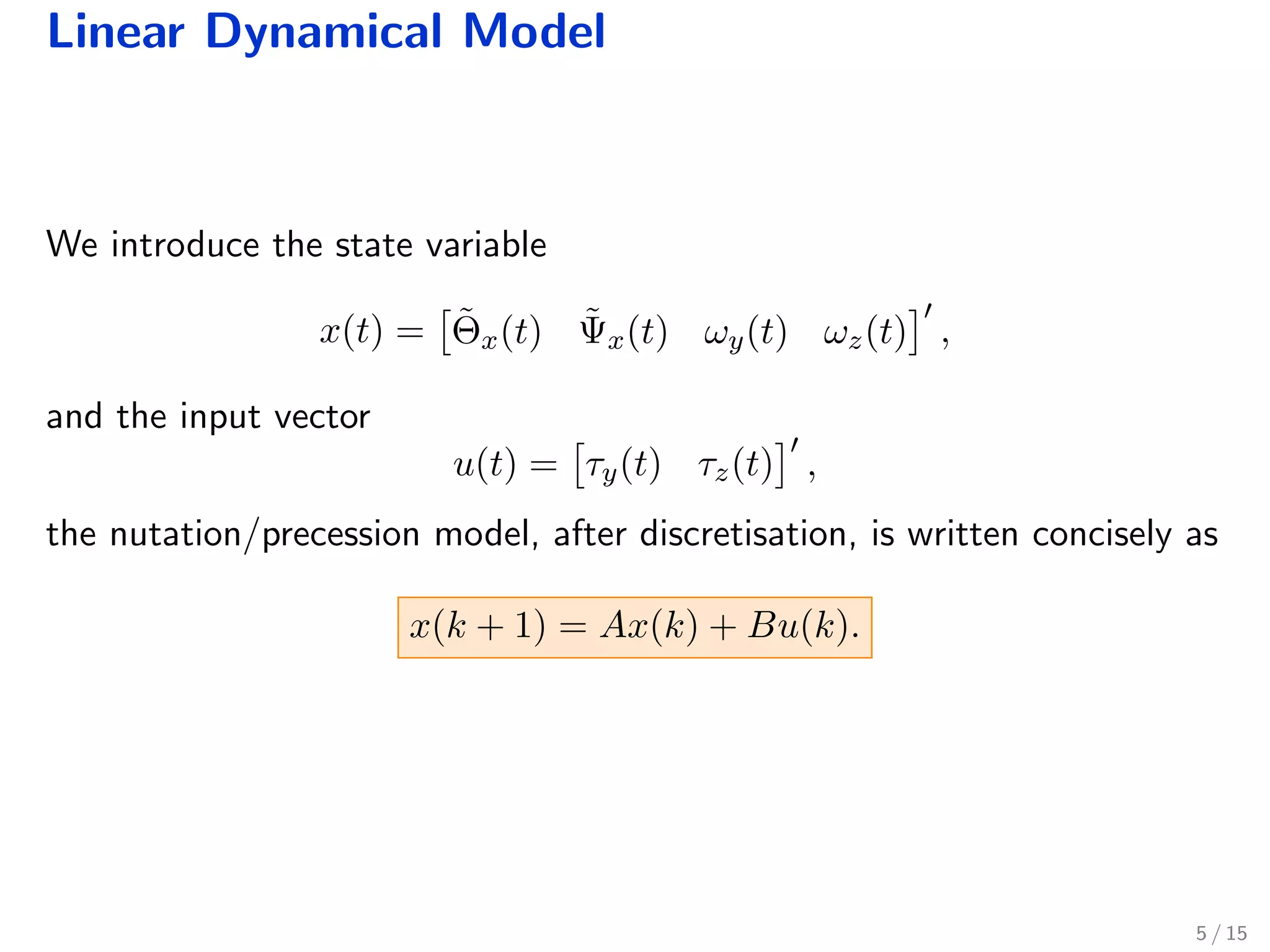
We introduce the state variable
x(t) = ˜Θx(t) ˜Ψx(t) ωy(t) ωz(t) ,
and the input vector
u(t) = τy(t) τz(t) ,
the nutation/precession model, after discretisation, is written concisely as
x(k + 1) = Ax(k) + Bu(k).
5 / 15
II. Impulsive Thrusters
Minimum impulse effect
Minimum impulse effect: thrusters cannot produce arbitrarily small
torques, thus uk is constrained in
U = [−umax, −umin] ∪ {0} ∪ [umin, umax]
We introduce the binary vectors δ− and δ+ so that3
δ−
(k) = [u(k) ≤ −umin],
δ+
(k) = [u(k) ≥ umin],
and the auxiliary variable ηk defined as4
ηi(k) = [δ−
i (k) ∨ δ+
i (k)] · ui(k)
3
Symbols ≤ and ≥ are element-wise comparison operators.
4
Here ηi(k) stands for the i-th component of vector η(k) at time k.
6 / 15
Minimum impulse effect
To detect thruster actuation we use the variable
v(k) = [δ−
(k) ∨ δ+
(k)]
and we recast the system dynamics as
z(k + 1) = Az(k) + Bη(k) + f,
γ(k + 1) = γ(k) + [ 1 1 ] v(k),
where γ(k) is the total actuation count up to time k on which we impose:
γ(k) ≤ γmax.
7 / 15
III. Hybrid MPC
Penalty function
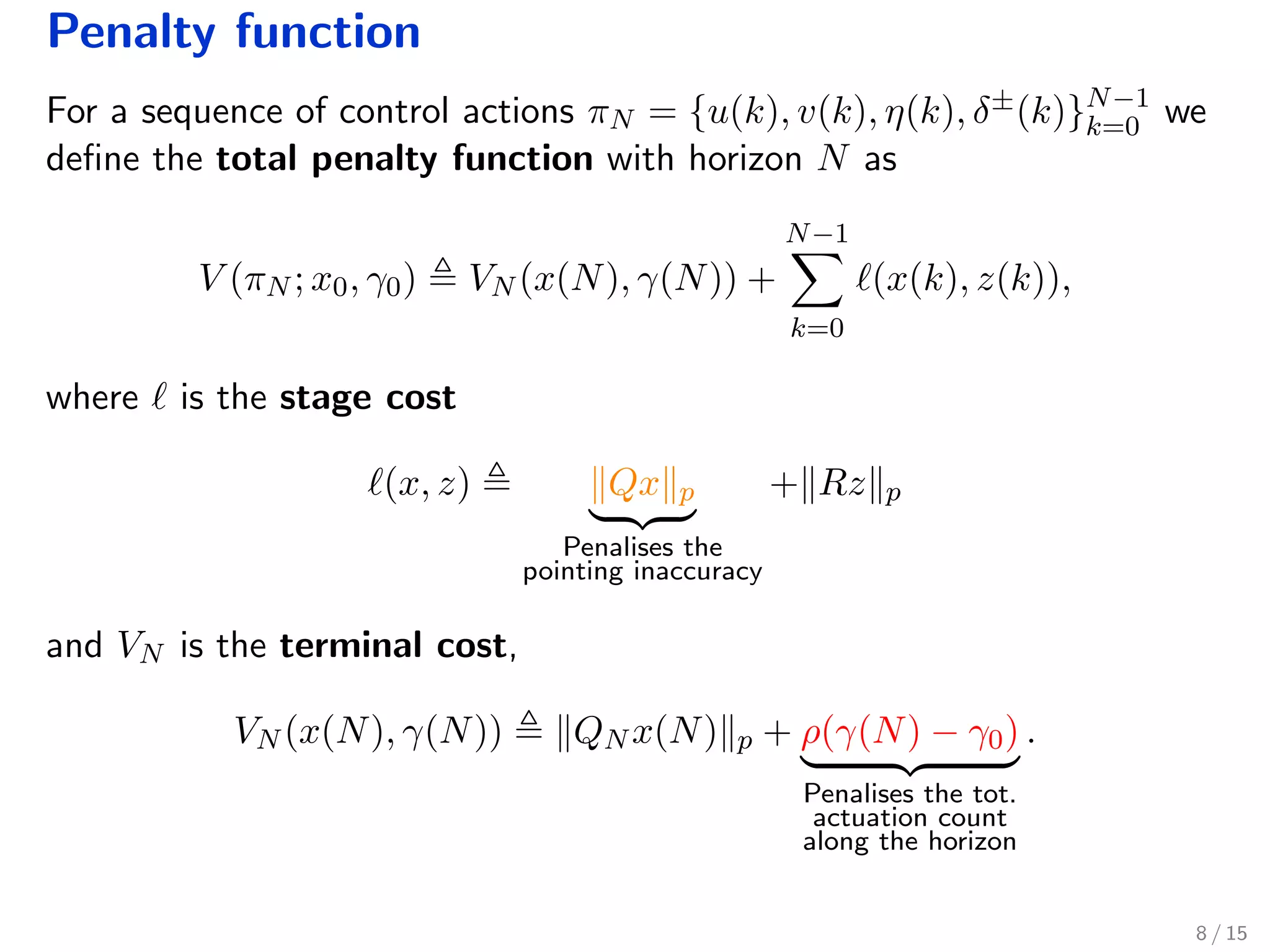
For a sequence of control actions πN = {u(k), v(k), η(k), δ±(k)}N−1
k=0 we
define the total penalty function with horizon N as
V (πN ; x0, γ0) VN (x(N), γ(N)) +
N−1
k=0
(x(k), z(k)),
where is the stage cost
(x, z) Qx p
Penalises the
pointing inaccuracy
+ Rz p
and VN is the terminal cost,
VN (x(N), γ(N)) QN x(N) p + ρ(γ(N) − γ0)
Penalises the tot.
actuation count
along the horizon
.
8 / 15
Hybrid MPC - problem formulation
MPC problem formulation:
min
πN
V (πN ; x0, γ0)
s.t. x(0) = x0, γ(0) = γ0,
Hybrid dynamics, for k ∈ N[0,Nu−1],
δ±
(k) = 0, for k ∈ N[Nu,N−1],
9 / 15
IV. Simulations
Barbecue mode
2 4 6 8 10 12 14 16 18 20
0.5
1
1.5
2
2.5
3
3.5
4
4.5
5
5.5
time [s]
Rollrateerror[deg]
Absolute value of tracking error on ω
x
Figure : ωx converges fast to its set-point.
10 / 15
Pointing Accuracy
−4 −3 −2 −1 0 1 2
−6
−5
−4
−3
−2
−1
0
1
2
pitch error [deg]
yawerror[deg]
Tracking error on pitch and yaw
PD
LQ
HMPC
Figure : HMPC achieves higher pointing accuracy compared to optimally tuned
PD and LQR controllers (which do not account for the MI effect).
11 / 15
Actuation Count
50 100 150 200 250 300
−200
−100
0
100
200
LQRTorque[Nm]
50 100 150 200 250 300
−200
−100
0
100
200
PDTorque[Nm]
50 100 150 200 250 300
−4000
−2000
0
2000
HMPCTorque[Nm]
Time [s]
50 100 150 200 250 300
0
200
400
600
LQRTorque[Nm]
50 100 150 200 250 300
−200
−100
0
100
200
PDTorque[Nm]
50 100 150 200 250 300
−5000
0
5000
HMPCTorque[Nm]
Time [s]
Figure : HMPC achieves a significantly lower actuation count. Left: ωy, Right:
ωz.
12 / 15
...with additive disturbances
−12 −10 −8 −6 −4 −2 0 2 4 6
−4
−2
0
2
4
6
8
10
12
14
pitch error [deg]
yawerror[deg]
Tracking error on pitch and yaw
Tsim
=500
PD
LQ
HMPC
Figure : Simulations in presence of a constant additive disturbance on uk of
6Nm.
13 / 15
Performance assessment
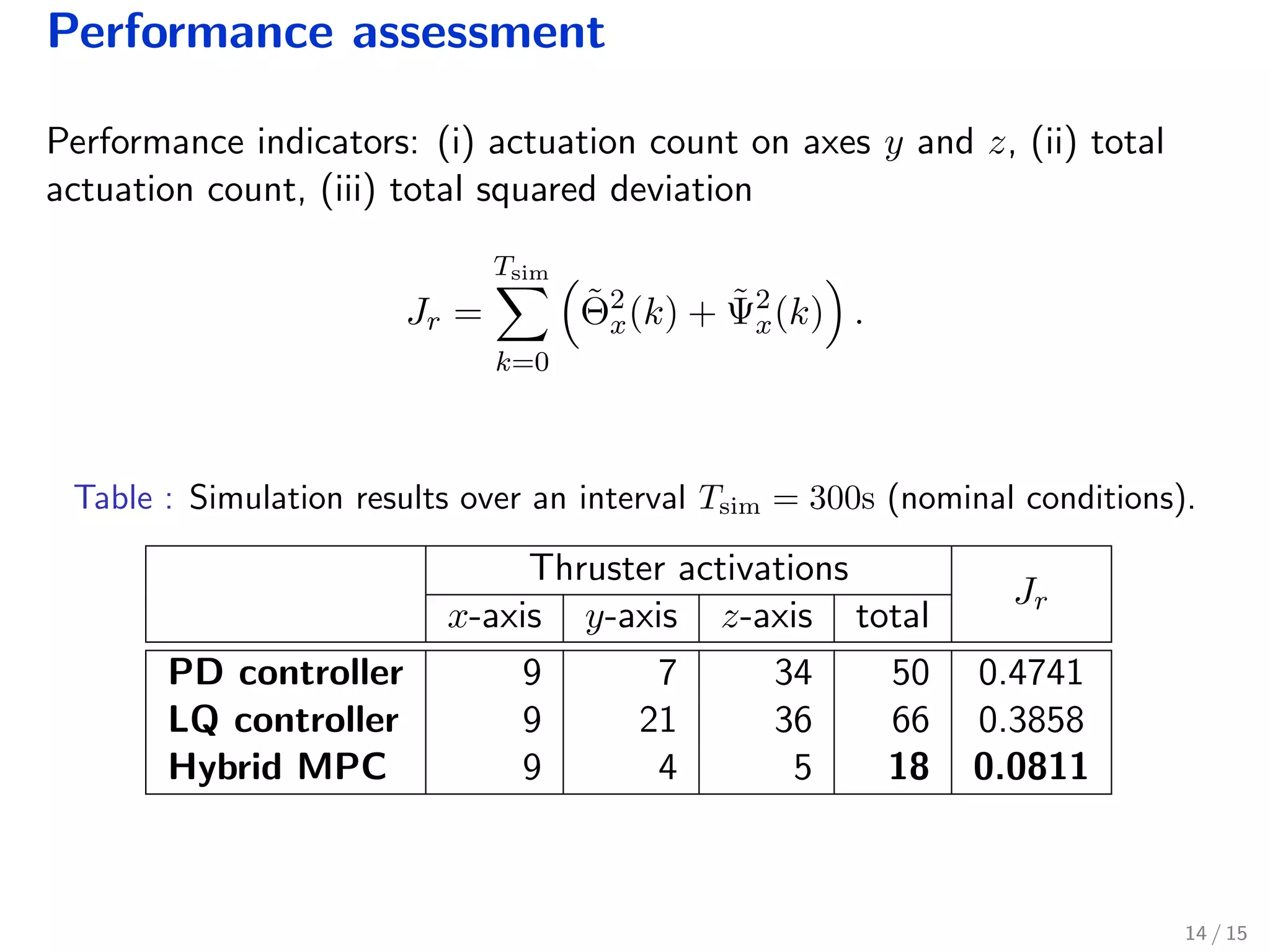
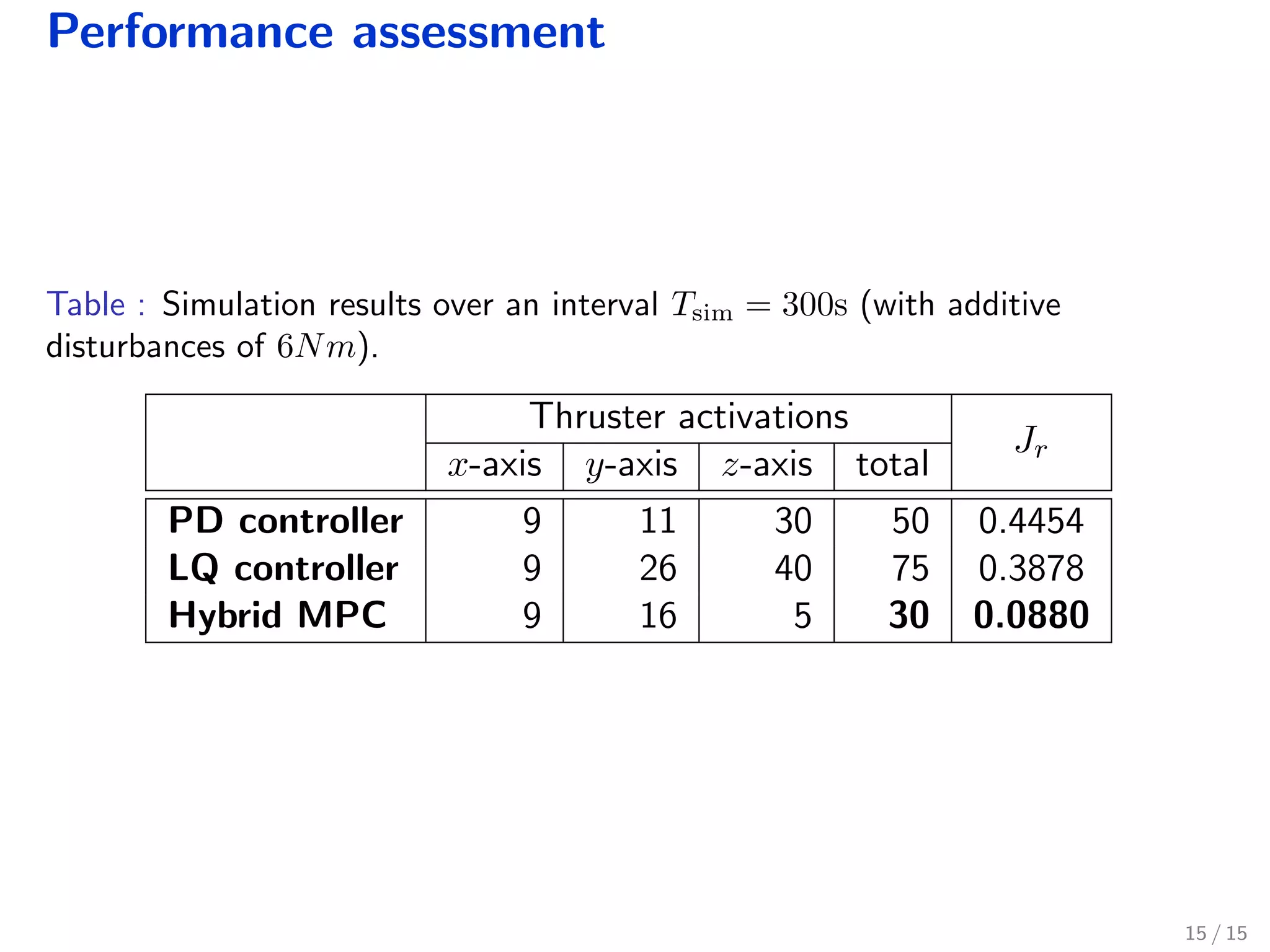
Performance indicators: (i) actuation count on axes y and z, (ii) total
actuation count, (iii) total squared deviation
Jr =
Tsim
k=0
˜Θ2
x(k) + ˜Ψ2
x(k) .
Table : Simulation results over an interval Tsim = 300s (nominal conditions).
Thruster activations
Jr
x-axis y-axis z-axis total
PD controller 9 7 34 50 0.4741
LQ controller 9 21 36 66 0.3858
Hybrid MPC 9 4 5 18 0.0811
14 / 15
Performance assessment
Table : Simulation results over an interval Tsim = 300s (with additive
disturbances of 6Nm).
Thruster activations
Jr
x-axis y-axis z-axis total
PD controller 9 11 30 50 0.4454
LQ controller 9 26 40 75 0.3878
Hybrid MPC 9 16 5 30 0.0880
15 / 15
Thank you for your attention

HMPC for Upper Stage Attitude Control

  • 1.
    Hybrid MPC forAttitude Control of Spacecraft with Impulsive Thrusters P. Sopasakisa, D. Bernardinia,c, H. Strauchb, S. Bennanid and A. Bemporada,c a Institute for Advanced Studies Lucca, b Airbus DS, c ODYS Srl d European Space Agency July 14, 2015
  • 2.
    Control objectives Operate inbarbecue mode with ωx = 5 deg · s−1, Achieve high pointing accuracy using impulsive thrusters Low actuation count Reasonable computational complexity 1 / 15
  • 3.
  • 4.
  • 5.
    Nonlinear dynamical model Notation:˜Θx, ˜Ψx: pitch and yaw error angles, ωi: angular velocity about i-axis, ωn = (1 − Jxx/Jyy)ωx.1 d dt       ˜Θx ˜Ψx ωx ωy ωz       =       0 ωx 0 1 0 −ωx 0 0 0 1 0 0 0 0 0 0 0 0 0 ωn 0 0 0 −ωn 0             ˜Θx ˜Ψx ωx ωy ωz       + +       0 0 0 0 0 0 J−1 xx 0 0 0 J−1 yy 0 0 0 J−1 zz         τx τy τz   1 A. Kater, “Attitude Control of Upper Stage Launcher During Long Coasting Period,” Master’s thesis, Lehrstuhk fur Automatisierungs und Regelungstechnik, Christian-Albrechts-University Kiel, Germany, 2013. 3 / 15
  • 6.
    Linear Dynamical Model Assumption:The spin rate equilibrates very fast, i.e., ωx(t) ωr x. Model is now written in two parts - the spin model2: ˙ωx = J−1 xx τx and the nutation/precession model: d dt     ˜Θx ˜Ψx ωy ωz     =     ωr x 1 −ωr x 1 ωr n −ωr n         ˜Θx ˜Ψx ωy ωz     +    J−1 yy J−1 zz     τy τz 2 The spin rate ωx is controlled with a simple but efficient P-controller. 4 / 15
  • 7.
    Linear Dynamical Model Weintroduce the state variable x(t) = ˜Θx(t) ˜Ψx(t) ωy(t) ωz(t) , and the input vector u(t) = τy(t) τz(t) , the nutation/precession model, after discretisation, is written concisely as x(k + 1) = Ax(k) + Bu(k). 5 / 15
  • 8.
  • 9.
    Minimum impulse effect Minimumimpulse effect: thrusters cannot produce arbitrarily small torques, thus uk is constrained in U = [−umax, −umin] ∪ {0} ∪ [umin, umax] We introduce the binary vectors δ− and δ+ so that3 δ− (k) = [u(k) ≤ −umin], δ+ (k) = [u(k) ≥ umin], and the auxiliary variable ηk defined as4 ηi(k) = [δ− i (k) ∨ δ+ i (k)] · ui(k) 3 Symbols ≤ and ≥ are element-wise comparison operators. 4 Here ηi(k) stands for the i-th component of vector η(k) at time k. 6 / 15
  • 10.
    Minimum impulse effect Todetect thruster actuation we use the variable v(k) = [δ− (k) ∨ δ+ (k)] and we recast the system dynamics as z(k + 1) = Az(k) + Bη(k) + f, γ(k + 1) = γ(k) + [ 1 1 ] v(k), where γ(k) is the total actuation count up to time k on which we impose: γ(k) ≤ γmax. 7 / 15
  • 11.
  • 12.
    Penalty function For asequence of control actions πN = {u(k), v(k), η(k), δ±(k)}N−1 k=0 we define the total penalty function with horizon N as V (πN ; x0, γ0) VN (x(N), γ(N)) + N−1 k=0 (x(k), z(k)), where is the stage cost (x, z) Qx p Penalises the pointing inaccuracy + Rz p and VN is the terminal cost, VN (x(N), γ(N)) QN x(N) p + ρ(γ(N) − γ0) Penalises the tot. actuation count along the horizon . 8 / 15
  • 13.
    Hybrid MPC -problem formulation MPC problem formulation: min πN V (πN ; x0, γ0) s.t. x(0) = x0, γ(0) = γ0, Hybrid dynamics, for k ∈ N[0,Nu−1], δ± (k) = 0, for k ∈ N[Nu,N−1], 9 / 15
  • 14.
  • 15.
    Barbecue mode 2 46 8 10 12 14 16 18 20 0.5 1 1.5 2 2.5 3 3.5 4 4.5 5 5.5 time [s] Rollrateerror[deg] Absolute value of tracking error on ω x Figure : ωx converges fast to its set-point. 10 / 15
  • 16.
    Pointing Accuracy −4 −3−2 −1 0 1 2 −6 −5 −4 −3 −2 −1 0 1 2 pitch error [deg] yawerror[deg] Tracking error on pitch and yaw PD LQ HMPC Figure : HMPC achieves higher pointing accuracy compared to optimally tuned PD and LQR controllers (which do not account for the MI effect). 11 / 15
  • 17.
    Actuation Count 50 100150 200 250 300 −200 −100 0 100 200 LQRTorque[Nm] 50 100 150 200 250 300 −200 −100 0 100 200 PDTorque[Nm] 50 100 150 200 250 300 −4000 −2000 0 2000 HMPCTorque[Nm] Time [s] 50 100 150 200 250 300 0 200 400 600 LQRTorque[Nm] 50 100 150 200 250 300 −200 −100 0 100 200 PDTorque[Nm] 50 100 150 200 250 300 −5000 0 5000 HMPCTorque[Nm] Time [s] Figure : HMPC achieves a significantly lower actuation count. Left: ωy, Right: ωz. 12 / 15
  • 18.
    ...with additive disturbances −12−10 −8 −6 −4 −2 0 2 4 6 −4 −2 0 2 4 6 8 10 12 14 pitch error [deg] yawerror[deg] Tracking error on pitch and yaw Tsim =500 PD LQ HMPC Figure : Simulations in presence of a constant additive disturbance on uk of 6Nm. 13 / 15
  • 19.
    Performance assessment Performance indicators:(i) actuation count on axes y and z, (ii) total actuation count, (iii) total squared deviation Jr = Tsim k=0 ˜Θ2 x(k) + ˜Ψ2 x(k) . Table : Simulation results over an interval Tsim = 300s (nominal conditions). Thruster activations Jr x-axis y-axis z-axis total PD controller 9 7 34 50 0.4741 LQ controller 9 21 36 66 0.3858 Hybrid MPC 9 4 5 18 0.0811 14 / 15
  • 20.
    Performance assessment Table :Simulation results over an interval Tsim = 300s (with additive disturbances of 6Nm). Thruster activations Jr x-axis y-axis z-axis total PD controller 9 11 30 50 0.4454 LQ controller 9 26 40 75 0.3878 Hybrid MPC 9 16 5 30 0.0880 15 / 15
  • 21.
    Thank you foryour attention