Gandhinagar Institute of Technology
Subject :- Control Engineering
MECHANICAL ENGINEERING
5th - B : 2
Presentation
on
Power steering
– Pavan Narkhede [130120119111]
Steering System
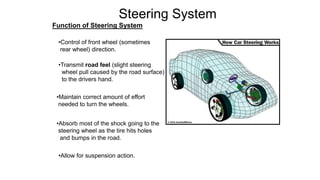
Function of Steering System
•Control of front wheel (sometimes
rear wheel) direction.
•Maintain correct amount of effort
needed to turn the wheels.
•Transmit road feel (slight steering
wheel pull caused by the road surface)
to the drivers hand.
•Absorb most of the shock going to the
steering wheel as the tire hits holes
and bumps in the road.
•Allow for suspension action.
POWER STEERING
 Power steering has two types of device for steering effort one type is a hydraulic device
utilizing engine power. The other type utilizes an electric motor.
 For the former, the engine is used to drive a pump. For the latter, an independent electric
motor in the front luggage compartment is used the pump. Both develop fluid pressure, and
this pressure acts on a piston within the power cylinder so that the pinion assists the rack
effort.
 The amount of this assistance depends on the extent of pressure acting on the piston.
Therefore, if more steering force is required, the pressure must be raised. The variation in the
fluid pressure is accomplished by a control valve which is linked to the steering main shaft.
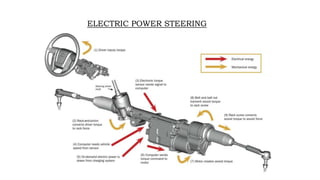
• ELECTRIC POWER STEERING (EPS OR EPAS) is designed to use an electric motor to
reduce effort by providing steering assist to the driver of a vehicle.
• Sensors detect the motion and torque of the steering column, and a computer module
applies assistive torque via an electric motor coupled directly to either the steering gear or
steering column.
• This allows varying amounts of assistance to be applied depending on driving conditions.
The system allows engineers to tailor steering-gear response to variable-rate and variable-
damping suspension systems achieving an ideal blend of ride, handling, and steering for
each vehicle.
• In the event of component failure, a mechanical linkage such as a rack and pinion serves as
a back-up in a manner similar to that of hydraulic systems.
ELECTRIC POWER STEERING
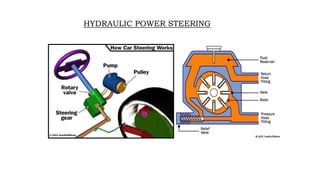
 HYDRAULIC POWER STEERING (HPS) is a hydraulic system for reducing the steering effort
on vehicles by using hydraulic pressure to assist in turning the wheels. It is intended to provide
for easier driving direction control of the car while preserving "feedback", stability and
unambiguity of the trajectory specified. The steering booster is arranged so that should the
booster fail, the steering will continue to work (although the wheel will feel heavier).
 The steering booster consists of the following basic elements:
• Steer torque detector
• Controlled pressure distributor case
• Hydraulic booster pump
• Tank with a working liquid
• Connection hoses
 The working liquid, also called "hydraulic fluid" or "oil", is the medium by which pressure is
transmitted. Common working liquids are based on mineral oil. For pressure restriction in the
pump there is a restrictive valve, which is adjusted on different cars in a range from 7 to 13 MPa.
HYDRAULIC POWER STEERING

Power steering system

  • 1.
    Gandhinagar Institute ofTechnology Subject :- Control Engineering MECHANICAL ENGINEERING 5th - B : 2 Presentation on Power steering – Pavan Narkhede [130120119111]
  • 2.
    Steering System Function ofSteering System •Control of front wheel (sometimes rear wheel) direction. •Maintain correct amount of effort needed to turn the wheels. •Transmit road feel (slight steering wheel pull caused by the road surface) to the drivers hand. •Absorb most of the shock going to the steering wheel as the tire hits holes and bumps in the road. •Allow for suspension action.
  • 3.
    POWER STEERING  Powersteering has two types of device for steering effort one type is a hydraulic device utilizing engine power. The other type utilizes an electric motor.  For the former, the engine is used to drive a pump. For the latter, an independent electric motor in the front luggage compartment is used the pump. Both develop fluid pressure, and this pressure acts on a piston within the power cylinder so that the pinion assists the rack effort.  The amount of this assistance depends on the extent of pressure acting on the piston. Therefore, if more steering force is required, the pressure must be raised. The variation in the fluid pressure is accomplished by a control valve which is linked to the steering main shaft.
  • 4.
    • ELECTRIC POWERSTEERING (EPS OR EPAS) is designed to use an electric motor to reduce effort by providing steering assist to the driver of a vehicle. • Sensors detect the motion and torque of the steering column, and a computer module applies assistive torque via an electric motor coupled directly to either the steering gear or steering column. • This allows varying amounts of assistance to be applied depending on driving conditions. The system allows engineers to tailor steering-gear response to variable-rate and variable- damping suspension systems achieving an ideal blend of ride, handling, and steering for each vehicle. • In the event of component failure, a mechanical linkage such as a rack and pinion serves as a back-up in a manner similar to that of hydraulic systems.
  • 5.
  • 6.
     HYDRAULIC POWERSTEERING (HPS) is a hydraulic system for reducing the steering effort on vehicles by using hydraulic pressure to assist in turning the wheels. It is intended to provide for easier driving direction control of the car while preserving "feedback", stability and unambiguity of the trajectory specified. The steering booster is arranged so that should the booster fail, the steering will continue to work (although the wheel will feel heavier).  The steering booster consists of the following basic elements: • Steer torque detector • Controlled pressure distributor case • Hydraulic booster pump • Tank with a working liquid • Connection hoses  The working liquid, also called "hydraulic fluid" or "oil", is the medium by which pressure is transmitted. Common working liquids are based on mineral oil. For pressure restriction in the pump there is a restrictive valve, which is adjusted on different cars in a range from 7 to 13 MPa.
  • 7.