Panoramic Technique Errors
The following slides identify common panoramic
technique errors.
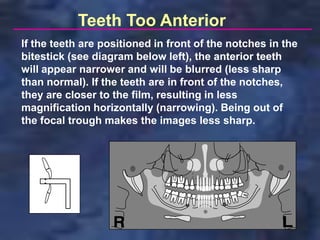
Teeth Too Anterior
If the teeth are positioned in front of the notches in the
bitestick (see diagram below left), the anterior teeth
will appear narrower and will be blurred (less sharp
than normal). If the teeth are in front of the notches,
they are closer to the film, resulting in less
magnification horizontally (narrowing). Being out of
the focal trough makes the images less sharp.
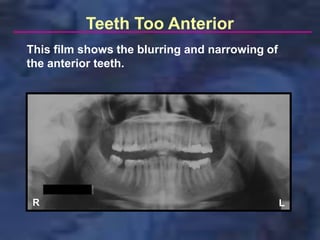
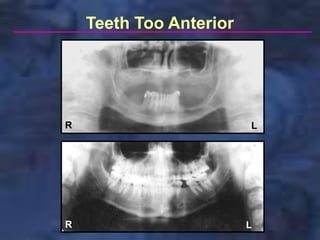
Teeth Too Anterior
This film shows the blurring and narrowing of
the anterior teeth.


 R                                              L
Teeth Too Anterior


R                        L


R                        L
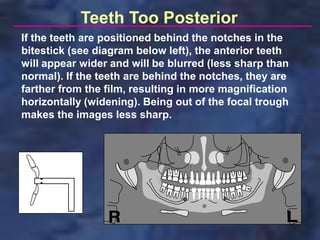
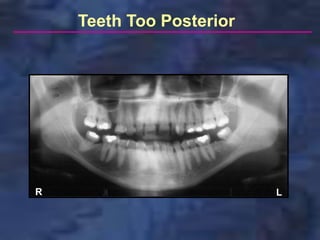
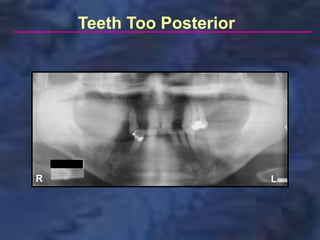
Teeth Too Posterior
If the teeth are positioned behind the notches in the
bitestick (see diagram below left), the anterior teeth
will appear wider and will be blurred (less sharp than
normal). If the teeth are behind the notches, they are
farther from the film, resulting in more magnification
horizontally (widening). Being out of the focal trough
makes the images less sharp.
Teeth Too Posterior


R                         L
Teeth Too Posterior


R                         L
Head Turned
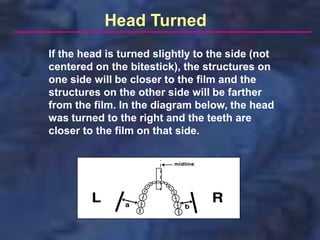
If the head is turned slightly to the side (not
centered on the bitestick), the structures on
one side will be closer to the film and the
structures on the other side will be farther
from the film. In the diagram below, the head
was turned to the right and the teeth are
closer to the film on that side.
Head Turned
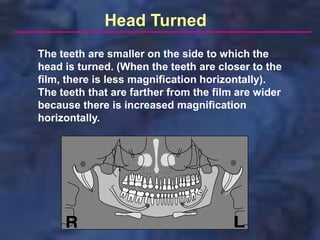
The teeth are smaller on the side to which the
head is turned. (When the teeth are closer to the
film, there is less magnification horizontally).
The teeth that are farther from the film are wider
because there is increased magnification
horizontally.
Head Turned
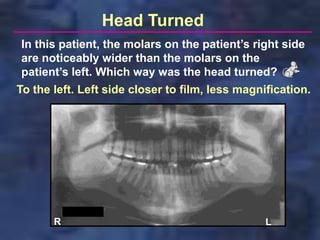
In this patient, the molars on the patient’s right side
are noticeably wider than the molars on the
patient’s left. Which way was the head turned?
To the left. Left side closer to film, less magnification.


       R                                         L
Head Turned
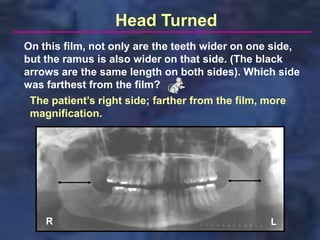
On this film, not only are the teeth wider on one side,
but the ramus is also wider on that side. (The black
arrows are the same length on both sides). Which side
was farthest from the film?
 The patient’s right side; farther from the film, more
 magnification.


    R                                            L
Head Turned
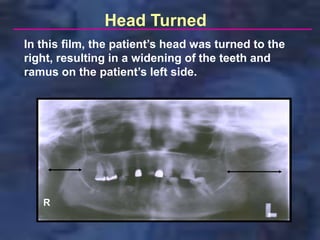
In this film, the patient’s head was turned to the
right, resulting in a widening of the teeth and
ramus on the patient’s left side.


   R
Head Tipped Down
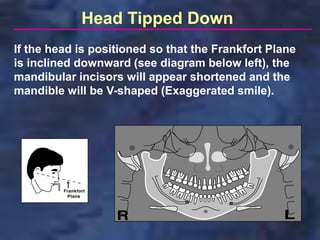
If the head is positioned so that the Frankfort Plane
is inclined downward (see diagram below left), the
mandibular incisors will appear shortened and the
mandible will be V-shaped (Exaggerated smile).
Head Tipped Down
Notice how short the mandibular incisors appear.
The rest of the teeth are relatively normal.


    R                                    L
Head Tipped Down
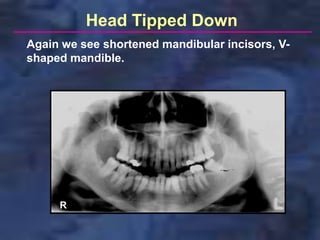
Again we see shortened mandibular incisors, V-
shaped mandible.


     R
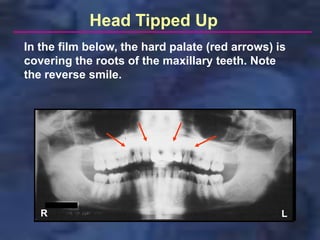
Head Tipped Up
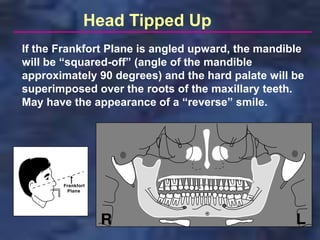
If the Frankfort Plane is angled upward, the mandible
will be “squared-off” (angle of the mandible
approximately 90 degrees) and the hard palate will be
superimposed over the roots of the maxillary teeth.
May have the appearance of a “reverse” smile.
Head Tipped Up
In the film below, the hard palate (red arrows) is
covering the roots of the maxillary teeth. Note
the reverse smile.


   R                                             L
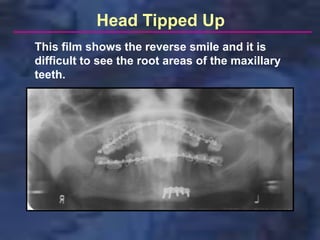
Head Tipped Up
This film shows the reverse smile and it is
difficult to see the root areas of the maxillary
teeth.
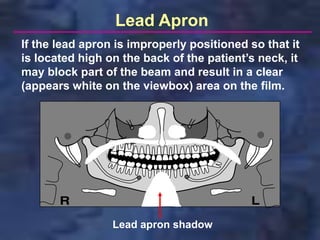
Lead Apron
If the lead apron is improperly positioned so that it
is located high on the back of the patient’s neck, it
may block part of the beam and result in a clear
(appears white on the viewbox) area on the film.


                 Lead apron shadow
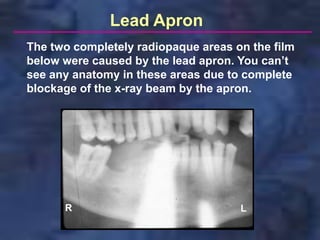
Lead Apron
The two completely radiopaque areas on the film
below were caused by the lead apron. You can’t
see any anatomy in these areas due to complete
blockage of the x-ray beam by the apron.


      R                              L
Lead Apron
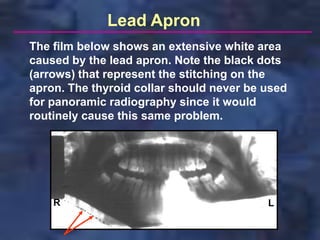
The film below shows an extensive white area
caused by the lead apron. Note the black dots
(arrows) that represent the stitching on the
apron. The thyroid collar should never be used
for panoramic radiography since it would
routinely cause this same problem.


    R                                     L
Cervical Vertebrae (Spine)
If the patient is not standing straight, the cervical
vertebrae may block the x-ray beam as the tubehead
travels behind the patient at an upward angle. This
results in a radiopaque area that extends up through
the middle of the film (arrows below). The teeth/bone
are faintly visible in the radiopaque area (not
completely blocked out as with the lead apron).
Cervical Vertebrae (Spine)
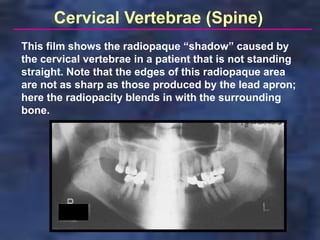
This film shows the radiopaque “shadow” caused by
the cervical vertebrae in a patient that is not standing
straight. Note that the edges of this radiopaque area
are not as sharp as those produced by the lead apron;
here the radiopacity blends in with the surrounding
bone.
Palatoglossal Air Space
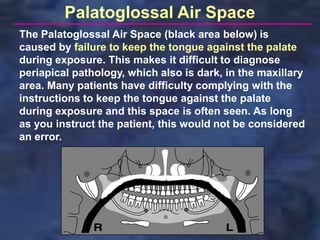
The Palatoglossal Air Space (black area below) is
caused by failure to keep the tongue against the palate
during exposure. This makes it difficult to diagnose
periapical pathology, which also is dark, in the maxillary
area. Many patients have difficulty complying with the
instructions to keep the tongue against the palate
during exposure and this space is often seen. As long
as you instruct the patient, this would not be considered
an error.
Palatoglossal Air Space
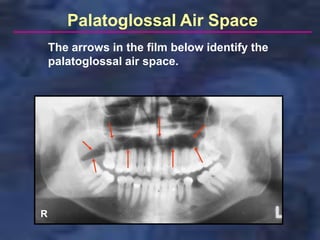
    The arrows in the film below identify the
    palatoglossal air space.


R
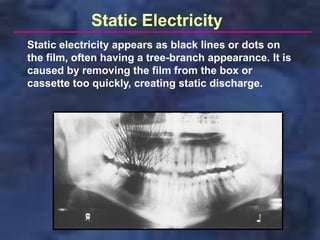
Static Electricity
Static electricity appears as black lines or dots on
the film, often having a tree-branch appearance. It is
caused by removing the film from the box or
cassette too quickly, creating static discharge.
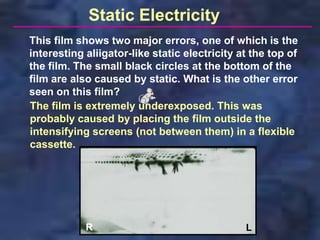
Static Electricity
This film shows two major errors, one of which is the
interesting aliigator-like static electricity at the top of
the film. The small black circles at the bottom of the
film are also caused by static. What is the other error
seen on this film?
The film is extremely underexposed. This was
probably caused by placing the film outside the
intensifying screens (not between them) in a flexible
cassette.


            R                                  L
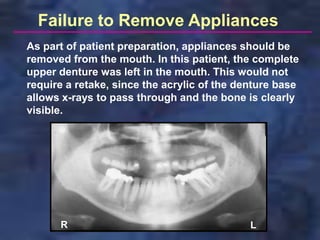
Failure to Remove Appliances
As part of patient preparation, appliances should be
removed from the mouth. In this patient, the complete
upper denture was left in the mouth. This would not
require a retake, since the acrylic of the denture base
allows x-rays to pass through and the bone is clearly
visible.


      R                                      L
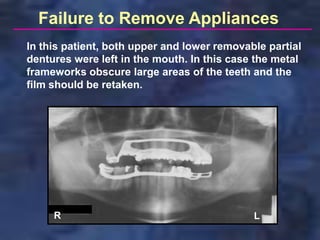
Failure to Remove Appliances
In this patient, both upper and lower removable partial
dentures were left in the mouth. In this case the metal
frameworks obscure large areas of the teeth and the
film should be retaken.


     R                                       L
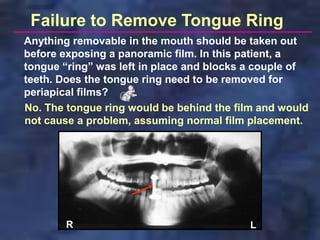
Failure to Remove Tongue Ring
Anything removable in the mouth should be taken out
before exposing a panoramic film. In this patient, a
tongue “ring” was left in place and blocks a couple of
teeth. Does the tongue ring need to be removed for
periapical films?
No. The tongue ring would be behind the film and would
not cause a problem, assuming normal film placement.


       R                                  L
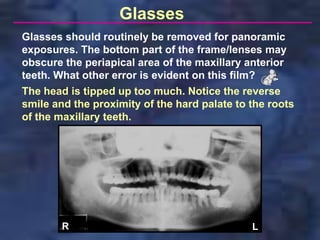
Glasses
Glasses should routinely be removed for panoramic
exposures. The bottom part of the frame/lenses may
obscure the periapical area of the maxillary anterior
teeth. What other error is evident on this film?
The head is tipped up too much. Notice the reverse
smile and the proximity of the hard palate to the roots
of the maxillary teeth.


        R                                     L
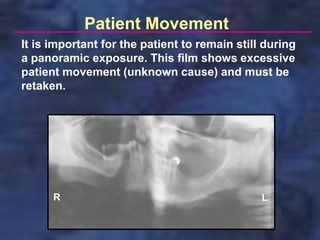
Patient Movement
It is important for the patient to remain still during
a panoramic exposure. This film shows excessive
patient movement (unknown cause) and must be
retaken.


      R                                        L
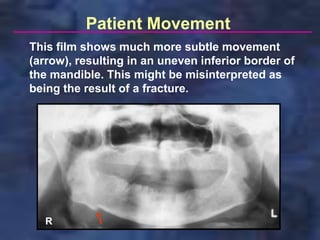
Patient Movement
This film shows much more subtle movement
(arrow), resulting in an uneven inferior border of
the mandible. This might be misinterpreted as
being the result of a fracture.


   R
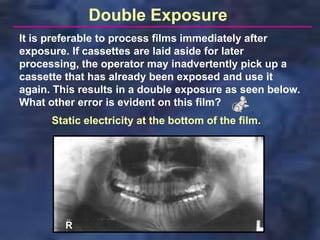
Double Exposure
It is preferable to process films immediately after
exposure. If cassettes are laid aside for later
processing, the operator may inadvertently pick up a
cassette that has already been exposed and use it
again. This results in a double exposure as seen below.
What other error is evident on this film?
      Static electricity at the bottom of the film.


         R
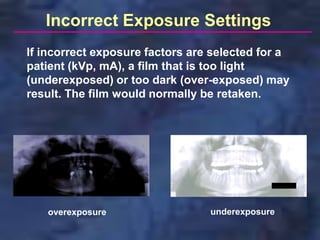
Incorrect Exposure Settings
If incorrect exposure factors are selected for a
patient (kVp, mA), a film that is too light
(underexposed) or too dark (over-exposed) may
result. The film would normally be retaken.


   overexposure                  underexposure

panoramic-techique errors

  • 1.
    Panoramic Technique Errors Thefollowing slides identify common panoramic technique errors.
  • 2.
    Teeth Too Anterior Ifthe teeth are positioned in front of the notches in the bitestick (see diagram below left), the anterior teeth will appear narrower and will be blurred (less sharp than normal). If the teeth are in front of the notches, they are closer to the film, resulting in less magnification horizontally (narrowing). Being out of the focal trough makes the images less sharp.
  • 3.
    Teeth Too Anterior Thisfilm shows the blurring and narrowing of the anterior teeth. R L
  • 4.
  • 5.
    Teeth Too Posterior Ifthe teeth are positioned behind the notches in the bitestick (see diagram below left), the anterior teeth will appear wider and will be blurred (less sharp than normal). If the teeth are behind the notches, they are farther from the film, resulting in more magnification horizontally (widening). Being out of the focal trough makes the images less sharp.
  • 6.
  • 7.
  • 8.
    Head Turned If thehead is turned slightly to the side (not centered on the bitestick), the structures on one side will be closer to the film and the structures on the other side will be farther from the film. In the diagram below, the head was turned to the right and the teeth are closer to the film on that side.
  • 9.
    Head Turned The teethare smaller on the side to which the head is turned. (When the teeth are closer to the film, there is less magnification horizontally). The teeth that are farther from the film are wider because there is increased magnification horizontally.
  • 10.
    Head Turned In thispatient, the molars on the patient’s right side are noticeably wider than the molars on the patient’s left. Which way was the head turned? To the left. Left side closer to film, less magnification. R L
  • 11.
    Head Turned On thisfilm, not only are the teeth wider on one side, but the ramus is also wider on that side. (The black arrows are the same length on both sides). Which side was farthest from the film? The patient’s right side; farther from the film, more magnification. R L
  • 12.
    Head Turned In thisfilm, the patient’s head was turned to the right, resulting in a widening of the teeth and ramus on the patient’s left side. R
  • 13.
    Head Tipped Down Ifthe head is positioned so that the Frankfort Plane is inclined downward (see diagram below left), the mandibular incisors will appear shortened and the mandible will be V-shaped (Exaggerated smile).
  • 14.
    Head Tipped Down Noticehow short the mandibular incisors appear. The rest of the teeth are relatively normal. R L
  • 15.
    Head Tipped Down Againwe see shortened mandibular incisors, V- shaped mandible. R
  • 16.
    Head Tipped Up Ifthe Frankfort Plane is angled upward, the mandible will be “squared-off” (angle of the mandible approximately 90 degrees) and the hard palate will be superimposed over the roots of the maxillary teeth. May have the appearance of a “reverse” smile.
  • 17.
    Head Tipped Up Inthe film below, the hard palate (red arrows) is covering the roots of the maxillary teeth. Note the reverse smile. R L
  • 18.
    Head Tipped Up Thisfilm shows the reverse smile and it is difficult to see the root areas of the maxillary teeth.
  • 19.
    Lead Apron If thelead apron is improperly positioned so that it is located high on the back of the patient’s neck, it may block part of the beam and result in a clear (appears white on the viewbox) area on the film. Lead apron shadow
  • 20.
    Lead Apron The twocompletely radiopaque areas on the film below were caused by the lead apron. You can’t see any anatomy in these areas due to complete blockage of the x-ray beam by the apron. R L
  • 21.
    Lead Apron The filmbelow shows an extensive white area caused by the lead apron. Note the black dots (arrows) that represent the stitching on the apron. The thyroid collar should never be used for panoramic radiography since it would routinely cause this same problem. R L
  • 22.
    Cervical Vertebrae (Spine) Ifthe patient is not standing straight, the cervical vertebrae may block the x-ray beam as the tubehead travels behind the patient at an upward angle. This results in a radiopaque area that extends up through the middle of the film (arrows below). The teeth/bone are faintly visible in the radiopaque area (not completely blocked out as with the lead apron).
  • 23.
    Cervical Vertebrae (Spine) Thisfilm shows the radiopaque “shadow” caused by the cervical vertebrae in a patient that is not standing straight. Note that the edges of this radiopaque area are not as sharp as those produced by the lead apron; here the radiopacity blends in with the surrounding bone.
  • 24.
    Palatoglossal Air Space ThePalatoglossal Air Space (black area below) is caused by failure to keep the tongue against the palate during exposure. This makes it difficult to diagnose periapical pathology, which also is dark, in the maxillary area. Many patients have difficulty complying with the instructions to keep the tongue against the palate during exposure and this space is often seen. As long as you instruct the patient, this would not be considered an error.
  • 25.
    Palatoglossal Air Space The arrows in the film below identify the palatoglossal air space. R
  • 26.
    Static Electricity Static electricityappears as black lines or dots on the film, often having a tree-branch appearance. It is caused by removing the film from the box or cassette too quickly, creating static discharge.
  • 27.
    Static Electricity This filmshows two major errors, one of which is the interesting aliigator-like static electricity at the top of the film. The small black circles at the bottom of the film are also caused by static. What is the other error seen on this film? The film is extremely underexposed. This was probably caused by placing the film outside the intensifying screens (not between them) in a flexible cassette. R L
  • 28.
    Failure to RemoveAppliances As part of patient preparation, appliances should be removed from the mouth. In this patient, the complete upper denture was left in the mouth. This would not require a retake, since the acrylic of the denture base allows x-rays to pass through and the bone is clearly visible. R L
  • 29.
    Failure to RemoveAppliances In this patient, both upper and lower removable partial dentures were left in the mouth. In this case the metal frameworks obscure large areas of the teeth and the film should be retaken. R L
  • 30.
    Failure to RemoveTongue Ring Anything removable in the mouth should be taken out before exposing a panoramic film. In this patient, a tongue “ring” was left in place and blocks a couple of teeth. Does the tongue ring need to be removed for periapical films? No. The tongue ring would be behind the film and would not cause a problem, assuming normal film placement. R L
  • 31.
    Glasses Glasses should routinelybe removed for panoramic exposures. The bottom part of the frame/lenses may obscure the periapical area of the maxillary anterior teeth. What other error is evident on this film? The head is tipped up too much. Notice the reverse smile and the proximity of the hard palate to the roots of the maxillary teeth. R L
  • 32.
    Patient Movement It isimportant for the patient to remain still during a panoramic exposure. This film shows excessive patient movement (unknown cause) and must be retaken. R L
  • 33.
    Patient Movement This filmshows much more subtle movement (arrow), resulting in an uneven inferior border of the mandible. This might be misinterpreted as being the result of a fracture. R
  • 34.
    Double Exposure It ispreferable to process films immediately after exposure. If cassettes are laid aside for later processing, the operator may inadvertently pick up a cassette that has already been exposed and use it again. This results in a double exposure as seen below. What other error is evident on this film? Static electricity at the bottom of the film. R
  • 35.
    Incorrect Exposure Settings Ifincorrect exposure factors are selected for a patient (kVp, mA), a film that is too light (underexposed) or too dark (over-exposed) may result. The film would normally be retaken. overexposure underexposure