Integrated Fish
Farming
Nishat Fatima
M.Sc Final Year
(Environmental Science)
Deen Dayal Upadhyaya Gorakhpur University, Gorakhpur
Marching Towards Excellence
CONTENTS
Introduction of Integrated Fish Farming
System.
Principle of Integrated Fish Farming System.
Scope of Integrated Fish Farming System.
Important types of Integrated Fish Farming
System.
Advantages of Integrated Fish Farming
System.
Conclusion.
Precautions.
INTEGRATED FISH
FARMING
Integrates fish farming system refer to the production , integrated
management and comprehensive use of aquaculture ,
agriculture and livestock.
PRINCIPLE OF
INTEGRATED FISH
FARMING SYSTEM.
• IFF is based on the concept that ‘there is no waste ’.
• Fishes utilizes the animal and agricultural wastes directly or
indirectly as food.
• It is considered as economic & efficient means of environmental
management.
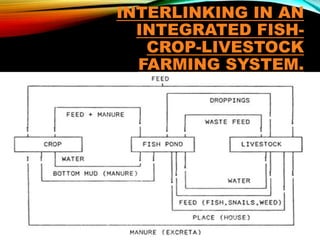
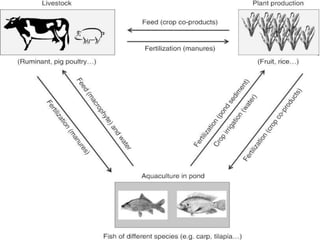
INTERLINKING IN AN
INTEGRATED FISH-
CROP-LIVESTOCK
FARMING SYSTEM.
SCOPE OF INTEGRATED
FISH FARMING SYSTEM.
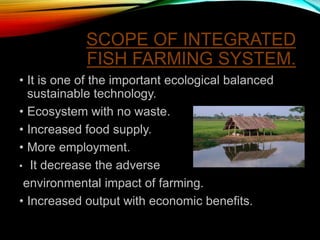
• It is one of the important ecological balanced
sustainable technology.
• Ecosystem with no waste.
• Increased food supply.
• More employment.
• It decrease the adverse
environmental impact of farming.
• Increased output with economic benefits.
IMPORTANT TYPES OF
INTEGRATED FISH
FARMING SYSTEM.
1) Paddy - Cum - Fish Culture.
2) Duck - Cum - Fish Integrated Farming.
3) Fish - Cum - Pig Integrated Farming.
4) Fish - Cum - Cattle Farming.
5) Fish -Cum- Poultry Integrated Farming.
Paddy-Cum-Fish Culture: Duck-Cum-Fish Farming:
• Fish raising and paddy growing make
a profitable on-farm combination.
• Fish cultivation promotes better
effective control on unwanted weeds,
molluscs, noxious insects and their
larval stages.
• Off season employment to farmers.
• Ducks can be said to be ‘living
manuring machines’.
• Ducks loosen the pond bottom,
releasing nutrients which increase
pond productivity.
• The ducks help to eradicate vectors of
fish pathogenic organisms and water
borne diseases.
ADVANTAGES OF
INTEGRATED FISH FARMING
SYSTEM.
• Profitability
• Productivity
• Balanced Food
• Environmental Safety
• Saving Energy
• Income Rounds the year
• Employment Generation
LIVELIHOOD OF
FARMERS
Paultry
Horticulture
Goat
Cow & Buffalo
Rice
Pisciculture
ECONOMIC
ENHANCEMENT
CONCLUSION OF
INTEGRATED FISH
FARMING SYSTEM
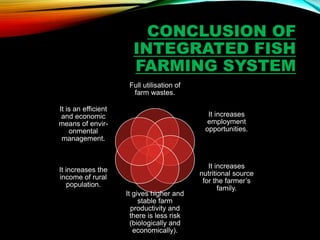
Full utilisation of
farm wastes.
It increases
employment
opportunities.
It increases
nutritional source
for the farmer’s
family.
It gives higher and
stable farm
productivity and
there is less risk
(biologically and
economically).
It increases the
income of rural
population.
It is an efficient
and economic
means of envir-
onmental
management.
PRECAUTIONS FOR
INTEGRATED FISH
FARMING SYSTEM.
DISEASE Environment
Set-up
Costs
Worker
Safety
Integrated fish farming system

Integrated fish farming system

  • 1.
    Integrated Fish Farming Nishat Fatima M.ScFinal Year (Environmental Science) Deen Dayal Upadhyaya Gorakhpur University, Gorakhpur Marching Towards Excellence
  • 2.
    CONTENTS Introduction of IntegratedFish Farming System. Principle of Integrated Fish Farming System. Scope of Integrated Fish Farming System. Important types of Integrated Fish Farming System. Advantages of Integrated Fish Farming System. Conclusion. Precautions.
  • 3.
    INTEGRATED FISH FARMING Integrates fishfarming system refer to the production , integrated management and comprehensive use of aquaculture , agriculture and livestock.
  • 4.
    PRINCIPLE OF INTEGRATED FISH FARMINGSYSTEM. • IFF is based on the concept that ‘there is no waste ’. • Fishes utilizes the animal and agricultural wastes directly or indirectly as food. • It is considered as economic & efficient means of environmental management.
  • 5.
    INTERLINKING IN AN INTEGRATEDFISH- CROP-LIVESTOCK FARMING SYSTEM.
  • 6.
    SCOPE OF INTEGRATED FISHFARMING SYSTEM. • It is one of the important ecological balanced sustainable technology. • Ecosystem with no waste. • Increased food supply. • More employment. • It decrease the adverse environmental impact of farming. • Increased output with economic benefits.
  • 7.
    IMPORTANT TYPES OF INTEGRATEDFISH FARMING SYSTEM. 1) Paddy - Cum - Fish Culture. 2) Duck - Cum - Fish Integrated Farming. 3) Fish - Cum - Pig Integrated Farming. 4) Fish - Cum - Cattle Farming. 5) Fish -Cum- Poultry Integrated Farming.
  • 9.
    Paddy-Cum-Fish Culture: Duck-Cum-FishFarming: • Fish raising and paddy growing make a profitable on-farm combination. • Fish cultivation promotes better effective control on unwanted weeds, molluscs, noxious insects and their larval stages. • Off season employment to farmers. • Ducks can be said to be ‘living manuring machines’. • Ducks loosen the pond bottom, releasing nutrients which increase pond productivity. • The ducks help to eradicate vectors of fish pathogenic organisms and water borne diseases.
  • 10.
    ADVANTAGES OF INTEGRATED FISHFARMING SYSTEM. • Profitability • Productivity • Balanced Food • Environmental Safety • Saving Energy • Income Rounds the year • Employment Generation
  • 11.
  • 12.
  • 13.
    CONCLUSION OF INTEGRATED FISH FARMINGSYSTEM Full utilisation of farm wastes. It increases employment opportunities. It increases nutritional source for the farmer’s family. It gives higher and stable farm productivity and there is less risk (biologically and economically). It increases the income of rural population. It is an efficient and economic means of envir- onmental management.
  • 14.
    PRECAUTIONS FOR INTEGRATED FISH FARMINGSYSTEM. DISEASE Environment Set-up Costs Worker Safety