

Forgotten Reflex Testing
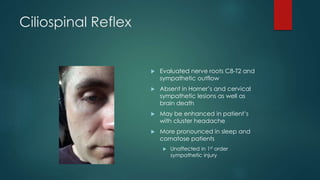
Ciliospinal Reflex
 Evaluated nerve roots C8-T2 and
sympathetic outflow
 Absent in Horner’s and cervical
sympathetic lesions as well as
brain death
 May be enhanced in patient’s
with cluster headache
 More pronounced in sleep and
comatose patients
 Unaffected in 1st order
sympathetic injury
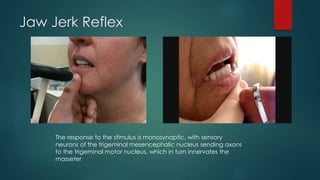
Jaw Jerk Reflex
The response to the stimulus is monosynaptic, with sensory
neurons of the trigeminal mesencephalic nucleus sending axons
to the trigeminal motor nucleus, which in turn innervates the
masseter
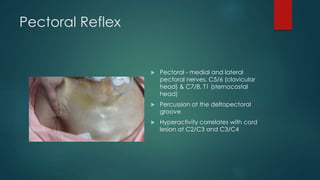
Pectoral Reflex
 Pectoral - medial and lateral
pectoral nerves, C5/6 (clavicular
head) & C7/8, T1 (sternocostal
head)
 Percussion at the deltopectoral
groove
 Hyperactivity correlates with cord
lesion at C2/C3 and C3/C4
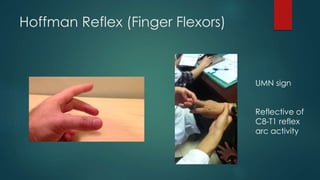
Hoffman Reflex (Finger Flexors)
UMN sign
Reflective of
C8-T1 reflex
arc activity
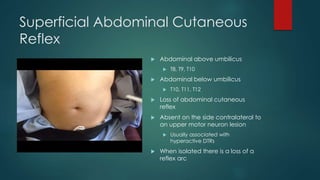
Superficial Abdominal Cutaneous
Reflex
 Abdominal above umbilicus
 T8, T9, T10
 Abdominal below umbilicus
 T10, T11, T12
 Loss of abdominal cutaneous
reflex
 Absent on the side contralateral to
an upper motor neuron lesion
 Usually associated with
hyperactive DTRs
 When isolated there is a loss of a
reflex arc
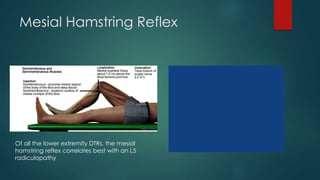
Mesial Hamstring Reflex
Of all the lower extremity DTRs, the mesial
hamstring reflex correlates best with an L5
radiculopathy
Cremasteric Reflex: Basics
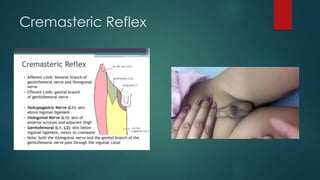
 Reflex is elicited by stroking the mesial thigh causing an ipsilateral
contraction of the cremasteric muscle
 Brings testicle closer to the external inguinal ring
 Reflex test L1-L2 (genitofemoral nerve responsible for afferent and
efferent limbs)
 Typically absent in testicular torsion
 Negative predictive value of over 90%
Cremasteric Reflex
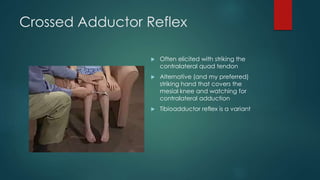
Crossed Adductor Reflex
 Often elicited with striking the
contralateral quad tendon
 Alternative (and my preferred)
striking hand that covers the
mesial knee and watching for
contralateral adduction
 Tibioadductor reflex is a variant
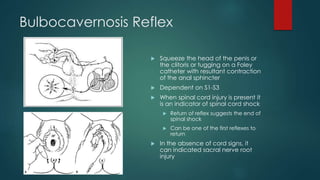
Bulbocavernosis Reflex
 Squeeze the head of the penis or
the clitoris or tugging on a Foley
catheter with resultant contraction
of the anal sphincter
 Dependent on S1-S3
 When spinal cord injury is present it
is an indicator of spinal cord shock
 Return of reflex suggests the end of
spinal shock
 Can be one of the first reflexes to
return
 In the absence of cord signs, it
can indicated sacral nerve root
injury
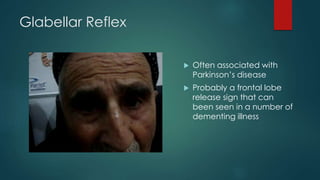
Glabellar Reflex
 Often associated with
Parkinson’s disease
 Probably a frontal lobe
release sign that can
been seen in a number of
dementing illness
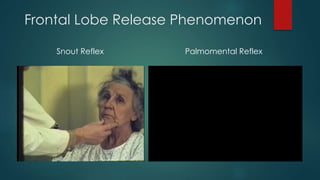
Frontal Lobe Release Phenomenon
Snout Reflex Palmomental Reflex

Forgotten Reflex Testing

  • 1.
  • 2.
    Ciliospinal Reflex  Evaluatednerve roots C8-T2 and sympathetic outflow  Absent in Horner’s and cervical sympathetic lesions as well as brain death  May be enhanced in patient’s with cluster headache  More pronounced in sleep and comatose patients  Unaffected in 1st order sympathetic injury
  • 3.
    Jaw Jerk Reflex Theresponse to the stimulus is monosynaptic, with sensory neurons of the trigeminal mesencephalic nucleus sending axons to the trigeminal motor nucleus, which in turn innervates the masseter
  • 4.
    Pectoral Reflex  Pectoral- medial and lateral pectoral nerves, C5/6 (clavicular head) & C7/8, T1 (sternocostal head)  Percussion at the deltopectoral groove  Hyperactivity correlates with cord lesion at C2/C3 and C3/C4
  • 5.
    Hoffman Reflex (FingerFlexors) UMN sign Reflective of C8-T1 reflex arc activity
  • 6.
    Superficial Abdominal Cutaneous Reflex Abdominal above umbilicus  T8, T9, T10  Abdominal below umbilicus  T10, T11, T12  Loss of abdominal cutaneous reflex  Absent on the side contralateral to an upper motor neuron lesion  Usually associated with hyperactive DTRs  When isolated there is a loss of a reflex arc
  • 7.
    Mesial Hamstring Reflex Ofall the lower extremity DTRs, the mesial hamstring reflex correlates best with an L5 radiculopathy
  • 8.
    Cremasteric Reflex: Basics Reflex is elicited by stroking the mesial thigh causing an ipsilateral contraction of the cremasteric muscle  Brings testicle closer to the external inguinal ring  Reflex test L1-L2 (genitofemoral nerve responsible for afferent and efferent limbs)  Typically absent in testicular torsion  Negative predictive value of over 90%
  • 9.
  • 10.
    Crossed Adductor Reflex Often elicited with striking the contralateral quad tendon  Alternative (and my preferred) striking hand that covers the mesial knee and watching for contralateral adduction  Tibioadductor reflex is a variant
  • 11.
    Bulbocavernosis Reflex  Squeezethe head of the penis or the clitoris or tugging on a Foley catheter with resultant contraction of the anal sphincter  Dependent on S1-S3  When spinal cord injury is present it is an indicator of spinal cord shock  Return of reflex suggests the end of spinal shock  Can be one of the first reflexes to return  In the absence of cord signs, it can indicated sacral nerve root injury
  • 12.
    Glabellar Reflex  Oftenassociated with Parkinson’s disease  Probably a frontal lobe release sign that can been seen in a number of dementing illness
  • 13.
    Frontal Lobe ReleasePhenomenon Snout Reflex Palmomental Reflex