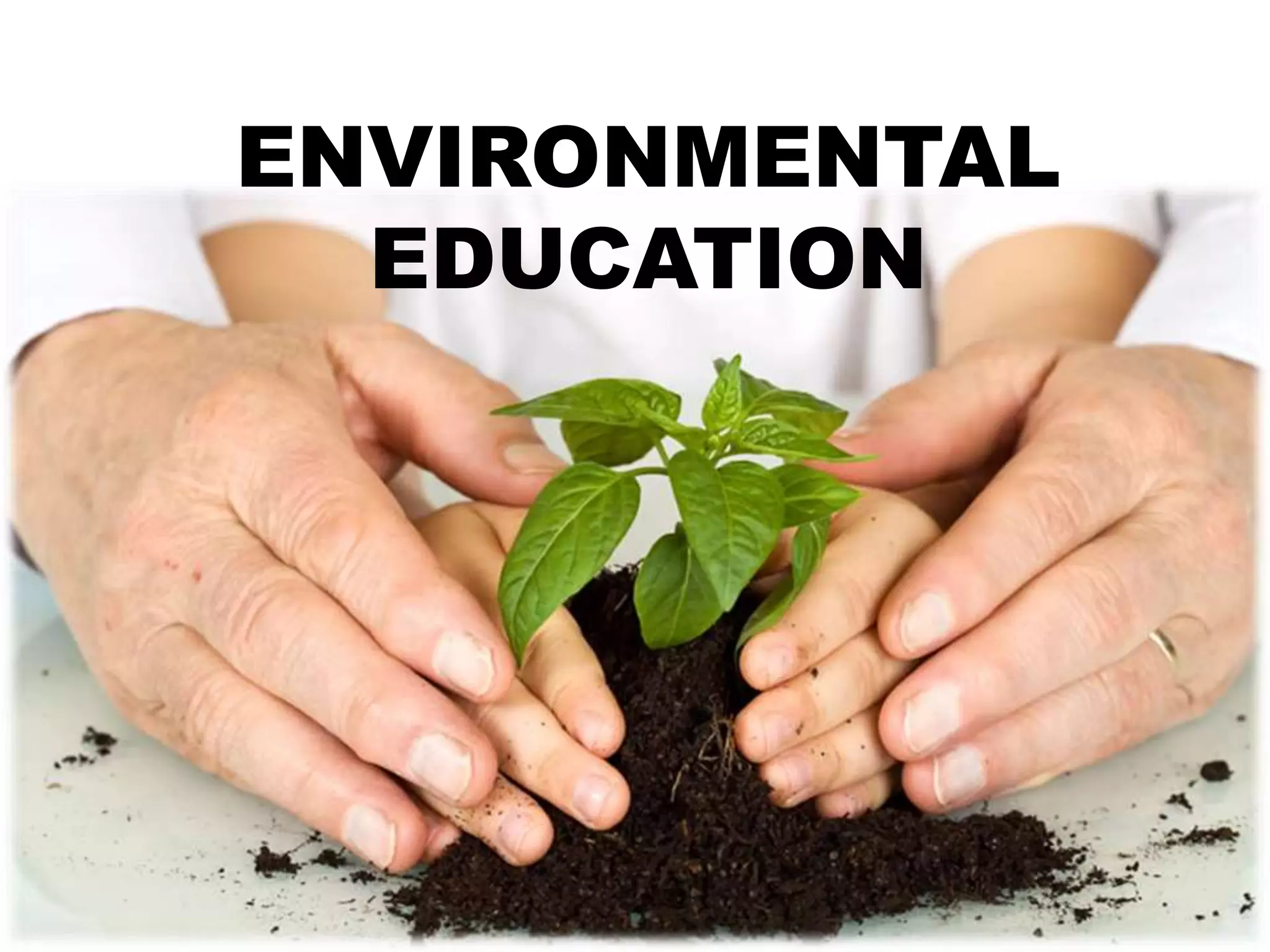
ENVIRONMENTAL
EDUCATION
According to IUCN :
“Environmental education is the
process of recognizing values and
clarifying concepts in order to
develop skills and attitudes
necessary to understand and
appreciate the interrelatedness
among man, his culture and his
bio-physical surroundings.EE also
entails practices in decision making
and self-formulating of a code of
behavior about issues concerning
environmental quality.”
According to UNESCO :
“Environmental education is a learning process
that increases people’s knowledge and
awareness about the environment and
associated challenges, develops the necessary
skills and expertise to address the challenges,
and fosters attitudes, motivations and
commitments to make informed decisions and
take responsible actions.”
The components of environmental education are :
1. Awareness (awareness about environment and its problems)
2. Knowledge(basic knowledge about the environment)
3. Attitude(a sense of responsibility towards the environment)
4. Skill(skills to solve environmental problems)
5. Participation(participate in programs related to environment)
OBJECTIVES OF
ENVIRONMENTAL
EDUCATION ?
To create awareness among the students about
the environment and its problems.
To enable the students to understand the
environment and its inter relationship with
man.
To enable the students to acquire basic
knowledge about the environment.
To identify the social values which are in
harmony with the environmental quality.
To create positive attitude among the students
towards environment.
To develop skills among the students for
evaluating environmental measures and
educational programs.
To develop skills among the students with a
view to solve environmental problems.
To create a sense of responsibility towards the
environment.
IMPORTANCE
OF
ENVIRONMENTAL EDUCATION
o EE is very important for the child and adult
for self-fulfillment and social development.it
helps in maintenance of life and health. In
self-preservation and in the preservation of
human race.
o It helps to understand different food chains
and the ecological balance in nature.
o It helps to understand and appreciate how
the environment is used for making a living
and for promoting a material culture.
o EE helps in appreciating and enjoying
nature and society.
o It stimulates concern for changing
environment in a systematic manner for
the long run as well as the immediate
welfare of mankind.
o It directs attention towards the problems of
population explosion, exhaustion of natural
resources and pollution of the environment
and sheds light on methods of solving them.
GUIDING PRINCIPLES
OF ENVIRONMENTAL
EDUCATION
According to UNESCO, the guiding principles of EE should be as
follows :
1. EE should be continuous and compulsory.
2. It should have an inter disciplinary approach by
including physical, chemical, biological as well as
socio-cultural aspects of the environment.
3. EE should promote the value and necessity of
examining the major environmental issues from the
local and national point of view.
4. EE should emphasis the complexities of
environmental problems and critical thinking of
problem solving skills.
5. EE should emphasis the importance of sustainable
development. i. e, economic development without
degrading the environment.
6. EE should enable learners to include environmental
impact analysis in proposed developmental projects
in order to minimize environmental damages.
7. EE should help the learner to discover the symptoms
of and real causes of environmental problems.
8. EE should emphasis the necessity of seeking
international co-operation in environmental
prevention and control of environmental problems.

ENVIRONMENTAL EDUCATION

  • 1.
  • 2.
    According to IUCN: “Environmental education is the process of recognizing values and clarifying concepts in order to develop skills and attitudes necessary to understand and appreciate the interrelatedness among man, his culture and his bio-physical surroundings.EE also entails practices in decision making and self-formulating of a code of behavior about issues concerning environmental quality.”
  • 3.
    According to UNESCO: “Environmental education is a learning process that increases people’s knowledge and awareness about the environment and associated challenges, develops the necessary skills and expertise to address the challenges, and fosters attitudes, motivations and commitments to make informed decisions and take responsible actions.”
  • 4.
    The components ofenvironmental education are : 1. Awareness (awareness about environment and its problems) 2. Knowledge(basic knowledge about the environment) 3. Attitude(a sense of responsibility towards the environment) 4. Skill(skills to solve environmental problems) 5. Participation(participate in programs related to environment)
  • 5.
  • 6.
    To create awarenessamong the students about the environment and its problems. To enable the students to understand the environment and its inter relationship with man. To enable the students to acquire basic knowledge about the environment. To identify the social values which are in harmony with the environmental quality. To create positive attitude among the students towards environment.
  • 7.
    To develop skillsamong the students for evaluating environmental measures and educational programs. To develop skills among the students with a view to solve environmental problems. To create a sense of responsibility towards the environment.
  • 8.
  • 9.
    o EE isvery important for the child and adult for self-fulfillment and social development.it helps in maintenance of life and health. In self-preservation and in the preservation of human race. o It helps to understand different food chains and the ecological balance in nature. o It helps to understand and appreciate how the environment is used for making a living and for promoting a material culture.
  • 10.
    o EE helpsin appreciating and enjoying nature and society. o It stimulates concern for changing environment in a systematic manner for the long run as well as the immediate welfare of mankind. o It directs attention towards the problems of population explosion, exhaustion of natural resources and pollution of the environment and sheds light on methods of solving them.
  • 11.
  • 12.
    According to UNESCO,the guiding principles of EE should be as follows : 1. EE should be continuous and compulsory. 2. It should have an inter disciplinary approach by including physical, chemical, biological as well as socio-cultural aspects of the environment. 3. EE should promote the value and necessity of examining the major environmental issues from the local and national point of view. 4. EE should emphasis the complexities of environmental problems and critical thinking of problem solving skills.
  • 13.
    5. EE shouldemphasis the importance of sustainable development. i. e, economic development without degrading the environment. 6. EE should enable learners to include environmental impact analysis in proposed developmental projects in order to minimize environmental damages. 7. EE should help the learner to discover the symptoms of and real causes of environmental problems. 8. EE should emphasis the necessity of seeking international co-operation in environmental prevention and control of environmental problems.