Casting defects
Casting defects
• Gas defects
• Shrinkage cavities
• Molding material defects
• Pouring metal defects
• Metallurgical defects
Gas Defects
These defects are mainly caused by lower gas
passing tendency of the mould.
• Blow holes and open blows:-
Spherical, flattened or
elongated cavities caused by moisture left in
the core.
On the surface they are called open blows and
inside they are called blow holes
• Air Inclusion:-
The atmospheric and other gases absorbed by
molten metal in furnace, laddle or during flow in
mould, if not allowed to escape will weaken it.
• Pin hole Porosity:-
when the molten metal solidify, its solubility with
gases decreases. If hydrogen is present, it will
expell from molten metal and will cause a long
pin hole shape cavity. High pouring temperature
is main reason for that defect.
Shrinkage cavity
• These are caused by liquid shrinkage occurring
during the solidification of the casting. To
compensate for this, proper feeding of liquid
metal is required.
Moulding material
defects
These defects are caused by characteristics of
molding material
• Cuts & Washes:-
Appears as rough spots and area of excess metal
due to erosion of moulding sand by the
flowing molten metal.
Caused by poor strength of moulding sand or
molten metal flowing at high velocity.
• Metal penetration:-
When the molten metal enters the gap between sand
grains resulting in rough casting surface. This
could be due to coarse grain size or no mould
wash is applied to mould cavity.
• Fusion:-
fusion of sand grains with molten metal resulting in
brittle, glassy appearance. Reason may be lower
refractoriness of clay in moulding sand or higher
pouring temperature.
• Runout:-
A runout is caused when the molten metal leaks out
of the mould. Caused by faulty mould making or
faulty flask.
• Rat tails and buckles:-
caused by compression failure of the skin of mould
cavity. Due to excessive heat, sand expands
resulting in a small line on casting surface.
Buckles are rat tails that are severe.
Reasons may be poor expansion properties of sand
or high pouring temperature.
• Swell:-
Under the metallostatic force mould wall my
move back causing a swell in the dimension.
This may result in increased feeding
requirement.
• Drop:-
The dropping of loose moulding sand or lumps
from the cope surface into the mould cavity.
Caused by improper ramming of the cope
flask.
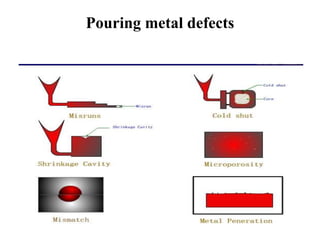
Pouring metal defects
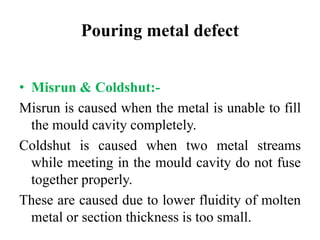
Pouring metal defect
• Misrun & Coldshut:-
Misrun is caused when the metal is unable to fill
the mould cavity completely.
Coldshut is caused when two metal streams
while meeting in the mould cavity do not fuse
together properly.
These are caused due to lower fluidity of molten
metal or section thickness is too small.
Metallurgical defects
• Hot tears:-
Since metal has low strength at higher
temperature, any unwanted cooling stress may
cause rupture of the casting.
• Hot spots:-
These are caused by chilling of the casting.
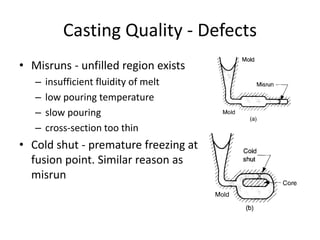
Casting Quality - Defects
• Misruns - unfilled region exists
– insufficient fluidity of melt
– low pouring temperature
– slow pouring
– cross-section too thin
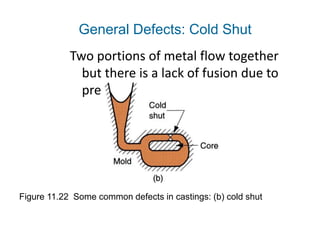
• Cold shut - premature freezing at
fusion point. Similar reason as
misrun
Casting Quality - Defects
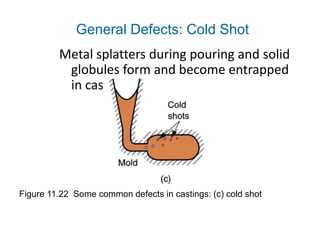
• Cold shots - Splattering during
pouring forming solid globules.
Redesign of pouring procedure or
gating system is needed.
• Shrinkage cavity - depression or
internal void caused by
solidification shrinkage. Solved by
proper riser design.
Casting Quality - Defects
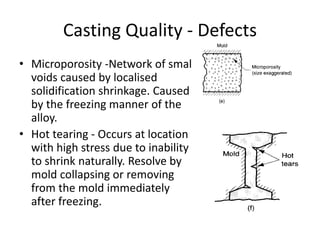
• Microporosity -Network of small
voids caused by localised
solidification shrinkage. Caused
by the freezing manner of the
alloy.
• Hot tearing - Occurs at location
with high stress due to inability
to shrink naturally. Resolve by
mold collapsing or removing
from the mold immediately
after freezing.
Casting Quality -
Defects (Sand Casting)
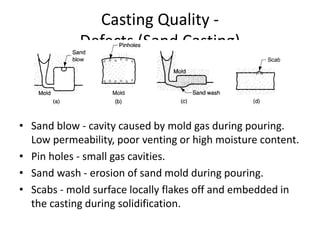
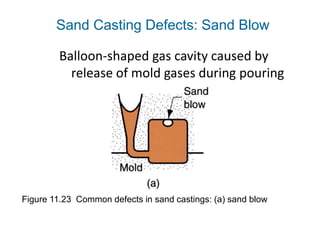
• Sand blow - cavity caused by mold gas during pouring.
Low permeability, poor venting or high moisture content.
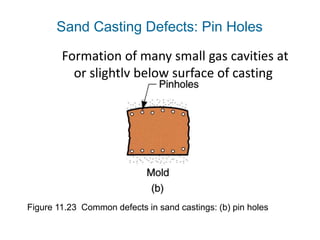
• Pin holes - small gas cavities.
• Sand wash - erosion of sand mold during pouring.
• Scabs - mold surface locally flakes off and embedded in
the casting during solidification.
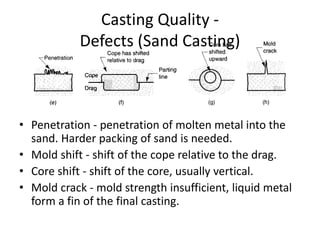
• Penetration - penetration of molten metal into the
sand. Harder packing of sand is needed.
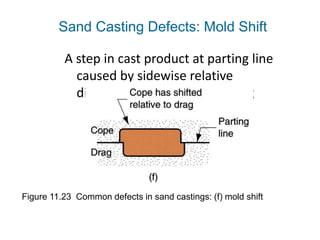
• Mold shift - shift of the cope relative to the drag.
• Core shift - shift of the core, usually vertical.
• Mold crack - mold strength insufficient, liquid metal
form a fin of the final casting.
Casting Quality -
Defects (Sand Casting)
Product Design Considerations
• Geometric simplicity - Avoid unnecessary complexity.
• Corners - Avoid sharp corners, generous fillet radius.
• Section thickness - Uniform section thickness to avoid
shrinkage cavities and hot spots.
• Draft - Facilitate removal of parts from mold. (1 deg. For
sand and 2/3 deg. for permanent)
• Use of cores - minimize the use of core
• Dimensional tolerance and surface finish - proper choice of
casting method.
• Machining allowances - For assembly purposes, typically 1.5
to 6 mm.
Product Design Considerations
Shrinkage, hot spot
Draft and core elimination
Casting Quality
• There are numerous opportunities for things
to go wrong in a casting operation, resulting in
quality defects in the product
• The defects can be classified as follows:
– General defects common to all casting processes
– Defects related to sand casting process
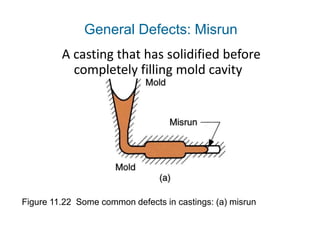
A casting that has solidified before
completely filling mold cavity
Figure 11.22 Some common defects in castings: (a) misrun
General Defects: Misrun
Two portions of metal flow together
but there is a lack of fusion due to
premature freezing
Figure 11.22 Some common defects in castings: (b) cold shut
General Defects: Cold Shut
Metal splatters during pouring and solid
globules form and become entrapped
in casting
Figure 11.22 Some common defects in castings: (c) cold shot
General Defects: Cold Shot
Depression in surface or internal void
caused by solidification shrinkage that
restricts amount of molten metal
available in last region to freeze
Figure 11.22 Some common defects in castings: (d) shrinkage cavity
General Defects: Shrinkage Cavity
Balloon-shaped gas cavity caused by
release of mold gases during pouring
Figure 11.23 Common defects in sand castings: (a) sand blow
Sand Casting Defects: Sand Blow
Formation of many small gas cavities at
or slightly below surface of casting
Figure 11.23 Common defects in sand castings: (b) pin holes
Sand Casting Defects: Pin Holes
When fluidity of liquid metal is high, it may
penetrate into sand mold or core,
causing casting surface to consist of a
mixture of sand grains and metal
Figure 11.23 Common defects in sand castings: (e) penetration
Sand Casting Defects: Penetration
A step in cast product at parting line
caused by sidewise relative
displacement of cope and drag
Figure 11.23 Common defects in sand castings: (f) mold shift
Sand Casting Defects: Mold Shift
Foundry Inspection Methods
• Visual inspection to detect obvious defects
such as misruns, cold shuts, and severe
surface flaws
• Dimensional measurements to insure that
tolerances have been met
• Metallurgical, chemical, physical, and other
tests concerned with quality of cast metal

10.casting defects

  • 1.
  • 2.
    Casting defects • Gasdefects • Shrinkage cavities • Molding material defects • Pouring metal defects • Metallurgical defects
  • 3.
    Gas Defects These defectsare mainly caused by lower gas passing tendency of the mould. • Blow holes and open blows:- Spherical, flattened or elongated cavities caused by moisture left in the core. On the surface they are called open blows and inside they are called blow holes
  • 4.
    • Air Inclusion:- Theatmospheric and other gases absorbed by molten metal in furnace, laddle or during flow in mould, if not allowed to escape will weaken it. • Pin hole Porosity:- when the molten metal solidify, its solubility with gases decreases. If hydrogen is present, it will expell from molten metal and will cause a long pin hole shape cavity. High pouring temperature is main reason for that defect.
  • 5.
    Shrinkage cavity • Theseare caused by liquid shrinkage occurring during the solidification of the casting. To compensate for this, proper feeding of liquid metal is required.
  • 6.
    Moulding material defects These defectsare caused by characteristics of molding material • Cuts & Washes:- Appears as rough spots and area of excess metal due to erosion of moulding sand by the flowing molten metal. Caused by poor strength of moulding sand or molten metal flowing at high velocity.
  • 7.
    • Metal penetration:- Whenthe molten metal enters the gap between sand grains resulting in rough casting surface. This could be due to coarse grain size or no mould wash is applied to mould cavity. • Fusion:- fusion of sand grains with molten metal resulting in brittle, glassy appearance. Reason may be lower refractoriness of clay in moulding sand or higher pouring temperature.
  • 8.
    • Runout:- A runoutis caused when the molten metal leaks out of the mould. Caused by faulty mould making or faulty flask. • Rat tails and buckles:- caused by compression failure of the skin of mould cavity. Due to excessive heat, sand expands resulting in a small line on casting surface. Buckles are rat tails that are severe. Reasons may be poor expansion properties of sand or high pouring temperature.
  • 9.
    • Swell:- Under themetallostatic force mould wall my move back causing a swell in the dimension. This may result in increased feeding requirement. • Drop:- The dropping of loose moulding sand or lumps from the cope surface into the mould cavity. Caused by improper ramming of the cope flask.
  • 10.
  • 11.
    Pouring metal defect •Misrun & Coldshut:- Misrun is caused when the metal is unable to fill the mould cavity completely. Coldshut is caused when two metal streams while meeting in the mould cavity do not fuse together properly. These are caused due to lower fluidity of molten metal or section thickness is too small.
  • 12.
    Metallurgical defects • Hottears:- Since metal has low strength at higher temperature, any unwanted cooling stress may cause rupture of the casting. • Hot spots:- These are caused by chilling of the casting.
  • 13.
    Casting Quality -Defects • Misruns - unfilled region exists – insufficient fluidity of melt – low pouring temperature – slow pouring – cross-section too thin • Cold shut - premature freezing at fusion point. Similar reason as misrun
  • 14.
    Casting Quality -Defects • Cold shots - Splattering during pouring forming solid globules. Redesign of pouring procedure or gating system is needed. • Shrinkage cavity - depression or internal void caused by solidification shrinkage. Solved by proper riser design.
  • 15.
    Casting Quality -Defects • Microporosity -Network of small voids caused by localised solidification shrinkage. Caused by the freezing manner of the alloy. • Hot tearing - Occurs at location with high stress due to inability to shrink naturally. Resolve by mold collapsing or removing from the mold immediately after freezing.
  • 16.
    Casting Quality - Defects(Sand Casting) • Sand blow - cavity caused by mold gas during pouring. Low permeability, poor venting or high moisture content. • Pin holes - small gas cavities. • Sand wash - erosion of sand mold during pouring. • Scabs - mold surface locally flakes off and embedded in the casting during solidification.
  • 17.
    • Penetration -penetration of molten metal into the sand. Harder packing of sand is needed. • Mold shift - shift of the cope relative to the drag. • Core shift - shift of the core, usually vertical. • Mold crack - mold strength insufficient, liquid metal form a fin of the final casting. Casting Quality - Defects (Sand Casting)
  • 18.
    Product Design Considerations •Geometric simplicity - Avoid unnecessary complexity. • Corners - Avoid sharp corners, generous fillet radius. • Section thickness - Uniform section thickness to avoid shrinkage cavities and hot spots. • Draft - Facilitate removal of parts from mold. (1 deg. For sand and 2/3 deg. for permanent) • Use of cores - minimize the use of core • Dimensional tolerance and surface finish - proper choice of casting method. • Machining allowances - For assembly purposes, typically 1.5 to 6 mm.
  • 19.
    Product Design Considerations Shrinkage,hot spot Draft and core elimination
  • 21.
    Casting Quality • Thereare numerous opportunities for things to go wrong in a casting operation, resulting in quality defects in the product • The defects can be classified as follows: – General defects common to all casting processes – Defects related to sand casting process
  • 22.
    A casting thathas solidified before completely filling mold cavity Figure 11.22 Some common defects in castings: (a) misrun General Defects: Misrun
  • 23.
    Two portions ofmetal flow together but there is a lack of fusion due to premature freezing Figure 11.22 Some common defects in castings: (b) cold shut General Defects: Cold Shut
  • 24.
    Metal splatters duringpouring and solid globules form and become entrapped in casting Figure 11.22 Some common defects in castings: (c) cold shot General Defects: Cold Shot
  • 25.
    Depression in surfaceor internal void caused by solidification shrinkage that restricts amount of molten metal available in last region to freeze Figure 11.22 Some common defects in castings: (d) shrinkage cavity General Defects: Shrinkage Cavity
  • 26.
    Balloon-shaped gas cavitycaused by release of mold gases during pouring Figure 11.23 Common defects in sand castings: (a) sand blow Sand Casting Defects: Sand Blow
  • 27.
    Formation of manysmall gas cavities at or slightly below surface of casting Figure 11.23 Common defects in sand castings: (b) pin holes Sand Casting Defects: Pin Holes
  • 28.
    When fluidity ofliquid metal is high, it may penetrate into sand mold or core, causing casting surface to consist of a mixture of sand grains and metal Figure 11.23 Common defects in sand castings: (e) penetration Sand Casting Defects: Penetration
  • 29.
    A step incast product at parting line caused by sidewise relative displacement of cope and drag Figure 11.23 Common defects in sand castings: (f) mold shift Sand Casting Defects: Mold Shift
  • 30.
    Foundry Inspection Methods •Visual inspection to detect obvious defects such as misruns, cold shuts, and severe surface flaws • Dimensional measurements to insure that tolerances have been met • Metallurgical, chemical, physical, and other tests concerned with quality of cast metal