Basic Concepts in
Nuclear Physics
Paolo Finelli
Literature/Bibliography
Some useful texts are available at the Library:
Wong,
Nuclear Physics
Krane,
Introductory Nuclear Physics
Basdevant, Rich and Spiro,
Fundamentals in Nuclear Physics
Bertulani,
Nuclear Physics in a Nutshell
Introduction
Purpose of these introductory notes is recollecting few basic notions of
Nuclear Physics. For more details, the reader is referred to the literature.
Binding energy and Liquid Drop Model
Nuclear dimensions
Saturation of nuclear forces
Fermi gas
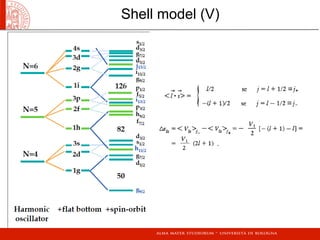
Shell model
Isospin
Several arguments will not be covered but, of course, are extremely
important: pairing, deformations, single and collective excitations,
α decay, β decay, γ decay, fusion process, fission process,...
The Nuclear Landscape
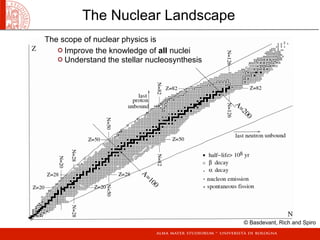
The scope of nuclear physics is
Improve the knowledge of all nuclei
Understand the stellar nucleosynthesis
© Basdevant, Rich and Spiro
e−5
e−6
e−7
≥ e−4
Stellar Nucleosynthesis
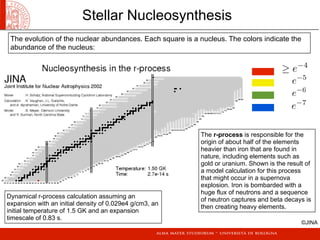
Dynamical r-process calculation assuming an
expansion with an initial density of 0.029e4 g/cm3, an
initial temperature of 1.5 GK and an expansion
timescale of 0.83 s.
The r-process is responsible for the
origin of about half of the elements
heavier than iron that are found in
nature, including elements such as
gold or uranium. Shown is the result of
a model calculation for this process
that might occur in a supernova
explosion. Iron is bombarded with a
huge flux of neutrons and a sequence
of neutron captures and beta decays is
then creating heavy elements.
The evolution of the nuclear abundances. Each square is a nucleus. The colors indicate the
abundance of the nucleus:
©JINA
mN c2
= mAc2
− Zmec2
+
Z
i=1
Bi  mAc2
− Zmec2
B = (Zmp + Nmn) c2
− mN c2
 [Zmp + Nmn − (mA − Zme)] c2
B =

Zm( 1
H) + Nmn − m( A
X)

c2
Binding energy
Electrons Mass (~Z)
Atomic Mass Electrons Binding Energies
(negligible)
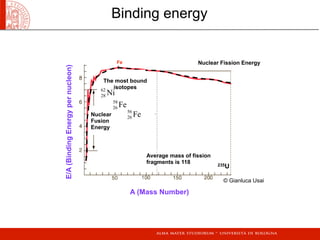
© Basdevant, Rich and Spiro
E/A(BindingEnergypernucleon)
A (Mass Number)
Average mass of fission
fragments is 118
Fe Nuclear Fission Energy
Nuclear
Fusion
Energy
235U
© Gianluca Usai
The most bound
isotopes
Binding energy
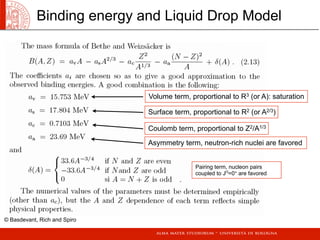
Binding energy and Liquid Drop Model
© Basdevant, Rich and Spiro
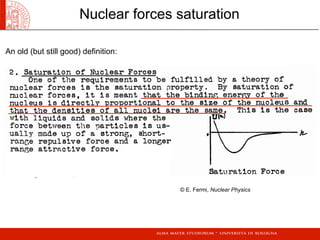
Volume term, proportional to R3 (or A): saturation
Surface term, proportional to R2 (or A2/3)
Coulomb term, proportional to Z2/A1/3
Pairing term, nucleon pairs
coupled to JΠ=0+ are favored
Asymmetry term, neutron-rich nuclei are favored
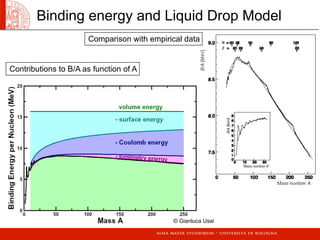
Binding energy and Liquid Drop Model
© Gianluca Usai
Contributions to B/A as function of A
Comparison with empirical data
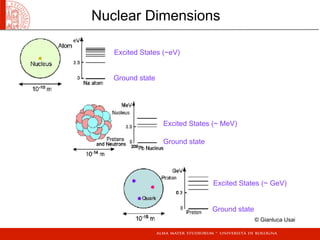
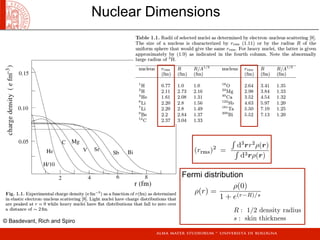
Nuclear Dimensions
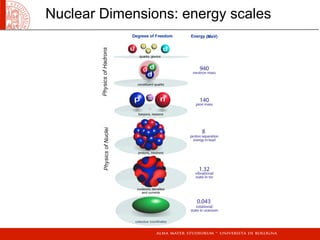
Ground state
Excited States (~eV)
© Gianluca Usai
Ground state
Ground state
Excited States (~ MeV)
Excited States (~ GeV)
Nuclear Dimensions: energy scales
ρ(r) =
ρ(0)
1 + e(r−R)/s
R : 1/2 density radius
s : skin thickness
Nuclear Dimensions
© Basdevant, Rich and Spiro
Fermi distribution
Nuclear forces saturation
An old (but still good) definition:
© E. Fermi, Nuclear Physics
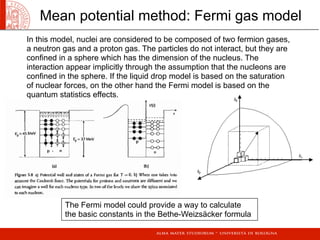
Mean potential method: Fermi gas model
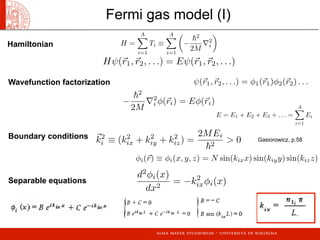
In this model, nuclei are considered to be composed of two fermion gases,
a neutron gas and a proton gas. The particles do not interact, but they are
confined in a sphere which has the dimension of the nucleus. The
interaction appear implicitly through the assumption that the nucleons are
confined in the sphere. If the liquid drop model is based on the saturation
of nuclear forces, on the other hand the Fermi model is based on the
quantum statistics effects.
The Fermi model could provide a way to calculate
the basic constants in the Bethe-Weizsäcker formula
H =
A
i=1
Ti ≡
A
i=1

−
2
2M
∇2
i

Hψ(r1,r2, . . .) = Eψ(r1,r2, . . .)
ψ(r1,r2, . . .) = φ1(r1)φ2(r2) . . .
−
2
2M
∇2
i φ(ri) = Eφ(ri)
E = E1 + E2 + E3 + . . . =
A
i=1
Ei
k2
i ≡ (k2
ix + k2
iy + k2
iz) =
2MEi
2
 0
φi(r) ≡ φi(x, y, z) = N sin(kixx) sin(kiyy) sin(kizz)
d2
φi(x)
dx2
= −k2
ixφi(x)
Fermi gas model (I)
Hamiltonian
Wavefunction factorization
Boundary conditions
Separable equations
Gasiorowicz, p.58
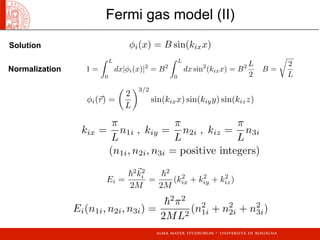
φi(x) = B sin(kixx)
1 =
 L
0
dx|φi(x)|2
= B2
 L
0
dx sin2
(kixx) = B2 L
2
B =

2
L
φi(r) =

2
L
3/2
sin(kixx) sin(kiyy) sin(kizz)
kix =
π
L
n1i , kiy =
π
L
n2i , kiz =
π
L
n3i
(n1i, n2i, n3i = positive integers)
Ei =
2k2
i
2M
=
2
2M
(k2
ix + k2
iy + k2
iz)
Ei(n1i, n2i, n3i) =
2
π2
2ML2
(n2
1i + n2
2i + n2
3i)
Fermi gas model (II)
Solution
Normalization
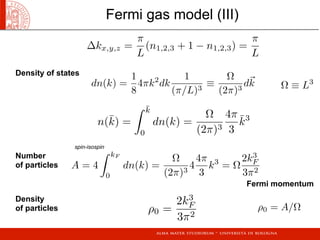
∆kx,y,z =
π
L
(n1,2,3 + 1 − n1,2,3) =
π
L
dn(k) =
1
8
4πk2
dk
1
(π/L)3
≡
Ω
(2π)3
dk
n(¯k) =
 ¯k
0
dn(k) =
Ω
(2π)3
4π
3
¯k3
A = 4
 kF
0
dn(k) =
Ω
(2π)3
4
4π
3
k3
= Ω
2k3
F
3π2
ρ0 =
2k3
F
3π2
Ω ≡ L3
ρ0 = A/Ω
Fermi gas model (III)
Density of states
Number
of particles
Density
of particles
spin-isospin
Fermi momentum
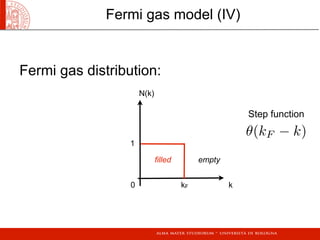
θ(kF − k)
Fermi gas model (IV)
Fermi gas distribution:
N(k)
kkF
1
0
Step function
filled empty
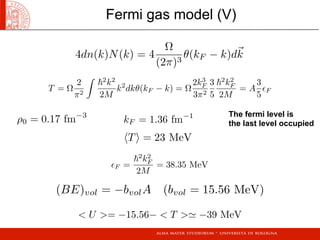
ρ0 = 0.17 fm−3
kF = 1.36 fm−1
F =
2
k2
F
2M
= 38.35 MeV
T = 23 MeV
4dn(k)N(k) = 4
Ω
(2π)3
θ(kF − k)dk
T = Ω
2
π2

2
k2
2M
k2
dkθ(kF − k) = Ω
2k3
F
3π2
3
5
2
k2
F
2M
= A
3
5
F
(BE)vol = −bvolA (bvol = 15.56 MeV)
 U = −15.56−  T  −39 MeV
Fermi gas model (V)
The fermi level is
the last level occupied
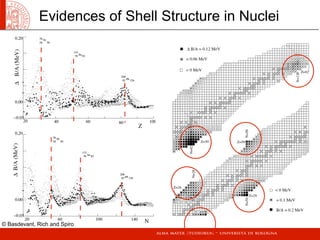
Evidences of Shell Structure in Nuclei
© Basdevant, Rich and Spiro
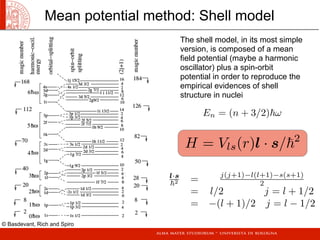
En = (n + 3/2)ω
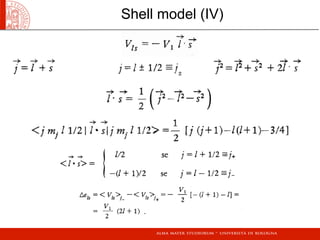
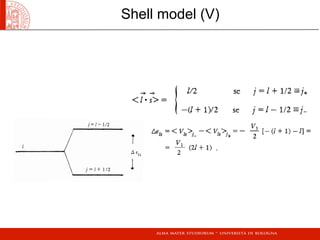
H = Vls(r)l · s/2
l·s
2 = j(j+1)−l(l+1)−s(s+1)
2
= l/2 j = l + 1/2
= −(l + 1)/2 j = l − 1/2
Mean potential method: Shell model
The shell model, in its most simple
version, is composed of a mean
field potential (maybe a harmonic
oscillator) plus a spin-orbit
potential in order to reproduce the
empirical evidences of shell
structure in nuclei
© Basdevant, Rich and Spiro
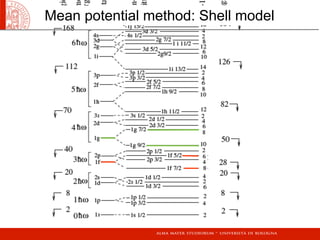
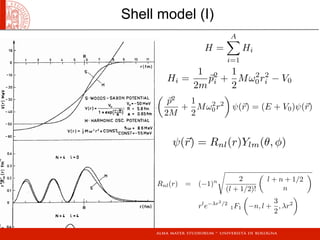
Mean potential method: Shell model
Hi =
1
2m
p2
i +
1
2
Mω2
0r2
i − V0

p2
2M
+
1
2
Mω2
0r2

ψ(r) = (E + V0)ψ(r)
ψ(r) = Rnl(r)Ylm(θ, φ)
Rnl(r) = (−1)n

2
(l + 1/2)!

l + n + 1/2
n

rl
e−λr2
/2
1F1

−n, l +
3
2
, λr2

Shell model (I)
H =
A
i=1
Hi
1F1 (−n, µ + 1, z) =
Γ(n + 1)Γ(µ + 1)
Γ(n + µ + 1)
Lµ
n(z)
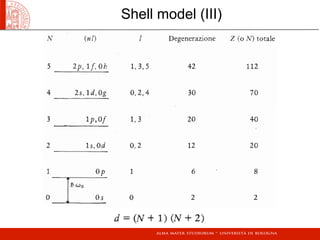
EN =

N +
3
2

ω0 N = 2n + l
d = 2
N
l=0
(2l + 1) = 2
[N/2]

n=0
(2(N − 2n) + 1) =
= 2(2N + 1)

N
2
+ 1

− 8
[N/2]

n=0
d = (N + 1)(N + 2)
Shell model (II)
Degeneracy
Shell model (III)
Shell model (IV)
Shell model (V)
Shell model (V)
Isospin
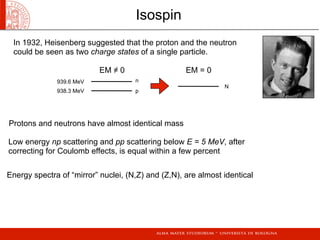
In 1932, Heisenberg suggested that the proton and the neutron
could be seen as two charge states of a single particle.
939.6 MeV
938.3 MeV
EM ≠ 0 EM = 0
n
p
N
Protons and neutrons have almost identical mass
Low energy np scattering and pp scattering below E = 5 MeV, after
correcting for Coulomb effects, is equal within a few percent
Energy spectra of “mirror” nuclei, (N,Z) and (Z,N), are almost identical
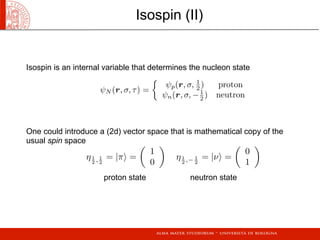
ψN (r, σ, τ) =

ψp(r, σ, 1
2 ) proton
ψn(r, σ, −1
2 ) neutron
η1
2 , 1
2
= |π =

1
0

η1
2 ,− 1
2
= |ν =

0
1

Isospin is an internal variable that determines the nucleon state
One could introduce a (2d) vector space that is mathematical copy of the
usual spin space
proton state neutron state
Isospin (II)
τ3|π = |π
τ3|ν = −|π
ψN = a|π + b|ν =

a
b

[ti, tj] = iijktk
Pp = 1+τ3
2 =
ˆQ
e
Pn = 1−τ3
2
τ1, τ2, τ3
ti =
1
2
τi
t+|ν = |π
t−|π = |ν
t+|π = 0
t−|ν = 0
t± = t1 ± it2
Isospin
eigenstates of	 the third component of isospin
In general
The isospin generators
Projectors Raising and lowering operators
Pauli matrices
neutron to
proton proton to
neutron
Fundamental representations
T = t1 + t2 T = 0, 1
T = 0 η0,0 = 1√
2
(π1ν2 − ν1π2)
T = 1



η1,1 = π1π2
η1,−1 = ν1ν2
η1,0 = 1√
2
(π1ν2 + π2ν1)
Isospin for 2 nucleons
|T = 1, Tz = 1 = |pp
|T = 1, Tz = −1 = |nn
1
√
2
[|T = 1, Tz = 0 + |T = 0, Tz = 0] = |pn
Proton-proton state
Neutron-neutron state
Proton-neutron state
Isospin for 2 nucleons
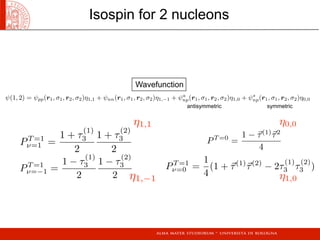
ψ(1, 2) = ψpp(r1, σ1, r2, σ2)η1,1 + ψnn(r1, σ1, r2, σ2)η1,−1 + ψa
np(r1, σ1, r2, σ2)η1,0 + ψs
np(r1, σ1, r2, σ2)η0,0
PT =0
=
1 − τ(1)
τ2
4
PT =1
ν=1 =
1 + τ
(1)
3
2
1 + τ
(2)
3
2
PT =1
ν=0 =
1
4
(1 + τ(1)
τ(2)
− 2τ
(1)
3 τ
(2)
3 )
η0,0η1,1
PT =1
ν=−1 =
1 − τ
(1)
3
2
1 − τ
(2)
3
2 η1,−1 η1,0
antisymmetric symmetric
Wavefunction
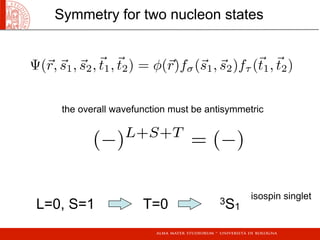
Ψ(r,s1,s2,t1,t2) = φ(r)fσ(s1,s2)fτ (t1,t2)
(−)L+S+T
= (−)
Symmetry for two nucleon states
the overall wavefunction must be antisymmetric
L=0, S=1 T=0 3S1
isospin singlet
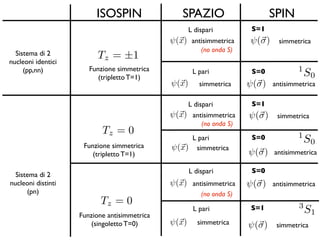
Sistema di 2
nucleoni identici
(pp,nn)
Sistema di 2
nucleoni distinti
(pn)
ISOSPIN SPAZIO SPIN
Tz = ±1
Tz = 0
Funzione simmetrica
(tripletto T=1)
Funzione antisimmetrica
(singoletto T=0)
L dispari
L dispari
L pari
L dispari
ψ(x)
ψ(x)
ψ(x)
ψ(x)
antisimmetrica
antisimmetrica
simmetrica
simmetrica
S=1
simmetrica
(no onda S)
S=0
ψ(σ)
ψ(σ) antisimmetrica
1
S0
L pari
L pari
ψ(x) simmetrica
ψ(x) antisimmetrica
S=1
S=1
simmetricaψ(σ)
simmetricaψ(σ)
S=0
S=0
ψ(σ) antisimmetrica
ψ(σ) antisimmetrica
(no onda S)
1
S0
(no onda S)
3
S1
Tz = 0
Funzione simmetrica
(tripletto T=1)
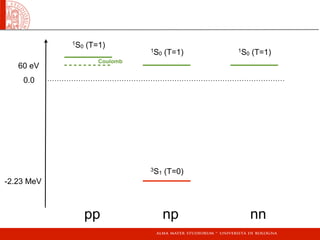
pp np nn
0.0
60 eV
-2.23 MeV
3S1 (T=0)
1S0 (T=1)1S0 (T=1)
1S0 (T=1)
Coulomb
Additional slides
...many open questions
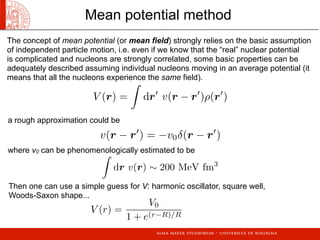
v(r − r
) = −v0δ(r − r
)
V (r) =

dr
v(r − r
)ρ(r
)

dr v(r) ∼ 200 MeV fm3
V (r) =
V0
1 + e(r−R)/R
Mean potential method
The concept of mean potential (or mean field) strongly relies on the basic assumption
of independent particle motion, i.e. even if we know that the “real” nuclear potential
is complicated and nucleons are strongly correlated, some basic properties can be
adequately described assuming individual nucleons moving in an average potential (it
means that all the nucleons experience the same field).
a rough approximation could be
where v0 can be phenomenologically estimated to be
Then one can use a simple guess for V: harmonic oscillator, square well,
Woods-Saxon shape...

Basics Nuclear Physics concepts

  • 1.
    Basic Concepts in NuclearPhysics Paolo Finelli
  • 2.
    Literature/Bibliography Some useful textsare available at the Library: Wong, Nuclear Physics Krane, Introductory Nuclear Physics Basdevant, Rich and Spiro, Fundamentals in Nuclear Physics Bertulani, Nuclear Physics in a Nutshell
  • 3.
    Introduction Purpose of theseintroductory notes is recollecting few basic notions of Nuclear Physics. For more details, the reader is referred to the literature. Binding energy and Liquid Drop Model Nuclear dimensions Saturation of nuclear forces Fermi gas Shell model Isospin Several arguments will not be covered but, of course, are extremely important: pairing, deformations, single and collective excitations, α decay, β decay, γ decay, fusion process, fission process,...
  • 4.
    The Nuclear Landscape Thescope of nuclear physics is Improve the knowledge of all nuclei Understand the stellar nucleosynthesis © Basdevant, Rich and Spiro
  • 5.
    e−5 e−6 e−7 ≥ e−4 Stellar Nucleosynthesis Dynamicalr-process calculation assuming an expansion with an initial density of 0.029e4 g/cm3, an initial temperature of 1.5 GK and an expansion timescale of 0.83 s. The r-process is responsible for the origin of about half of the elements heavier than iron that are found in nature, including elements such as gold or uranium. Shown is the result of a model calculation for this process that might occur in a supernova explosion. Iron is bombarded with a huge flux of neutrons and a sequence of neutron captures and beta decays is then creating heavy elements. The evolution of the nuclear abundances. Each square is a nucleus. The colors indicate the abundance of the nucleus: ©JINA
  • 6.
    mN c2 = mAc2 −Zmec2 + Z i=1 Bi mAc2 − Zmec2 B = (Zmp + Nmn) c2 − mN c2 [Zmp + Nmn − (mA − Zme)] c2 B = Zm( 1 H) + Nmn − m( A X) c2 Binding energy Electrons Mass (~Z) Atomic Mass Electrons Binding Energies (negligible) © Basdevant, Rich and Spiro
  • 7.
    E/A(BindingEnergypernucleon) A (Mass Number) Averagemass of fission fragments is 118 Fe Nuclear Fission Energy Nuclear Fusion Energy 235U © Gianluca Usai The most bound isotopes Binding energy
  • 8.
    Binding energy andLiquid Drop Model © Basdevant, Rich and Spiro Volume term, proportional to R3 (or A): saturation Surface term, proportional to R2 (or A2/3) Coulomb term, proportional to Z2/A1/3 Pairing term, nucleon pairs coupled to JΠ=0+ are favored Asymmetry term, neutron-rich nuclei are favored
  • 9.
    Binding energy andLiquid Drop Model © Gianluca Usai Contributions to B/A as function of A Comparison with empirical data
  • 10.
    Nuclear Dimensions Ground state ExcitedStates (~eV) © Gianluca Usai Ground state Ground state Excited States (~ MeV) Excited States (~ GeV)
  • 11.
  • 12.
    ρ(r) = ρ(0) 1 +e(r−R)/s R : 1/2 density radius s : skin thickness Nuclear Dimensions © Basdevant, Rich and Spiro Fermi distribution
  • 13.
    Nuclear forces saturation Anold (but still good) definition: © E. Fermi, Nuclear Physics
  • 14.
    Mean potential method:Fermi gas model In this model, nuclei are considered to be composed of two fermion gases, a neutron gas and a proton gas. The particles do not interact, but they are confined in a sphere which has the dimension of the nucleus. The interaction appear implicitly through the assumption that the nucleons are confined in the sphere. If the liquid drop model is based on the saturation of nuclear forces, on the other hand the Fermi model is based on the quantum statistics effects. The Fermi model could provide a way to calculate the basic constants in the Bethe-Weizsäcker formula
  • 15.
    H = A i=1 Ti ≡ A i=1 − 2 2M ∇2 i Hψ(r1,r2,. . .) = Eψ(r1,r2, . . .) ψ(r1,r2, . . .) = φ1(r1)φ2(r2) . . . − 2 2M ∇2 i φ(ri) = Eφ(ri) E = E1 + E2 + E3 + . . . = A i=1 Ei k2 i ≡ (k2 ix + k2 iy + k2 iz) = 2MEi 2 0 φi(r) ≡ φi(x, y, z) = N sin(kixx) sin(kiyy) sin(kizz) d2 φi(x) dx2 = −k2 ixφi(x) Fermi gas model (I) Hamiltonian Wavefunction factorization Boundary conditions Separable equations Gasiorowicz, p.58
  • 16.
    φi(x) = Bsin(kixx) 1 = L 0 dx|φi(x)|2 = B2 L 0 dx sin2 (kixx) = B2 L 2 B = 2 L φi(r) = 2 L 3/2 sin(kixx) sin(kiyy) sin(kizz) kix = π L n1i , kiy = π L n2i , kiz = π L n3i (n1i, n2i, n3i = positive integers) Ei = 2k2 i 2M = 2 2M (k2 ix + k2 iy + k2 iz) Ei(n1i, n2i, n3i) = 2 π2 2ML2 (n2 1i + n2 2i + n2 3i) Fermi gas model (II) Solution Normalization
  • 17.
    ∆kx,y,z = π L (n1,2,3 +1 − n1,2,3) = π L dn(k) = 1 8 4πk2 dk 1 (π/L)3 ≡ Ω (2π)3 dk n(¯k) = ¯k 0 dn(k) = Ω (2π)3 4π 3 ¯k3 A = 4 kF 0 dn(k) = Ω (2π)3 4 4π 3 k3 = Ω 2k3 F 3π2 ρ0 = 2k3 F 3π2 Ω ≡ L3 ρ0 = A/Ω Fermi gas model (III) Density of states Number of particles Density of particles spin-isospin Fermi momentum
  • 18.
    θ(kF − k) Fermigas model (IV) Fermi gas distribution: N(k) kkF 1 0 Step function filled empty
  • 19.
    ρ0 = 0.17fm−3 kF = 1.36 fm−1 F = 2 k2 F 2M = 38.35 MeV T = 23 MeV 4dn(k)N(k) = 4 Ω (2π)3 θ(kF − k)dk T = Ω 2 π2 2 k2 2M k2 dkθ(kF − k) = Ω 2k3 F 3π2 3 5 2 k2 F 2M = A 3 5 F (BE)vol = −bvolA (bvol = 15.56 MeV) U = −15.56− T −39 MeV Fermi gas model (V) The fermi level is the last level occupied
  • 20.
    Evidences of ShellStructure in Nuclei © Basdevant, Rich and Spiro
  • 21.
    En = (n+ 3/2)ω H = Vls(r)l · s/2 l·s 2 = j(j+1)−l(l+1)−s(s+1) 2 = l/2 j = l + 1/2 = −(l + 1)/2 j = l − 1/2 Mean potential method: Shell model The shell model, in its most simple version, is composed of a mean field potential (maybe a harmonic oscillator) plus a spin-orbit potential in order to reproduce the empirical evidences of shell structure in nuclei © Basdevant, Rich and Spiro
  • 22.
  • 23.
    Hi = 1 2m p2 i + 1 2 Mω2 0r2 i− V0 p2 2M + 1 2 Mω2 0r2 ψ(r) = (E + V0)ψ(r) ψ(r) = Rnl(r)Ylm(θ, φ) Rnl(r) = (−1)n 2 (l + 1/2)! l + n + 1/2 n rl e−λr2 /2 1F1 −n, l + 3 2 , λr2 Shell model (I) H = A i=1 Hi
  • 24.
    1F1 (−n, µ+ 1, z) = Γ(n + 1)Γ(µ + 1) Γ(n + µ + 1) Lµ n(z) EN = N + 3 2 ω0 N = 2n + l d = 2 N l=0 (2l + 1) = 2 [N/2] n=0 (2(N − 2n) + 1) = = 2(2N + 1) N 2 + 1 − 8 [N/2] n=0 d = (N + 1)(N + 2) Shell model (II) Degeneracy
  • 25.
  • 26.
  • 27.
  • 28.
  • 29.
    Isospin In 1932, Heisenbergsuggested that the proton and the neutron could be seen as two charge states of a single particle. 939.6 MeV 938.3 MeV EM ≠ 0 EM = 0 n p N Protons and neutrons have almost identical mass Low energy np scattering and pp scattering below E = 5 MeV, after correcting for Coulomb effects, is equal within a few percent Energy spectra of “mirror” nuclei, (N,Z) and (Z,N), are almost identical
  • 30.
    ψN (r, σ,τ) = ψp(r, σ, 1 2 ) proton ψn(r, σ, −1 2 ) neutron η1 2 , 1 2 = |π = 1 0 η1 2 ,− 1 2 = |ν = 0 1 Isospin is an internal variable that determines the nucleon state One could introduce a (2d) vector space that is mathematical copy of the usual spin space proton state neutron state Isospin (II)
  • 31.
    τ3|π = |π τ3|ν= −|π ψN = a|π + b|ν = a b [ti, tj] = iijktk Pp = 1+τ3 2 = ˆQ e Pn = 1−τ3 2 τ1, τ2, τ3 ti = 1 2 τi t+|ν = |π t−|π = |ν t+|π = 0 t−|ν = 0 t± = t1 ± it2 Isospin eigenstates of the third component of isospin In general The isospin generators Projectors Raising and lowering operators Pauli matrices neutron to proton proton to neutron Fundamental representations
  • 32.
    T = t1+ t2 T = 0, 1 T = 0 η0,0 = 1√ 2 (π1ν2 − ν1π2) T = 1    η1,1 = π1π2 η1,−1 = ν1ν2 η1,0 = 1√ 2 (π1ν2 + π2ν1) Isospin for 2 nucleons |T = 1, Tz = 1 = |pp |T = 1, Tz = −1 = |nn 1 √ 2 [|T = 1, Tz = 0 + |T = 0, Tz = 0] = |pn Proton-proton state Neutron-neutron state Proton-neutron state
  • 33.
    Isospin for 2nucleons ψ(1, 2) = ψpp(r1, σ1, r2, σ2)η1,1 + ψnn(r1, σ1, r2, σ2)η1,−1 + ψa np(r1, σ1, r2, σ2)η1,0 + ψs np(r1, σ1, r2, σ2)η0,0 PT =0 = 1 − τ(1) τ2 4 PT =1 ν=1 = 1 + τ (1) 3 2 1 + τ (2) 3 2 PT =1 ν=0 = 1 4 (1 + τ(1) τ(2) − 2τ (1) 3 τ (2) 3 ) η0,0η1,1 PT =1 ν=−1 = 1 − τ (1) 3 2 1 − τ (2) 3 2 η1,−1 η1,0 antisymmetric symmetric Wavefunction
  • 34.
    Ψ(r,s1,s2,t1,t2) = φ(r)fσ(s1,s2)fτ(t1,t2) (−)L+S+T = (−) Symmetry for two nucleon states the overall wavefunction must be antisymmetric L=0, S=1 T=0 3S1 isospin singlet
  • 35.
    Sistema di 2 nucleoniidentici (pp,nn) Sistema di 2 nucleoni distinti (pn) ISOSPIN SPAZIO SPIN Tz = ±1 Tz = 0 Funzione simmetrica (tripletto T=1) Funzione antisimmetrica (singoletto T=0) L dispari L dispari L pari L dispari ψ(x) ψ(x) ψ(x) ψ(x) antisimmetrica antisimmetrica simmetrica simmetrica S=1 simmetrica (no onda S) S=0 ψ(σ) ψ(σ) antisimmetrica 1 S0 L pari L pari ψ(x) simmetrica ψ(x) antisimmetrica S=1 S=1 simmetricaψ(σ) simmetricaψ(σ) S=0 S=0 ψ(σ) antisimmetrica ψ(σ) antisimmetrica (no onda S) 1 S0 (no onda S) 3 S1 Tz = 0 Funzione simmetrica (tripletto T=1)
  • 36.
    pp np nn 0.0 60eV -2.23 MeV 3S1 (T=0) 1S0 (T=1)1S0 (T=1) 1S0 (T=1) Coulomb
  • 37.
  • 38.
  • 39.
    v(r − r )= −v0δ(r − r ) V (r) = dr v(r − r )ρ(r ) dr v(r) ∼ 200 MeV fm3 V (r) = V0 1 + e(r−R)/R Mean potential method The concept of mean potential (or mean field) strongly relies on the basic assumption of independent particle motion, i.e. even if we know that the “real” nuclear potential is complicated and nucleons are strongly correlated, some basic properties can be adequately described assuming individual nucleons moving in an average potential (it means that all the nucleons experience the same field). a rough approximation could be where v0 can be phenomenologically estimated to be Then one can use a simple guess for V: harmonic oscillator, square well, Woods-Saxon shape...