The nuclear shell model
By Shrianshu Manimaya
Shell Model – Mayer and Jensen 1963 Nobel Prize
• In this model the protons and neutrons occupy separate systems of
shells, analogous to the shells in which electrons are found outside
the nucleus.
• The shell model describes how much energy is required to move
nucleons from one orbit to another
• The nucleons move under the action of a particular potential well as
electrons move in K, L, M shells due to Coulomb's potential.
Why do we need to develop Shell Model ?
The liquid drop model can explain the observed variation of the nuclear
binding energy with mass no. (A) and fission of heavy nuclei but could
not explain various nuclear properties such as Magic Numbers ,Spin
and Parity.
• Atoms having 2,10,18,36,54,86 electrons have their outermost shells
completely filled.
• As in atomic physics, there are inert gases/noble gases where the
outermost shell is completely filled and electrons are tightly bound so,
we can say these gases are stable.
• Similarly, the nuclei that have their proton or neutron equal to one of
magic numbers show high stability and are more abundant than other
nuclei.
• The magic numbers are 2,8,20,28,50,82,126.
• There is a semi-magic no. at N and Z = 40.
• Whereas some nuclei contain magic number of both protons and
neutrons such as Helium-(Z=2, N=2), Oxygen-(Z=8, N=8) Calcium-
(Z=20, N=20). So, these are called doubly magic numbers and show
exceptionally high stability.
Evidences to show Existence of Shell
Structure in Nuclei
• Nuclei containing magic number of protons and neutrons show
very high stability.
• Measurements show that separation energy of a neutron from a
nucleus containing a magic number of neutrons is large as
compared to that for a nucleus which doesn't have magic
number of neutron.
• The stable end product of all the three natural radioactive series
(Uranium series, Actinium series, Thorium series) are three
isotopes of lead (206
Pb,207
Pb and 208
Pb) where all have magic
number Z = 82 of protons.
• The naturally occurring isotopes whose nuclei contain magic number
of neutron or proton have generally greater relative abundance. Eg.
88
Sr (N = 50) and 138
Ba (N = 82) have relative abundances of 82.56%
and 71.66% respectively.
• The number of stable isotopes of an element containing a magic
number of protons is large as compared to those for other elements.
For example Calcium (Z = 20) have six stable isotopes as compared to
Argon(Z = 18) and Titanium(Z = 22) having three and five isotopes
respectively.
• Nuclei with magic numbers of neutrons or protons have their first
excited states at higher energies than in the cases of the neighboring
nuclei.
Assumptions
• It is assumed that the nucleons move in an average harmonic
oscillator potential V(r) (spherically symmetric central field) given by
V( ) = - V
𝑟 0 + 1/2M𝜔2
𝑟2
…(1)
M = Nucleon Mass, V0 = Well depth and = circular frequency of SHO
𝜔
of the nucleon.
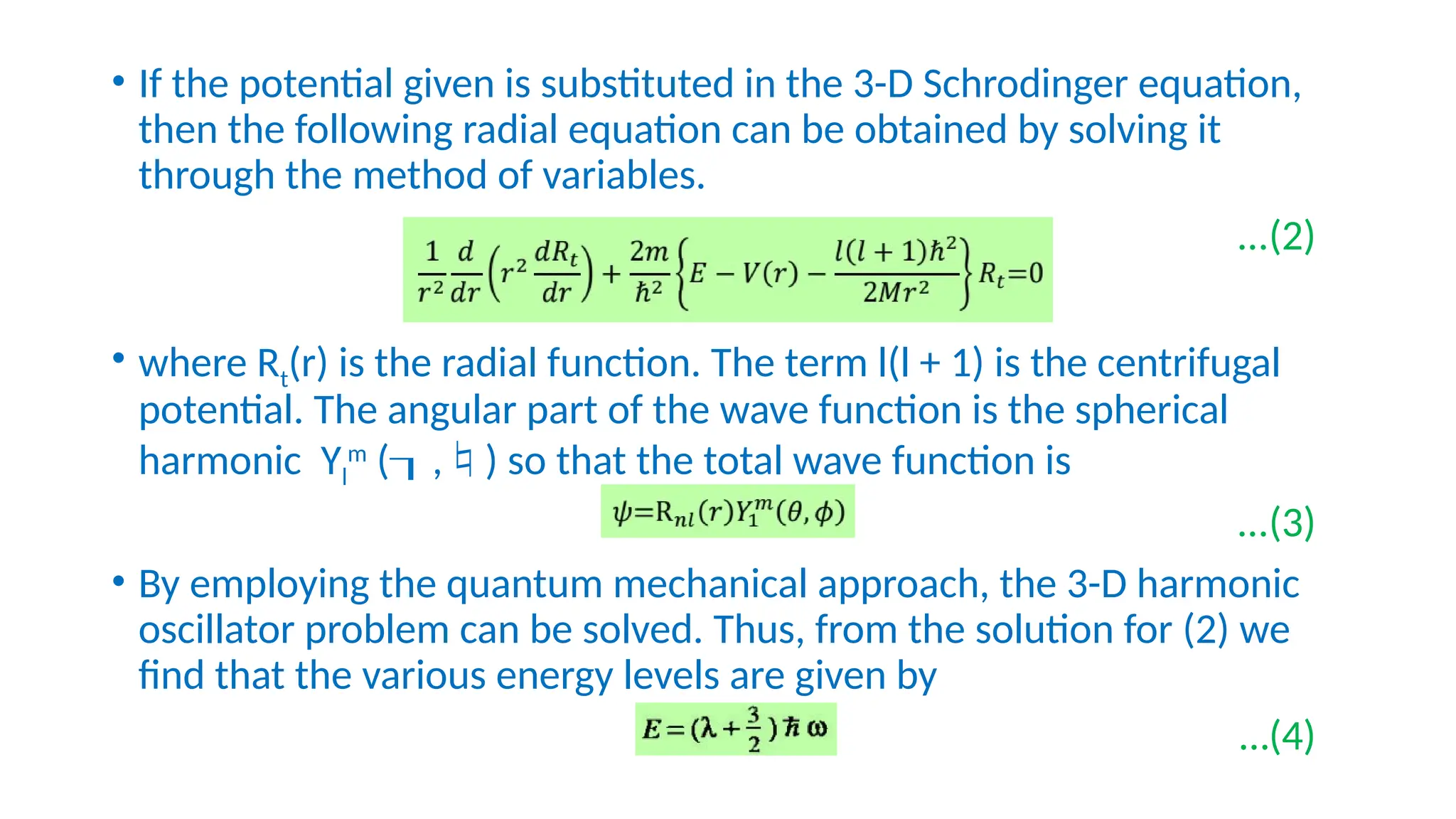
• If the potential given is substituted in the 3-D Schrodinger equation,
then the following radial equation can be obtained by solving it
through the method of variables.
…(2)
• where Rt(r) is the radial function. The term l(l + 1) is the centrifugal
potential. The angular part of the wave function is the spherical
harmonic Yl
m
(,) so that the total wave function is
…(3)
• By employing the quantum mechanical approach, the 3-D harmonic
oscillator problem can be solved. Thus, from the solution for (2) we
find that the various energy levels are given by
…(4)
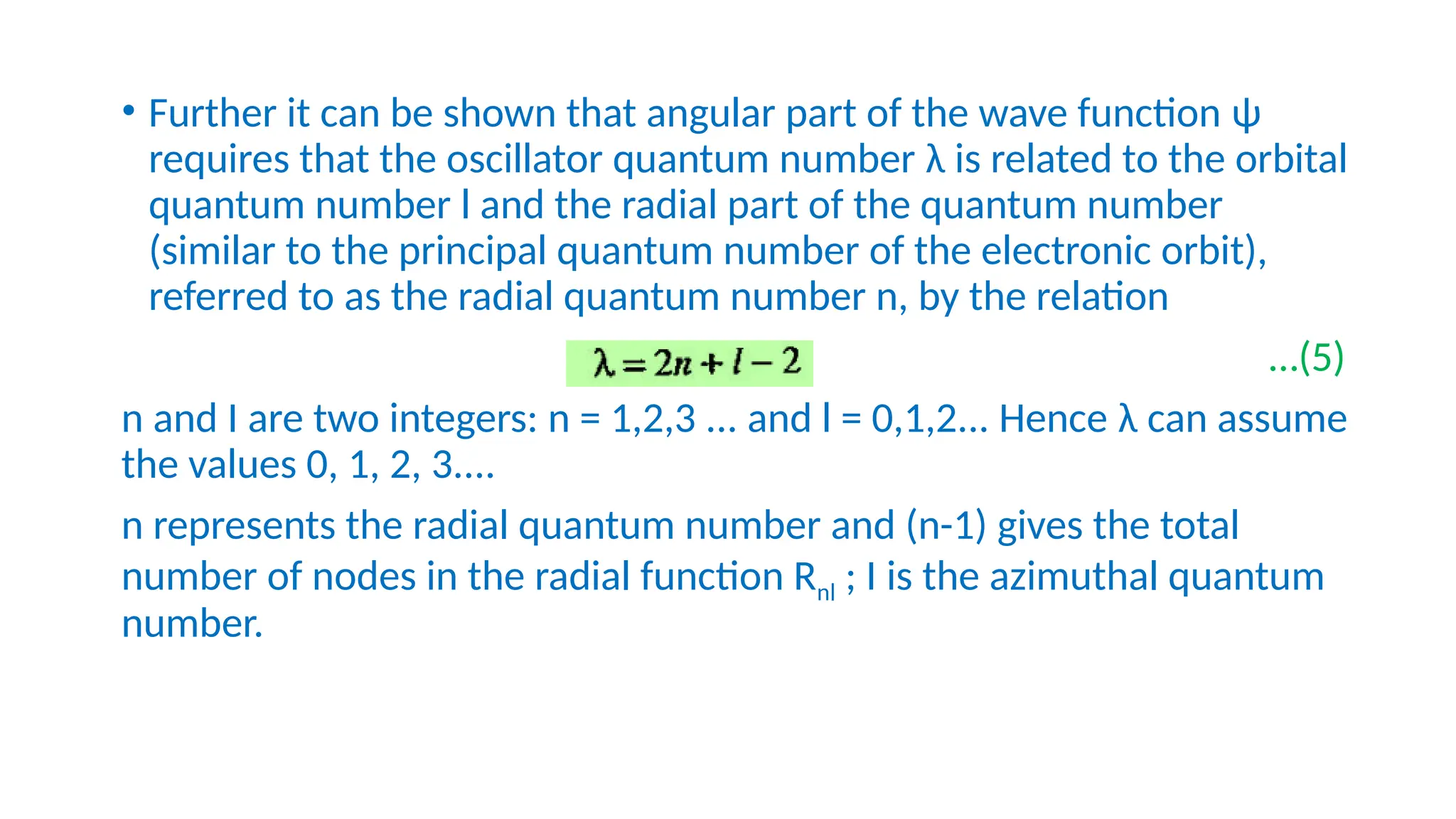
• Further it can be shown that angular part of the wave function ψ
requires that the oscillator quantum number λ is related to the orbital
quantum number l and the radial part of the quantum number
(similar to the principal quantum number of the electronic orbit),
referred to as the radial quantum number n, by the relation
…(5)
n and I are two integers: n = 1,2,3 ... and l = 0,1,2... Hence λ can assume
the values 0, 1, 2, 3....
n represents the radial quantum number and (n-1) gives the total
number of nodes in the radial function Rnl ; I is the azimuthal quantum
number.
• Since the angular part of wave-function Yl
m
(,) in (3) has a
degeneracy of (2l+1) for a given I with the magnetic quantum numbers
m=l,l-1,....-l each level with a given set of (n,l) values has a degeneracy
of (2l+1). Further, each level of given energy (given λ) contains several
states of different (n,l) values. So the degeneracy of a state is actually
over the different possible I values for a given 2. The factor 2 is due to
the two possible spin orientations of the neutron or the proton.
• The degenerate states for a given energy having different
combinations of n, l, ml and ms values determine a sublevel of given
energy. According to Pauli's exclusion principle, each of these can be
occupied by a nucleon of a particular kind. When all these sublevels of
a given oscillator energy level are filled up, we have a nucleus with a
closed shell of neutrons or protons.
REFERENCE
• Nuclear Physics by S.N Ghoshal, 1997

Nuclear Chemistry : The nuclear shell model.pptx

  • 1.
    The nuclear shellmodel By Shrianshu Manimaya
  • 2.
    Shell Model –Mayer and Jensen 1963 Nobel Prize • In this model the protons and neutrons occupy separate systems of shells, analogous to the shells in which electrons are found outside the nucleus. • The shell model describes how much energy is required to move nucleons from one orbit to another • The nucleons move under the action of a particular potential well as electrons move in K, L, M shells due to Coulomb's potential.
  • 3.
    Why do weneed to develop Shell Model ? The liquid drop model can explain the observed variation of the nuclear binding energy with mass no. (A) and fission of heavy nuclei but could not explain various nuclear properties such as Magic Numbers ,Spin and Parity. • Atoms having 2,10,18,36,54,86 electrons have their outermost shells completely filled. • As in atomic physics, there are inert gases/noble gases where the outermost shell is completely filled and electrons are tightly bound so, we can say these gases are stable.
  • 5.
    • Similarly, thenuclei that have their proton or neutron equal to one of magic numbers show high stability and are more abundant than other nuclei. • The magic numbers are 2,8,20,28,50,82,126. • There is a semi-magic no. at N and Z = 40. • Whereas some nuclei contain magic number of both protons and neutrons such as Helium-(Z=2, N=2), Oxygen-(Z=8, N=8) Calcium- (Z=20, N=20). So, these are called doubly magic numbers and show exceptionally high stability.
  • 6.
    Evidences to showExistence of Shell Structure in Nuclei • Nuclei containing magic number of protons and neutrons show very high stability. • Measurements show that separation energy of a neutron from a nucleus containing a magic number of neutrons is large as compared to that for a nucleus which doesn't have magic number of neutron. • The stable end product of all the three natural radioactive series (Uranium series, Actinium series, Thorium series) are three isotopes of lead (206 Pb,207 Pb and 208 Pb) where all have magic number Z = 82 of protons.
  • 7.
    • The naturallyoccurring isotopes whose nuclei contain magic number of neutron or proton have generally greater relative abundance. Eg. 88 Sr (N = 50) and 138 Ba (N = 82) have relative abundances of 82.56% and 71.66% respectively. • The number of stable isotopes of an element containing a magic number of protons is large as compared to those for other elements. For example Calcium (Z = 20) have six stable isotopes as compared to Argon(Z = 18) and Titanium(Z = 22) having three and five isotopes respectively. • Nuclei with magic numbers of neutrons or protons have their first excited states at higher energies than in the cases of the neighboring nuclei.
  • 8.
    Assumptions • It isassumed that the nucleons move in an average harmonic oscillator potential V(r) (spherically symmetric central field) given by V( ) = - V 𝑟 0 + 1/2M𝜔2 𝑟2 …(1) M = Nucleon Mass, V0 = Well depth and = circular frequency of SHO 𝜔 of the nucleon.
  • 9.
    • If thepotential given is substituted in the 3-D Schrodinger equation, then the following radial equation can be obtained by solving it through the method of variables. …(2) • where Rt(r) is the radial function. The term l(l + 1) is the centrifugal potential. The angular part of the wave function is the spherical harmonic Yl m (,) so that the total wave function is …(3) • By employing the quantum mechanical approach, the 3-D harmonic oscillator problem can be solved. Thus, from the solution for (2) we find that the various energy levels are given by …(4)
  • 10.
    • Further itcan be shown that angular part of the wave function ψ requires that the oscillator quantum number λ is related to the orbital quantum number l and the radial part of the quantum number (similar to the principal quantum number of the electronic orbit), referred to as the radial quantum number n, by the relation …(5) n and I are two integers: n = 1,2,3 ... and l = 0,1,2... Hence λ can assume the values 0, 1, 2, 3.... n represents the radial quantum number and (n-1) gives the total number of nodes in the radial function Rnl ; I is the azimuthal quantum number.
  • 11.
    • Since theangular part of wave-function Yl m (,) in (3) has a degeneracy of (2l+1) for a given I with the magnetic quantum numbers m=l,l-1,....-l each level with a given set of (n,l) values has a degeneracy of (2l+1). Further, each level of given energy (given λ) contains several states of different (n,l) values. So the degeneracy of a state is actually over the different possible I values for a given 2. The factor 2 is due to the two possible spin orientations of the neutron or the proton. • The degenerate states for a given energy having different combinations of n, l, ml and ms values determine a sublevel of given energy. According to Pauli's exclusion principle, each of these can be occupied by a nucleon of a particular kind. When all these sublevels of a given oscillator energy level are filled up, we have a nucleus with a closed shell of neutrons or protons.
  • 13.
    REFERENCE • Nuclear Physicsby S.N Ghoshal, 1997