Images of Ancient China
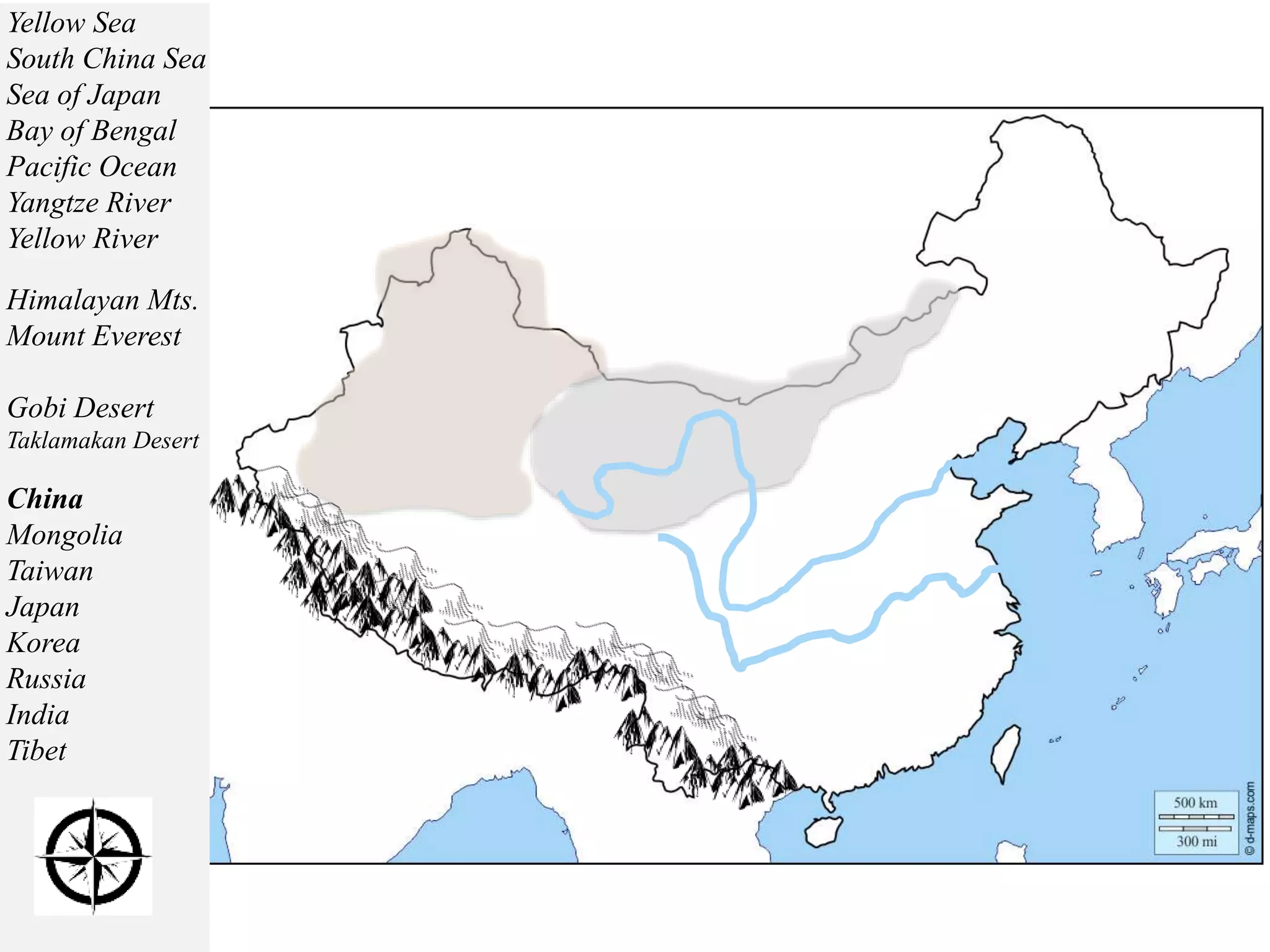
Yellow Sea
South China Sea
Sea of Japan
Bay of Bengal
Pacific Ocean
Yangtze River
Yellow River
Himalayan Mts.
Mount Everest
Gobi Desert
Taklamakan Desert
China
Mongolia
Taiwan
Japan
Korea
Russia
India
Tibet
Yellow Sea
South China Sea
Sea of Japan
Bay of Bengal
Pacific Ocean
Yangtze River
Yellow River
Himalayan Mts.
Mount Everest
Gobi Desert
Taklamakan Desert
China
Mongolia
Taiwan
Japan
Korea
Russia
India
Tibet
CHINA
TAIWANINDIA
RUSSIA
MONGOLIA
TIBET
Bay of
Bengal
South China Sea
Pacific Ocean
Ancient ChinaWhere is China?
What are 2 important rivers in China?
Why did they build dams in ancient China?
What were dynasties?
What was the Great Wall of China and who built it?
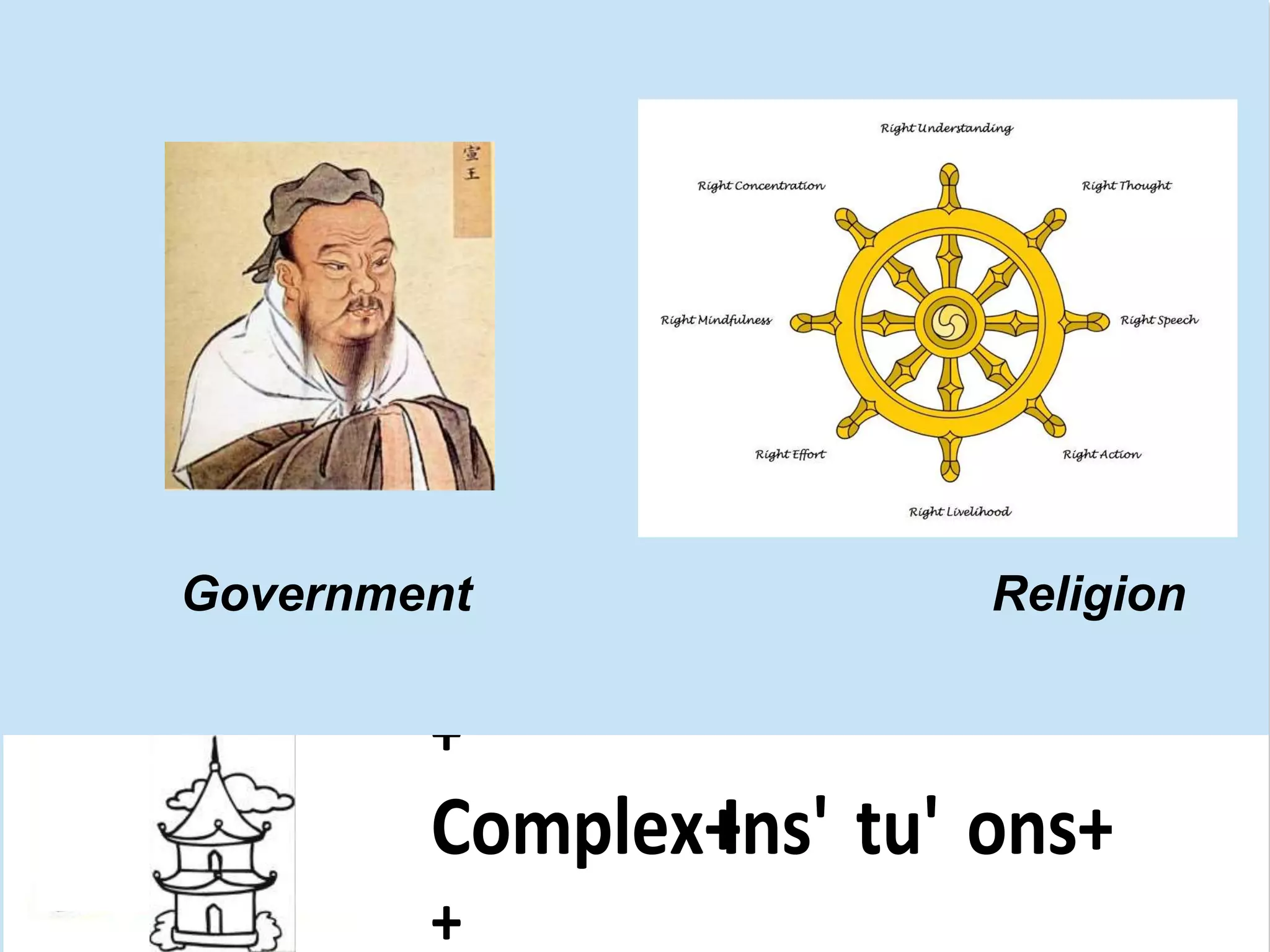
Who were important teachers in China?
What did Confucius say?
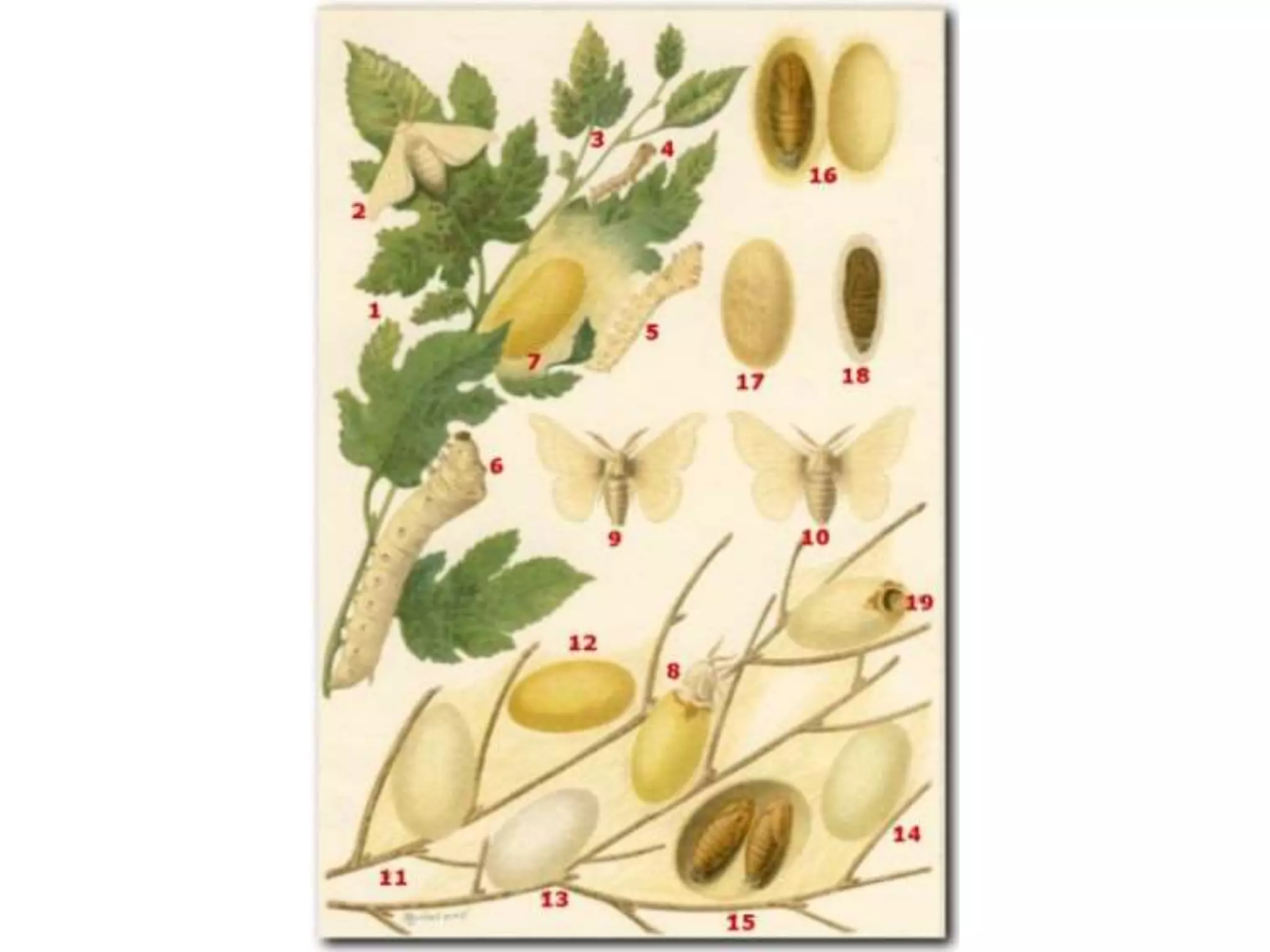
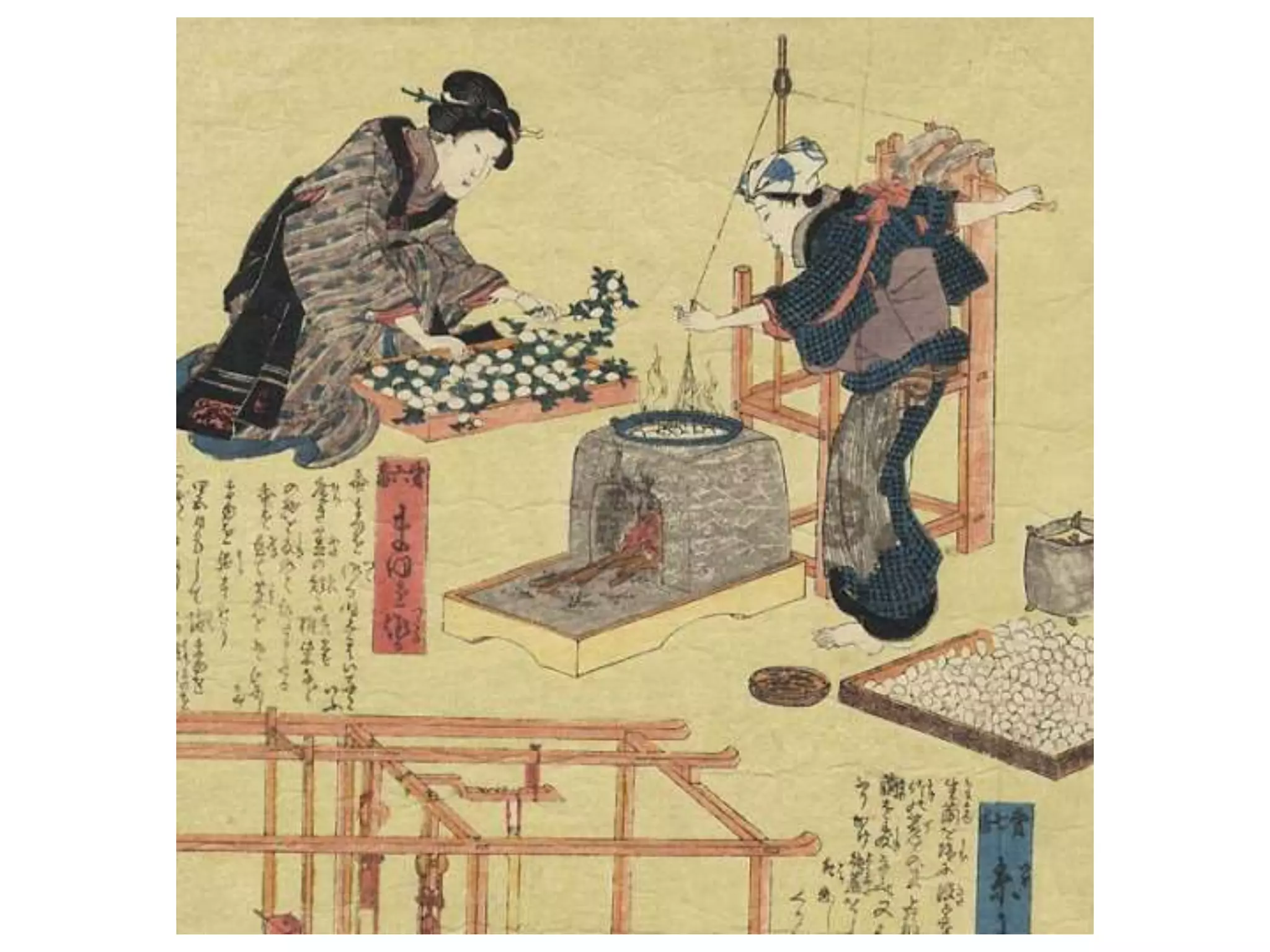
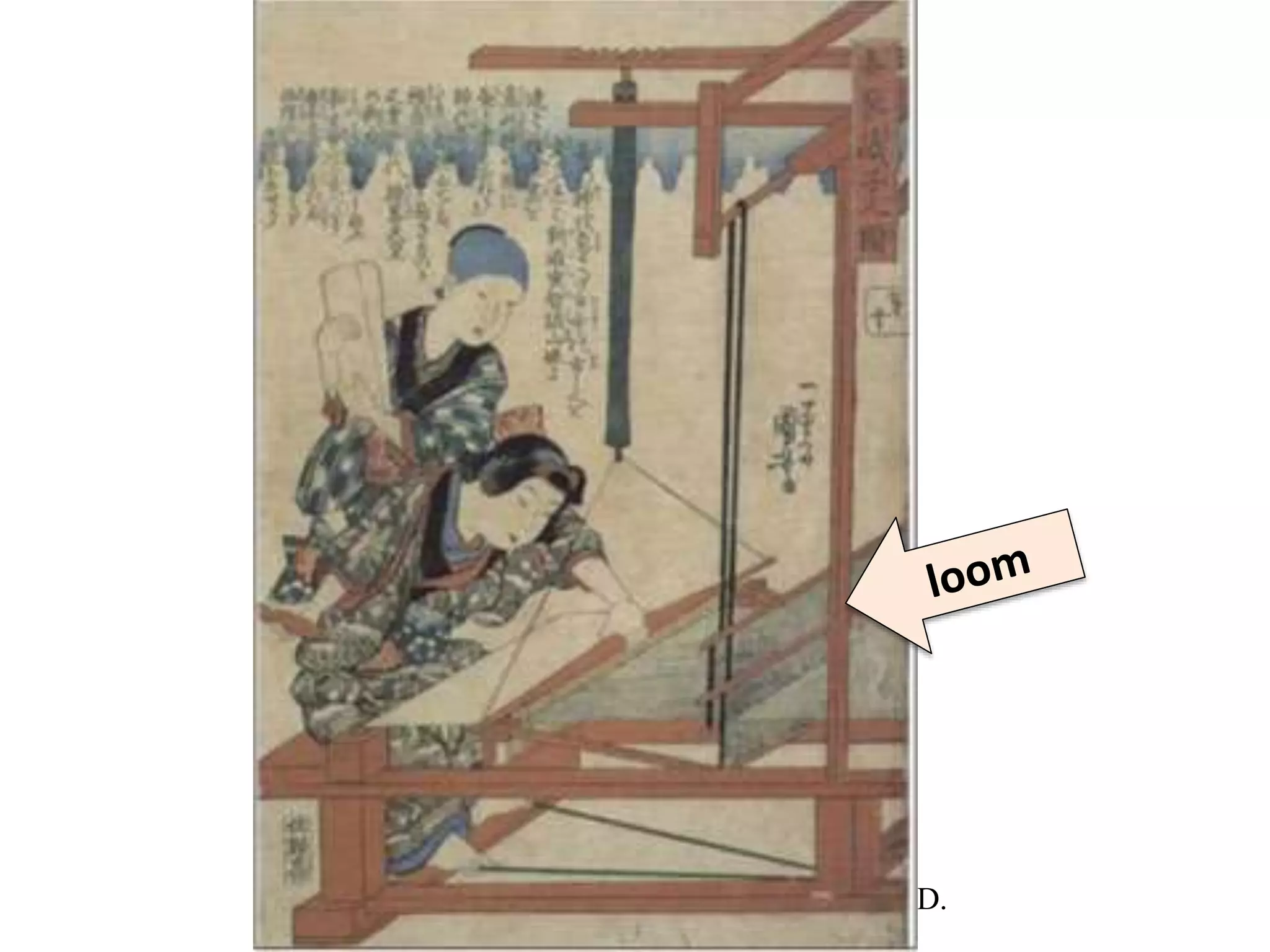
How did ancient Chinese people make silk clothes?
Advanced(Ci+es(
(
Complex(Ins+tu+ons(
(
Record(Keeping(
(
Advanced(Technology(
(
Specialized(Labor(
Civiliza+ons(Have(5(Parts(
!
!
China and USA are about the same size.
Some people say: China’s shape looks like a moose!
China was isolated because of geography.
sd
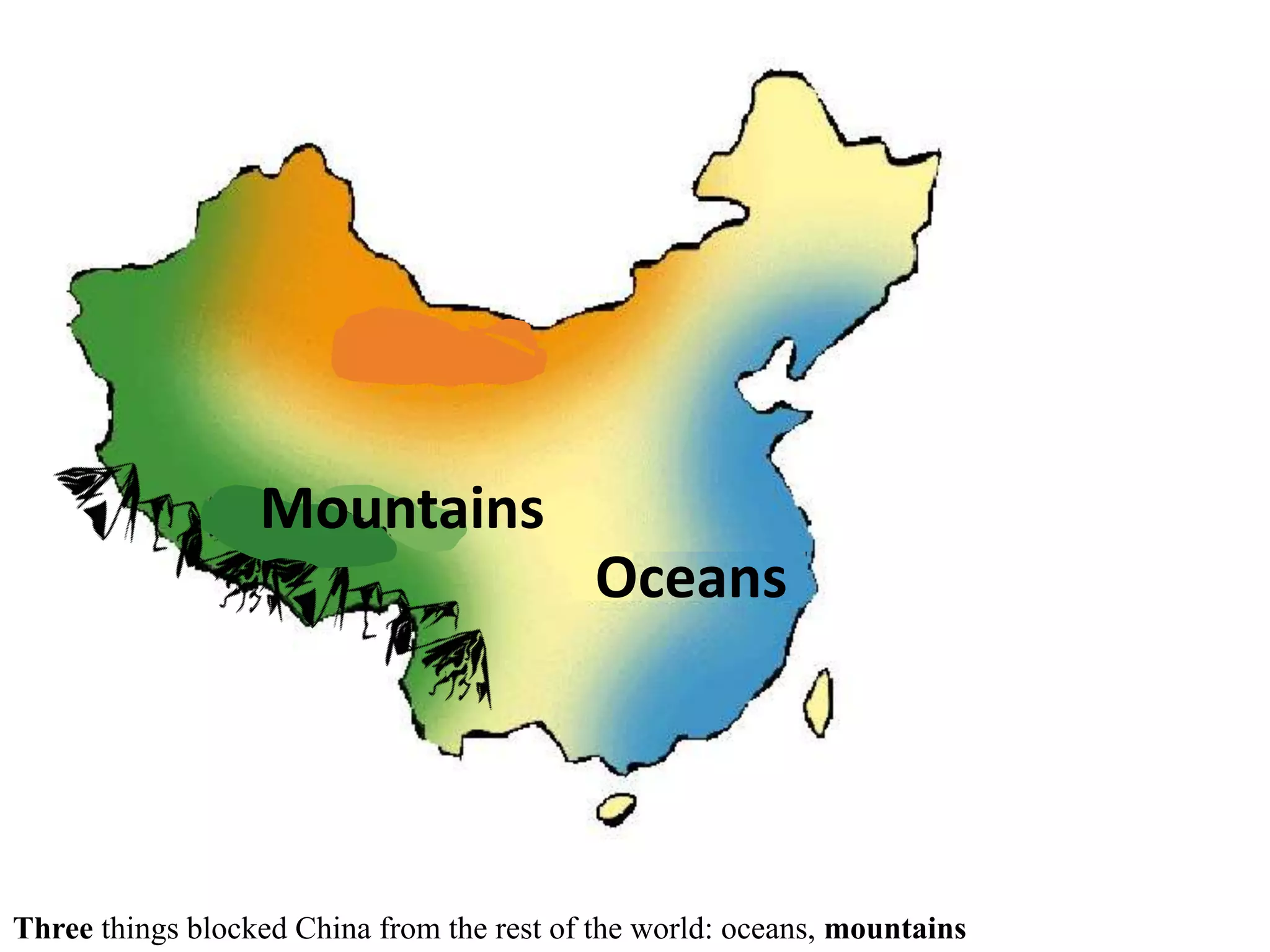
Three things blocked China from the rest of the world: oceans,
Oceans
The South China Sea
Three things blocked China from the rest of the world: oceans, mountains
Oceans
Mountains
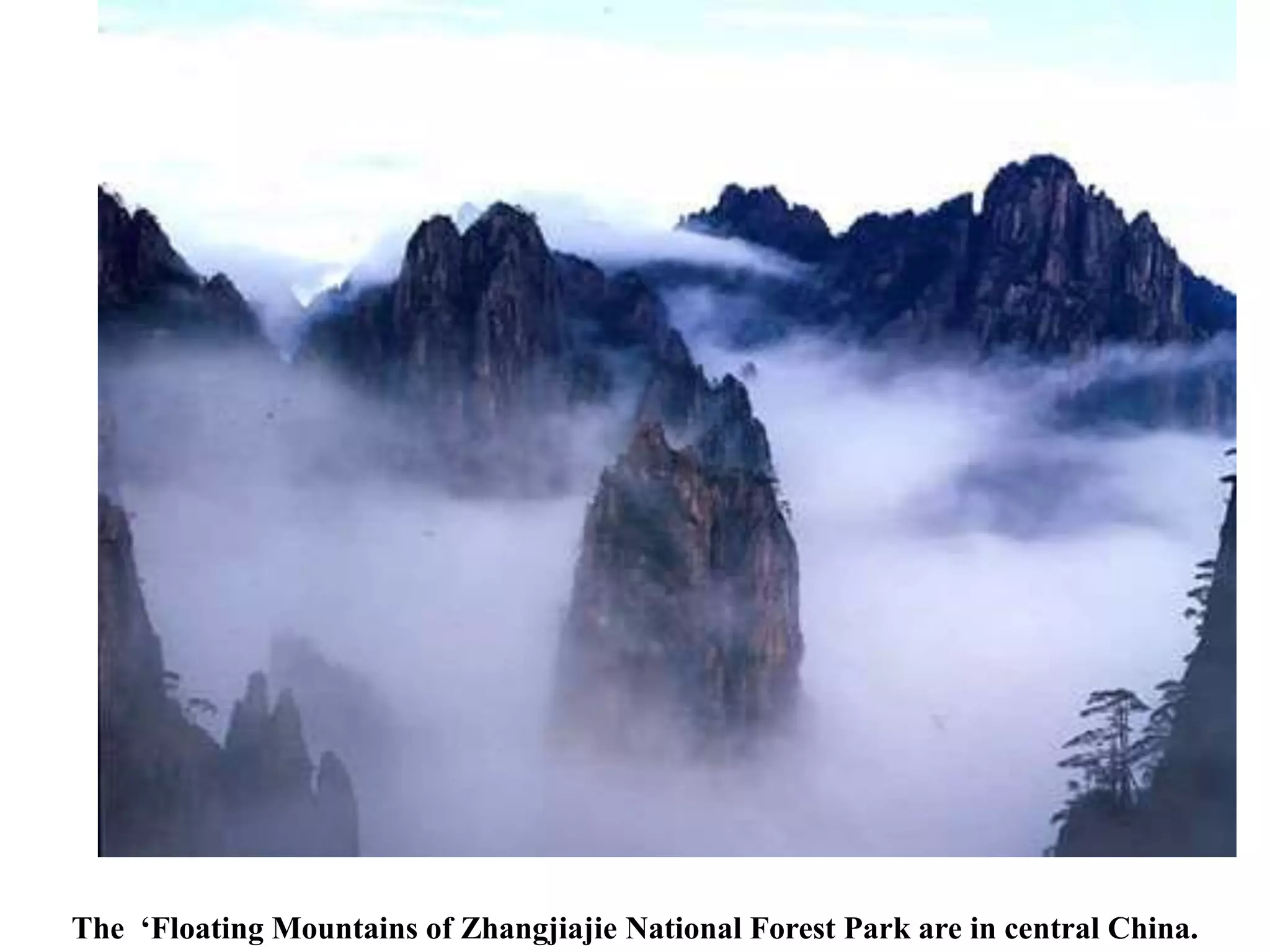
The ‘Floating Mountains of Zhangjiajie National Forest Park are in central China.
Three things blocked China from the rest of the world: oceans, mountains and deserts.
Oceans
Mountains
Deserts
The Talamakan Desert is in the northwest of China.
Three things blocked China from the rest of the world: oceans, mountains and deserts.
Oceans
Mountains
Deserts
Yellow River Civilizations
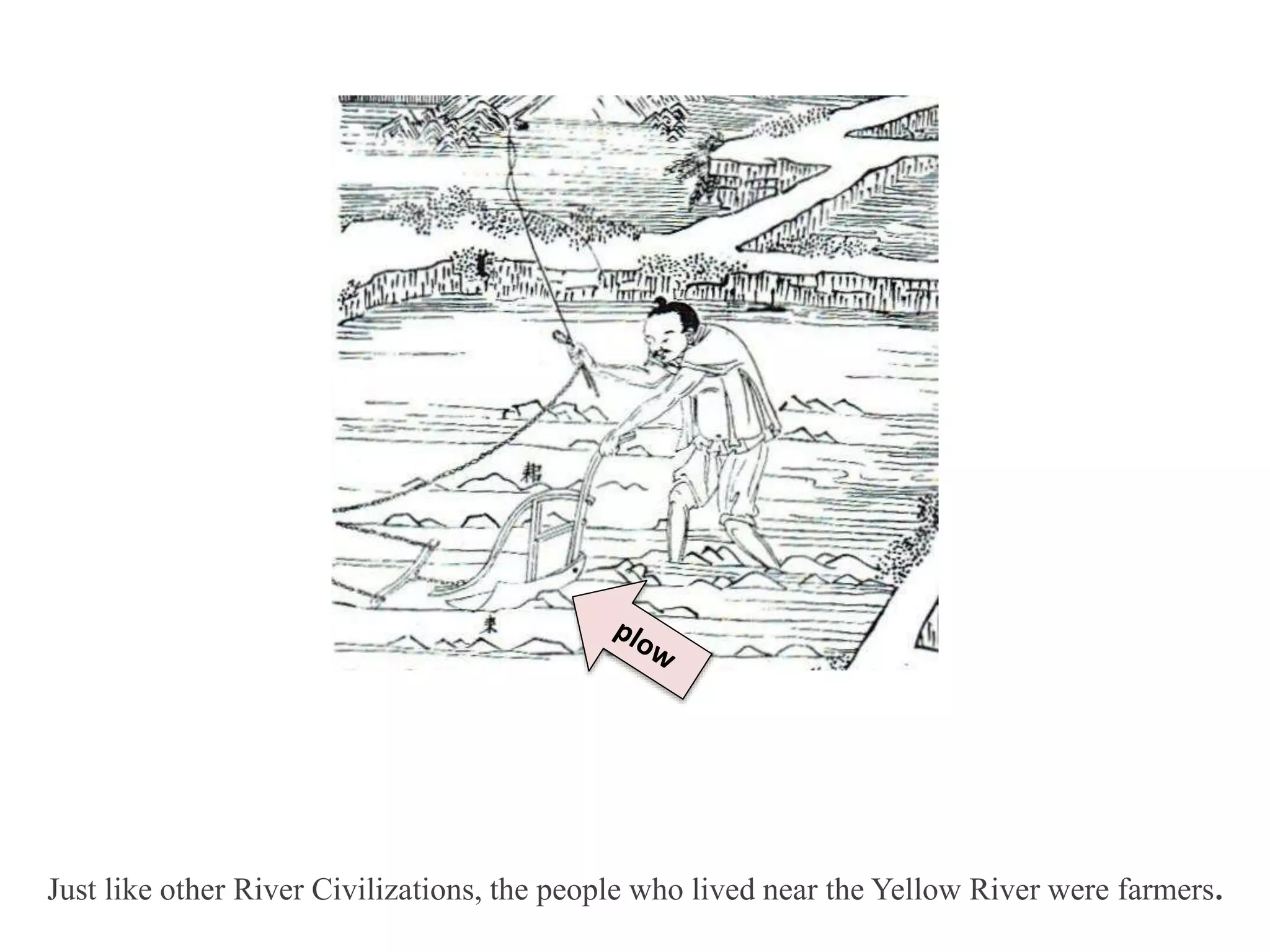
Just like other River Civilizations, the people who lived near the Yellow River were farmers.
There was lots of loess near the Yellow River, which was very good for growing food.
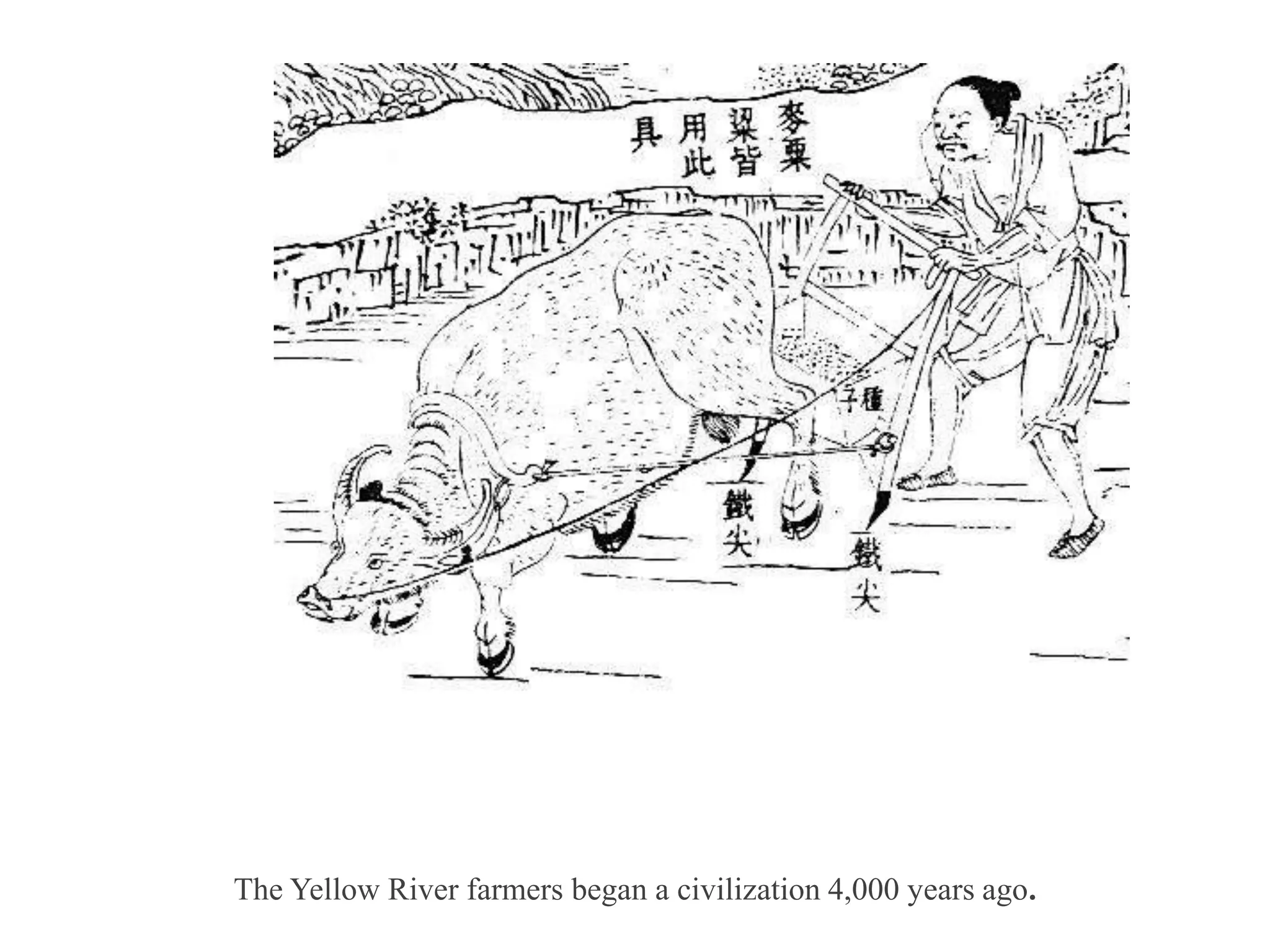
The Yellow River farmers began a civilization 4,000 years ago.
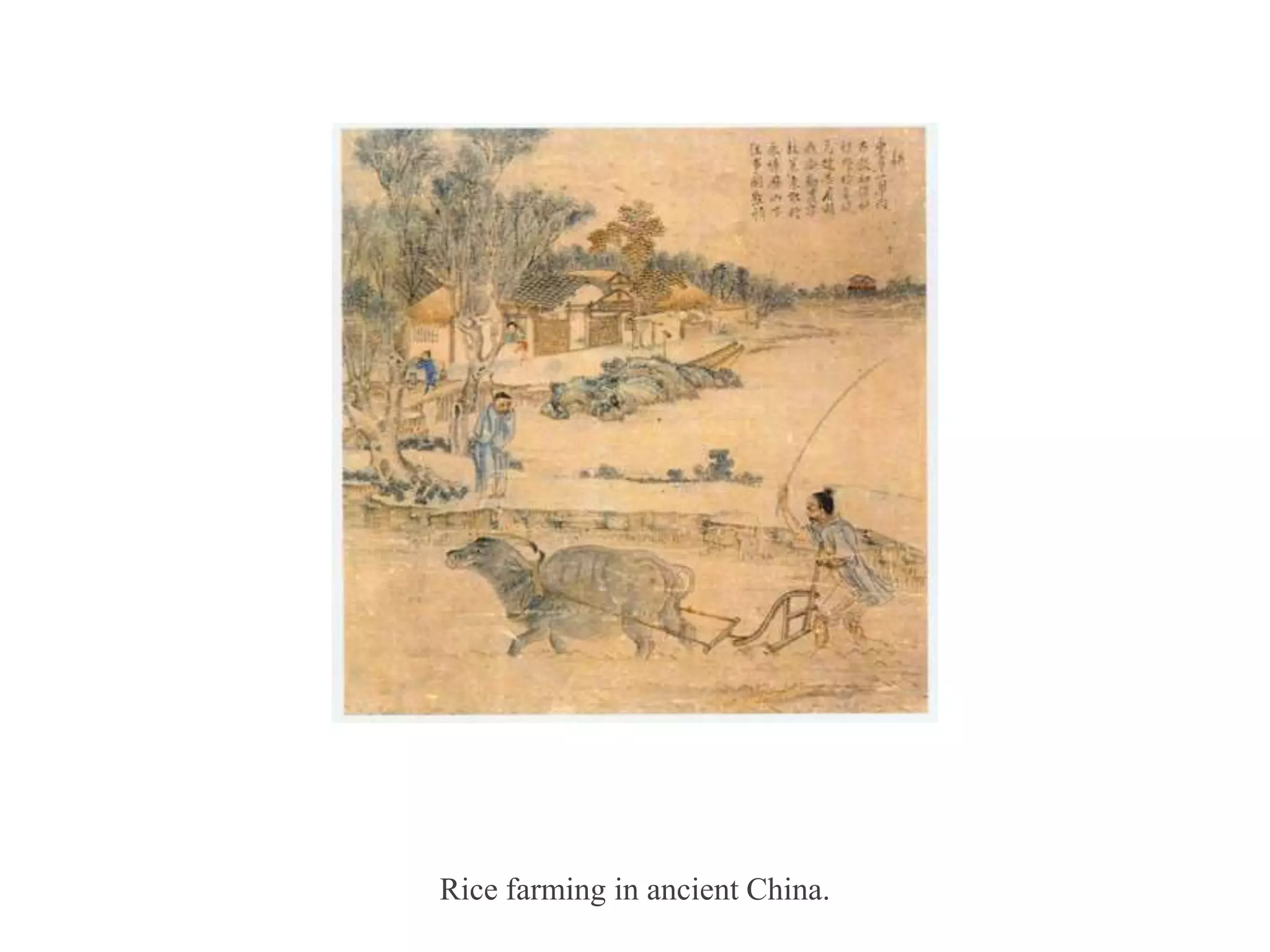
Rice farming in ancient China.
Who were the leaders of ancient China?
Dynasties
Dynasties ruled China.
Dynasties = families who pass power to rule
the nation from father to son.
Who were the leaders of ancient China?
Dynasties
Dynasties ruled China.
Dynasties = families who pass power to rule
the nation from father to son.
Power
Who were the leaders of ancient China?
Dynasties
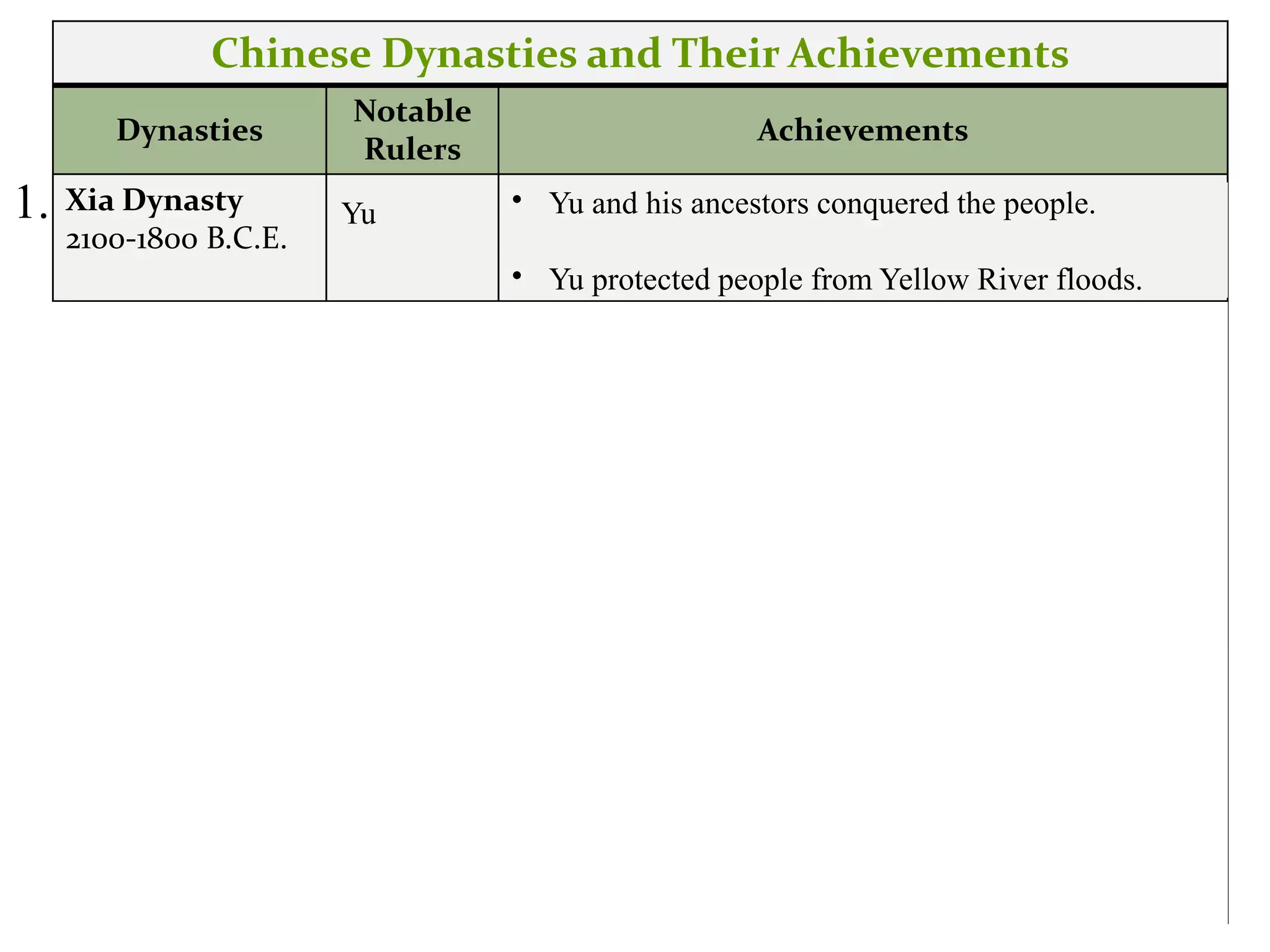
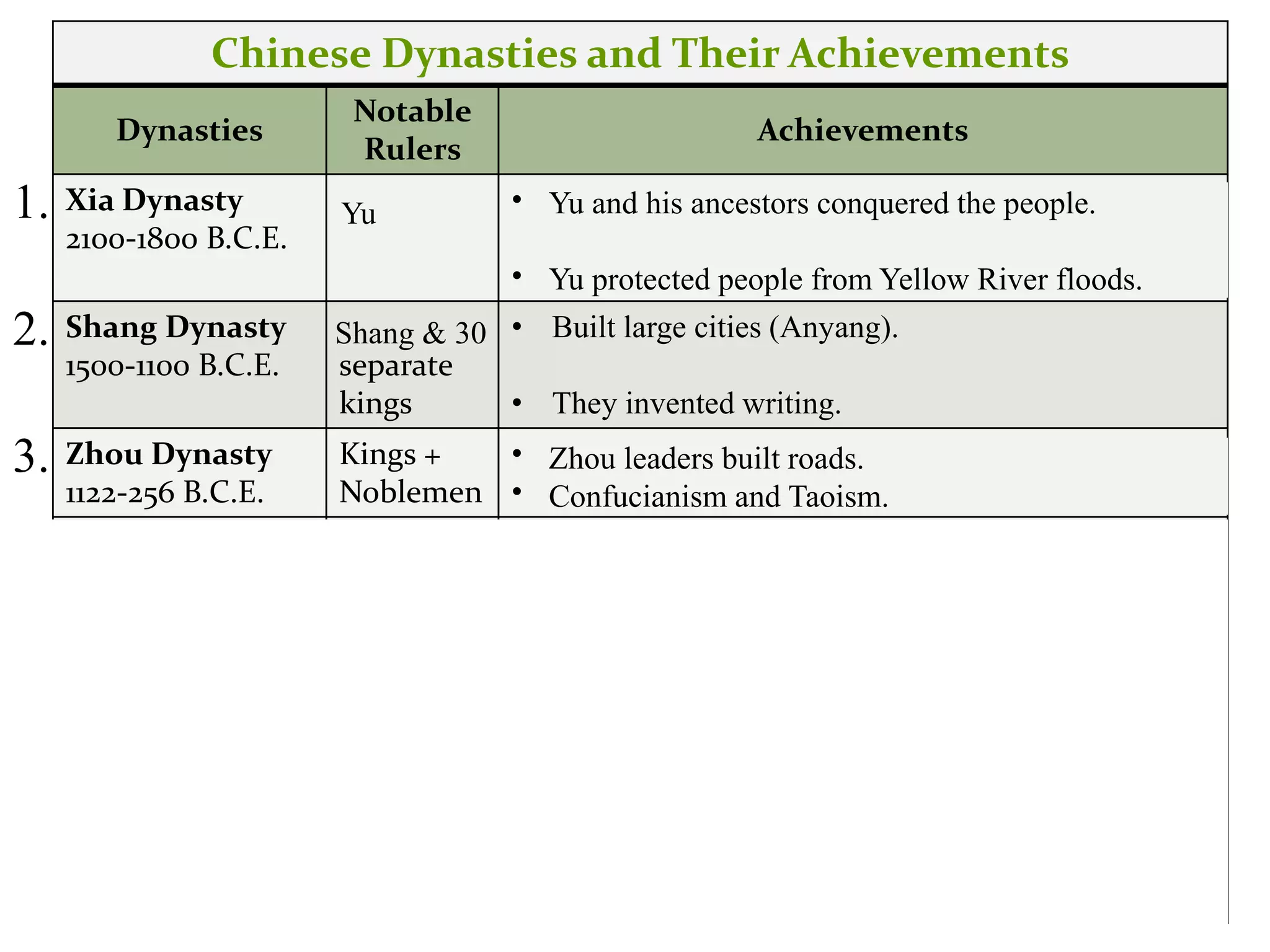
Chinese Dynasties and Their Achievements
Dynasties
Notable
Rulers
Achievements
Xia Dynasty
2100-1800 B.C.E.
Aryans • Migrated into the area and conquered the local
peoples
• Developed superior weaponry and technology
Shang Dynasty
1500-1100 B.C.E.
Thirty
separate
kings
• Ruled from a succession of seven different
capitals.
• Invention of writing
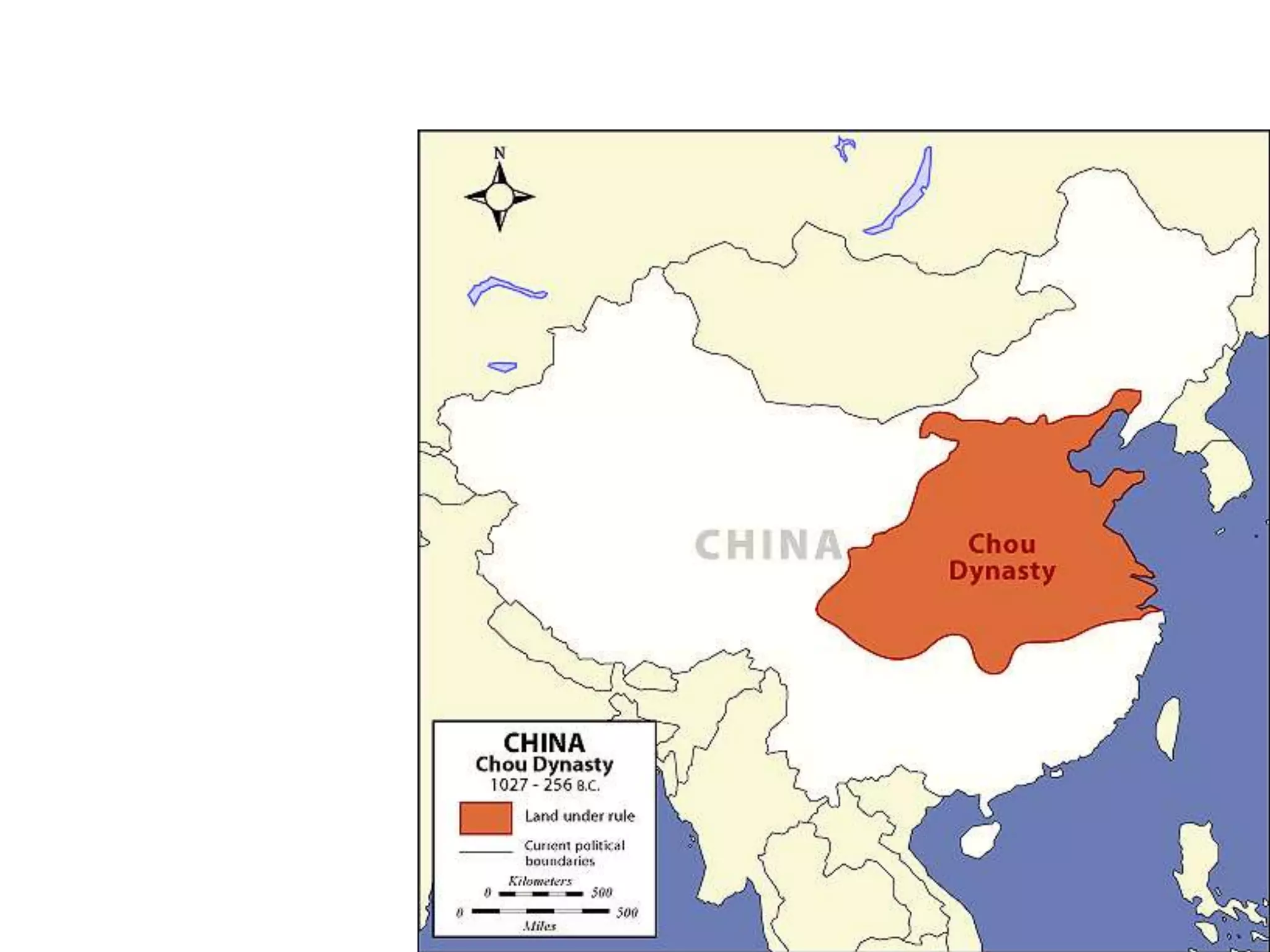
Zhou Dynasty
1122-256 B.C.E.
Kings +
Noblemen
• Expansion
• Regional rulers
Qin Dynasty
221-206 B.C.E.
Qin • Centralization of authority
• Written laws
• Building projects (Great Wall of China)
Han Dynasty Han
Wudi
• 400 year rule
• Exploration (Zhang Qian)
• Expansion of trade
• Silk Road
• Pax Sinica
• Food reserves
• Merit-based appointments
Yu Yu and his ancestors conquered the people.
Yu protected people from Yellow River floods.
Yu and his ancestors conquered the people.
Yu protected people from Yellow River floods.
Yu and his ancestors conquered the people.
Yu protected people from Yellow River floods.
Built large cities (Anyang).
They invented writing.
Ruled for a short time but did many things.
Qin family built the Great Wall of China.
The name “China” comes from the name Qin.
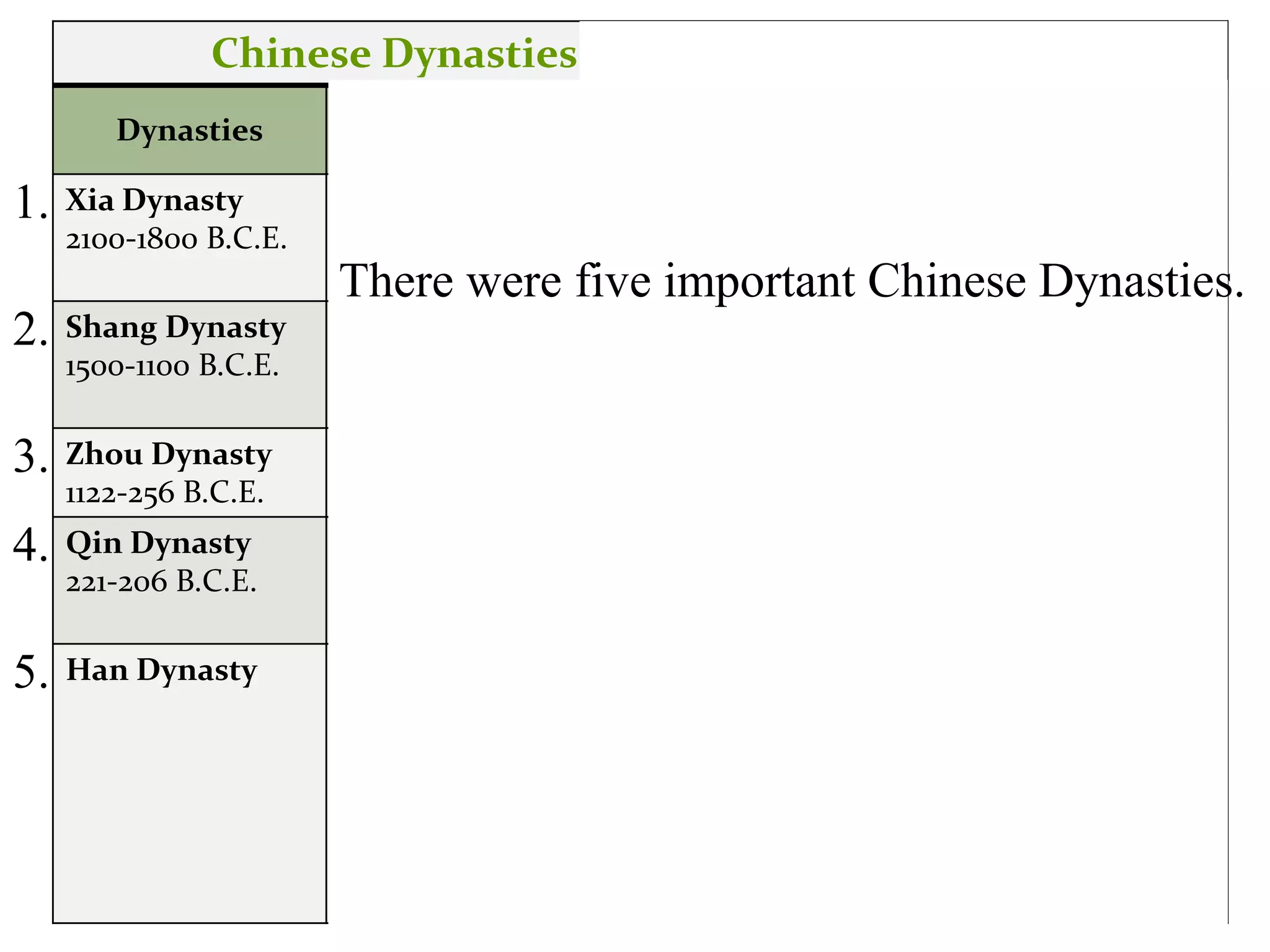
There were five important Chinese Dynasties.
Chinese Dynasties and Their Achievements
Dynasties
Notable
Rulers
Achievements
Xia Dynasty
2100-1800 B.C.E.
Aryans • Migrated into the area and conquered the local
peoples
• Developed superior weaponry and technology
Shang Dynasty
1500-1100 B.C.E.
Thirty
separate
kings
• Ruled from a succession of seven different
capitals.
• Invention of writing
Zhou Dynasty
1122-256 B.C.E.
Kings +
Noblemen
• Expansion
• Regional rulers
Qin Dynasty
221-206 B.C.E.
Qin • Centralization of authority
• Written laws
• Building projects (Great Wall of China)
Han Dynasty Han
Wudi
• 400 year rule
• Exploration (Zhang Qian)
• Expansion of trade
• Silk Road
• Pax Sinica
• Food reserves
• Merit-based appointments
Yu Yu and his ancestors conquered the people.
Yu protected people from Yellow River floods.
Yu and his ancestors conquered the people.
Yu protected people from Yellow River floods.
Yu and his ancestors conquered the people.
Yu protected people from Yellow River floods.
Built large cities (Anyang).
They invented writing.
Ruled for a short time but did many things.
Qin family built the Great Wall of China.
The name “China” comes from the name Qin.
There were five important Chinese Dynasties.
1.
2.
3.
4.
5.
Chinese Dynasties and Their Achievements
Dynasties
Notable
Rulers
Achievements
Xia Dynasty
2100-1800 B.C.E.
Aryans • Migrated into the area and conquered the local
peoples
• Developed superior weaponry and technology
Shang Dynasty
1500-1100 B.C.E.
Thirty
separate
kings
• Ruled from a succession of seven different
capitals.
• Invention of writing
Zhou Dynasty
1122-256 B.C.E.
Kings +
Noblemen
• Expansion
• Regional rulers
Qin Dynasty
221-206 B.C.E.
Qin • Centralization of authority
• Written laws
• Building projects (Great Wall of China)
Han Dynasty Han
Wudi
• 400 year rule
• Exploration (Zhang Qian)
• Expansion of trade
• Silk Road
• Pax Sinica
• Food reserves
• Merit-based appointments
Yu Yu and his ancestors conquered the people.
Yu protected people from Yellow River floods.
Yu and his ancestors conquered the people.
Yu protected people from Yellow River floods.
Yu and his ancestors conquered the people.
Yu protected people from Yellow River floods.
Built large cities (Anyang).
They invented writing.
Ruled for a short time but did many things.
Qin family built the Great Wall of China.
The name “China” comes from the name Qin.
1.
2.
3.
4.
5.
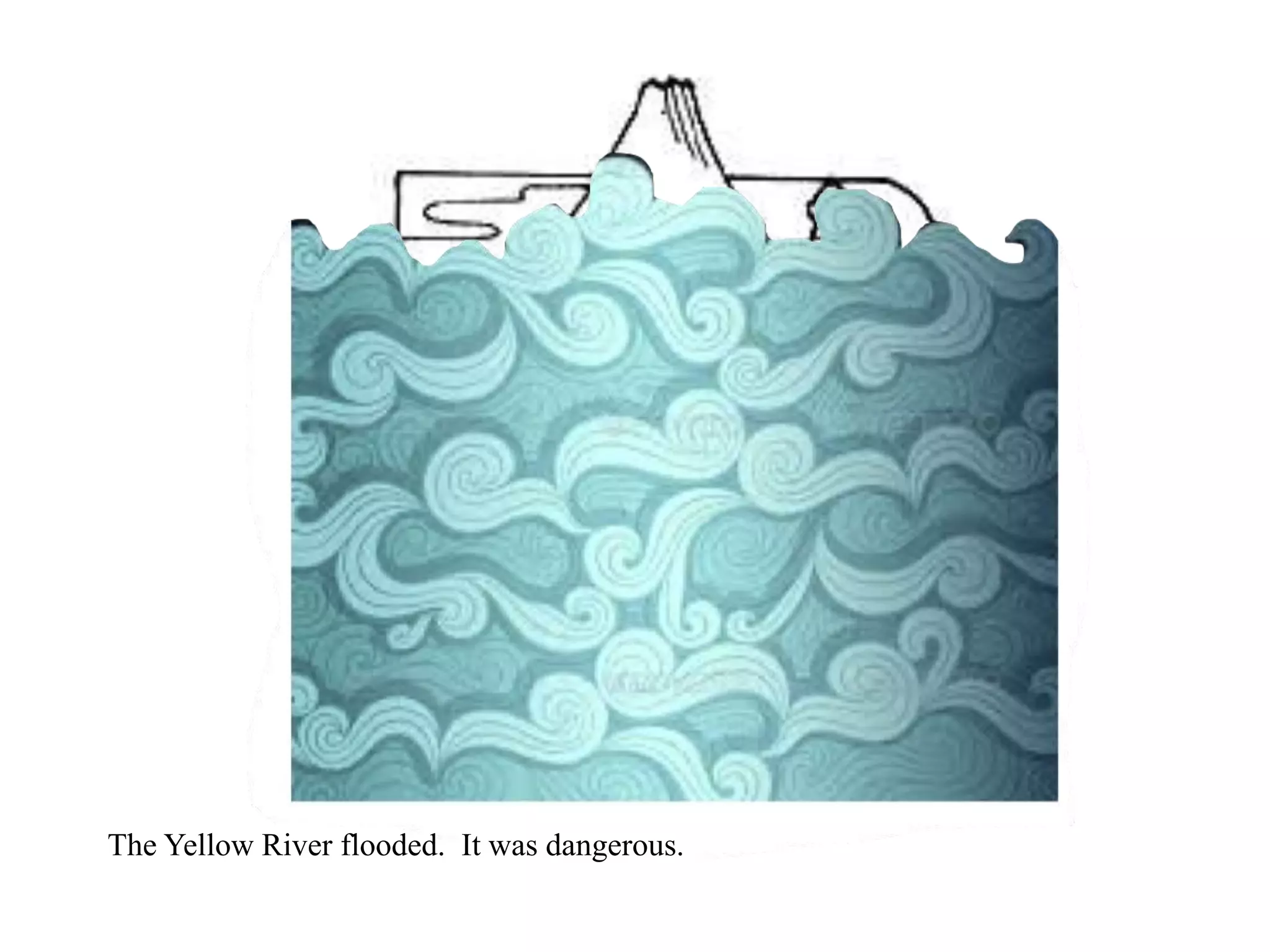
The Yellow River flooded. It was dangerous.
The artist Ma Yuan created this image of The Yellow River around 1200 AD.
The Yellow River flooded. It was dangerous.
The artist Ma Yuan created this image of The Yellow River around 1200 AD.
The Yellow River flooded. It was dangerous.
The artist Ma Yuan created this image of a Yellow River flood around 1200 AD.
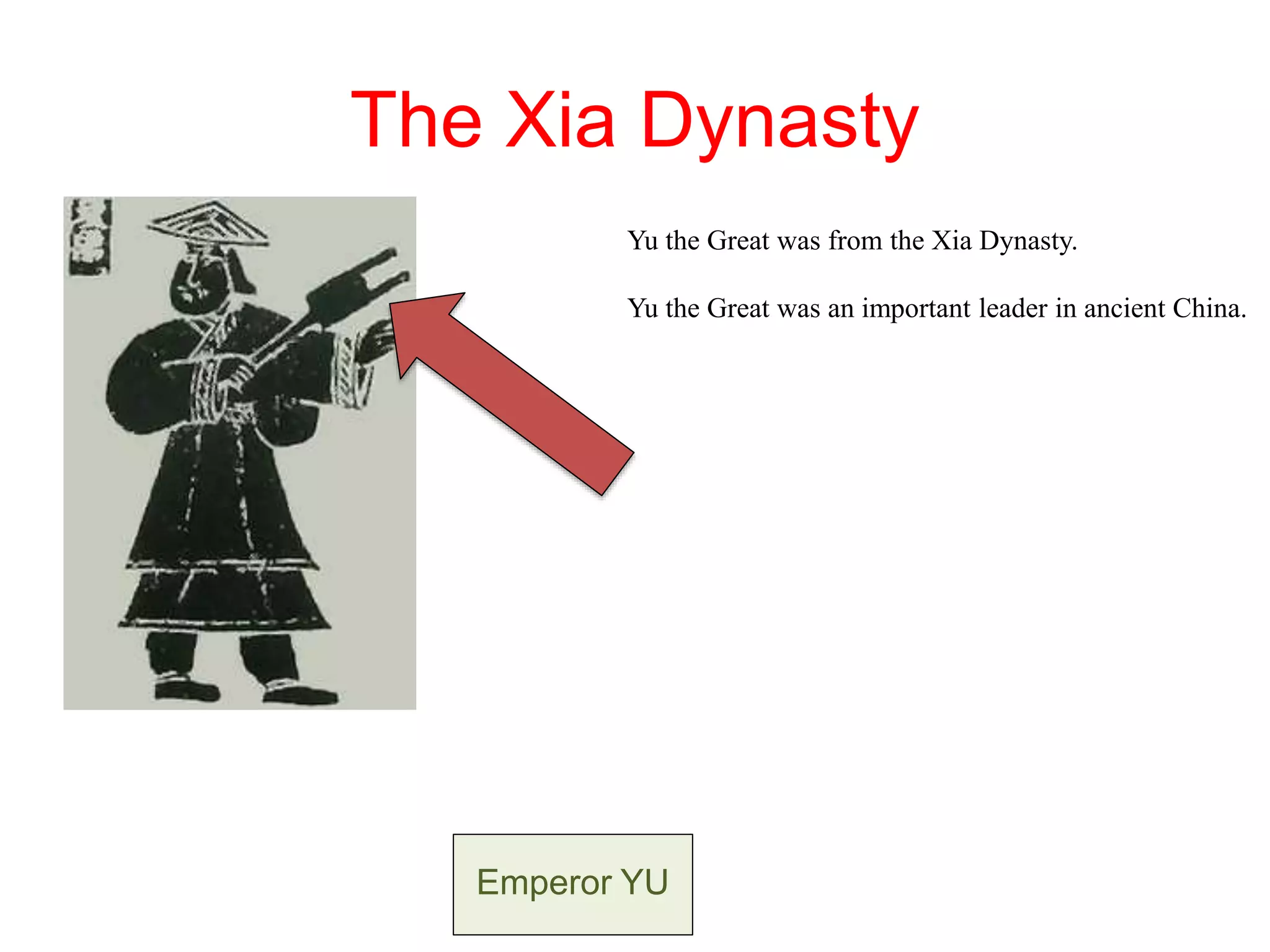
The Xia Dynasty
The Xia Dynasty
Yu the Great was from the Xia Dynasty.
Yu the Great was an important leader in ancient China.
Yu the Great encouraged family groups living along the
Yellow River to work together building canals and dams
to end dangerous floods.
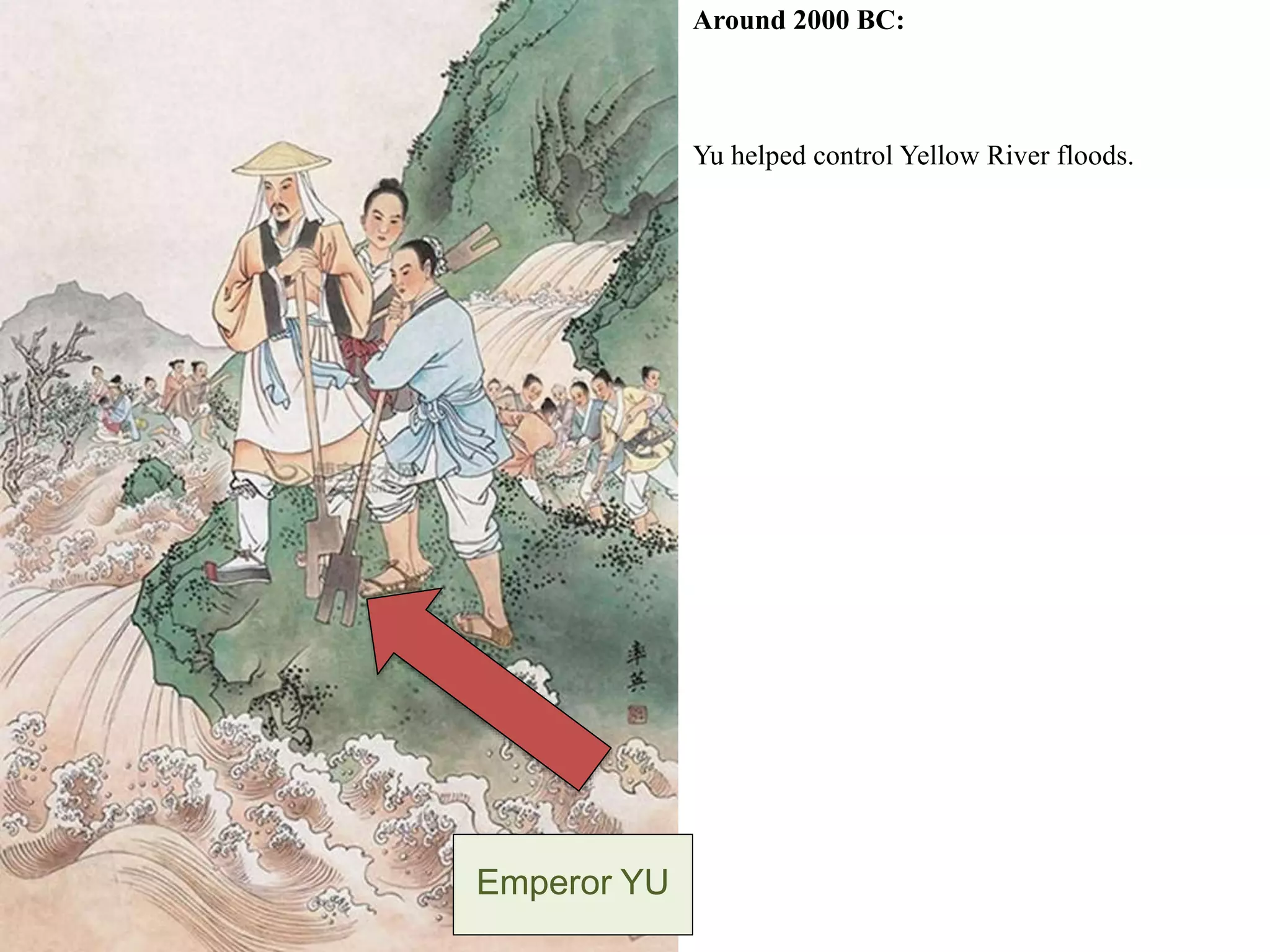
Emperor YU
Around 2000 BC:
Yu the Great was an important leader in ancient
China.
Yu helped control Yellow River floods.
Yu the Great encouraged family groups living
along the Yellow River to work together building
canals and dams to end dangerous floods.
Emperor YU
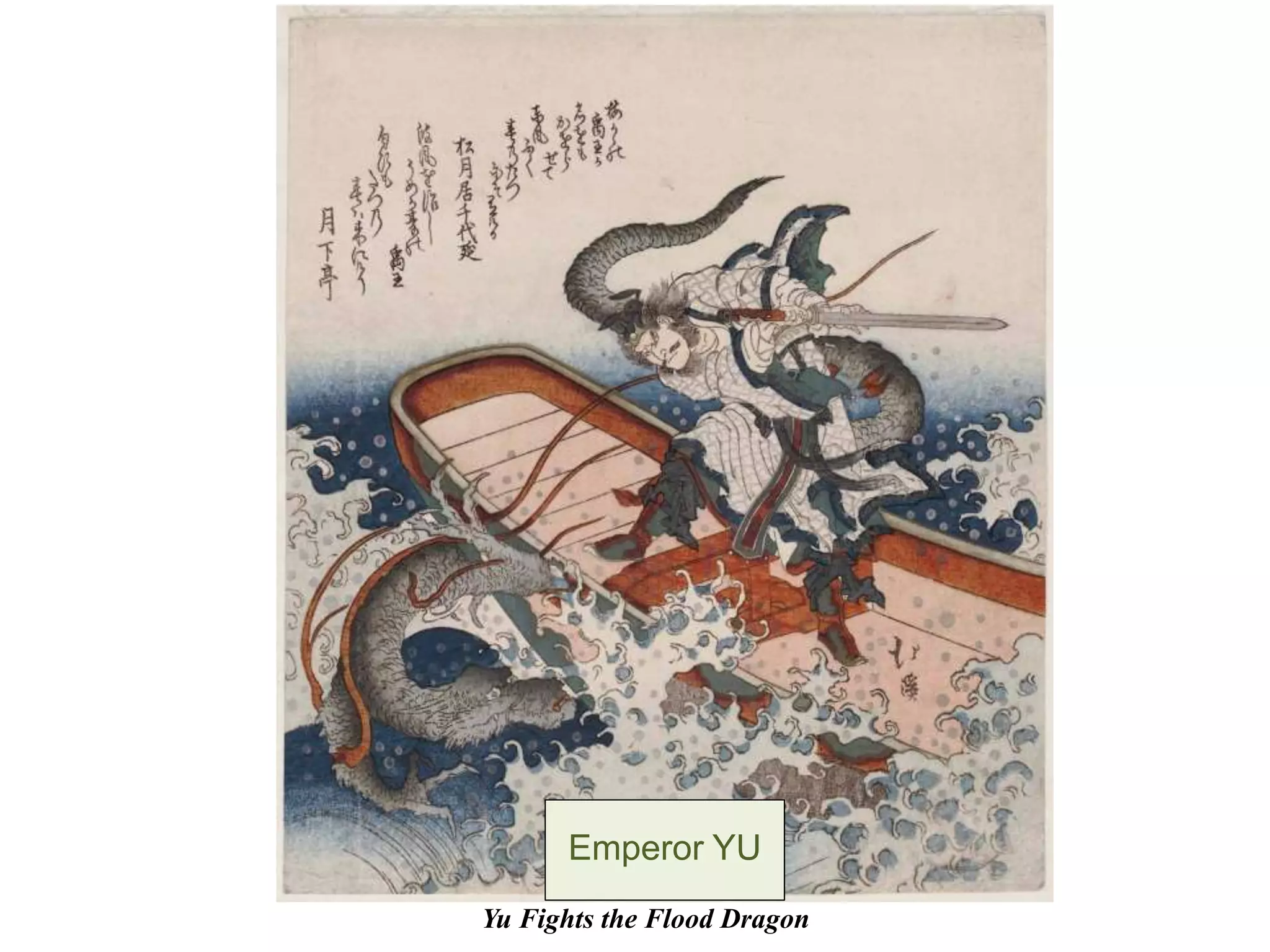
aYu Fights the Flood Dragon
Emperor YU
Around 2000 BC:
Yu helped control Yellow River floods.
Yu the Great encouraged family groups living
along the Yellow River to work together building
canals and dams to end dangerous floods.
Emperor YU
Around 2000 BC:
Yu helped control Yellow River floods.
Yu the Great encouraged family groups living
along the Yellow River to work together building
canals and dams to end dangerous floods.
Emperor YU
Around 2000 BC:
Yu helped control Yellow River floods.
Yu the Great encouraged family groups living
along the Yellow River to work together building
canals and dams to end dangerous floods.
Emperor YU
Around 2000 BC:
Yu helped control Yellow River floods.
Yu the Great encouraged family groups living
along the Yellow River to work together building
canals and dams to end dangerous floods.
Emperor YU
Dams: long walls
blocking river water in a flood
Around 2000 BC:
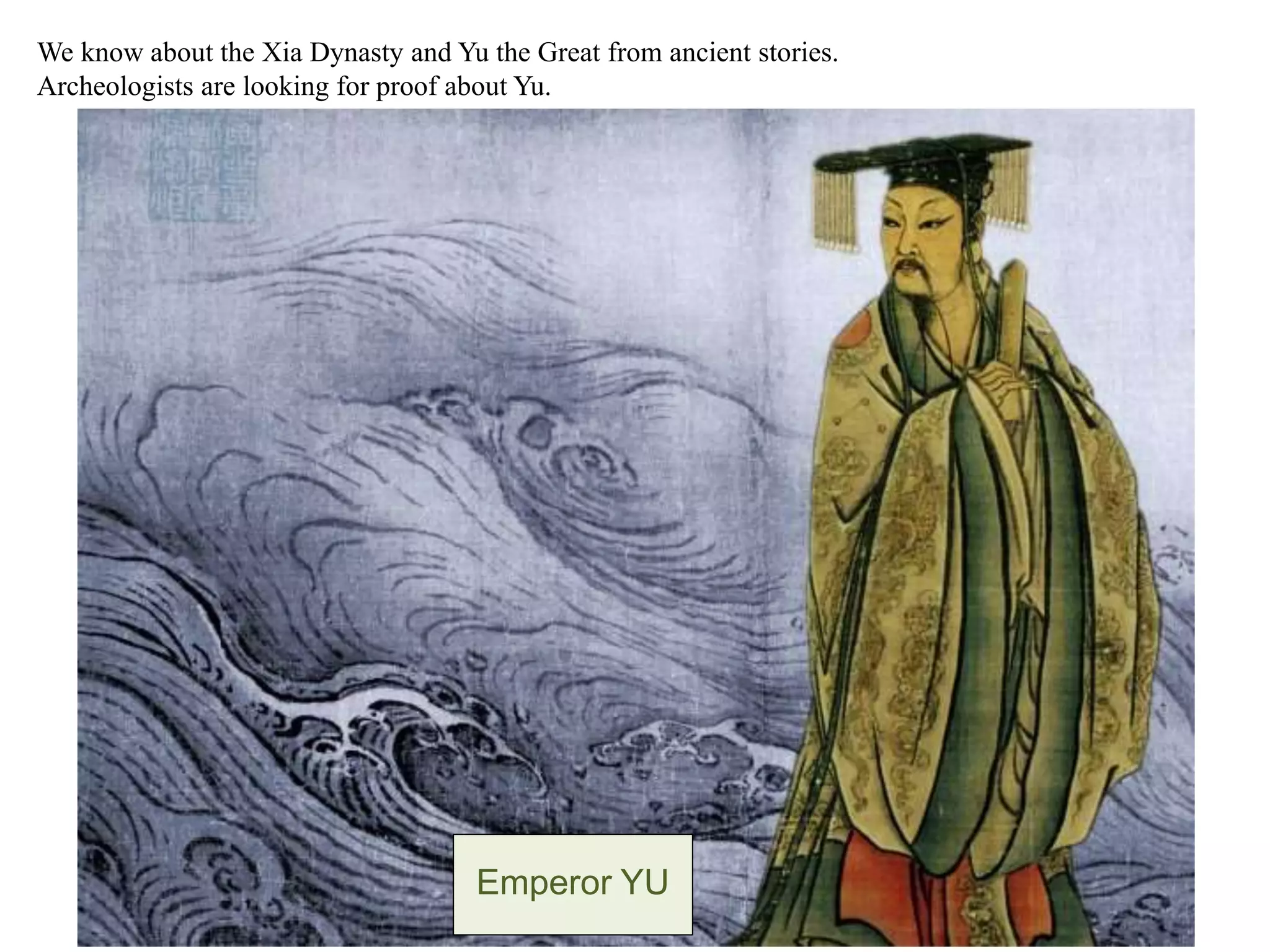
We know about the Xia Dynasty and Yu the Great from ancient stories.
Archeologists are looking for proof about Yu.
Emperor YU
Chinese Dynasties and Their Achievements
Dynasties
Notable
Rulers
Achievements
Xia Dynasty
2100-1800 B.C.E.
Aryans • Migrated into the area and conquered the local
peoples
• Developed superior weaponry and technology
Shang Dynasty
1500-1100 B.C.E.
Thirty
separate
kings
• Ruled from a succession of seven different
capitals.
• Invention of writing
Zhou Dynasty
1122-256 B.C.E.
Kings +
Noblemen
• Expansion
• Regional rulers
Qin Dynasty
221-206 B.C.E.
Qin • Centralization of authority
• Written laws
• Building projects (Great Wall of China)
Han Dynasty Han
Wudi
• 400 year rule
• Exploration (Zhang Qian)
• Expansion of trade
• Silk Road
• Pax Sinica
• Food reserves
• Merit-based appointments
Yu Yu and his ancestors conquered the people.
Yu protected people from Yellow River floods.
Yu and his ancestors conquered the people.
Yu protected people from Yellow River floods.
Yu and his ancestors conquered the people.
Yu protected people from Yellow River floods.
Built large cities (Anyang).
They invented writing.
Ruled for a short time but did many things.
Qin family built the Great Wall of China.
The name “China” comes from the name Qin.
Shang & 30
1.
2.
3.
4.
5.
Shang Tang was an important leader
in ancient China.
He ruled during the Shang Dynasty.
The Shang Dynasty ruled China for 400 years.
The Shang Dynasty
Emperor shang tang
During the Shang Dynasty, the city of Anyang grew near the Yellow River.
The Shang Dynasty
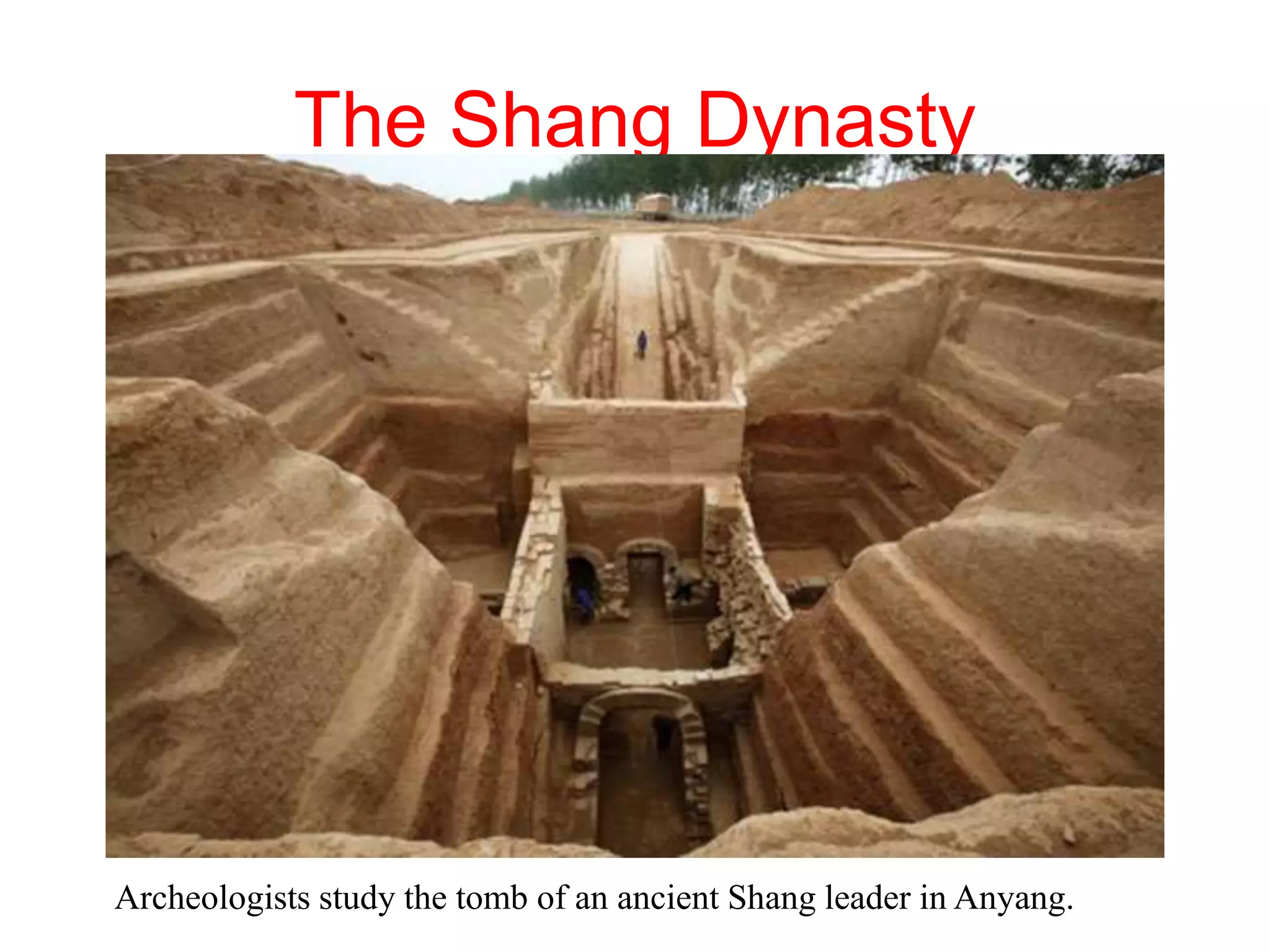
Archeologists study the tomb of an ancient Shang leader in Anyang.
The Shang Dynasty
There was a large palace near Anyang city.
The Shang Dynasty
palace = beautiful, large
home for a leader.
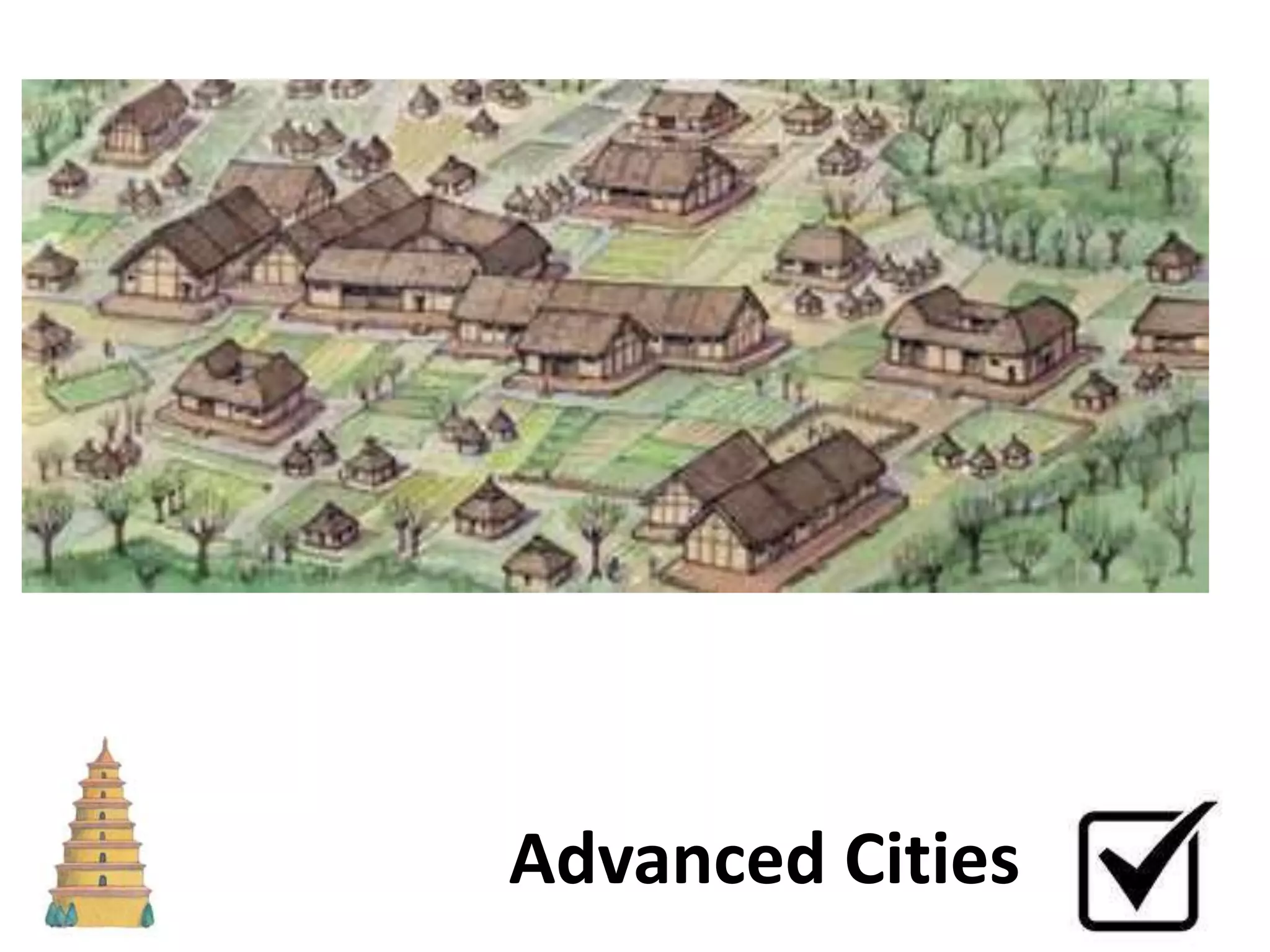
Advanced Cities
TheShangDynasty
King &
family
Nobles
(rich leaders)
Artisans &
Traders
Farmers
Slaves
Social Classes in the Shang Dynasty
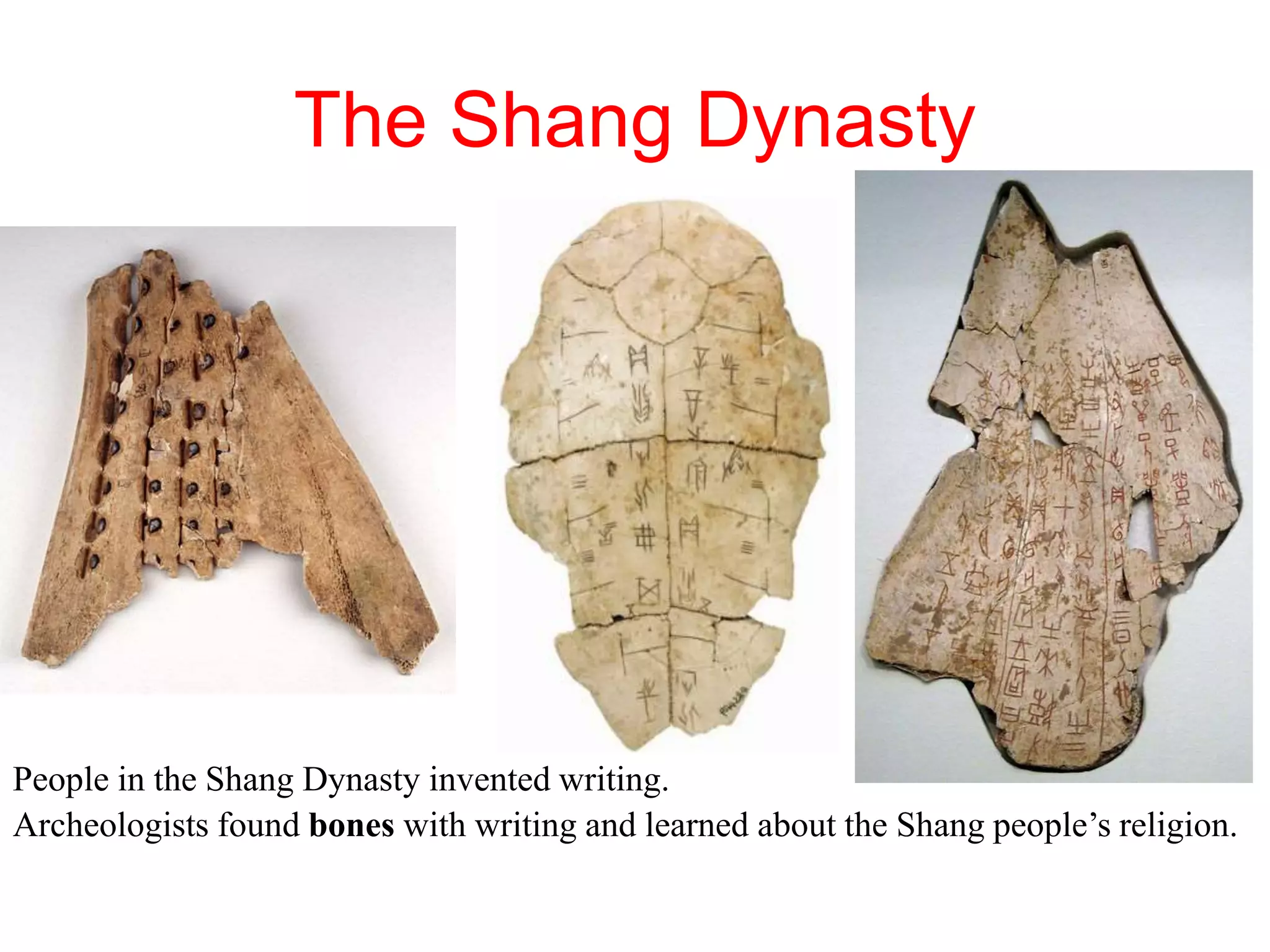
People in the Shang Dynasty invented writing.
Archeologists found bones with writing and learned about the Shang people’s religion.
The Shang Dynasty
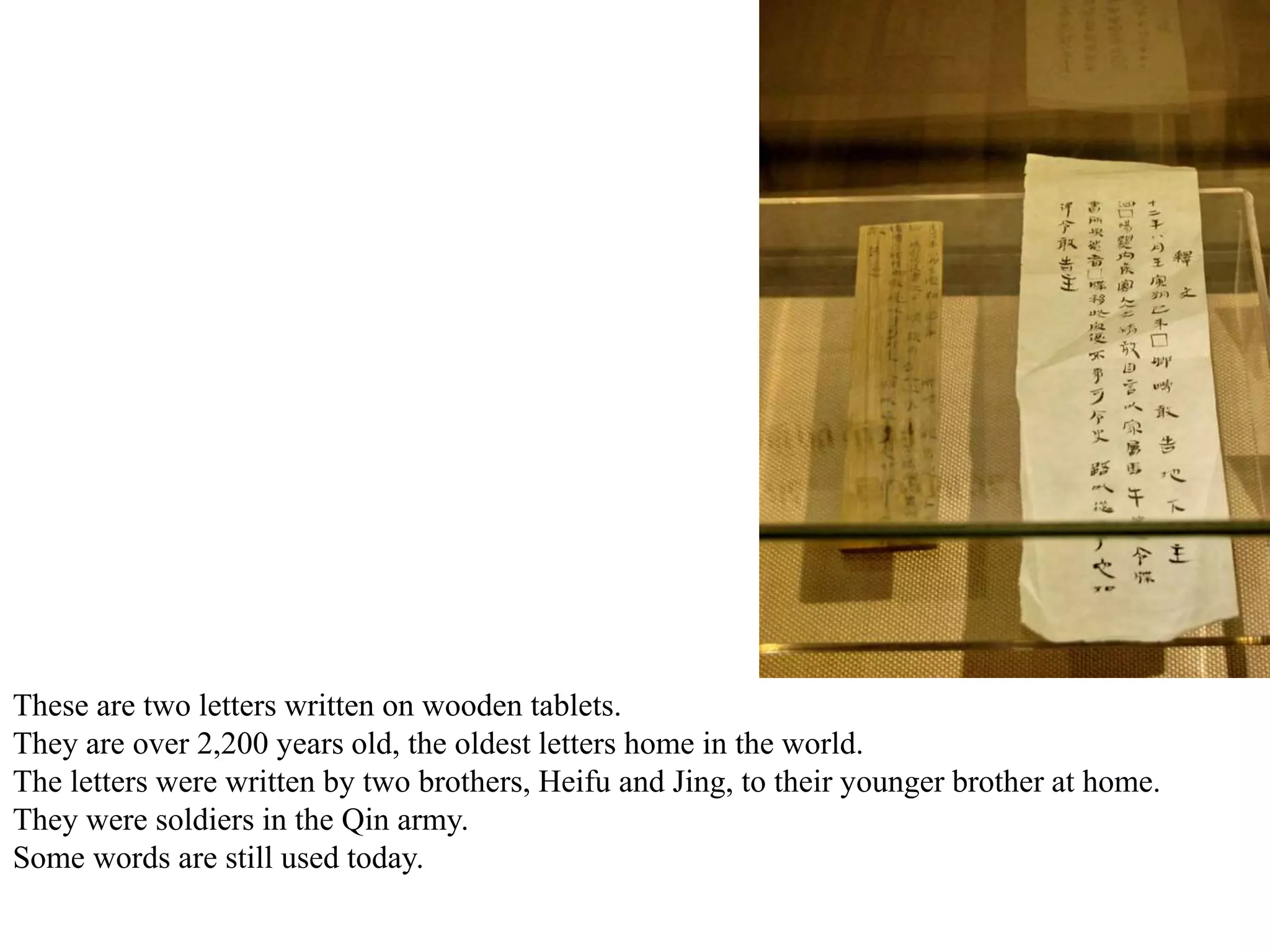
These are two letters written on wooden tablets.
They are over 2,200 years old, the oldest letters home in the world.
The letters were written by two brothers, Heifu and Jing, to their younger brother at home.
They were soldiers in the Qin army.
Some words are still used today.
Advanced+Ci' es+
+
Complex+Ins' tu' ons+
+
Record+Keeping+
roved technology: First, stone tools,
then metal tools. Metal tools were better.
Civiliza' ons+Have+5+Parts+
Chinese Dynasties and Their Achievements
Dynasties
Notable
Rulers
Achievements
Xia Dynasty
2100-1800 B.C.E.
Aryans • Migrated into the area and conquered the local
peoples
• Developed superior weaponry and technology
Shang Dynasty
1500-1100 B.C.E.
Thirty
separate
kings
• Ruled from a succession of seven different
capitals.
• Invention of writing
Zhou Dynasty
1122-256 B.C.E.
Kings +
Noblemen
• Expansion
• Regional rulers
Qin Dynasty
221-206 B.C.E.
Qin • Centralization of authority
• Written laws
• Building projects (Great Wall of China)
Han Dynasty Han
Wudi
• 400 year rule
• Exploration (Zhang Qian)
• Expansion of trade
• Silk Road
• Pax Sinica
• Food reserves
• Merit-based appointments
Yu Yu and his ancestors conquered the people.
Yu protected people from Yellow River floods.
Yu and his ancestors conquered the people.
Yu protected people from Yellow River floods.
Built large cities (Anyang).
They invented writing.
Ruled for a short time but did many things.
Qin family built the Great Wall of China.
The name “China” comes from the name Qin.
Shang & 30
Zhou leaders built roads.
Confucianism and Taoism.
1.
2.
3.
4.
5.
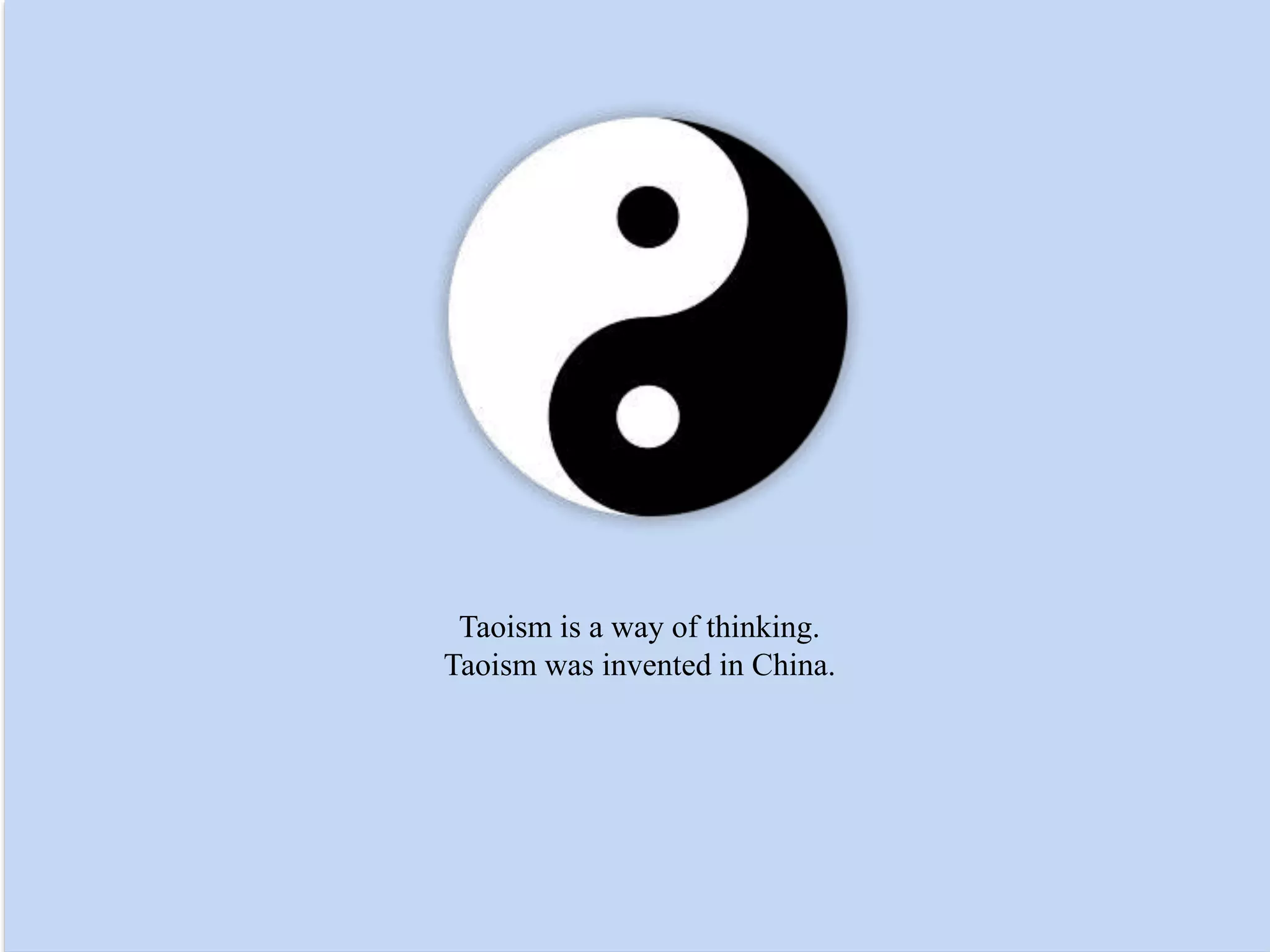
Taoism is a way of thinking.
Taoism was invented in China.
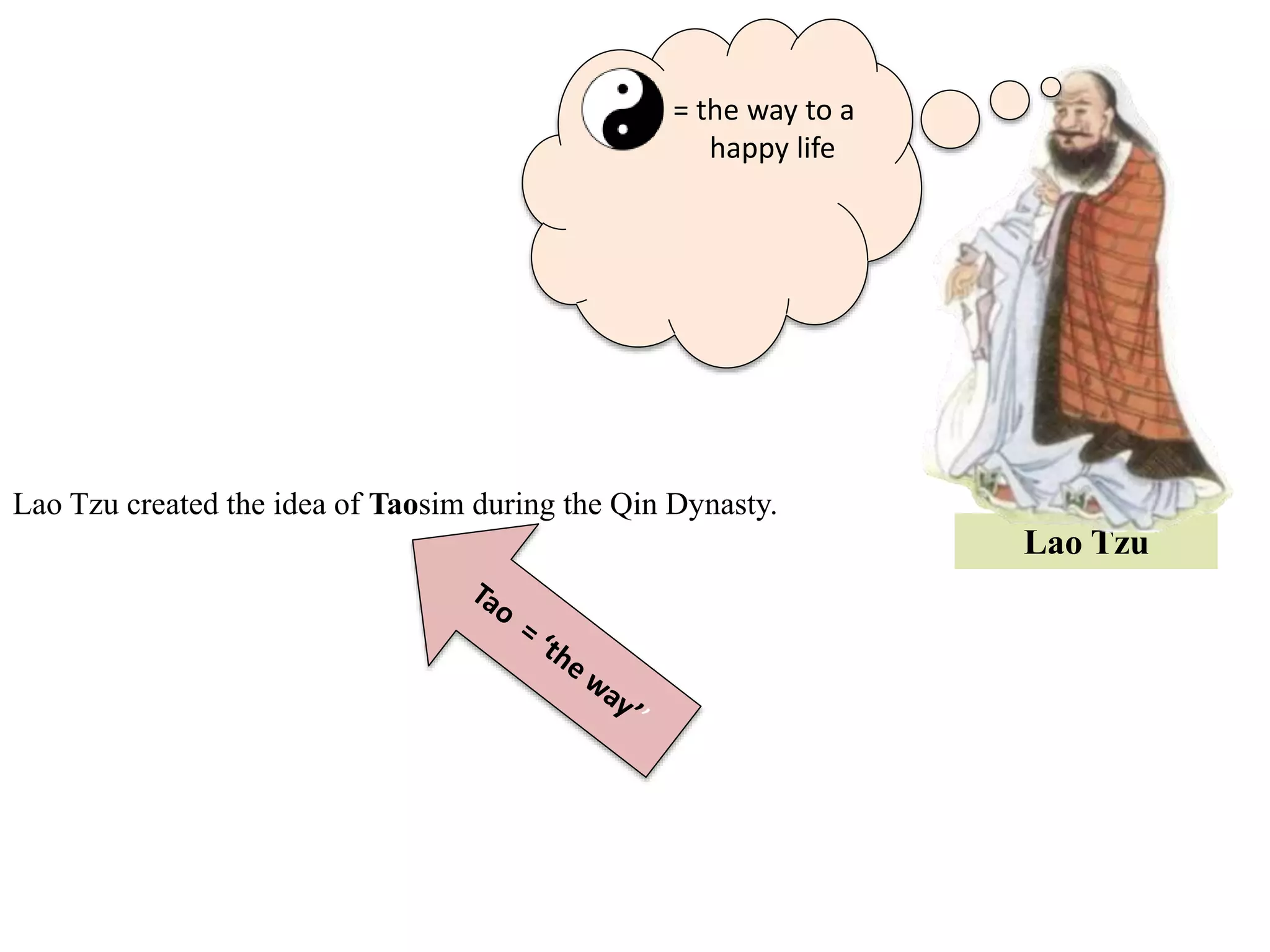
Lao Tzu
Lao Tzu created the idea of Taosim during the Qin Dynasty.
Lao Tzu
= the way to a
happy life
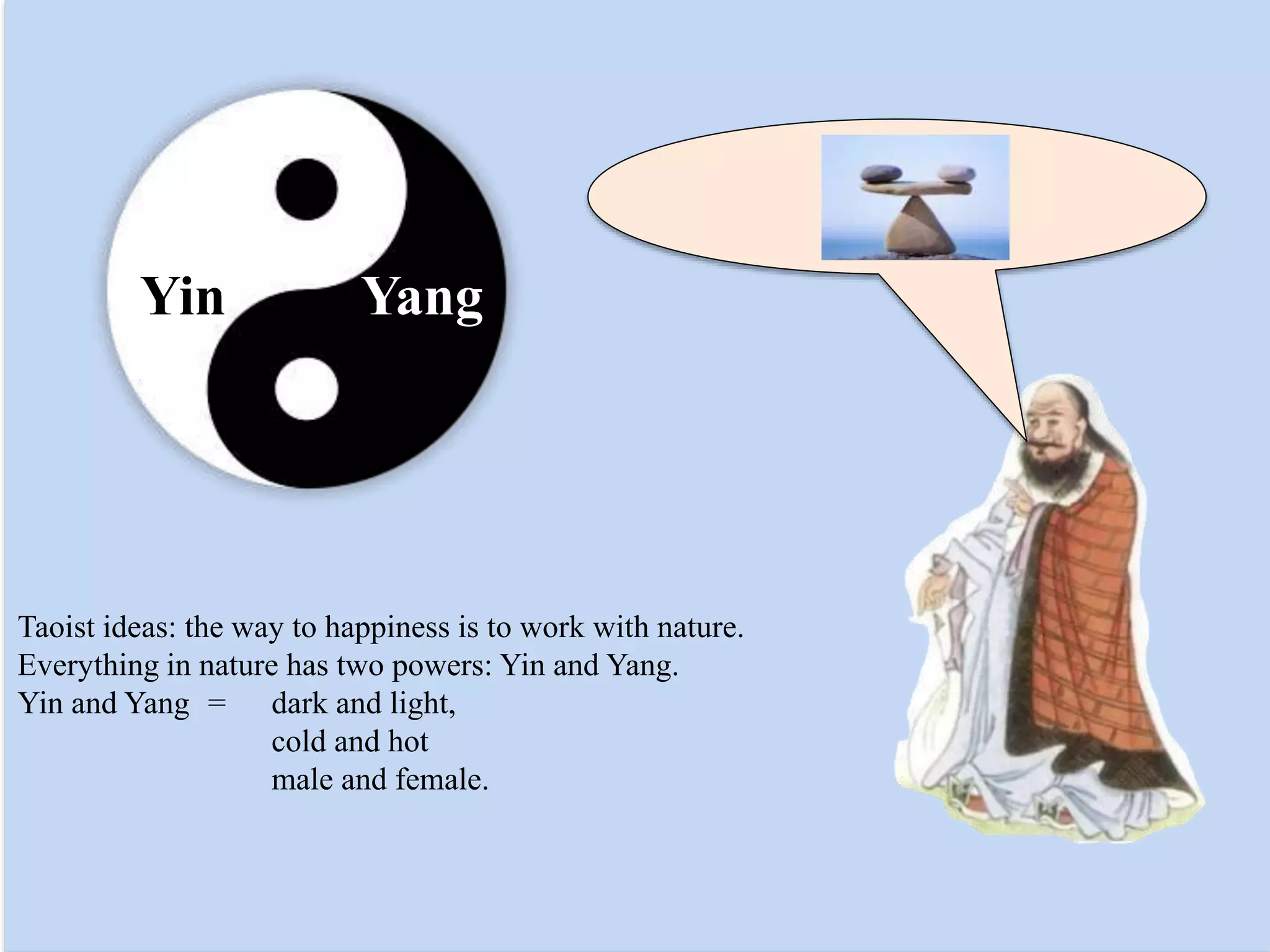
Taoist ideas: the way to happiness is to work with nature.
Everything in nature has two powers: Yin and Yang.
Yin and Yang = dark and light,
cold and hot
male and female.
Yin Yang
People must work to balance
the two opposite powers.
Taoist ideas: the way to happiness is to work with nature.
Everything in nature has two powers: Yin and Yang.
Yin and Yang = dark and light,
cold and hot
male and female.
Yin Yang
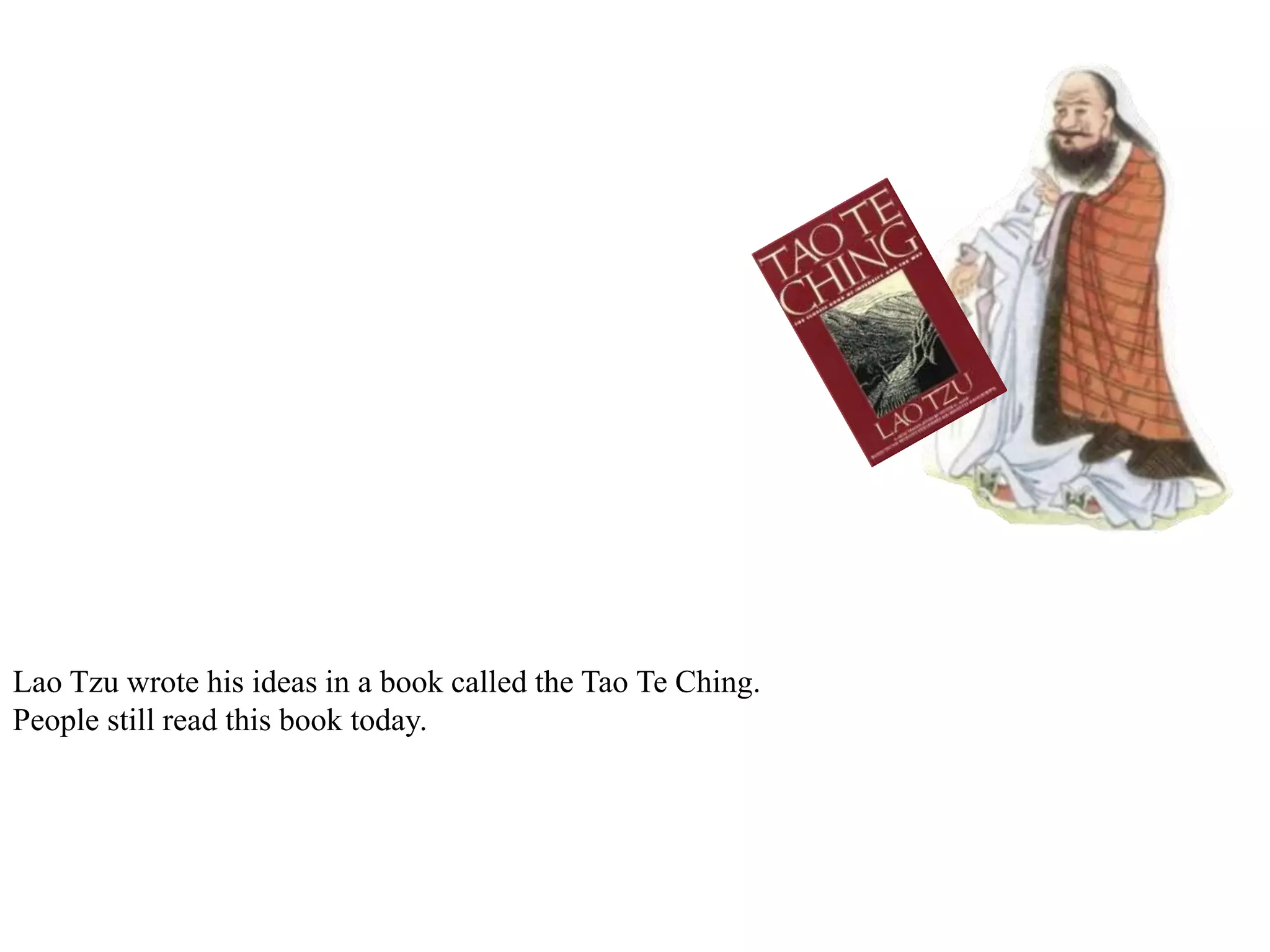
Lao Tzu wrote his ideas in a book called the Tao Te Ching.
People still read this book today.
Some historians believe that Lao Tzu taught another leader, Confucius.
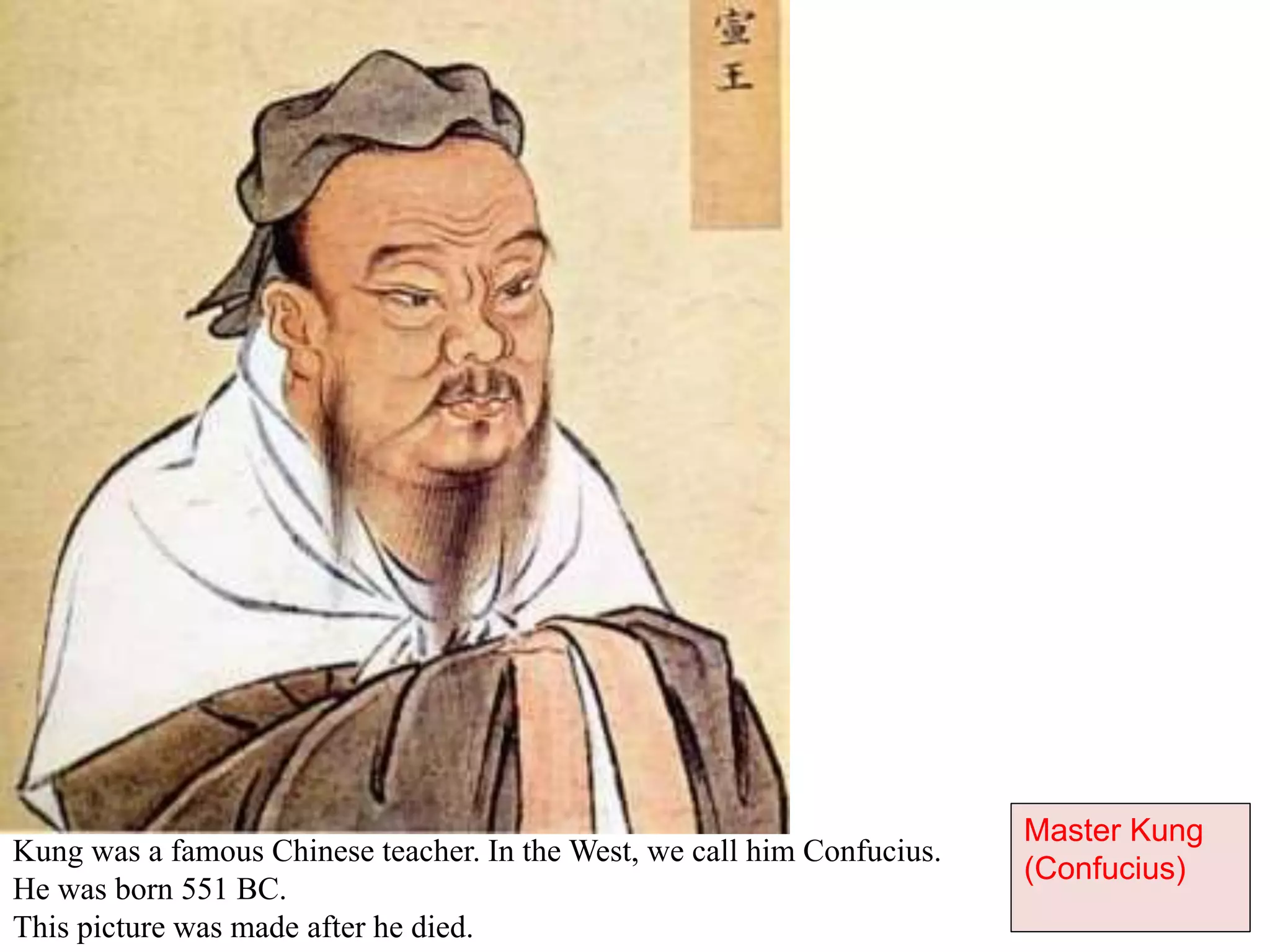
Kung was a famous Chinese teacher. In the West, we call him Confucius.
He was born 551 BC.
This picture was made after he died.
Master Kung
(Confucius)
I was a teacher.
My most important idea:
Accept your place in the world.
Master Kung
(Confucius)
People like my ideas about making
society successful.
Master Kung
(Confucius)
There are five important
relationships:
ruler people
husband wife
parent child
older brother younger brother
older friend younger friend
Master Kung
(Confucius)
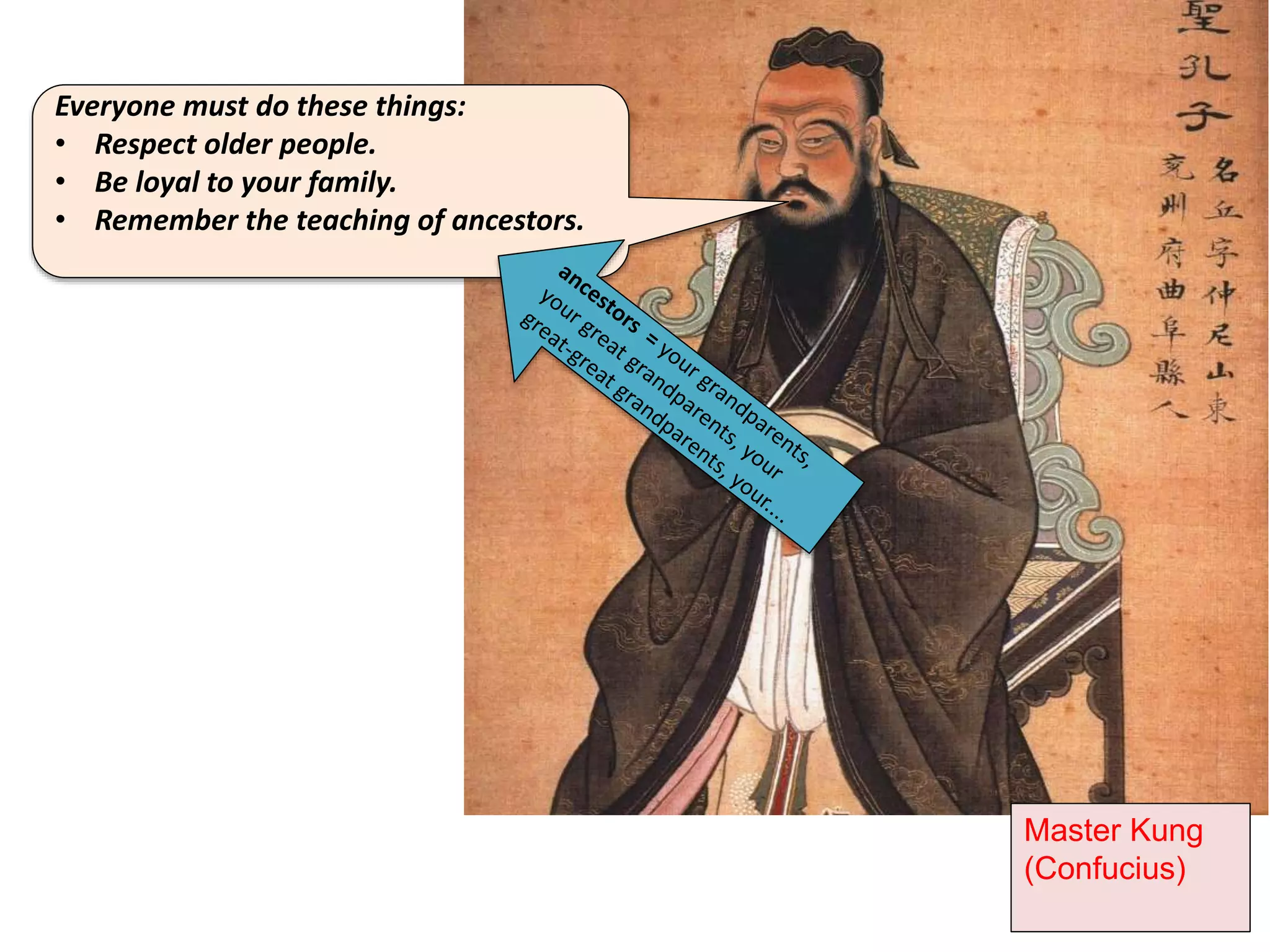
Everyone must do these things:
• Respect older people.
• Be loyal to your family.
• Remember the teaching of ancestors.
Master Kung
(Confucius)
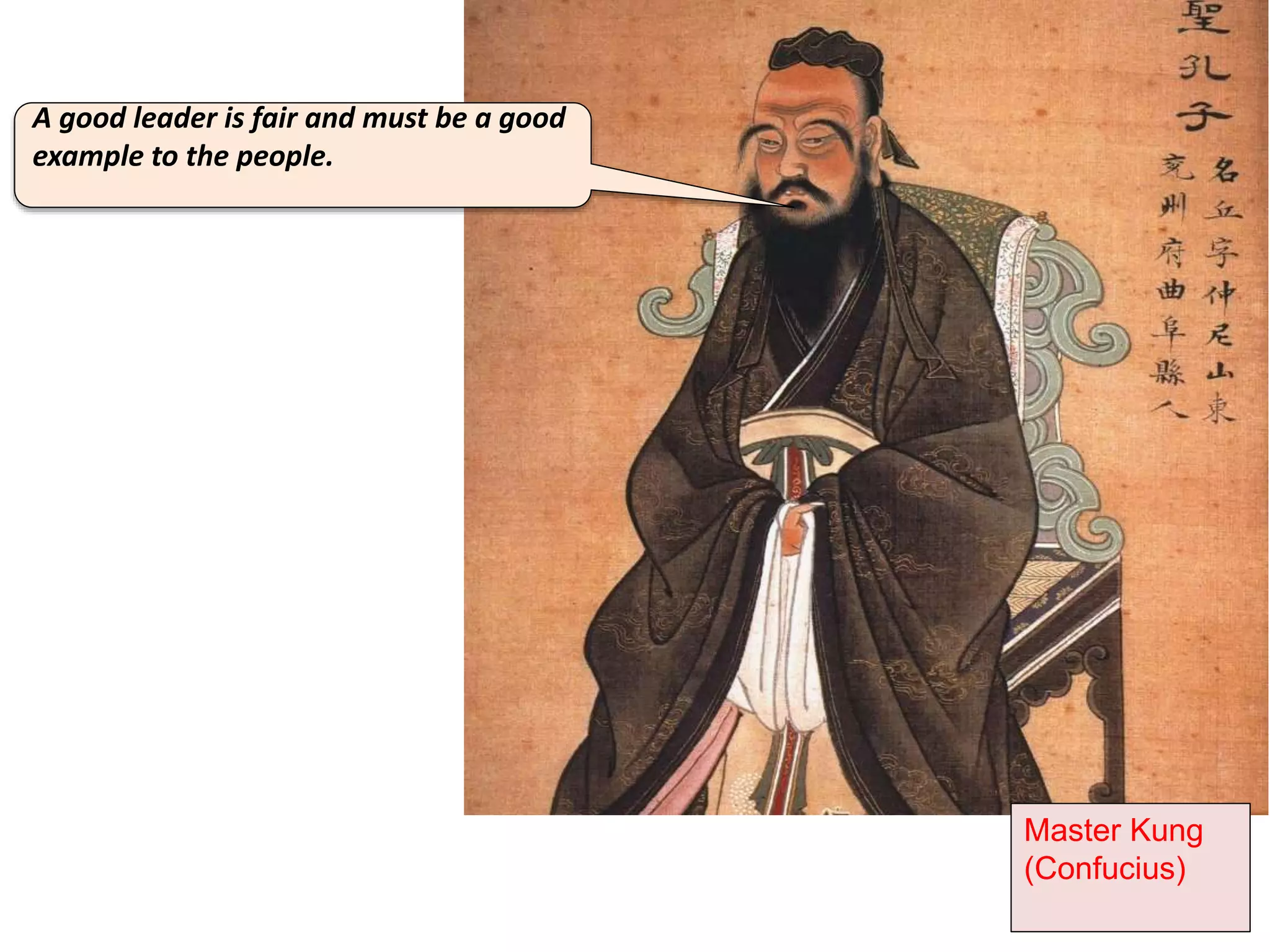
A good leader is fair and must be a good
example to the people.
Master Kung
(Confucius)
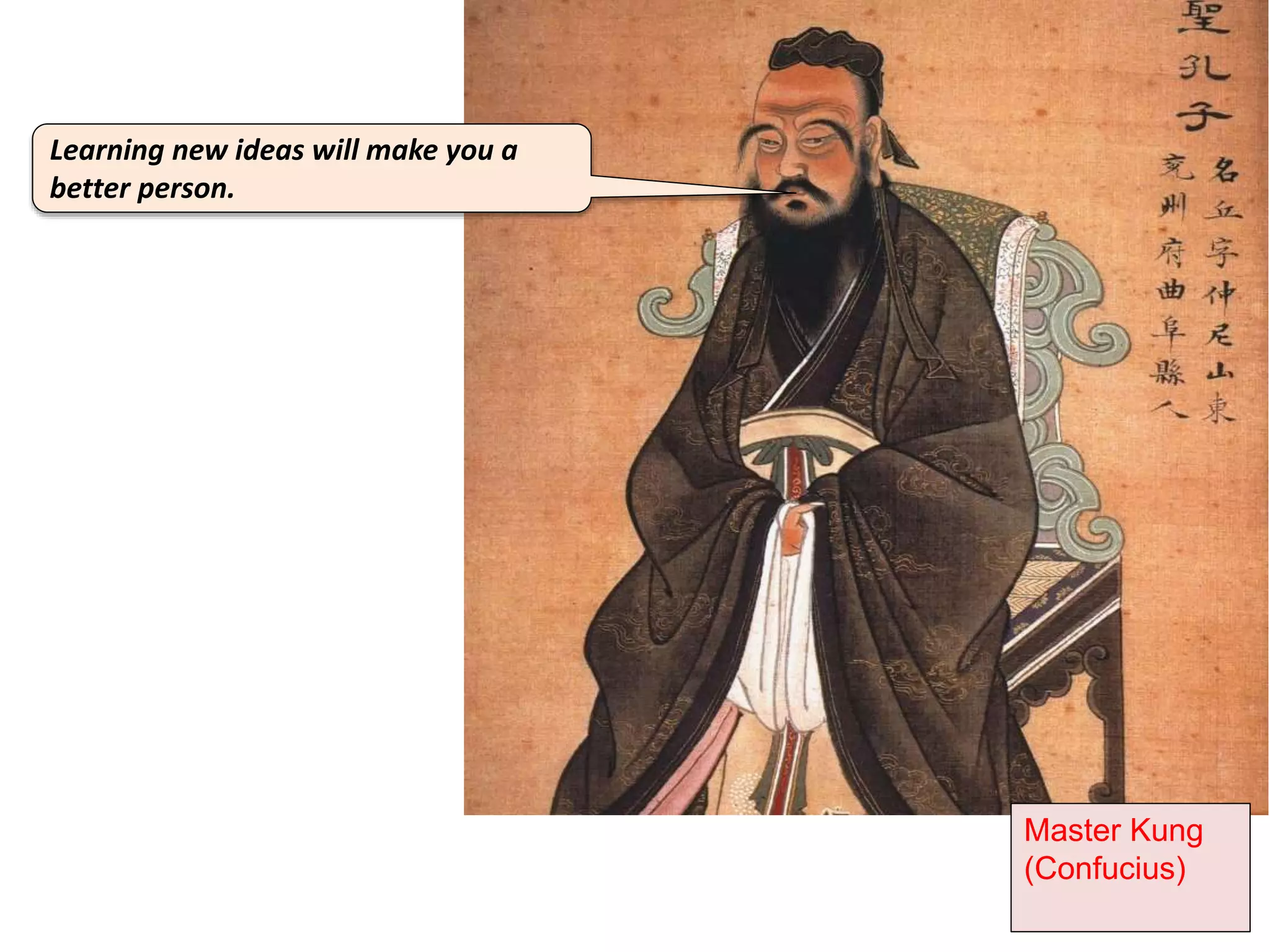
Learning new ideas will make you a
better person.
Master Kung
(Confucius)
Chinese Dynasties and Their Achievements
Dynasties
Notable
Rulers
Achievements
Xia Dynasty
2100-1800 B.C.E.
Aryans • Migrated into the area and conquered the local
peoples
• Developed superior weaponry and technology
Shang Dynasty
1500-1100 B.C.E.
Thirty
separate
kings
• Ruled from a succession of seven different
capitals.
• Invention of writing
Zhou Dynasty
1122-256 B.C.E.
Kings +
Noblemen
• Expansion
• Regional rulers
Qin Dynasty
221-206 B.C.E.
Qin • Centralization of authority
• Written laws
• Building projects (Great Wall of China)
Han Dynasty Han
Wudi
• 400 year rule
• Exploration (Zhang Qian)
• Expansion of trade
• Silk Road
• Pax Sinica
• Food reserves
• Merit-based appointments
Yu Yu and his ancestors conquered the people.
Yu protected people from Yellow River floods.
Zhou leaders built roads.
Confucianism and Taoism.
Yu and his ancestors conquered the people.
Yu protected people from Yellow River floods.
Built large cities (Anyang).
They invented writing.
Ruled for a short time but did many things.
Qin family built the Great Wall of China.
The name “China” comes from the name Qin.
Shang & 30
1.
2.
3.
4.
5.
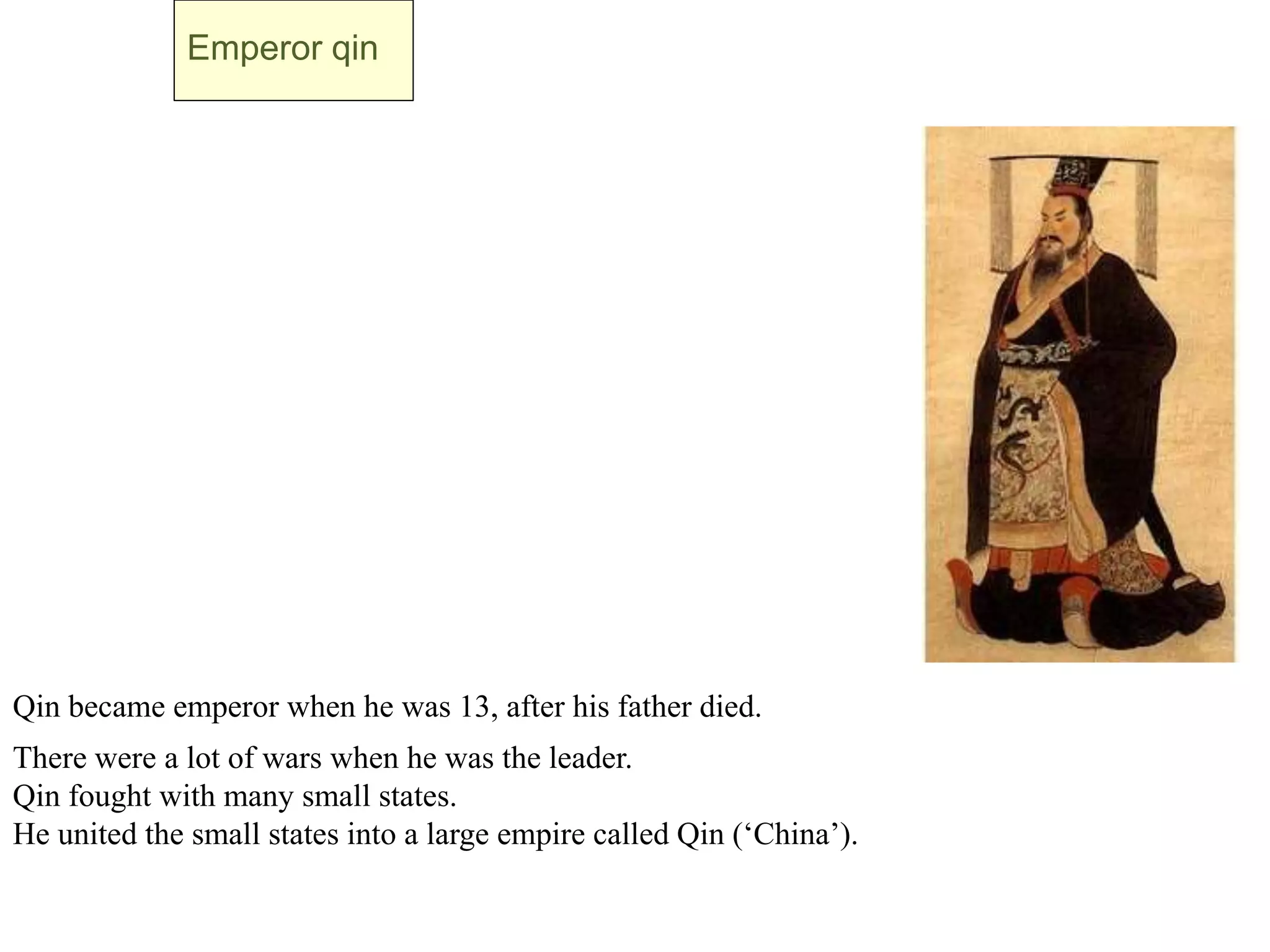
There were a lot of wars when he was the leader.
Qin fought with many small states.
He united the small states into a large empire called Qin (‘China’).
Emperor qin
Qin became emperor when he was 13, after his father died.
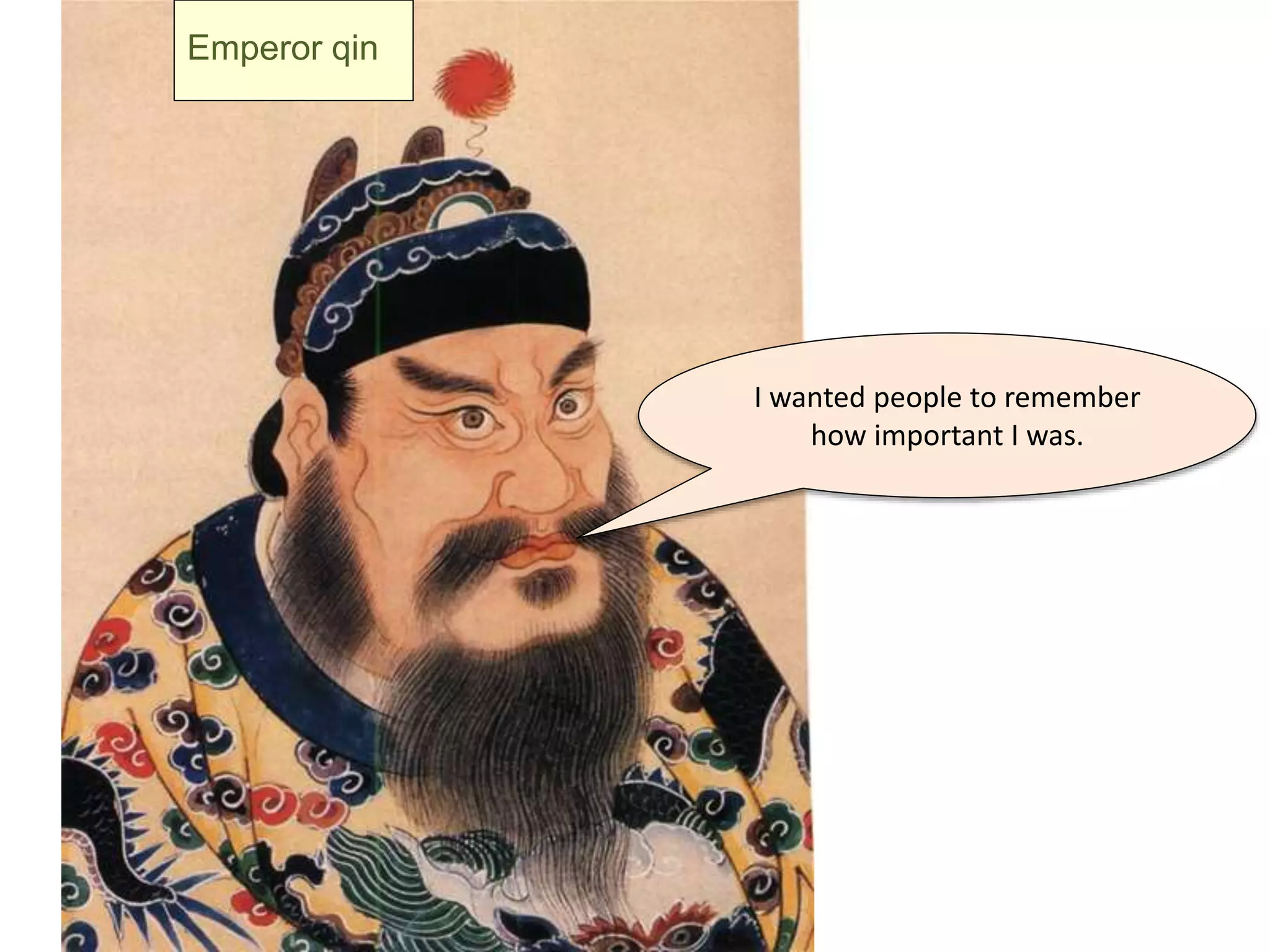
I wanted people to remember
how important I was.
Emperor qin
700,000 workers built an army
for my tomb.
Emperor qin
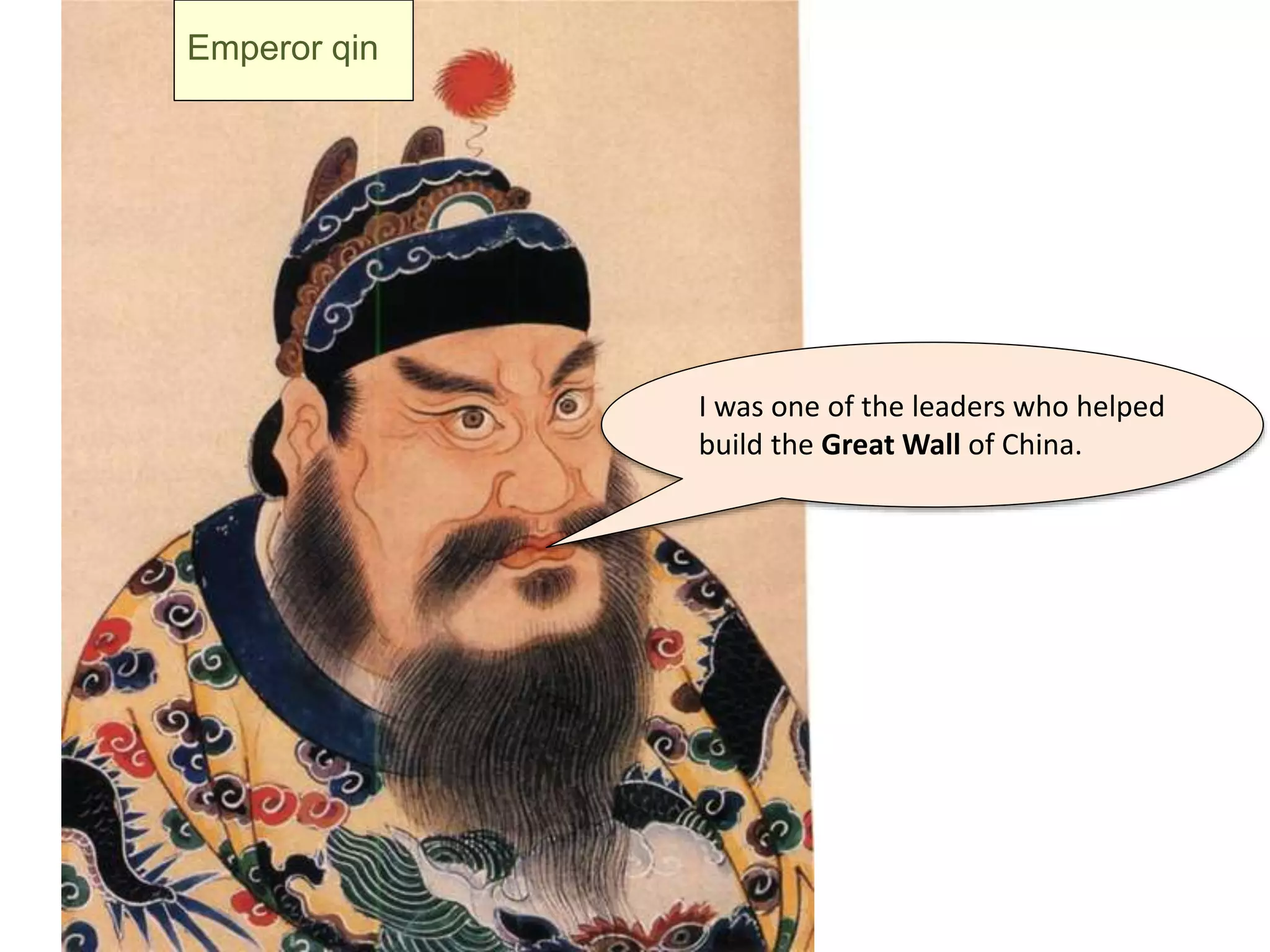
I was one of the leaders who helped
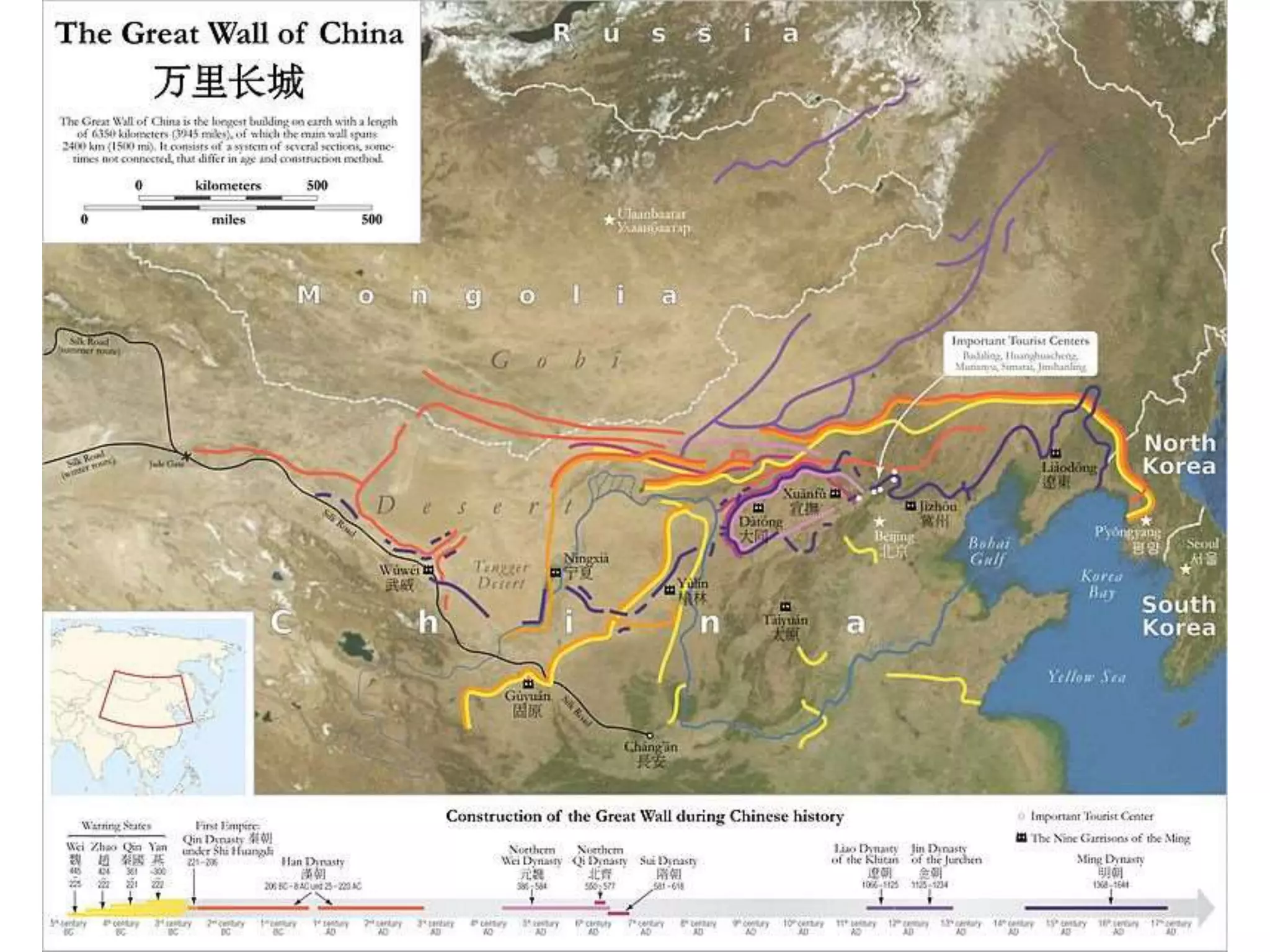
build the Great Wall of China.
Emperor qin
The Great Wall of China
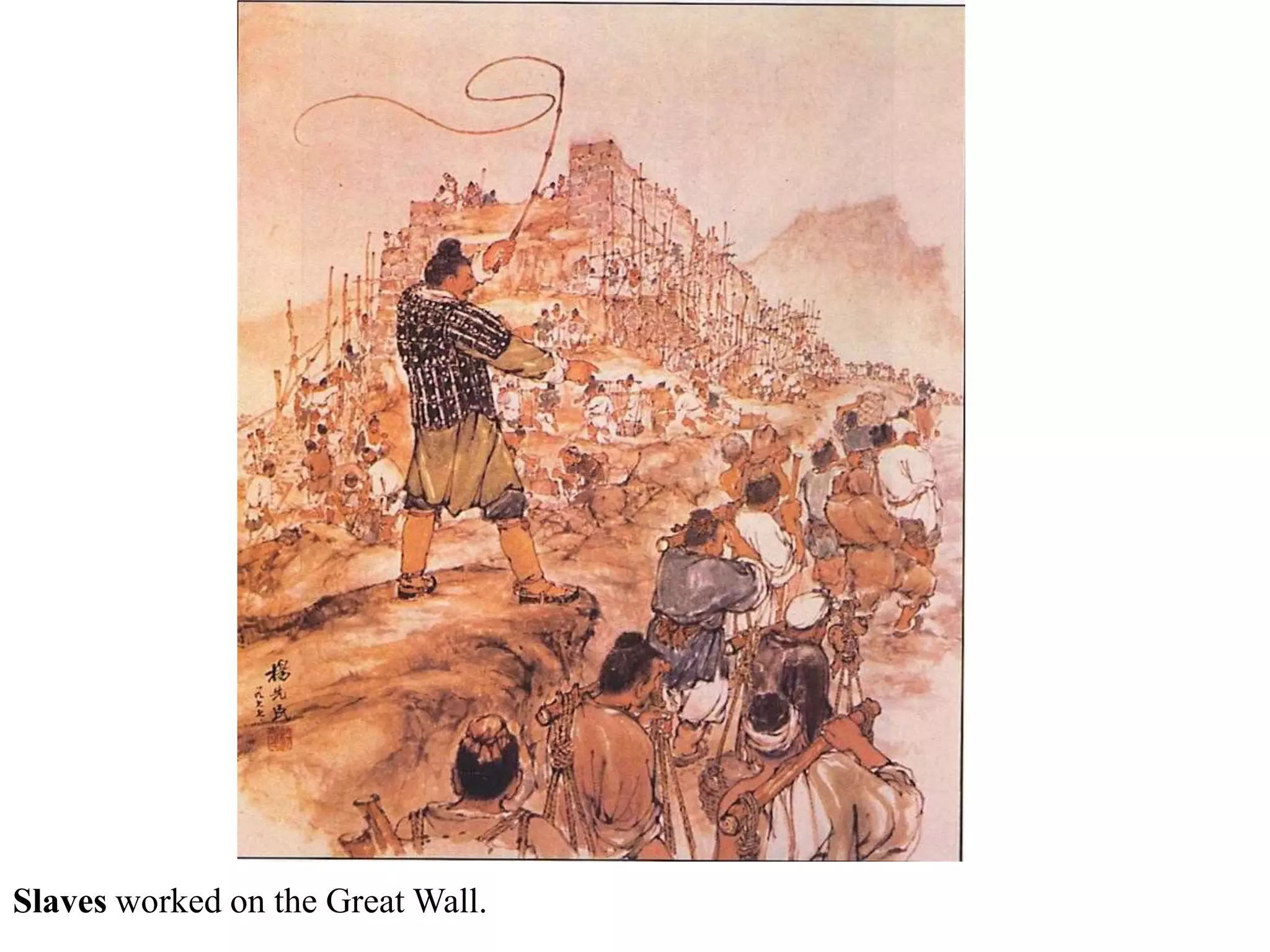
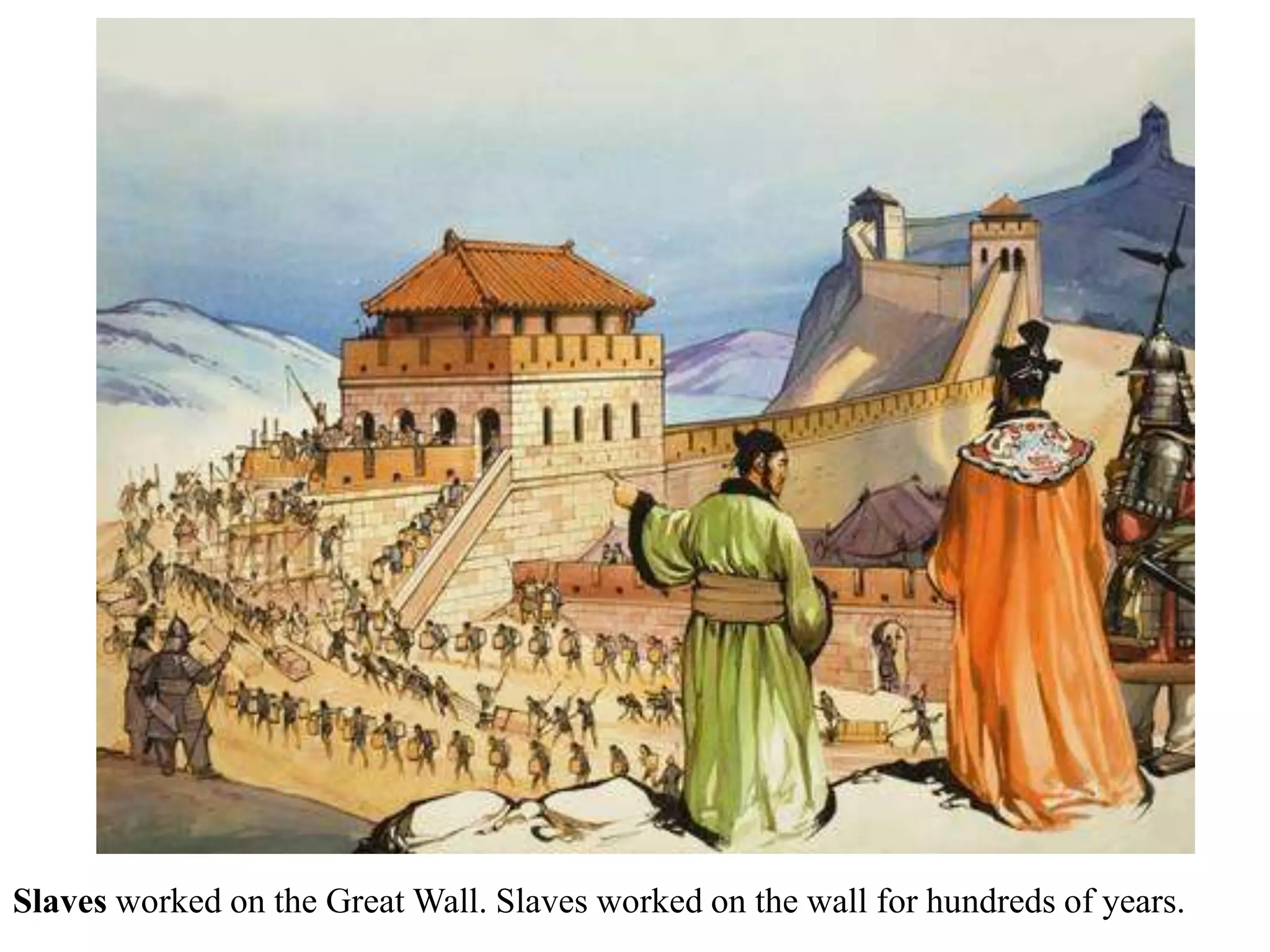
Slaves worked on the Great Wall.
Slaves worked on the Great Wall. Slaves worked on the wall for hundreds of years.
Chinese leaders built the Great Wall for protection.
Chines leaders built the
Great Wall for protection.
The Wall was built over
hundreds of years by slaves.
Chinese Dynasties and Their Achievements
Dynasties
Notable
Rulers
Achievements
Xia Dynasty
2100-1800 B.C.E.
Aryans • Migrated into the area and conquered the local
peoples
• Developed superior weaponry and technology
Shang Dynasty
1500-1100 B.C.E.
Thirty
separate
kings
• Ruled from a succession of seven different
capitals.
• Invention of writing
Zhou Dynasty
1122-256 B.C.E.
Kings +
Noblemen
• Expansion
• Regional rulers
Qin Dynasty
221-206 B.C.E.
Qin • Centralization of authority
• Written laws
• Building projects (Great Wall of China)
Han Dynasty Han
Wudi
• 400 year rule
• Exploration (Zhang Qian)
• Expansion of trade
• Silk Road
• Pax Sinica
• Food reserves
• Merit-based appointments
Yu Yu and his ancestors conquered the people.
Yu protected people from Yellow River floods.
Zhou leaders built roads.
Confucianism and Taoism.
Built large cities (Anyang).
They invented writing.
Ruled for a short time but did many things.
Qin family built the Great Wall of China.
The name “China” comes from the name Qin.
Shang & 30
1.
2.
3.
4.
5.
http://randomwire.com/silk-production-in-wuzhen/
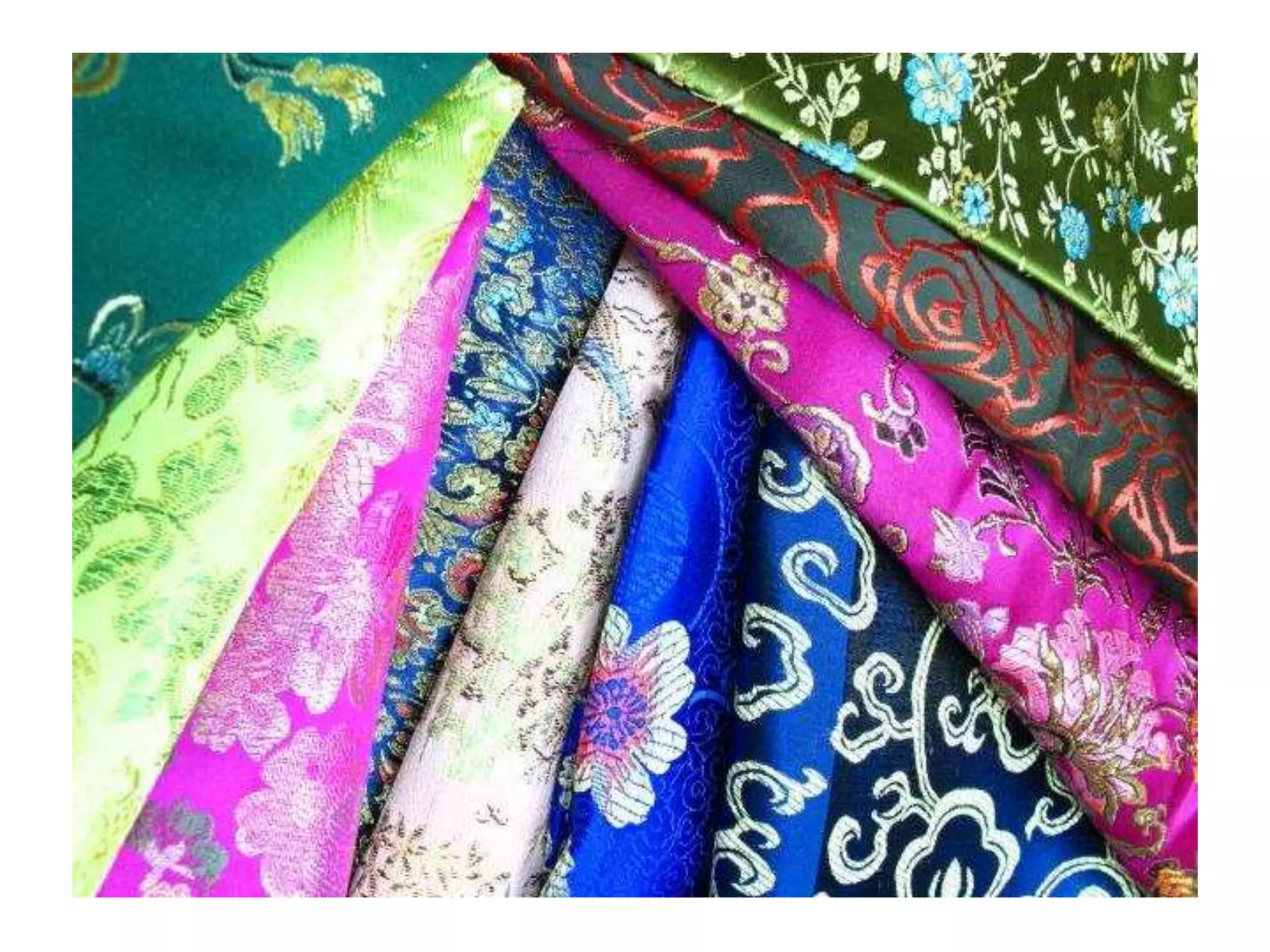
Silk was important for trade.
Kings and Queens in Europe wanted silk from Asia.
Women inspecting silk, created around 1200 AD.
Silk was important for trade.
Kings and Queens in Europe wanted silk from Asia.
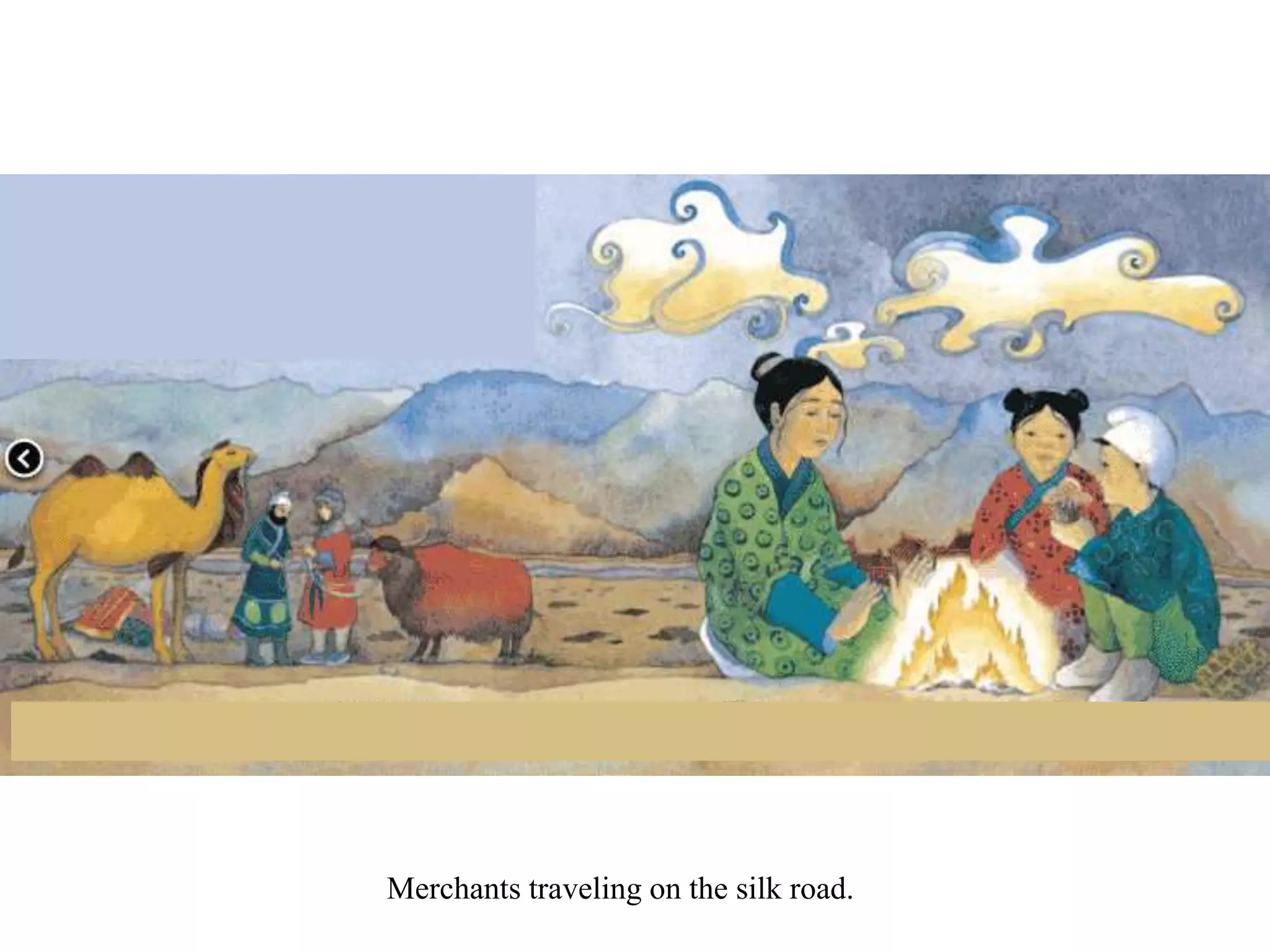
Asian traders traveled very far on the Silk Road to
bring beautiful clothes to Europe.
Merchants traveling on the silk road.
Wall of China
Terra Cotta army
Roads, canals improved
The Qin Dynasty
Made the Great Wall of China bigger
Improved more roads
Invented the wheelbarrow, ship’s
rudder, fishing reel
The Han Dynasty
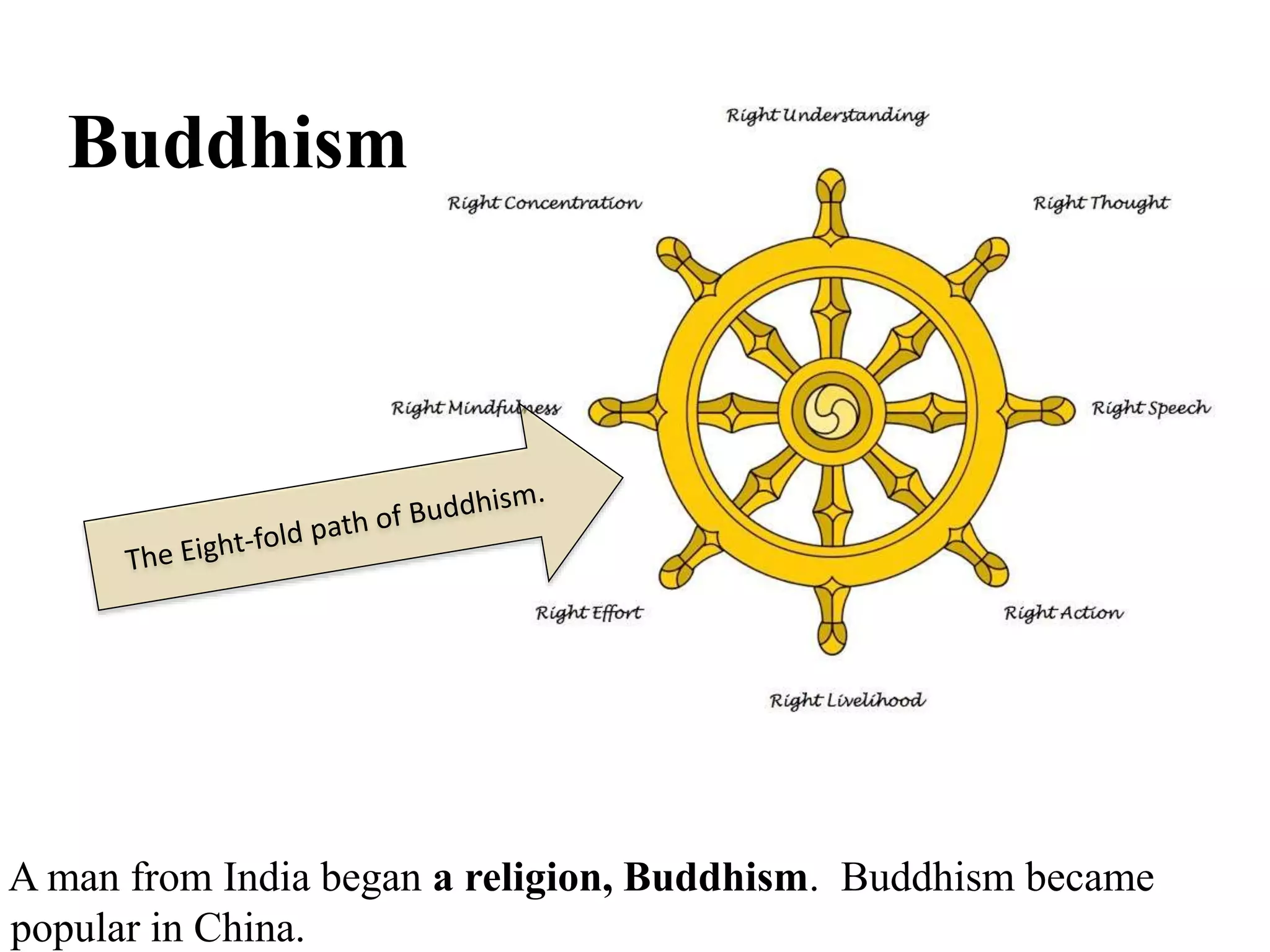
A man from India began a religion, Buddhism. Buddhism became
popular in China.
A man from India began a religion, Buddhism. Buddhism became
popular in China.
Buddhism
A man from India began a religion, Buddhism. Buddhism became
popular in China.
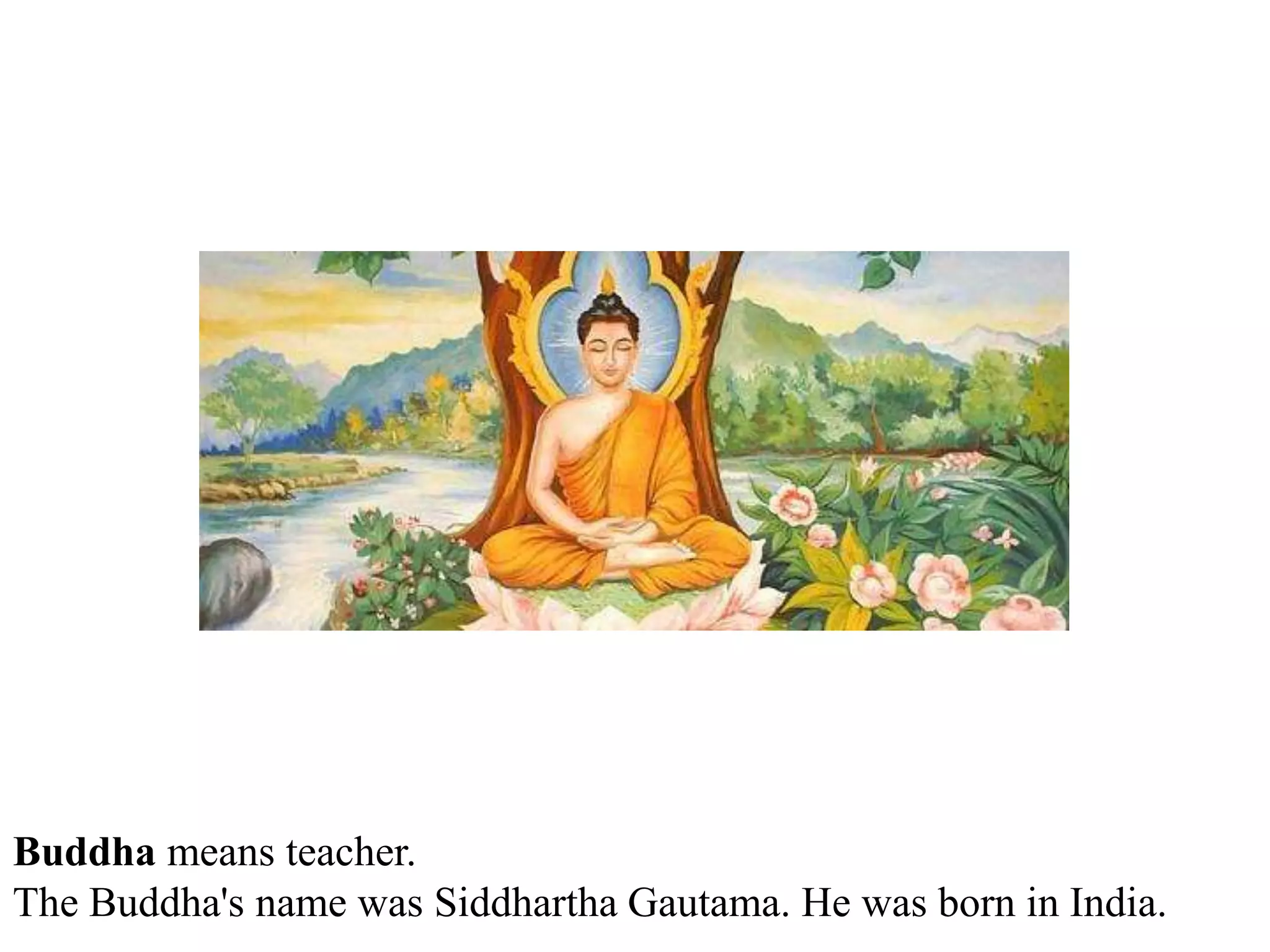
Buddha means teacher.
The Buddha's name was Siddhartha Gautama. He was born in India.
Around 450 A.D., artists carved huge, beautiful statues of Buddha in caves near Wuzhoushan Mountains.
A Qing Dynasty print showing
Confucius presenting Guatama Buddha
to the philosopher Lao-Tzu.
Confucius
the Buddha
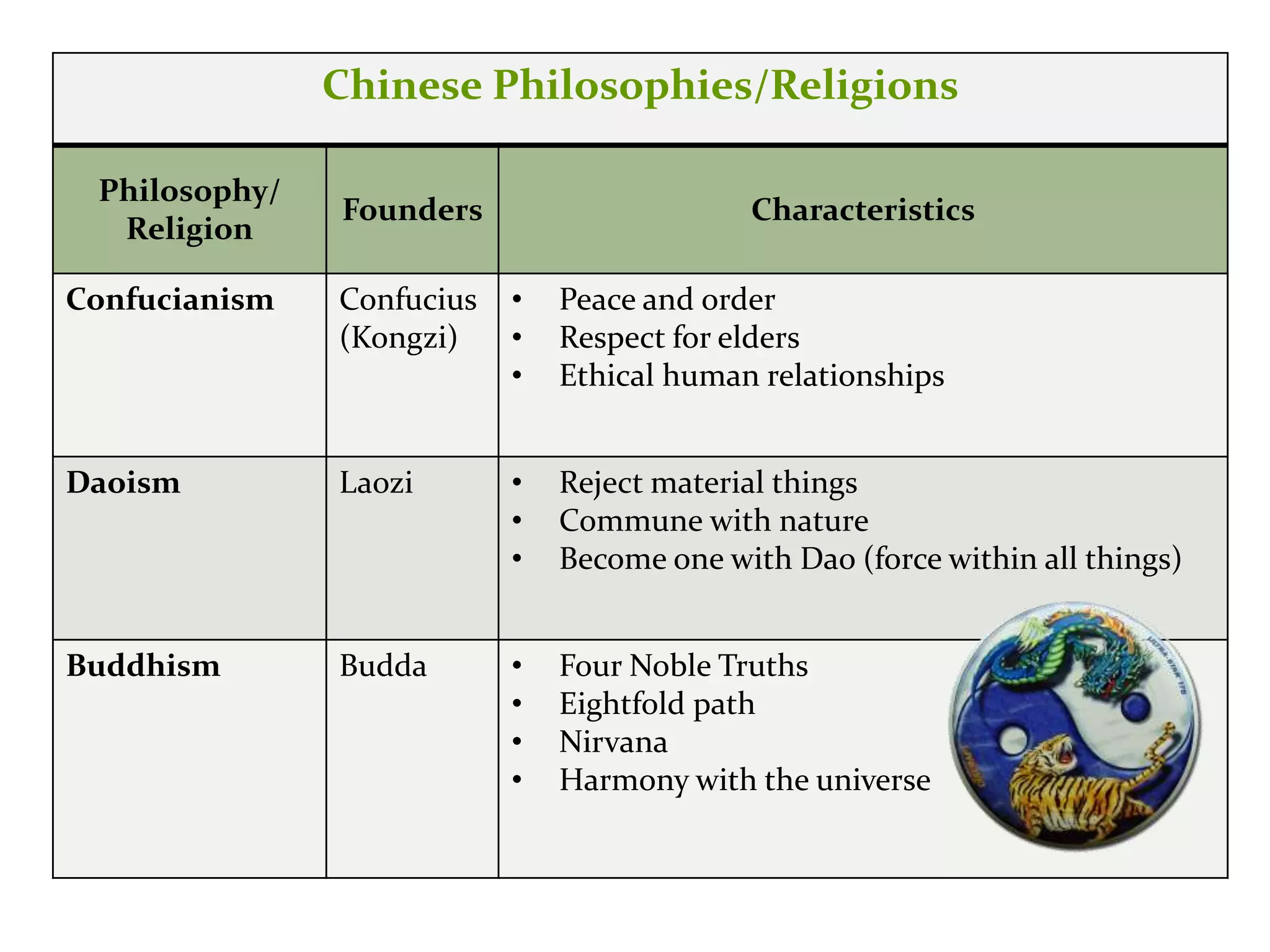
Chinese Philosophies/Religions
Philosophy/
Religion
Founders Characteristics
Confucianism Confucius
(Kongzi)
• Peace and order
• Respect for elders
• Ethical human relationships
Daoism Laozi • Reject material things
• Commune with nature
• Become one with Dao (force within all things)
Buddhism Budda • Four Noble Truths
• Eightfold path
• Nirvana
• Harmony with the universe
Advanced+Ci' es+
+
Complex+Ins' tu' ons+
+
Civiliza' ons+Have+5+Parts+
Government Religion
Advanced+Ci' es+
+
Complex+Ins' tu' ons+
+
Civiliza' ons+Have+5+Parts+
Government Religion
Advanced+Ci' es+
+
Complex+Ins' tu' ons+
+
Record+Keeping+
+
Advanced+Technology+
+
Specialized+Labor+
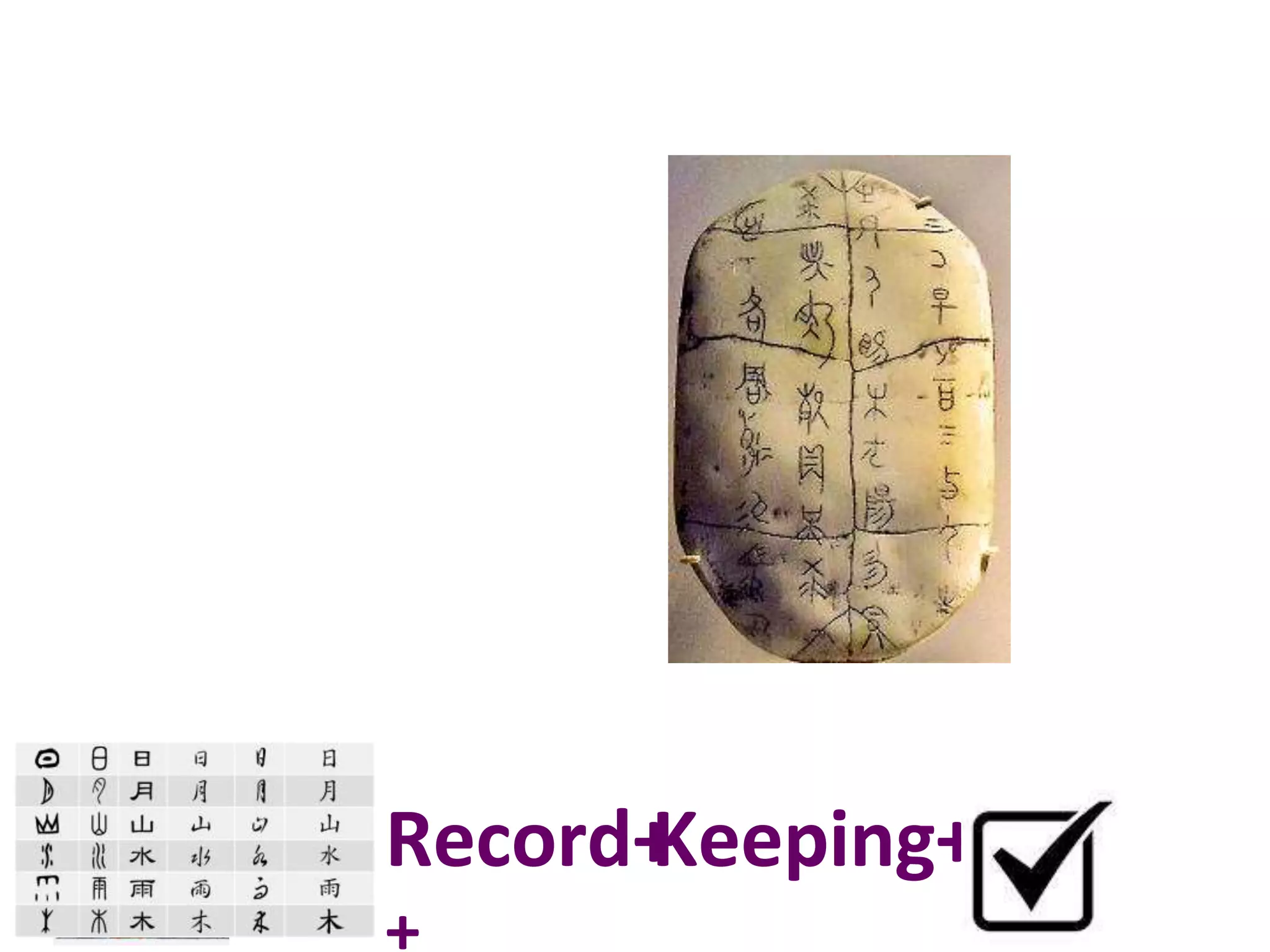
Leaders of the first cities used writing for record
keeping. Government scribes wrote how much
food farmers grew and how much taxes people paid.
mproved technology: First, stone tools,
then metal tools. Metal tools were better.
+"""""""""""""="metal"
Civiliza' ons+Have+5+Parts+
The people of ancient China invented the first sundial
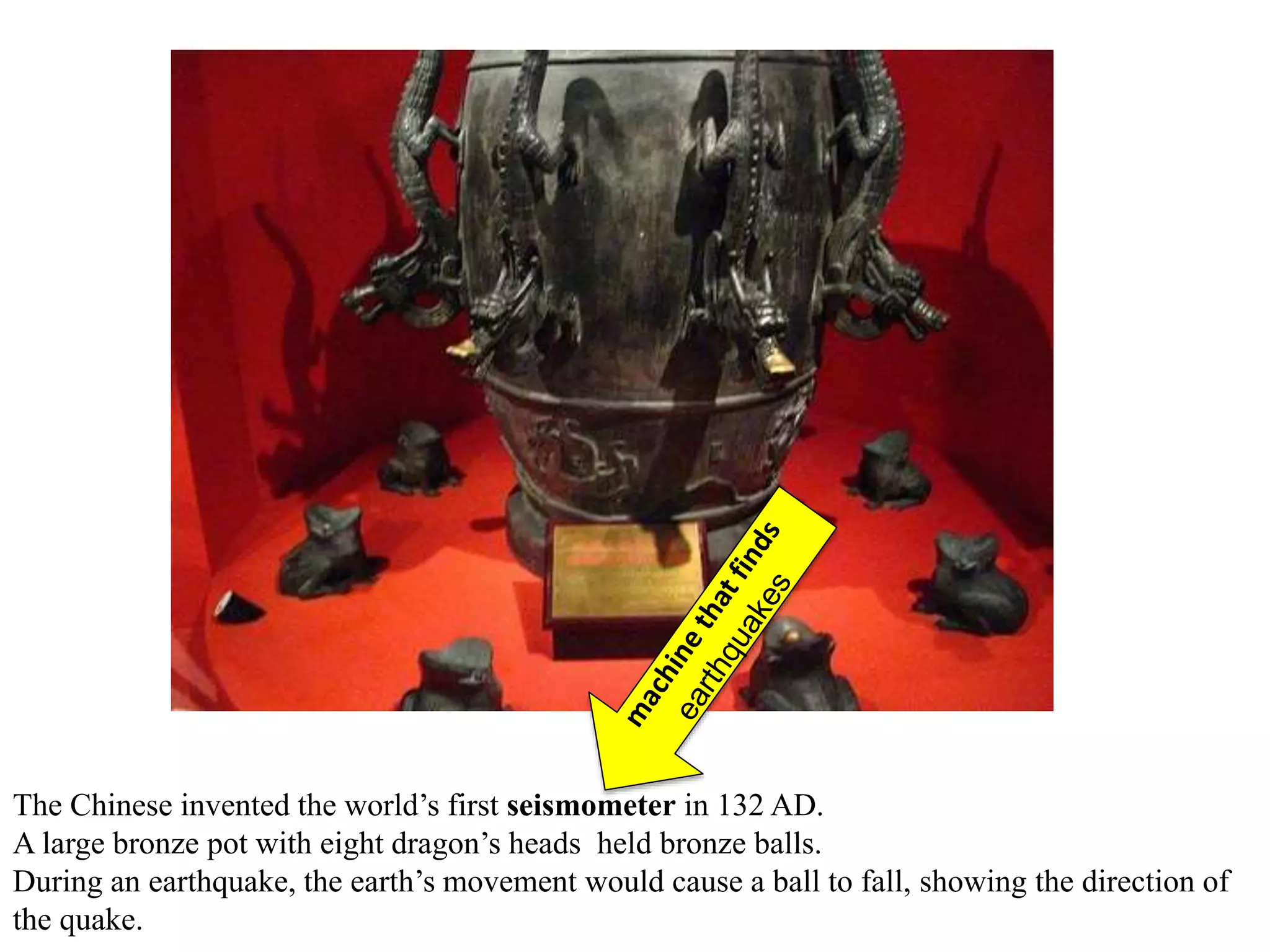
The Chinese invented the world’s first seismometer in 132 AD.
A large bronze pot with eight dragon’s heads held bronze balls.
During an earthquake, the earth’s movement would cause a ball to fall, showing the direction of
the quake.
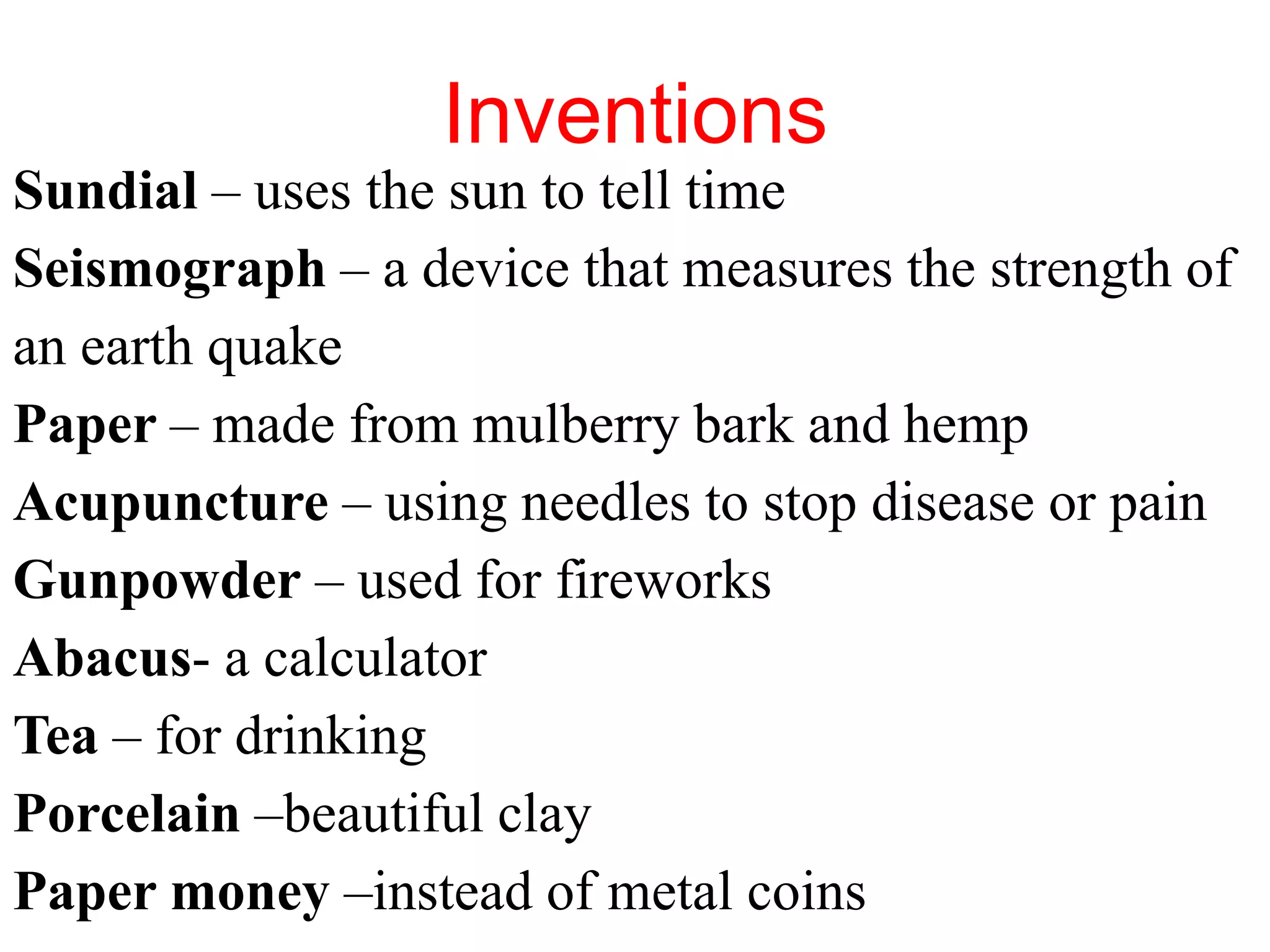
Inventions
Sundial – uses the sun to tell time
Seismograph – a device that measures the strength of
an earth quake
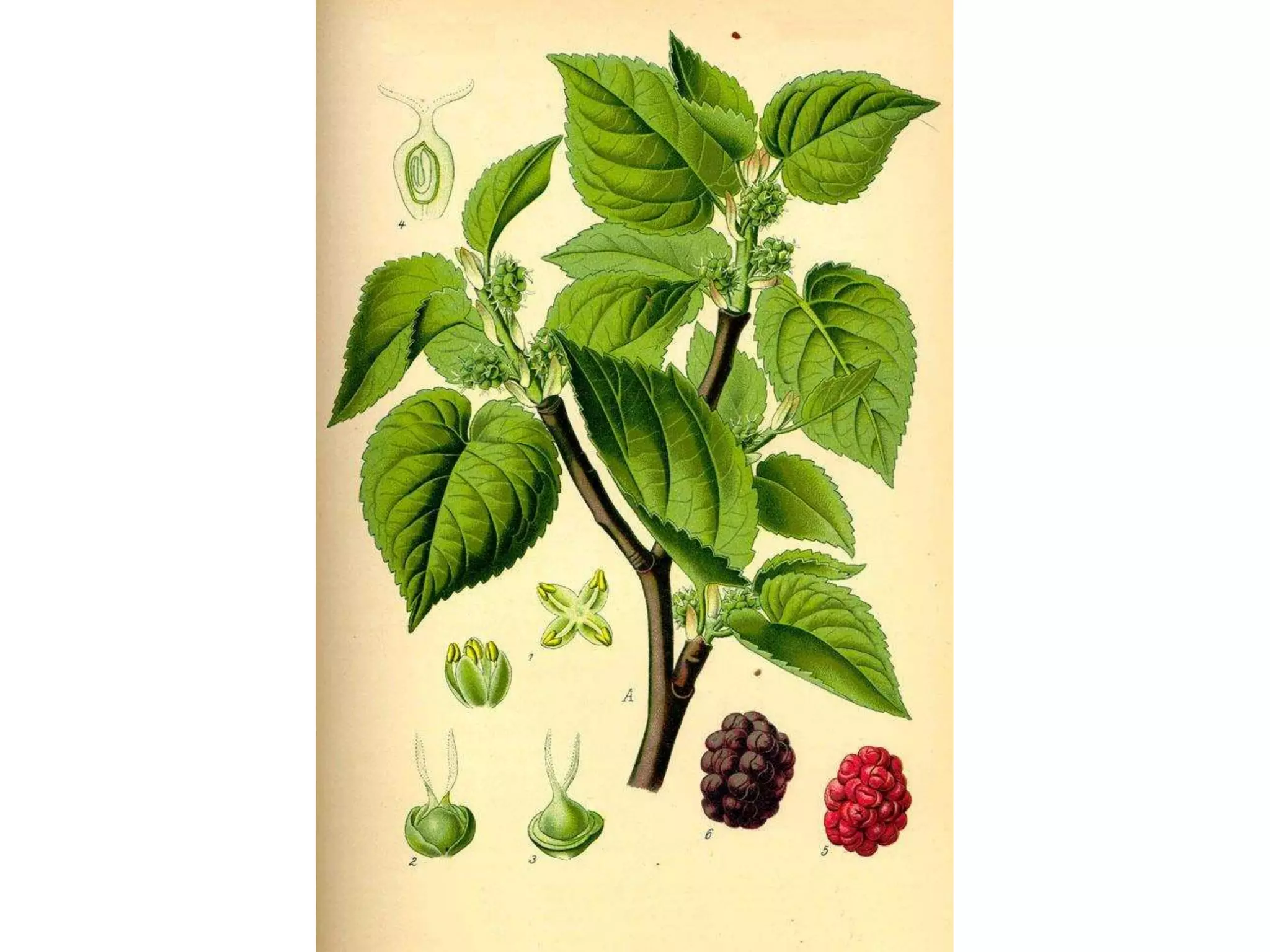
Paper – made from mulberry bark and hemp
Acupuncture – using needles through the skin at
specific places to cure disease or relieve pain
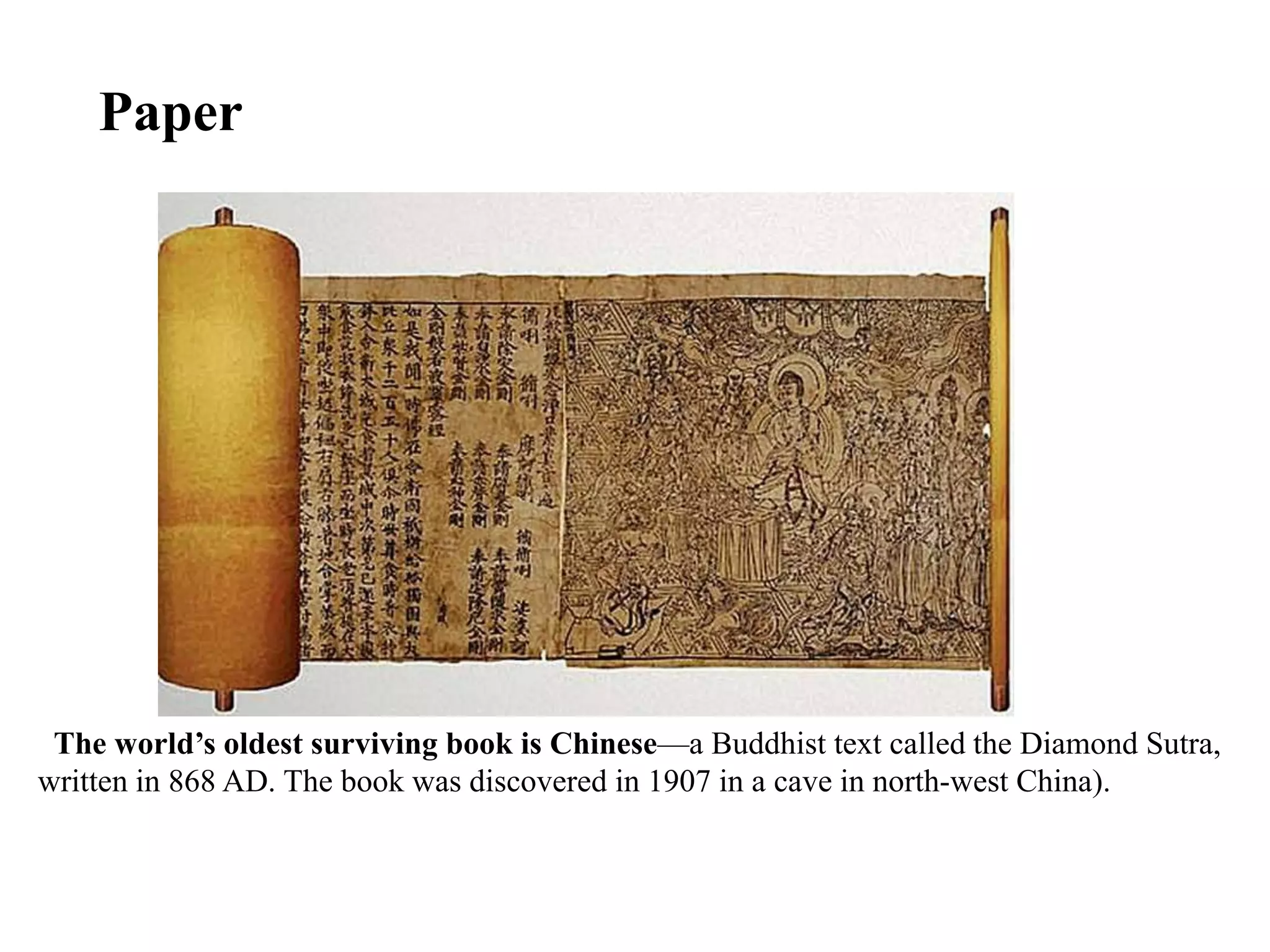
The world’s oldest surviving book is Chinese—a Buddhist text called the Diamond Sutra,
written in 868 AD. The book was discovered in 1907 in a cave in north-west China)..
Paper
Inventions
Sundial – uses the sun to tell time
Seismograph – a device that measures the strength of
an earth quake
Paper – made from tree bark and hemp
Acupuncture – using needles to stop disease or pain
Acupuncture—using needles to stop pain
The people of ancient China invented gunpowder.
This is an ancient jfirecracker.s.
Inventions
Sundial – uses the sun to tell time
Seismograph – a device that measures the strength of
an earth quake
Paper – made from mulberry bark and hemp
Acupuncture – using needles to stop disease or pain
Gunpowder – used for fireworks
The people of ancient China invented the abacus.
The people of ancient China invented the idea of drinking tea.
Inventions
Sundial – uses the sun to tell time
Seismograph – a device that measures the strength of
an earth quake
Paper – made from mulberry bark and hemp
Acupuncture – using needles to stop disease or pain
Gunpowder – used for fireworks
Abacus- a calculator
Tea – for drinking
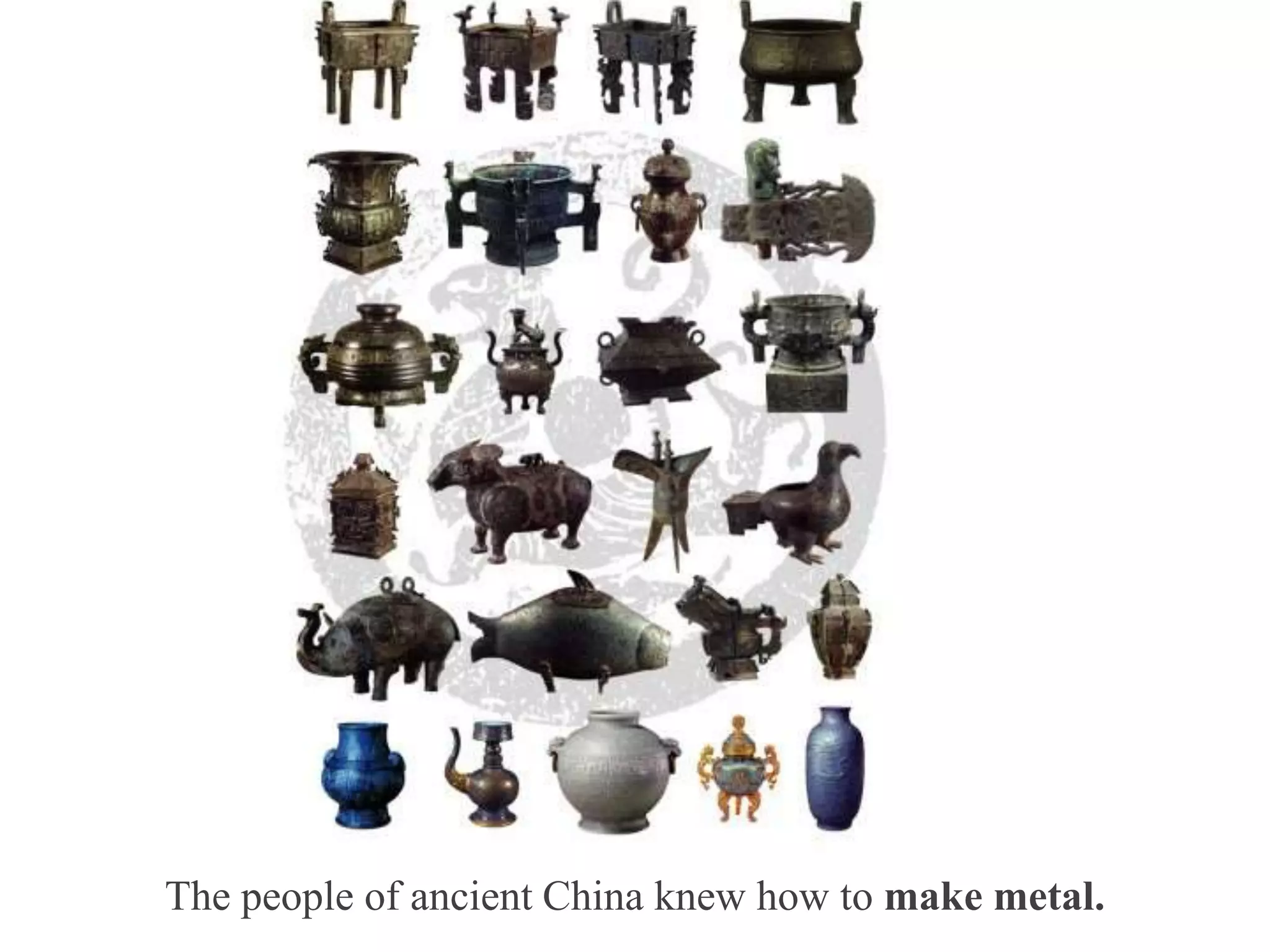
The people of ancient China knew how to make metal.
The people of ancient China invented special clay called porcelain.
Ancient Chinese paper money.
Inventions
Sundial – uses the sun to tell time
Seismograph – a device that measures the strength of
an earth quake
Paper – made from mulberry bark and hemp
Acupuncture – using needles to stop disease or pain
Gunpowder – used for fireworks
Abacus- a calculator
Tea – for drinking
Porcelain –beautiful clay
Paper money –instead of metal coins
Advanced+Ci' es+
+
Complex+Ins' tu' ons+
+
Record+Keeping+
+
Advanced+Technology+
Leaders of the first cities used writing for record
keeping. Government scribes wrote how much
food farmers grew and how much taxes people paid.
Improved technology: First, stone tools,
then metal tools. Metal tools were better.
+"""""""""""""="metal"
Civiliza' ons+Have+5+Parts+
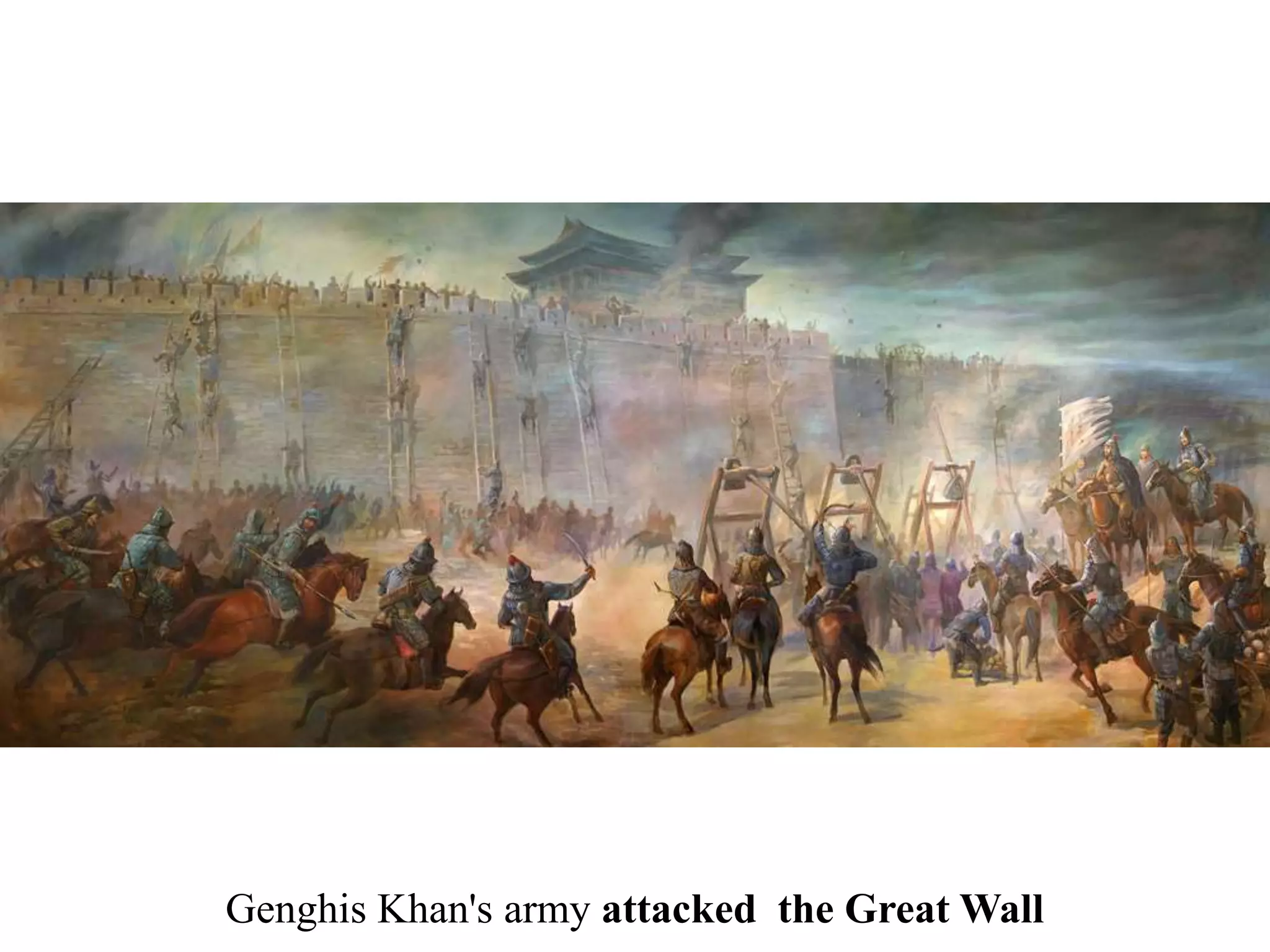
The Mongol Invasion
About the year 1162, a leader Temujin ruled a group called the Mongols.
He changed his name to Genghis Khan.
Genghis Khan was a strong leader who conquered a lot of land in Asia.
Genghis Khan's Elite Warlords
Genghis Khan's army attacked the Great Wall
Today, you can visit this huge statue of Genghis Khan.
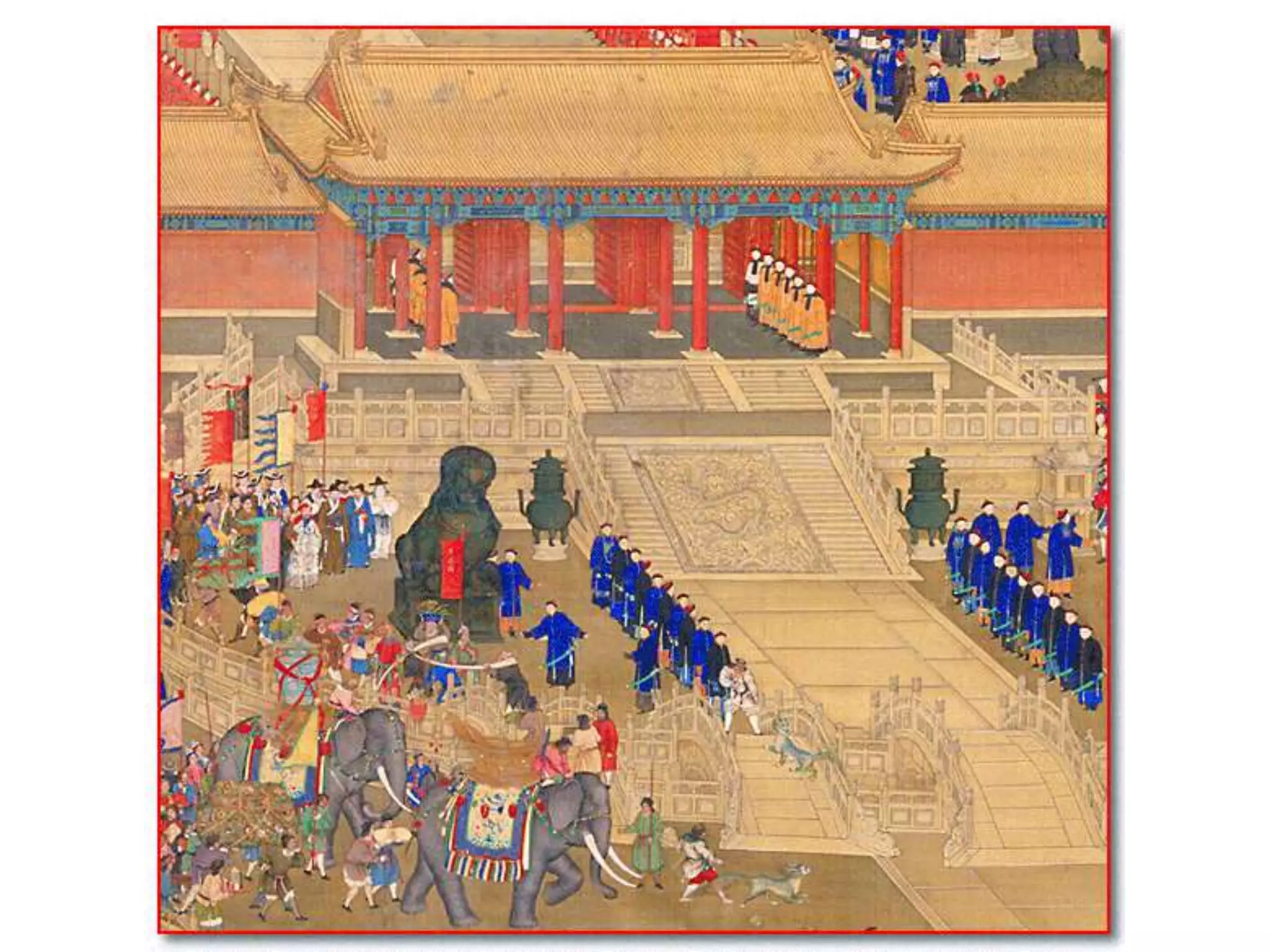
The Forbidden City
The Forbidden City was built in the 1400s. It has 980 buildings.
Twenty-four different emperors from the Ming and Qing Dynasties lived there until 1924.
Today, it is a museum.
An Ancient Painting of the Forbidden City
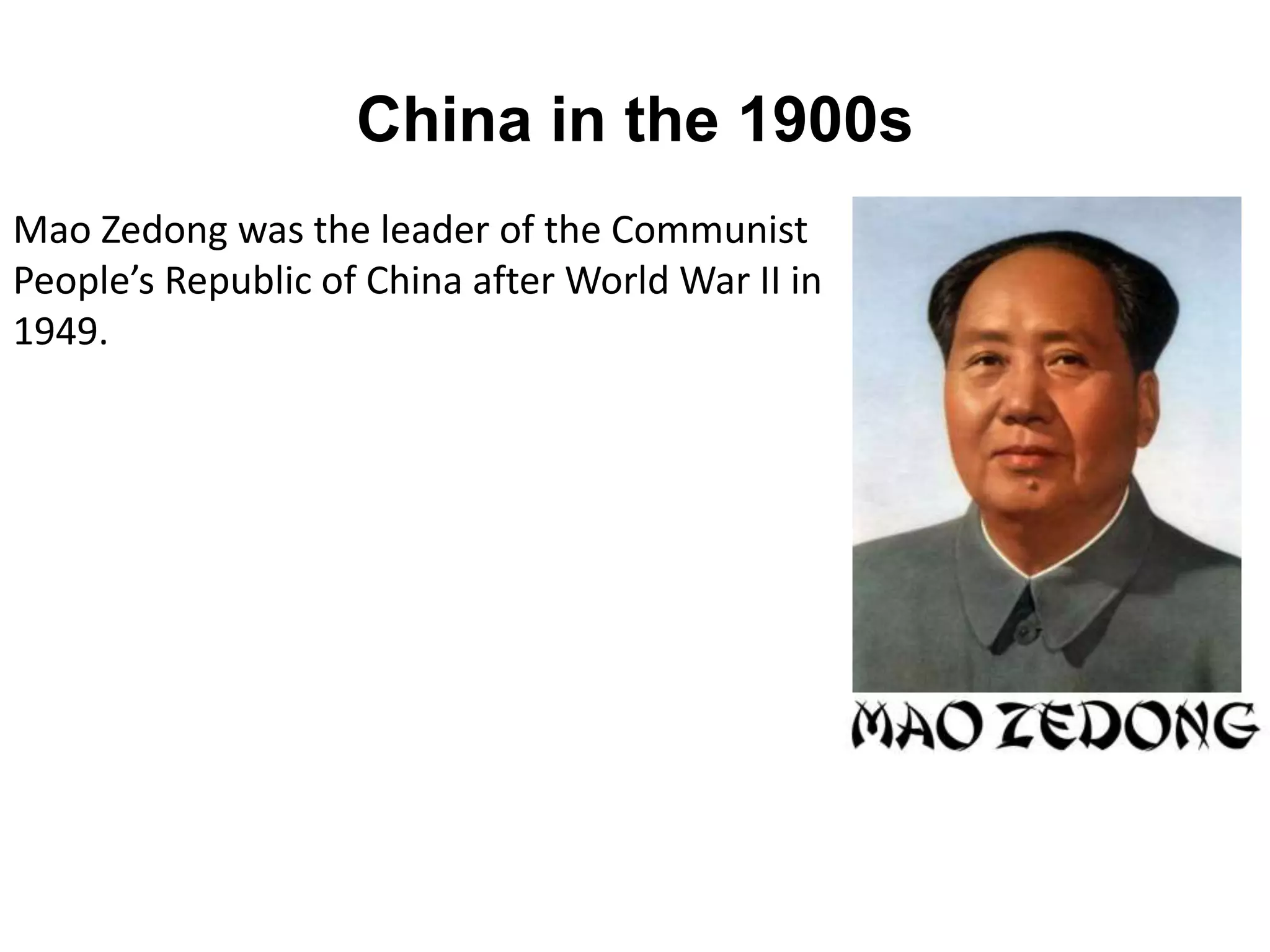
China in the 1900s
Mao Zedong started the People’s Republic of
China in 1949.
China in the 1900s
Mao Zedong was the leader of the Communist
People’s Republic of China after World War II in
1949.
China in the 1900s
Poster of Mao’s wife, Madame Mao holding The “Little Red Book.”
“The invincible thoughts of Mao Zedong illuminate the images of revolutionary art!”
Mao Zedong was the leader of the Communist
People’s Republic of China after World War II in
1949.
Xi Jinping is China’s leader today.
Civilizations Have 5 Parts
Advanced(Ci+es(
(
Complex(Ins+tu+ons(
(
Record(Keeping(
(
Advanced(Technology(
(
Specialized(Labor(
Civiliza+ons(Have(5(Parts(
!
!
The Yellow River Valley of China was an important
civilization.
Ancient ChinaWhere is China?
What are 2 important rivers in China?
Why did they build dams in ancient China?
What were dynasties?
Who built the Great Wall?
What was the Great Wall of China?
Who were important teachers in China?
What did Confucius say?
How did ancient Chinese people make silk clothes?

Images of Ancient China

  • 1.
  • 2.
    Yellow Sea South ChinaSea Sea of Japan Bay of Bengal Pacific Ocean Yangtze River Yellow River Himalayan Mts. Mount Everest Gobi Desert Taklamakan Desert China Mongolia Taiwan Japan Korea Russia India Tibet
  • 3.
    Yellow Sea South ChinaSea Sea of Japan Bay of Bengal Pacific Ocean Yangtze River Yellow River Himalayan Mts. Mount Everest Gobi Desert Taklamakan Desert China Mongolia Taiwan Japan Korea Russia India Tibet CHINA TAIWANINDIA RUSSIA MONGOLIA TIBET Bay of Bengal South China Sea Pacific Ocean
  • 5.
    Ancient ChinaWhere isChina? What are 2 important rivers in China? Why did they build dams in ancient China? What were dynasties? What was the Great Wall of China and who built it? Who were important teachers in China? What did Confucius say? How did ancient Chinese people make silk clothes?
  • 6.
  • 9.
    China and USAare about the same size.
  • 10.
    Some people say:China’s shape looks like a moose!
  • 11.
    Some people say:China’s shape looks like a moose!
  • 12.
    Some people say:China’s shape looks like a moose!
  • 13.
    China was isolatedbecause of geography. sd
  • 14.
    Three things blockedChina from the rest of the world: oceans, Oceans
  • 15.
  • 16.
    Three things blockedChina from the rest of the world: oceans, mountains Oceans Mountains
  • 17.
    The ‘Floating Mountainsof Zhangjiajie National Forest Park are in central China.
  • 18.
    The ‘Floating Mountainsof Zhangjiajie National Forest Park are in central China.
  • 19.
    Three things blockedChina from the rest of the world: oceans, mountains and deserts. Oceans Mountains Deserts
  • 20.
    The Talamakan Desertis in the northwest of China.
  • 21.
    Three things blockedChina from the rest of the world: oceans, mountains and deserts. Oceans Mountains Deserts
  • 24.
  • 25.
    Just like otherRiver Civilizations, the people who lived near the Yellow River were farmers.
  • 26.
    Just like otherRiver Civilizations, the people who lived near the Yellow River were farmers.
  • 27.
    There was lotsof loess near the Yellow River, which was very good for growing food.
  • 28.
    The Yellow Riverfarmers began a civilization 4,000 years ago.
  • 29.
    Rice farming inancient China.
  • 30.
    Who were theleaders of ancient China? Dynasties
  • 31.
    Dynasties ruled China. Dynasties= families who pass power to rule the nation from father to son. Who were the leaders of ancient China? Dynasties
  • 32.
    Dynasties ruled China. Dynasties= families who pass power to rule the nation from father to son. Power Who were the leaders of ancient China? Dynasties
  • 33.
    Chinese Dynasties andTheir Achievements Dynasties Notable Rulers Achievements Xia Dynasty 2100-1800 B.C.E. Aryans • Migrated into the area and conquered the local peoples • Developed superior weaponry and technology Shang Dynasty 1500-1100 B.C.E. Thirty separate kings • Ruled from a succession of seven different capitals. • Invention of writing Zhou Dynasty 1122-256 B.C.E. Kings + Noblemen • Expansion • Regional rulers Qin Dynasty 221-206 B.C.E. Qin • Centralization of authority • Written laws • Building projects (Great Wall of China) Han Dynasty Han Wudi • 400 year rule • Exploration (Zhang Qian) • Expansion of trade • Silk Road • Pax Sinica • Food reserves • Merit-based appointments Yu Yu and his ancestors conquered the people. Yu protected people from Yellow River floods. Yu and his ancestors conquered the people. Yu protected people from Yellow River floods. Yu and his ancestors conquered the people. Yu protected people from Yellow River floods. Built large cities (Anyang). They invented writing. Ruled for a short time but did many things. Qin family built the Great Wall of China. The name “China” comes from the name Qin. There were five important Chinese Dynasties.
  • 34.
    Chinese Dynasties andTheir Achievements Dynasties Notable Rulers Achievements Xia Dynasty 2100-1800 B.C.E. Aryans • Migrated into the area and conquered the local peoples • Developed superior weaponry and technology Shang Dynasty 1500-1100 B.C.E. Thirty separate kings • Ruled from a succession of seven different capitals. • Invention of writing Zhou Dynasty 1122-256 B.C.E. Kings + Noblemen • Expansion • Regional rulers Qin Dynasty 221-206 B.C.E. Qin • Centralization of authority • Written laws • Building projects (Great Wall of China) Han Dynasty Han Wudi • 400 year rule • Exploration (Zhang Qian) • Expansion of trade • Silk Road • Pax Sinica • Food reserves • Merit-based appointments Yu Yu and his ancestors conquered the people. Yu protected people from Yellow River floods. Yu and his ancestors conquered the people. Yu protected people from Yellow River floods. Yu and his ancestors conquered the people. Yu protected people from Yellow River floods. Built large cities (Anyang). They invented writing. Ruled for a short time but did many things. Qin family built the Great Wall of China. The name “China” comes from the name Qin. There were five important Chinese Dynasties. 1. 2. 3. 4. 5.
  • 35.
    Chinese Dynasties andTheir Achievements Dynasties Notable Rulers Achievements Xia Dynasty 2100-1800 B.C.E. Aryans • Migrated into the area and conquered the local peoples • Developed superior weaponry and technology Shang Dynasty 1500-1100 B.C.E. Thirty separate kings • Ruled from a succession of seven different capitals. • Invention of writing Zhou Dynasty 1122-256 B.C.E. Kings + Noblemen • Expansion • Regional rulers Qin Dynasty 221-206 B.C.E. Qin • Centralization of authority • Written laws • Building projects (Great Wall of China) Han Dynasty Han Wudi • 400 year rule • Exploration (Zhang Qian) • Expansion of trade • Silk Road • Pax Sinica • Food reserves • Merit-based appointments Yu Yu and his ancestors conquered the people. Yu protected people from Yellow River floods. Yu and his ancestors conquered the people. Yu protected people from Yellow River floods. Yu and his ancestors conquered the people. Yu protected people from Yellow River floods. Built large cities (Anyang). They invented writing. Ruled for a short time but did many things. Qin family built the Great Wall of China. The name “China” comes from the name Qin. 1. 2. 3. 4. 5.
  • 36.
    The Yellow Riverflooded. It was dangerous.
  • 37.
    The Yellow Riverflooded. It was dangerous. The artist Ma Yuan created this image of The Yellow River around 1200 AD.
  • 38.
    The Yellow Riverflooded. It was dangerous. The artist Ma Yuan created this image of The Yellow River around 1200 AD.
  • 39.
    The Yellow Riverflooded. It was dangerous. The artist Ma Yuan created this image of a Yellow River flood around 1200 AD.
  • 40.
  • 41.
    The Xia Dynasty Yuthe Great was from the Xia Dynasty. Yu the Great was an important leader in ancient China. Yu the Great encouraged family groups living along the Yellow River to work together building canals and dams to end dangerous floods. Emperor YU
  • 42.
    Around 2000 BC: Yuthe Great was an important leader in ancient China. Yu helped control Yellow River floods. Yu the Great encouraged family groups living along the Yellow River to work together building canals and dams to end dangerous floods. Emperor YU
  • 43.
    aYu Fights theFlood Dragon Emperor YU
  • 44.
    Around 2000 BC: Yuhelped control Yellow River floods. Yu the Great encouraged family groups living along the Yellow River to work together building canals and dams to end dangerous floods. Emperor YU
  • 45.
    Around 2000 BC: Yuhelped control Yellow River floods. Yu the Great encouraged family groups living along the Yellow River to work together building canals and dams to end dangerous floods. Emperor YU
  • 46.
    Around 2000 BC: Yuhelped control Yellow River floods. Yu the Great encouraged family groups living along the Yellow River to work together building canals and dams to end dangerous floods. Emperor YU
  • 47.
    Around 2000 BC: Yuhelped control Yellow River floods. Yu the Great encouraged family groups living along the Yellow River to work together building canals and dams to end dangerous floods. Emperor YU
  • 48.
    Dams: long walls blockingriver water in a flood
  • 49.
    Around 2000 BC: Weknow about the Xia Dynasty and Yu the Great from ancient stories. Archeologists are looking for proof about Yu. Emperor YU
  • 50.
    Chinese Dynasties andTheir Achievements Dynasties Notable Rulers Achievements Xia Dynasty 2100-1800 B.C.E. Aryans • Migrated into the area and conquered the local peoples • Developed superior weaponry and technology Shang Dynasty 1500-1100 B.C.E. Thirty separate kings • Ruled from a succession of seven different capitals. • Invention of writing Zhou Dynasty 1122-256 B.C.E. Kings + Noblemen • Expansion • Regional rulers Qin Dynasty 221-206 B.C.E. Qin • Centralization of authority • Written laws • Building projects (Great Wall of China) Han Dynasty Han Wudi • 400 year rule • Exploration (Zhang Qian) • Expansion of trade • Silk Road • Pax Sinica • Food reserves • Merit-based appointments Yu Yu and his ancestors conquered the people. Yu protected people from Yellow River floods. Yu and his ancestors conquered the people. Yu protected people from Yellow River floods. Yu and his ancestors conquered the people. Yu protected people from Yellow River floods. Built large cities (Anyang). They invented writing. Ruled for a short time but did many things. Qin family built the Great Wall of China. The name “China” comes from the name Qin. Shang & 30 1. 2. 3. 4. 5.
  • 52.
    Shang Tang wasan important leader in ancient China. He ruled during the Shang Dynasty. The Shang Dynasty ruled China for 400 years. The Shang Dynasty Emperor shang tang
  • 53.
    During the ShangDynasty, the city of Anyang grew near the Yellow River. The Shang Dynasty
  • 54.
    Archeologists study thetomb of an ancient Shang leader in Anyang. The Shang Dynasty
  • 55.
    There was alarge palace near Anyang city. The Shang Dynasty palace = beautiful, large home for a leader.
  • 56.
  • 57.
    TheShangDynasty King & family Nobles (rich leaders) Artisans& Traders Farmers Slaves Social Classes in the Shang Dynasty
  • 58.
    People in theShang Dynasty invented writing. Archeologists found bones with writing and learned about the Shang people’s religion. The Shang Dynasty
  • 60.
    These are twoletters written on wooden tablets. They are over 2,200 years old, the oldest letters home in the world. The letters were written by two brothers, Heifu and Jing, to their younger brother at home. They were soldiers in the Qin army. Some words are still used today.
  • 61.
    Advanced+Ci' es+ + Complex+Ins' tu'ons+ + Record+Keeping+ roved technology: First, stone tools, then metal tools. Metal tools were better. Civiliza' ons+Have+5+Parts+
  • 62.
    Chinese Dynasties andTheir Achievements Dynasties Notable Rulers Achievements Xia Dynasty 2100-1800 B.C.E. Aryans • Migrated into the area and conquered the local peoples • Developed superior weaponry and technology Shang Dynasty 1500-1100 B.C.E. Thirty separate kings • Ruled from a succession of seven different capitals. • Invention of writing Zhou Dynasty 1122-256 B.C.E. Kings + Noblemen • Expansion • Regional rulers Qin Dynasty 221-206 B.C.E. Qin • Centralization of authority • Written laws • Building projects (Great Wall of China) Han Dynasty Han Wudi • 400 year rule • Exploration (Zhang Qian) • Expansion of trade • Silk Road • Pax Sinica • Food reserves • Merit-based appointments Yu Yu and his ancestors conquered the people. Yu protected people from Yellow River floods. Yu and his ancestors conquered the people. Yu protected people from Yellow River floods. Built large cities (Anyang). They invented writing. Ruled for a short time but did many things. Qin family built the Great Wall of China. The name “China” comes from the name Qin. Shang & 30 Zhou leaders built roads. Confucianism and Taoism. 1. 2. 3. 4. 5.
  • 64.
    Taoism is away of thinking. Taoism was invented in China.
  • 65.
  • 66.
    Lao Tzu createdthe idea of Taosim during the Qin Dynasty. Lao Tzu = the way to a happy life
  • 67.
    Taoist ideas: theway to happiness is to work with nature. Everything in nature has two powers: Yin and Yang. Yin and Yang = dark and light, cold and hot male and female. Yin Yang People must work to balance the two opposite powers.
  • 68.
    Taoist ideas: theway to happiness is to work with nature. Everything in nature has two powers: Yin and Yang. Yin and Yang = dark and light, cold and hot male and female. Yin Yang
  • 69.
    Lao Tzu wrotehis ideas in a book called the Tao Te Ching. People still read this book today.
  • 70.
    Some historians believethat Lao Tzu taught another leader, Confucius.
  • 71.
    Kung was afamous Chinese teacher. In the West, we call him Confucius. He was born 551 BC. This picture was made after he died. Master Kung (Confucius)
  • 72.
    I was ateacher. My most important idea: Accept your place in the world. Master Kung (Confucius)
  • 73.
    People like myideas about making society successful. Master Kung (Confucius)
  • 74.
    There are fiveimportant relationships: ruler people husband wife parent child older brother younger brother older friend younger friend Master Kung (Confucius)
  • 75.
    Everyone must dothese things: • Respect older people. • Be loyal to your family. • Remember the teaching of ancestors. Master Kung (Confucius)
  • 76.
    A good leaderis fair and must be a good example to the people. Master Kung (Confucius)
  • 77.
    Learning new ideaswill make you a better person. Master Kung (Confucius)
  • 78.
    Chinese Dynasties andTheir Achievements Dynasties Notable Rulers Achievements Xia Dynasty 2100-1800 B.C.E. Aryans • Migrated into the area and conquered the local peoples • Developed superior weaponry and technology Shang Dynasty 1500-1100 B.C.E. Thirty separate kings • Ruled from a succession of seven different capitals. • Invention of writing Zhou Dynasty 1122-256 B.C.E. Kings + Noblemen • Expansion • Regional rulers Qin Dynasty 221-206 B.C.E. Qin • Centralization of authority • Written laws • Building projects (Great Wall of China) Han Dynasty Han Wudi • 400 year rule • Exploration (Zhang Qian) • Expansion of trade • Silk Road • Pax Sinica • Food reserves • Merit-based appointments Yu Yu and his ancestors conquered the people. Yu protected people from Yellow River floods. Zhou leaders built roads. Confucianism and Taoism. Yu and his ancestors conquered the people. Yu protected people from Yellow River floods. Built large cities (Anyang). They invented writing. Ruled for a short time but did many things. Qin family built the Great Wall of China. The name “China” comes from the name Qin. Shang & 30 1. 2. 3. 4. 5.
  • 79.
    There were alot of wars when he was the leader. Qin fought with many small states. He united the small states into a large empire called Qin (‘China’). Emperor qin Qin became emperor when he was 13, after his father died.
  • 80.
    I wanted peopleto remember how important I was. Emperor qin
  • 81.
    700,000 workers builtan army for my tomb. Emperor qin
  • 85.
    I was oneof the leaders who helped build the Great Wall of China. Emperor qin
  • 86.
  • 87.
  • 88.
  • 89.
    Slaves worked onthe Great Wall.
  • 90.
    Slaves worked onthe Great Wall.
  • 91.
    Slaves worked onthe Great Wall.
  • 92.
    Slaves worked onthe Great Wall.
  • 93.
    Slaves worked onthe Great Wall.
  • 94.
    Slaves worked onthe Great Wall. Slaves worked on the wall for hundreds of years.
  • 95.
    Chinese leaders builtthe Great Wall for protection.
  • 96.
    Chinese leaders builtthe Great Wall for protection.
  • 97.
    Chines leaders builtthe Great Wall for protection. The Wall was built over hundreds of years by slaves.
  • 98.
    Chinese Dynasties andTheir Achievements Dynasties Notable Rulers Achievements Xia Dynasty 2100-1800 B.C.E. Aryans • Migrated into the area and conquered the local peoples • Developed superior weaponry and technology Shang Dynasty 1500-1100 B.C.E. Thirty separate kings • Ruled from a succession of seven different capitals. • Invention of writing Zhou Dynasty 1122-256 B.C.E. Kings + Noblemen • Expansion • Regional rulers Qin Dynasty 221-206 B.C.E. Qin • Centralization of authority • Written laws • Building projects (Great Wall of China) Han Dynasty Han Wudi • 400 year rule • Exploration (Zhang Qian) • Expansion of trade • Silk Road • Pax Sinica • Food reserves • Merit-based appointments Yu Yu and his ancestors conquered the people. Yu protected people from Yellow River floods. Zhou leaders built roads. Confucianism and Taoism. Built large cities (Anyang). They invented writing. Ruled for a short time but did many things. Qin family built the Great Wall of China. The name “China” comes from the name Qin. Shang & 30 1. 2. 3. 4. 5.
  • 99.
  • 100.
    Silk was importantfor trade. Kings and Queens in Europe wanted silk from Asia.
  • 114.
    Women inspecting silk,created around 1200 AD.
  • 115.
    Women inspecting silk,created around 1200 AD.
  • 119.
    Silk was importantfor trade. Kings and Queens in Europe wanted silk from Asia. Asian traders traveled very far on the Silk Road to bring beautiful clothes to Europe.
  • 122.
    Merchants traveling onthe silk road.
  • 123.
    Merchants traveling onthe silk road.
  • 124.
    Wall of China TerraCotta army Roads, canals improved The Qin Dynasty
  • 126.
    Made the GreatWall of China bigger Improved more roads Invented the wheelbarrow, ship’s rudder, fishing reel The Han Dynasty
  • 128.
    A man fromIndia began a religion, Buddhism. Buddhism became popular in China.
  • 129.
    A man fromIndia began a religion, Buddhism. Buddhism became popular in China.
  • 130.
    Buddhism A man fromIndia began a religion, Buddhism. Buddhism became popular in China.
  • 131.
    Buddha means teacher. TheBuddha's name was Siddhartha Gautama. He was born in India.
  • 132.
    Around 450 A.D.,artists carved huge, beautiful statues of Buddha in caves near Wuzhoushan Mountains.
  • 133.
    A Qing Dynastyprint showing Confucius presenting Guatama Buddha to the philosopher Lao-Tzu. Confucius the Buddha
  • 134.
    Chinese Philosophies/Religions Philosophy/ Religion Founders Characteristics ConfucianismConfucius (Kongzi) • Peace and order • Respect for elders • Ethical human relationships Daoism Laozi • Reject material things • Commune with nature • Become one with Dao (force within all things) Buddhism Budda • Four Noble Truths • Eightfold path • Nirvana • Harmony with the universe
  • 135.
    Advanced+Ci' es+ + Complex+Ins' tu'ons+ + Civiliza' ons+Have+5+Parts+ Government Religion
  • 136.
    Advanced+Ci' es+ + Complex+Ins' tu'ons+ + Civiliza' ons+Have+5+Parts+ Government Religion
  • 137.
    Advanced+Ci' es+ + Complex+Ins' tu'ons+ + Record+Keeping+ + Advanced+Technology+ + Specialized+Labor+ Leaders of the first cities used writing for record keeping. Government scribes wrote how much food farmers grew and how much taxes people paid. mproved technology: First, stone tools, then metal tools. Metal tools were better. +"""""""""""""="metal" Civiliza' ons+Have+5+Parts+
  • 138.
    The people ofancient China invented the first sundial
  • 139.
    The Chinese inventedthe world’s first seismometer in 132 AD. A large bronze pot with eight dragon’s heads held bronze balls. During an earthquake, the earth’s movement would cause a ball to fall, showing the direction of the quake.
  • 140.
    Inventions Sundial – usesthe sun to tell time Seismograph – a device that measures the strength of an earth quake Paper – made from mulberry bark and hemp Acupuncture – using needles through the skin at specific places to cure disease or relieve pain
  • 141.
    The world’s oldestsurviving book is Chinese—a Buddhist text called the Diamond Sutra, written in 868 AD. The book was discovered in 1907 in a cave in north-west China).. Paper
  • 142.
    Inventions Sundial – usesthe sun to tell time Seismograph – a device that measures the strength of an earth quake Paper – made from tree bark and hemp Acupuncture – using needles to stop disease or pain
  • 143.
  • 144.
  • 145.
    The people ofancient China invented gunpowder.
  • 146.
    The people ofancient China invented gunpowder. This is an ancient jfirecracker.s.
  • 147.
    Inventions Sundial – usesthe sun to tell time Seismograph – a device that measures the strength of an earth quake Paper – made from mulberry bark and hemp Acupuncture – using needles to stop disease or pain Gunpowder – used for fireworks
  • 148.
    The people ofancient China invented the abacus.
  • 149.
    The people ofancient China invented the idea of drinking tea.
  • 150.
    Inventions Sundial – usesthe sun to tell time Seismograph – a device that measures the strength of an earth quake Paper – made from mulberry bark and hemp Acupuncture – using needles to stop disease or pain Gunpowder – used for fireworks Abacus- a calculator Tea – for drinking
  • 151.
    The people ofancient China knew how to make metal.
  • 152.
    The people ofancient China invented special clay called porcelain.
  • 153.
  • 154.
    Inventions Sundial – usesthe sun to tell time Seismograph – a device that measures the strength of an earth quake Paper – made from mulberry bark and hemp Acupuncture – using needles to stop disease or pain Gunpowder – used for fireworks Abacus- a calculator Tea – for drinking Porcelain –beautiful clay Paper money –instead of metal coins
  • 155.
    Advanced+Ci' es+ + Complex+Ins' tu'ons+ + Record+Keeping+ + Advanced+Technology+ Leaders of the first cities used writing for record keeping. Government scribes wrote how much food farmers grew and how much taxes people paid. Improved technology: First, stone tools, then metal tools. Metal tools were better. +"""""""""""""="metal" Civiliza' ons+Have+5+Parts+
  • 156.
  • 158.
    About the year1162, a leader Temujin ruled a group called the Mongols. He changed his name to Genghis Khan. Genghis Khan was a strong leader who conquered a lot of land in Asia.
  • 159.
  • 160.
    Genghis Khan's armyattacked the Great Wall
  • 161.
    Today, you canvisit this huge statue of Genghis Khan.
  • 162.
    Today, you canvisit this huge statue of Genghis Khan.
  • 163.
    Today, you canvisit this huge statue of Genghis Khan.
  • 164.
    The Forbidden City TheForbidden City was built in the 1400s. It has 980 buildings. Twenty-four different emperors from the Ming and Qing Dynasties lived there until 1924. Today, it is a museum.
  • 165.
    An Ancient Paintingof the Forbidden City
  • 166.
    An Ancient Paintingof the Forbidden City
  • 167.
    An Ancient Paintingof the Forbidden City
  • 168.
    China in the1900s Mao Zedong started the People’s Republic of China in 1949.
  • 169.
    China in the1900s Mao Zedong was the leader of the Communist People’s Republic of China after World War II in 1949.
  • 170.
    China in the1900s Poster of Mao’s wife, Madame Mao holding The “Little Red Book.” “The invincible thoughts of Mao Zedong illuminate the images of revolutionary art!” Mao Zedong was the leader of the Communist People’s Republic of China after World War II in 1949.
  • 171.
    Xi Jinping isChina’s leader today.
  • 173.
  • 174.
  • 175.
    Ancient ChinaWhere isChina? What are 2 important rivers in China? Why did they build dams in ancient China? What were dynasties? Who built the Great Wall? What was the Great Wall of China? Who were important teachers in China? What did Confucius say? How did ancient Chinese people make silk clothes?

Editor's Notes

  • #30  A Chinese painting depicting an agricultural scene probably during the Ming Dynasty. Datebefore 1911
  • #91  Thomas Allom's 1845 China, in a series of views
  • #96  Thomas Allom's 1845 China, in a series of views
  • #134 https://www.ancient.eu/image/996/confucius-buddha-and-lao-tzu/
  • #142 http://www.ancientpages.com/2016/05/11/day-history-diamond-sutra-oldest-dated-printed-book-published-may-11-868/