1. Olaudah Equiano born in
West Indies
West Coast
West Africa
2. Olaudah Equiano is famous because he wrote
part of the Declaration of Independence
the first English book about being enslaved
the first laws for freeing slaves.
3. Historians think he was born in the year
1745.
1845.
1945.
4. Olaudah means........
when he speaks, others listen.
great hunter and fisherman.
son of the chief.
5. As a child, Olaudah studied
how to play football.
how to throw javelins.
how to play soccer.
6. He was kidnapped at age
11.
13.
15.
7. Olaudah came to North America but no one would pay for him to be a slave because he was
so
skilled.
young.
tall.
8. Equiano spent most of his life enslaved
on a tobacco plantation.
on a cotton plantation.
in the Royal Navy.
9. A British naval lieutenant paid for Olaudah Equiano and changed his name to
Gustavus Vassa.
10. Olaudah worked on the ship by bringing the lieutenant
cannons.
gunpowder.
bombs.
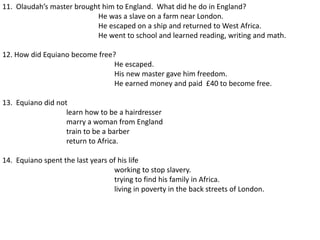
11. Olaudah’s master brought him to England. What did he do in England?
He was a slave on a farm near London.
He escaped on a ship and returned to West Africa.
He went to school and learned reading, writing and math.
12. How did Equiano become free?
He escaped.
His new master gave him freedom.
He earned money and paid £40 to become free.
13. Equiano did not
learn how to be a hairdresser
marry a woman from England
train to be a barber
return to Africa.
14. Equiano spent the last years of his life
working to stop slavery.
trying to find his family in Africa.
living in poverty in the back streets of London.
A Kidnapped Prince: Olauda Equiano
Does this man look like a slave?
Olaudah Equiano was born free in an Ibo
village near the Niger River in the land now
called Nigeria. His father was a wealthy chief.
He became a slave.
He traveled around the world and he earned
money to buy his freedom.
He wrote a popular book about his life in 1790.
Why is this book important?
•First English language
account of slavery.
•Early example of a slave
narrative.
In Ibo language, Olaudah Equiano
means "when he speaks, others listen."
t
Olauda Equiano was born about 1745 in Essaka, an Ibo village in the southeast of present-day Nigeria.
Nigeria Today
http://www.childrensbestbooks.com/
One day, all our people
wernt to their works as usual.
Only I and my dear sister were left to
mind the house. Two men and a woman got
over our walls, and in a moment seized us
both. Without giving us time to cry out, or
make resistance, they stopped our mouths,
and ran off with us into the nearest wood.
Here they tied our hands, and
continued to carry us.
The kidnappers took the children to the coast of Africa where they stayed in a prison for six months.
Commercial agreement.
This is an agreement among merchants involved
in the sale and transportation of slaves
between Timbuktu in Mali and Ghadamas in Libya.
Loaned by the Mamma Haidara
Commemorative Library, Timbuktu, Mali
The Triangular Trade Route
North America
The Triangular Trade
New
England
West
Africa
West
Indies
Rum
Guns
Cloth
Tools
Enslaved
Africans
Lumber
Fish
Flour
Sugar
Molasses
http://www.socialstudiesforkids.com/graphics/triangulartrade.jpg
A slave holding pen on Gorée Island, Senegal.
Olauda Equiano never saw his sister nor the rest of his family ever again.
http://www.childrensbestbooks.com/
I no longer doubted my fate and quite
overpowered with horror and anguish, I fell
motionless on the deck and fainted.
I asked if we were not to be eaten by those
white men with horrible looks, red faces and
long hair?
Olaudah Equiano never saw the ocean nor ships before.
Equiano wrote about his terrible experiences on the slave ship.
“The shrieks of the women and the groans of the dying rendered the whole
a scene of horror almost inconceivable.”
http://www.pbs.org/wgbh/aia/part1/1h300b.html
http://www.si.umich.edu/CHICO/Schomburg/text/migration6Big.html.html
"I now wished for the last friend,
Death, to relieve me."
The slave ship went to the Caribbean island of Barbados.
http://www.socialstudiesforkids.com/graphics/triangulartrade.jpg
This was the first of Olaudah Equiano’s many trips across the Atlantic Ocean.
Enlaved workers on the Caribbean islands were farmers on sugar plantations.
http://www.socialstudiesforkids.com/graphics/triangulartrade.jpg
Virginia
No one bought Equiano in Barbados.
After a few weeks, slave traders sent him to Virginia Colony to do farm work.
We learned about smoking from Native
American Indians.
http://www.decsy.org.uk/downloads/Triangular-Trade-map.gif
The Travels of Olaudah Equiano, Part I: Taken into Slavery –1756
In 1757, a British naval lieutenant named Michael Pascal paid money for Olauda Equiano.
Boys worked on warships.
I will use my new slave to help
me fight wars.
http://www.socialstudiesforkids.com/graphics/triangulartrade.jpg
England is north of here.
Lieutenant Pascal took him from Virginia to London.
The officer changed Equiano’s name to Gustavus Vassa.
Gustav Vasa: became king of Sweden in 1523.
He won a war of freedom for Sweden.
London, 1700s
While he was Lietuenant Pascal’s slave, Olaudah Equiano has new experiences:
He lived in London and learned how to read and write in English.
He became a Christian in 1759.
A book of church records shows Olaudah Equiano’s acceptance of Christianity as a young
slave in Great Britain.
As the slave of a naval officer, he trained to become a sailor.
Equiano joined his master fighting sea battles against France in the
Mediterranean and North America.
His job: carrying gun powder to the deck.
As the slave of a naval officer, he trained to become a sailor.
Equiano joined his master fighting sea battles against France in the
Mediterranean and North America.
His job: carrying gun powder to the deck.
As the slave of a naval officer, he trained to become a sailor.
Equiano joined his master fighting sea battles against France in the
Mediterranean and North America.
His job: carrying gun powder to the deck.
http://www.decsy.org.uk/downloads/Triangular-Trade-map.gif
The Travels of Olaudah Equiano, Part II: Slave to a Royal Naval Officer –1757-1762
Great Britain won the Seven Years War. (Americans called this the French and Indian War.)
After victories, British sailors won prize money, but Lieutenant Pascal refused
to share his money with Olaudah Equiano.
Captain Pascal sold Equiano to a sea captain who brought him back to the
Caribbean islands.
Great Britain won the Seven Years War. (Americans called this the French and Indian War.)
After victories, British sailors won prize money, but Lieutenant Pascal refused
to share his money with Olaudah Equiano.
Captain Pascal sold Equiano to a sea captain who brought him back to the
Caribbean islands.
On the island of Montserrat, a Quaker merchant from Philadelphia, Robert King,
bought Equiano.
Robert King saw that Equiano was skilled in reading and writing.
King gave him business work on his ships.
Equiano had free time and was able to earn his own money.
http://www.decsy.org.uk/downloads/Triangular-Trade-map.gif
The Travels of Olaudah Equiano, Part III: Slave to a Quaker Merchant –1762-1766
Robert King promised, “If you pay me £40, I will give you your freedom.”
In 1766, Equiano earned his freedom after saving money for three years.
At that time, £40 was equal to about $4,000 in today’s money.
He was twenty-one years old.
“Before night, I who had been a slave in the morning, trembling at
the will of another, was become my own master and completely free.
I thought this was the happiest day I had ever experienced.”
North America was a dangerous place for Africans because men kidnapped Free
Africans and forced them to become slaves.
Equiano declined King’s offer. He decided to go back to Great Britain.
Robert King respected Equiano. He asked him to become his business partner
Olauda Equiano, aka Gustavas Vassa, sailed back to Great Britain.
2. He got a paycheck from the Royal Navy.
1. He found his old master, Lieutenant Pascal.
Equiano demanded that Pascal give him his prize money, but he was unsuccessful.
3. He trained to become a hairdresser.
http://www.history.org/Foundation/journal/Winter03-04/images/cart_barber.jpg
Olaudah Equiano wanted to earn more money, so he returned to sailing.
He traveled around the Mediterranean Sea.
He joined a ship that explored the North Pole, where he escaped an attack
from a polar bear.
In 1775, Equiano returned to the Caribbean to start a plantation in Central America.
There were slaves on the plantation and he tried to help them.
http://www.decsy.org.uk/downloads/Triangular-Trade-map.gif
The Travels of Olaudah Equiano, Part IV: A Free Man –1766-1797
The North Pole
Equiano became involved in the
new movement to abolish
slavery in England.
First, he became a popular
speaker.
Later, he wrote the story of his
life in a book.
Equiano’s book became wildly popular in England, Europe and North America.
Sales of the book made him rich.
After reading it, many readers were convinced that slavery should be stopped.
A newspaper advertisement for Equiano’s book.
In 1792, Equiano married an English woman, Susannah Cullen.
Actors portrayed Gustavas and Susannah in a movie made in England in 2007.
In 2007, the church put up this plaque to remember their wedding.
The couple traveled together around England
as Equiano sold his book and made speeches
supporting the abolition of slavery.
The rest of this story is sad.
Susannah, Equiano’s wife, died in 1796, after the birth of Joanna.
She was only 34 years old.
Equiano died a year later in 1797. He was about 51.
The eldest daughter, Anna Maria, died when she was four years old.
Joanna inherited a lot of money from her father’s earnings.
Historians think that Joanna Vassa was
raised by her mother’s family.
When she was 27, Joanna married a
preacher, Henry Bromley.
She helped him organize the Sunday
School in his church.
This is an imagined picuture of Joanna Vassa with her father, Olaudah Equiano.
Catherine Ancholou is an Associate Professor of English Literature in the
Awuku College of Education, Nigeria
She wrote The Igbo Roots Of Olaudah Equiano: An Anthropological Research in 1989.
Nobody had any idea what happened
to those who left the shores of Africa.
…at that time, those who went beyond
Africa never came back.
Nobody could tell the story.
It was only after the colonial masters
began to return with the freed slaves, some
of whom had received some form of
education and were coming in as
missionaries.
This was…when the stories began to
filter in.
Olaudah Equiano died in 1797
…ten years before the slave trade was
abolished;
…forty years before the end of slavery
in the United Kingdom;
….sixty-eight years before the end of
slavery in the United States.
Equiano did not live to see these events
happen, but his work helped abolish
slavery.
Olauda Equiano

Olauda Equiano

  • 1.
    1. Olaudah Equianoborn in West Indies West Coast West Africa 2. Olaudah Equiano is famous because he wrote part of the Declaration of Independence the first English book about being enslaved the first laws for freeing slaves. 3. Historians think he was born in the year 1745. 1845. 1945. 4. Olaudah means........ when he speaks, others listen. great hunter and fisherman. son of the chief. 5. As a child, Olaudah studied how to play football. how to throw javelins. how to play soccer.
  • 2.
    6. He waskidnapped at age 11. 13. 15. 7. Olaudah came to North America but no one would pay for him to be a slave because he was so skilled. young. tall. 8. Equiano spent most of his life enslaved on a tobacco plantation. on a cotton plantation. in the Royal Navy. 9. A British naval lieutenant paid for Olaudah Equiano and changed his name to Gustavus Vassa. 10. Olaudah worked on the ship by bringing the lieutenant cannons. gunpowder. bombs.
  • 3.
    11. Olaudah’s masterbrought him to England. What did he do in England? He was a slave on a farm near London. He escaped on a ship and returned to West Africa. He went to school and learned reading, writing and math. 12. How did Equiano become free? He escaped. His new master gave him freedom. He earned money and paid £40 to become free. 13. Equiano did not learn how to be a hairdresser marry a woman from England train to be a barber return to Africa. 14. Equiano spent the last years of his life working to stop slavery. trying to find his family in Africa. living in poverty in the back streets of London.
  • 4.
    A Kidnapped Prince:Olauda Equiano
  • 5.
    Does this manlook like a slave? Olaudah Equiano was born free in an Ibo village near the Niger River in the land now called Nigeria. His father was a wealthy chief. He became a slave. He traveled around the world and he earned money to buy his freedom. He wrote a popular book about his life in 1790.
  • 6.
    Why is thisbook important? •First English language account of slavery. •Early example of a slave narrative.
  • 7.
    In Ibo language,Olaudah Equiano means "when he speaks, others listen."
  • 8.
    t Olauda Equiano wasborn about 1745 in Essaka, an Ibo village in the southeast of present-day Nigeria.
  • 9.
  • 10.
  • 11.
  • 12.
  • 13.
  • 14.
  • 15.
  • 17.
    http://www.childrensbestbooks.com/ One day, allour people wernt to their works as usual. Only I and my dear sister were left to mind the house. Two men and a woman got over our walls, and in a moment seized us both. Without giving us time to cry out, or make resistance, they stopped our mouths, and ran off with us into the nearest wood. Here they tied our hands, and continued to carry us.
  • 18.
    The kidnappers tookthe children to the coast of Africa where they stayed in a prison for six months.
  • 19.
    Commercial agreement. This isan agreement among merchants involved in the sale and transportation of slaves between Timbuktu in Mali and Ghadamas in Libya. Loaned by the Mamma Haidara Commemorative Library, Timbuktu, Mali
  • 20.
    The Triangular TradeRoute North America
  • 21.
  • 22.
  • 23.
    A slave holdingpen on Gorée Island, Senegal.
  • 24.
    Olauda Equiano neversaw his sister nor the rest of his family ever again.
  • 25.
    http://www.childrensbestbooks.com/ I no longerdoubted my fate and quite overpowered with horror and anguish, I fell motionless on the deck and fainted. I asked if we were not to be eaten by those white men with horrible looks, red faces and long hair? Olaudah Equiano never saw the ocean nor ships before.
  • 26.
    Equiano wrote abouthis terrible experiences on the slave ship. “The shrieks of the women and the groans of the dying rendered the whole a scene of horror almost inconceivable.”
  • 27.
  • 28.
  • 29.
    The slave shipwent to the Caribbean island of Barbados.
  • 30.
  • 31.
  • 32.
    This was thefirst of Olaudah Equiano’s many trips across the Atlantic Ocean.
  • 35.
    Enlaved workers onthe Caribbean islands were farmers on sugar plantations.
  • 36.
    http://www.socialstudiesforkids.com/graphics/triangulartrade.jpg Virginia No one boughtEquiano in Barbados. After a few weeks, slave traders sent him to Virginia Colony to do farm work.
  • 39.
    We learned aboutsmoking from Native American Indians.
  • 41.
    http://www.decsy.org.uk/downloads/Triangular-Trade-map.gif The Travels ofOlaudah Equiano, Part I: Taken into Slavery –1756
  • 42.
    In 1757, aBritish naval lieutenant named Michael Pascal paid money for Olauda Equiano. Boys worked on warships. I will use my new slave to help me fight wars.
  • 44.
    http://www.socialstudiesforkids.com/graphics/triangulartrade.jpg England is northof here. Lieutenant Pascal took him from Virginia to London.
  • 45.
    The officer changedEquiano’s name to Gustavus Vassa. Gustav Vasa: became king of Sweden in 1523. He won a war of freedom for Sweden.
  • 46.
  • 47.
    While he wasLietuenant Pascal’s slave, Olaudah Equiano has new experiences: He lived in London and learned how to read and write in English. He became a Christian in 1759.
  • 48.
    A book ofchurch records shows Olaudah Equiano’s acceptance of Christianity as a young slave in Great Britain.
  • 49.
    As the slaveof a naval officer, he trained to become a sailor. Equiano joined his master fighting sea battles against France in the Mediterranean and North America. His job: carrying gun powder to the deck.
  • 50.
    As the slaveof a naval officer, he trained to become a sailor. Equiano joined his master fighting sea battles against France in the Mediterranean and North America. His job: carrying gun powder to the deck.
  • 51.
    As the slaveof a naval officer, he trained to become a sailor. Equiano joined his master fighting sea battles against France in the Mediterranean and North America. His job: carrying gun powder to the deck.
  • 53.
    http://www.decsy.org.uk/downloads/Triangular-Trade-map.gif The Travels ofOlaudah Equiano, Part II: Slave to a Royal Naval Officer –1757-1762
  • 54.
    Great Britain wonthe Seven Years War. (Americans called this the French and Indian War.) After victories, British sailors won prize money, but Lieutenant Pascal refused to share his money with Olaudah Equiano. Captain Pascal sold Equiano to a sea captain who brought him back to the Caribbean islands.
  • 55.
    Great Britain wonthe Seven Years War. (Americans called this the French and Indian War.) After victories, British sailors won prize money, but Lieutenant Pascal refused to share his money with Olaudah Equiano. Captain Pascal sold Equiano to a sea captain who brought him back to the Caribbean islands.
  • 57.
    On the islandof Montserrat, a Quaker merchant from Philadelphia, Robert King, bought Equiano. Robert King saw that Equiano was skilled in reading and writing. King gave him business work on his ships. Equiano had free time and was able to earn his own money.
  • 58.
    http://www.decsy.org.uk/downloads/Triangular-Trade-map.gif The Travels ofOlaudah Equiano, Part III: Slave to a Quaker Merchant –1762-1766
  • 59.
    Robert King promised,“If you pay me £40, I will give you your freedom.” In 1766, Equiano earned his freedom after saving money for three years. At that time, £40 was equal to about $4,000 in today’s money. He was twenty-one years old.
  • 60.
    “Before night, Iwho had been a slave in the morning, trembling at the will of another, was become my own master and completely free. I thought this was the happiest day I had ever experienced.”
  • 61.
    North America wasa dangerous place for Africans because men kidnapped Free Africans and forced them to become slaves. Equiano declined King’s offer. He decided to go back to Great Britain. Robert King respected Equiano. He asked him to become his business partner
  • 62.
    Olauda Equiano, akaGustavas Vassa, sailed back to Great Britain. 2. He got a paycheck from the Royal Navy. 1. He found his old master, Lieutenant Pascal. Equiano demanded that Pascal give him his prize money, but he was unsuccessful. 3. He trained to become a hairdresser. http://www.history.org/Foundation/journal/Winter03-04/images/cart_barber.jpg
  • 63.
    Olaudah Equiano wantedto earn more money, so he returned to sailing. He traveled around the Mediterranean Sea. He joined a ship that explored the North Pole, where he escaped an attack from a polar bear.
  • 64.
    In 1775, Equianoreturned to the Caribbean to start a plantation in Central America. There were slaves on the plantation and he tried to help them.
  • 65.
    http://www.decsy.org.uk/downloads/Triangular-Trade-map.gif The Travels ofOlaudah Equiano, Part IV: A Free Man –1766-1797 The North Pole
  • 66.
    Equiano became involvedin the new movement to abolish slavery in England. First, he became a popular speaker. Later, he wrote the story of his life in a book. Equiano’s book became wildly popular in England, Europe and North America. Sales of the book made him rich. After reading it, many readers were convinced that slavery should be stopped.
  • 67.
    A newspaper advertisementfor Equiano’s book.
  • 68.
    In 1792, Equianomarried an English woman, Susannah Cullen.
  • 70.
    Actors portrayed Gustavasand Susannah in a movie made in England in 2007.
  • 71.
    In 2007, thechurch put up this plaque to remember their wedding.
  • 72.
    The couple traveledtogether around England as Equiano sold his book and made speeches supporting the abolition of slavery.
  • 73.
    The rest ofthis story is sad. Susannah, Equiano’s wife, died in 1796, after the birth of Joanna. She was only 34 years old. Equiano died a year later in 1797. He was about 51. The eldest daughter, Anna Maria, died when she was four years old.
  • 75.
    Joanna inherited alot of money from her father’s earnings.
  • 76.
    Historians think thatJoanna Vassa was raised by her mother’s family. When she was 27, Joanna married a preacher, Henry Bromley. She helped him organize the Sunday School in his church. This is an imagined picuture of Joanna Vassa with her father, Olaudah Equiano.
  • 80.
    Catherine Ancholou isan Associate Professor of English Literature in the Awuku College of Education, Nigeria She wrote The Igbo Roots Of Olaudah Equiano: An Anthropological Research in 1989. Nobody had any idea what happened to those who left the shores of Africa. …at that time, those who went beyond Africa never came back. Nobody could tell the story. It was only after the colonial masters began to return with the freed slaves, some of whom had received some form of education and were coming in as missionaries. This was…when the stories began to filter in.
  • 81.
    Olaudah Equiano diedin 1797 …ten years before the slave trade was abolished; …forty years before the end of slavery in the United Kingdom; ….sixty-eight years before the end of slavery in the United States. Equiano did not live to see these events happen, but his work helped abolish slavery.

Editor's Notes

  • #9 tp://www.history-map.com/picture/000/Africa-North-Map-of.htm
  • #17 http://atlasshrugs2000.typepad.com/photos/uncategorized/slavery.jpg
  • #20 http://www.loc.gov/exhibits/mali/images/amm0021rs.jpg
  • #21 http://www.decsy.org.uk/downloads/Triangular-Trade-map.gif
  • #24 http://www.vagabondish.com/wp-content/uploads/portal-of-sorrow-goree-island.jpg
  • #30 http://www.liverpoolmuseums.org.uk/online/wallpapers/graphics/1024x768/SlaveShip1024x768.jpg
  • #35 http://www.brycchancarey.com/equiano/equimap2.jpg
  • #36 http://www.haiyingart.com/images/graphics/a8.jpg
  • #38 http://historyproject.ucdavis.edu/ic/collection/halttunen/Seventeenth_Century/Early_American_Slavery/6986.html
  • #39 http://www.virginiaplaces.org/agriculture/colonialag.html
  • #40 https://upload.wikimedia.org/wikipedia/commons/3/3c/Chute_tobacco.JPG
  • #41 https://upload.wikimedia.org/wikipedia/commons/3/3c/Chute_tobacco.JPG
  • #43 http://viceroybooks.com.au/product_info.php?manufacturers_id=20&products_id=332&osCsid=aeffa9fce90a107000a85a041d526a00
  • #46 http://pro.corbis.com/images/PG5279.jpg?size=67&uid=996B1FD1-AC53-4619-8FFF-AEFD762634
  • #47 http://www.adnax.com/views/viewsoflondonbridges01.htm
  • #48 http://www.newforestnpa.gov.uk/text/great_britain_and_nfnp4web1.jpg StMargaretsChurch.jpg
  • #49 http://www.equiano.soham.org.uk/biography.htm In recent years, however, it has been suggested by Vincent Carretta that Equiano may not have been born in Africa at all. According to Carretta, Equiano may have been born a slave in South Carolina - at that time one of the thirteen British colonies in North America. Indeed, if Carretta's evidence - Equiano's baptismal records, and a naval muster roll - is accurate, there is a possibility that Equiano never visited Africa. The early parts of his autobiography may reflect the oral history of other slaves, combined with information Equiano gleaned from books he had read about Africa.While Carretta's research opens up a very important debate, we do need to be cautious. Carretta's research strongly suggests that the young Equiano told people that his birthplace was Carolina. However, as a slave and later a recently freed slave, Equiano might have had any number of reasons to disguise his true origins. Indeed, although we can be reasonably sure that Equiano sometimes told people he was from Carolina, there is no conclusive proof that his birthplace was actually there and, until such proof emerges (if it ever does), there is no real reason to doubt the essential truth of Equiano's account of his childhood in Africa. Even if it is ever proved that Equiano was born in Carolina, it is important to stress that it is unlikely that Equiano would have invented an African origin merely to deceive the reading public. Instead, he may have included the real experience of many other slaves in his effort to make the strongest possible case against slavery and the slave trade.
  • #50 http://www.brycchancarey.com/equiano/biog.htm
  • #53 http://www.brycchancarey.com/equiano/biog.htm
  • #62 http://www.clker.com/cliparts/3/b/1/1/1207583894321393493bobocal_Shaking_Hands.svg.hi.png
  • #64 http://greeningwashington.files.wordpress.com/2009/02/polar-bear2.jpg
  • #70 http://emeagwali.com/igbo/index_files/olaudah-equiano-marriage-certificate.jpg
  • #71 http://www.equiano.soham.org.uk/extraordinary-equiano.html
  • #72 http://www.equiano.soham.org.uk/wedding.htm
  • #73 http://en.wikipedia.org/wiki/File:Olaudah_Equiano_-_Project_Gutenberg_eText_15399.png
  • #75 http://www.standrews-chesterton.org/vassa.htm
  • #77 http://www.breakingthechains.co.uk/news.jsp?newsID=14
  • #78 http://re-photo.co.uk/?m=200710
  • #79 http://farm4.static.flickr.com/3616/3459494370_cd466177db.jpg?v=1240234227
  • #81 http://www.pbs.org/wgbh/aia/part1/1i3011.html
  • #82 http://www.100greatblackbritons.com/archive/eq_sc.html