Dominique Pifat, Ph.D., MBA
The Biologics Consulting Group
dpifat@bcg-usa.com
GLP vs GMP vs GCP
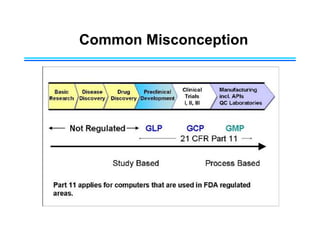
Common Misconception
Good Laboratory Practices
1) A quality system concerned with the organizational
process and the conditions under which non-clinical
health and environmental safety studies are planned,
performed, monitored, recorded, archived and reported.
2) GLPs are regulations published in the Code of Federal
Regulations (21CFR part 58)
3) The OECD Principles of Good Laboratory Practice
4) GLPs are not guidelines, they have the force of law.
5) GLP’s are not “watered down” GMPs!
Good Manufacturing Processes
1) Good manufacturing practice is the part of quality
assurance which ensures that products are consistently
produced and controlled to the quality standard appropriate to
their intended use and as required by the Marketing
Authorization or product specification.
2) GMP is concerned with both production and quality control
3) The rules Governing Medicinal Products in the EU; Volume
4 – EU Guidelines to GMP Medicinal products for human and
veterinary use
Good Clinical Practice
1) GCP is an international ethical and scientific quality
standard for designing, conducting, recording, and reporting
trials that involve the participation of human subjects.
2) Compliance with this standard provides public assurance
that the rights, safety, and well being of trial subjects are
protected, consistent with the principles that hve their origin in
the Declaration of Helsinki, and that the clinical data are
credible.
4) Guideline for Good Clinical Practice – ICH Harmonization
Triparite Guideline
FDA GLP Regulations Apply to (58.1)
• Non-clinical laboratory studies that support or are
intended to support application for research or
marketing permits for the following products:
– food and color additives
– human and animal drugs
– medical devices for human use
– biological products
– electronic products
• GLPs have nothing to do with manufacturing
product!
Non-clinical Laboratory Studies (58.3)
“In vitro or in vivo experiments in which test articles
are studied prospectively in test systems under
laboratory conditions to determine their safety.
The term does not include studies utilizing human
subjects or clinical studies or field trials in animals.
The term does not include basic exploratory studies
carried out to determine whether a test article has any
potential utility or to determine the physical or
chemical characteristics of a test article.”
Basic Elements of GLP
Personnel Documents
- Sponsor - Standard Operating
- Management - Protocols
- Study Director - Reports
- Quality Assurance - Archiving
Facility Test and Control Articles
- Laboratory Operation - Characterization
- Animal care - Handling
- Equipment - Storage
- Reagents
- Storage
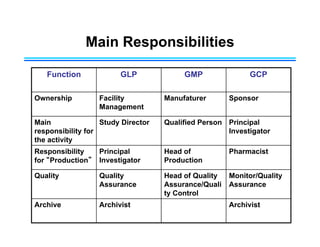
Main Responsibilities
Function GLP GMP GCP
Ownership Facility
Management
Manufaturer Sponsor
Main
responsibility for
the activity
Study Director Qualified Person Principal
Investigator
Responsibility
for “Production”
Principal
Investigator
Head of
Production
Pharmacist
Quality Quality
Assurance
Head of Quality
Assurance/Quali
ty Control
Monitor/Quality
Assurance
Archive Archivist Archivist
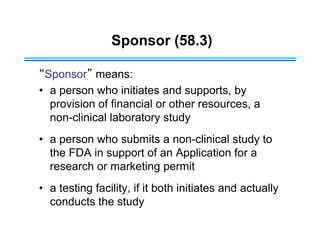
Sponsor (58.3)
“Sponsor” means:
• a person who initiates and supports, by
provision of financial or other resources, a
non-clinical laboratory study
• a person who submits a non-clinical study to
the FDA in support of an Application for a
research or marketing permit
• a testing facility, if it both initiates and actually
conducts the study
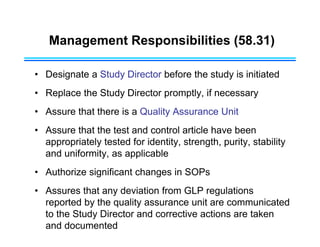
Management Responsibilities (58.31)
• Designate a Study Director before the study is initiated
• Replace the Study Director promptly, if necessary
• Assure that there is a Quality Assurance Unit
• Assure that the test and control article have been
appropriately tested for identity, strength, purity, stability
and uniformity, as applicable
• Authorize significant changes in SOPs
• Assures that any deviation from GLP regulations
reported by the quality assurance unit are communicated
to the Study Director and corrective actions are taken
and documented
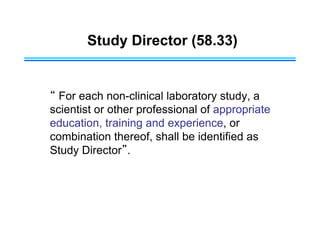
Study Director (58.33)
“ For each non-clinical laboratory study, a
scientist or other professional of appropriate
education, training and experience, or
combination thereof, shall be identified as
Study Director”.
Study Directors
• Only one person is designated as Study Director
• There cannot be a co-Study Director
• There can be an alternate Study Director
• There is no requirement for a Study Director in
GMPs
• The GCPs require a Principal Investigator
Quality Assurance Unit (58.35)
“A testing facility shall have a Quality Assurance unit
which shall be responsible for monitoring each study to
assure management that the facilities, equipment,
personnel, methods, practices, records, and controls are
in conformance with the regulations.
For any given study, the Quality Assurance unit shall be
entirely separate from and independent of the personnel
engaged in the direction and conduct of the study.”
15
QAU Responsibilities (58.35 (b)(1)
• Maintain a copy of a master schedule sheet of
all non-clinical studies conducted at the testing
facility indexed by:
• test article
• test system
• nature of the study
• date study was initiated
• current status of study
• Sponsor
• Study Director
QAU Responsibilities (Cont.)
• Maintain copies of all protocols
• Inspect each non-clinical study at adequate
intervals
• Maintain signed records of each inspection
• date of inspection
• study inspected
• phase inspected
• person performing the inspection
• findings
• recommendations
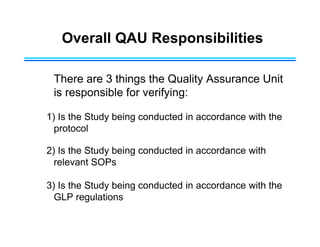
Overall QAU Responsibilities
There are 3 things the Quality Assurance Unit
is responsible for verifying:
1) Is the Study being conducted in accordance with the
protocol
2) Is the Study being conducted in accordance with
relevant SOPs
3) Is the Study being conducted in accordance with the
GLP regulations
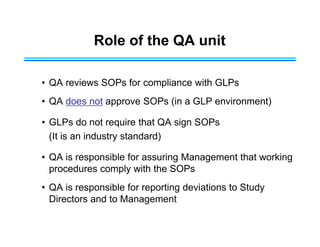
Role of the QA unit
• QA reviews SOPs for compliance with GLPs
• QA does not approve SOPs (in a GLP environment)
• GLPs do not require that QA sign SOPs
(It is an industry standard)
• QA is responsible for assuring Management that working
procedures comply with the SOPs
• QA is responsible for reporting deviations to Study
Directors and to Management
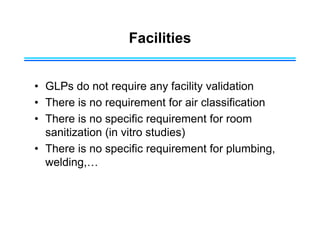
Facilities
• GLPs do not require any facility validation
• There is no requirement for air classification
• There is no specific requirement for room
sanitization (in vitro studies)
• There is no specific requirement for plumbing,
welding,…
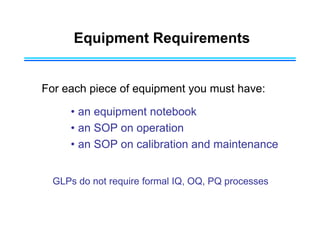
Equipment Requirements
For each piece of equipment you must have:
• an equipment notebook
• an SOP on operation
• an SOP on calibration and maintenance
GLPs do not require formal IQ, OQ, PQ processes
21 CFR Part 58.81
“ A testing facility shall have standard
operating procedures in writing setting forth
non-clinical laboratory study methods that
Management is satisfied are adequate to
insure the quality and integrity of the data
generated in the course of a study.”
21 CFR Part 58.81
“ Each laboratory area shall have immediately
available laboratory manuals and standard operating
procedures relative to the laboratory procedures being
performed. Published literature may be used as a
supplement to standard operating procedures.”
“ A historical file of standard operating procedures, and
all revisions thereof, including the dates of such
revisions, shall be maintained.”
QA and SOPs
• QA doesn’t write all SOPs, only those that are directly
related to QA functions
• QA reviews SOPs for compliance with GLPs
• QA does not approve SOPs (in a GLP environment)
• GLPs do not require that QA sign SOPs
• QA is responsible for assuring Management that working
procedures comply with the SOPs
• QA is responsible for reporting deviations to Study
Directors and to Management
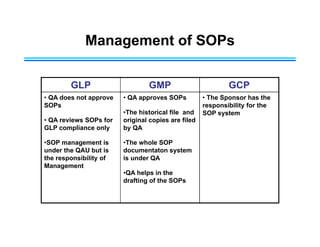
Management of SOPs
GLP GMP GCP
• QA does not approve
SOPs
• QA reviews SOPs for
GLP compliance only
•SOP management is
under the QAU but is
the responsibility of
Management
• QA approves SOPs
•The historical file and
original copies are filed
by QA
•The whole SOP
documentaton system
is under QA
•QA helps in the
drafting of the SOPs
• The Sponsor has the
responsibility for the
SOP system
21 CFR Part 58.120
“Each study shall have an approved written protocol that
clearly indicates the objectives and all the methods for
the conduct of the study.”
Protocols do not contain “fill in the blanks”; they are
stand alone documents.
There are no batch records in GLPs
OECD: Study Plan
GLP pecking order
GLP regs > Protocol > SOPs
• GLP regs supercede the protocol and the SOPs
• The protocol always supercedes the SOPs
Protocol Amendments
“All changes in or revisions of an approved protocol and the
reasons therefor shall be documented, signed by the Study
Director and maintained with the protocol.”
• Protocol amendments are intended to document permanent
changes
• If a deviation from the protocol is an error, it should not result
in a protocol amendment (GLPs do not require investigations)
• If possible, protocol amendments should be prospective
• If possible, a protocol amendment should be distributed
before the change is intended to occur (that includes QA).
Final Reports: 58.185
A final report shall be prepared for each non-
clinical laboratory study and shall include, but
not be limited to, the following:
– name and address of the facility performing the
study
– dates on which the study was initiated and
completed
• date the study director signed the protocol
• date the study director signed the final report
Final reports: 58.185
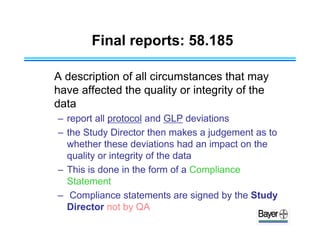
A description of all circumstances that may
have affected the quality or integrity of the
data
– report all protocol and GLP deviations
– the Study Director then makes a judgement as to
whether these deviations had an impact on the
quality or integrity of the data
– This is done in the form of a Compliance
Statement
– Compliance statements are signed by the Study
Director not by QA
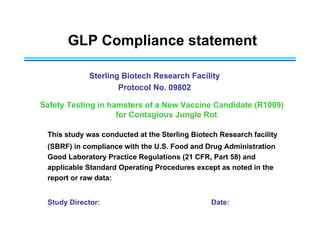
GLP Compliance statement
Sterling Biotech Research Facility
Protocol No. 09802
Safety Testing in hamsters of a New Vaccine Candidate (R1009)
for Contagious Jungle Rot
This study was conducted at the Sterling Biotech Research facility
(SBRF) in compliance with the U.S. Food and Drug Administration
Good Laboratory Practice Regulations (21 CFR, Part 58) and
applicable Standard Operating Procedures except as noted in the
report or raw data:
Study Director: Date:
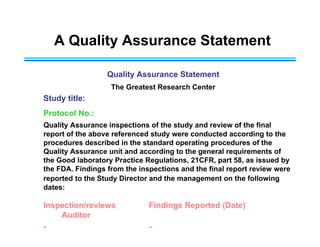
A Quality Assurance Statement
Quality Assurance Statement
The Greatest Research Center
Study title:
Protocol No.:
Quality Assurance inspections of the study and review of the final
report of the above referenced study were conducted according to the
procedures described in the standard operating procedures of the
Quality Assurance unit and according to the general requirements of
the Good laboratory Practice Regulations, 21CFR, part 58, as issued by
the FDA. Findings from the inspections and the final report review were
reported to the Study Director and the management on the following
dates:
Inspection/reviews Findings Reported (Date)
Auditor
- -
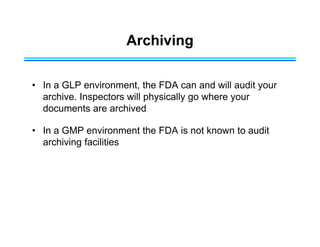
Archiving
• In a GLP environment, the FDA can and will audit your
archive. Inspectors will physically go where your
documents are archived
• In a GMP environment the FDA is not known to audit
archiving facilities
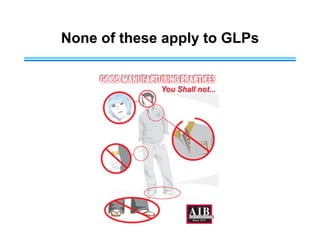
None of these apply to GLPs
Retention of Records: 21CFR part 58.195
FDA
Documentation records, raw data and specimens
pertaining to a non-clinical laboratory study shall be
retained in the archive(s) for which ever period is the
shortest:
1) A period of at least 2 years following the date on which
an application for a research or marketing permit, in
support of which the results of the non-clinical laboratory
study were submitted, is approved by the FDA
2) A period of at least 5 years following the date on which
the results of the non-clinical laboratory study are
submitted to the FDA in support of an application for a
research or marketing permit.
FDA inspections
• In the US there is no means by which you can
request a GLP inspection
• In the US there is no GLP certification program
similar to the ISO certifications
• Submission of data to the regulatory authorities is
what triggers a GLP inspection
Four Kinds of FDA Inspections
1) GLP inspection: periodic routine determination of a laboratory’s
compliance with GLPs (usually includes an ongoing study as
well as as a completed study). Scheduled once every two years.
2) Data audit: an inspection made to verify that the information
contained in a final report submitted to the FDA is accurate and
reflected by the raw data.
3) A directed inspection (or for cause inspection): inspections
conducted for various compelling reasons (questionable data in
a final report, tips from informers, etc...).
4) A follow-up inspection: an inspection made sometime after a
GLP inspection which revealed objectionable practices and
conditions. The purpose of a follow up inspection is to assure
that proper corrective actions have been taken.
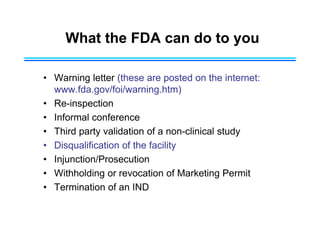
What the FDA can do to you
• Warning letter (these are posted on the internet:
www.fda.gov/foi/warning.htm)
• Re-inspection
• Informal conference
• Third party validation of a non-clinical study
• Disqualification of the facility
• Injunction/Prosecution
• Withholding or revocation of Marketing Permit
• Termination of an IND
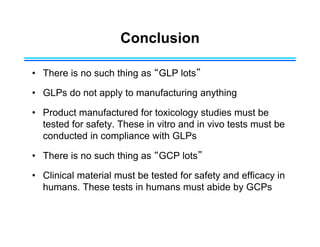
Conclusion
• There is no such thing as “GLP lots”
• GLPs do not apply to manufacturing anything
• Product manufactured for toxicology studies must be
tested for safety. These in vitro and in vivo tests must be
conducted in compliance with GLPs
• There is no such thing as “GCP lots”
• Clinical material must be tested for safety and efficacy in
humans. These tests in humans must abide by GCPs
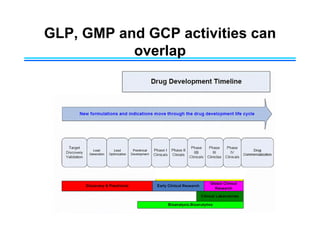
GLP, GMP and GCP activities can
overlap
This many people working for a year to make
this much drug!

GLP-vs-GMP-vs-GCP Comparasation

  • 1.
    Dominique Pifat, Ph.D.,MBA The Biologics Consulting Group dpifat@bcg-usa.com GLP vs GMP vs GCP
  • 2.
  • 3.
    Good Laboratory Practices 1)A quality system concerned with the organizational process and the conditions under which non-clinical health and environmental safety studies are planned, performed, monitored, recorded, archived and reported. 2) GLPs are regulations published in the Code of Federal Regulations (21CFR part 58) 3) The OECD Principles of Good Laboratory Practice 4) GLPs are not guidelines, they have the force of law. 5) GLP’s are not “watered down” GMPs!
  • 4.
    Good Manufacturing Processes 1)Good manufacturing practice is the part of quality assurance which ensures that products are consistently produced and controlled to the quality standard appropriate to their intended use and as required by the Marketing Authorization or product specification. 2) GMP is concerned with both production and quality control 3) The rules Governing Medicinal Products in the EU; Volume 4 – EU Guidelines to GMP Medicinal products for human and veterinary use
  • 5.
    Good Clinical Practice 1)GCP is an international ethical and scientific quality standard for designing, conducting, recording, and reporting trials that involve the participation of human subjects. 2) Compliance with this standard provides public assurance that the rights, safety, and well being of trial subjects are protected, consistent with the principles that hve their origin in the Declaration of Helsinki, and that the clinical data are credible. 4) Guideline for Good Clinical Practice – ICH Harmonization Triparite Guideline
  • 6.
    FDA GLP RegulationsApply to (58.1) • Non-clinical laboratory studies that support or are intended to support application for research or marketing permits for the following products: – food and color additives – human and animal drugs – medical devices for human use – biological products – electronic products • GLPs have nothing to do with manufacturing product!
  • 7.
    Non-clinical Laboratory Studies(58.3) “In vitro or in vivo experiments in which test articles are studied prospectively in test systems under laboratory conditions to determine their safety. The term does not include studies utilizing human subjects or clinical studies or field trials in animals. The term does not include basic exploratory studies carried out to determine whether a test article has any potential utility or to determine the physical or chemical characteristics of a test article.”
  • 8.
    Basic Elements ofGLP Personnel Documents - Sponsor - Standard Operating - Management - Protocols - Study Director - Reports - Quality Assurance - Archiving Facility Test and Control Articles - Laboratory Operation - Characterization - Animal care - Handling - Equipment - Storage - Reagents - Storage
  • 9.
    Main Responsibilities Function GLPGMP GCP Ownership Facility Management Manufaturer Sponsor Main responsibility for the activity Study Director Qualified Person Principal Investigator Responsibility for “Production” Principal Investigator Head of Production Pharmacist Quality Quality Assurance Head of Quality Assurance/Quali ty Control Monitor/Quality Assurance Archive Archivist Archivist
  • 10.
    Sponsor (58.3) “Sponsor” means: •a person who initiates and supports, by provision of financial or other resources, a non-clinical laboratory study • a person who submits a non-clinical study to the FDA in support of an Application for a research or marketing permit • a testing facility, if it both initiates and actually conducts the study
  • 11.
    Management Responsibilities (58.31) •Designate a Study Director before the study is initiated • Replace the Study Director promptly, if necessary • Assure that there is a Quality Assurance Unit • Assure that the test and control article have been appropriately tested for identity, strength, purity, stability and uniformity, as applicable • Authorize significant changes in SOPs • Assures that any deviation from GLP regulations reported by the quality assurance unit are communicated to the Study Director and corrective actions are taken and documented
  • 12.
    Study Director (58.33) “For each non-clinical laboratory study, a scientist or other professional of appropriate education, training and experience, or combination thereof, shall be identified as Study Director”.
  • 13.
    Study Directors • Onlyone person is designated as Study Director • There cannot be a co-Study Director • There can be an alternate Study Director • There is no requirement for a Study Director in GMPs • The GCPs require a Principal Investigator
  • 14.
    Quality Assurance Unit(58.35) “A testing facility shall have a Quality Assurance unit which shall be responsible for monitoring each study to assure management that the facilities, equipment, personnel, methods, practices, records, and controls are in conformance with the regulations. For any given study, the Quality Assurance unit shall be entirely separate from and independent of the personnel engaged in the direction and conduct of the study.”
  • 15.
    15 QAU Responsibilities (58.35(b)(1) • Maintain a copy of a master schedule sheet of all non-clinical studies conducted at the testing facility indexed by: • test article • test system • nature of the study • date study was initiated • current status of study • Sponsor • Study Director
  • 16.
    QAU Responsibilities (Cont.) •Maintain copies of all protocols • Inspect each non-clinical study at adequate intervals • Maintain signed records of each inspection • date of inspection • study inspected • phase inspected • person performing the inspection • findings • recommendations
  • 17.
    Overall QAU Responsibilities Thereare 3 things the Quality Assurance Unit is responsible for verifying: 1) Is the Study being conducted in accordance with the protocol 2) Is the Study being conducted in accordance with relevant SOPs 3) Is the Study being conducted in accordance with the GLP regulations
  • 18.
    Role of theQA unit • QA reviews SOPs for compliance with GLPs • QA does not approve SOPs (in a GLP environment) • GLPs do not require that QA sign SOPs (It is an industry standard) • QA is responsible for assuring Management that working procedures comply with the SOPs • QA is responsible for reporting deviations to Study Directors and to Management
  • 19.
    Facilities • GLPs donot require any facility validation • There is no requirement for air classification • There is no specific requirement for room sanitization (in vitro studies) • There is no specific requirement for plumbing, welding,…
  • 20.
    Equipment Requirements For eachpiece of equipment you must have: • an equipment notebook • an SOP on operation • an SOP on calibration and maintenance GLPs do not require formal IQ, OQ, PQ processes
  • 21.
    21 CFR Part58.81 “ A testing facility shall have standard operating procedures in writing setting forth non-clinical laboratory study methods that Management is satisfied are adequate to insure the quality and integrity of the data generated in the course of a study.”
  • 22.
    21 CFR Part58.81 “ Each laboratory area shall have immediately available laboratory manuals and standard operating procedures relative to the laboratory procedures being performed. Published literature may be used as a supplement to standard operating procedures.” “ A historical file of standard operating procedures, and all revisions thereof, including the dates of such revisions, shall be maintained.”
  • 23.
    QA and SOPs •QA doesn’t write all SOPs, only those that are directly related to QA functions • QA reviews SOPs for compliance with GLPs • QA does not approve SOPs (in a GLP environment) • GLPs do not require that QA sign SOPs • QA is responsible for assuring Management that working procedures comply with the SOPs • QA is responsible for reporting deviations to Study Directors and to Management
  • 24.
    Management of SOPs GLPGMP GCP • QA does not approve SOPs • QA reviews SOPs for GLP compliance only •SOP management is under the QAU but is the responsibility of Management • QA approves SOPs •The historical file and original copies are filed by QA •The whole SOP documentaton system is under QA •QA helps in the drafting of the SOPs • The Sponsor has the responsibility for the SOP system
  • 25.
    21 CFR Part58.120 “Each study shall have an approved written protocol that clearly indicates the objectives and all the methods for the conduct of the study.” Protocols do not contain “fill in the blanks”; they are stand alone documents. There are no batch records in GLPs OECD: Study Plan
  • 26.
    GLP pecking order GLPregs > Protocol > SOPs • GLP regs supercede the protocol and the SOPs • The protocol always supercedes the SOPs
  • 27.
    Protocol Amendments “All changesin or revisions of an approved protocol and the reasons therefor shall be documented, signed by the Study Director and maintained with the protocol.” • Protocol amendments are intended to document permanent changes • If a deviation from the protocol is an error, it should not result in a protocol amendment (GLPs do not require investigations) • If possible, protocol amendments should be prospective • If possible, a protocol amendment should be distributed before the change is intended to occur (that includes QA).
  • 28.
    Final Reports: 58.185 Afinal report shall be prepared for each non- clinical laboratory study and shall include, but not be limited to, the following: – name and address of the facility performing the study – dates on which the study was initiated and completed • date the study director signed the protocol • date the study director signed the final report
  • 29.
    Final reports: 58.185 Adescription of all circumstances that may have affected the quality or integrity of the data – report all protocol and GLP deviations – the Study Director then makes a judgement as to whether these deviations had an impact on the quality or integrity of the data – This is done in the form of a Compliance Statement – Compliance statements are signed by the Study Director not by QA
  • 30.
    GLP Compliance statement SterlingBiotech Research Facility Protocol No. 09802 Safety Testing in hamsters of a New Vaccine Candidate (R1009) for Contagious Jungle Rot This study was conducted at the Sterling Biotech Research facility (SBRF) in compliance with the U.S. Food and Drug Administration Good Laboratory Practice Regulations (21 CFR, Part 58) and applicable Standard Operating Procedures except as noted in the report or raw data: Study Director: Date:
  • 31.
    A Quality AssuranceStatement Quality Assurance Statement The Greatest Research Center Study title: Protocol No.: Quality Assurance inspections of the study and review of the final report of the above referenced study were conducted according to the procedures described in the standard operating procedures of the Quality Assurance unit and according to the general requirements of the Good laboratory Practice Regulations, 21CFR, part 58, as issued by the FDA. Findings from the inspections and the final report review were reported to the Study Director and the management on the following dates: Inspection/reviews Findings Reported (Date) Auditor - -
  • 32.
    Archiving • In aGLP environment, the FDA can and will audit your archive. Inspectors will physically go where your documents are archived • In a GMP environment the FDA is not known to audit archiving facilities
  • 33.
    None of theseapply to GLPs
  • 34.
    Retention of Records:21CFR part 58.195 FDA Documentation records, raw data and specimens pertaining to a non-clinical laboratory study shall be retained in the archive(s) for which ever period is the shortest: 1) A period of at least 2 years following the date on which an application for a research or marketing permit, in support of which the results of the non-clinical laboratory study were submitted, is approved by the FDA 2) A period of at least 5 years following the date on which the results of the non-clinical laboratory study are submitted to the FDA in support of an application for a research or marketing permit.
  • 35.
    FDA inspections • Inthe US there is no means by which you can request a GLP inspection • In the US there is no GLP certification program similar to the ISO certifications • Submission of data to the regulatory authorities is what triggers a GLP inspection
  • 36.
    Four Kinds ofFDA Inspections 1) GLP inspection: periodic routine determination of a laboratory’s compliance with GLPs (usually includes an ongoing study as well as as a completed study). Scheduled once every two years. 2) Data audit: an inspection made to verify that the information contained in a final report submitted to the FDA is accurate and reflected by the raw data. 3) A directed inspection (or for cause inspection): inspections conducted for various compelling reasons (questionable data in a final report, tips from informers, etc...). 4) A follow-up inspection: an inspection made sometime after a GLP inspection which revealed objectionable practices and conditions. The purpose of a follow up inspection is to assure that proper corrective actions have been taken.
  • 37.
    What the FDAcan do to you • Warning letter (these are posted on the internet: www.fda.gov/foi/warning.htm) • Re-inspection • Informal conference • Third party validation of a non-clinical study • Disqualification of the facility • Injunction/Prosecution • Withholding or revocation of Marketing Permit • Termination of an IND
  • 38.
    Conclusion • There isno such thing as “GLP lots” • GLPs do not apply to manufacturing anything • Product manufactured for toxicology studies must be tested for safety. These in vitro and in vivo tests must be conducted in compliance with GLPs • There is no such thing as “GCP lots” • Clinical material must be tested for safety and efficacy in humans. These tests in humans must abide by GCPs
  • 39.
    GLP, GMP andGCP activities can overlap
  • 40.
    This many peopleworking for a year to make this much drug!