CODE BLUE
MANAGEMENT
CODE BLUE
is generally used to indicate a patient
requiring resuscitation or otherwise in need of
immediate medical attention, most often as a
result of a respiratory or cardiac arrest.
What is Code Blue
Cardiopulmonary Resuscitation (CPR)
is an emergency procedure performed in an effort
to manually preserve intact brain function/
provide adequate blood circulation until further
measures are taken to restore spontaneous blood
circulation and breathing in a person in cardiac
arrest.
Cardiac Arrest is the
sudden loss of cardiac
of cardiac function,
breathing and
consciousness.
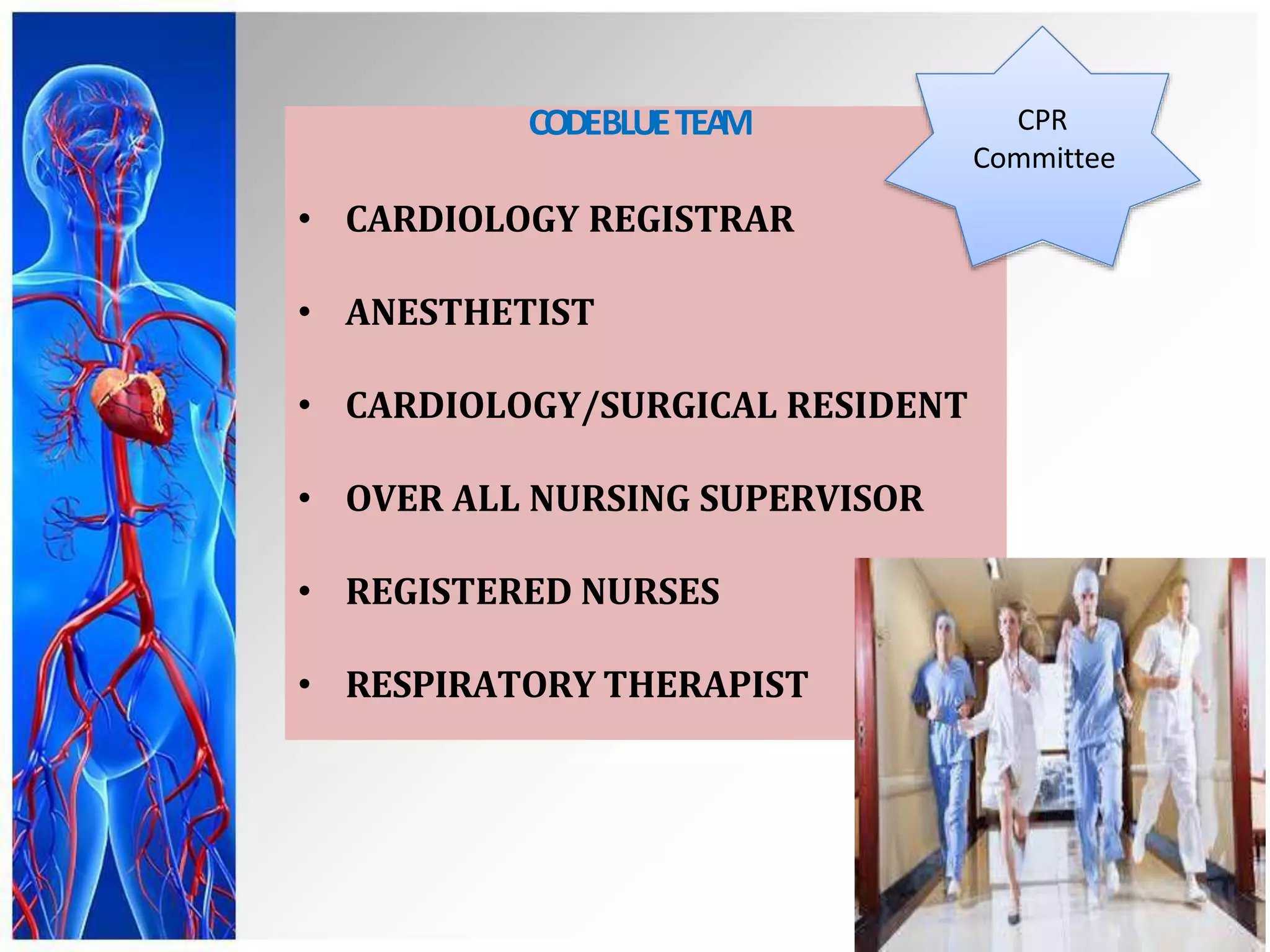
CODEBLUETEA
M CPR
Committee
• CARDIOLOGY REGISTRAR
• ANESTHETIST
• CARDIOLOGY/SURGICAL RESIDENT
• OVER ALL NURSING SUPERVISOR
• REGISTERED NURSES
• RESPIRATORY THERAPIST
Criteria for Code Blue
RRT
• The patient is responsive but
there is a sudden deterioration
in patient’s status.
• Respiratory distress.
• O2 saturation, BP, pulse is
gradually dropping/below
normal.
CODE BLUE
• Unresponsive
• Pulseless
• Apneic
CALM DOWN AND DON’T PANIC
WHAT TO REMEMBER DURING CODE BLUE
RULE #1
Always start with BCLS
RULE #2
WHAT TO REMEMBER DURING CODE BLUE
RULE #3
Always BE SYSTEMATIC IN PERFORMING
ACLS
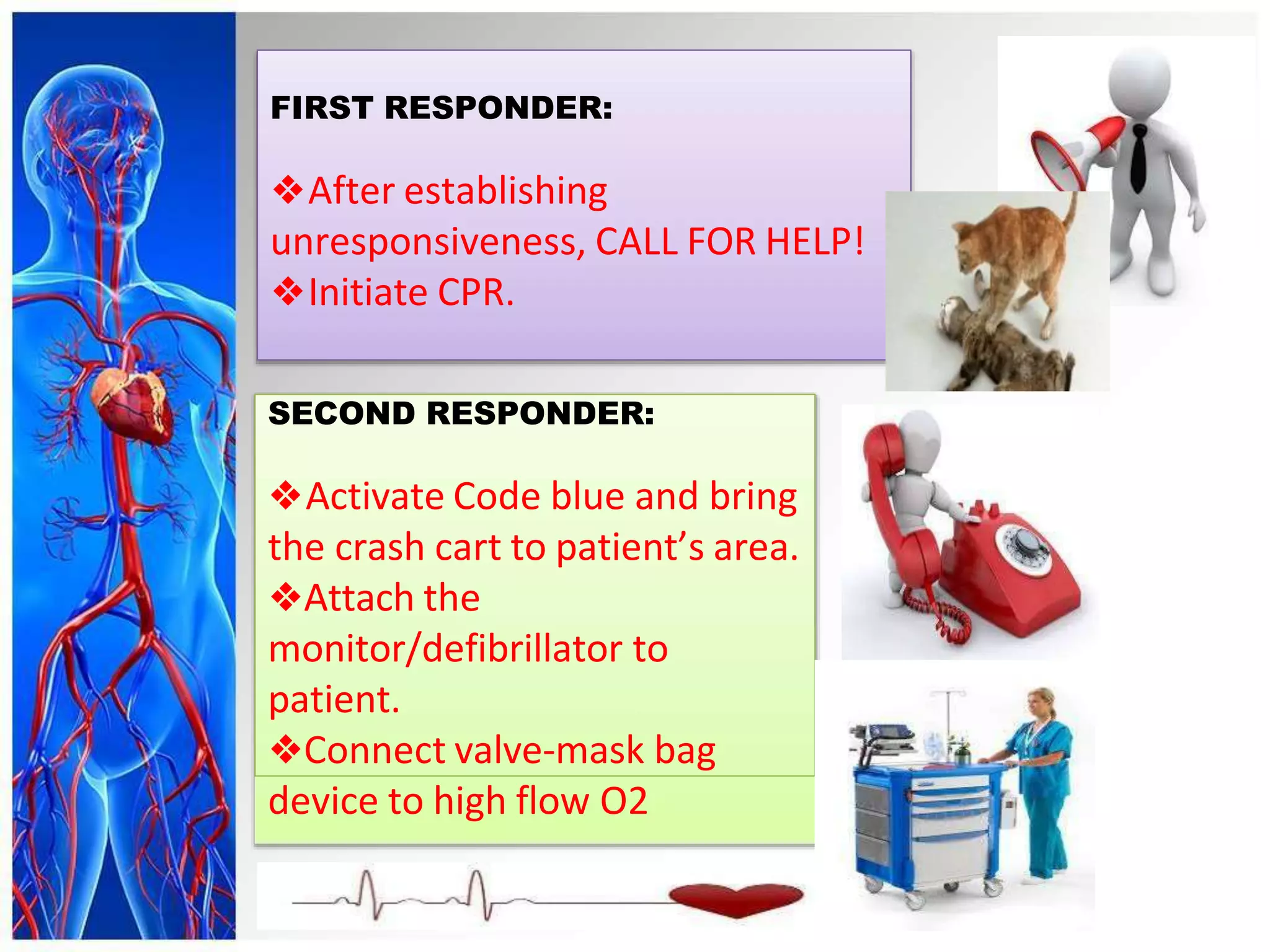
SECOND RESPONDER:
❖Activate Code blue and bring
the crash cart to patient’s area.
❖Attach the
monitor/defibrillator to
patient.
❖Connect valve-mask bag
device to high flow O2
FIRST RESPONDER:
❖After establishing
unresponsiveness, CALL FOR HELP!
❖Initiate CPR.
CODE BLUE ACTIVATION
>Dial 855-0999 (Overhead paging system)
> State the type of Emergency Code
>Give the exact location (floor, room number)
>Repeat 3 times.
Example:
Code Blue 4th floor room number 401! (3x)
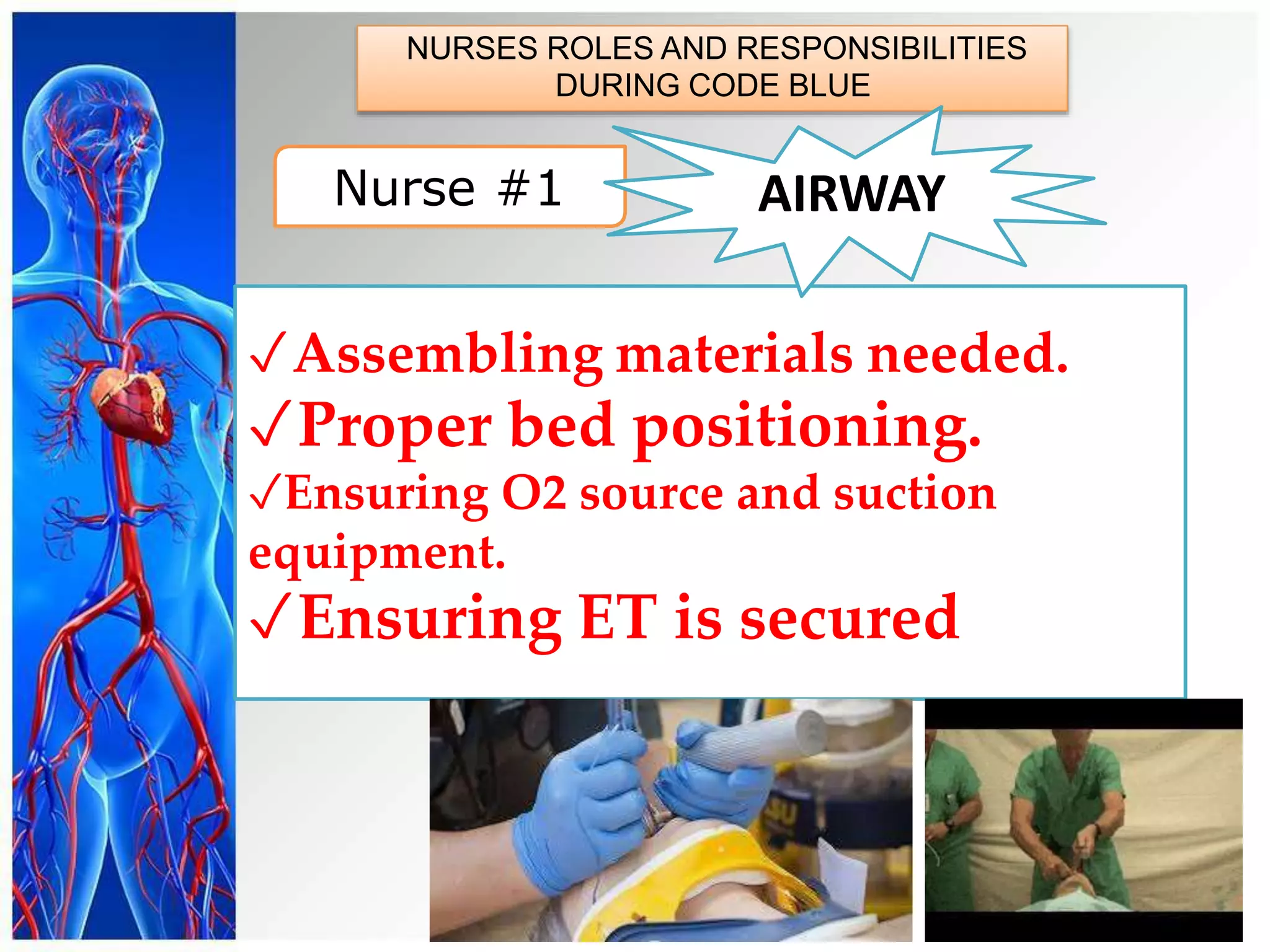
NURSES ROLES AND RESPONSIBILITIES
DURING CODE BLUE
✓Assembling materials needed.
✓Proper bed positioning.
✓Ensuring O2 source and suction
equipment.
✓Ensuring ET is secured
Nurse #1 AIRWAY
NURSES ROLES AND RESPONSIBILITIES
DURING CODE BLUE
Nurse #2 MEDICATION/DEFIBRILLATION
✓Must secure IV access promptly if not yet
established.
✓Prepare and give medications as directed by
team leader.
✓Select the joules as per team leader’s advice,
charge the defibrillator , apply gel on the
paddles before giving to the doctor.
✓Make sure that the doctor has a clear view of
the monitor
NURSES ROLES AND RESPONSIBILITIES
DURING CODE BLUE
DOCUMENTATION
Nurse #3
✓Ensures all
observation are taken
and recorded.
✓The code blue will be
documented in a code
blue record which will
be signed by the
recording nurse and
code physician.
NURSES ROLES AND RESPONSIBILITIES
DURING CODE BLUE
Nurse #4 CIRCULATING
✓Ensures all needed
equipment and materials
are available at the
bedside.
✓Responsible for
sending specimens such
as blood gases.
Post Resuscitation Activities
• Obtaining 12 lead E C G
• Obtaining CXR
• Laboratory work ups
• NGT & IFC insertion
• Coordinate with Critical unit for
transfer
• Documentation
PRIMARY SURVEY
SECONDARYSURVEY
HIGH QUALITY CPR
2MINUTES/5 CYCLES
EPINEPHRINE 1 mg every 3-5
minutes (IV/IO)
ASYSTOLE PEA
ARRHYTMIAS
PULSELESS VTACH
POLYMORPHIC VTACH/ TORSADE DE POINTES
VENTRICULAR FIBRILLATION
C-Chest pain
A- Altered Mental Status
S- SOB
H- Hypotension
•50 HR - CASH = MONITOR
<50 HR + CASH = DATE
Treatment:
D- Dopamine
A- Atropine
T- transcutaneous pacing
E- Epinephrine
Atropine 0.5mg IV 3-5 minutes as needed.
Maximum dosage is 3mg.
Epinephrine 2-10mcg/min or Dopamine 2-
10mcg/kg/min
Transcutaneous pacing
BRADYCARDIA
Stable (Narrow QRS
Complex)
>150 HR – CASH=
MANEUVERS /DRUGS
vagal maneuver, Adenosine
>150 HR + CASH= SYNC
CARDIOVERSION
Narrow/reg= 50-100joules
narrow-/irreg=120-
200joules
Stable (Wide/
Regular/Monomorphic)
Consider antiarrythmic infusion.
Amiodarone
Patients with unstable
tachycardia should be treated
immediately with synchronized
cardioversion.
Wide/reg=100joules
Treat underlying
condition
SINUSTACHYCARDIA
Stable (Narrow QRS Complex) Stable (Wide/ Regular/Monomorphic)
It is a means of
storing and
transporting vital
equipment and drugs
which may be
required during a
code blue (cardiac
emergency) to the
location of
emergency.
CRASH CART
EMERGENCY DRUGS
(1st DRAWER)
TOP AND SIDE OF
TROLLEY (HANG)
IVF &
MISCELLANEOUS
(3rd DRAWER)
CIRCULATORY
ACCESS
(2nd DRAWER)
PPE & OTHER
EQUIPMENT
(5th DRAWER)
AIRWAY &
BREATHING
DEVICES
(4th DRAWER)
1. Crash cart mustbe checked at the
beginning of every shift bythe assigned
CPRnurse.
2. Standardizationmustbe maintained.
3.Defibrillatorperformancecheckmustbe
done alongwithcrashcartchecking and
keepthe teststripfor documentation.
4. Crashcartitemsand medicationsmust
be checked monthlyfor expiry dates.
5.Eachunit willhavea crashcartplaced in
an easilyaccessible location.
6. In caseof CPR,all itemsmustbe
replacedaftereachuse.
“By failing to
prepare,
You are preparing
to fail
In your role to
save lives”
INDICATIONS:
Cardiac arrest: VF/ pulseless VT, asystole, PEA
Symptomatic bradycardia: alternative to dopamine
after atrophine.
anaphylaxis
DOSAGE:
1mg (10ml of 1:10,000 solution) IV/IO every 3-5
min during CPR
Profound bradycardia or hypotension:
2-10mcg/min infusion (titrate according to patient’s
response)
ETT: 2 – 2.5mg
Pedia dose: 0.01mg/kg IV/IO every 3-5 min max
dose : 1mg
CONTRAINDICATIONS/PRECAUTIONS:
Increase cerebral and myocardial oxygen demand
EPINEPHRINE
INDICATIONS:
First drug for symptomatic bradycardia
Organophosphate poisoning
DOSAGE:
0.5 mg IV every 3-5 minutes as needed
not to exceed total dose of 3 mg.
CONTRAINDICATIONS/ PRECAUTIONS:
Use with caution in presence of MI and
hypoxia.
May not be effective with Type II and
3rd degree AV block
Doses of < 0.5 mg may result in
paradoxical slowing of heart rate.
ATROPINE SULPHATE
INDICATIONS:
2ND –line drug for symptomatic bradycardia
Hypotension (SBP <70 mmHg) with signs and
symptoms of shock
Low cardiac output
Poor perfusion to vital organs
DOSAGE:
1-5 mcg/kg/min IV infusion-increase renal blood flow
and urine output
5-15 mcg/kg/min- may increase renal output, cardiac
output, HR and cardiac contractility
10-15 mcg/kg/min-increase BP and stimulate
vasoconstriction (shock)
CONTRAINDICATIONS/ PRECAUTIONS:
Tachyarrhythmia
Severe vasoconstriction
Hypertension
Extravasation
DOPAMINE
INDICATIONS:
Life threatening arrhythmias:
VF/pulseless VT unresponsive to shock delivery, CPR and vasopressor
Recurrent, hemodynamically unstable VT
Some atrial and ventricular arrhythmias
DOSAGE:
VF/VT Cardiac arrest:
1st dose: 300mg IV/IO push
2nd dose: 150mg IV/IO push if needed
Life threatening arrhythmias:
150 mg diluted with 150 ml D5W IV infusion over 10 minutes.
360 mg over 6 hours (1 mg/ min)
540 mg IV over 18 hours (0.5 mg/min)
Maximum cumulative dose: 2.2g IV over 24 hours
CONTRAINDICATIONS/ PRECAUTIONS:
Hypotension
Risk for substantial toxicity
Terminal elimination is extremely long
Bradycardia
AMIODARONE
INDICATIONS:
Drug of choice for stable-narrow complex SVT.
DOSAGE:
6-12-12
Initial dose of 6 mg IV rapidly then another 12mg if needed and 3rd dose
of 12mg if still needed.
Flush with 20ml saline
Elevate the extremity.
CONTRAINDICATIONS/ PRECAUTIONS:
Contraindicated with:
-2nd or 3rd degree AV block
-Sick sinus node or symptomatic bradycardia
-suspected bronchoconstrictive or bronchospastic lung disease
-hypersensitivity to adenosine
Transient side effects include flushing, chest pain or tightness, brief
periods of asystole or bradycardia, ventricular ectopy
ADENOSINE
INDICATIONS:
Alternative to Amiodarone in cardiac arrest from VF/VT
Stable monomorphic VT with preserved ventricular
function
DOSAGE:
Initial 1-1.5mg/kg IV/IO
For refractory VF may give additional 0.5-.75mg/kg IV
push repeat in 5-10 minutes
Maximum of 3 doses or 3mg/kg.
Maintenance infusion:
1-4mg/ minute (30-50mcg/kg/min)
Pedia dose: 1mg/kg IV/IO
Maintenance infusion: 20-50 mcg/kg/min
CONTRAINDICATIONS/PRECAUTIONS:
Contraindicated in prophylactic used in AMI
Discontinue infusion immediately if signs and symptoms
of toxicity develop
LIDOCAINE
INDICATIONS:
Torsades de pointes or suspected Hypomagnesemia in cardiac
arrest
Life threatening ventricular arrhythmias due to digitalis toxicity
DOSAGE:
Cardiac arrest due to hypomagnesemia or torsades de pointes : 1-
2 g diluted in 10ml of D5W IV/IO
Torsades de pointes with pulse or AMI with hypomagnesemia: 1-2
g mixed in 50-100ml D5W over 5-60 min IV.
CONTRAINDICATIONS/PRECAUTIONS:
Occasional fall in BP with rapid administration.
Use with caution if renal failure is present
MAGNESIUM SULPHATE
1. CODE BLUE MANAGEMNET.pptx

1. CODE BLUE MANAGEMNET.pptx

  • 1.
  • 2.
    CODE BLUE is generallyused to indicate a patient requiring resuscitation or otherwise in need of immediate medical attention, most often as a result of a respiratory or cardiac arrest. What is Code Blue
  • 3.
    Cardiopulmonary Resuscitation (CPR) isan emergency procedure performed in an effort to manually preserve intact brain function/ provide adequate blood circulation until further measures are taken to restore spontaneous blood circulation and breathing in a person in cardiac arrest. Cardiac Arrest is the sudden loss of cardiac of cardiac function, breathing and consciousness.
  • 4.
    CODEBLUETEA M CPR Committee • CARDIOLOGYREGISTRAR • ANESTHETIST • CARDIOLOGY/SURGICAL RESIDENT • OVER ALL NURSING SUPERVISOR • REGISTERED NURSES • RESPIRATORY THERAPIST
  • 5.
    Criteria for CodeBlue RRT • The patient is responsive but there is a sudden deterioration in patient’s status. • Respiratory distress. • O2 saturation, BP, pulse is gradually dropping/below normal. CODE BLUE • Unresponsive • Pulseless • Apneic
  • 6.
    CALM DOWN ANDDON’T PANIC WHAT TO REMEMBER DURING CODE BLUE RULE #1
  • 7.
    Always start withBCLS RULE #2 WHAT TO REMEMBER DURING CODE BLUE
  • 9.
    RULE #3 Always BESYSTEMATIC IN PERFORMING ACLS
  • 10.
    SECOND RESPONDER: ❖Activate Codeblue and bring the crash cart to patient’s area. ❖Attach the monitor/defibrillator to patient. ❖Connect valve-mask bag device to high flow O2 FIRST RESPONDER: ❖After establishing unresponsiveness, CALL FOR HELP! ❖Initiate CPR.
  • 11.
    CODE BLUE ACTIVATION >Dial855-0999 (Overhead paging system) > State the type of Emergency Code >Give the exact location (floor, room number) >Repeat 3 times. Example: Code Blue 4th floor room number 401! (3x)
  • 12.
    NURSES ROLES ANDRESPONSIBILITIES DURING CODE BLUE ✓Assembling materials needed. ✓Proper bed positioning. ✓Ensuring O2 source and suction equipment. ✓Ensuring ET is secured Nurse #1 AIRWAY
  • 13.
    NURSES ROLES ANDRESPONSIBILITIES DURING CODE BLUE Nurse #2 MEDICATION/DEFIBRILLATION ✓Must secure IV access promptly if not yet established. ✓Prepare and give medications as directed by team leader. ✓Select the joules as per team leader’s advice, charge the defibrillator , apply gel on the paddles before giving to the doctor. ✓Make sure that the doctor has a clear view of the monitor
  • 14.
    NURSES ROLES ANDRESPONSIBILITIES DURING CODE BLUE DOCUMENTATION Nurse #3 ✓Ensures all observation are taken and recorded. ✓The code blue will be documented in a code blue record which will be signed by the recording nurse and code physician.
  • 16.
    NURSES ROLES ANDRESPONSIBILITIES DURING CODE BLUE Nurse #4 CIRCULATING ✓Ensures all needed equipment and materials are available at the bedside. ✓Responsible for sending specimens such as blood gases.
  • 17.
    Post Resuscitation Activities •Obtaining 12 lead E C G • Obtaining CXR • Laboratory work ups • NGT & IFC insertion • Coordinate with Critical unit for transfer • Documentation
  • 18.
  • 19.
  • 20.
    HIGH QUALITY CPR 2MINUTES/5CYCLES EPINEPHRINE 1 mg every 3-5 minutes (IV/IO) ASYSTOLE PEA ARRHYTMIAS
  • 21.
    PULSELESS VTACH POLYMORPHIC VTACH/TORSADE DE POINTES VENTRICULAR FIBRILLATION
  • 22.
    C-Chest pain A- AlteredMental Status S- SOB H- Hypotension •50 HR - CASH = MONITOR <50 HR + CASH = DATE Treatment: D- Dopamine A- Atropine T- transcutaneous pacing E- Epinephrine Atropine 0.5mg IV 3-5 minutes as needed. Maximum dosage is 3mg. Epinephrine 2-10mcg/min or Dopamine 2- 10mcg/kg/min Transcutaneous pacing BRADYCARDIA
  • 23.
    Stable (Narrow QRS Complex) >150HR – CASH= MANEUVERS /DRUGS vagal maneuver, Adenosine >150 HR + CASH= SYNC CARDIOVERSION Narrow/reg= 50-100joules narrow-/irreg=120- 200joules Stable (Wide/ Regular/Monomorphic) Consider antiarrythmic infusion. Amiodarone Patients with unstable tachycardia should be treated immediately with synchronized cardioversion. Wide/reg=100joules Treat underlying condition SINUSTACHYCARDIA Stable (Narrow QRS Complex) Stable (Wide/ Regular/Monomorphic)
  • 24.
    It is ameans of storing and transporting vital equipment and drugs which may be required during a code blue (cardiac emergency) to the location of emergency. CRASH CART
  • 25.
    EMERGENCY DRUGS (1st DRAWER) TOPAND SIDE OF TROLLEY (HANG)
  • 26.
  • 27.
    PPE & OTHER EQUIPMENT (5thDRAWER) AIRWAY & BREATHING DEVICES (4th DRAWER)
  • 28.
    1. Crash cartmustbe checked at the beginning of every shift bythe assigned CPRnurse. 2. Standardizationmustbe maintained. 3.Defibrillatorperformancecheckmustbe done alongwithcrashcartchecking and keepthe teststripfor documentation. 4. Crashcartitemsand medicationsmust be checked monthlyfor expiry dates. 5.Eachunit willhavea crashcartplaced in an easilyaccessible location. 6. In caseof CPR,all itemsmustbe replacedaftereachuse. “By failing to prepare, You are preparing to fail In your role to save lives”
  • 29.
    INDICATIONS: Cardiac arrest: VF/pulseless VT, asystole, PEA Symptomatic bradycardia: alternative to dopamine after atrophine. anaphylaxis DOSAGE: 1mg (10ml of 1:10,000 solution) IV/IO every 3-5 min during CPR Profound bradycardia or hypotension: 2-10mcg/min infusion (titrate according to patient’s response) ETT: 2 – 2.5mg Pedia dose: 0.01mg/kg IV/IO every 3-5 min max dose : 1mg CONTRAINDICATIONS/PRECAUTIONS: Increase cerebral and myocardial oxygen demand EPINEPHRINE
  • 30.
    INDICATIONS: First drug forsymptomatic bradycardia Organophosphate poisoning DOSAGE: 0.5 mg IV every 3-5 minutes as needed not to exceed total dose of 3 mg. CONTRAINDICATIONS/ PRECAUTIONS: Use with caution in presence of MI and hypoxia. May not be effective with Type II and 3rd degree AV block Doses of < 0.5 mg may result in paradoxical slowing of heart rate. ATROPINE SULPHATE
  • 31.
    INDICATIONS: 2ND –line drugfor symptomatic bradycardia Hypotension (SBP <70 mmHg) with signs and symptoms of shock Low cardiac output Poor perfusion to vital organs DOSAGE: 1-5 mcg/kg/min IV infusion-increase renal blood flow and urine output 5-15 mcg/kg/min- may increase renal output, cardiac output, HR and cardiac contractility 10-15 mcg/kg/min-increase BP and stimulate vasoconstriction (shock) CONTRAINDICATIONS/ PRECAUTIONS: Tachyarrhythmia Severe vasoconstriction Hypertension Extravasation DOPAMINE
  • 32.
    INDICATIONS: Life threatening arrhythmias: VF/pulselessVT unresponsive to shock delivery, CPR and vasopressor Recurrent, hemodynamically unstable VT Some atrial and ventricular arrhythmias DOSAGE: VF/VT Cardiac arrest: 1st dose: 300mg IV/IO push 2nd dose: 150mg IV/IO push if needed Life threatening arrhythmias: 150 mg diluted with 150 ml D5W IV infusion over 10 minutes. 360 mg over 6 hours (1 mg/ min) 540 mg IV over 18 hours (0.5 mg/min) Maximum cumulative dose: 2.2g IV over 24 hours CONTRAINDICATIONS/ PRECAUTIONS: Hypotension Risk for substantial toxicity Terminal elimination is extremely long Bradycardia AMIODARONE
  • 33.
    INDICATIONS: Drug of choicefor stable-narrow complex SVT. DOSAGE: 6-12-12 Initial dose of 6 mg IV rapidly then another 12mg if needed and 3rd dose of 12mg if still needed. Flush with 20ml saline Elevate the extremity. CONTRAINDICATIONS/ PRECAUTIONS: Contraindicated with: -2nd or 3rd degree AV block -Sick sinus node or symptomatic bradycardia -suspected bronchoconstrictive or bronchospastic lung disease -hypersensitivity to adenosine Transient side effects include flushing, chest pain or tightness, brief periods of asystole or bradycardia, ventricular ectopy ADENOSINE
  • 34.
    INDICATIONS: Alternative to Amiodaronein cardiac arrest from VF/VT Stable monomorphic VT with preserved ventricular function DOSAGE: Initial 1-1.5mg/kg IV/IO For refractory VF may give additional 0.5-.75mg/kg IV push repeat in 5-10 minutes Maximum of 3 doses or 3mg/kg. Maintenance infusion: 1-4mg/ minute (30-50mcg/kg/min) Pedia dose: 1mg/kg IV/IO Maintenance infusion: 20-50 mcg/kg/min CONTRAINDICATIONS/PRECAUTIONS: Contraindicated in prophylactic used in AMI Discontinue infusion immediately if signs and symptoms of toxicity develop LIDOCAINE
  • 35.
    INDICATIONS: Torsades de pointesor suspected Hypomagnesemia in cardiac arrest Life threatening ventricular arrhythmias due to digitalis toxicity DOSAGE: Cardiac arrest due to hypomagnesemia or torsades de pointes : 1- 2 g diluted in 10ml of D5W IV/IO Torsades de pointes with pulse or AMI with hypomagnesemia: 1-2 g mixed in 50-100ml D5W over 5-60 min IV. CONTRAINDICATIONS/PRECAUTIONS: Occasional fall in BP with rapid administration. Use with caution if renal failure is present MAGNESIUM SULPHATE